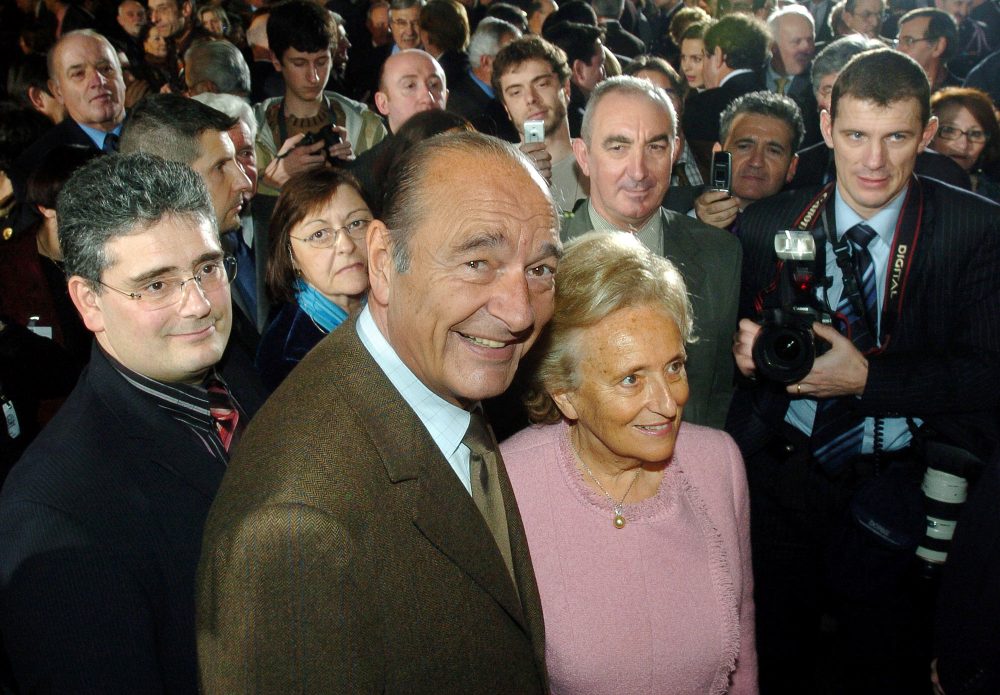

The former first lady of France, Bernadette Chirac, has passed away at the age of 93, leaving behind a legacy of political influence and charitable work that spanned more than five decades.
French President Emmanuel Macron announced her death on Saturday, expressing that he and his wife Brigitte learned with “great sadness” of the loss of a woman who left her mark on French history alongside Jacques Chirac, who passed away in 2019, and transformed the lives of countless patients through her humanitarian efforts.
“A great lady of the heart has departed,” Macron said.
Throughout more than 50 years, Chirac served as the steady anchor during her late husband’s ambitious political journey — from his time in Parliament through two stints as prime minister, nearly two decades leading Paris as mayor, and ultimately winning the presidency in 1995.
Official photographs captured her distinctive presence with raised chin, perfectly styled blonde hair, and small purse in hand, projecting an image more institutional than spousal.
However, the public persona only told part of her story.
Her signature style — designer suits, dark sunglasses, distinctive voice, and sharp commentary — became woven into France’s cultural fabric.
Behind this image stood a tireless professional and shrewd political strategist who, unlike most French presidential spouses, established her own independent power base.
Born Bernadette Thérèse Marie Chodron de Courcel on May 18, 1933, in Paris, she came from a family of wealth, noble heritage, and strong Catholic values.
Her paternal lineage featured military officers, business leaders, and diplomatic figures; one uncle had worked alongside Charles de Gaulle during the war years in London.
However, her most significant life chapter began at the renowned Sciences Po university in Paris, where she encountered Jacques Chirac, an attractive and popular young man whose political ambitions would shape both their destinies.
Their wedding took place in March 1956. The marriage endured for 63 years and became, in her own words, an extended exercise in perseverance.
Jacques Chirac gained recognition for his charisma, energy, and natural ability to connect with the public. Bernadette possessed different strengths, according to political observers.
She demonstrated self-discipline, social commanding presence, religious devotion, high standards, and occasionally sharp wit.
Catholic philosopher Jean Guitton dubbed her the “last queen of France,” a characterization she seemed to embrace rather than reject.
Her husband’s well-known reputation for extramarital affairs became a public matter she eventually chose to address through sardonic humor, following considerable personal anguish.
When photographers surrounded her in Corrèze in 1998 — following speculation that Jacques Chirac had been unreachable the evening Princess Diana died because he was with an actress — she emerged from her vehicle and remarked dryly: “Calm down. I’m not Claudia Cardinale. Or Lollobrigida.”
“At first, it was hard. I was very heartbroken, and then I got used to it,” she said years later in a television documentary.
“I told myself that was how things were and that I had to accept it with as much dignity as possible.”
While assigned to maintain her husband’s rural political base in Corrèze as he pursued power in Paris, she accomplished far more than simple caretaking. She won election as municipal councilor in Sarran in 1971. Eight years later, she secured a general councilor position in Corrèze and retained that seat until 2015.
Her political clout expanded after Jacques Chirac assumed the presidency in 1995. Though France’s first lady role carries no constitutional authority, she transformed the Élysée into a venue where her endorsement carried weight.
She demonstrated loyalty, sharpness, and an unforgiving nature, recognizing that political campaigns depend not only on speeches and polling data but also on obligations, insults, and grudges.
Nevertheless, she also established a domain for female leadership within a male-dominated political environment that showed little willingness to share authority — making it subtly understood that she would not be diminished to merely “the wife of.”
Her most profound sorrow remained largely hidden from public view.
The Chiracs’ older daughter, Laurence, developed serious anorexia following adolescent meningitis and made multiple suicide attempts. She never completely recovered and died in 2016 at age 58.
This family crisis directed Chirac toward the charitable activities that transformed her public reputation.
In 1994, she assumed leadership of a medical charity that gathered donations for hospitalized children. For millions of French television viewers, the woman previously criticized for arrogance became the representative of sick children and families camping beside hospital beds.
She maintained control of the organization until 2019, when she transferred leadership to Brigitte Macron, the current president’s wife, while accepting the honorary president title.
By that point, she had established herself as a political power under her own identity.
“My husband no longer does politics, but I do,” she told reporters after Jacques Chirac concluded his presidency in 2007.
She memorably gave Dominique de Villepin, the Élysée official she mistrusted, the nickname “Nero,” while also allegedly orchestrating her husband’s reconciliation with Nicolas Sarkozy, the former ally who had politically betrayed him.
Her 2001 autobiography, “Conversation,” co-written with journalist Patrick de Carolis, achieved sales of hundreds of thousands of copies and revealed to the French public a more candid, humorous, and autonomous woman than many had previously recognized.
Following Jacques Chirac’s departure from the Élysée, his health deteriorated and his public presence diminished. Her voice stayed clearer for a longer period. When asked about his condition, according to French media reports, she responded in her characteristic flat, recognizable tone: “He keeps the dog.”
Advancing age and personal loss eventually pulled her away from public life.
When Jacques Chirac died in 2019, she had become too frail to participate in the public memorial ceremony where France and international leaders paid their respects.