State environmental officials are proceeding with dredging operations on the Indian River near Millsboro, working to enhance navigation channels for boaters while supporting wetland restoration efforts in the area.
DNREC has lifted typical seasonal timing restrictions for the project, determining that the environmental benefits of completing the marsh restoration work outweigh potential negative impacts. Officials cite degraded water flow conditions in the region as justification for allowing the dual projects to move forward during summer months.
The dredging and restoration work is scheduled to run through March 2027, with operations focusing on improving the waterway’s navigation channel while restoring nearby tidal marsh areas.
Drivers traveling on southbound Peachtree Run Road will encounter a shoulder closure between Sunny Meadow Drive and Jericho Road that is expected to last until 6 PM today.
The temporary closure is affecting traffic flow in the area, and motorists are advised to plan accordingly for potential delays.
No additional details about the reason for the closure or expected completion time beyond 6 PM were immediately available.
DENDRON—Breyon D. Pierce, a sixth-generation farmer from Surry County, recalls countless Saturdays working the land rather than enjoying cartoons or playing outdoors.
“But over time, seeds were planted within me that taught me something much greater,” Pierce explained. “Farming is not just a profession; it’s a calling.”
Pierce, an accomplished agriculture educator, cultivates peanuts, corn, soybeans and wheat across more than 900 acres alongside his father Glen at Pierce Farms LLC.
On June 9, the family welcomed state officials to their operation, hosting Gov. Abigail Spanberger, Sec. of Agriculture and Forestry Katie Frazier, Virginia General Assembly representatives and Virginia Farm Bureau Federation officials. The governor enacted several measures supporting the state’s agricultural and forestry sectors while promoting community food access.
Gov. Spanberger also delivered a proclamation honoring the Pierce family for their role as producers of food, fiber and fuel during Virginia Agriculture Week, June 7–13.
“There is no better place to recognize it than right here on this farm with a family that embodies what it means to devote your life to our land,” she said.
Pierce emphasized the complex challenges confronting farmers today. The state has seen nearly half a million acres of farmland disappear over the past five years, while producers struggle with increasing costs across various markets.
Safeguarding agricultural property remains essential for Virginia’s leading private industry and farming families’ survival, Pierce stated, noting the land “is meant to feed families, support communities, and provide opportunities for our future generations.”
The governor enacted five measures supporting Virginia’s agricultural and forestry industries while surrounded by local producers and agricultural advocates, including VFBF senior vice president of governmental relations Martha Moore.
Farm Bureau backed these legislative measures, Moore noted. “And now we consider them victories.”
HB 512 establishes a comprehensive prosperity strategy for agriculture and forestry sectors with yearly reports to the General Assembly.
SB 522 improves Forest Sustainability Fund management for localities preserving forest areas within the Chesapeake Bay watershed.
SB 186 safeguards Virginia consumers and cattle producers by mandating clear labeling of manufactured protein products that cannot be misrepresented as genuine beef.
HB 1086 enables farmers to bid against out-of-state competitors for school nutrition contracts, increasing Virginia children’s access to locally-grown food.
SB 302 continues the peanut excise tax that funds essential marketing, research and educational programs for Virginia’s peanut growers.
Virginia’s agricultural sector generates an annual economic impact of $82.3 billion in total industry production, creates more than 381,000 jobs, and adds $43.8 billion in additional value. Broiler chickens led 2024 commodity rankings by cash receipts exceeding $1.2 billion, followed by cattle and calves, miscellaneous crops, milk and dairy products, soybeans, turkey and corn.
The state houses approximately 38,600 farms, with 95% owned and operated by individuals or families.
Visit vdacs.virginia.gov/vagrown to locate farmers markets, roadside vendors and agritourism sites. Shoppers should look for Virginia Grown and Virginia’s Finest labels on products throughout retail locations statewide.
Drivers should expect delays on a busy stretch of Foulk Road today as construction crews have shut down the right lane of southbound traffic.
The lane closure affects the section of Foulk Road running between Silverside Road and Chatham Drive, where construction activities are currently underway.
Transportation officials indicate the right lane restriction will remain active until 3:30 PM this afternoon. Motorists are advised to allow extra travel time and merge safely when approaching the work zone.
Drivers traveling northbound on S DuPont Boulevard should expect delays today as construction crews have closed the right shoulder of the roadway.
The shoulder closure affects the stretch of highway between Big Woods Road and Cathleen Drive, according to traffic officials.
The construction-related closure is expected to remain in place until 3 PM today. Motorists are advised to use caution when traveling through the work zone and allow extra time for their commute.
ORANGE—As National Dairy Month kicks off in June, shoppers can celebrate by purchasing milk that showcases Orange County dairy farmer Molly Elgin McWilliams on the packaging.
Molly Elgin McWilliams, a Virginia Farm Bureau member, appears alongside her daughter Halle on the new Strawberry Whole Milk cartons from Maola, which hit store shelves on May 5. This packaging approach addresses increasing consumer desire to learn about the origins of their food.
“On the consumer side, content that features our farmers consistently drives the highest engagement, showing how much customers value knowing where their food comes from,” said Amanda Culp, Maola director of communications and marketing. “It makes sense to carry that through to our packaging.”
This farmer-consumer connection holds particular significance in Virginia, where 365 dairy operations house committed farmers who tend their cattle and deliver fresh, premium milk daily, the Virginia Department of Agriculture and Consumer Services reports. Each dairy cow typically yields approximately 8 gallons of milk per day.
Maola operates as a farmer-owned dairy cooperative that emphasizes the bond between agricultural producers and customers as central to its goal of sustainably creating premium dairy offerings.
“We want our farmers to have pride in the products we are producing,” Culp said. “It’s our duty to be good stewards of their milk.”
The newly launched Maola Strawberry Whole Milk demonstrates this dedication. Produced without artificial coloring, the beverage delivers 8 grams of protein along with 13 vital nutrients. Customers can find the product throughout Maryland, North Carolina and Virginia, including at 60 Wegmans stores, 188 Ingles Markets and Sheetz locations.
Dairy items remain crucial components of nutritious eating habits. Milk provides vital nutrients such as protein, calcium and vitamins A and D, which promote strong bones, help regulate blood pressure and may lower the likelihood of certain chronic conditions, U.S. Dairy states.
With rising consumer appetite for high-protein alternatives, Maola has broadened its product selection. The cooperative introduced Maola More in April, an ultra-filtered milk offering 15 grams of protein and 3 grams of prebiotic fiber while containing reduced sugar and being lactose-free. Maola More comes in whole milk and 2% chocolate milk options.
Throughout National Dairy Month, highlighting local producers like McWilliams underscores the essential contribution dairy farmers make in delivering milk from agricultural operations to dining tables daily.
“The package says 100% fresh, 100% local, and it truly is,” Culp said.
HENRICO—With blooming flowers and fresh crops appearing at Virginia farmstands, June highlights the vital pollinators that make this abundance possible.
National Pollinator Month draws attention to the essential role that birds, bats, bees, butterflies, beetles and other creatures play in our daily lives, while promoting efforts to establish and safeguard their living spaces. The month’s main event, National Pollinator Week, takes place June 22-28 this year.
These pollinators do more than create beautiful gardens. According to the Pollinator Partnership, pollinators make possible one in every three bites of food consumed by humans, with no less than 75% of food crops depending on them. The U.S. Department of Agriculture calculates that pollinators add $18 billion each year to crop production.
However, pollinator numbers keep dropping due to climate change, loss of habitat, pesticide application, parasites and diseases.
Stephen Living, habitat coordinator with the Virginia Department of Wildlife Resources, explained that truly helping pollinators requires thinking about “the whole structure” of their habitats—including food sources, nesting areas, breeding grounds and protective shelter.
“A lot of native bees are ground nesting, so providing areas of bare ground is valuable,” Living advised. “And keep some fallen leaves where possible.”
An effective habitat design incorporates diverse flowering plants and year-round resources. DWR provides Virginia Native Pollinator seed packets containing a mix of native wildflowers that benefit pollinators.
“When you’re doing a landscape from an aesthetics standpoint and want interest across the seasons, think about that from a wildlife perspective too,” he said. “Choose plants that bloom successively to provide resources across seasons.”
Trees and shrubs play an equally vital role in creating lasting habitats. Native oak and black cherry trees provide support for various butterflies and caterpillars.
The crucial factor is selecting native species.
“Native plants also feed the young insects, the larvae,” he said. “They support a much greater diversity and number of young insects than non-native plants do, and these in turn support wildlife like our songbirds.”
Living also recommended reducing pesticide use and adopting integrated pest management methods to lessen harm to beneficial insects.
While many tools and garden additions can help pollinators, he cautioned against certain popular trends—like widely-used bee hotels, which “can be valuable but have some pitfalls.
“They need to be carefully managed and cleaned out regularly, so we don’t create concentrations of harmful parasites,” he advised. “Do some research and find some that can be maintained and cleaned.”
He recommended avoiding butterfly houses, since “butterflies aren’t using those.”
The DWR’s Habitat at Home initiative provides guidance and resources for developing pollinator- and wildlife-friendly areas, plus recognition opportunities. Visit bit.ly/43uS3cx.
For additional information about native plants for pollinators, visit Plant Virginia Natives at plantvirginianatives.org.
Media: Contact Shelby Crouch, Virginia DWR public information officer, at 804-802
On Thursday, the European Central Bank became the first major financial institution to increase interest rates as a direct response to the Iran war, while policymakers including new U.S. Federal Reserve Chair Kevin Warsh grapple with addressing inflation driven by soaring oil costs.
The ECB’s governing council increased its key rate from 2% to 2.25%, ending a year-long period at the previous level. This decision precedes upcoming rate-setting sessions next week involving the Fed, the Bank of Japan, and the Bank of England.
Crude oil costs have surged dramatically as Iran has blocked oil flow through the Strait of Hormuz, a critical waterway that typically handles one-fifth of global oil and fuel transportation. The rate increase is designed to combat consumer price inflation driven by higher expenses for petroleum-based products including gasoline, diesel fuel, cooking gas and heating oil.
International benchmark Bent crude traded near $92 per barrel Thursday, climbing from approximately $73 before the conflict began. This surge has driven inflation to 3.2% in May across the 21 nations using the euro currency, exceeding the ECB’s 2% goal.
However, ECB officials must balance higher borrowing costs against an economy experiencing modest growth. This consideration has led analysts to believe Thursday’s increase will be isolated, primarily intended to demonstrate to financial markets that the bank won’t fall behind if inflation continues climbing.
Australia and the Philippines have implemented rate increases since the conflict started, with focus now turning to decisions in major economies. The U.S. Federal Reserve is anticipated to maintain its current key rate when it convenes next week under new chair Warsh, who was appointed this year by President Donald Trump.
Warsh previously supported rate reductions last year, while Trump frequently criticized Warsh’s predecessor, Jerome Powell, for insufficient borrowing cost cuts. However, with inflation reaching a three-year peak as fuel prices have jumped following the Iran war, even Trump and his administration have begun shifting toward maintaining current rates.
The Fed will likely modify its post-meeting statement by eliminating language suggesting its next action would be a reduction. This change would create possibilities for future rate increases. Multiple Fed officials have cautioned that if inflation doesn’t start declining soon, a rate hike might be required before year’s end.
Increasing benchmark rates affects lending costs across the economy, making borrowing more expensive and reducing demand for goods. Higher central bank rates can increase interest expenses for home purchases, factory investments, and government borrowing.
The ECB might manage with just one or two increases because the inflation surge could be less severe than anticipated, according to Carsten Brzeski, global chief of macro at ING bank.
This is because consumers affected by post-pandemic inflation increases are reluctant to accept higher prices, forcing businesses to absorb elevated energy costs themselves. “The pass-through of higher energy and input prices to final consumption will be limited due to a lack of ability and willingness of consumers to actually pay for these higher prices,” he wrote in an emailed comment.
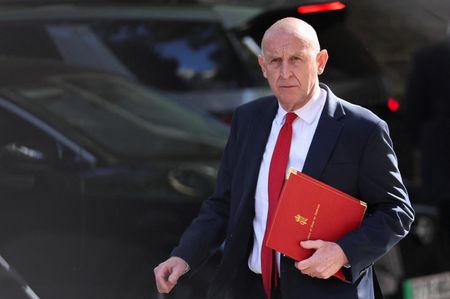
LONDON (AP) — Britain’s Defense Secretary John Healey stepped down unexpectedly Thursday, criticizing the government for inadequate military funding during a period of escalating global threats.
In his resignation letter to Prime Minister Keir Starmer, Healey stated the government’s Defense Investment Plan falls “well short of what is required at this dangerous time.”
The plan’s release has been postponed following reported disputes between the defense ministry and the Treasury over spending levels.
While Starmer has promised to increase U.K. defense expenditures to 2.5% of gross domestic product by 2027 and 3% by 2034, military officials argue this timeline is insufficient.
“You have been unable, and the Treasury has been unwilling, to commit the resources that the nation needs to defend the country at this time of rising threats,” Healey stated in his departure letter.
The defense secretary pointed to growing military obligations and security challenges, including the Iran war, Ukraine’s ongoing conflict, and Russian threats.
“I am now left with no other option than to submit my resignation as your Defence Secretary,” he wrote.
Since the Labour Party took power in July 2024, Healey has served as Britain’s defense leader and earned recognition as a competent and dedicated official.
During his tenure, he played a crucial part in strengthening international backing for Ukraine and building a multinational alliance to ensure security following any potential ceasefire. Healey also helped lead efforts to create a maritime security force aimed at maintaining shipping access through the Strait of Hormuz after the Iran conflict concludes.
This departure creates additional challenges for the struggling prime minister, who is already confronting pressure from Labour Party members calling for his resignation.
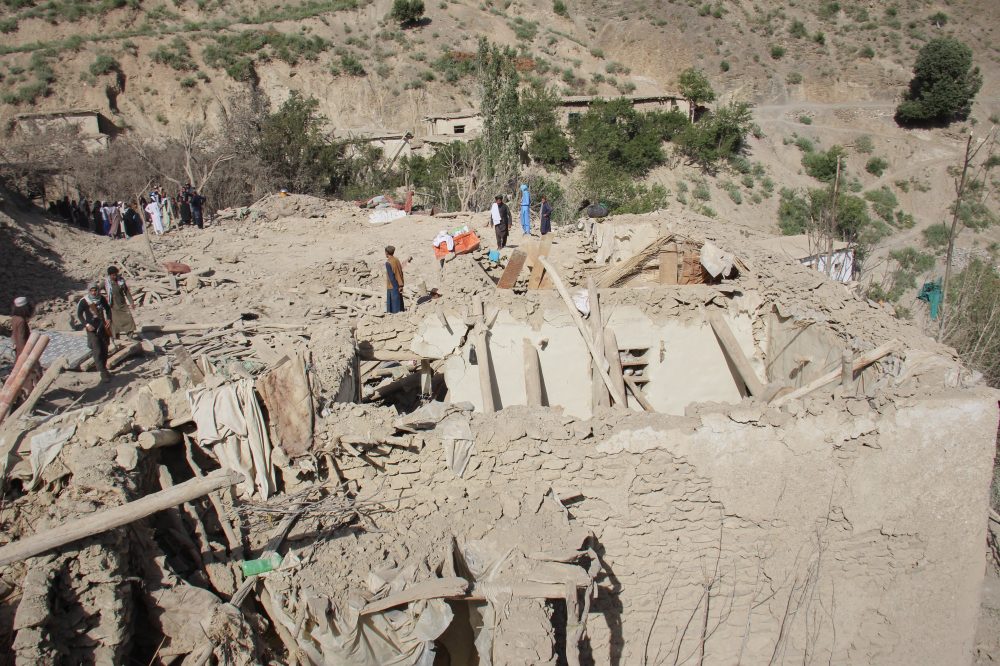
KABUL, Afghanistan — The United Nations mission in Afghanistan announced Thursday that it has verified the deaths of 13 civilians, primarily women and children, resulting from Pakistani military strikes on eastern Afghanistan the day before, backing up casualty figures provided by Afghan officials.
Pakistan had rejected as false propaganda a Wednesday statement from Afghan government spokesperson Zabihullah Mujahid claiming the military strikes in Khost, Kunar and Paktika provinces resulted in 13 civilian deaths — including 11 children, one woman and one man.
The military action ended a month-long peaceful period after what Pakistan had earlier characterized as “open war” between the two nations. The ongoing dispute has resisted international attempts to establish lasting peace.
UNAMA, the UN mission’s official designation, stated on X that it had “documented 13 civilian deaths and 10 injuries, mainly children and women, from airstrikes” during the overnight hours between Tuesday and Wednesday.
“UNAMA reiterates its call for de-escalation, a durable ceasefire, protection of civilians, reopening of border crossings particularly for humanitarian assistance, and dialogue to resolve differences,” the organization stated. The border closure has lasted for months, hampering commerce and travel while leaving thousands stranded.
Since February, when Afghanistan launched retaliatory strikes against Pakistan following Pakistani airstrikes within Afghan territory, hundreds have died in the cross-border violence. Multiple rounds of internationally brokered peace negotiations have been unsuccessful in achieving a permanent ceasefire.
Pakistan maintains that Afghanistan provides sanctuary to militants responsible for deadly attacks within Pakistani territory, particularly the Pakistani Taliban, identified as Tehrik-e-Taliban Pakistan, or TTP. This organization operates independently from but maintains ties with the Afghan Taliban, which has controlled Afghanistan since taking power in 2021 following the disorganized departure of U.S.-led forces. Afghan authorities reject these allegations.
Pakistan stated it conducted border strikes with Afghanistan on Wednesday to eliminate militant training facilities and safe houses.
During Thursday’s regular press briefing in Islamabad, Foreign Ministry spokesperson Tahir Andrabi explained that the strikes responded to numerous recent militant attacks within Pakistan.
“We carried out these strikes to target safe havens, masterminds and planners belonging to Fitna al-Khawarij,” Andrabi stated, referencing the government’s designation for the Pakistani Taliban and similar militant organizations. “We acted on credible intelligence, and there was selective targeting of their hideouts.”
He emphasized that protecting Pakistani citizens remains the government’s primary concern and that anti-militant operations will persist. “We continue to undertake military strikes with precision and accuracy, eliminating terrorist hideouts,” he stated.
Andrabi refused to address the UN casualty report directly, indicating officials would need to examine its findings. Nevertheless, he challenged the UN’s casualty documentation methods.
“What is their methodology for measuring that?” he questioned. “Our strikes were precise and targeted at the hideouts and camps of these terrorists.”
Following increased militant attacks against Pakistani civilians and security personnel, Pakistan announced in February it was engaged in open warfare with Afghanistan. The combat has focused primarily along border regions, though Pakistan has also launched airstrikes against Afghanistan’s capital, Kabul.
In March, an airstrike targeted a drug rehabilitation facility in the city, with Afghan officials reporting over 400 fatalities. Pakistan contested the casualty count and denied civilian targeting, claiming it had struck an arms storage facility.
Wednesday’s military action occurred months following China’s hosting of peace negotiations between Pakistan and Afghanistan. Beijing subsequently reported both nations had committed to avoiding conflict escalation and pursuing resolution.
Pakistani officials have indicated that China and other allied nations continue encouraging both parties to reach a sustainable peace agreement.
Military exchanges between the United States and Iran continued for a consecutive day, bringing the Middle East dangerously close to renewed full-scale warfare.
This marks the third instance this week of retaliatory military action that has destabilized the Middle East. Initial exchanges occurred between Iran and Israel, followed by two separate rounds of military strikes between America and Iran, impacting regional nations that house U.S. military installations.
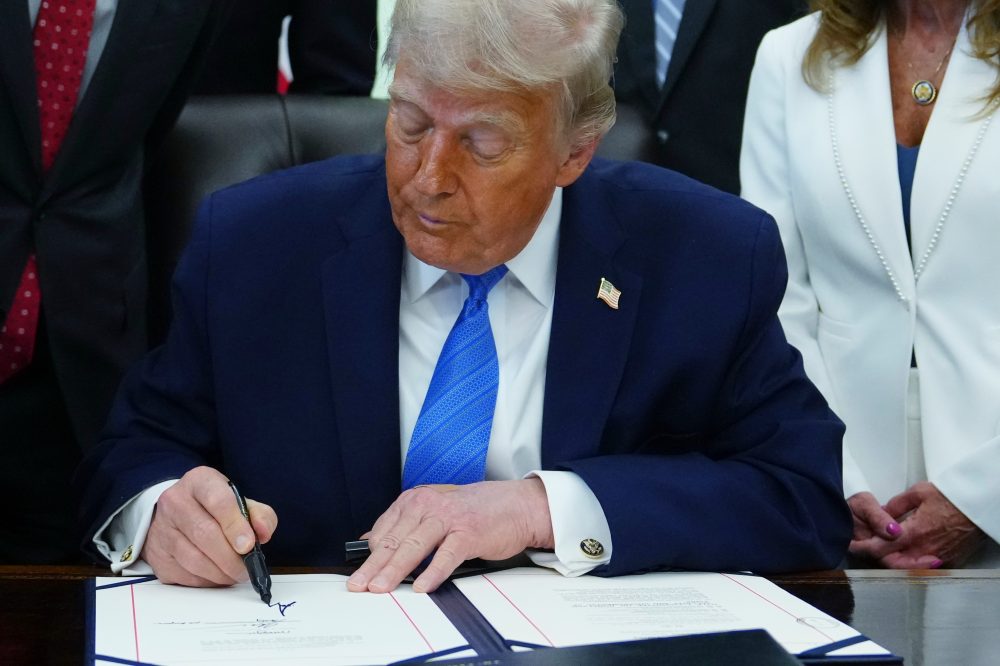
In other developments, President Donald Trump responded to news that May’s consumer price index rose 4.2% annually by expressing an unexpected perspective on inflation. Rather than dismissing rising costs as a Democratic “hoax” as he has done before, or claiming progress on reducing living expenses, Trump took a different approach.
A federal judge Wednesday denied a government oversight organization’s petition for an emergency court order that would have temporarily halted the Trump administration’s progress on establishing a new $1.776 billion compensation fund for individuals claiming to be victims of government weaponization.
However, the judge concluded the proceedings with a stern caution to Trump’s team: “Don’t play possum with this court,” U.S. District Judge Richard Leon warned a government lawyer.
Leon delivered his ruling from the bench supporting the administration, which contended that the oversight group’s legal challenge has become irrelevant since acting Attorney General Todd Blanche informed Congress this month that the government is abandoning its fund plans. Leon, appointed by Republican President George W. Bush, stated he currently accepts Blanche’s assurance.
The judge’s decision against issuing emergency relief does not finalize the government’s “Anti-Weaponization Fund” fate. Leon indicated he will review a separate petition from the plaintiffs — Citizens for Responsibility and Ethics in Washington — seeking a preliminary injunction for more lasting prevention of fund distributions.
A potential gap in legislation permitting U.S. overseas intelligence collection becomes increasingly probable as Trump rejected bipartisan Congressional pressure to quickly appoint a permanent intelligence agency leader.
Trump has reinforced his temporary selection for director of national intelligence, Federal Housing Finance Regulator Bill Pulte, despite his limited relevant background. Democrats indicate they will oppose renewing Section 702 of the Foreign Intelligence Surveillance Act, called FISA, unless the president removes Pulte’s nomination and selects a permanent successor.
Thursday morning will see House attempts to pass temporary FISA extension legislation, though success appears doubtful. The Senate may pursue similar action, hoping to avoid an unprecedented gap in this surveillance capability.
This deadlock could soon restrict U.S. government overseas intelligence gathering just as World Cup matches commence in cities nationwide and before celebrations marking the nation’s 250th anniversary. The legislation expires Friday at midnight.
Trump’s proposed UFC event on the White House South Lawn has demanded extensive coordination from over seven federal departments, hundreds of daily on-site personnel and a minimum $60 million investment, according to court documents revealing preparation details.
The event celebrates America’s 250th founding anniversary, scheduled for this weekend with the primary feature — seven mixed martial arts competitions — planned for Sunday.
However, proceedings could be stopped by judicial intervention, as requested by two Virginia residents in their federal case against the National Park Service, which manages the South Lawn.
The agency submitted its opposition to the request Tuesday, outlining event operations in the filing.
“Well over $60 million and tens of thousands of hours of labor have been expended,” the document stated, noting that UFC and its associated organizations provided the funding.
Trump Wednesday demonstrated his evolved approach to inflation concerns, expressing what he described as affection for rising prices.
When questioned about the latest consumer price index report showing May’s 4.2% annual increase, the president adopted an unexpectedly positive stance regarding the difficult economic news. Trump avoided characterizing affordability challenges as a Democratic “hoax” as he previously has done, and refrained from asserting progress in reducing living costs.
Following government reports that inflation reached its highest point since April 2023, Trump commended the figures.
“You know what I really love?” Trump stated. “I love the inflation.”
This represented an unusual position considering voters approaching November midterm elections have identified the economy as a primary concern — and have given Trump poor ratings on economic issues. Democrats immediately began promoting his televised remarks across social media platforms within minutes.
The United States and Iran continued military exchanges for a second consecutive day, pushing the Middle East toward renewed full-scale conflict.
The American military action, extending into Thursday morning Iranian time, seemed more comprehensive and intense than the previous day’s operations, though Tehran provided minimal information regarding damage assessment. An Indian official reported that a U.S. strike on an oil vessel allegedly attempting to breach Washington’s Iranian port blockade resulted in three Indian sailor deaths, highlighting maritime personnel dangers.
This represented the third weekly instance of reciprocal strikes destabilizing the Middle East. Initial exchanges involved Iran and Israel, followed by two U.S.-Iran military rounds affecting regional countries hosting American military facilities.
These renewed hostilities occurred while war-ending negotiations appeared stalled, with Trump cautioning that Tehran would “pay the price” for negotiation delays.
WASHINGTON—Agricultural producers across nine Virginia counties can now access emergency financial assistance after the U.S. Department of Agriculture declared their drought-affected regions as natural disaster areas.
This federal designation enables the USDA Farm Service Agency to provide critical emergency funding to agricultural operations impacted by severe drought conditions. These financial resources may be utilized for equipment and livestock replacement, farm operation restructuring, or refinancing specific debts. The FSA will evaluate loan applications considering loss severity, available collateral, and the borrower’s capacity to repay.
The counties qualifying for emergency loan assistance are: Amherst, Appomattox, Buckingham, Campbell, Charlotte, Henry, Nelson, Pittsylvania and Sussex.
Furthermore, these adjacent regions also qualify for assistance: Albemarle, Augusta, Bedford, Cumberland, Dinwiddie, Fluvanna, Franklin, Greensville, Halifax, Lunenburg, Mecklenburg, Patrick, Prince Edward, Prince George, Rockbridge, Southampton and Surry counties, along with the cities of Danville, Lynchburg and Martinsville.
Agricultural producers must submit loan applications by Jan. 31, 2027. Farmers may explore available programs and financing options by accessing farmers.gov and utilizing its Loan Assistance Tool.
For filing a Notice of Loss or additional inquiries, producers should reach out to their local USDA Service Center.
A Heat Advisory remains in effect for northern Delaware and surrounding areas through Friday evening as dangerous heat and humidity grip the region. The National Weather Service warns heat index values could reach 104 degrees, creating potentially hazardous conditions for residents.
New Castle County is included in the advisory, which runs from 11 AM today through 8 PM Friday. The combination of high temperatures and oppressive humidity may lead to heat-related illnesses, particularly for those spending extended time outdoors.
Health officials urge residents to take precautions: drink plenty of fluids, stay in air-conditioned spaces when possible, and avoid prolonged sun exposure. If you must be outside, wear lightweight, loose-fitting clothing and limit strenuous activities to early morning or evening hours.
Check on elderly relatives and neighbors, as they’re especially vulnerable to heat-related health issues. Watch for symptoms of heat exhaustion and heat stroke, including dizziness, nausea, and excessive sweating.
Some relief may come from scattered showers and thunderstorms late this afternoon and again Friday afternoon. However, humidity will remain high until a cold front brings much less humid conditions this weekend.
Those without air conditioning can call 211 for assistance finding cooling centers.
A high-ranking Russian foreign ministry official criticized Western nations’ involvement in the Ukraine conflict during a Thursday meeting with diplomatic representatives from three European countries in Moscow.
Mikhail Galuzin, who serves as Russian Deputy Foreign Minister, hosted ambassadors from France, Germany and Britain at the foreign ministry, where he accused their governments of pursuing what he called a “destructive policy” regarding the ongoing war.
Following the diplomatic session, French ambassador Nicolas de Riviere spoke with media outside the ministry headquarters, describing the exchange as a “good discussion” and indicating the three nations would issue a joint statement at a later time.
Thursday’s Moscow gathering occurred days after leaders from the three European nations held talks with Ukrainian President Volodymyr Zelenskiy in London this past Sunday. The three countries form an informal security partnership known as the E3, which has become a significant source of international backing for Ukraine, and during the London meeting they endorsed Zelenskiy’s appeal for a ceasefire.
According to an official statement from Russia’s Foreign Ministry, Galuzin provided the visiting diplomats with what the ministry termed “an objective assessment of the destructive policy pursued by their countries’ leaderships regarding the Ukrainian crisis, which is aimed at maximally encouraging the Kyiv regime to continue the war against Russia on behalf of, at the expense of, and with the direct assistance of the Western ‘coalition of the willing’.”
The ministry’s statement added that “The Russian side’s fundamental approaches to seeking a political and diplomatic settlement of the conflict based on addressing its root causes were explained” during Galuzin’s presentation.
During Sunday’s discussions at Downing Street, the European officials and Zelenskiy reached agreement on several key points: establishing the present contact line between Russian and Ukrainian military forces as a foundation for future negotiations; providing Ukraine with legally enforceable security assurances that would include deploying an international peacekeeping force; and keeping seized Russian financial resources frozen until Russia provides compensation to Ukraine for war-related damages.
Russian President Vladimir Putin has maintained his firm position regarding the conflict, though he indicated last week that peace proposals from U.S. President Donald Trump might offer a path toward ending hostilities.
Speaking to international journalists in St Petersburg, Putin expressed openness to discussions with European political figures while questioning their suitability as peace negotiators.
“What kind of mediator can the European Union or individual EU countries be when they directly assist a country with which we are in armed conflict?” he said.
Britain’s defense minister John Healey stepped down from his position Thursday following disagreements about military funding, claiming Prime Minister Keir Starmer has not allocated sufficient government resources to protect the nation during a period of increased security concerns.
The surprise departure, paired with a harsh public resignation letter, adds to mounting challenges facing Starmer as he confronts a potential leadership contest and highlights the government’s central dilemma of boosting defense expenditures while operating with limited financial resources.
For several months, Britain’s defense and finance departments have engaged in ongoing discussions about addressing growing demands for increased military investment, causing delays to Britain’s Defence Investment Plan that was originally scheduled for release last year.
Senior military officials have emphasized the necessity of this plan to address escalating security risks, particularly with frequent Russian naval activities in British territorial waters, while the government simultaneously works to lower national debt amid record-high taxation levels.
This prominent resignation occurs as Starmer faces political instability, following Wes Streeting’s departure as health minister in May and Andy Burnham’s efforts to re-enter prominent political roles for a potential leadership campaign.
“You have been unable, and the Treasury has been unwilling, to commit the resources that the nation needs to defend the country at this time of rising threats,” Healey stated in his resignation letter to Starmer.
The defense sector has expressed frustration over the plan’s postponement, arguing that uncertainty prevents investment in extended military programs.
Britain faces challenges as the United States reduces its European protection role, while the U.S.-Israeli conflict with Iran revealed Britain’s military preparedness gaps when its navy couldn’t rapidly send an advanced vessel to the area.
The defense strategy aims to outline funding for military hardware and services to bring armed forces to “warfighting readiness” status, with Starmer announcing Wednesday that publication would occur before the NATO summit starting July 7.
“Your DIP financial settlement – which I was first given in full on Monday afternoon this week – falls well short of what is required for defence and the country at this dangerous time,” Healey wrote.
“I am being forced to make decisions that would reduce the readiness of our forces and increase the risk to personnel on operations, and could make the country less safe.”
Drivers traveling on Indian Town Road eastbound should prepare for potential delays due to ongoing traffic control operations.
According to DelDOT, a flagging operation is currently in effect along the eastbound lanes of Indian Town Road in the stretch between Rebel Road and Hickory Hill Road.
The traffic control activity is expected to remain in place until 5 PM today. Motorists are advised to allow extra travel time and exercise caution when passing through the work zone.
A Wilmington resident is facing felony drug charges following a traffic stop conducted by Newark Police earlier this month.
Newark Police Department’s Street Crimes Unit pulled over a vehicle on South College Avenue on June 2, 2026, around 10:15 in the morning. The car had been linked to a shoplifting case being investigated by a different law enforcement agency.
During the traffic stop, officers made contact with the driver and subsequently arrested the individual on felony drug-related charges.
The incident remains under investigation by the Newark Police Department.
The Canadian Pediatric Society has appointed Natasha Johnson as its new president, a decision that has generated debate due to her strong stance supporting gender transition surgeries for minors.
Johnson’s appointment has raised eyebrows among critics who question her advocacy for these procedures in young patients. When addressing concerns about whether adolescents possess the maturity to make informed choices regarding life-altering medical interventions, Dr. Johnson characterizes these worries as “overstated.”
Johnson previously established a gender diversity clinic at McMaster’s Children’s Hospital in Hamilton, Ontario, where she has worked to expand access to gender-related medical services for young patients.
Fresh polling data from Gallup reveals a notable shift in American attitudes toward several social issues over the past year. The survey shows acceptance of having children outside of marriage dropped significantly from 67% to 58% in just twelve months. Similarly, public approval of gambling decreased from 63% to 57% during the same period. The poll also found reduced acceptance among Americans regarding intimate relationships outside marriage and contraceptive use. Researchers have not identified clear reasons for such dramatic changes occurring within such a brief timeframe. According to Gallup, these findings could signal that the nation’s progressive movement on social matters may be reaching a turning point.
New research from the Public Religion Research Institute reveals distinct regional patterns in America’s LGBT population distribution. The study shows that individuals identifying as gay, lesbian, bisexual or transgender are most heavily concentrated in Northeast and Far West regions.
In contrast, the research found significantly smaller LGBT populations throughout Southeast and Midwest areas. Nevada and Rhode Island topped the rankings as states with the largest percentages of homosexual residents, while Kansas and South Dakota recorded the nation’s smallest percentages according to the PRRI findings.
Elon Musk’s space exploration company SpaceX is set to begin trading on Wall Street this Friday, with investors eagerly awaiting the chance to purchase 555.6 million shares priced at $135 each. The move could potentially make Musk, who is already the wealthiest person globally, the world’s first trillionaire.
During a video call on Musk’s social media platform X with JPMorgan CEO Jamie Dimon, Musk explained that while people have been urging him to take SpaceX public for a decade, he’s choosing to do so now because the company intends to launch 100,000 next-generation Starlink satellites into orbit. He stated that putting AI data centers in space represents a “massive new growth base and you need capital for that.”
The public offering is expected to generate approximately $75 billion in proceeds, potentially making it the largest initial public offering in history. SpaceX aims to become the first company to transport humans to Mars, and part of Musk’s future earnings are tied to SpaceX successfully creating a colony of at least 1 million people on Mars.
While going public will provide SpaceX with the capital it requires, it also subjects the company to increased shareholder scrutiny and regulatory oversight. This includes mandatory quarterly financial reporting, which some critics argue promotes short-term decision-making over long-term planning and creates unnecessary expenses. Securities regulators are currently seeking public input on a proposal that would require public companies to file financial reports just twice annually instead.
SpaceX acknowledges Musk as the “driving force” behind its growth, innovation and achievements. However, the company warns that losing Musk could disrupt its ability to implement its strategy and damage its “reputation and relationships with customers, partners and other stakeholders.” SpaceX also cautions that finding someone with Musk’s equivalent skills and experience would be time-consuming, if not nearly impossible. As Wedbush Securities analyst Dan Ives noted Wednesday, “At the end of the day Musk is SpaceX and SpaceX is Musk.”
Musk will retain control of a majority of special shares, giving him authority over company strategy, financial decisions and staffing choices. Due to his ownership of most Class B shares, Musk is essentially the only person with the power to remove himself as CEO.
Industry experts say SpaceX has gained a significant advantage over competitors like Blue Origin, headed by Amazon founder Jeff Bezos, by developing reusable rocket technology. The Starlink satellite division faces competition from companies including AST SpaceMobile, which ironically plans to use a SpaceX rocket to launch its newest satellites next week.
According to the prospectus filed last week, SpaceX identifies its largest potential market as selling business-focused artificial intelligence products that could revolutionize workplace productivity. The company estimates this opportunity could be worth $22.7 trillion if it could outcompete rivals like Anthropic, OpenAI and Microsoft in this highly competitive sector. However, the prospectus reveals no clear path to profitability for the xAI business, which combined with SpaceX earlier this year.
The massive reusable rocket currently in testing phase is crucial to achieving Musk’s goals. Much of the commercial space industry depends on SpaceX successfully developing Starship’s capability to be completely reusable and durable enough for rapid turnaround between missions. If this fails to materialize, SpaceX warns that deploying data centers and satellites in space will require more time and money, potentially causing customers to abandon the company.
Should the SpaceX public offering succeed as anticipated, the stock could rapidly be added to the Nasdaq 100, a closely watched index that monitors the 100 largest non-financial companies on the Nasdaq. This inclusion matters because popular funds, such as the $460 billion QQQ exchange-traded fund, replicate the index and automatically purchase whatever stocks are listed.
Nasdaq recently modified its regulations to permit select companies to join the Nasdaq 100 after only 15 trading days.
Meanwhile, S&P Dow Jones Indices maintains its established and more conventional requirements that would enable SpaceX or other companies with enormous IPOs quicker access to its S&P 500 index. This means companies must still wait for their stocks to trade for a complete 12 months before index inclusion.
Companies seek S&P 500 inclusion particularly because it’s considered the most significant index on Wall Street, with trillions of dollars either directly copying it or using it as a benchmark. For instance, Vanguard’s VOO fund that follows the S&P 500 has approximately $950 billion invested in it.
LONDON (AP) — The time-traveling protagonist of ‘Doctor Who’ has weathered countless close calls and transformations throughout more than 60 years on television.
However, could this be the end for the BBC’s iconic science fiction program that has captivated multiple generations of viewers?
The British network has pulled a holiday special that was previously scheduled for this year, while showrunner Russell T. Davies has announced his departure from the series.
Davies was set to pen the holiday episode, which was revealed when the most recent season concluded in May 2025.
On Wednesday, the BBC announced that the network, Davies, and production partner Bad Wolf ‘have collectively decided not to go ahead’ with the holiday installment. The broadcaster stated it remains committed ‘to push forward to invest in the long-term future of the show.’
The network revealed plans to seek bids from production companies interested in working on the program. A partnership between the BBC and Disney+ for co-production and distribution concluded in 2025 following two seasons.
Debuting in 1963, ‘Doctor Who’ chronicles the journeys of a Time Lord from Gallifrey who explores time and space in the Tardis, a vessel that appears externally as a vintage British police call box from the mid-1900s.
The show’s endurance stems partly from its concept: the main character can transform into a new form when the previous one expires, allowing the series to continue beyond any single performer. Over a dozen actors have portrayed the character, with Ncuti Gatwa being the most recent.
Davies, who brought the series back in 2005 following a 16-year break and resumed leadership in 2022, revealed that the holiday episode remained unwritten and no performer had been contacted about taking on the Doctor’s role.
Davies, whose credits include ‘Queer as Folk,’ ‘It’s a Sin’ and the recent ‘Tip Toe,’ described the program’s prospects as ‘unpredictable’ in a social media message.
‘You’ll have to wait a bit longer for new Doctor Who … but you’ll be waiting for MORE Doctor Who than a one-off. So it’s worth it!’ Davies posted. ‘It’s all up for grabs, which is so Doctor Who — exciting and unpredictable and new! Here comes the future.’
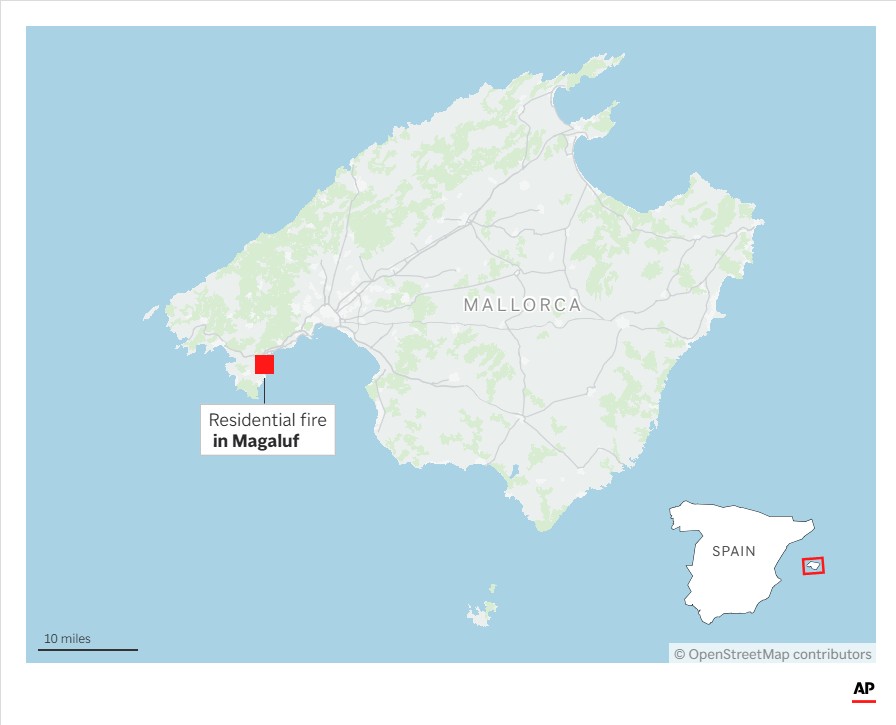
Two people lost their lives and multiple others sustained injuries when flames engulfed an apartment building in a popular tourist section of Spain’s Mallorca island during the early morning hours Thursday, according to official reports.
The blaze ignited around 5 a.m. on the building’s third level in the Magaluf district, according to a Civil Guard statement.
Building occupants attempted without success to extinguish the flames, which then consumed other parts of the structure, particularly climbing to higher levels, officials reported. Emergency crews evacuated more than 12 individuals from the premises. Firefighters managed to control the flames approximately two hours after they started.
Medical teams transported nine individuals to hospitals for smoke inhalation treatment, according to a Civil Guard spokesperson. The official requested anonymity in accordance with departmental guidelines.
Among those who perished was a 58-year-old citizen of Argentina, while the second victim was a woman whose identity remains unknown, the Civil Guard reported. Both fatalities occurred in different units within the building.
Investigators with the Civil Guard are working to determine what sparked the deadly fire.
The Magaluf area serves as a favored coastal and entertainment hub for young visitors from Britain and Germany, situated along Calvià’s shoreline, approximately 22 kilometers (13.7 miles) west of Palma de Mallorca, the Mediterranean island chain’s capital city.
Following the tragic incident, local government officials announced a two-day period of mourning.
A woman from Thailand made her first court appearance Thursday in Myanmar, where she’s facing murder charges in connection with the death of an American diplomat, two lawyers with knowledge of the proceedings confirmed.
The woman, whose name authorities have not disclosed, faces both murder charges and violations of Myanmar’s immigration laws that target foreign nationals who commit crimes within the country’s borders, one attorney said.
Details about whether the defendant entered any plea or secured legal counsel during Thursday’s proceedings at Kamayut Township Court remain unclear. A murder conviction could result in a prison sentence anywhere from 10 years to execution.
Both legal sources requested anonymity due to concerns about potential retaliation from Myanmar’s military leadership.
The American diplomat was discovered deceased on May 11 inside the Sakura Residence & Hotel, a lodging establishment frequented by diplomatic personnel, business travelers and other international guests located approximately 1.5 kilometers from the U.S. Embassy, one attorney revealed. The victim had sustained multiple stab wounds to his head and neck area.
While the U.S. State Department has acknowledged the diplomat’s death, officials have declined to release additional details, including the victim’s identity.
Myanmar’s military leadership took control from the democratically elected government of Aung San Suu Kyi in 2021, sparking widespread demonstrations that have since evolved into ongoing armed conflict throughout the nation, also called Burma.
Media access remains severely limited, with law enforcement handling the investigation, detention facilities housing the accused, and court officials all declining to provide statements.
When asked Thursday whether American representatives attended the court hearing, State Department officials with the Asia Pacific Media Hub directed inquiries to the U.S. Embassy in Myanmar. Embassy personnel reiterated previous official statements regarding the death and referred additional questions to Myanmar’s local authorities.
Thailand’s Foreign Ministry confirmed it is offering consular support to the detained woman but said it lacked immediate details about any legal assistance provided during Thursday’s hearing.
The ministry directed further inquiries to its Myanmar embassy, which declined phone interviews and did not respond to email requests.
During sweltering summer days, DeAnna Brandon enjoys watching her three dogs run around while she cools off in a backyard kiddie pool alongside her grandchildren. The 48-year-old blood cancer survivor treasures these precious moments — while questioning whether she’ll experience them in future years.
Brandon, a Rockwell, North Carolina resident, fears that upcoming Medicaid work requirements beginning next year might threaten her healthcare coverage. While she anticipated qualifying for a medical frailty exemption, fresh guidance issued by President Donald Trump’s administration last week has created uncertainty about her eligibility.
The interim final rule published by the Centers for Medicare and Medicaid Services indicates that Brandon’s severe fatigue and memory problems from her treatments might not suffice to avoid the new work requirements. She must declare and subsequently demonstrate that these symptoms “significantly impair” her capacity to meet the new mandates.
Should the government reject her application, she risks losing her coverage — along with the bi-monthly maintenance chemotherapy that maintains her multiple myeloma in remission. Employment remains “outside of the realm of possibility for me,” she explained during an interview.
“I was always a push-through-it person — you know, ‘Oh, you’re tired. Push through,’” Brandon stated. “It’s hard to explain to people you can’t push through it.”
Healthcare analysts have raised concerns about the Republican Trump administration’s latest guidance, which diverges from state expectations. Specialists warn it will increase the number of Americans at risk of losing health insurance and force states to scramble in their already rushed implementation efforts.
“This will mean more paperwork for Medicaid patients — specifically for the sickest Medicaid patients,” stated Adrianna McIntyre, a professor at Harvard University’s school of public health. This development, she noted, “is going to push in the direction of more people needlessly losing coverage.”
The new Medicaid restrictions formed part of Trump’s comprehensive tax and policy law in 2025. The modification impacts those covered through an expansion that most states adopted, providing additional lower-income individuals access to the government’s safety net healthcare program.
Expansion participants between ages 19 and 64 must demonstrate they work or perform community service for at least 80 hours monthly or attend school at least half-time. Exceptions exist for those deemed medically frail or enrolled in addiction treatment programs, among other categories.
Last week’s CMS announcement surprised states with a revised definition of medical frailty. The law had specified that medically frail individuals include those with substance use disorders, disabilities or serious medical conditions. However, the CMS rule went beyond this, stating someone’s condition must “significantly impair” their capacity to work, volunteer or attend school at required rates to receive an exemption.
During 2027 and once in 2028, patients can declare they meet this definition. However, when seeking coverage renewal in 2028, they must provide proof.
Advocates express uncertainty about what documentation could establish that standard. They suggest physician notes might be necessary — something some providers feel uncomfortable providing. Medicaid participants battling illness may bear the administrative burden.
Brandon, who previously attempted to prove work incapacity for disability benefits during active cancer treatment and was unsuccessful, worries about the obstacles she and fellow patients might face.
“It’s not that easy — you may have to go through four doctors,” Brandon explained. “If you’re already battling an illness like this, you don’t have the physical or the mental or the emotional energy to do that all the time.”
States have planned to utilize Medicaid claims data and additional data sources to automatically exempt qualified participants whenever feasible.
CMS Administrator Dr. Mehmet Oz during a reporter call last week supported this strategy, expressing hope that most individuals would receive assistance “without ever having to talk to anybody.”
When asked to explain rule implementation, CMS informed The Associated Press via email that the agency “chose not to allow states to categorically exclude individuals from work requirements based solely on a diagnosis or condition type.” For 2028 renewal, it stated, “verification through claims data or other documentation will generally be required.”
State Medicaid officials and consultants report that Medicaid claims data cannot prove significant work impairment, and they’re unaware of existing data that does. This has created confusion about complying with the government’s rule.
“States are going to be asked to make a determination using information that doesn’t exist in their systems,” explained Kinda Serafi, a partner at consulting firm Manatt Health who assists states with these changes.
Nebraska began implementing new Medicaid work requirements early. However, it utilized diagnostic codes to identify medically frail individuals, likely requiring system modifications, according to Sarah Maresh, healthcare access program director at advocacy group Nebraska Appleseed.
Maresh expressed concern that rural state physicians already hesitant to accept Medicaid patients might cease participation entirely.
“They’re already drowning in paperwork, so to require them to do an additional step of certifying whether someone is able to work, I think is concerning,” she noted.
Preparing for the January 1 launch represents an enormous and costly undertaking. A $200 million federal allocation supports states, and CMS has collaborated with technology companies to offer free and discounted services, but expenses for additional technology requirements and staffing will likely surpass $1 billion, according to an AP analysis. This additional cost will be shared between federal and state tax dollars.
Republicans supporting the new rules describe them as commonsense measures to eliminate government freeloading and preserve benefits for those most in need. Oz last week, referencing a conservative American Enterprise Institute think tank report, claimed able-bodied Medicaid recipients spend an average of 6.1 hours daily “watching TV or just hanging out.”
“This is a concern, not a criticism,” he stated. “Work requirements are going to turn this around, we hope.”
Current participants who don’t meet work requirement thresholds say this mischaracterizes their experiences.
Mids Meinberg, a 42-year-old freelance writer from New Jersey living with chronic depression and diabetes, said that despite health challenges, he takes pride in establishing a meaningful career. However, his conditions prevent him from working 80 hours monthly. He believes many disabled individuals are “too disabled to work but not disabled enough for the state to think they can’t work.”
Brandon, in North Carolina, wants the government to recognize she’s “not just sitting around wasting time or being a drain on society.”
“I’m pouring into my grandchildren,” she said. “We’re valuable, and we can still contribute to our communities even if it’s not working.”
The 2026 FIFA World Cup will make history as the first edition to feature 48 teams, expanding from the traditional 32-team format. The tournament will span across three host nations – Mexico, the United States, and Canada – taking place in 16 cities from June 11 to July 19.
GROUP A HIGHLIGHTS
Mexico enters as a three-time World Cup host, earning automatic qualification and opening the tournament against South Africa at Azteca Stadium – recreating the matchup that began the 2010 World Cup in South Africa. Under coach Javier Aguirre, Mexico blends veteran leadership with emerging talent, featuring Fulham striker Raul Jimenez and goalkeeper Guillermo Ochoa, who will tie the record for World Cup appearances at six tournaments alongside Portugal’s Cristiano Ronaldo and Argentina’s Lionel Messi. The squad also includes 17-year-old Tijuana midfielder Gilberto Mora, the tournament’s youngest participant.
South Africa returns to the World Cup stage for the first time since 2010, despite facing a three-point deduction during qualifying for fielding an ineligible player. The team secured their spot with a 3-0 victory over Rwanda in October 2025. South Korea continues their remarkable consistency, qualifying for their 11th straight World Cup since 1986 after defeating Iraq in June 2025.
Czech Republic earned their place through dramatic penalty shootouts against Ireland and Denmark in European qualifiers, marking their first World Cup appearance since 2006.
HOST NATIONS’ PROSPECTS
The United States, hosting for the second time after 1994, faces significant pressure as they open against Paraguay in Los Angeles. The team’s performance could significantly impact soccer’s growth in the country, with AC Milan striker Christian Pulisic leading the charge. Notably, Pope Leo counts among their supporters.
Canada qualified automatically as co-hosts, entering with what many consider their strongest-ever squad. Led by Bayern winger Alphonso Davies and Juventus striker Jonathan David, Canada seeks their first World Cup victory after appearing in 1986 and 2022 without recording a win or draw.
DEFENDING CHAMPIONS AND FAVORITES
Argentina arrives as defending champions and among the tournament favorites. Lionel Scaloni’s squad finished atop South American qualifying and features Lionel Messi alongside younger stars Julian Alvarez, Enzo Fernandez, and Alexis Mac Allister. A victory would place Argentina alongside Italy and Germany as four-time world champions.
Brazil, despite being the most decorated nation with five titles, hasn’t won in nearly 25 years. Carlo Ancelotti’s team, featuring Real Madrid’s Vinicius Jr and Barcelona’s Raphinha, ranks below Argentina and top European competitors according to FIFA.
Spain enters as reigning European champions and tournament favorites under Luis de la Fuente, combining midfield control with explosive wide players including Barcelona’s Lamine Yamal and Athletic Bilbao’s Nico Williams.
NOTABLE DEBUTS AND RETURNS
Several nations will make historic debuts, including Curaçao, the smallest country ever to qualify with approximately 150,000 residents. Cape Verde also reaches their first World Cup, representing one of the expansion’s great success stories.
Other significant returns include Norway (first appearance since 1998), Turkey (first since 2002), and Algeria (first since 2014). Iraq returns after 40 years, while DR Congo makes their first appearance since 1974 when they competed as Zaire.
MILESTONE APPEARANCES
Portugal’s Cristiano Ronaldo will compete in his sixth and final World Cup at age 41, sharing the appearance record with Messi and Mexico’s Ochoa. Germany’s Manuel Neuer returned from international retirement at 40 to participate in his fifth tournament.
TOURNAMENT FORMAT
The expanded format creates 12 groups of four teams each, with matches scheduled across North American time zones. The tournament promises to showcase both established powerhouses and emerging nations, reflecting FIFA’s vision of global football expansion.
Group stage play begins June 11 with Mexico facing South Africa, setting the stage for what organizers expect to be the most inclusive World Cup in history. The final will take place July 19, concluding nearly six weeks of competition across the three host nations.
Gas stations throughout the Russian-occupied Crimean peninsula were without fuel Thursday, according to Reuters witnesses on the ground, as Ukraine continues its campaign of attacking supply routes to the region.
A Reuters reporter in Sevastopol, the peninsula’s main city, observed that most local gas stations had no fuel available, with supplies failing to meet demand even under the rationing system put in place in recent weeks.
In the resort community of Yevpatoriya, another witness reported seeing a lengthy line at the only functioning gas station in the area.
Ukraine has been stepping up drone attacks on supply corridors to the peninsula, which Russia took control of from Ukraine in 2014. Regional officials have put fuel rationing measures in place, and some food items are also becoming scarce.
Reuters data shows fuel shortages have been documented in traditional and social media across 13 regions. Just three regions – Crimea and two Siberian areas – have officially acknowledged the shortages.
Most other regions have stated the situation remains manageable and attributed some disruptions to panic purchasing. Moscow has rejected claims of fuel supply issues.
State-owned bank Sberbank has indicated that increasing fuel costs pose an additional inflation threat to Russia’s economy.
DELIVERY TRUCKS BLOCKED FROM REACHING CITY
Wednesday saw Russian-backed Sevastopol governor Mikhail Razvozhaev announce that plans to distribute rationed gasoline had been postponed because delivery trucks could not reach the city following recent Ukrainian attacks on supply corridors.
Crimea receives most of its fuel through road and rail transport via Russian-controlled territories to the north, areas Moscow captured in 2022. These transportation routes have faced increasing disruption from drone strikes.
Previously, fuel reached Crimea through barge deliveries to an oil facility in Feodosia, but those shipments stopped after Ukraine attacked the terminal in April.
In Sevastopol, the Moscow-appointed governor reported that Ukrainian drones caused minor damage during overnight attacks, with 33 drones shot down. The Russian-backed governor of the Moscow-controlled section of Kherson region, which sits north of Crimea, said Ukraine had targeted regional bridges, resulting in some damage.
Ukrainian forces also conducted strikes in southern Russia overnight, officials reported, causing damage including a fire at the Afipsky oil refinery that was later put out.
The governor of nearby Adygea also confirmed damage to civilian infrastructure throughout the region.
LONDON, June 11 – The tennis comeback of Serena Williams faced an unexpected halt Thursday when her doubles teammate Victoria Mboko pulled out of the Queen’s Club WTA tournament due to a knee injury.
Following an absence of almost four years, the 44-year-old tennis legend from America teamed up with the Canadian teenager Mboko to defeat Nicole Melichar-Martinez and Erin Routliffe before a packed audience on Tuesday.
The duo was set to face Canada’s Leylah Fernandez and Germany’s Laura Siegemund in their quarter-final match, but the 19-year-old Mboko was forced to pull out after suffering a painful fall during her individual match against Czech Republic’s Karolina Pliskova on Wednesday.
Mboko was unable to finish that singles contest and exited the court limping and visibly emotional.
The 23-time Grand Slam singles champion Williams plans to advance her return to professional tennis in Berlin next week and may pursue a wildcard entry for the Wimbledon championships.
An Indian space technology company has received a substantial government grant to advance artificial intelligence capabilities for monitoring Earth from orbit, according to reports from Thursday.
SatSure Analytics was awarded 246 million rupees, equivalent to $2.57 million, by the country’s space regulatory authority to create AI-powered systems for Earth observation. This funding is part of India’s broader initiative to establish independent artificial intelligence technologies.
Nations across the globe are putting more resources into developing their own AI and geographic intelligence systems to reduce reliance on international technology providers. Satellite information has become increasingly vital for climate monitoring, emergency response operations, and protecting national interests.
India has transformed its space industry by allowing private companies to participate in what was previously dominated by the government-operated Indian Space Research Organisation (ISRO). The country has also established a 10-billion-rupee funding program to help space-focused startups expand their operations.
The company, headquartered in Bengaluru, explained that the grant will support creating comprehensive Earth observation systems using both satellite and drone information specifically designed for Indian conditions. These customized models aim to provide better precision than international systems that may not perform well under local circumstances.
Information gathered will cover monsoon weather patterns, farming regions, and city growth, among other areas. This data could be used across various industries including infrastructure development and financial services, according to the geospatial analytics company.
“Earth observation is moving from project-specific analytics to reusable intelligence infrastructure,” stated Rashmit Singh Sukhmani, the company’s co-founder and chief technology officer. He added that these systems could help create decision-making tools that better account for India’s unique geographic features, weather patterns, agricultural variety, and infrastructure needs.
The grant also enables SatSure’s involvement in India’s collaborative program to create a commercial satellite network.
Stock market futures posted gains Thursday morning as traders snapped up discounted technology shares and reacted optimistically to diplomatic developments in Middle East peace negotiations between the United States and Iran.
Semiconductor companies recovered from Wednesday’s sharp decline that pushed major stock indexes down over 1% and sent technology shares into correction territory with a 10% fall from recent peak levels.
In early trading before markets opened, shares of major chipmakers Nvidia, Intel and Micron Technology climbed between 1.2% and 4.7%.
Despite ongoing military exchanges between the United States and Iran on Thursday, three Iranian sources and a European official reported that both nations were discussing specifics of an agreement following a broader political accord, though several matters require further negotiation.
Market optimism about potential reopening of the Strait of Hormuz shipping lane contributed to declining oil prices. Early morning trading showed the Dow E-minis climbing 367 points or 0.73%, while S&P 500 E-minis gained 53.75 points or 0.74%. The Nasdaq 100 E-minis advanced 338.75 points or 1.19%.
The S&P 500 has declined roughly 4% from its record peak reached in early June as market participants wrestle with high technology sector valuations and concerns over stricter monetary policy, while Middle East tensions drive up energy costs and fuel inflation worries.
Friday’s highly anticipated public offering of Elon Musk’s SpaceX, expected to carry a $1.75 trillion valuation, may challenge this year’s rally that has repeatedly pushed stocks to new highs.
Market watchers will focus on the monthly producer price index and weekly unemployment claims data, both scheduled for release at 8:30 a.m. ET, seeking insights into Federal Reserve policy direction before next week’s central bank meeting.
Wednesday’s data revealed U.S. consumer price increases reached their fastest rate in three years during May, driven higher by surging energy costs related to Middle East conflicts.
In individual stock movements, Oracle shares dropped 7% following the company’s announcement of capital expenditure plans for fiscal 2027 exceeding analyst projections, highlighting substantial cash requirements for artificial intelligence infrastructure expansion.
Corporate travel platform Navan saw shares surge 17.6% after the company increased its annual revenue and operating income forecasts on Wednesday, pointing to robust business travel activity and expanding enterprise client numbers.
Motorists traveling on Peach Tree Run should expect delays and plan alternate routes as construction work continues to impact traffic flow in the area.
The roadway between Voshell Mill Star Road and Lochmeath Way is experiencing intermittent lane restrictions that will remain in effect until 6 PM today.
Drivers are advised to allow extra travel time when using this route and to exercise caution when navigating through the construction zone.
While the 2026 World Cup matches are taking place across the river in New Jersey, soccer enthusiasts in Queens, New York are celebrating the global tournament with tremendous enthusiasm.
In this diverse borough that serves as home to immigrants from countless nations around the globe, soccer transcends mere athletic competition. For residents of Queens, the sport represents an integral part of their daily existence and cultural identity.
The multicultural makeup of Queens, accessible via the 7 train line, creates a unique atmosphere where World Cup fever thrives among communities that have brought their love of the game from their home countries to New York.
The 2026 FIFA World Cup is poised to make history with its expanded format, featuring an unprecedented 48 teams and 1,248 players competing in the tournament.
These numbers represent a significant increase from previous World Cup tournaments, creating countless statistical milestones and records that soccer enthusiasts can use to enhance their understanding of the upcoming competition.
The expanded roster of participants means fans will witness the largest gathering of international soccer talent ever assembled for the World Cup, providing numerous talking points and fascinating data for those looking to deepen their knowledge of the tournament.
Health investigators in the Democratic Republic of Congo are examining a tragic chain of events that may have sparked the country’s current Ebola epidemic – beginning with a damaged wooden casket that cracked during a bumpy truck ride across rural terrain.
The investigation centers on the February 4 funeral of Pastor Paluku Makundi Denis, a 44-year-old Congolese clergyman whose body was transported from a morgue in Bunia to the remote gold-mining community of Mongbwalu for burial.
During the three-hour journey across Ituri province, the aging Nissan SUV carrying the coffin bounced violently over broken dirt roads, potholes, and rocky terrain. Young family members riding in the vehicle sat directly on top of the wooden casket during the rough trip.
When the truck finally arrived in Mongbwalu that February afternoon, the coffin had collapsed and cracked under the weight, according to four experts working on the health ministry’s investigation into the outbreak’s origins.
What followed has become the focus of investigators searching for “patient zero” – the earliest infection in an epidemic that has now caused approximately 635 confirmed cases and at least 127 deaths across eastern Congo, with health officials warning the actual numbers could be significantly higher.
The rare Bundibugyo strain of Ebola currently spreading has no available vaccine or treatment and proves fatal for 30% to 50% of those infected. A surveillance epidemiologist working on the inquiry believes this particular strain had been spreading undetected for four to six months before Congo officially confirmed the outbreak on May 15.
Hospital records show that Makundi had been diagnosed with peritonitis, a serious abdominal infection, at a Bunia medical facility on February 3. Three doctors and a nurse from the hospital confirmed that no Ebola testing was conducted because Congolese health authorities were unaware of any outbreak at the time.
An infectious-disease professor at the London School of Hygiene and Tropical Medicine, David Heymann, explained that peritonitis can be a symptom of severe Ebola infection, though determining the actual cause of Makundi’s death would be impossible without proper testing.
When the damaged coffin reached Mongbwalu – a transient community of roughly 130,000 residents – dozens of mourners had already assembled at a family compound for the funeral service.
The pastor’s 70-year-old father, Pascal Kibali, known locally as Paka, examined the broken casket in the dimming afternoon light. Makundi, called Paluku by friends, had been a respected leader in Mongbwalu’s ethnic Nande community and helped establish the area’s charcoal cooperative before moving to Bunia to pursue religious work.
Kibali later recalled his thoughts upon seeing the damaged coffin: “My eldest son cannot be buried in such a coffin.”
Family members quickly purchased a replacement casket from a local craftsman. Community members then transferred the body from the broken coffin to the new one before sunset, with residents handling the remains directly – a potentially dangerous situation if Makundi had been infected with Ebola, since victims’ bodies remain highly contagious.
The wake took place at the family compound, followed by a cemetery burial. Traditional Congolese funeral customs often involve mourners touching and kissing the deceased, though it remains unknown whether these practices occurred during Makundi’s service.
More than 80 relatives, friends, and neighbors gathered at the local cemetery that evening, according to Edmond Kambale Katuwene, who leads Mongbwalu’s Nande community. A priest conducted prayers, encouraging attendees to contemplate life’s fragility and prepare for their own mortality, Katuwene reported.
Within days of the funeral, several community members began showing signs of illness, according to Mongbwalu’s Mayor Sesereki Mandro Israel. Nearly 50 deaths occurred within two weeks of the burial, with many victims displaying classic Ebola symptoms including fever, vomiting, and bleeding.
Pastor Makundi’s brother Idi became one of the first casualties. The 36-year-old miner died on February 16 from what was diagnosed as suspected appendicitis, according to a May 16 situation report from the provincial health authority. Within weeks, another brother and a relative also died from suspected hemorrhoids and tuberculosis respectively, with the bulletin noting these deaths required additional investigation.
These family deaths preceded at least 108 additional fatalities in Mongbwalu between April and May, according to the same Ituri authority report. Patients in family groups collapsed with fever, vomiting, diarrhea, and sometimes hemorrhaging symptoms.
The investigation report identifies these deaths as potentially connected to the Ebola spread, with Makundi’s case representing the earliest suspected infection. The document suggests the disease may have circulated undetected in Mongbwalu for months.
Congo’s health ministry announced on June 9 that at least 40 people in Mongbwalu had been confirmed dead from Ebola, though aid workers caution that limited testing capabilities may mean official figures are incomplete.
As deaths mounted throughout the community, frightened residents sought explanations for the tragedy. Many focused not on medical causes but on the unusual circumstances surrounding Pastor Makundi’s burial.
After the cemetery service concluded and families departed in the warm evening air, word spread that someone had set fire to the damaged original coffin.
None of six relatives and local residents interviewed claimed to have witnessed the burning, though all reported seeing the coffin’s charred remains. Pastor Makundi’s father and uncle attributed the fire to intoxicated young people but provided no additional details. The entire family remained shocked and confused by the incident.
Community leader Katuwene explained that residents viewed the burned coffin as an insult to ancestral spirits.
Tensions escalated during the burial of Tsongo Kenda Kenda, Makundi’s younger brother, when local police had to intervene in a family dispute over opening the coffin, according to the May 16 provincial authority situation report.
Katuwene said family members had argued about where to hold the pre-burial wake, leading one relative to remove and replace the coffin lid in protest. Many community members consider such actions disrespectful to the deceased.
For some residents, neighborhood chief administrator Joseph Payi Mute explained, the subsequent deaths were interpreted not as viral disease but as punishment from ancestors angered by the disrespectful treatment surrounding both brothers’ burials.
Jeremy Rayan Tamelegu, who worked as a mining-geology consultant in the same neighborhood as the pastor’s family, said the unexplained surge in illness and death reinforced the curse narrative. He witnessed people in the area suddenly becoming sick and dying within days.
The story quickly spread across social media throughout Mongbwalu and surrounding areas. Dark humor emerged among the anxious population, even inspiring a local music group to record a song about the rumors.
One verse stated: “We hear a coffin is wandering Mongbwalu, leaving devastation in its wake.”
The song sparked a TikTok trend across eastern Congo, with users posting videos showing coffins apparently moving independently along dirt roads or floating above terrified residents.
When provincial health investigators from the patient-zero inquiry reached Mongbwalu in early May, curse rumors had spread widely and some residents had become hostile toward health workers and officials, one investigator reported.
The mistrust has escalated to violence, similar to previous Ebola outbreaks where many locals blamed the disease on modern medicine.
On May 22, an unspecified number of young people in the nearby village of Mabilindey attacked a response team collecting information about a confirmed Ebola case, according to the epidemiologist on the patient zero inquiry. The following day, attackers set fire to an isolation tent that aid workers had erected at Mongbwalu General Hospital.
Medical personnel are not the only targets of blame.
Pastor Makundi’s father, Paka Kibali, said his family has been unfairly accused by some locals of causing the outbreak due to the events surrounding both burials.
“They vandalized my son’s coffin and blamed me for the deaths that followed,” he said through tears. “Yet I am the victim – it was my son’s coffin that was desecrated.”
The space exploration company is preparing for what could become the biggest initial public offering in history, seeking a staggering $1.75 trillion valuation that would place it among the globe’s most valuable corporations.
While the company markets itself as humanity’s gateway to Mars exploration, its financial records paint a picture of an organization whose heavy investments in artificial intelligence computing power and new rocket technology have exceeded the revenue generated by its profitable Starlink satellite internet operations.
The company’s revenue climbed 33% to reach $18.67 billion in the previous year, with Starlink contributing approximately 60% of total sales through its network of roughly 10.3 million subscribers served by 9,600 satellites orbiting Earth.
However, the acquisition and integration of the money-losing xAI division resulted in a net loss of $4.94 billion last year, a sharp reversal from the $791 million profit recorded in 2024, when rapid Starlink expansion and reusable rocket launch services drove strong earnings.
The company has dramatically expanded its launch operations from a single mission in 2006 to conducting more than two launches weekly, significantly outperforming competitors and establishing itself as the preferred launch provider for NASA and Pentagon missions.
The workhorse Falcon 9 reusable rocket has enabled this launch frequency increase, while the larger Starship vehicle under development aims to transport crew and cargo on a scale never before achieved.
The Falcon Heavy configuration combines three Falcon 9 boosters to create one of the world’s most powerful operational rockets, capable of delivering 64 metric tons to low-Earth orbit and currently used for launching heavy military satellites and deep space missions.
Company leadership identifies artificial intelligence as their largest potential market opportunity. The February acquisition of xAI merged two major components of the business empire, though xAI lags behind competitors Anthropic and OpenAI by several metrics.
Recent analysis by finance startup Ramp revealed that over 30% of business customers were purchasing AI services from Anthropic and OpenAI in April, with the Claude Code developer surpassing OpenAI for the first time, while xAI maintained approximately 5% market adoption.
This data, derived from Ramp’s examination of spending patterns among roughly 50,000 customers, represents only a fraction of enterprise AI expenditure, a sector where Anthropic is considered the market leader.
IPO investors face a premium valuation that exceeds multiples commanded by leading technology companies. At $135 per share, the company would trade at approximately 94 times trailing sales — higher than Nvidia, Amazon and Meta, and comparable to specialized space companies Planet Labs and Rocket Lab, which trade at 50.4 and 115.4 times sales respectively, despite being newer enterprises.
Given last year’s losses, traditional price-to-earnings comparisons cannot be applied.
The premium valuation depends partially on Starship’s potential, designed for full reusability while carrying over 100 metric tons to low-Earth orbit, exceeding any currently operational rocket’s capacity. This capability would be essential not only for launch services but also for plans to deploy AI data centers in space.
Existing rockets, the Falcon 9 and Falcon Heavy, can transport approximately 22.8 metric tons and 63.8 metric tons to low-Earth orbit respectively.
Starship’s May test flight achieved a significant milestone before the public offering, successfully deploying simulated satellites and completing a controlled splashdown in the Indian Ocean despite minor engine complications.
GENEVA — The head of the world’s ski federation was removed from power Thursday in an extremely close election that ended with accusations of interference from Olympic officials.
Johan Eliasch, the billionaire who owns Head sports equipment company, was defeated 65-64 by Alexander Ospelt, an attorney from Liechtenstein who will now lead the International Ski and Snowboard Federation (FIS) for the next four years.
The election campaign was supported by major skiing countries in Europe and North America, with backing from elite athletes including Mikaela Shiffrin.
Following his defeat, Eliasch will also forfeit his position on the International Olympic Committee, considered among the most prestigious organizations in global athletics.
During his speech accepting the loss, Eliasch made pointed accusations against Olympic leadership while encouraging FIS to maintain its autonomy before offering congratulations to Ospelt.
“The IOC tried to influence the outcome of today’s vote. Against this we must stay firm,” Eliasch said.
Eliasch had previously competed for IOC leadership in an election won by Kirsty Coventry 15 months earlier.
The FIS gathering in Belgrade, Serbia’s capital, began with demonstrations of authority from 75 member organizations, with early voting patterns suggesting difficulties for Eliasch’s re-election bid.
Members voted 88% to modify the schedule and move the presidential vote to the opening business item. FIS operates under a weighted voting structure that grants two or three votes to prominent skiing nations, unlike the equal voting system used by organizations such as soccer’s FIFA.
A subsequent 60% vote chose paper ballots over electronic voting, appearing to show skepticism toward the FIS leadership structure.
The 64-year-old Eliasch led FIS for five years characterized by ongoing disputes with skiing powerhouses including Austria and Switzerland regarding his leadership approach and use of the organization’s financial reserves.
Holding citizenship in both Sweden and Britain, Eliasch received support from neither nation’s federation for his re-election attempt. Following FIS regulations, he obtained a passport and endorsement from Georgia.
Under FIS procedures, Ospelt officially assumes the presidency one day following the election, allowing Eliasch to complete the remaining congress duties on his final day as leader.
“It’s been a great privilege to serve you,” the departing president stated, having previously described the election as beneficial regardless of outcome since he could “get my life back” with a loss. “Either way I am very happy.”
Ospelt, who served on the FIS council under Eliasch’s leadership, expressed his readiness to begin his new role with “great joy and humility.”
“I will be the president for all of you. Let’s be united,” he said.
While Ospelt doesn’t automatically receive IOC membership, he would likely be invited to join as leader of the organization that manages approximately half the medal competitions at Winter Olympics.
MUZAFFARABAD, Pakistan — Recovery teams have retrieved the bodies of all 22 military personnel who perished when their helicopter went down in Pakistan-administered Kashmir on Wednesday, authorities confirmed Thursday. Officials stated no one survived the crash as senior government and military leaders gathered for a mass funeral service.
The aircraft went down Wednesday in Muzaffarabad, the area’s regional capital, with Pakistan’s military stating the incident appears to have resulted from a technical malfunction. Military officials have launched an investigation to pinpoint the precise cause of the crash.
A reporter with The Associated Press observed 22 flag-draped coffins bearing Pakistan’s colors during the funeral proceedings.
Local witnesses and regional authorities reported that soldiers’ remains were retrieved from severely damaged and burned debris. The casualties included one colonel and two army majors, two security officials confirmed while requesting anonymity since they lacked authorization for public statements.
Regional Prime Minister Faisal Mumtaz Rathore was among the dignitaries who attended the funeral services.
Security officials revealed the military personnel were en route to perform security operations following calls for a demonstration in Muzaffarabad by the Joint Awami Action Committee, a coalition of organizations that has recently been prohibited.
Officials have made no suggestion of any link between the planned demonstration and the aircraft accident.
Pakistan has increased security personnel deployment throughout the area, where unrest has escalated since the weekend following attacks by members of a banned organization against law enforcement and security forces, resulting in four officer deaths.
Aircraft accidents involving military helicopters occur regularly in Pakistan.
This past September, a military helicopter conducting standard operations crashed in Pakistan’s northern region, resulting in the deaths of two pilots and three technical personnel.
The United Nations refugee agency announced that worldwide forced displacement decreased in 2025 for the first time in ten years, though officials emphasized that the 118 million people who had to abandon their homes or countries remains dangerously elevated.
The agency released its annual Global Trends Report on Thursday, revealing key statistics about refugees and displaced populations worldwide:
At the close of 2025, 117.8 million individuals were forcibly displaced due to conflict, violence, or persecution. This figure encompasses refugees, asylum seekers, internally displaced persons, and other groups requiring international protection. According to Tarek Abou Chabake, the UN agency’s chief statistician, the decrease resulted from both more people returning home and many refugees obtaining citizenship in their host nations, among other factors. The UN High Commissioner for Refugees emphasized that the global displacement numbers, primarily driven by conflict, remain unacceptably elevated.
Children comprised a significant portion of the 41.6 million refugees recorded last year. While Colombia, Germany, and Turkey each sheltered over 2 million refugees, most refugees reside in low- to middle-income nations. Despite a 3% decrease from the prior year, 5.4 million individuals crossed international boundaries seeking safety in 2025.
Seven in ten refugees have remained in exile for five years or longer, frequently confined to expansive camps in impoverished countries. “Humanitarian assistance has saved lives,” stated High Commissioner for Refugees Barham Salih, but added that “it was never intended to sustain generations of people indefinitely.” The organization seeks to reduce by half the number of refugees in prolonged displacement who rely on humanitarian aid by 2035.
The figure represents internally displaced individuals. Sudan’s continuing conflict generated the world’s largest displacement, with 9.1 million people forced from their homes. Colombia, Syria, Yemen, and Afghanistan also contain substantial displaced populations.
Forecasts for 2026 appeared equally concerning. Following the Iran war’s outbreak in February, 3.2 million people were displaced within Iran by March, and by mid-May, 1 million were displaced inside Lebanon. “This is truly unacceptable and we must make sure this doesn’t become a new normal,” Salih stated.
Three nations — Syria, Afghanistan, and Sudan — accounted for 90% of the 4.4 million refugees who returned home in 2025. This represented the second-highest total since the UNHCR started maintaining records sixty years ago. Additionally, 10.3 million internally displaced individuals returned to their original areas last year. However, Salih cautioned that many returnees faced pressure and lacked basic infrastructure and conditions for dignified living. “Voluntary returns to post-conflict Syria and returns under pressure to Afghanistan are not the same thing,” Salih explained.
This represents the count of stateless individuals, with Myanmar’s Rohingya population forming the largest group. Most stateless people reside in Bangladesh, Ivory Coast, Thailand, and Myanmar. Only 46,000 obtained citizenship in 2025.
The number of resettled refugees dropped dramatically from 188,000 in 2024. Salih noted this represents only a small fraction of those requiring assistance and urged governments to expand legal relocation pathways for refugees. “Every dangerous sea crossing and every death in the desert represents a failure of the international community,” Salih said. “The human cost of the failure is measured not with statistics but with lives.”
Severe thunderstorms ripped across the Midwest on Wednesday, leaving hundreds of thousands in the dark and creating travel chaos at Chicago’s major airports with over 1,000 flight disruptions.
Weather officials issued tornado warnings throughout Illinois, Kansas, northern Missouri and southern Iowa on Wednesday, with severe thunderstorm watches covering portions of the Great Lakes region.
The storm system reached the Chicago metropolitan area Wednesday afternoon, toppling trees and causing structural damage to buildings throughout the region.
Both Chicago O’Hare International Airport and Chicago Midway International Airport issued temporary flight holds Wednesday evening as thunderstorms moved through the area. John F. Kennedy International Airport in New York implemented similar ground stops due to severe weather conditions.
Flight tracking service FlightAware reported that by Wednesday night, more than 1,000 departing and arriving Chicago flights had been either delayed or cancelled.
Powerful winds tore portions of roofing from an apartment complex in the Chicago region, displacing residents, NBC 5 Chicago reported. Additional damage included collapsed barns in Wisconsin, destroyed structures in rural northern Missouri, and numerous fallen trees and power lines throughout the Midwest, as documented in online photos and videos.
Illinois experienced the most significant power disruptions with over 264,000 customers losing electricity, primarily concentrated in Cook County, while Michigan saw nearly 140,000 outages, according to poweroutage.com. Additional blackouts affected Kansas, Wisconsin, Iowa, Indiana and Ohio.
Commonwealth Edison Company, the electric utility serving northern Illinois, reported that the storms had brought down electrical poles and transmission lines.
“We know this is challenging and will restore service as safely and quickly as conditions allow,” the company said in a post on X.
A recent national survey shows limited public support for President Donald Trump’s proposal to stage mixed martial arts competition at the White House, with most Americans expressing disapproval of the controversial plan.
According to a Reuters/Ipsos poll, merely 16% of respondents believe it would be suitable for Trump to organize the Ultimate Fighting Championship event, which is set to coincide with his 80th birthday celebration. Nearly half of those surveyed, 46%, deemed the idea unsuitable, while the remainder provided no response.
Republican support proved surprisingly weak, with only 31% backing the proposal despite Trump maintaining approximately 80% approval among party members for his presidential performance overall, the six-day survey that ended Monday revealed.
The mixed martial arts event represents part of Trump’s broader series of public festivities commemorating the 250th anniversary of America’s independence declaration from Britain on July 4, 1776. These planned celebrations have generated debate, with multiple musical acts withdrawing from the opening ceremony due to concerns about Trump’s involvement.
On Tuesday, Trump’s legal team requested a federal judge dismiss attempts to block the UFC competition after area residents challenged the event, claiming sporting activities violate South Lawn regulations and the massive metal structure being built for the matches lacks proper permits.
The competition will feature athletes wearing minimally padded gloves who will strike opponents using hands, feet, knees and elbows within a 92-foot-tall octagon-shaped enclosure.
Survey data showed 18% of respondents identified as mixed martial arts enthusiasts, trailing behind basketball fans at 31% and slightly ahead of U.S. soccer followers at 16%.
The nationwide online Reuters/Ipsos survey included 4,531 American adults and carried a 2 percentage point margin of error.
Trump’s relationship with UFC extends to the early 2000s, when he permitted events at his now-defunct Taj Mahal casino in Atlantic City, New Jersey. UFC Chief Executive Dana White maintains a close relationship with Trump.
A recent nationwide survey reveals that SpaceX has achieved remarkable name recognition across America, even surpassing established aerospace giants and well-known political personalities as the company prepares for its public stock debut.
The Reuters/Ipsos poll, conducted over six days and concluding Monday, found that 84% of Americans recognize the space exploration company, while only 13% reported never hearing of SpaceX.
This recognition level matches that of Boeing, the century-old aviation company that transports millions of passengers yearly, which 14% of survey participants said was unfamiliar to them. SpaceX’s visibility significantly exceeds that of Northrop Grumman, the defense contractor behind the B-2 stealth bomber, which half of those polled had never encountered.
The space company’s fame also outshines prominent political personalities considered strong candidates for the 2028 presidential race. Republican Secretary of State Marco Rubio was unknown to one in five respondents, while Democratic California Governor Gavin Newsom was unfamiliar to one in four survey participants.
Over the past ten years, SpaceX rockets have consistently executed dramatic controlled descents, landing on ocean platforms or being caught by massive mechanical arms at launch sites in displays that appear straight from science fiction. The company has simultaneously transformed the satellite internet industry.
The United States space program now depends significantly on SpaceX capabilities, as it represents the sole American organization currently able to transport astronauts to the International Space Station. The company is constructing a crucial lunar lander for NASA, handles the majority of Pentagon satellite launches, and attracts U.S. military and intelligence agencies through its extensive Starlink and Starshield satellite networks.
SpaceX plans to leverage its widespread recognition in its upcoming stock market launch, allegedly setting aside up to 30% of initial share sales for individual retail investors — substantially higher than the typical 5% to 10% allocation. The new stock pricing is anticipated Thursday, with the offering potentially establishing a company valuation exceeding $1 trillion despite recent financial losses.
Survey results showed 29% of participants would likely purchase SpaceX stock if available to them. However, this doesn’t indicate one-third of Americans will immediately buy shares, as Federal Reserve data shows only about 20% of households directly own individual stocks, with many holdings tied to employer programs.
The company generates mixed reactions among Americans who connect SpaceX with its CEO, the billionaire who significantly influenced Republican President Donald Trump’s second term opening months. The Reuters/Ipsos survey found 74% of Republicans view SpaceX favorably, compared to 32% of Democrats and 49% of all Americans. The CEO’s personal approval rating reached 34%, slightly below Trump’s rating.
NASA, the national space agency, earned an 80% favorability rating, though respondents showed division regarding human space exploration missions. Some 38% believe the costs of NASA’s crewed space programs exceed their benefits, while 58% consider the efforts worthwhile.
Americans also express mixed feelings about commercial space ventures, with 33% of poll participants opposing private companies’ objectives to extract lunar resources. Another 24% support this concept, which appears among SpaceX’s future business strategies, while 41% remained neutral.
The Reuters/Ipsos survey collected responses from 4,531 American adults nationwide through online methods, producing results with a 2 percentage point margin of error.
Federal agencies are rushing to implement emergency measures against the New World screwworm, a dangerous parasite that poses a serious threat to America’s struggling cattle industry, even as staffing shortages and resource limitations raise questions about the government’s readiness.
An extensive outbreak of this pest could inflict billions of dollars in damage to the beef sector, which is already suffering from persistent drought conditions. With beef costs reaching near-record levels, the situation adds to Americans’ financial worries ahead of November’s midterm elections, where President Donald Trump’s Republican party battles to keep its narrow congressional majority.
Since early last year, the USDA has collaborated with animal health manufacturers, state livestock authorities, agricultural organizations and other federal departments to prepare for a possible screwworm invasion on U.S. soil, according to agency announcements and interviews conducted by Reuters.
However, the department now operates with 25% fewer animal health specialists compared to the beginning of Trump’s second term, following the departure of hundreds who accepted financial incentives as part of the administration’s previous federal workforce reduction initiative.
Preparatory efforts have encompassed expediting screwworm medications for livestock and companion animals, establishing a treatment reserve in Texas, and deploying additional personnel to confirmed case areas in Texas.
“We have been prepared and preparing since early last year for the re-emergence in America,” Agriculture Secretary Brooke Rollins stated Monday during a news conference in Kerrville, Texas, where she announced the USDA would release $100 million in funding ahead of schedule for innovative screwworm-fighting technologies.
Rollins informed the Senate Agriculture Committee on Wednesday that more than 100 agency employees are working full-time on screwworm issues. To date, the USDA has verified six screwworm incidents in Texas and New Mexico, impacting four cattle, one goat and one dog.
Several Texas cattle ranchers have expressed dissatisfaction with the USDA’s response efforts. Susan Storey, 62, who operates a ranch in La Salle County, criticized the agency’s public communication as inadequate for addressing her worries about the parasite’s potential spread.
“We just want more action,” she said.
Since September, the Food and Drug Administration has granted 12 emergency use permits or conditional approvals for screwworm medications as part of federal preparation efforts. Both approval types enable treatment use after companies submit safety and limited effectiveness data, bypassing the FDA’s complete review procedures.
This expedited process involved coordination between the FDA, USDA and Environmental Protection Agency, which oversees certain pesticides that might be deployed against screwworm, according to Jeff Simmons, CEO of animal health company Elanco.
Elanco has participated extensively in preparations, with two of the company’s fast-tracked medications being delivered to a USDA reserve facility in Texas, Simmons noted.
“It is something that we were preparing for, expecting — it was probably a matter of if, not when,” Simmons said.
The animal health division of biopharmaceutical company Merck has also collaborated closely with the USDA and Texas animal health authorities over the past year to prepare for potential screwworm incidents, receiving conditional FDA approval for its topical screwworm medication in December, said Justin Welsh, executive director of livestock technical services.
Welsh described the USDA response as proactive while anticipating additional cases will surface.
“It’s safe to say we’ll see it continue to spread, but hopefully very slowly,” Welsh said.
The USDA faces a critical shortage of sterile male flies, one of its primary weapons against screwworm flies. These sterile males mate with females, preventing reproduction. While the USDA is constructing a Texas facility to produce additional sterile flies, it won’t become operational until late 2027.
The department is currently utilizing 100 million sterile flies produced weekly at a Panama facility, though officials acknowledge millions more are required to effectively combat the pest.
“We don’t have enough (flies) to do the complete push, but we do have enough to manage … the growth of the development of it in Texas,” the USDA’s undersecretary for research, Scott Hutchins, explained at Monday’s news conference.
The agency has experienced a substantial decline in animal health response personnel since Trump’s second term began.
Data from the USDA’s Office of Inspector General shows that over 2,100 employees departed the USDA’s Animal and Plant Health Inspection Service between January and June 2025, representing approximately 25% turnover.
A coalition of Democratic senators addressed a Tuesday correspondence to Rollins and her deputy secretary, Stephen Vaden, warning that personnel reductions at APHIS and other USDA divisions could undermine the agency’s screwworm response capabilities.
“The reemergence of the New World screwworm in the U.S. highlights the urgent need to fully staff the USDA’s Services, which are on the frontlines of disease outbreak detection and rapid response to dangerous threats to agricultural security,” stated the letter from Oregon Senator Jeff Merkley and 10 colleagues.
Rollins assured the Senate Agriculture Committee that reduced staffing levels have not impacted the agency’s screwworm response operations.
Veterinarians employed by APHIS play crucial roles in screwworm response by collaborating with local, state and federal officials to monitor and advise on suspicious cases while directing response efforts, explained Michael Bailey, a veterinarian and president of the American Veterinary Medical Association.
“We don’t have enough veterinarians in those public health areas to begin with, and anything that leads to them leaving the government, any area of government, is going to have a negative impact,” Bailey said.
Companies across the nation are preparing to eliminate insurance coverage for popular weight loss medications next year, even as pharmaceutical manufacturers reduce prices for these treatments.
Research from the Business Group on Health reveals that approximately 10% of companies currently providing coverage for GLP-1 weight loss drugs intend to discontinue this benefit in 2027. A separate study conducted by benefits consultancy Mercer found that 5% of large companies – those with workforces exceeding 500 people – are making similar plans.
Current coverage rates vary between studies, with Mercer reporting that 44% of large companies provide obesity drug benefits, while the Business Group on Health indicates 67% of major employers offer GLP-1 coverage in 2026.
Health insurer Cigna recently stopped providing weight-loss medication coverage for its own workforce beginning in July, directing employees to purchase these medicines through alternative sources.
Pharmaceutical companies now offer both newer pill forms and traditional injections through their direct-to-consumer websites at reduced rates, facilitated by arrangements with the Trump administration’s TrumpRx.gov platform.
Novo introduced its Wegovy pill option in January, followed by Lilly’s launch of Foundayo pills in April. Both oral medications begin at approximately $149 monthly.
Lauren Remspecher, who serves as a director at Purchaser Business Group on Health, explained that many companies remain frustrated by their inability to secure the same cost reductions through pharmacy benefit managers that individual cash-paying customers receive.
“One advantage of having the direct-to-consumer and some of the government-negotiated pricing more transparent is that now employers can see how much more they’re paying and where there is an opportunity for improvement,” Remspecher stated.
The introduction of oral alternatives has significantly boosted medication demand this year, attracting individuals who previously avoided GLP-1 treatments, which continues to drive up employer expenses according to five industry specialists.
Multiple experts noted that companies are observing longer treatment durations and expanded patient populations compared to other medical interventions.
Clinical trials demonstrate that Foundayo and Wegovy pills achieve weight reductions of 11% and 14% respectively, showing less effectiveness than injectable versions but appealing to patients who prefer avoiding needles.
“Even though we have seen the unit cost come down, the patient population keeps growing,” explained Louis Zollo, a pharmacy practice leader at healthcare consultancy Segal.
Benefits consultancy Aon has documented both existing injectable users switching to oral formulations and new patients selecting pill options. Aon also anticipates reduced GLP-1 coverage in the coming year.
Dan Mendelson, CEO of Morgan Health, a healthcare division of JPMorgan, predicted that pill options will drive down individual treatment costs this year.
“But every year there’s going to be market growth,” he noted. “There’s going to be more people taking these drugs, so on aggregate this still represents a major cost driver for employers.”
The upcoming World Cup tournament represents the most demanding security operation the FBI has ever tackled, according to Director Kash Patel, who spoke during an exclusive interview while traveling on the agency’s aircraft.
With 48 participating teams, 36 training facilities, and 11 venues hosting matches beginning Thursday, the scale of the security challenge is unprecedented. Add to that 3 million expected attendees, including world leaders, plus potential dangers from unmanned aircraft, espionage activities, terrorist threats, unruly spectators, criminal organizations, and explosive devices.
“It’s a huge lift, probably the biggest lift in FBI history, in American history,” Patel stated during the mid-flight conversation aboard the bureau’s Gulfstream aircraft.
During the comprehensive discussion in late May, as Patel traveled from Joint Base Andrews in Maryland to Dallas for a law enforcement gathering, he discussed the agency’s extensive preparations for the global sporting spectacle. This comes amid ongoing controversies and regular speculation that his tenure may be cut short.
The 46-year-old Patel assumed the FBI director role in February 2025 and has already overseen multiple significant investigations, including the homicide of Charlie Kirk. However, he emphasized that major sporting events present unique security challenges due to elevated terror and other risks.
“Literally the first week in office when I got to the FBI I said we have to prepare for the Olympics, the World Cup, two Formula One races and the Super Bowl,” Patel explained. The FBI, working alongside the Department of Homeland Security, bears ultimate responsibility for safeguarding the tournament “not just here but overseas,” he noted.
As the primary domestic intelligence agency for the World Cup, which the United States is jointly hosting with Canada and Mexico, the FBI coordinates with state and local law enforcement agencies. The bureau must conduct 300,000 background investigations of athletes, coaching staff, and other personnel, while regional and municipal authorities handle security beyond venue perimeters and assist with anti-drone operations.
DRONE SCHOOL
Unmanned aircraft pose among the most significant risks to the competitions and host communities, Patel explained. The FBI established an anti-drone training initiative in October 2025, successfully training 70 local officers in American host cities.
Drones represent “one of the biggest ways that people who want to conduct adversarial attacks can effectuate them cheaply and from a distance, and with not much planning,” Patel observed.
The FBI has also created a collaborative operations hub featuring international law enforcement from 46 of the 48 tournament nations — excluding Iran and Haiti — to share real-time security intelligence from their respective countries.
This approach mirrors a similar coordination center established in Milan for the 2026 Winter Olympics, where American officials worked with Italian authorities to safeguard U.S. visitors and competitors.
That Milan experience also became controversial when Patel was photographed celebrating with the victorious U.S. hockey team, joining in songs, spraying beverages in the locker room, and placing President Donald Trump on speakerphone. Critics characterized the trip as an inappropriate use of taxpayer funds.
This incident coincided with multiple news accounts alleging excessive alcohol consumption, which both Patel and the FBI have categorically rejected. Patel has filed a personal lawsuit against The Atlantic over what he characterizes as inaccurate reporting.
Patel maintains the Milan journey was essential preparation for World Cup security.
“We learned a ton from Milan,” he said.
THREAT ASSESSMENT
Reuters obtained the 78-page joint FBI and DHS security evaluation from May regarding the World Cup, revealing the intricate nature of tournament protection. The document outlines numerous threats both nationally and specific to individual host cities and training locations, providing guidance to local law enforcement across all 11 American host cities.
The assessment notes that Trump’s potential attendance at games will add complexity to security operations and highlights increased risks to law enforcement and venue personnel if they are confused with National Guard or ICE immigration officers.
“Recent conflicts in the Middle East, such as with Iran, have resonated with some U.S.-based violent extremists and some hate crime perpetrators and could further exacerbate anti-U.S., anti-Israel, anti-Semitic, or anti-Muslim grievances,” the evaluation states.
The document specifically addresses concerns surrounding Iran’s two preliminary matches at SoFi Stadium near Los Angeles, including potential violent demonstrations from team supporters or Iranian government opponents.
Patel attributed a cyber attack on the Los Angeles Metro system in March to Iran, which disrupted portions of the transit network. The pro-Iran organization Ababil of Minab took credit for the incident.
AIR PATEL
Congressional Democrats have criticized Patel’s use of government aircraft, with lawmakers requesting a Government Accountability Office investigation.
Patel considers these allegations unjustified. Legal requirements prohibit him from using commercial flights, and he must compensate the bureau for personal travel.
FBI data provided to the GAO shows Patel has taken fewer personal flights than his two predecessors while providing required reimbursements.
The FBI informed the GAO that Patel made 11 trips to his personal residence in 2025, roughly half the annual trips of former director Christopher Wray and more than one-third fewer than former director James Comey.
The GAO investigation continues and is anticipated to conclude next year, according to a GAO representative.
Patel also claims to have saved the agency millions by departing from Joint Base Andrews rather than Ronald Reagan National Airport.
“We use military government airfields every chance we get,” he stated.
Reuters compensated the FBI for the reporter’s one-way flight.
ANKARA, June 11 – Leadership allies of Turkey’s removed opposition chief Ozgur Ozel have stepped down from the party’s governing body, according to his office on Thursday, stating this action should legally require an emergency party convention to choose a new chairman.
Last month, a Turkish court invalidated the Republican People’s Party’s (CHP) 2023 convention that put Ozel in the chairman position, pointing to procedural violations. The ruling also restored Kemal Kilicdaroglu to leadership, the CHP’s controversial former head who was defeated by President Tayyip Erdogan in the 2023 presidential race.
Critics have characterized the court’s ruling as having political motivations during an extraordinary legal assault on the CHP, which has shaken financial markets and raised alarm about democratic institutions and legal standards in Turkey.
Before the court’s intervention, the CHP was polling at similar levels to Erdogan’s Islamic-influenced and conservative governing AK Party.
This opposition turmoil may strengthen Erdogan’s chances of continuing his over twenty-year leadership of NATO member Turkey in elections set for 2028 or earlier, which political experts suggest could happen sooner if the administration attempts to capitalize on the CHP’s internal conflict.
TENSION BETWEEN REINSTATED AND REMOVED LEADERS
Kilicdaroglu has stated his intention to cleanse the CHP of corrupt practices, referencing investigations involving CHP-controlled local governments. The removed leadership rejects these corruption claims, calling them a politically driven and undemocratic “coup”.
These departures occurred one day after Kilicidaroglu requested the removal of nine CHP members who support Ozel, including four from the governing body. He will lead a party assembly session on Thursday.
According to a statement from Ozel’s office, 28 members from the 57-person assembly have quit, representing the collapse of the party’s governing structure and legally requiring a convention within 45 days.
Zeynel Emre, a spokesperson for Ozel, stated it would now be illegal to avoid calling the convention, since the party assembly and central leadership committee no longer meet minimum membership requirements.
Financial markets are making intensive preparations as SpaceX approaches its historic $75 billion public trading launch, with brokers, exchanges and trading firms conducting round-the-clock system checks to prevent the technical disasters that disrupted previous major stock debuts.
The shadow of Facebook’s troubled 2012 market launch looms large over preparations, as that debut suffered from system failures that created hours of confusion about trade completions and ultimately resulted in hundreds of millions in losses for trading companies. Investment firms have spent weeks preparing to ensure SpaceX’s Friday market entry succeeds, especially with other major debuts from Anthropic and OpenAI anticipated later this year.
“It’s an historic event,” Peter Tuz, president of Chase Investment Counsel in Charlottesville, Virginia, said. “I hope it trades successfully afterwards, for the market’s sake. If something like this comes out and trades down, not only will it cast a pall over the market in general, but over the other IPOs that are lining up for the rest of the summer.”
Although financial executives are hosting elaborate client celebrations and decorating their offices to promote the space company, those in critical positions at trading platforms, investment houses and brokerage firms remain focused on guaranteeing a seamless market launch. Demonstrating how deeply the Facebook experience affected the industry, one Wall Street executive involved in the IPO who spoke anonymously referenced continuing trauma from that earlier debut.
Leaders at trading platforms including major market makers like Citadel Securities and Jane Street have conducted extensive simulations and system stress tests, according to three sources with direct knowledge. Trading platform officials invited clients to participate in weekend practice IPO sessions throughout the past month, two sources revealed.
Lead underwriter Morgan Stanley holds the crucial position as the IPO’s stabilization agent, the firm responsible for opening the stock and maintaining orderly trading. Morgan Stanley did not respond to requests for comment.
Leaders at S&P Global, which provides technology to facilitate institutional investor allocations and collaborates with SpaceX’s underwriters on order processing, have continuously tested their systems given the transaction’s enormous scale.
Darren Thomas, head of enterprise solutions at S&P Global Market Intelligence, said the firm also used AI to make sure its code was operating efficiently.
“We really had to scale the infrastructure so that it could handle much larger volumes,” said Thomas. “We’ve never seen anything of this size before.”
Trading platforms have enhanced their infrastructure to manage increased volumes following the technology breakdown that disrupted Facebook’s $16 billion IPO. The exchange where it was listed paid almost $42 million in participant claims after they estimated collective losses of $500 million. Regulators also imposed a $10 million fine on the exchange.
During that same period, BATS Global Markets tried to launch its own stock on its trading platform, but severe technological problems forced BATS to completely abandon the offering.
The exchange has completely rebuilt its trading systems, enhanced its primary IPO technology Bookviewer in preparation for the SpaceX IPO, and established a backup trading platform in case its main technology encounters problems.
The exchange has previously conducted IPO practice sessions, including preparations before chip designer Arm Holdings’ 2023 debut. The exchange declined to comment.
Citadel, Jane Street, and other rapid-trading firms have performed multiple internal system tests to prepare for the exceptional volume of client orders, sources indicated.
S&P has spent the past six weeks stress-testing its infrastructure through multiple upgrades and live testing to boost capacity by 200% and improve response speeds. The company has not required system testing for other recent large IPOs, but SpaceX’s unprecedented magnitude made ensuring foolproof systems necessary, S&P executives stated.
Contributing to uncertainty, SpaceX has allocated an unusually high number of shares for individual investors — coinciding ironically with a significant decline in technology stocks amid concerns that the AI-driven market surge has become excessive.
“No one’s ever tried an IPO of this size, and no one has tried to place as much with retail,” said one individual close to the transaction, who asked not to be named. He added that the possibility of a “chaotic and volatile aftermarket” may cause some wariness among both institutions and individuals.
During standard IPOs, exchanges gather incoming purchase and sale orders before trading starts, involving investors repeatedly canceling orders and submitting new ones at varying prices as they assess market sentiment. Underwriters observe these orders and postpone the launch until they identify a balanced opening price where supply equals demand.
This procedure aims to prevent chaotic price fluctuations when stock trading begins, but even with underwriters’ careful management, opening-day trading remains unpredictable. Technology issues notably disrupted this process during the Facebook IPO, creating a massive backlog of unprocessed orders and hours of uncertainty regarding trade completion.
“Every investment management firm in the country is talking about and considering SpaceX,” said Jed Ellerbroek, portfolio manager at Argent Capital Management. “We all know Friday’s trading day is going to be crazy.”
A Heat Advisory remains in effect for New Castle County and surrounding areas through Friday at 8 PM, with heat index values expected to reach a dangerous 104 degrees.
The National Weather Service issued the advisory early this morning, warning residents in northern Delaware, southeastern Pennsylvania including Philadelphia, and parts of southern New Jersey to prepare for potentially dangerous heat and humidity conditions from 11 AM today through Friday evening.
The combination of hot temperatures and high humidity could lead to heat-related illnesses, particularly for vulnerable populations including the elderly, children, and those working outdoors.
Health officials urge residents to drink plenty of fluids, stay in air-conditioned spaces when possible, and avoid prolonged sun exposure. If you must be outside, wear lightweight, loose-fitting clothing and limit strenuous activities to early morning or evening hours.
Some relief may come in the form of scattered showers and thunderstorms late this afternoon and again Friday afternoon, though humidity levels will remain high. Cooler, less humid conditions are expected this weekend following a cold front.
Residents without air conditioning can call 211 for assistance finding cooling centers. Check on elderly neighbors and relatives during this heat event.
Good morning, Delmarva! We’re starting this Thursday with some patchy fog across the peninsula, but don’t let that fool you – it’s going to be a hot one today! That early morning fog will clear out by 8 AM, along with just a slight chance of some early showers or thunderstorms. Once we get past the morning, expect partly sunny skies with temperatures climbing to a toasty 94 degrees. With the humidity factored in, it’s going to feel like 101 degrees out there, so please stay hydrated and take breaks in the air conditioning if you’re working outside. We’ll have a light west wind at 5 to 10 mph to provide just a little relief.
Tonight brings our low down to a more comfortable 74 degrees, though we’re tracking another chance for showers and thunderstorms. Looking ahead to Friday, we’re expecting mostly sunny skies early with temperatures reaching 95 degrees, but another slight chance for afternoon and evening storms.
Stay cool and safe out there, Delmarva! I’m your meteorologist reminding you to beat the heat and have a great Thursday!
Indian aviation authorities will miss the one-year deadline for releasing their final investigation report into a fatal Air India Boeing 787 accident, according to a source familiar with the probe. Officials say they need additional time to complete their analysis of the aircraft’s engines.
Audio recordings from the cockpit appear to show conversations between the flight crew that support the theory that the captain stopped fuel flow to the aircraft’s engines, based on an initial evaluation by U.S. authorities reported previously. However, Indian crash investigators cautioned that it was “too early to reach any definite conclusions.”
Investigation documents and news coverage have revealed details about both flight crew members aboard the doomed aircraft.
CAPTAIN SUMEET SABHARWAL
The 56-year-old captain held a valid airline transport pilot certificate through May 14, 2026. His qualifications included authorization to serve as pilot-in-command on multiple aircraft types, including the Boeing 787 and 777 as well as the Airbus A310.
Sabharwal’s flight experience totaled 15,638 hours, with 8,596 of those hours logged on Boeing 787 aircraft. According to the Times of India, he contacted his family from the terminal before departure, promising to call them again once the flight reached London. A fellow pilot who spoke with him described Sabharwal as a “gentleman” to Reuters.
Following the accident, Sabharwal’s father petitioned India’s Supreme Court requesting an independent probe that would examine potential causes beyond pilot error. He stated that two representatives from India’s Aircraft Accident Investigation Bureau who met with him following the crash suggested his son had deliberately cut off fuel to the engines after takeoff.
FIRST OFFICER CLIVE KUNDER
The 32-year-old first officer possessed a commercial pilot certificate issued in 2020, remaining valid through September 26, 2025. His certifications covered pilot-in-command duties on Cessna 172 and Piper PA-34 Seneca aircraft, plus co-pilot responsibilities on Airbus A320 and Boeing 787 jets.
Kunder had accumulated 3,403 total flight hours, including 1,128 hours as a 787 co-pilot. Indian media reports, citing family members, indicated he had been interested in aviation since his student years and began his pilot career in 2012.
According to Wall Street Journal reporting, Kunder traveled to Florida for flight training. Air India hired him in 2017, initially assigning him to Airbus A320 operations before transferring him to the 787 fleet. Family and friends remembered him as someone who enjoyed superhero films, taught himself computer building skills, and nearly pursued competitive gaming professionally during college.
Indian aviation authorities will postpone releasing their final investigation report into a fatal Air India Boeing 787 crash past the one-year anniversary this Friday, as they continue analyzing the aircraft’s engines, according to a source familiar with the investigation.
The following timeline details the tragic sequence of events on June 12, 2025, as documented by Indian investigators in their report released July 12 last year:
05:47 GMT (11:17 a.m. local time) – Air India Dreamliner VT-ANB touched down in Ahmedabad after flying from New Delhi on flight AI423.
07:48:38 GMT – The plane was seen leaving Bay 34 at the airport.
07:55:15 GMT – The aircraft requested permission to taxi, receiving approval from air traffic control. One minute later, the plane moved from the bay to Runway 23 using Taxiway R4, then backtracked and positioned for departure.
08:02:03 GMT – Control was transferred from ground to tower personnel.
08:07:33 GMT – Tower cleared the aircraft for takeoff.
08:07:37 GMT – The plane began its takeoff roll.
08:08:39 GMT – The aircraft became airborne. “The aircraft air/ground sensors transitioned to air mode, consistent with liftoff,” investigators noted.
08:08:42 GMT – The plane hit its maximum speed of 180 knots. “Immediately thereafter, the Engine 1 and Engine 2 fuel cutoff switches transitioned from RUN to CUTOFF position one after another with a time gap of 01 sec.”
“The Engine N1 and N2 began to decrease from their take-off values as the fuel supply to the engines was cut off.
“In the cockpit voice recording, one of the pilots is heard asking the other why did he cutoff.
“The other pilot responded that he did not do so.
“The CCTV footage obtained from the airport showed Ram Air Turbine (RAT) getting deployed during the initial climb immediately after lift-off.
“The aircraft started to lose altitude before crossing the airport perimeter wall.”
08:08:47 GMT – Both engines dropped “below minimum idle speed,” and the RAT hydraulic pump started providing hydraulic power.
08:08:52 GMT – Engine 1’s fuel cutoff switch moved from CUTOFF back to RUN.
08:08:56 GMT – Engine 2’s fuel cutoff switch also returned from CUTOFF to RUN.
“When fuel control switches are moved from CUTOFF to RUN while the aircraft is inflight, each engines full authority dual engine control (FADEC) automatically manages a relight and thrust recovery sequence of ignition and fuel introduction.”
“Engine 1’s core deceleration stopped, reversed and started to progress to recovery. Engine 2 was able to relight but could not arrest core speed deceleration and re-introduced fuel repeatedly to increase core speed acceleration and recovery.”
08:09:05 GMT – A pilot broadcast “MAYDAY MAYDAY MAYDAY.”
08:09:11 GMT – Data recording ceased.
08:14:44 GMT – Emergency fire and rescue vehicles departed the airport for the crash site.
A prominent French entertainer has been formally charged with multiple serious sexual crimes spanning over a decade, according to prosecutors in France.
Patrick Bruel, a 67-year-old singer and actor, received preliminary charges Thursday for rape, attempted rape, sexual assault, and sexual harassment involving multiple women from 2008 through 2019. The performer maintains his innocence regarding all accusations.
Following two days in police detention, Bruel appeared Wednesday before four investigative judges at a court in Nanterre, located in the western suburbs of Paris.
According to the Nanterre prosecutor’s office, the formal investigation encompasses rape allegations from 2008 in Neuilly-sur-Seine, west of Paris, attempted rape charges from 2010 in Brussels, plus sexual assault and harassment accusations from Perpignan in southern France and Ajaccio, Corsica, both occurring in 2019.
The judicial probe also extends to additional allegations of rape, attempted rape, and sexual harassment spanning 2010 to 2019 across three French cities and in Nyon, Switzerland, prosecutors stated.
Authorities noted that certain allegations previously dismissed without action have been reopened and incorporated into the current case.
While released from custody, Bruel faces significant restrictions under judicial supervision. He cannot leave France and must surrender his passport, complete psychological treatment, and provide bail totaling 500,000 euros ($576,760). Additional conditions prohibit contact with his accusers or their family members and ban him from entering massage parlors, where some alleged incidents reportedly occurred.
Legal representatives for Bruel issued a statement indicating the singer will fully cooperate with the investigation and remains accessible to judicial authorities.
Recent media coverage, particularly by French investigative outlet Mediapart, has highlighted accusations from multiple women spanning several decades, leading to additional complaints being filed.
Prosecutors explained that accusations from other women potentially barred by statute of limitations have been included in the case file to provide investigating judges with comprehensive context. Additional complaints from other jurisdictions may later be incorporated into the Nanterre investigation.
Bruel achieved massive fame throughout the French-speaking world during the late 1980s and 1990s. His popularity reached such heights that French media created the term “Bruelmania,” comparing it to Beatlemania.
Popular tracks from his 1989 second album became embedded in French cultural consciousness, exploring themes of love, heartbreak, nostalgia, and childhood while appealing to multiple generations. He subsequently developed a successful acting career, participating in numerous film and television projects.
The performer cancelled all scheduled summer performances last month across France, Canada, Switzerland, and Belgium, as well as year-end shows in Canada.
Two men from China’s Uyghur minority received death sentences Thursday from a Thai court for their involvement in a deadly 2015 bombing at a Bangkok tourist site that claimed 20 lives and wounded over 120 people.
Yusufu Mieraili and Bilal Mohammad were taken into custody following the August 17, 2015 attack at the Erawan shrine, a destination favored by tourists, especially those visiting from China.
The defendants faced multiple charges including murder, attempted murder and unlawful possession of explosive devices. Video footage, fingerprint analysis and additional evidence allegedly connected them to the deadly incident.
A panel of four judges delivered the verdict at Bangkok South Criminal Court. The court determined guilt based on substantial evidence presented against the defendants, who failed to offer convincing proof of their innocence.
Following the judges’ departure from the courtroom, Mieraili declared his innocence in limited Thai, rejecting the court’s decision.
“I mourn for Thailand,” he said. “I did not receive justice … I ask Thai people to help me.”
During his time in custody, Mieraili acquired Thai language skills, his attorney noted. He is also fluent in English and on Thursday served as a translator for Bilal, converting the court proceedings into Uyghur since only an English interpreter was present. The trial faced numerous postponements due to challenges in securing appropriate translation services.
Defense attorney Chuchart Kanpai announced plans to file an appeal, stating that multiple elements of the case remained unaddressed.
While the defendants reportedly admitted guilt during early interrogations, they entered not guilty pleas when proceedings commenced in 2016. The case initially went before a military tribunal before moving to the civilian Bangkok South Criminal Court in 2019.
Both men claimed they endured abuse and torture while incarcerated following their arrests. However, the judges stated Thursday that no evidence supported torture allegations and that investigators appeared not to have forced the confessions.
Multiple human rights organizations have condemned the legal procedures and extended trial duration. In 2023, the International Federation for Human Rights based in France filed a petition with the United Nations citing various human rights and due process violations, including questionable arrest justification and discriminatory conduct.
Law enforcement identified 17 individuals suspected in the bombing but captured only three. A Thai woman’s charges were dismissed in 2024 for insufficient evidence.
Investigators believe Mieraili triggered the explosive device moments after Bilal, also called Adem Karadag, allegedly placed a backpack containing the bomb at the shrine location.
Thai officials have stated the attack was retaliation by a human trafficking organization whose operations had been disrupted by law enforcement. Thailand intensified efforts against human smugglers in early 2015 after discovering abandoned camps housing Rohingyas fleeing Myanmar persecution and economic migrants from Bangladesh in border jungle areas near Malaysia.
Some experts theorize the bombing was carried out by Uyghur separatists angered by Thailand’s forced return of numerous Uyghurs to China in July 2015. Many Uyghurs attempt to flee persecution and strict oversight in China using professional smuggling networks.
Thailand sent 40 Uyghur asylum seekers back to China in 2025, prompting international condemnation.
The shrine’s appeal to Chinese visitors supported theories that the bombing contained political motivations.
MIAMI (AP) — During a late March evening, an officer with Florida’s Fish and Wildlife department approached a Guatemalan husband and wife as they walked their pet through a park in the wealthy Gulf Coast town of Bonita Springs. Without leaving his vehicle, the officer requested the man’s identification documents and directed the pair to walk toward the park’s entrance, the woman recalled.
Upon reaching the parking area, the officer placed the husband under arrest using what his wife described as fabricated charges. The woman agreed to speak with The Associated Press anonymously to protect herself and her 48-year-old spouse from potential detention and to safeguard their ongoing asylum proceedings.
“The officer claimed he was writing a citation because our dog had attacked him, which was impossible since he never stepped out of his vehicle,” the woman explained. “He began making phone calls, placed my husband under arrest, and we waited for 40 minutes” until federal Immigration and Customs Enforcement agents arrived to transport her husband.
While Trump’s immigration enforcement efforts have faced strong opposition in Democratic-controlled sanctuary jurisdictions—where law enforcement is prohibited from cooperating, political leaders have resisted, and community members have attempted to shield immigrant residents through warning signals, video documentation, and confronting masked federal operatives seen by many as occupying forces—the situation differs significantly in Republican-controlled Florida.
In the Sunshine State, 347 state and municipal agencies have agreed to participate in the enforcement campaign, resulting in a massive increase in immigration detentions. Participating organizations include police forces and sheriff’s offices, the Florida National Guard and Highway Patrol, along with seemingly unexpected participants like the state Fish and Wildlife Conservation Commission and Florida Lottery.
The dramatic increase in Florida’s immigration detentions during Trump’s current presidency has remained largely hidden from public view, as many begin as routine police encounters like traffic violations, the public appears more accepting of the program, and cooperating state and local departments are consistently denying requests for detention records and body camera footage following instructions from the Department of Homeland Security.
Data shows that approximately 39,000 immigrants were detained in Florida during the 416-day span from Jan. 20, 2025—when President Donald Trump began his second presidency—through March 11, 2026, the most recent date available in information provided to the University of California, Berkeley’s Deportation Data Project and examined by the AP. The previous 416 days under the Biden administration saw 11,088 detentions. Florida averaged 93 daily detentions during the Trump period, ranking second only to Texas’s 239, which borders Mexico along the nation’s longest international boundary.
Republican Gov. Ron DeSantis has promoted Florida’s collaboration with ICE through what are known as 287(g) agreements, which grant immigration enforcement authority to state and local law enforcement departments, enabling them to question immigrants in their custody and hold them for potential deportation. Experts indicate these officers face pressure to produce results.
“Numerous officers have received deputization and immigration authority, and they are actively seeking targets,” explained immigration lawyer Vilerka Bilbao, who represents no fewer than 23 clients detained by local police in the Jacksonville region. “They are detaining anyone they can—they must demonstrate results to DeSantis and federal authorities.”
Officers conduct vehicle stops using a “pretext reason”—like a damaged taillight or excessively dark window tinting—”and subsequently you find yourself in ICE detention,” Bilbao explained.
On Feb. 15, Lee County sheriff’s officers detained a 44-year-old Guatemalan man along with his 21-year-old son near Fort Myers. The deputies confronted the pair in a retail parking lot, claiming their license plate had expired and demanding they exit their vehicle despite the tags remaining valid until March 25, according to the older man’s spouse and the younger man’s mother.
The 40-year-old Guatemalan asylum-seeker, who requested anonymity for her family due to safety concerns for herself and her three remaining children in Florida, reported that her husband and adult son were detained and sent back to Guatemala one week later, abandoning her, her two minor sons, and her daughter, who holds American citizenship.
She explained that both her husband and adult son had active immigration court proceedings but were detained regardless. Her husband had appeared at three immigration hearings but missed one scheduled in Miami, approximately 120 miles (193 kilometers) south of Fort Myers, because he lacked transportation funds. Her son was pursuing asylum, possessed a valid driver’s license, and held a work authorization.
DHS contests that the man and his son were legally present in the U.S., stating they entered the border unlawfully in 2017 and received a final removal order in 2019.
Regarding the dog-walking incident, DHS stated the man was arrested due to having two final removal orders.
In both situations, the Florida departments that conducted the initial stops—the Fish and Wildlife Commission and the Lee County Sheriff’s Office—declined to provide arrest documentation and body camera recordings to the AP, stating that ICE requires them to direct all inquiries regarding immigration arrests to federal authorities.
ICE and DHS, its oversight agency, refused to provide the arrest documentation and body camera footage, with DHS stating: “We are not going to disclose law enforcement sensitive intelligence.”
An ICE directive distributed to the 287(g) partners in Florida specifies that “information obtained or developed” through the agreements remains “under the control of ICE” and cannot be disclosed without federal authorization.
The directive seems to conflict with Florida’s established Sunshine Law, enacted in 1967, which assumes records are publicly accessible unless specifically exempted. However, the conservative state Legislature has created additional exceptions in recent years.
While Florida leads in partnering with the enforcement campaign, establishing the “Alligator Alcatraz” and “Deportation Depot” immigration detention facilities within the past year, participation in the 287(g) program has exploded, expanding from 135 agreements across 20 states before Trump’s second term to over 1,700 across 41 states and territories.
DHS has announced financial incentives for state and local law enforcement departments, including salary reimbursement. These benefits include up to $7,500 for equipment per participating officer in the agreements, and up to $100,000 for agencies to acquire new vehicles.
A British manufacturer of health and safety technology equipment saw its stock value plummet nearly 15% on Thursday after announcing reduced revenue growth projections for fiscal 2027.
Halma, which produces health and safety devices, announced it anticipates low double-digit percentage organic revenue growth in constant currency for the year ending March 2027. This represents a significant slowdown from the 16% organic growth the company achieved in fiscal 2026.
The company has experienced strong performance largely due to its photonics division, which develops light-based technology for sensors and monitoring equipment. This includes systems used in data centers, where demand has surged due to artificial intelligence expansion.
However, analysts expressed concern about the future outlook. The company’s projections include approximately five percentage points of growth from the photonics division, which JP Morgan analysts indicated would likely disappoint investors.
Morningstar analyst Matthew Donen noted that Halma’s forecast suggests declining revenue growth rates for both the photonics division and other company segments.
Trading on the FTSE 100 index showed Halma shares falling to 3,962 pence as of 0825 GMT, making it the worst performer among blue-chip stocks that day.
Despite the concerning projections, the company reported strong results for the year that concluded March 31, with adjusted pretax profit climbing 23% to reach £564.5 million ($755.2 million).
BEIJING, June 11 – Technology company Xiaomi from China has submitted regulatory documents seeking authorization to manufacture an extended-range electric vehicle as part of its growing automotive portfolio, based on an announcement from the industry ministry released Wednesday.
The proposed vehicle addition requires government approval after a public review process that concludes on June 17.
The technology company, which entered the electric vehicle market recently but has quickly positioned itself as a formidable competitor to established manufacturers like Tesla, presently produces the battery-operated SU7 sedan and YU7 SUV models.
Sweden’s center-right administration announced Thursday it will abandon its disputed proposal to reduce the criminal responsibility age to 13 years old, citing lack of parliamentary backing for the measure.
Justice Minister Gunnar Strommer explained that without adequate legislative support, the government will instead pursue new laws establishing 14 as the minimum age for criminal responsibility, down from the existing threshold of 15.
“We are going to propose that the age of criminal responsibility should be cut to 14 instead of 13-years-old,” Strommer told reporters.
The Nordic nation has experienced a dramatic increase in organized criminal activity over the past two decades, with shooting incidents now ranking among Europe’s highest rates.
While the administration has reformed the justice system by expanding police authority and implementing harsher penalties, efforts to prevent criminal organizations from recruiting increasingly younger participants for violent offenses have proven challenging.
According to Strommer, more than 50 children under 15 appeared in court last year facing charges related to murder or attempted murder.
Currently, minors who commit violent offenses are placed in youth facilities, but this approach is broadly considered ineffective.
The original proposal would have placed children as young as 13 in specialized detention facilities.
The United Nations Committee on the Rights of the Child advocates for a minimum criminal responsibility age of 14, which represents the European Union average.
The Japanese sneaker company behind the iconic footwear featured in the movie “Kill Bill” is pursuing an ambitious worldwide expansion strategy, though financial experts caution that this growth plan might jeopardize the brand’s exceptionally high profit margins.
Onitsuka Tiger, known for the distinctive yellow and black sneakers worn by actress Uma Thurman in the 2003 film “Kill Bill” and versions connected to martial arts legend Bruce Lee, is establishing flagship retail locations across Europe and the United States.
The brand has already benefited significantly from international visitors to Japan, attracted by the country’s weakened currency that makes shopping more affordable. Revenue increased by one-third during the January through March period, achieving profit margins of approximately 40% – the strongest performance among all of the parent company’s divisions.
These profit levels reach “a level far closer to luxury brands than traditional sporting goods companies,” according to Mark Chadwick, an analyst who publishes on Smartkarma. He cautioned that the brand’s new organizational structure could threaten its substantial margins.
The “exceptional margins” may prove harder to maintain as operating as an independent business brings additional expenses, Chadwick explained. The company also faces implementation challenges with its “capital-intensive” approach of establishing flagship retail locations.
The brand’s history spans nearly eight decades, beginning with a footwear company established in Kobe in 1949 by Kihachiro Onitsuka. However, the Mexico collection featuring the brand’s signature stripes didn’t debut until 1966, after earlier products like basketball footwear.
In the 1960s, Nike co-founder Phil Knight connected with company representatives and started bringing the firm’s running shoes to American markets.
Following a break in operations, the parent company revived Onitsuka Tiger in 2002 throughout Europe, bringing back its traditional styling as a lifestyle brand.
“Onitsuka Tiger was able to benefit from consumers switching their preference from maximalist shoes, which have a lot of cushioning, to minimalist shoes,” explained Ivan Su, an analyst at Morningstar.
The brand’s appeal has grown dramatically in recent years, supported by renewed interest in vintage-style athletic shoes. The company named Momo from K-pop group TWICE as its brand representative in 2022.
On Wednesday, the parent company, valued at approximately $20 billion, announced that Onitsuka Tiger would move to OT Group, a completely owned subsidiary, through a corporate division.
Company officials stated no public offering plans exist. However, some market watchers believe the separation makes it simpler for the parent company to modify ownership arrangements if needed.
“The move does not unlock value immediately, but it lays the groundwork for the market to recognise OT as a fundamentally different business with fundamentally different economics,” Chadwick noted.
Operating nearly 200 retail locations globally, Onitsuka Tiger intends to open additional stores this year in markets including China, Italy and South Korea. The brand plans to return to the United States next February with a Los Angeles location, three years after shutting down its New York store.
Japanese culture holds worldwide appeal, said Glenn McMahon, a fashion and retail brand consultant in Los Angeles.
“The brand benefits from … growing consumer interest in alternative sneaker brands and increasing fatigue with the dominance of Nike and Adidas,” McMahon explained.
Product designs featuring elements like pink cherry blossoms highlight the company’s Japanese heritage. The brand offers a premium “Nippon Made” collection crafted by hand in a small western Japanese town.
Onitsuka Tiger footwear has “the vintage feel with the novelty to the U.S. market and the exotic vibe,” said American college student Kaito Hikino.
During a family trip to Japan this year, he purchased Mexico 66 TGRS sneakers for his girlfriend and noted that most of his female friends in the United States own Onitsuka Tiger shoes.
The company sells clothing and accessories at current stores in upscale areas such as London’s Regent Street and Paris’s Champs-Elysees.
“We think some level of prior investment will be needed, including for opening directly managed stores in major U.S. cities and strengthening advertising,” Nomura Securities analyst Shintaro Umeda wrote in a research note.
“When looking online for must-dos in Japan, getting Onitsuka Tigers is always talked about as a must-do,” said Brazilian Ana Lebl, who visited Japan after completing high school in the United States.
“I had found them online about a year ago through resellers but they’re always much more expensive,” Lebl explained after purchasing Mexico 66 SD sneakers in Tokyo last week.
“We would expect steeper sales growth if the firm accelerated store openings compared to its currently cautious approach,” SMBC Nikko analyst Kenya Matsuo wrote in a research note.
However, major competitors including Nike, Adidas and Puma offer their own simple sneaker collections in an increasingly crowded market of classic-inspired designs.
Fashion trends can be unpredictable, and Onitsuka Tiger might stumble, one analyst warned.
“We have seen a lot of companies doing something like what Onitsuka Tiger has done with the Mexico 66 model and fashion trends are outside their control,” Su of Morningstar said.
“The Onitsuka Tiger brand has been popular for a while, but we think that might fade in the coming years, affecting margins.”
Diplomatic negotiations between Iran and the United States are gaining momentum as both countries work toward a preliminary agreement, according to three Iranian sources and a European official who spoke to Reuters on Thursday. The discussions continue despite ongoing tensions and recent military actions by both nations, with talks centered on creating a system for unfreezing Iranian assets.
According to the sources, Iran and the United States continue to communicate through intermediaries about the specifics of a potential memorandum of understanding, even as confrontations persist between the two governments.
The Iranian sources indicated that while a basic political agreement has been established, several details still require further negotiation. Chief among these is developing a process for releasing tens of billions of dollars in Iranian oil revenues that have been frozen in international banking institutions.
“Iran wants $6 billion to $12 billion of its frozen funds to be released to Tehran, while Washington wants to release funds in stages for humanitarian goods and rejects returning funds to Iran outright,” said one of the Iranian sources.
According to the Iranian sources, the clerical establishment’s main concern for its continued existence is not achieving a complete resolution but rather establishing a structure that would provide essential relief by accessing frozen resources and bringing an end to current hostilities.
A Heat Advisory is now in effect for New Castle County and surrounding areas through Friday evening at 8 PM, with heat index values expected to reach up to 104 degrees.
The National Weather Service issued the advisory early this morning for New Castle County in Delaware, along with parts of New Jersey including Mercer, Camden, Gloucester, and Northwestern Burlington counties, and several Pennsylvania counties including Philadelphia, Delaware, Eastern Chester, Eastern Montgomery, and Lower Bucks.
The dangerous heat and humidity combination poses a risk for heat-related illnesses. Health officials urge residents to drink plenty of fluids, stay indoors in air conditioning when possible, and avoid prolonged sun exposure.
If you must go outside, wear lightweight, loose-fitting clothing and limit strenuous activities to early morning or evening hours. Check on elderly relatives and neighbors, and watch for signs of heat exhaustion or heat stroke.
Some relief may come from scattered showers and thunderstorms expected late this afternoon and again Friday afternoon, though humidity will remain high. Much drier conditions are forecast for the weekend behind a passing cold front.
For those without air conditioning, call 211 or visit your local health department website for cooling center locations.
Listen to the Morning Delmarva Farm Report Update — June 11, 2026
DELMARVA — Wet growing conditions continue to challenge farmers nationwide with weed and disease pressure topping the management list. An Iowa producer told Brownfield yesterday that corn spraying is mostly wrapped up for the season with only potential fungicide applications remaining, but soybeans are keeping crews busy with ongoing herbicide work. The challenging moisture conditions are intensifying the battle against weeds and plant diseases during the growing season.
Markets
Soybeans rebounded yesterday, snapping an 8-day losing streak. Soybean oil and nearby meal contracts also posted gains. USDA flash sales data showed some positive activity, and traders are focused on today’s report from the department.
Locally, corn at Laurel Grain Company in Laurel, Delaware is bringing $4.60 a bushel for December delivery. Soybeans are $10.88 for November. Up in Lebanon, Pennsylvania, Triple M Farms is paying $5.08 for July corn and $11.10 for July beans.
Forecast
Patchy fog is clearing this morning with partly sunny skies developing. Temperatures will hit 88°F today with light west winds around 5 mph. A Heat Advisory is in effect through tomorrow evening. Tonight brings a chance of showers and thunderstorms with a low around 73°F. Tomorrow looks sunny with a high near 89°F, but another round of scattered storms is possible tomorrow night.
This article is based on the Delmarva Farm Report Update Morning Edition, June 11, 2026. Hosted by Tom Bradley.
A French streaming service announced Thursday the release of a free web-based tool designed to identify artificially generated music within user playlists across approximately 20 major streaming platforms.
The music platform is also making its artificial intelligence detection technology available for licensing to the broader music industry, expanding on previous agreements including a deal struck with France’s royalty agency Sacem in January.
According to company statistics, 43% of users who switch to the platform from competing services already have artificially generated music included in their playlists. The streaming service handles this issue on its own platform by marking AI-created songs and automatically excluding them from algorithm-driven recommendations and curated playlists.
“This is a first step in making sure that these tracks don’t dilute the royalty pool in any significant way,” the company stated.
The platform referenced a 2024 Cisac study indicating that 25% of artists’ earnings, equivalent to €4 billion ($4.6 billion) annually, could potentially be diverted by artificially generated songs by 2028.
The streaming service currently processes nearly 75,000 AI-created tracks each day, representing more than 44% of its incoming music content, an increase from 60,000 tracks reported in early 2025.
A joint survey conducted by the platform and Ipsos revealed that 80% of participants wanted AI-generated music to be clearly identified on streaming services.
Conflicts in the Middle East and Ukraine will take center stage at next week’s Group of Seven summit, with host nation France designing an agenda focused on maintaining unity while avoiding potential clashes with U.S. President Donald Trump.
The June 15-17 meeting in Evian-les-Bains, located along Lake Geneva’s shoreline, will bring together leaders from France, Britain, Canada, Germany, Italy, Japan and the United States, along with European Union representatives.
Diplomatic sources indicate that crisis management will be the primary focus, as Trump works to resolve a conflict that has disrupted global economic stability while expressing frustration with European partners he believes have disappointed him in the Gulf region and become too dependent on American security support.
Major breakthrough decisions are not anticipated on key matters, which include addressing global economic imbalances and securing critical mineral sources outside of China.
The organization, established fifty years ago, has historically tackled economic and geopolitical challenges through broad agreement. However, this unity has deteriorated since Trump’s return to the White House in 2025.
French officials have already adjusted the summit dates to work around Trump’s birthday plans for cage fighting on the White House lawn, and like other recent host countries, they have set modest expectations, suggesting success would simply mean Trump remaining for the entire event, given his early departure from the 2025 gathering.
“Macron has gone out of his way to have an agenda that is designed to appeal to the sort of things President Trump wants,” said Josh Lipsky, chair of international economics at the Atlantic Council.
The summit’s pace may be influenced by Middle Eastern developments. A delicate ceasefire between the U.S. and Iran faces pressure, and achieving even a temporary agreement that postpones addressing more complex issues like Iran’s nuclear program remains challenging.
Trump seeks Iran’s reopening of the Strait of Hormuz, a critical passage for global oil and gas transport. Tehran demands the U.S. lift its blockade on Iranian ports and unfreeze Iranian assets, while also requiring Israel to halt its offensive against the Iranian-supported Hezbollah militia in Lebanon.
Diplomatic sources suggest Trump’s disposition may depend on securing an agreement before the summit begins. Recently, he has criticized some of America’s closest NATO partners for refusing to support his Gulf operations.
A senior diplomat from a G7 nation indicated that reaching an accord could help the group move past months of U.S. tensions.
France has extended invitations to Saudi Arabia, the United Arab Emirates and Qatar, all nations directly affected by the conflict, along with Egypt, which plays a crucial mediation role.
Ukrainian President Volodymyr Zelenskiy has also received an invitation.
Talks to end Russia’s invasion of Ukraine have reached an impasse, and Zelenskiy seeks renewed momentum while advocating for Europe to assume greater responsibility.
Zelenskiy worries that the Iranian conflict has shifted American focus away from Ukraine. Meanwhile, battlefield conditions have evolved, with Ukrainian drones penetrating deeper into Russian territory to disrupt supply chains and damage energy facilities.
European diplomatic representatives view the summit as a chance to persuade Trump that American proposals for a resolution have been overly generous to Moscow. European countries also aim to demonstrate their readiness to engage with Moscow while strengthening sanctions and increasing military aid to Ukraine, stressing their belief that Russia, rather than Kyiv, is preventing progress.
“What we are increasingly seeing is Europeans beginning to think about a life with less America,” said Victor Cha, head of geopolitics and foreign policy at Washington’s Center for Strategic and International Studies.
French officials have abandoned plans for a comprehensive final statement, choosing instead to focus on specific joint declarations covering areas like critical minerals, migration and drug trafficking.
Asuka Tatebayashi, senior analyst at Mizuho Bank in Tokyo, noted that the Japanese government and major corporations have spent over ten years building critical mineral reserves and demonstrating resilience against supply disruptions.
“It’s one of the few fields that the U.S. actually comes to Japan for advice on,” Tatebayashi said.
She encouraged the G7 to establish meaningful critical mineral initiatives such as minimum pricing, stockpile sharing or collaborative development projects, though acknowledged significant differences remain among member nations.
Paris has leveraged its leadership role to advocate for addressing global macroeconomic imbalances, a persistent American concern, before Washington assumes G20 leadership this year and G7 leadership next year.
France has characterized the issue as shared accountability, with China overproducing, the United States consuming excessively, and Europe investing inadequately.
Brazil, India, Kenya and South Korea have been invited to participate in G7 discussions, while Macron has encouraged China to increase domestic consumption.
“None of that solves the problem, but the first step is recognising that you have one,” Lipsky said. “This has been discussed for years, but not collectively within the G7.”
The U.S. State Department has confirmed that an American government worker has died in Yangon, Myanmar’s largest commercial city, according to officials on June 11th. Two sources indicated the incident took place at a hotel facility last month.
“We can confirm the death of a U.S. government employee assigned to U.S. Embassy Rangoon,” stated a spokesperson from the State Department, declining to share further details. The city of Yangon was previously called Rangoon when it was under colonial rule.
“Out of respect for the privacy of the family and loved ones, we have no further information to provide at this time.”
According to two individuals with knowledge of the situation who requested anonymity due to the sensitive nature of the matter, the official was discovered at Yangon’s Sakura Residence & Hotel, located within a major diplomatic area of the city.
When contacted by phone, hotel employees refused to provide any statement, and the local police department has not responded to inquiries for comment.
The Associated Press initially broke this story and reported that authorities have detained a Thai woman in relation to the death. Reuters has not been able to independently confirm these details at this time.
“This is currently a matter of consular assistance and an ongoing police investigation being handled through the relevant official channels,” stated Thailand’s Foreign Ministry, refusing to elaborate further.
Myanmar has experienced significant political and economic instability following the military’s power grab through a coup in February 2021, which resulted in the arrest of Nobel Prize winner Aung San Suu Kyi and other government officials.
This military takeover led to massive public demonstrations, ultimately igniting a civil conflict between the military forces and a combination of pro-democracy armed groups and established ethnic minority militias.
In early April, former military leader Min Aung Hlaing took the oath of office as the nation’s president after a heavily criticized, military-controlled election held during ongoing conflict.
BANGKOK – Two ethnic Uyghur men from China’s northwestern Xinjiang region received death sentences Thursday from a Thai court for their involvement in a deadly 2015 bombing at a Bangkok shrine that claimed 20 lives, court records show.
The blast took place at the Erawan Shrine in central Bangkok, a location frequented by international visitors. Beyond the fatalities, the attack wounded 120 individuals. Among those who died, five were from mainland China and two from Hong Kong.
According to the court’s written decision, “The actions of both defendants constitute multiple separate offenses,” with the death penalty stemming from convictions on premeditated murder charges.
Attorney Choochat Kanpai, representing one of the convicted men, informed reporters that both defendants plan to file appeals within the next month.
While no organization took credit for the attack, security analysts believe it served as payback for Thailand’s forced return of over 100 Uyghurs to China the month before the bombing occurred.
Members of the Uyghur community, predominantly Muslim, report leaving China’s northwestern Xinjiang region to escape what they describe as persecution. Chinese officials dispute these allegations.
Beijing has drawn international condemnation over what critics view as harsh limitations on religious and cultural practices in Xinjiang, home to most of the Uyghur population.
Both men have maintained their innocence throughout the proceedings.
The legal process stretched over more than a decade before reaching trial, as prosecutors worked to gather testimony from hundreds of witnesses. Officials also encountered difficulties securing proper translation services for the defendants.
In the previous year, Thailand sent another 40 Uyghurs back to China, ignoring appeals from United Nations human rights officials who warned the individuals faced potential torture, mistreatment and “irreparable harm” upon their return.
A Malaysian budget airline has delayed the debut of a new international flight route because of ongoing tensions in the Middle East region.
AirAsia X announced Thursday that it is pushing back the start date for its planned service connecting Kuala Lumpur with Bahrain and continuing to London’s Gatwick airport. The low-cost carrier had originally targeted a June launch for the route.
The airline now anticipates beginning the service sometime between August and September, depending on how market conditions develop, according to a company statement released Thursday.
Travelers who had booked flights on the postponed route will receive either full refunds or the option to reschedule their trips, the airline said.
Despite the delay, the budget carrier emphasized its ongoing commitment to establishing operations in Bahrain, though officials said they must take a cautious approach given current circumstances.
“Bahrain continues to play an important role in our long-term growth plans and regional connectivity strategy, and we remain focused on launching services to both Bahrain and London Gatwick when the operating environment is better aligned with our operational and commercial objectives,” said AirAsia General Manager Benyamin Ismail.
The airline has faced significant financial challenges recently due to fluctuating fuel costs. Earlier this year, AirAsia reported quarterly losses after being forced to reduce its flight schedule by 10% and implement fuel surcharges of approximately 20%.
TOKYO – The Bank of Japan faces a challenging communication situation as Governor Kazuo Ueda’s hospitalization will prevent him from attending a crucial policy meeting next week where interest rates are expected to rise.
Ueda’s two-week medical treatment will sideline him during the June 15-16 rate review, creating what analysts call an awkward timing issue as the central bank works to establish its reputation as a serious inflation fighter and demonstrate market commitment.
The 74-year-old governor is receiving hospital care for an infected liver cyst and is anticipated to work from his hospital room before returning for the July 30-31 policy session, according to central bank officials.
Government officials are attempting to minimize concerns about the situation. Chief Cabinet Secretary Minoru Kihara stated during Thursday’s press conference that the central bank’s policy implementation and government coordination would continue without disruption.
However, even short-term leadership questions could challenge the institution as it shifts toward a more aggressive inflation-fighting approach amid global price pressures from the Iran conflict, while managing political concerns about increased borrowing costs and market doubts about the pace of policy tightening.
Former central bank board member Takahide Kiuchi offered his perspective on the situation: “The governor missing just one policy meeting won’t cause big problems. But if it turns into something longer, that’s a different story.”
Kiuchi added: “When markets are turning attention to the rift within the board, his absence may raise questions about his leadership.”
The concern grows more significant given perceptions that Ueda has taken a more measured approach compared to some board colleagues. His absence might spotlight whether more aggressive board members will gain influence or whether the lack of his stabilizing presence will expose internal disagreements.
This hospitalization follows Deputy Governor Shinichi Uchida’s recent medical leave, who was released from the hospital last month after leukemia treatment.
The upcoming policy decision appears largely predetermined. Ueda recently indicated willingness to increase the policy rate to 1% from 0.75%, a move broadly viewed as supported by an increasingly hawkish board.
However, the governor’s absence could complicate the institution’s public messaging since Uchida will conduct the post-decision media briefing, an uncommon arrangement that forces investors to analyze both the message content and the messenger’s delivery style.
For a central bank attempting to carefully manage market expectations, this personnel change introduces additional uncertainty.
Tsuyoshi Ueno, a senior economist at NLI Research Institute, explained the communication challenge: “Even if Uchida’s communication is different in nuance from Ueda, it would be hard to discern whether it’s due to the deputy governor’s character or a change in the BOJ’s thinking.”
Mari Iwashita, executive rates strategist at Nomura Securities, anticipates the institution will avoid providing clear future rate guidance entirely.
“Given uncertainty on how long it may take for the governor to fully recover, it’s also becoming more unclear on whether the BOJ would hike again this year,” she stated.
Analysts currently see minimal likelihood of Ueda resigning before his five-year term concludes in April 2028. Japanese law prevents forced resignation of central bank governors.
Nevertheless, the situation has renewed questions about whether job demands, including constant travel and parliamentary oversight, might eventually impact his leadership capacity.
Should Ueda step down, Uchida would serve as interim governor while the government selects a permanent replacement.
Such circumstances could provide Prime Minister Sanae Takaichi, who is perceived as supporting looser monetary policy, an opportunity to guide the central bank toward a more accommodative stance.
Both deputy governors, Uchida and Ryozo Himino, will complete their five-year terms one month before Ueda’s term ends.
Even if Ueda serves his complete term, the possibility of a dovish administration influencing future appointments could create subtle pressure for cautious policy decisions, some analysts suggest.
A significant test will arrive next July when two hawkish members of the nine-person board complete their terms, giving Takaichi the chance to name replacements.
NLI’s Ueno warned about potential political influence: “Next year’s personnel shift could overhaul the (dove-hawk) balance within the board. The BOJ may find it difficult to do anything that could draw the government’s ire.”
“Given such pressure, the BOJ may not be able to raise rates again for the rest of this year,” he concluded.
In one of baseball’s most stunning comebacks, Bryce Eldridge delivered a walk-off grand slam with no outs in the ninth inning Wednesday night, completing the San Francisco Giants’ remarkable rally from eight runs down to defeat the visiting Washington Nationals 11-10.
The Giants scored 10 runs in their final two at-bats to pull off the shocking victory. Matt Chapman and Rafael Devers connected on home runs during a five-run eighth inning that brought San Francisco back into contention. After adding another run in the ninth, Eldridge sent a towering blast off Mitchell Parker (2-3) to right field that just cleared the brick wall at Oracle Park.
At 21 years old, Eldridge made baseball history by becoming the youngest player ever to hit a walk-off grand slam, breaking the record previously held by Roberto Clemente, who accomplished the feat on July 25, 1956, when he was 109 days older.
Washington starter Foster Griffin dominated through five innings, carrying a four-hit shutout into the sixth before Chapman connected for his first home run. Griffin finished with one run allowed on six hits over six innings of work. Reiver Sanmartin (1-0) earned the victory in his Giants debut, throwing two innings while allowing one run.
Pirates 9, Dodgers 8
Tyler Callihan overshadowed Shohei Ohtani’s pitching performance by launching the first two home runs of his career, including one against Ohtani, as host Pittsburgh mounted a comeback victory over Los Angeles.
Callihan’s three-run blast in the eighth inning off Kyle Hurt (1-1) gave the Pirates a 7-6 advantage, completing their recovery from a 6-1 deficit and ending a four-game skid. Spencer Horwitz added insurance with a two-run homer later in the frame. Evan Sisk (1-0) earned the win by getting a crucial out in the eighth.
Ohtani, who had surrendered just one run across his previous four outings, allowed four runs (three earned) on six hits in 6 2/3 innings. He also connected on a ninth-inning homer. Ryan Ward staked Los Angeles to their 6-1 lead with his first career grand slam.
Angels 3, Astros 2 (10 innings)
Jose Siri delivered a walk-off single to bring home automatic runner Nick Madrigal from third base in the 10th inning, giving Los Angeles a series-deciding victory over visiting Houston.
Logan O’Hoppe went 2-for-2 with a home run while Mike Trout homered, walked and stole a base for the Angels. Reid Detmers dominated by allowing just one run on one hit across seven innings, and Ryan Zeferjahn (3-3) threw a hitless 10th.
Shay Whitcomb and Cam Smith homered for Houston, which managed only four hits total. Peter Lambert allowed two runs on five hits over 6 1/3 innings. Bryan Abreu (2-3) gave up Siri’s game-winning hit.
Rangers 6, Royals 4 (10 innings)
Jake Burger came off the bench to tie the game twice with a homer and sacrifice fly, while visiting Texas capitalized on nine walks issued by Kansas City to win in extra innings.
Elias Diaz delivered the go-ahead double and Josh Jung drew a bases-loaded walk against Alex Lange (0-3) in the 10th as the Rangers evened their three-game series. Burger, who entered after Joc Pederson left with a sore left hip, contributed two hits in a contest that saw 27 runners stranded.
Rangers reliever Jakob Junis (1-1) pitched two scoreless innings. Jac Caglianone collected four hits for Kansas City, which loaded the bases against Jacob Latz (10 saves) in the 10th but couldn’t score.
Rockies 3, Cubs 2
Sterlin Thompson lined a pinch-hit single in the ninth inning off Daniel Palencia (1-1) to bring home the deciding run, lifting Colorado past Chicago in Denver.
TJ Rumfield homered among his two hits while Hunter Goodman and Ezequiel Tovar also recorded two hits for the Rockies, who have captured the first two games of their three-game series.
Chicago’s Ian Happ tied the game with a leadoff home run in the ninth against Antonio Senzatela (6-0). Cubs starter Shota Imanaga delivered five shutout innings.
Yankees 8, Guardians 4
Jazz Chisholm Jr. recorded a two-run triple and three RBIs while Trent Grisham scored three times as visiting New York completed a three-game sweep of Cleveland.
Grisham tripled and scored the go-ahead run on Jose Caballero’s sacrifice fly in the sixth, when the Yankees plated three runs to take a 6-3 lead. Anthony Volpe and Paul Goldschmidt added RBI hits while chasing Guardians starter Parker Messick (6-3).
Messick surrendered a career-high five runs (four earned) on five hits over 5 2/3 innings, losing back-to-back starts for the first time in his two-year career. New York outscored Cleveland 18-11 during the series, recording their first sweep of the Guardians since April 22-24, 2022.
Athletics 4, Brewers 3
Carlos Cortes and Lawrence Butler each homered during a seventh-inning rally to give the A’s a comeback victory over Milwaukee in the series finale in Las Vegas.
Alika Williams connected for his first career homer, a sixth-inning shot that trimmed the Athletics’ deficit to 3-1. Cortes greeted reliever Chad Patrick (3-3) in the seventh with a leadoff blast, and Butler followed with a two-run shot in the same frame. Scott Barlow (2-0) recorded two outs for the victory.
Gary Sanchez and Jackson Chourio went deep for Milwaukee. Brandon Sproat held the A’s to one run on four hits across six innings.
Rays 7, Red Sox 5
Drew Rasmussen struck out a career-best 13 batters over seven scoreless innings, and Tampa Bay held on for a victory over Boston to complete a sweep in St. Petersburg, Fla.
Rasmussen (6-2) surrendered just two hits in the dominant performance, his second consecutive outing with seven scoreless frames. Nick Fortes went 4-for-4 with three runs to pace the Rays, including doubles in his first two plate appearances. Yandy Diaz added a 3-for-5 performance with one run and two RBIs.
Boston scored five runs over the final two innings on solo homers from Caleb Durbin and a three-run blast from Ceddanne Rafaela. However, Cedric Mullins’ two-run homer in the eighth proved decisive for Tampa Bay.
Padres 5, Reds 4
Fernando Tatis Jr. connected on a game-ending solo home run with two outs in the ninth inning as San Diego rallied past visiting Cincinnati.
Gavin Sheets and Samad Taylor each drove in runs during the eighth to even the score 4-4 as the Padres won for just the fourth time in 16 games. Wandy Peralta (1-0) threw a scoreless ninth.
JJ Bleday, Eugenio Suarez and Spencer Steer homered for Cincinnati, which dropped their fourth straight series. Chase Petty (0-1) allowed Tatis’ game-winner.
Marlins 8, Diamondbacks 0
Kyle Stowers and Owen Caissie hit two-out homers during a six-run fourth inning, Otto Lopez had two hits and two RBIs, and host Miami defeated Arizona to extend its winning streak to four games.
Liam Hicks and Heriberto Hernandez each recorded two hits and scored twice for the Marlins. William Kempner (1-0), the third of four Miami pitchers, worked two innings for his first major league victory.
Gabriel Moreno had two of Arizona’s six hits. The Diamondbacks have dropped four of five games. Ryne Nelson (2-5) allowed seven runs on eight hits in four innings.
Orioles 7, Mariners 2
Brandon Young pitched seven shutout innings, Pete Alonso broke a scoreless tie with a sixth-inning homer and Jackson Holliday added a grand slam as Baltimore ended a four-game losing streak by defeating visiting Seattle.
Young (5-1) limited the Mariners to two hits. Alonso, Leody Taveras and Tyler O’Neill all collected two hits for Baltimore, while Alonso and Taveras each scored twice.
Seattle, which had lost only four times in their previous 15 games, scored their only runs in the eighth on a Julio Rodriguez RBI groundout and Josh Naylor single. George Kirby (5-6) surrendered seven hits and three runs in six innings.
Twins 6, Tigers 4
Byron Buxton hit his team-leading 20th home run, a three-run blast, and visiting Minnesota held off Detroit to even their three-game series.
Royce Lewis added a solo homer and Austin Martin scored twice for the Twins, who received at least one hit from every lineup spot. Minnesota reliever Taylor Rogers (2-3) worked a scoreless inning, and Yoendrys Gomez escaped a ninth-inning jam to earn his fifth save.
Gleyber Torres collected three hits and an RBI for Detroit. Kerry Carpenter provided a two-run single while Kevin McGonigle walked three times and scored twice. Detroit starter Framber Valdez (3-5) surrendered four runs and six hits in five innings.
Phillies 7, Blue Jays 4
Alec Bohm, Bryce Harper and Kyle Schwarber homered to lead Philadelphia to a rubber-match victory over host Toronto.
Bohm’s three-run blast in the third extended Philadelphia’s lead to 4-0. Jesus Luzardo (5-4) surrendered one run on four hits in 5 2/3 innings. Philadelphia right fielder Adolis Garcia exited the game after straining his right shoulder muscle in the seventh.
Toronto’s Max Scherzer (1-4), making his first start since April 24, struck out the game’s first batter to become the 11th pitcher in major league history to reach 3,500 strikeouts. However, he allowed five runs and five hits in 3 1/3 innings.
Cardinals 9, Mets 2
Jordan Walker went 2-for-5 with four RBIs as St. Louis extended its winning streak to six games with a victory at New York.
Cardinals starter Andre Pallante (7-4) allowed just two runs on three hits in six innings. JJ Wetherholt collected three hits while Walker, Alec Burleson and Nelson Velazquez homered for St. Louis.
Mets opener Austin Warren (1-3) surrendered two runs in the first inning. Francisco Alvarez’s fourth-inning homer produced both of New York’s runs.
White Sox 2, Braves 1
Davis Martin pitched six shutout innings and Derek Hill and Luisangel Acuna drove in runs during the fourth to lift host Chicago to a victory against Atlanta.
Martin (9-2) scattered six hits. Bryan Hudson overcame a one-out walk in the ninth to record his third save. Braden Montgomery and Acuna each had two hits for Chicago, which became the first team this season to win the opening two games of a series against Atlanta.
Atlanta starter Chris Sale (8-5) allowed two runs and six hits in 5 2/3 innings, failing to complete six innings for the third consecutive start.
Elon Musk is scheduled to make a virtual presentation at a technology conference hosted by semiconductor equipment leader ASML on Thursday, where he will outline his ambitious Terafab project – a proposed massive chip manufacturing facility designed to serve Tesla and the soon-to-be-public SpaceX.
The timing coincides with the anticipated pricing announcement for SpaceX’s initial public offering, which industry observers believe could become the largest IPO on record.
According to an ASML spokesperson, “Musk will share his vision on AI, robotics, space, and semiconductor manufacturing.”
The Dutch company characterizes its annual technology gathering as an “internal event for employees only” and declined to provide specific timing for Musk’s appearance. The conference is scheduled to conclude around 5 p.m. local time (1500 GMT).
ASML’s chief executive Christophe Fouquet previously acknowledged having conversations with Musk regarding the Terafab initiative, which represents a potentially significant new client for the European market leader. The company holds a dominant position in the lithography equipment sector, manufacturing specialized machines that create the intricate circuitry patterns on computer chips.
Musk has indicated that SpaceX plans to partner with Intel on the Terafab venture, with the facility ultimately producing semiconductors for both SpaceX operations and Tesla’s Optimus robotic systems.
During March presentations, Musk detailed preliminary plans featuring a Texas-based development facility that would produce lithography masks – templates containing chip patterns used by ASML equipment – enabling rapid prototyping of both logic and memory semiconductors within a single location.
“Musk and his team are becoming part of the broader semiconductor ecosystem, and many companies, including ASML, will collaborate on this initiative,” the company stated.
In a June 6 post on X, Musk praised ASML as “arguably the greatest company in Europe” and suggested it deserves to be “treasured and supported.”
Ford Motor Company announced Thursday it will pull more than 548,000 vehicles off American roads due to a potentially dangerous defect in their interior consoles, according to the U.S. National Highway Traffic Safety Administration.
The problem stems from deteriorating chrome plating on the center console that can bubble and flake off as it ages, creating sharp edges that pose an injury risk to anyone who touches them, safety officials explained.
The safety recall impacts select Ford Expedition models from the 2018 through 2024 model years, according to the NHTSA. Officials say the defect appears to stem from a supplier who manufactured the chrome console trim using methods that fell short of Ford’s required standards.
Ford dealerships will examine affected vehicles and swap out faulty center consoles at no cost to owners, the safety administration confirmed.
Drivers traveling eastbound on Kirkwood Highway near Capitol Trail should expect delays due to construction activity affecting traffic flow.
The right lane is currently blocked between Harmony Road and Meadowood Drive as crews work in the area. The lane restriction is scheduled to remain in place until 6:00 AM.
Motorists are advised to use caution when traveling through the construction zone and consider alternate routes if possible to avoid potential delays.
Pope Leo XIV traveled to the Canary Islands Thursday to shine a spotlight on migrants who put their lives at risk annually attempting to reach Europe, carrying out a goal that Pope Francis had hoped to accomplish by visiting this central location in Europe’s migration crisis.
The pontiff is concluding his seven-day Spanish journey with two days in the Canary Islands, a Spanish island chain that sits nearer to Africa than Spain’s mainland and serves as a major entry point for people smuggled from West Africa.
During his visit, he plans to meet with newly arrived migrants along with church officials and aid organizations who provide care and help integrate them into Spanish communities.
In the most significant moment, he will honor the thousands who perished at sea from a harbor that earned the nickname “dock of shame” in 2020 due to the terrible living conditions migrants endured upon arrival during a surge in crossings.
Spain’s Socialist-led administration, which faced criticism during the 2020 emergency, has gone against European and U.S. trends by supporting immigration for both economic and humanitarian reasons. The government initiated a legalization campaign this year targeting hundreds of thousands of undocumented immigrants.
Prime Minister Pedro Sánchez has emphasized the economic advantages given Spain’s aging population and declining birth rates.
Leo has previously advocated for enhanced global cooperation to stop migrant smuggling, establish legal migration routes, and promote development in origin countries so more people can remain home.
During an address to Spain’s Parliament earlier this week, marking the first papal speech to that body, Leo urged acceptance and integration for those who choose to flee, emphasizing their fundamental human worth.
“The moral greatness of a nation is manifested, above all, in its capacity to accompany, protect and love those lives that are most fragile,” Leo stated in remarks that also defended the dignity of the unborn, elderly and ill. His speech concluded with a 7-minute standing ovation.
Migrant arrivals to the Canary Islands reached their highest point in 2024 with nearly 47,000 people, but numbers have dropped significantly, with just over 2,000 arriving in the first four months of 2026.
After landing in Las Palmas, Leo was scheduled to visit Arguineguin, where 2020 arrivals became so overwhelming that migrants were forced into temporary outdoor camps on a dock that became known as the “dock of shame.”
Numerous migrants spent weeks sleeping with only blankets and no washing facilities. Those seeking asylum lacked adequate legal assistance and some remained detained for weeks, far exceeding the legal three-day limit. The emergency embarrassed officials, who were compelled by their ombudsman to close the temporary facility and move the migrants.
After learning about the situation, Francis had intended to visit the Canary Islands to show support, but was unable to make the journey. Francis had made refugee advocacy a central focus of his leadership, following the Gospel instruction to “welcome the stranger.”
Leo has continued this approach, particularly emphasizing migrant dignity in his home country of the United States during the Trump administration’s enforcement and mass deportation efforts.
In July, on July 4, the American pope will mark U.S. Independence Day on Lampedusa island in Sicily, another primary entry point for migrants smuggled from North Africa seeking to reach Europe.
Francis had traveled to Lampedusa in 2013 during his first journey beyond Rome, where he threw a wreath into the Mediterranean to remember the thousands of migrants who died making the dangerous voyage. During that visit, he created a phrase that became central to his leadership, condemning the “globalization of indifference” that the world displayed toward migrants.
Authorities in India’s northeastern Manipur state have discovered the bodies of six men from the Naga community who were believed to have been kidnapped by armed militants nearly four weeks ago, according to state police officials who announced the findings on Wednesday.
The victims, all members of the Christian Naga community, are thought to be among individuals who were taken captive from Leilon Vaiphei village on May 13, according to a statement posted by Manipur Police on X.
Police located the bodies following an extensive search operation that lasted more than 24 hours and involved 450 officers along with sniffer dogs, the police statement indicated.
The deaths occur against a backdrop of mounting ethnic conflict that initially erupted in May 2023 between the state’s majority Hindu Meitei population and the predominantly Christian Kuki tribal groups, with disputes centered on economic advantages and employment quotas.
The violence expanded in February when the Naga community, representing the state’s third major ethnic group, became drawn into the conflict following reports that Kuki individuals had attacked a Naga man.
The ongoing ethnic strife has resulted in approximately 260 deaths and forced more than 60,000 residents from their homes since the violence first began.
A prominent French entertainer has been formally charged with serious sexual crimes following a lengthy investigation, prosecutors announced Thursday from Paris.
Patrick Bruel, a well-known singer and actor who ranks among France’s best-selling musical artists, now faces formal charges including rape, attempted rape, sexual assault, and harassment. The alleged incidents occurred between 2008 and 2019, according to the local prosecutor’s office.
When authorities place someone under formal investigation, it indicates sufficient evidence exists to suggest criminal activity took place and represents a significant step toward potential trial proceedings.
Multiple women have come forward with accusations against Bruel spanning from 1997 to 2012, though the performer has consistently maintained his innocence in public statements.
The case adds Bruel to a growing list of prominent French celebrities facing legal scrutiny following the #MeToo movement’s impact. Film actor Gerard Depardieu received an 18-month suspended prison sentence last year after being convicted of sexually assaulting two women during film production.
The 67-year-old appeared before four investigating judges on Wednesday to receive the formal charges.
Court officials will also review whether accusations from 13 additional alleged victims dating from September 1992 through September 2008 fall within the statute of limitations, according to French media outlets.
Authorities released Bruel from custody but placed him under judicial supervision.
Pope Leo departed Barcelona Thursday morning bound for the Canary Islands, where he will encounter migrants who made treacherous voyages across Atlantic waters during the concluding portion of his Spanish visit.
The papal visit to the Spanish island chain located off Africa’s western shores represents a key highlight of Leo’s weeklong Spanish journey, during which he has also cautioned that growing global conflicts have created a deep worldwide crisis.
Juan Carlos Lorenzo, coordinator of the Spanish Commission for Refugees in the Canary Islands, described Leo’s upcoming visit as a “significant milestone” when speaking with Reuters. The pope is scheduled to meet approximately 1,000 migrants on Friday.
“It will serve as a strong affirmation of the defense of human rights, respect, and the dignity that all people deserve, regardless of their origin,” Lorenzo stated.
The pope’s aircraft was scheduled to touch down on Gran Canaria, a primary island in the archipelago, at approximately 10:50 a.m. local time. Upon arrival, Leo will gather with various organizations that assist newly arrived migrants before placing flowers at a monument honoring migrants who perished at sea.
According to NGO Caminando Fronteras, more than 3,000 individuals lost their lives in 2025 attempting to reach the Canary Islands.
Leo, who has voiced strong opposition to current global leadership trends in recent months, addressed the Spanish parliament Monday, declaring that insufficient assistance for worldwide migrants was challenging “the ethical foundation of the international order.”
Unlike much of Europe, Spain has embraced a more welcoming approach toward migrants, implementing a program designed to provide residency for over half a million undocumented individuals.
The program has faced opposition from far-right political figures in Spain and throughout Europe, while the nation grapples with delays in processing legal status for thousands awaiting resolution.
Britain’s minister for Northern Ireland condemned ongoing anti-immigration violence as racist thuggery Thursday, following two consecutive nights of rioting that required police to deploy water cannon against demonstrators.
Hilary Benn reported that Wednesday evening saw reduced unrest on Belfast’s streets compared to Tuesday, when rioters set fire to residences and vehicles while targeting ethnic minorities. The violence erupted after a knife attack incident, for which authorities have charged a Sudanese man with attempted murder.
On Wednesday, many confronting police were attempting to reach a hotel located outside Belfast that has previously been targeted for providing accommodation to asylum seekers.
When questioned by Sky News whether the violent incidents constituted racist riots instead of protests, Benn responded: “Well, if you are targeting people on the basis of the color of their skin, how else can you describe them? That is racist thuggery.”
The minister emphasized that the unrest has created significant psychological damage throughout the province.
“It’s really difficult to convey the genuine sense of fear there is on the part of the ethnic minority community here in Northern Ireland as they’ve witnessed these scenes, reports of people being stopped in their cars to be asked what their nationality is, nurses going to work. This is appalling,” Benn stated.
A Heat Advisory remains in effect for New Castle County and surrounding areas through 8 PM Friday as dangerous heat index values climb to 104 degrees.
The National Weather Service issued the advisory early this morning, warning residents in northern Delaware, southeastern Pennsylvania, and southern New Jersey to take precautions against heat-related illness. The advisory covers New Castle County in Delaware, along with Philadelphia, parts of Chester, Montgomery, and Bucks counties in Pennsylvania.
The combination of hot temperatures and high humidity creates potentially dangerous conditions from 11 AM today through Friday evening. While scattered thunderstorms may provide temporary relief late this afternoon and Friday evening, humidity levels will remain elevated until a cold front moves through this weekend.
Health officials urge residents to drink plenty of fluids, stay indoors in air conditioning when possible, and avoid prolonged sun exposure. Wear lightweight, loose-fitting clothing and limit outdoor activities to early morning or evening hours.
Check on elderly relatives and neighbors, and watch for signs of heat exhaustion including dizziness, nausea, and excessive sweating. Those without air conditioning can call 211 for assistance finding cooling centers.
Relief is expected this weekend as cooler, less humid air moves into the region.
A brutal knife assault on a Belfast street has triggered two consecutive nights of violent unrest fueled by anti-immigrant anger in Northern Ireland.
The accused attacker, a 30-year-old man from Sudan who had sought asylum in the United Kingdom, made his first court appearance Wednesday at Belfast Magistrates’ Court facing charges of attempted murder, making death threats against another individual, and weapons possession.
His court hearing occurred amid escalating street violence that began Tuesday when hooded rioters torched multiple residences they suspected of housing immigrants, destroyed a city bus, and bombarded officers with stones and debris. Emergency crews had to evacuate residents from blazing buildings.
According to police testimony, Hadi Alodid attacked Stephen Ogilvie with a kitchen blade, causing permanent blindness in his left eye and inflicting severe lacerations to his head, face and back.
While receiving medical treatment for an injured hand, Alodid made threats against a hospital radiologist, authorities reported.
“I’ve killed someone, I don’t know if they are dead,” Alodid stated to hospital personnel, a detective testified during court proceedings.
Investigators have not disclosed what motivated the assault but emphasized it does not appear to be terrorism-related.
Speaking through an Arabic translator, Alodid declined legal counsel and entered no plea. The court ordered him detained.
Despite government appeals for peaceful response to the crime, masked groups ignored those calls and launched projectiles at law enforcement, ignited garbage containers, and set fire to homes and cars.
Officers deployed water cannons against demonstrators who threw bricks and chunks of stone ripped from garden structures and walkways.
The violence displaced more than 24 residents from their homes.
Anselme Shima, a Belfast resident who emigrated from Congo, witnessed smoke rising from burning cars near his residence.
“I’ve lived on my street for almost 10 years, I have a good relationship with my neighbors, but last night was a horrific one,” he said. “We don’t know what to do. I’m scared. Seeing this, I’m wondering if I’m next.”
Leaders from both sides of Northern Ireland’s coalition government denounced the unrest. First Minister Michelle O’Neill of Irish nationalist party Sinn Fein called it “thuggery.”
The disturbances echoed similar riots that erupted across England and parts of Northern Ireland two years earlier following a teen’s deadly knife attack on three girls and wounding of 10 others at a dance studio near Liverpool.
The Belfast violence erupted one week after demonstrators confronted police in Southampton regarding the sentencing of a man convicted in the fatal stabbing of a college student.
Each incident involved Black or Asian perpetrators and white victims.
In the 2024 Southport girls’ deaths, the unnamed suspect was falsely portrayed on social media as a Muslim refugee. Despite police clarification that he was a British citizen born in Wales (later disclosed to have been raised by Christian parents from Rwanda), demonstrations primarily targeted migrants and Muslims.
Public anger over the Southampton fatal stabbing centered on police officers who responded to reports of a racist attack but mistakenly identified the victim, Henry Nowak, as the attacker. They initially ignored Nowak’s cries that he had been stabbed and couldn’t breathe, restraining him with handcuffs as he died.
Vickrum Digwa, who carried a ceremonial Sikh blade but used a different dagger to stab Nowak, deceived police by claiming Nowak had attacked him, Judge William Mousley stated when sentencing him to life imprisonment.
Nigel Farage, leader of the anti-immigration Reform UK party, cited Nowak’s death as evidence of alleged two-tier policing — a far-right claim that ethnic minorities receive preferential treatment over white citizens.
Government leaders and law enforcement have rejected such allegations, with many specialists arguing that British policing actually favors white individuals. A study from three years ago determined the Metropolitan Police in London, the nation’s largest department, was plagued by institutional racism.
Demonstrators have been mobilized through social media by British far-right activists, including Stephen Yaxley-Lennon, also known as Tommy Robinson, and encouraged by prominent international figures including tech mogul Elon Musk.
Musk posted more than 100 messages about British politics with heavy emphasis on Nowak’s death during Digwa’s trial period and offered to finance a private prosecution of the local police department.
U.S. Vice President JD Vance, in a post on X, attributed Nowak’s death to “the mass invasion of migrants, many of whom despise the West and the people who love it.”
Prime Minister Sir Keir Starmer responded sharply to Musk and Vance, condemning individuals “trying to interfere in our democracy and seeking to stir up division on our streets.”
Public response to these stabbings demonstrates growing anti-immigrant attitudes in portions of the United Kingdom and Europe recently, driven by political discussions about asylum seekers, small-boat crossings and strain on public services.
Several political leaders highlighted the essentially open border between Northern Ireland, which belongs to the United Kingdom, and the Republic of Ireland, where the suspect arrived in Dublin from Paris before traveling north.
Maintaining free movement of people represents a fundamental element of the peace process that largely ended decades of violence called “The Troubles.” The conflict involving Irish Republican and British Loyalist militants and United Kingdom security forces claimed nearly 3,600 lives before a 1998 peace agreement.
“There is absolutely no doubt in my mind that this man should not have been in this country,” Farage said Wednesday. “He entered the country illegally. And is it any surprise that people in Belfast and elsewhere are scared?”
GENEVA (AP) — Authorities in France and Switzerland are implementing extensive security protocols reminiscent of pandemic border controls as U.S. President Donald Trump and fellow world leaders prepare for a G7 summit beginning Monday, with officials concerned about possible violent demonstrations.
The gathering of leaders from the globe’s wealthiest countries will take place June 15-17 in Evian-les-Bains, a French community situated on Lake Geneva, with discussions planned on Middle Eastern affairs, Ukraine, and worldwide economic disparities.
In the neighboring Swiss city of Geneva, merchants and civic officials hope to prevent a recurrence of the destructive demonstrations that damaged shop windows during the 2003 G8 summit when Russia remained part of the group.
Demonstrations have become commonplace at such high-profile international meetings. On this occasion, protesters plan to express dissatisfaction with Trump’s policies on matters ranging from trade tariffs and the conflict in Iran to environmental concerns, while some may also reference his previous connections to convicted sex offender Jeffrey Epstein.
Geneva officials and various activist organizations, including environmental advocates, women’s rights supporters, and anti-capitalist groups, are in conflict over demonstration rights versus protection from those targeting symbols of corporate and governmental authority.
“As the G7 meets in Evian, France, to plan the destruction of peoples, the exploitation of life and the domination of bodies, let us organize our resistance against fascism and imperialism,” the No G7 coalition of anti-capitalism groups said in its call for a “large-scale internationalist mobilization against this meeting.”
Geneva merchants have begun covering their storefronts with protective barriers, while organizations such as the World Trade Organization, which experienced anti-capitalist demonstrations in Seattle during the 1990s, are shuttering offices and directing employees to work from home.
Switzerland, a wealthy Alpine nation, is not part of the G7 membership which consists of Britain, Canada, France, Germany, Italy, Japan and the U.S.
French and Swiss officials have established a military cooperation pact for summit security. Visiting dignitaries will arrive through Geneva’s airport, which sits almost entirely within French territory and connects to Switzerland through a narrow land corridor.
Swiss officials announced that military forces will provide approximately 4,000 personnel to assist law enforcement. Security operations will encompass flight restrictions, Lake Geneva patrols, and traffic limitations. Only seven of 35 border crossing points will stay operational. Geneva authorities are also shutting down a significant park where demonstrators had planned to assemble.
French forces will station over 13,000 police and gendarmerie personnel to maintain security in the summit vicinity across the border. More than 800 French border agents will be working, compared to the typical 60.
France has also established special authorization requirements for Evian residents, the town famous for its bottled water, and surrounding areas while creating a restricted perimeter around the Hotel Royal where leaders will convene.
An approved demonstration is scheduled for June 14. Spontaneous public assemblies are prohibited.
Cedric Dupont, a professor of international relations at the Geneva Graduate Institute, said authorities were “overreacting” with such stringent security measures that will impact the economy and people, alluding to the long lines at the border during the COVID crisis.
“It seems that they have not learned the lesson,” he said, noting that protesters can find their way to Geneva by traveling from other parts of Switzerland. “It’s just creating more problems than actually solving them.”
Over 110,000 cross-border workers commute daily from France to Geneva, France’s Foreign Ministry says.
French authorities have advised people to postpone nonessential travel and work from home when possible.
Lake crossings by boat, also used by commuters, have been moved from Evian to other ferry landings outside restricted areas. Recreational water activities, including paddleboarding and swimming, will be allowed outside the summit area as the summer season begins, authorities said.
The Geneva canton, or state, has set up a 6 million Swiss franc ($7.6 million) fund for businesses that incur damage related to G7 protests.
“Unrest cannot be ruled out,” authorities have said.
International laborers constructing a massive $350 million American diplomatic facility in Milan report receiving wages below $2 per hour despite promises of fair compensation, according to interviews with five former workers and documentation of their contracts and payment records.
Italian authorities are examining Montgomery, Alabama-based Caddell Construction, a prominent contractor for U.S. diplomatic facilities. This month, two company managers in Italy were taken into custody on labor exploitation charges, with one apprehended while attempting to board a departing flight and another preparing to leave the country, according to prosecutors.
Prosecutor Paolo Storari leads the inquiry, who has previously directed investigations into factories serving high-end fashion companies. Currently, only Caddell faces scrutiny as a target, with no subcontractors named in the probe.
The diplomatic facility investigation began approximately six months ago and encompasses roughly 70 laborers, primarily from India. Authorities claim Caddell unlawfully subtracted housing and meal costs from paychecks and required 10-hour shifts six days weekly. Following deductions for accommodations and food, some received as little as 500 euros (under $580) each month, prosecutors stated.
Both Caddell and the U.S. State Department confirmed they are examining the claims and working with Italian officials.
The diplomatic facility represents part of Milan’s construction surge spanning the last twenty years, which has transformed the city’s appearance and elevated the international standing of Italy’s fashion and financial hub.
Reporters interviewed four Kenyan workers and one Indian worker at a labor organization center where officials coordinated support services, including legal representation and housing assistance. The laborers shared documents and agreed to speak anonymously due to concerns about reprisals and to safeguard the ongoing inquiry.
The Kenyan employees stated Caddell recruited them following their work on a multi-million-dollar U.S. Embassy expansion in Nairobi.
Two displayed hiring documents on Caddell letterhead bearing a company official’s signature, guaranteeing yearly compensation exceeding 25,000 euros (approximately $29,000).
They reported receiving substantially less than promised amounts and facing intimidation from human resources staff when they questioned supervisors.
“When you go to the office to ask any question, you are being told, ‘Either you work or you will be returned to your country. That’s the amount you are supposed to be paid,’” one Kenyan electrician said. He added that he was paid just 800 euros ($925) a month after being promised 2,300 euros ($2,660).
A second Kenyan electrician reported threats of defamation charges after showing an AI-generated summary of Italian employment regulations and being informed the 25,000 euros mentioned in his contract was “for visa purposes,” not an actual payment commitment.
The State Department confirmed it is examining the allegations raised by prosecutors and that U.S. law enforcement collaborates with Italian authorities.
“The U.S. government does not tolerate labor exploitation,” the department said in a statement.
Caddell stated it was “fully cooperating” with Italian authorities and conducting its own “comprehensive inquiry into this matter to ensure all our global subcontractors and consultancies are in compliance with all labor standards and legal requirements.”
“Caddell is committed (to) treating and paying workers fairly. We will continue to work with authorities in good faith to ensure the welfare of those who work on this important project,” the company said in a statement.
More than ten years ago, Caddell paid millions to the U.S. government to resolve claims it submitted false statements to obtain government benefits. Caddell did not respond to requests for comment regarding that matter.
All five workers who spoke with reporters, aged from their late twenties to early fifties, reported termination without justification this year. One stated he discovered upon returning from family visits in Kenya that he no longer had employment or housing.
Four workers were skilled electricians, including the Indian employee whose background demonstrated over ten years of experience with other companies in Persian Gulf nations.
The Indian worker reported promises of 2,500 euros (nearly $3,000) monthly. However, his payment documentation revealed actual compensation of approximately 500 euros (under $580) per month. The record showed an hourly rate of 1.55 euros ($1.80).
The Kenyan workers contacted authorities after discovering the investigation.
“I believe in justice,” one said. “Also the workers there should not be afraid. They should come and speak up.”
Two reported currently sleeping outdoors in parks, while another stays with an acquaintance. One declined a job offer at a Caddell location in another country following his Milan experience.
Caddell emerged as a major diplomatic facility contractor when the State Department initiated extensive security improvements following the 1998 U.S. Embassy attacks in Tanzania and Kenya that killed over 250 people.
“Very few contractors can meet the strict requirements to even bid on secure work necessary for diplomatic facility projects,” Caddell stated on its website celebrating its 40th anniversary in 2023. At that time, the company reported 39 embassy projects worth $7.4 billion. Four additional projects have been added since.
The Milan diplomatic campus occupies a 10-acre (40,000-square meter) location at a former shooting facility. The existing U.S. Consulate operates from a tower designed by renowned Italian architect Gio Ponti.
Campus blueprints specified approximately 500 “locally employed workers,” according to the U.S. State Department. The development includes renovating a century-old structure, constructing a five-story consulate building, restoring gardens, adding a reflecting pool and creating a large outdoor assembly space.
Construction continues under judicial oversight. Workers no longer face housing and meal deductions. They work maximum 45 hours with guaranteed two-day weekends.
Payment records shown by workers indicated apparent monthly housing charges of 510 euros (around $590) and food costs exceeding 300 euros (around $350). However, these deductions explain only part of the gap between promised and actual compensation.
Labor organizations plan to pursue compensation for workers to recover at least what they earned “through hard work and commitment,” said Laura Malguzzi, a labor representative at the Fillea Cgil union federation representing construction workers.
Malguzzi expressed surprise that payment records provided by workers appeared to document the alleged violations. Union specialists continue examining the documents, which don’t meet Italian requirements, and couldn’t confirm their authenticity.
“They probably had in their minds the absolute certainty that they were untouchable,” Malguzzi said.
The Kenyan workers reported reluctantly accepting $200 monthly wages in Nairobi, where joblessness is widespread. However, they anticipated better treatment from an American company operating in Europe.
“They can just hire you, and you just go running,” one worker said of the company. “Because you are poor you have nothing. And you have nothing you can do.”
British pharmaceutical giant GSK has announced its largest acquisition in company history, agreeing to purchase U.S. biotech firm Nuvalent for $10.6 billion in a move designed to strengthen its cancer treatment portfolio and compete with industry leaders AstraZeneca and Roche.
The acquisition, internally referred to by the code name Nashville, is set to finalize during the third quarter and will add two lung cancer therapies to GSK’s pipeline that may receive U.S. regulatory approval within the year.
The massive purchase aligns with the vision of CEO Luke Miels, who assumed leadership at the beginning of this year and has prioritized expanding the company’s cancer treatment capabilities. GSK had previously exited the oncology market ten years ago through an asset exchange worth more than $16 billion with Novartis.
This strategic move is also intended to help balance potential revenue losses from upcoming patent expirations later this decade, particularly for the HIV medication dolutegravir. Industry analysts project GSK’s total pharmaceutical revenue will reach £34 billion ($45.53 billion) this year.
The Nuvalent purchase represents an escalation of GSK’s gradual return to cancer treatment development, following earlier investments including a $5.1 billion acquisition of Tesaro in 2018, a nearly $2 billion purchase of Sierra Oncology, and several multi-billion-dollar licensing agreements.
“Our strategy has been a brick-by-brick building approach,” Miels explained to reporters on Tuesday following the announcement of the Nuvalent agreement.
James Eugene, an analyst at GSK-shareholder Verso Investment Management, characterized Nuvalent as “a very large brick” in the comprehensive rebuilding effort.
Investment professionals expressed support for the strategy while noting the unprecedented scale of this particular deal.
“The scale is obviously much larger than what GSK has done historically,” commented Elena Meng, portfolio manager at Gabelli Funds, which maintains holdings in U.S.-listed GSK depositary receipts. She noted that while the oncology strategy was already established, “What’s new is the size of the commitment.”
According to a source familiar with the transaction, multiple companies had competed for Nuvalent, which partially accounts for the 40% premium above the biotech firm’s stock price before the deal announcement.
The source, who requested anonymity due to lack of authorization to discuss the matter publicly, revealed that Nuvalent had attracted attention from major pharmaceutical companies for approximately 18 months, as it was among the few firms with advanced-stage cancer treatments approaching regulatory approval.
Several investors viewed the return to oncology as correcting a previous strategic error made under former CEO Andrew Witty, when the company abandoned cancer treatment development to concentrate on vaccines, respiratory medications, and consumer health products.
This strategic pivot back to oncology began under Miels’ predecessor Emma Walmsley, who took leadership in 2017.
“It was definitely a mistake in 2015 to sell the oncology franchise,” stated Markus Manns, portfolio manager at GSK shareholder Union Investment.
Manns added that the Nuvalent acquisition provides lower-risk products that collectively could generate $3 billion to $4 billion in peak sales, helping offset the loss of exclusivity for HIV treatments and supporting the company’s goal of reaching £40 billion in sales by 2031.
GSK does not anticipate competing with Merck, AstraZeneca, or Roche across the entire oncology landscape but considers it a significant growth opportunity. The Nuvalent deal will contribute two advanced-stage medications to its development pipeline.
“A specialty business without an oncology component is not a complete proposition,” GSK’s chief scientific officer Tony Wood explained to Reuters prior to the deal announcement.
GSK must now demonstrate that its lung cancer treatments, which target ROS1- and ALK-positive mutations, can effectively compete with established competing medications from U.S. pharmaceutical company Pfizer and Switzerland’s Roche, while also proving their safety profile.
Barclays analysts acknowledged the acquisition’s strategic logic but warned that neither treatment appears to possess “mega blockbuster” potential.
GSK anticipates that focused patient populations could represent substantial opportunities if the treatments allow younger, active patients to remain on therapy for extended periods with reduced side effects compared to current options.
Ketan Patel, fund manager at London-based family investment office Whitefriars, suggested that while the Nuvalent acquisition represents significant progress, GSK requires additional deals to establish genuine competitiveness in oncology.
“GSK is playing catchup,” he observed, referencing Roche and Merck’s market leadership. “I think they are way behind and unlikely to catch up to those names, and will in all probability have to pay up to play in the same arena.”
India’s Tata Consultancy Services announced Thursday it has formed a strategic partnership with Anthropic to create an alliance focused on expanding artificial intelligence capabilities for enterprise clients, according to the nation’s biggest software services company.
This collaboration emerges as investors express worry that artificial intelligence technologies could disrupt the conventional labor-heavy approach used by India’s $315-billion information technology industry. Earlier this year in February, Indian IT service companies saw their combined market value drop by over $62.8 billion, partially due to Anthropic’s introduction of an AI agent platform.
The Tata group subsidiary plans to train 50,000 staff members on Anthropic’s Claude technology, while the two organizations will work together to bring AI-powered solutions to heavily regulated industries.
During the company’s annual shareholder meeting on Tuesday, Chairman N Chandrasekaran indicated that TCS anticipates IT firms will reduce their hiring pace as the organization transitions toward maintaining equivalent numbers of human workers and AI systems within its operations.
The company eliminated over 12,000 positions last July, with total workforce numbers declining by more than 23,000 employees during the fiscal period that concluded in March 2026.
A competing IT services provider, Infosys, established a comparable agreement with Anthropic in February.
Conservative candidate Keiko Fujimori has reclaimed a razor-thin advantage in Peru’s presidential election, moving ahead of her leftist opponent Roberto Sanchez as international ballots continue to be tallied.
According to Peru’s ONPE electoral authority, Fujimori currently holds 50.002% of the vote compared to Sanchez’s 49.998% – a margin of approximately 650 votes out of roughly 18 million cast. The count reflects results from 98.21% of polling locations.
While only a small fraction of votes remains to be processed, election officials have designated 1.76% of polling stations for judicial examination, representing around 400,000 ballots. This review process could extend for several weeks.
The majority of disputed ballots originate from Lima’s metropolitan area, which serves as Fujimori’s political base.
The race has remained extremely competitive throughout the counting process. Initial exit polling showed Fujimori ahead, while the Ipsos quick count – which has correctly predicted past elections – indicated a slight advantage for Sanchez.
Both contenders initially urged supporters to remain calm and patient during the vote counting. However, Sanchez, who had moved ahead of Fujimori earlier this week with support from rural areas, adopted a more critical stance Wednesday, requesting discussions with international observers regarding what he termed “strange, unusual and questionable developments.”
Wednesday evening saw some Sanchez supporters assemble outside Peru’s National Election Jury headquarters in downtown Lima, but authorities used water cannons to disperse the crowd.
This marks Fujimori’s fourth straight runoff election. She narrowly lost her previous two campaigns by minimal margins. In 2021, Fujimori – whose father is former president Alberto Fujimori – was defeated by now-imprisoned President Pedro Castillo by roughly 45,000 votes.
Sanchez previously held a ministerial position under Castillo and has positioned himself as the continuation of that political movement, adopting the same distinctive cowboy hat and awaiting initial results near the facility where Castillo is currently detained.
Throughout the counting period, Fujimori has made limited public comments but has consistently expressed confidence about the outcome.
Both North Korea and China are declaring diplomatic victories following Chinese President Xi Jinping’s recent visit to the reclusive nation, a trip that boosted North Korean leader Kim Jong Un’s international profile while strengthening ties between the two countries.
During the two-day diplomatic mission, both nations exchanged high praise and discussed enhanced cooperation. Kim welcomed Xi with ceremonial honors including a 21-gun salute and performances featuring songs from both countries, while deliberately steering clear of sensitive topics like nuclear disarmament and relations with the United States.
Jenny Town, director of the Korea program at the Washington-based Stimson Center, noted Kim’s perspective on global influence. “Kim has often talked about how North Korea is now a pivotal player in reshaping the global order, and its partnership with Russia has been a major catalyst in validating that assertion,” Town explained.
“Having Xi now take his first trip out of country this year to visit Pyongyang on an agenda that didn’t include North Korea’s nuclear programme was a big win for Kim,” she added.
The absence of nuclear disarmament discussions marks a notable shift, as this issue had previously created tension between China and North Korea.
Just before Xi’s arrival, Kim Yo Jong, the North Korean leader’s sister, criticized the U.S. for allegedly spreading misinformation. This came after Washington claimed in May that Xi and U.S. President Donald Trump had agreed on shared denuclearization goals for North Korea during Beijing discussions.
Jeremy Chan, a China & Northeast Asia analyst at Eurasia Group, observed the strategic implications. “Beijing has very clearly moved on from that issue and now tacitly accepts North Korea as a nuclear state, which likely puts China on an equal footing with Russia in Pyongyang’s eyes,” Chan stated.
“I think China achieved its primary goal of this trip, which was drawing North Korea closer and counterbalancing Russia’s growing influence in North Korea,” he continued.
However, Chinese academics disputed suggestions that the visit targeted any third nation. Zhang Yun, an international relations professor at China’s Nanjing University, emphasized different motivations.
“The visit is primarily aimed at consolidating the traditional bilateral friendship between China and the DPRK,” Zhang explained.
When questioned about nuclear discussions during the visit, China’s foreign ministry maintained that their peninsula policies remain unchanged. Officials declined to clarify whether avoiding the nuclear topic signaled acceptance of North Korea’s nuclear status, reiterating their established position.
While China officially opposes North Korea’s nuclear development, Beijing has increasingly avoided public pressure on this issue.
Experts identified notable differences in how each side characterized the leaders’ discussions. North Korea emphasized the ceremonial aspects and portrayed itself as China’s equal, while China focused on potential outcomes in trade, tourism, and law enforcement cooperation.
Town suggested these differences reveal limitations in North Korea’s willingness to strengthen Chinese relations, particularly given its recent alignment with Russia through military support for the Ukraine conflict in exchange for economic assistance.
“It is clear that Kim and Xi do not have the kind of rapport Kim has with Putin; there seems to be little personal affinity between them. But both understand the strategic value of the relationship to push through,” she observed.
Analysts highlighted Kim’s explicit endorsement of Beijing’s One China principle, which asserts that Taiwan and mainland China constitute one nation, along with China’s references to military cooperation.
Chad O’Carroll, founder of North Korea-focused website NK News, noted the broader implications. “North Korea’s support for Russia has shown that Pyongyang can provide material assistance to a major power in wartime. There is no evidence yet of a comparable commitment to China, but DPRK (North Korea) messaging on Taiwan now matters more than before,” O’Carroll said.
Observers also monitored whether Kim’s daughter would appear during the visit, as her presence might support intelligence assessments that she’s being prepared as his successor.
The daughter, believed to be approximately 13 years old and named Ju Ae, joined Kim’s previous Beijing visit and appears regularly in official photos. However, she was absent from images released by both Chinese and North Korean state media covering this trip.
Benjamin Ho, China programme associate professor at the S. Rajaratnam School of International Studies in Singapore, attributed her absence to diplomatic protocol.
“Given Beijing’s penchant for protocol, it would be awkward if a young girl appears among all the senior officials present,” Ho explained.
NEW YORK — A championship drought spanning five decades for the New York Knicks may have turned on a single play lasting just 4 1/2 seconds.
Those precious few seconds will be etched forever in both Knicks and San Antonio Spurs history.
The scene: Game 4 of the NBA Finals, with New York trailing by a single point in a contest where they had fallen behind by as much as 29 points. With 5.7 seconds remaining on the clock, they called a timeout just after Jose Alvarado nearly turned the ball over with a backcourt violation.
The dramatic sequence unfolded like this.
Following the timeout, New York’s Josh Hart was devastated. He took responsibility for a defensive breakdown that allowed San Antonio’s Stephon Castle to sink two free throws, giving the Spurs a 106-105 advantage.
“I’m sitting there just hoping my guys make a play,” Hart said.
OG Anunoby handled the inbound pass for New York. San Antonio chose not to pressure the inbounder, instead using all five defenders to cover the four Knicks players in motion. Jalen Brunson broke away from multiple defenders, including the Spurs’ Victor Wembanyama, this season’s Defensive Player of the Year, and received the pass around midcourt.
Brunson dribbled once before launching a shot from approximately 31 feet away, arcing it over Wembanyama’s extended left hand. The attempt, which stayed airborne for roughly 1.2 seconds, fell short and caromed off the rim into the air.
Anunoby — completely unguarded — raced from his inbound position toward the basket, anticipating a potential rebound opportunity.
“I just went and crashed,” Anunoby said. “Tried to get a tip-dunk or something. The ball went over my head, so I couldn’t really dunk it. So, I tried to tip it in softly.”
With 2.5 seconds showing, Anunoby jumped. Several Knicks players, including Karl-Anthony Towns, were being blocked out by San Antonio defenders. However, Anunoby slipped past the Spurs’ Dylan Harper and Devin Vassell undetected.
“I was contesting the first shot,” Wembanyama said. “Turned around and saw him up there. That’s all I saw.”
As Anunoby soared through the air, he extended his right arm upward, just beyond Vassell’s reach. He managed to get his thumb and several fingers on the basketball, redirecting it toward the basket.
“Right hand from God,” Towns called it.
Anunoby crashed to the court. The ball cleared the front rim. Brunson raised his fist skyward. The Garden held its collective breath.
Announcer Mike Breen initially thought Brunson’s three-pointer would find its mark. Ultimately, Breen shouted “Bedlam here at the Garden! They can’t believe it!” as Anunoby’s tip shot swished through the net.
Hart — who also missed a potential go-ahead layup in the closing moments — expressed eternal gratitude.
“I’ve got a special shoutout for OG, man,” Hart said. “He saved me, at least for this game, a lifetime of regret.”
If Brunson’s missed shot had bounced differently, Anunoby never would have reached the rebound.
“Bounced off the rim the right way,” Harper said. “He tipped it in the right way. It went in. I could play, ‘Wish I could have did this, wish I could have did that.’ But at the end of the day, he tipped the ball, and it went in.”
The one-point advantage represented New York’s largest lead of the entire evening.
It proved to be sufficient.
“That has to be the most iconic shot in the history of New York basketball,” Knicks coach Mike Brown said. “I’m not you guys. You guys know better than me. But it was just unbelievable.”
NEW YORK (AP) — What elements create an unforgettable World Cup anthem? Should it mirror the hosting nations’ culture? Must it be a worldwide hit featuring various languages and musical styles? Or is a singable chorus the most important factor?
Each approach has merit — possibly all of them together. In preparation for the 2026 FIFA World Cup, The Associated Press spoke with several artists who have created World Cup songs throughout the years. The group features Shakira — who partnered with Afrobeats artist Burna Boy for the official 2026 FIFA World Cup song “Dai Dai” — along with Colombian performer J Balvin, Wyclef Jean and rising star Nora Fatehi.
Prior to “Dai Dai,” the Colombian music icon helped write and sang “Waka Waka (This Time for Africa)” with Freshlyground, which served as the official song for the 2010 FIFA World Cup in South Africa.
“Fútbol is a thing that unites so many cultures and people of different walks of life,” she told the AP. “The big responsibility of making a World Cup song is that you’ve got to make a song that represents people’s feelings, emotions, and passion.”
“So you’ve got to write that song, in a way, understanding that it has to be global. It has to encompass so many cultures and represent so many in one tune,” Shakira continued. “That, in a way, has helped me craft those songs in the past.”
Beyond these broader concepts, Shakira offers particular musical recommendations too.
“I feel like a good World Cup song needs to definitely have rhythm. It has to be rhythmic. It has to make people want to dance. And it has to be an anthem as well. It has to make people want to sing along in unison, sing out loud at the top of their lungs. It also has that kind of energy,” she says. “That’s a must.”
Colombian artist J Balvin contributed to Coca-Cola’s official FIFA World Cup 2026 track, a fresh take on Van Halen’s “Jump” that includes drummer Travis Barker, pop/R&B performer Amber Mark and guitarist Steve Vai. He believes any track — not exclusively a World Cup theme — needs to capture listeners immediately.
“Nowadays, with the music and every type of music — it doesn’t matter if it’s the World Cup, if it is a reggaeton or hip-hop (song) — you know, people’s attention (span) is only like five seconds. And that’s the reality. I’m not judging — you’ve just got to do it with all the love,” he says.
For a World Cup theme particularly? It needs to mirror soccer’s intensity. “Fútbol brings us together, with all different highs and lows,” he says. “All these different emotions happen in one game.” The track needs matching power.
The Canadian Moroccan artist Nora Fatehi appears on the official 2026 FIFA World Cup collection with “Siir, Siir,” working alongside French musician Vegedream and Bangladeshi American DJ Sanjoy.
“It needs a great beat because we’re here to dance and we need to celebrate,” she says regarding World Cup themes.
Beyond rhythm, Fatehi, recognized primarily for Bollywood film work, explains that upon hearing it, “You feel like you’re winning, or you’re gonna win, or you won. That’s the emotion it needs to evoke.”
Regarding “Siir, Siir,” she explains, “what we were after was finding an emotion. So, the minute you hear that song, it should make you feel like you’ve conquered the world. It should make you feel motivated. It should be aspirational. That’s what it should feel like.”
Wyclef Jean, the versatile Fugees member, helped create and performed “Dar um Jeito (We Will Find a Way)” for Brazil’s 2014 FIFA World Cup, collaborating with guitar legend Santana, the late electronic music pioneer Avicii and Brazil’s cherished artist Alexandre Pires.
“The topline? It has to electrify the stadium,” Jean says. “You literally have to feel the entire stadium shaking.” Without that effect — the song fails.
“I don’t know any World Cup song that don’t have amazing rhythm and amazing movement,” he says.
While his track’s collaborators represent multiple countries — Brazil, Sweden, Haiti, Mexico and the U.S. — Jean believes he doesn’t “think like necessarily you need to have five different artists to make a global anthem.”
“Whether they come from the Middle East, Africa, Europe, America, any part of the world, the Caribbean — people gravitate towards culture,” he says. “And what I love best about World Cup is that before it has a language, it has an energy and a vibe. It has absolutely nothing to do with a language.”
An effective hook, a powerful melody for universal singing — those elements matter most.
However, “Dar um Jeito” delivers a powerful unity message, enhancing its anthem status. “Resilience is a very important word,” he says about the track’s theme. Jean explains it targeted “boys and girls all over the world,” especially those in remote communities.
The goal resembled Bob Marley’s “Get Up, Stand Up,” “where the messaging in the song is not being preachy, but it’s a message of hope,” he says. “If you keep fighting the good fight, you’re gonna get to that stadium. And ain’t nobody gonna stop you.”
GENERAL SANTOS, Philippines — A local mayor whose community was ravaged by a devastating earthquake made an urgent appeal Thursday for military aircraft to deliver essential supplies to villages cut off by landslides and facing starvation.
Monday’s massive 7.8 magnitude tremor, which originated offshore near the southern province of Sarangani, ranks among the most severe seismic events to impact the Philippine islands in fifty years. The disaster has claimed no fewer than 47 lives while wounding 688 individuals, with 31 people still unaccounted for.
Over 45,000 residents continue to live in displacement, with approximately half housed in temporary emergency facilities, following extensive damage to more than 12,600 homes across agricultural communities and urban centers. Provincial authorities report that many survivors remain too frightened by continuing aftershocks to return to their residences.
The province of Sarangani has recorded the highest death count at 20 fatalities among all impacted areas, with most casualties resulting from a devastating landslide that engulfed homes in the seaside community of Glan, as reported by the government’s Office of Civil Defense disaster response agency.
Victor James Yap, who serves as mayor of Glan, explained that electrical service has yet to be restored throughout his province, while 10 out of 31 communities within his municipality of over 100,000 residents remain completely cut off, primarily due to landslide damage. He has requested immediate deployment of military helicopters to transport food and emergency supplies to these affected zones.
“We need food and water but it’s difficult to transport them to some of our villages which remain isolated,” Yap stated during an interview with DZMM radio network. “Choppers are needed to transport food because people there are already very hungry.”
While a critical transportation route into the community has been cleared and should permit fuel deliveries by Thursday, the municipality continues to operate without electricity and cellular communications remain unreliable, Yap noted.
The majority of earthquake fatalities resulted from falling rubble and building collapses, along with landslides affecting Sarangani, the port city of General Santos, and surrounding areas including South Cotabato and Davao Occidental provinces.
Three swimmers were caught in dangerous waters off General Santos when the earthquake occurred, with two drowning and one person still missing after being pulled out to sea. Ocean surges reaching 1.4 meters (4.6 feet) above normal tide levels were recorded across the nation’s southern regions, while smaller wave activity reached shores in Indonesia and Palau, extending as far as Japan’s southern coastline.
This seismic event represents one of the most powerful to strike the archipelago since the catastrophic 8.1 magnitude earthquake and tsunami of August 17, 1976, which resulted in approximately 8,000 deaths.
The Philippine islands frequently experience earthquakes and volcanic activity due to their position along the Pacific “Ring of Fire,” a zone of active seismic activity encircling the Pacific Ocean.
DUBAI, United Arab Emirates (AP) — America conducted another round of military strikes against Iran on Thursday morning following U.S. President Donald Trump’s warning that Tehran would face consequences for stagnant peace talks, while Iran launched retaliatory attacks on Bahrain, Kuwait and Jordan.
Thursday’s American military operation targeted several Iranian cities as diplomatic efforts to resolve the conflict appeared deadlocked once again, with Iran maintaining its blockade of the Strait of Hormuz that has caused global energy supply disruptions and elevated oil costs. The latest U.S. offensive seemed more extensive and forceful than Wednesday’s action, though Iran provided no details about targets that were struck.
Kuwait shut down its airspace due to Thursday morning’s attack, offering no details about potential damage. Jordan made no public statement regarding the strike, although the U.S. Embassy in Amman issued warnings about it. Bahrain activated its missile warning sirens without reporting any casualties or damage.
This week’s third exchange of strikes has put strain on a fragile two-month ceasefire. Sunday and Monday saw the initial attacks between Iran and Israel, followed by two rounds of military action between America and Tehran.
Trump has pushed Iran to agree to a peace deal and indicated earlier this week that a settlement might be achieved within days.
However, Iran has shown endurance despite weeks of intensive bombardment. The nation is counting on its capacity to effectively shut down the Strait of Hormuz — a vital corridor for oil and natural gas transport — as a powerful negotiating advantage.
Nevertheless, both nations appear to be seeking an exit from the conflict — provided they can present it as a victory to their domestic audiences.
At the same time, Israeli Prime Minister Benjamin Netanyahu seems determined to pursue objectives that complicate any potential settlement: toppling Iran’s theocratic leadership, dismantling its nuclear capabilities, and defeating the Iranian-backed Hezbollah militant organization in Lebanon.
The U.S. Central Command reported its most recent airstrikes concluded shortly before Thursday’s sunrise in Iran. The military authority stated the attacks occurred “in response to Iran’s unwarranted and continued aggression” and focused on “Iranian military surveillance capabilities, communication systems and air defense sites.” Officials provided no specifics about strike damage, noting the operations involved the U.S. Air Force, Marines and Navy.
Strike explosions reverberated throughout Iran’s capital, Tehran, along with the port city of Bandar Abbas and additional southern regions near the Strait of Hormuz.
Iran retaliated by conducting strikes against Bahrain, Kuwait and Jordan for the second consecutive day.
Israel also issued early Thursday shelter warnings to northern residents following detection of potential incoming fire from Lebanon.
The conflict, which began with Feb. 28 attacks on Iran by the U.S. and Israel, has destabilized the global economy, increased energy costs and made food and other essentials more costly.
International crude oil benchmarks traded above $93 per barrel on Wednesday, representing a more than 25% increase since the war’s beginning.
Trump revealed the U.S. military has conducted a “secret mission” since last month to smuggle oil shipments past Iranian forces in the Strait of Hormuz. He explained that vessels were navigating through during nighttime hours, assisted by the destruction of Iranian radar infrastructure.
Trump claimed these efforts have resulted in more than 100 million barrels of oil bypassing Iran’s strait blockade. No immediate verification of this number was available, though it roughly represents five days worth of oil shipments through the waterway before hostilities began.
The military’s specific involvement remained unclear. The U.S. Central Command on Wednesday challenged Iran’s assertions that the Strait of Hormuz is sealed, maintaining that commercial vessels continue normal transit operations.
Concerned about elevated gas prices ahead of November’s midterm elections, Trump appears to want a swift resolution. However, he is also making demands that will be difficult for Iran to accept.
The U.S. seeks Iran’s surrender of its highly enriched uranium stockpile. Although Iran maintains its nuclear program serves peaceful purposes, this uranium requires only brief technical processing to reach weapons-grade concentrations.
Iran refuses to relinquish the uranium and demands sanctions relief. The nation also wants frozen assets released before any final agreement is completed, which Trump has rejected.
Iran has maintained that any war-ending agreement must also halt combat between its ally Hezbollah and Israel.
The New York Knicks pulled off a historic turnaround Wednesday night, erasing a 29-point deficit to edge the San Antonio Spurs 107-106 and take a commanding 3-1 series lead in the NBA Finals.
The dramatic victory puts the Knicks on the verge of capturing their first NBA championship since 1973. The comeback represents a record-setting rally in Finals competition.
New York now needs just one more win to claim the title after overcoming what appeared to be an insurmountable deficit against San Antonio in Game 4.
America has claimed the title of the world’s biggest oil exporter, overthrowing a global hierarchy that Saudi Arabia and Russia controlled for decades. This transformation strengthens U.S. companies’ control over energy markets while Washington’s conflict with Iran continues to reshape international energy commerce.
This rise to the number one position represents a remarkable turnaround for a nation that relied on Middle Eastern petroleum for many years and endured an oil blockade from certain OPEC nations in 1973 as punishment for American backing of Israel.
The nation’s energy landscape started transforming after 2010, when petroleum and natural gas production from shale rock surged, initially establishing America as the leading gas producer globally, followed by becoming the top oil producer.
Due to the U.S.-Iran conflict hampering Saudi petroleum shipments since February 2026 and Russian oil deliveries facing Ukrainian drone strikes plus American sanctions on Moscow following Ukraine’s invasion, America has emerged as the globe’s premier oil exporter.
American shipments of crude and refined products rose to approximately 10.5 million barrels daily in May, supported by strong production and strategic reserve releases, according to vessel tracking service Vortexa data. This made America the leading global exporter for three consecutive months. Russian shipments totaled 7 million barrels per day in May based on calculations, while Saudi Arabia’s exports reached 5.9 million barrels daily, Vortexa reported.
For context, Saudi Arabia exported roughly 8.1 million barrels per day in 2025, while America sent out 6.6 million barrels daily, and Russian exports were approximately 5.8 million barrels per day, Vortexa data indicated.
“Washington has a new tool they didn’t realize they had before the Iran war — energy exports,” said Michelle Brouhard, head of policy at ship tracking firm Kpler.
America’s new dominance might reduce the pricing influence that the Organization of Petroleum Exporting Countries and its partners have traditionally wielded over oil markets. The president has repeatedly criticized OPEC for market manipulation. The organization also took a hit in May when one of its largest members, the United Arab Emirates, departed after almost 60 years of membership.
Leading oil export status will provide Washington with a potent new bargaining chip in discussions with allies and competitors, complementing its global military superiority and financial market control through the dollar’s position as the world’s reserve currency.
“You can see now the leverage the United States has over some of these countries because they are dependent on the U.S. for their oil or gas,” Brouhard noted, explaining that America was Europe’s largest crude supplier and second-biggest distillate provider.
European Union officials, who initially celebrated the American oil and gas surge as an alternative to Russian and Middle Eastern sources, have become more cautious and raised concerns about excessive reliance on American corporations.
This caution emerged as the EU disagreed with the American administration regarding trade duties and environmental policies.
Moscow is also struggling to conceal its irritation.
American energy firms were the primary winners from the Strait of Hormuz closure, according to Igor Sechin, the leader of Kremlin oil giant Rosneft and one of President Vladimir Putin’s closest associates, who made this statement recently.
However, well before the U.S.-Iran conflict began, both Saudi Arabia and Russia were falling significantly behind American companies in production increases.
Crude and liquid fuel production in America has almost tripled to roughly 22 million barrels daily since 2000. Saudi crude and liquid output has mainly varied between 10 million and 12 million barrels per day based on OPEC quotas from 2000 to 2026.
Russian oil and liquid production jumped to 10 million barrels daily from 6 million between 2000 and 2010, increased by another 2 million barrels daily during the 2010s, but has mostly stalled and dropped below 10 million barrels per day since 2020.
Worldwide oil consumption reached 104 million barrels daily last year from 87 million in 2010, indicating that the majority of global growth over the past 15 years has been primarily satisfied by America’s oil expansion.
In 2015, America eliminated a 40-year export prohibition that had existed since the Arab oil embargo, unleashing its oil boom to international markets. A decade later, it has become the largest oil exporter, disproving doubters who believed the growth would be temporary as reserves depleted.
Unlike Saudi Arabia and Russia, where governments completely or partly determine production and export goals, America’s boom depends on private companies’ choices and is mainly profit-driven.
When oil costs increase, American companies respond by boosting production, helping lower prices. When prices weaken, American firms reduce output, supporting prices, explained Kenneth Medlock III, a fellow in Energy and Resource Economics at the Baker Institute for Public Policy.
“In many ways, it’s kind of a similar role to what OPEC and Saudi Arabia have been doing with spare production capacity, but it’s more of a market mechanism than a strategic device,” he explained.
European nations have depended heavily on America since the Ukraine conflict started in 2022. The continent purchased about 47% of American oil exports this year so far, compared with 37% in 2021.
Asian nations, which previously bought most of their crude from the Middle East, are now increasingly depending on America for supplies. Asia represented about 46% of American oil exports in May, compared with around 37% last year.
NEW YORK – A dramatic buzzer-beating tip-in by OG Anunoby has been hailed as the most significant moment in New York Knicks franchise history by coach Mike Brown, after the team completed the largest comeback ever recorded in NBA Finals play to defeat San Antonio 107-106 in Game 4 Wednesday night.
The Knicks mounted an extraordinary rally from 29 points down as the previously deflated Madison Square Garden audience exploded in thunderous celebration when Anunoby, who was born in London, converted All-Star point guard Jalen Brunson’s failed three-point shot with just 1.2 seconds remaining.
“That has to be the most iconic shot in the history of New York basketball,” Brown said. “It was just unbelievable.”
New York will head to San Antonio for Game 5 and stands just one victory away from breaking a championship dry spell stretching back to 1973, with even skeptical New York supporters beginning to embrace hope.
“I don’t know if there was a play bigger than any other play in the history in Knicks basketball,” Brown said.
The dramatic finish seemed impossible at intermission, as San Antonio delivered a dominant performance featuring an NBA Finals record 14 made three-pointers in the opening two quarters, while their imposing French star Victor Wembanyama appeared to overcome the anxiety he displayed during portions of the series’ first two contests.
With music superstar Taylor Swift watching from courtside, elevating the Knicks’ already impressive “Celebrity Row” to unprecedented levels of stardom, New York started to flourish under the Garden’s intense spotlight, as Anunoby and Brunson spearheaded the rally that cut the deficit to 15 points entering the final quarter.
Consecutive three-pointers from Brunson and Jose Alvarado in the closing minutes brought the Knicks within one point, giving New York supporters who paid premium prices for the astronomically expensive seats tremendous value for their investment.
“I challenged a lot of our guys today and OG was one of the guys I challenged,” Brown said, marveling at the athleticism that clinched the game. “I told OG, as big, as strong, as athletic as he is, he’s got to be a monster on the offensive glass tonight.”
“That was a huge offensive rebound. Huge offensive rebound. He took on the challenge, and he went and won the game for us.”
The Knicks face the Spurs in Game 5 of the NBA Finals on Saturday in San Antonio.
NEW YORK (AP) — Despite Victor Wembanyama’s stellar play throughout the playoffs that helped propel the San Antonio Spurs to the NBA Finals, critical missed shots are now becoming the storyline of this championship series.
Following his failed buzzer-beater attempt that would have won Game 2, Wembanyama struggled again in crucial moments during Game 4. When presented with an opportunity to extend his team’s lead to three points with 1:47 remaining on the clock, the French center missed both free throw attempts. The New York Knicks capitalized on this momentum shift, taking control of the game and securing a 107-106 victory on OG Anunoby’s tip-in basket with just 1.2 seconds left on the clock.
The loss puts Wembanyama and the Spurs in a dire position, trailing 3-1 in the best-of-seven championship series and now facing elimination. Despite the 7-foot-4 center’s impressive stat line of 24 points and 13 rebounds, his performance wasn’t enough to prevent the defeat.
More significantly, the Knicks successfully limited Wembanyama to just eight points in the second half while orchestrating an incredible rally from a 29-point deficit, marking the largest comeback in NBA Finals history.
PITTSBURGH (AP) — Shohei Ohtani prefers to stay out of his catchers’ decision-making process.
According to the Los Angeles Dodgers star, his role while pitching is simply to deliver the ball, leaving it to the players behind home plate to determine if they should question an umpire’s ball or strike ruling.
However, that hands-off approach may have contributed to Ohtani and the Dodgers’ shocking 9-8 defeat against the Pittsburgh Pirates on Wednesday evening.
Los Angeles appeared comfortable when Ohtani took the mound for the seventh inning, marking only his third time doing so this season. The Dodgers held a five-run advantage following Ryan Ward’s first career grand slam, and Ohtani looked positioned to secure his fifth consecutive victory.
But everything fell apart quickly, an unusual occurrence for the two-time defending champions and baseball’s premier talent.
Pirates newcomer Tyler Callihan got a base hit. Jake Mangum made it to first on a swinging bunt. Despite this, Ohtani and the blister affecting his right hand that has temporarily reduced his split-fingered fastball usage felt confident when Pittsburgh second baseman Brandon Lowe came to bat.
Ohtani immediately found himself in a 3-0 hole, with the opening and third deliveries being questionable decisions on 98 mph fastballs that home plate umpire Felix Neon called balls. Catcher Dalton Rushing chose not to challenge, and with only one challenge left, Ohtani thought the risk probably wasn’t worthwhile.
Lowe immediately punished Ohtani, connecting on a fastball over the plate for a two-run double that concluded Ohtani’s pitching performance and sparked a five-run comeback against the Dodger relief pitchers in the eighth that delivered the Pirates what may be their most surprising victory of the year.
Ohtani, who gave up season-worst totals in hits (six), runs (four) and earned runs (three), found himself wondering afterward if he should have signaled for a review earlier in the confrontation by tapping his cap for the ABS system to examine the call.
“I usually let the catchers make that determination,” he said. “But looking back, I think situationally, how important it was that at-bat, looking back I think I could have done a few challenges.”
Dodgers manager Dave Roberts described questioning pitch calls as an “inexact science” and, similar to Ohtani, prefers allowing the players with the clearest view in the ballpark to make those choices. Additionally, if the umpire’s decision was upheld, Los Angeles would lose their remaining challenges for the final innings.
Furthermore, how frequently do Ohtani and the Los Angeles relief corps surrender a five-run advantage? Rarely. Even following Lowe’s double and a fielding mistake by third baseman Max Muncy that let Lowe cross home plate, the Dodgers maintained a two-run edge entering the eighth.
Los Angeles came into the evening with an impressive 36-3 record when ahead after seven innings. Callihan — who connected for his first major league home run earlier in the contest with a 427-foot blast off Ohtani — put the Pirates in front with a three-run shot in the eighth. Spencer Horwitz followed with a two-run homer to provide Pittsburgh the breathing room it required after Ohtani launched a two-run home run in the top of the ninth to narrow the gap to one.
“You’re not going to face too many guys like that,” Pirates manager Don Kelly said. “There’s one. It’s ridiculous what he’s able to do.”
Even though Ohtani displayed minor signs of weakness during his debut appearance at PNC Park. Ohtani admitted to waving off Rushing several times, which he blamed on limited experience working with the Los Angeles backup catcher.
“It’s something you just have to have a conversation here and there and be on the same page,” Ohtani said.
The pair might collaborate more frequently soon after Roberts revealed following the game that starter Will Smith is going on the 10-day injured list with a neck problem.
Ohtani will get almost a full week of rest before his next scheduled pitching appearance. However, the preparation never truly ends. Roberts indicated the strategy is for Ohtani to bat leadoff as normal during Thursday’s series conclusion instead of receiving time off after what was statistically his most difficult outing this season.
That’s exactly how Ohtani prefers it.
“I’m always going to be prepared to play tomorrow,” he said.
ASHTON-IN-MAKERFIELD, England — Approximately 75,000 voters in northwest England are preparing to make a crucial decision that could determine Britain’s next prime minister or send the nation’s volatile political landscape into further chaos.
The special election on June 18 in Makerfield has attracted global media attention, unusual for a midterm contest to fill a single House of Commons seat among 650 total positions.
“I think they’re all a waste of time,” voter Shirley Prior commented about the candidate choices in this closely watched race.
Should centre-left Labour Party candidate Andy Burnham secure victory, he could potentially unseat struggling Prime Minister Keir Starmer as both party chief and national leader. His opponent from Reform UK, a far-right organization, aims to demonstrate that this traditional Labour territory welcomes their anti-immigration platform, which could have dramatic implications for British politics.
While Labour has maintained control of this district for 120 years, Burnham’s victory isn’t guaranteed. Reform, under veteran anti-immigration figure Nigel Farage, captured 24 of 25 available council positions in recent local voting.
“I always voted Labour because my dad, my grandad, everybody voted Labour then,” Prior explained. “I’ve never done that for a lot, a lot of years.”
The voting occurs during heightened immigration debates. A stabbing incident in Belfast this week, resulting in attempted murder charges against a Sudanese man, sparked violent demonstrations across Northern Ireland with vehicles and homes set ablaze.
In Ashton-in-Makerfield, located 200 miles northwest of London, some residents support Reform’s claims that newcomers are overwhelming housing and public resources.
“Immigration’s too high, all the services are being put under pressure and Labour just keep inviting more and more people into the country and it’s the taxpayer who has to pay for them,” retiree Phil Arrowsmith stated.
Net migration to Britain peaked above 900,000 in 2023 under Conservative leadership before dropping to 171,000 last year.
This decrease hasn’t helped Labour’s government, which has struggled since taking power in July 2024. Starmer faces criticism for failing to deliver promised economic expansion, fix damaged public services, and address living costs. His troubles include controversial appointments like Peter Mandelson, a scandal-linked associate of Jeffrey Epstein, as Britain’s Washington ambassador.
Poor local election results last month prompted Labour legislators to demand Starmer’s departure. While he’s declined to step down, Cabinet minister Wes Streeting resigned to pursue a potential leadership campaign.
Burnham, Greater Manchester’s well-regarded mayor, also seeks leadership but requires a parliamentary seat to challenge Starmer. The opportunity arose when Josh Simons, Makerfield’s Labour representative, resigned to trigger this special vote.
Burnham acknowledges voter frustration and describes the substantial Reform UK support as “a cry for real change” that Labour must address.
The Makerfield area represents British transformation – former coal mining towns now serving as commuter communities. The industrial decay and poor housing George Orwell documented in his 1937 work “The Road to Wigan Pier” has given way to neat modern neighborhoods mixed with Victorian worker homes and farmland.
Despite being outside the city center, it belongs to Greater Manchester, where Burnham receives supportive honks and gestures from drivers as he campaigns in his typical dark jeans, navy shirt and jacket.
The 56-year-old has led the 3 million-person region since 2017, overseeing central Manchester’s growth with new skyscrapers replacing former industrial sites. Residents credit him for promoting the city and consolidating fragmented public transit under municipal control as the Bee Network.
Before his mayoral role, he spent fifteen years as a parliamentary member and Labour government minister. He downplays that experience, preferring his outsider image that earned him the “King of the North” nickname.
“What we’ve built in Greater Manchester needs to go national,” Burnham told reporters during campaign activities this week. “I know what it is to turn places around.”
The race combines local and international elements. While some voters prioritize immigration concerns, others focus on declining shopping areas, road conditions, and minor criminal activity.
Burnham’s primary challenger is Reform UK’s Rob Kenyon, a 41-year-old plumber and local council member who finished second to Labour in the 2024 general election. He presents himself as an unpretentious ordinary citizen, though critics highlight his inappropriate, sexist, and anti-vaccination social media posts.
Reform supporters also face competition from Restore, an even more extreme anti-immigration organization.
Michael Poultney, a retired educator and Labour backer, believes Starmer’s government unpopularity creates significant obstacles for Burnham.
“Without his personal vote, I think we would struggle,” he observed. “Keir Starmer has done reasonably well on the international stage, but the government are yet to be in control of the economy.”
Burnham maintains he’s campaigning for Makerfield residents rather than personal advancement and isn’t assuming victory.
“I am making no assumptions beyond the 18th of June,” Burnham declared.
However, he emphasized that “this is a change byelection.”
“I will take the fight for the changes I want to see in politics as far as I can take it,” he added.
A defendant facing charges in the political killings of Minnesota’s top Democratic House leader and her spouse is scheduled to appear in federal court Thursday to modify his not-guilty plea, following prosecutors’ announcement that they will not pursue capital punishment.
The Minneapolis U.S. attorney’s office informed the court Wednesday that the Justice Department will not seek the death penalty against Vance Boelter under the terms of a proposed plea deal. Boelter’s legal team has not yet responded to requests for comment, and the court documents did not reveal specifics about the agreement’s conditions.
Former Minnesota House Speaker Melissa Hortman and her husband, Mark Hortman, along with state Sen. John Hoffman and his wife, Yvette Hoffman, were attacked by a gunman who arrived at their residences in the early morning hours of June 14, 2025. The assailant was dressed as a police officer and used a counterfeit patrol vehicle. The Hortmans’ golden retriever sustained such severe injuries that the animal had to be put down.
Boelter, age 58, was apprehended near his residence in rural Green Isle the following evening after what authorities described as Minnesota’s most extensive manhunt for a criminal suspect. He is facing both federal and state charges including murder, attempted murder, and additional offenses. His state prosecution has been suspended while federal charges are resolved.
Minnesota eliminated the death penalty in 1911 and has no history of federal capital cases. Daniel Borgertpoepping, a spokesperson for the Hennepin County Attorney’s Office, indicated the federal plea arrangement would not impact Boelter’s state charges.
Although the Trump administration has advocated for expanded use of capital punishment, there were uncertainties about whether Boelter’s case would meet federal death penalty criteria.
Authorities have characterized the shootings as politically motivated. When announcing the federal charges in July, they disclosed a lengthy handwritten note they claim Boelter sent to FBI Director Kash Patel admitting to the attacks. The letter, however, did not clearly explain his reasons for targeting the Hortmans or Hoffmans.
In communications with news outlets, Boelter mentioned a vague and mysterious “investigation” he claimed to be conducting, sometimes suggesting it related to the COVID-19 vaccine.
Acquaintances characterized Boelter as an evangelical Christian who occasionally served as a preacher and missionary, held politically conservative beliefs, and had been experiencing employment difficulties.
John Hoffman stated in a lawsuit filed against Boelter in April that his left arm and hand would likely never fully heal, and that he also sustained permanent damage to his digestive and urinary systems.
Yvette Hoffman was left with lasting physical impairment, according to the lawsuit, while their adult daughter, Hope Hoffman, who witnessed the attack and contacted 911 but was not shot, experienced severe psychological trauma.