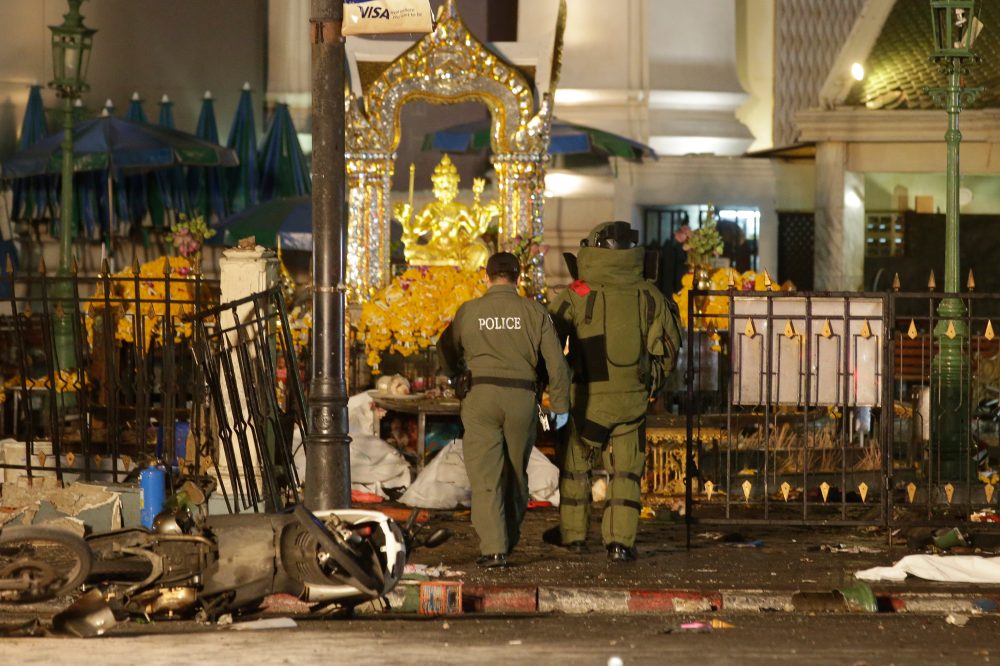

Two men from China’s Uyghur minority received death sentences Thursday from a Thai court for their involvement in a deadly 2015 bombing at a Bangkok tourist site that claimed 20 lives and wounded over 120 people.
Yusufu Mieraili and Bilal Mohammad were taken into custody following the August 17, 2015 attack at the Erawan shrine, a destination favored by tourists, especially those visiting from China.
The defendants faced multiple charges including murder, attempted murder and unlawful possession of explosive devices. Video footage, fingerprint analysis and additional evidence allegedly connected them to the deadly incident.
A panel of four judges delivered the verdict at Bangkok South Criminal Court. The court determined guilt based on substantial evidence presented against the defendants, who failed to offer convincing proof of their innocence.
Following the judges’ departure from the courtroom, Mieraili declared his innocence in limited Thai, rejecting the court’s decision.
“I mourn for Thailand,” he said. “I did not receive justice … I ask Thai people to help me.”
During his time in custody, Mieraili acquired Thai language skills, his attorney noted. He is also fluent in English and on Thursday served as a translator for Bilal, converting the court proceedings into Uyghur since only an English interpreter was present. The trial faced numerous postponements due to challenges in securing appropriate translation services.
Defense attorney Chuchart Kanpai announced plans to file an appeal, stating that multiple elements of the case remained unaddressed.
While the defendants reportedly admitted guilt during early interrogations, they entered not guilty pleas when proceedings commenced in 2016. The case initially went before a military tribunal before moving to the civilian Bangkok South Criminal Court in 2019.
Both men claimed they endured abuse and torture while incarcerated following their arrests. However, the judges stated Thursday that no evidence supported torture allegations and that investigators appeared not to have forced the confessions.
Multiple human rights organizations have condemned the legal procedures and extended trial duration. In 2023, the International Federation for Human Rights based in France filed a petition with the United Nations citing various human rights and due process violations, including questionable arrest justification and discriminatory conduct.
Law enforcement identified 17 individuals suspected in the bombing but captured only three. A Thai woman’s charges were dismissed in 2024 for insufficient evidence.
Investigators believe Mieraili triggered the explosive device moments after Bilal, also called Adem Karadag, allegedly placed a backpack containing the bomb at the shrine location.
Thai officials have stated the attack was retaliation by a human trafficking organization whose operations had been disrupted by law enforcement. Thailand intensified efforts against human smugglers in early 2015 after discovering abandoned camps housing Rohingyas fleeing Myanmar persecution and economic migrants from Bangladesh in border jungle areas near Malaysia.
Some experts theorize the bombing was carried out by Uyghur separatists angered by Thailand’s forced return of numerous Uyghurs to China in July 2015. Many Uyghurs attempt to flee persecution and strict oversight in China using professional smuggling networks.
Thailand sent 40 Uyghur asylum seekers back to China in 2025, prompting international condemnation.
The shrine’s appeal to Chinese visitors supported theories that the bombing contained political motivations.