
MIAMI (AP) — During a late March evening, an officer with Florida’s Fish and Wildlife department approached a Guatemalan husband and wife as they walked their pet through a park in the wealthy Gulf Coast town of Bonita Springs. Without leaving his vehicle, the officer requested the man’s identification documents and directed the pair to walk toward the park’s entrance, the woman recalled.
Upon reaching the parking area, the officer placed the husband under arrest using what his wife described as fabricated charges. The woman agreed to speak with The Associated Press anonymously to protect herself and her 48-year-old spouse from potential detention and to safeguard their ongoing asylum proceedings.
“The officer claimed he was writing a citation because our dog had attacked him, which was impossible since he never stepped out of his vehicle,” the woman explained. “He began making phone calls, placed my husband under arrest, and we waited for 40 minutes” until federal Immigration and Customs Enforcement agents arrived to transport her husband.
While Trump’s immigration enforcement efforts have faced strong opposition in Democratic-controlled sanctuary jurisdictions—where law enforcement is prohibited from cooperating, political leaders have resisted, and community members have attempted to shield immigrant residents through warning signals, video documentation, and confronting masked federal operatives seen by many as occupying forces—the situation differs significantly in Republican-controlled Florida.
In the Sunshine State, 347 state and municipal agencies have agreed to participate in the enforcement campaign, resulting in a massive increase in immigration detentions. Participating organizations include police forces and sheriff’s offices, the Florida National Guard and Highway Patrol, along with seemingly unexpected participants like the state Fish and Wildlife Conservation Commission and Florida Lottery.
The dramatic increase in Florida’s immigration detentions during Trump’s current presidency has remained largely hidden from public view, as many begin as routine police encounters like traffic violations, the public appears more accepting of the program, and cooperating state and local departments are consistently denying requests for detention records and body camera footage following instructions from the Department of Homeland Security.
Data shows that approximately 39,000 immigrants were detained in Florida during the 416-day span from Jan. 20, 2025—when President Donald Trump began his second presidency—through March 11, 2026, the most recent date available in information provided to the University of California, Berkeley’s Deportation Data Project and examined by the AP. The previous 416 days under the Biden administration saw 11,088 detentions. Florida averaged 93 daily detentions during the Trump period, ranking second only to Texas’s 239, which borders Mexico along the nation’s longest international boundary.
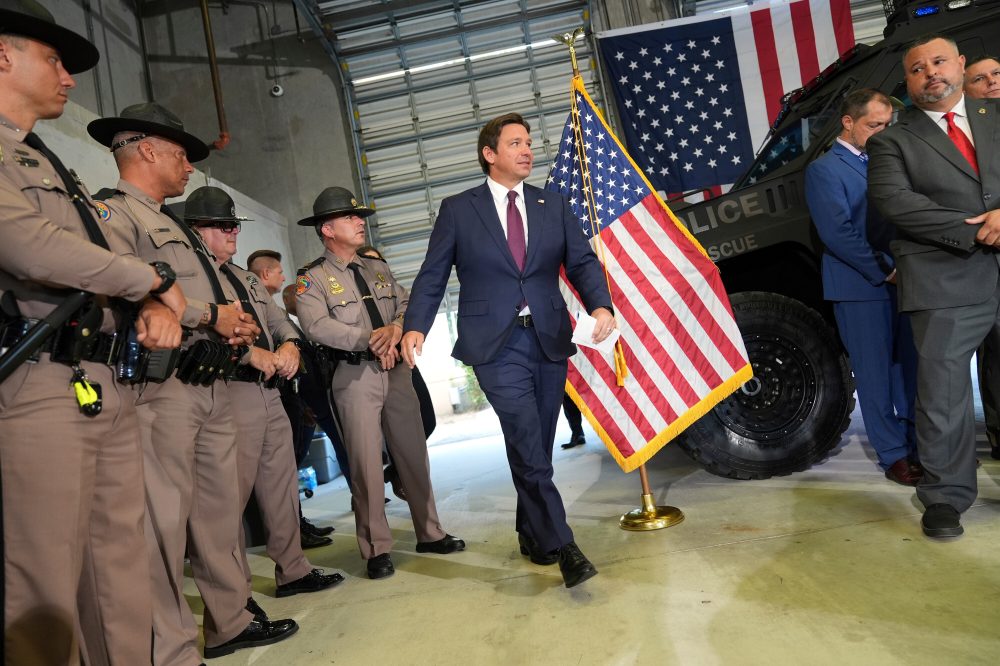
Republican Gov. Ron DeSantis has promoted Florida’s collaboration with ICE through what are known as 287(g) agreements, which grant immigration enforcement authority to state and local law enforcement departments, enabling them to question immigrants in their custody and hold them for potential deportation. Experts indicate these officers face pressure to produce results.
“Numerous officers have received deputization and immigration authority, and they are actively seeking targets,” explained immigration lawyer Vilerka Bilbao, who represents no fewer than 23 clients detained by local police in the Jacksonville region. “They are detaining anyone they can—they must demonstrate results to DeSantis and federal authorities.”
Officers conduct vehicle stops using a “pretext reason”—like a damaged taillight or excessively dark window tinting—”and subsequently you find yourself in ICE detention,” Bilbao explained.
On Feb. 15, Lee County sheriff’s officers detained a 44-year-old Guatemalan man along with his 21-year-old son near Fort Myers. The deputies confronted the pair in a retail parking lot, claiming their license plate had expired and demanding they exit their vehicle despite the tags remaining valid until March 25, according to the older man’s spouse and the younger man’s mother.
The 40-year-old Guatemalan asylum-seeker, who requested anonymity for her family due to safety concerns for herself and her three remaining children in Florida, reported that her husband and adult son were detained and sent back to Guatemala one week later, abandoning her, her two minor sons, and her daughter, who holds American citizenship.
She explained that both her husband and adult son had active immigration court proceedings but were detained regardless. Her husband had appeared at three immigration hearings but missed one scheduled in Miami, approximately 120 miles (193 kilometers) south of Fort Myers, because he lacked transportation funds. Her son was pursuing asylum, possessed a valid driver’s license, and held a work authorization.
DHS contests that the man and his son were legally present in the U.S., stating they entered the border unlawfully in 2017 and received a final removal order in 2019.
Regarding the dog-walking incident, DHS stated the man was arrested due to having two final removal orders.
In both situations, the Florida departments that conducted the initial stops—the Fish and Wildlife Commission and the Lee County Sheriff’s Office—declined to provide arrest documentation and body camera recordings to the AP, stating that ICE requires them to direct all inquiries regarding immigration arrests to federal authorities.
ICE and DHS, its oversight agency, refused to provide the arrest documentation and body camera footage, with DHS stating: “We are not going to disclose law enforcement sensitive intelligence.”
An ICE directive distributed to the 287(g) partners in Florida specifies that “information obtained or developed” through the agreements remains “under the control of ICE” and cannot be disclosed without federal authorization.
The directive seems to conflict with Florida’s established Sunshine Law, enacted in 1967, which assumes records are publicly accessible unless specifically exempted. However, the conservative state Legislature has created additional exceptions in recent years.
While Florida leads in partnering with the enforcement campaign, establishing the “Alligator Alcatraz” and “Deportation Depot” immigration detention facilities within the past year, participation in the 287(g) program has exploded, expanding from 135 agreements across 20 states before Trump’s second term to over 1,700 across 41 states and territories.
DHS has announced financial incentives for state and local law enforcement departments, including salary reimbursement. These benefits include up to $7,500 for equipment per participating officer in the agreements, and up to $100,000 for agencies to acquire new vehicles.