
DENDRON—Breyon D. Pierce, a sixth-generation farmer from Surry County, recalls countless Saturdays working the land rather than enjoying cartoons or playing outdoors.
“But over time, seeds were planted within me that taught me something much greater,” Pierce explained. “Farming is not just a profession; it’s a calling.”
Pierce, an accomplished agriculture educator, cultivates peanuts, corn, soybeans and wheat across more than 900 acres alongside his father Glen at Pierce Farms LLC.
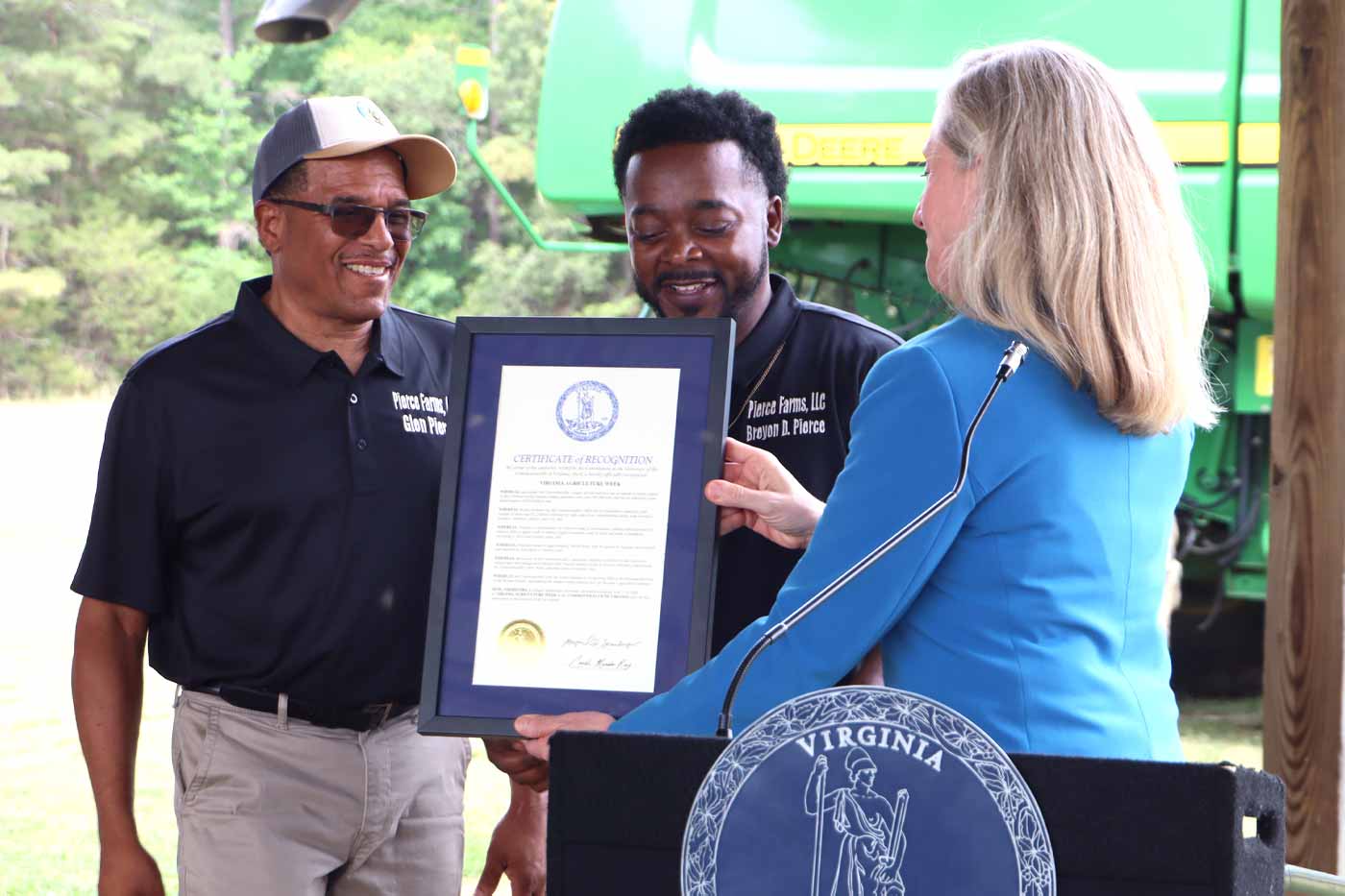
On June 9, the family welcomed state officials to their operation, hosting Gov. Abigail Spanberger, Sec. of Agriculture and Forestry Katie Frazier, Virginia General Assembly representatives and Virginia Farm Bureau Federation officials. The governor enacted several measures supporting the state’s agricultural and forestry sectors while promoting community food access.
Gov. Spanberger also delivered a proclamation honoring the Pierce family for their role as producers of food, fiber and fuel during Virginia Agriculture Week, June 7–13.
“There is no better place to recognize it than right here on this farm with a family that embodies what it means to devote your life to our land,” she said.
Pierce emphasized the complex challenges confronting farmers today. The state has seen nearly half a million acres of farmland disappear over the past five years, while producers struggle with increasing costs across various markets.
Safeguarding agricultural property remains essential for Virginia’s leading private industry and farming families’ survival, Pierce stated, noting the land “is meant to feed families, support communities, and provide opportunities for our future generations.”
The governor enacted five measures supporting Virginia’s agricultural and forestry industries while surrounded by local producers and agricultural advocates, including VFBF senior vice president of governmental relations Martha Moore.
Farm Bureau backed these legislative measures, Moore noted. “And now we consider them victories.”
HB 512 establishes a comprehensive prosperity strategy for agriculture and forestry sectors with yearly reports to the General Assembly.
SB 522 improves Forest Sustainability Fund management for localities preserving forest areas within the Chesapeake Bay watershed.
SB 186 safeguards Virginia consumers and cattle producers by mandating clear labeling of manufactured protein products that cannot be misrepresented as genuine beef.
HB 1086 enables farmers to bid against out-of-state competitors for school nutrition contracts, increasing Virginia children’s access to locally-grown food.
SB 302 continues the peanut excise tax that funds essential marketing, research and educational programs for Virginia’s peanut growers.
Virginia’s agricultural sector generates an annual economic impact of $82.3 billion in total industry production, creates more than 381,000 jobs, and adds $43.8 billion in additional value. Broiler chickens led 2024 commodity rankings by cash receipts exceeding $1.2 billion, followed by cattle and calves, miscellaneous crops, milk and dairy products, soybeans, turkey and corn.
The state houses approximately 38,600 farms, with 95% owned and operated by individuals or families.
Visit vdacs.virginia.gov/vagrown to locate farmers markets, roadside vendors and agritourism sites. Shoppers should look for Virginia Grown and Virginia’s Finest labels on products throughout retail locations statewide.