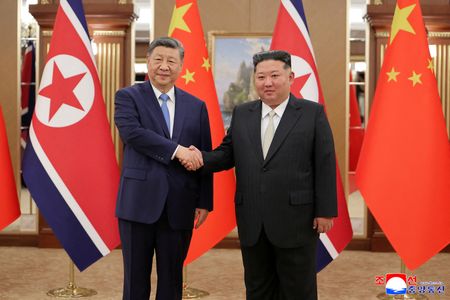

Both North Korea and China are declaring diplomatic victories following Chinese President Xi Jinping’s recent visit to the reclusive nation, a trip that boosted North Korean leader Kim Jong Un’s international profile while strengthening ties between the two countries.
During the two-day diplomatic mission, both nations exchanged high praise and discussed enhanced cooperation. Kim welcomed Xi with ceremonial honors including a 21-gun salute and performances featuring songs from both countries, while deliberately steering clear of sensitive topics like nuclear disarmament and relations with the United States.
Jenny Town, director of the Korea program at the Washington-based Stimson Center, noted Kim’s perspective on global influence. “Kim has often talked about how North Korea is now a pivotal player in reshaping the global order, and its partnership with Russia has been a major catalyst in validating that assertion,” Town explained.
“Having Xi now take his first trip out of country this year to visit Pyongyang on an agenda that didn’t include North Korea’s nuclear programme was a big win for Kim,” she added.
The absence of nuclear disarmament discussions marks a notable shift, as this issue had previously created tension between China and North Korea.
Just before Xi’s arrival, Kim Yo Jong, the North Korean leader’s sister, criticized the U.S. for allegedly spreading misinformation. This came after Washington claimed in May that Xi and U.S. President Donald Trump had agreed on shared denuclearization goals for North Korea during Beijing discussions.
Jeremy Chan, a China & Northeast Asia analyst at Eurasia Group, observed the strategic implications. “Beijing has very clearly moved on from that issue and now tacitly accepts North Korea as a nuclear state, which likely puts China on an equal footing with Russia in Pyongyang’s eyes,” Chan stated.
“I think China achieved its primary goal of this trip, which was drawing North Korea closer and counterbalancing Russia’s growing influence in North Korea,” he continued.
However, Chinese academics disputed suggestions that the visit targeted any third nation. Zhang Yun, an international relations professor at China’s Nanjing University, emphasized different motivations.
“The visit is primarily aimed at consolidating the traditional bilateral friendship between China and the DPRK,” Zhang explained.
When questioned about nuclear discussions during the visit, China’s foreign ministry maintained that their peninsula policies remain unchanged. Officials declined to clarify whether avoiding the nuclear topic signaled acceptance of North Korea’s nuclear status, reiterating their established position.
While China officially opposes North Korea’s nuclear development, Beijing has increasingly avoided public pressure on this issue.
Experts identified notable differences in how each side characterized the leaders’ discussions. North Korea emphasized the ceremonial aspects and portrayed itself as China’s equal, while China focused on potential outcomes in trade, tourism, and law enforcement cooperation.
Town suggested these differences reveal limitations in North Korea’s willingness to strengthen Chinese relations, particularly given its recent alignment with Russia through military support for the Ukraine conflict in exchange for economic assistance.
“It is clear that Kim and Xi do not have the kind of rapport Kim has with Putin; there seems to be little personal affinity between them. But both understand the strategic value of the relationship to push through,” she observed.
Analysts highlighted Kim’s explicit endorsement of Beijing’s One China principle, which asserts that Taiwan and mainland China constitute one nation, along with China’s references to military cooperation.
Chad O’Carroll, founder of North Korea-focused website NK News, noted the broader implications. “North Korea’s support for Russia has shown that Pyongyang can provide material assistance to a major power in wartime. There is no evidence yet of a comparable commitment to China, but DPRK (North Korea) messaging on Taiwan now matters more than before,” O’Carroll said.
Observers also monitored whether Kim’s daughter would appear during the visit, as her presence might support intelligence assessments that she’s being prepared as his successor.
The daughter, believed to be approximately 13 years old and named Ju Ae, joined Kim’s previous Beijing visit and appears regularly in official photos. However, she was absent from images released by both Chinese and North Korean state media covering this trip.
Benjamin Ho, China programme associate professor at the S. Rajaratnam School of International Studies in Singapore, attributed her absence to diplomatic protocol.
“Given Beijing’s penchant for protocol, it would be awkward if a young girl appears among all the senior officials present,” Ho explained.