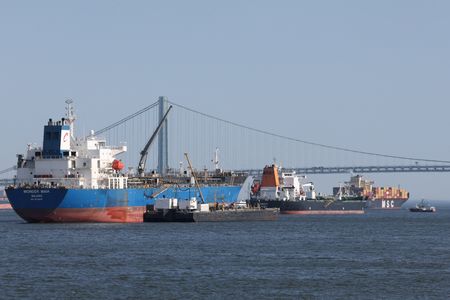

America has claimed the title of the world’s biggest oil exporter, overthrowing a global hierarchy that Saudi Arabia and Russia controlled for decades. This transformation strengthens U.S. companies’ control over energy markets while Washington’s conflict with Iran continues to reshape international energy commerce.
This rise to the number one position represents a remarkable turnaround for a nation that relied on Middle Eastern petroleum for many years and endured an oil blockade from certain OPEC nations in 1973 as punishment for American backing of Israel.
The nation’s energy landscape started transforming after 2010, when petroleum and natural gas production from shale rock surged, initially establishing America as the leading gas producer globally, followed by becoming the top oil producer.
Due to the U.S.-Iran conflict hampering Saudi petroleum shipments since February 2026 and Russian oil deliveries facing Ukrainian drone strikes plus American sanctions on Moscow following Ukraine’s invasion, America has emerged as the globe’s premier oil exporter.
American shipments of crude and refined products rose to approximately 10.5 million barrels daily in May, supported by strong production and strategic reserve releases, according to vessel tracking service Vortexa data. This made America the leading global exporter for three consecutive months. Russian shipments totaled 7 million barrels per day in May based on calculations, while Saudi Arabia’s exports reached 5.9 million barrels daily, Vortexa reported.
For context, Saudi Arabia exported roughly 8.1 million barrels per day in 2025, while America sent out 6.6 million barrels daily, and Russian exports were approximately 5.8 million barrels per day, Vortexa data indicated.
“Washington has a new tool they didn’t realize they had before the Iran war — energy exports,” said Michelle Brouhard, head of policy at ship tracking firm Kpler.
America’s new dominance might reduce the pricing influence that the Organization of Petroleum Exporting Countries and its partners have traditionally wielded over oil markets. The president has repeatedly criticized OPEC for market manipulation. The organization also took a hit in May when one of its largest members, the United Arab Emirates, departed after almost 60 years of membership.
Leading oil export status will provide Washington with a potent new bargaining chip in discussions with allies and competitors, complementing its global military superiority and financial market control through the dollar’s position as the world’s reserve currency.
“You can see now the leverage the United States has over some of these countries because they are dependent on the U.S. for their oil or gas,” Brouhard noted, explaining that America was Europe’s largest crude supplier and second-biggest distillate provider.
European Union officials, who initially celebrated the American oil and gas surge as an alternative to Russian and Middle Eastern sources, have become more cautious and raised concerns about excessive reliance on American corporations.
This caution emerged as the EU disagreed with the American administration regarding trade duties and environmental policies.
Moscow is also struggling to conceal its irritation.
American energy firms were the primary winners from the Strait of Hormuz closure, according to Igor Sechin, the leader of Kremlin oil giant Rosneft and one of President Vladimir Putin’s closest associates, who made this statement recently.
However, well before the U.S.-Iran conflict began, both Saudi Arabia and Russia were falling significantly behind American companies in production increases.
Crude and liquid fuel production in America has almost tripled to roughly 22 million barrels daily since 2000. Saudi crude and liquid output has mainly varied between 10 million and 12 million barrels per day based on OPEC quotas from 2000 to 2026.
Russian oil and liquid production jumped to 10 million barrels daily from 6 million between 2000 and 2010, increased by another 2 million barrels daily during the 2010s, but has mostly stalled and dropped below 10 million barrels per day since 2020.
Worldwide oil consumption reached 104 million barrels daily last year from 87 million in 2010, indicating that the majority of global growth over the past 15 years has been primarily satisfied by America’s oil expansion.
In 2015, America eliminated a 40-year export prohibition that had existed since the Arab oil embargo, unleashing its oil boom to international markets. A decade later, it has become the largest oil exporter, disproving doubters who believed the growth would be temporary as reserves depleted.
Unlike Saudi Arabia and Russia, where governments completely or partly determine production and export goals, America’s boom depends on private companies’ choices and is mainly profit-driven.
When oil costs increase, American companies respond by boosting production, helping lower prices. When prices weaken, American firms reduce output, supporting prices, explained Kenneth Medlock III, a fellow in Energy and Resource Economics at the Baker Institute for Public Policy.
“In many ways, it’s kind of a similar role to what OPEC and Saudi Arabia have been doing with spare production capacity, but it’s more of a market mechanism than a strategic device,” he explained.
European nations have depended heavily on America since the Ukraine conflict started in 2022. The continent purchased about 47% of American oil exports this year so far, compared with 37% in 2021.
Asian nations, which previously bought most of their crude from the Middle East, are now increasingly depending on America for supplies. Asia represented about 46% of American oil exports in May, compared with around 37% last year.