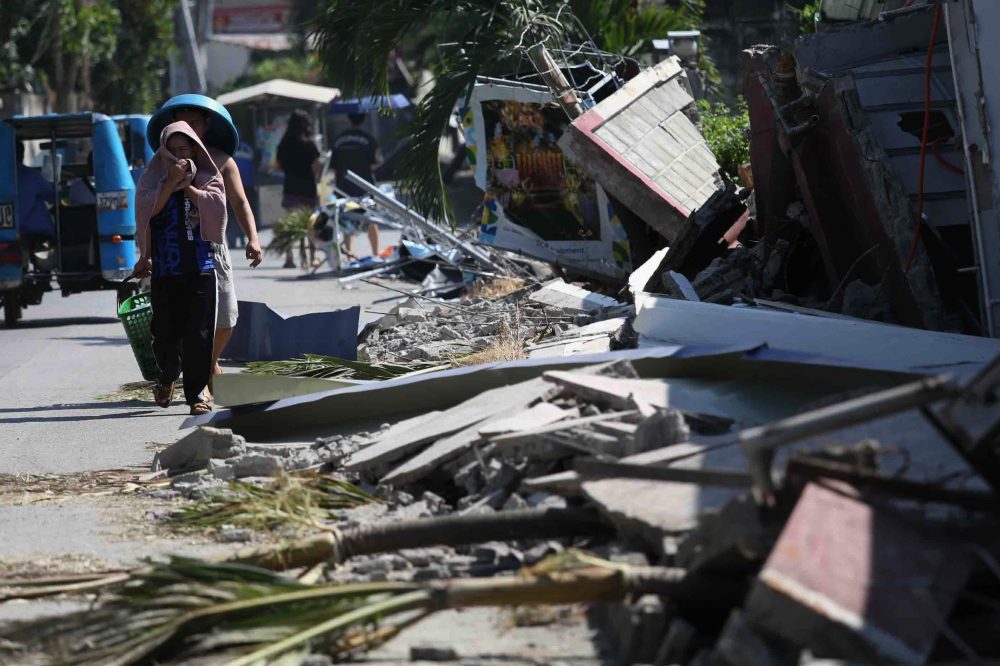

GENERAL SANTOS, Philippines — A local mayor whose community was ravaged by a devastating earthquake made an urgent appeal Thursday for military aircraft to deliver essential supplies to villages cut off by landslides and facing starvation.
Monday’s massive 7.8 magnitude tremor, which originated offshore near the southern province of Sarangani, ranks among the most severe seismic events to impact the Philippine islands in fifty years. The disaster has claimed no fewer than 47 lives while wounding 688 individuals, with 31 people still unaccounted for.
Over 45,000 residents continue to live in displacement, with approximately half housed in temporary emergency facilities, following extensive damage to more than 12,600 homes across agricultural communities and urban centers. Provincial authorities report that many survivors remain too frightened by continuing aftershocks to return to their residences.
The province of Sarangani has recorded the highest death count at 20 fatalities among all impacted areas, with most casualties resulting from a devastating landslide that engulfed homes in the seaside community of Glan, as reported by the government’s Office of Civil Defense disaster response agency.
Victor James Yap, who serves as mayor of Glan, explained that electrical service has yet to be restored throughout his province, while 10 out of 31 communities within his municipality of over 100,000 residents remain completely cut off, primarily due to landslide damage. He has requested immediate deployment of military helicopters to transport food and emergency supplies to these affected zones.
“We need food and water but it’s difficult to transport them to some of our villages which remain isolated,” Yap stated during an interview with DZMM radio network. “Choppers are needed to transport food because people there are already very hungry.”
While a critical transportation route into the community has been cleared and should permit fuel deliveries by Thursday, the municipality continues to operate without electricity and cellular communications remain unreliable, Yap noted.
The majority of earthquake fatalities resulted from falling rubble and building collapses, along with landslides affecting Sarangani, the port city of General Santos, and surrounding areas including South Cotabato and Davao Occidental provinces.
Three swimmers were caught in dangerous waters off General Santos when the earthquake occurred, with two drowning and one person still missing after being pulled out to sea. Ocean surges reaching 1.4 meters (4.6 feet) above normal tide levels were recorded across the nation’s southern regions, while smaller wave activity reached shores in Indonesia and Palau, extending as far as Japan’s southern coastline.
This seismic event represents one of the most powerful to strike the archipelago since the catastrophic 8.1 magnitude earthquake and tsunami of August 17, 1976, which resulted in approximately 8,000 deaths.
The Philippine islands frequently experience earthquakes and volcanic activity due to their position along the Pacific “Ring of Fire,” a zone of active seismic activity encircling the Pacific Ocean.