
International laborers constructing a massive $350 million American diplomatic facility in Milan report receiving wages below $2 per hour despite promises of fair compensation, according to interviews with five former workers and documentation of their contracts and payment records.
Italian authorities are examining Montgomery, Alabama-based Caddell Construction, a prominent contractor for U.S. diplomatic facilities. This month, two company managers in Italy were taken into custody on labor exploitation charges, with one apprehended while attempting to board a departing flight and another preparing to leave the country, according to prosecutors.
Prosecutor Paolo Storari leads the inquiry, who has previously directed investigations into factories serving high-end fashion companies. Currently, only Caddell faces scrutiny as a target, with no subcontractors named in the probe.
The diplomatic facility investigation began approximately six months ago and encompasses roughly 70 laborers, primarily from India. Authorities claim Caddell unlawfully subtracted housing and meal costs from paychecks and required 10-hour shifts six days weekly. Following deductions for accommodations and food, some received as little as 500 euros (under $580) each month, prosecutors stated.
Both Caddell and the U.S. State Department confirmed they are examining the claims and working with Italian officials.
The diplomatic facility represents part of Milan’s construction surge spanning the last twenty years, which has transformed the city’s appearance and elevated the international standing of Italy’s fashion and financial hub.
Reporters interviewed four Kenyan workers and one Indian worker at a labor organization center where officials coordinated support services, including legal representation and housing assistance. The laborers shared documents and agreed to speak anonymously due to concerns about reprisals and to safeguard the ongoing inquiry.
The Kenyan employees stated Caddell recruited them following their work on a multi-million-dollar U.S. Embassy expansion in Nairobi.
Two displayed hiring documents on Caddell letterhead bearing a company official’s signature, guaranteeing yearly compensation exceeding 25,000 euros (approximately $29,000).
They reported receiving substantially less than promised amounts and facing intimidation from human resources staff when they questioned supervisors.
“When you go to the office to ask any question, you are being told, ‘Either you work or you will be returned to your country. That’s the amount you are supposed to be paid,’” one Kenyan electrician said. He added that he was paid just 800 euros ($925) a month after being promised 2,300 euros ($2,660).
A second Kenyan electrician reported threats of defamation charges after showing an AI-generated summary of Italian employment regulations and being informed the 25,000 euros mentioned in his contract was “for visa purposes,” not an actual payment commitment.
The State Department confirmed it is examining the allegations raised by prosecutors and that U.S. law enforcement collaborates with Italian authorities.
“The U.S. government does not tolerate labor exploitation,” the department said in a statement.
Caddell stated it was “fully cooperating” with Italian authorities and conducting its own “comprehensive inquiry into this matter to ensure all our global subcontractors and consultancies are in compliance with all labor standards and legal requirements.”
“Caddell is committed (to) treating and paying workers fairly. We will continue to work with authorities in good faith to ensure the welfare of those who work on this important project,” the company said in a statement.
More than ten years ago, Caddell paid millions to the U.S. government to resolve claims it submitted false statements to obtain government benefits. Caddell did not respond to requests for comment regarding that matter.
All five workers who spoke with reporters, aged from their late twenties to early fifties, reported termination without justification this year. One stated he discovered upon returning from family visits in Kenya that he no longer had employment or housing.
Four workers were skilled electricians, including the Indian employee whose background demonstrated over ten years of experience with other companies in Persian Gulf nations.
The Indian worker reported promises of 2,500 euros (nearly $3,000) monthly. However, his payment documentation revealed actual compensation of approximately 500 euros (under $580) per month. The record showed an hourly rate of 1.55 euros ($1.80).
The Kenyan workers contacted authorities after discovering the investigation.
“I believe in justice,” one said. “Also the workers there should not be afraid. They should come and speak up.”
Two reported currently sleeping outdoors in parks, while another stays with an acquaintance. One declined a job offer at a Caddell location in another country following his Milan experience.
Caddell emerged as a major diplomatic facility contractor when the State Department initiated extensive security improvements following the 1998 U.S. Embassy attacks in Tanzania and Kenya that killed over 250 people.
“Very few contractors can meet the strict requirements to even bid on secure work necessary for diplomatic facility projects,” Caddell stated on its website celebrating its 40th anniversary in 2023. At that time, the company reported 39 embassy projects worth $7.4 billion. Four additional projects have been added since.
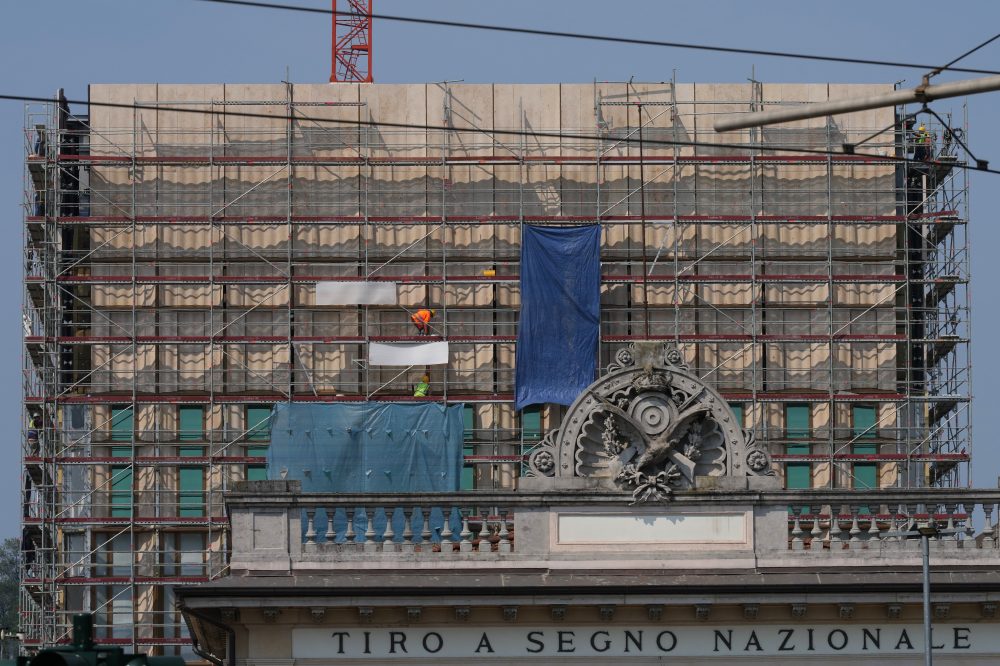
The Milan diplomatic campus occupies a 10-acre (40,000-square meter) location at a former shooting facility. The existing U.S. Consulate operates from a tower designed by renowned Italian architect Gio Ponti.
Campus blueprints specified approximately 500 “locally employed workers,” according to the U.S. State Department. The development includes renovating a century-old structure, constructing a five-story consulate building, restoring gardens, adding a reflecting pool and creating a large outdoor assembly space.
Construction continues under judicial oversight. Workers no longer face housing and meal deductions. They work maximum 45 hours with guaranteed two-day weekends.
Payment records shown by workers indicated apparent monthly housing charges of 510 euros (around $590) and food costs exceeding 300 euros (around $350). However, these deductions explain only part of the gap between promised and actual compensation.
Labor organizations plan to pursue compensation for workers to recover at least what they earned “through hard work and commitment,” said Laura Malguzzi, a labor representative at the Fillea Cgil union federation representing construction workers.
Malguzzi expressed surprise that payment records provided by workers appeared to document the alleged violations. Union specialists continue examining the documents, which don’t meet Italian requirements, and couldn’t confirm their authenticity.
“They probably had in their minds the absolute certainty that they were untouchable,” Malguzzi said.
The Kenyan workers reported reluctantly accepting $200 monthly wages in Nairobi, where joblessness is widespread. However, they anticipated better treatment from an American company operating in Europe.
“They can just hire you, and you just go running,” one worker said of the company. “Because you are poor you have nothing. And you have nothing you can do.”