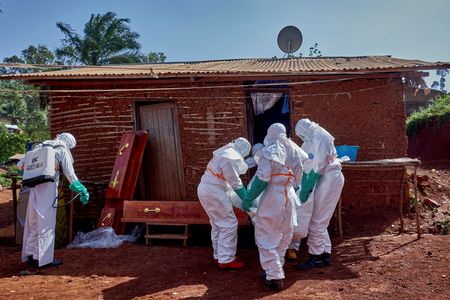

Health investigators in the Democratic Republic of Congo are examining a tragic chain of events that may have sparked the country’s current Ebola epidemic – beginning with a damaged wooden casket that cracked during a bumpy truck ride across rural terrain.
The investigation centers on the February 4 funeral of Pastor Paluku Makundi Denis, a 44-year-old Congolese clergyman whose body was transported from a morgue in Bunia to the remote gold-mining community of Mongbwalu for burial.
During the three-hour journey across Ituri province, the aging Nissan SUV carrying the coffin bounced violently over broken dirt roads, potholes, and rocky terrain. Young family members riding in the vehicle sat directly on top of the wooden casket during the rough trip.
When the truck finally arrived in Mongbwalu that February afternoon, the coffin had collapsed and cracked under the weight, according to four experts working on the health ministry’s investigation into the outbreak’s origins.
What followed has become the focus of investigators searching for “patient zero” – the earliest infection in an epidemic that has now caused approximately 635 confirmed cases and at least 127 deaths across eastern Congo, with health officials warning the actual numbers could be significantly higher.
The rare Bundibugyo strain of Ebola currently spreading has no available vaccine or treatment and proves fatal for 30% to 50% of those infected. A surveillance epidemiologist working on the inquiry believes this particular strain had been spreading undetected for four to six months before Congo officially confirmed the outbreak on May 15.
Hospital records show that Makundi had been diagnosed with peritonitis, a serious abdominal infection, at a Bunia medical facility on February 3. Three doctors and a nurse from the hospital confirmed that no Ebola testing was conducted because Congolese health authorities were unaware of any outbreak at the time.
An infectious-disease professor at the London School of Hygiene and Tropical Medicine, David Heymann, explained that peritonitis can be a symptom of severe Ebola infection, though determining the actual cause of Makundi’s death would be impossible without proper testing.
When the damaged coffin reached Mongbwalu – a transient community of roughly 130,000 residents – dozens of mourners had already assembled at a family compound for the funeral service.
The pastor’s 70-year-old father, Pascal Kibali, known locally as Paka, examined the broken casket in the dimming afternoon light. Makundi, called Paluku by friends, had been a respected leader in Mongbwalu’s ethnic Nande community and helped establish the area’s charcoal cooperative before moving to Bunia to pursue religious work.
Kibali later recalled his thoughts upon seeing the damaged coffin: “My eldest son cannot be buried in such a coffin.”
Family members quickly purchased a replacement casket from a local craftsman. Community members then transferred the body from the broken coffin to the new one before sunset, with residents handling the remains directly – a potentially dangerous situation if Makundi had been infected with Ebola, since victims’ bodies remain highly contagious.
The wake took place at the family compound, followed by a cemetery burial. Traditional Congolese funeral customs often involve mourners touching and kissing the deceased, though it remains unknown whether these practices occurred during Makundi’s service.
More than 80 relatives, friends, and neighbors gathered at the local cemetery that evening, according to Edmond Kambale Katuwene, who leads Mongbwalu’s Nande community. A priest conducted prayers, encouraging attendees to contemplate life’s fragility and prepare for their own mortality, Katuwene reported.
Within days of the funeral, several community members began showing signs of illness, according to Mongbwalu’s Mayor Sesereki Mandro Israel. Nearly 50 deaths occurred within two weeks of the burial, with many victims displaying classic Ebola symptoms including fever, vomiting, and bleeding.
Pastor Makundi’s brother Idi became one of the first casualties. The 36-year-old miner died on February 16 from what was diagnosed as suspected appendicitis, according to a May 16 situation report from the provincial health authority. Within weeks, another brother and a relative also died from suspected hemorrhoids and tuberculosis respectively, with the bulletin noting these deaths required additional investigation.
These family deaths preceded at least 108 additional fatalities in Mongbwalu between April and May, according to the same Ituri authority report. Patients in family groups collapsed with fever, vomiting, diarrhea, and sometimes hemorrhaging symptoms.
The investigation report identifies these deaths as potentially connected to the Ebola spread, with Makundi’s case representing the earliest suspected infection. The document suggests the disease may have circulated undetected in Mongbwalu for months.
Congo’s health ministry announced on June 9 that at least 40 people in Mongbwalu had been confirmed dead from Ebola, though aid workers caution that limited testing capabilities may mean official figures are incomplete.
As deaths mounted throughout the community, frightened residents sought explanations for the tragedy. Many focused not on medical causes but on the unusual circumstances surrounding Pastor Makundi’s burial.
After the cemetery service concluded and families departed in the warm evening air, word spread that someone had set fire to the damaged original coffin.
None of six relatives and local residents interviewed claimed to have witnessed the burning, though all reported seeing the coffin’s charred remains. Pastor Makundi’s father and uncle attributed the fire to intoxicated young people but provided no additional details. The entire family remained shocked and confused by the incident.
Community leader Katuwene explained that residents viewed the burned coffin as an insult to ancestral spirits.
Tensions escalated during the burial of Tsongo Kenda Kenda, Makundi’s younger brother, when local police had to intervene in a family dispute over opening the coffin, according to the May 16 provincial authority situation report.
Katuwene said family members had argued about where to hold the pre-burial wake, leading one relative to remove and replace the coffin lid in protest. Many community members consider such actions disrespectful to the deceased.
For some residents, neighborhood chief administrator Joseph Payi Mute explained, the subsequent deaths were interpreted not as viral disease but as punishment from ancestors angered by the disrespectful treatment surrounding both brothers’ burials.
Jeremy Rayan Tamelegu, who worked as a mining-geology consultant in the same neighborhood as the pastor’s family, said the unexplained surge in illness and death reinforced the curse narrative. He witnessed people in the area suddenly becoming sick and dying within days.
The story quickly spread across social media throughout Mongbwalu and surrounding areas. Dark humor emerged among the anxious population, even inspiring a local music group to record a song about the rumors.
One verse stated: “We hear a coffin is wandering Mongbwalu, leaving devastation in its wake.”
The song sparked a TikTok trend across eastern Congo, with users posting videos showing coffins apparently moving independently along dirt roads or floating above terrified residents.
When provincial health investigators from the patient-zero inquiry reached Mongbwalu in early May, curse rumors had spread widely and some residents had become hostile toward health workers and officials, one investigator reported.
The mistrust has escalated to violence, similar to previous Ebola outbreaks where many locals blamed the disease on modern medicine.
On May 22, an unspecified number of young people in the nearby village of Mabilindey attacked a response team collecting information about a confirmed Ebola case, according to the epidemiologist on the patient zero inquiry. The following day, attackers set fire to an isolation tent that aid workers had erected at Mongbwalu General Hospital.
Medical personnel are not the only targets of blame.
Pastor Makundi’s father, Paka Kibali, said his family has been unfairly accused by some locals of causing the outbreak due to the events surrounding both burials.
“They vandalized my son’s coffin and blamed me for the deaths that followed,” he said through tears. “Yet I am the victim – it was my son’s coffin that was desecrated.”