
Conflicts in the Middle East and Ukraine will take center stage at next week’s Group of Seven summit, with host nation France designing an agenda focused on maintaining unity while avoiding potential clashes with U.S. President Donald Trump.
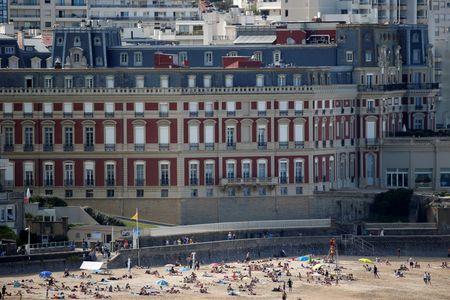
The June 15-17 meeting in Evian-les-Bains, located along Lake Geneva’s shoreline, will bring together leaders from France, Britain, Canada, Germany, Italy, Japan and the United States, along with European Union representatives.
Diplomatic sources indicate that crisis management will be the primary focus, as Trump works to resolve a conflict that has disrupted global economic stability while expressing frustration with European partners he believes have disappointed him in the Gulf region and become too dependent on American security support.
Major breakthrough decisions are not anticipated on key matters, which include addressing global economic imbalances and securing critical mineral sources outside of China.
The organization, established fifty years ago, has historically tackled economic and geopolitical challenges through broad agreement. However, this unity has deteriorated since Trump’s return to the White House in 2025.
French officials have already adjusted the summit dates to work around Trump’s birthday plans for cage fighting on the White House lawn, and like other recent host countries, they have set modest expectations, suggesting success would simply mean Trump remaining for the entire event, given his early departure from the 2025 gathering.
“Macron has gone out of his way to have an agenda that is designed to appeal to the sort of things President Trump wants,” said Josh Lipsky, chair of international economics at the Atlantic Council.
The summit’s pace may be influenced by Middle Eastern developments. A delicate ceasefire between the U.S. and Iran faces pressure, and achieving even a temporary agreement that postpones addressing more complex issues like Iran’s nuclear program remains challenging.
Trump seeks Iran’s reopening of the Strait of Hormuz, a critical passage for global oil and gas transport. Tehran demands the U.S. lift its blockade on Iranian ports and unfreeze Iranian assets, while also requiring Israel to halt its offensive against the Iranian-supported Hezbollah militia in Lebanon.
Diplomatic sources suggest Trump’s disposition may depend on securing an agreement before the summit begins. Recently, he has criticized some of America’s closest NATO partners for refusing to support his Gulf operations.
A senior diplomat from a G7 nation indicated that reaching an accord could help the group move past months of U.S. tensions.
France has extended invitations to Saudi Arabia, the United Arab Emirates and Qatar, all nations directly affected by the conflict, along with Egypt, which plays a crucial mediation role.
Ukrainian President Volodymyr Zelenskiy has also received an invitation.
Talks to end Russia’s invasion of Ukraine have reached an impasse, and Zelenskiy seeks renewed momentum while advocating for Europe to assume greater responsibility.
Zelenskiy worries that the Iranian conflict has shifted American focus away from Ukraine. Meanwhile, battlefield conditions have evolved, with Ukrainian drones penetrating deeper into Russian territory to disrupt supply chains and damage energy facilities.
European diplomatic representatives view the summit as a chance to persuade Trump that American proposals for a resolution have been overly generous to Moscow. European countries also aim to demonstrate their readiness to engage with Moscow while strengthening sanctions and increasing military aid to Ukraine, stressing their belief that Russia, rather than Kyiv, is preventing progress.
“What we are increasingly seeing is Europeans beginning to think about a life with less America,” said Victor Cha, head of geopolitics and foreign policy at Washington’s Center for Strategic and International Studies.
French officials have abandoned plans for a comprehensive final statement, choosing instead to focus on specific joint declarations covering areas like critical minerals, migration and drug trafficking.
Asuka Tatebayashi, senior analyst at Mizuho Bank in Tokyo, noted that the Japanese government and major corporations have spent over ten years building critical mineral reserves and demonstrating resilience against supply disruptions.
“It’s one of the few fields that the U.S. actually comes to Japan for advice on,” Tatebayashi said.
She encouraged the G7 to establish meaningful critical mineral initiatives such as minimum pricing, stockpile sharing or collaborative development projects, though acknowledged significant differences remain among member nations.
Paris has leveraged its leadership role to advocate for addressing global macroeconomic imbalances, a persistent American concern, before Washington assumes G20 leadership this year and G7 leadership next year.
France has characterized the issue as shared accountability, with China overproducing, the United States consuming excessively, and Europe investing inadequately.
Brazil, India, Kenya and South Korea have been invited to participate in G7 discussions, while Macron has encouraged China to increase domestic consumption.
“None of that solves the problem, but the first step is recognising that you have one,” Lipsky said. “This has been discussed for years, but not collectively within the G7.”