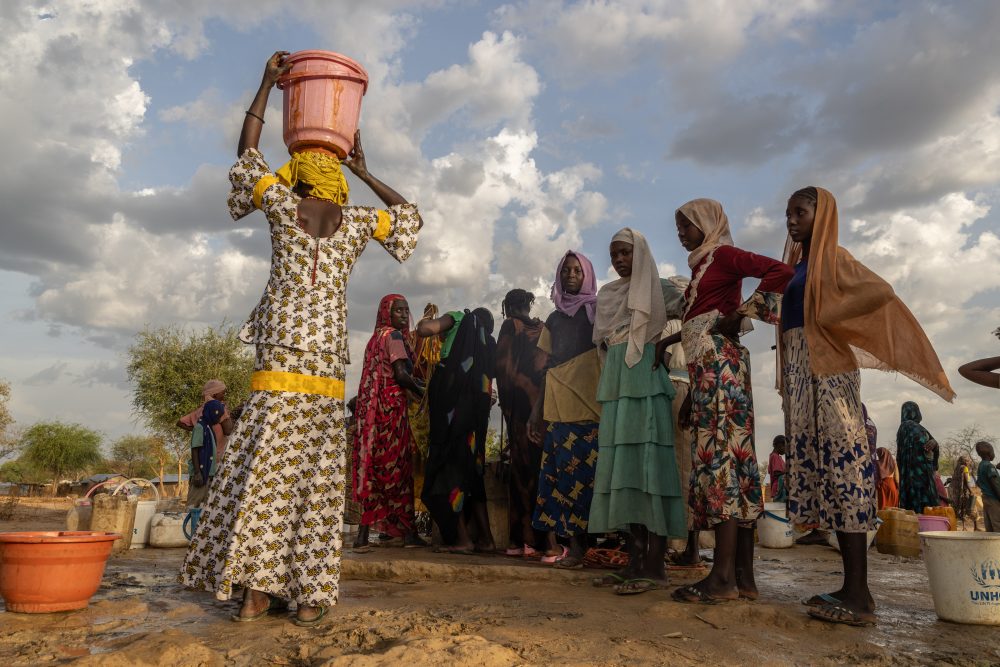

The United Nations refugee agency announced that worldwide forced displacement decreased in 2025 for the first time in ten years, though officials emphasized that the 118 million people who had to abandon their homes or countries remains dangerously elevated.
The agency released its annual Global Trends Report on Thursday, revealing key statistics about refugees and displaced populations worldwide:
At the close of 2025, 117.8 million individuals were forcibly displaced due to conflict, violence, or persecution. This figure encompasses refugees, asylum seekers, internally displaced persons, and other groups requiring international protection. According to Tarek Abou Chabake, the UN agency’s chief statistician, the decrease resulted from both more people returning home and many refugees obtaining citizenship in their host nations, among other factors. The UN High Commissioner for Refugees emphasized that the global displacement numbers, primarily driven by conflict, remain unacceptably elevated.
Children comprised a significant portion of the 41.6 million refugees recorded last year. While Colombia, Germany, and Turkey each sheltered over 2 million refugees, most refugees reside in low- to middle-income nations. Despite a 3% decrease from the prior year, 5.4 million individuals crossed international boundaries seeking safety in 2025.
Seven in ten refugees have remained in exile for five years or longer, frequently confined to expansive camps in impoverished countries. “Humanitarian assistance has saved lives,” stated High Commissioner for Refugees Barham Salih, but added that “it was never intended to sustain generations of people indefinitely.” The organization seeks to reduce by half the number of refugees in prolonged displacement who rely on humanitarian aid by 2035.
The figure represents internally displaced individuals. Sudan’s continuing conflict generated the world’s largest displacement, with 9.1 million people forced from their homes. Colombia, Syria, Yemen, and Afghanistan also contain substantial displaced populations.
Forecasts for 2026 appeared equally concerning. Following the Iran war’s outbreak in February, 3.2 million people were displaced within Iran by March, and by mid-May, 1 million were displaced inside Lebanon. “This is truly unacceptable and we must make sure this doesn’t become a new normal,” Salih stated.
Three nations — Syria, Afghanistan, and Sudan — accounted for 90% of the 4.4 million refugees who returned home in 2025. This represented the second-highest total since the UNHCR started maintaining records sixty years ago. Additionally, 10.3 million internally displaced individuals returned to their original areas last year. However, Salih cautioned that many returnees faced pressure and lacked basic infrastructure and conditions for dignified living. “Voluntary returns to post-conflict Syria and returns under pressure to Afghanistan are not the same thing,” Salih explained.
This represents the count of stateless individuals, with Myanmar’s Rohingya population forming the largest group. Most stateless people reside in Bangladesh, Ivory Coast, Thailand, and Myanmar. Only 46,000 obtained citizenship in 2025.
The number of resettled refugees dropped dramatically from 188,000 in 2024. Salih noted this represents only a small fraction of those requiring assistance and urged governments to expand legal relocation pathways for refugees. “Every dangerous sea crossing and every death in the desert represents a failure of the international community,” Salih said. “The human cost of the failure is measured not with statistics but with lives.”