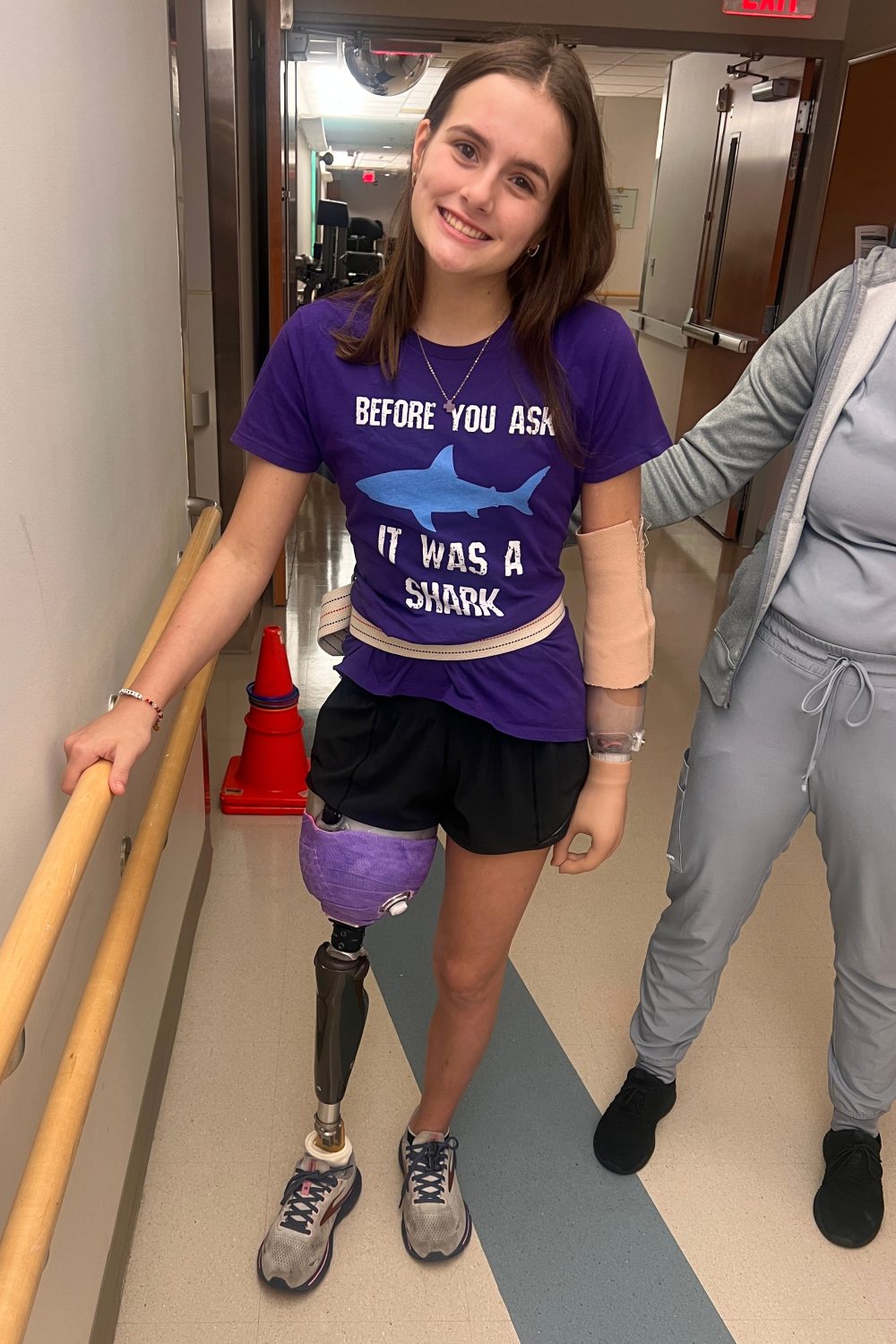

When Lulu Gribbin was 15 years old, she survived a terrifying shark attack off the Florida coast — but not without a devastating cost. The Alabama teen lost her left hand and part of her right leg in the incident.
What made the ordeal even harder to accept was learning afterward that another woman had been bitten by a shark just 90 minutes before her attack, only 3 miles — about 4.8 kilometers — down the same beach. Gribbin says if she had known about that earlier bite, she never would have gone into the water.
That realization has now driven a change in federal law. President Donald Trump recently signed legislation known as “Lulu’s Law,” which directs the Federal Communications Commission to permit emergency alert messages to be sent to mobile phones when a shark attack occurs nearby. The law classifies a shark attack as an event that qualifies for an emergency alert, similar to how Amber Alerts notify the public when a child is abducted. Individual states will be responsible for putting the warning systems into practice. Gribbin’s home state of Alabama had already established such a system last year.
“It’s really just common-sense legislation. It says that whenever there has been a shark attack in a certain area where you are near, it will send an alert to your phone, exactly like how an Amber Alert system works when a child is abducted,” Gribbin said.
She added that she is optimistic about what the law can accomplish. “I definitely see this law working in the future and I’m really excited to hopefully save lives,” she said.
Gribbin was one of three people bitten by sharks on June 7, 2024, off the Florida Panhandle. She had been on a mother-daughter trip to the area and was diving for sand dollars with a friend when the situation turned dangerous.
“All of the sudden my best friend yelled, ‘Shark!’ and so we all started swimming for our lives,” Gribbin recalled. Remembering that sharks are drawn to frantic movement, she called out for everyone to stay calm. Being the closest to the animal, she was the one who was bitten.
“The shark bit off my hand first, and I raised my arm out of the water, and there was just flesh and bone there,” Gribbin described. The shark then grabbed hold of her leg. A nearby man punched the animal to drive it away, and strangers on the beach rushed to assist her. She was airlifted by helicopter to a hospital.
Doctors managed to save her life, though they were forced to amputate part of her right leg.
During her hospital recovery, Gribbin made a conscious choice to embrace a positive outlook. She struggled at first with the reality that her body and her life had been permanently changed.
“I would cry, and I would ask my mom, ‘Why is it happening to me?’ And on that day, we put a Bible verse on my bedside table that said, ‘With God, all things are possible.’ And then she told me that what you look like doesn’t define you, it’s who you are on the inside. And so, I think that stuck with me throughout my whole recovery the past two years. It doesn’t matter what I look like, as long as I’m spreading positivity and inspiring others to stay strong and to never give up,” she said.
Gribbin was fitted with prosthetic limbs, regained her ability to walk relatively quickly, returned to playing sports, and earned her driver’s license. She has also returned to the ocean, learned to surf, and even met professional surfer Bethany Hamilton, who herself lost an arm in a shark attack.
U.S. Sen. Katie Britt, the Alabama Republican who championed the legislation in Congress, credited Gribbin’s determination for making the law a reality. “Because of her strength, lives will be changed. We should all be inspired by her,” Britt said, noting that the law came to be because of the teenager’s “courage, perseverance, and advocacy to protect future beachgoers.”
While sharks are a common presence in U.S. coastal waters, actual bites remain uncommon, according to Gavin Naylor, director of the Florida Museum of Natural History’s shark research program. He said there are between 60 and 80 documented unprovoked bites worldwide each year, and it is extremely unusual for multiple people to be bitten in the same area on the same day. A database known as the International Shark Attack File shows only a handful of such occurrences on record.
When clusters of bites do happen, Naylor said environmental conditions are usually to blame — such as sharks trailing schools of bait fish closer to shore, or murky water that causes a shark to confuse a person with a fish or seal.
In the area where Gribbin was attacked, Naylor noted that roughly 20 to 30 bull sharks are present about 1,312 feet — or 400 meters — offshore at any given time. Great white sharks have been spotted with increasing frequency in the colder waters off New England and Atlantic Canada, according to conservation groups. A smartphone application called Sharktivity also allows people to report shark sightings in real time.
Despite the attention those sightings can generate, Naylor emphasized that the threat is still quite low. “If sharks wanted to eat people, we’d have about 10,000 bites a day. The fact that we have so few is basically testament to the fact that the sharks are doing their level best to avoid people, not to target them,” he said.
Gribbin said her goal is simply to make sure people have access to information before they enter the water, rather than going in unaware of potential dangers nearby.
Braxton Rocha, who was bitten by a large tiger shark while spearfishing off the north shore of the Big Island of Hawaii in 2015, said he supports the idea of an alert system. He believes it is the kind of information that beachgoers — especially tourists — would want to have.
Rocha described the shark as enormous when he first spotted it. “Looked like a bus or submarine. She was the biggest thing I’d seen in the ocean at that time,” he said. As he headed toward shore and looked back, the shark was suddenly right in front of him. He tried to push it away, but the animal overpowered him and bit down on his leg. Rocha punched it in the nose, and the shark released him and swam off.
“Everything happened so fast. It was almost like being struck by lightning. I was still kind of out of it. I looked down and see giant clouds of blood just bursting out of my leg,” Rocha said.
It took nearly 100 staples to close the wound on his leg. Even so, the encounter did not shake his love of the ocean. “I’ve always loved sharks,” Rocha said.