
WASHINGTON (AP) — With midterm elections on the horizon, President Donald Trump and Republican allies are dusting off a familiar political weapon: labeling Democrats as communists.
Over the past week alone, Trump has issued stark warnings that the growing left wing of the Democratic Party is made up of communists who seek to “completely destroy the traditional American way of life” and even carry out assassinations. Vice President JD Vance has labeled the ideological drift toward communism as “something we haven’t seen in the U.S.,” while House Speaker Mike Johnson has condemned “radical candidates” who are “self-described, self-identifying Marxists.”
The Republican Party’s ideological offensive has been building since democratic socialist Zohran Mamdani captured the Democratic nomination for New York City mayor last year. It has since accelerated after democratic socialists claimed several New York City congressional primary victories last week. Adding fuel to the fire, democratic socialist Melat Kiros won a Denver congressional primary on Tuesday, signaling the movement may not be confined to Manhattan.
“The Democrats are making this easy for us,” said Rep. Richard Hudson, the North Carolina Republican who oversees the House GOP’s strategy and fundraising efforts. “They’re nominating extreme liberals, leftists who are out of touch even with mainstream Democrats.”
The messaging campaign comes as Republicans fight to preserve narrow congressional majorities heading into November. The attacks blur the distinction between democratic socialism — which typically centers on universal healthcare, higher taxes on the wealthy, and tighter corporate oversight — and communism, a system in which private ownership is largely abolished.
The strategy also carries risks. Growing frustration with unchecked capitalism, especially among younger voters dealing with rising costs and widening income inequality, could make the attacks less effective than Republicans hope.
Still, the approach offers Republicans a chance to steer the political conversation away from uncomfortable ground. The party has spent much of the year on defense following fallout from Trump’s decision to launch a war against Iran, a move that contributed to broad price increases.
Ralph Reed, a longtime conservative activist who welcomed Trump at a Faith and Freedom Coalition conference last week, acknowledged Republicans face tough headwinds this year. But he said the recent wave of democratic socialist primary wins hands Republicans a clear contrast — one between “common sense and crazy.”
The renewed offensive could also deepen divisions within the Democratic Party. While Democrats are broadly unified in their opposition to Trump, they remain split over the party’s future direction. This year’s primaries are shaping up as a battle between centrists eager to pull back from what they view as progressive overreach earlier in the decade and a left flank pushing for more dramatic change.
“A lot of this anger has been boiling under the surface,” said Joseph Geevarghese, executive director of Our Revolution, which was founded by U.S. Sen. Bernie Sanders, a Vermont independent who caucuses with Democrats. “It’s coming to the fore in this moment in a very powerful way.”
Not everyone in the party sees the socialist surge as a defining shift. Rep. Josh Gottheimer, a centrist New Jersey Democrat, dismissed the wins in Colorado and New York as “aberrations.”
“We’ve got to fight like hell to keep our party from being hijacked by socialists,” he said. “Most of them are bomb throwers, not problem solvers.”
Nevada Attorney General Aaron Ford, who defeated a more progressive opponent earlier this year in his Democratic bid for governor, argued that candidates like those who triumphed in New York don’t speak for the broader party. He said the Democratic Socialists of America “is not the face of our party.”
Rep. Susan DelBene, a Washington Democrat who chairs the House Democratic campaign committee, said in a statement that Republicans were “resorting to desperate attacks that aren’t actually about the pocketbook issues.”
Public opinion data suggests the communist line may not land as hard as Republicans hope. According to an August Gallup poll, about 54% of U.S. adults view capitalism favorably — a drop from 61% in 2010. Among Democrats, only 42% hold a positive view of capitalism, while 66% view socialism favorably. Younger Democrats in particular have grown less enthusiastic about capitalism, though older Democrats showed little meaningful shift.
“Young voters, who I would argue are driving a lot of the electoral energy that we’re seeing, came of age politically in a post-Soviet world,” Geevarghese said. “The attacks don’t land in the same way when Donald Trump was politically of age.”
Hudson conceded the communist messaging may not connect equally with all voters, especially younger ones, and said Republicans need to tailor their pitch district by district. “I’ve never run cookie-cutter campaigns where we just say one thing over and over everywhere,” he said.
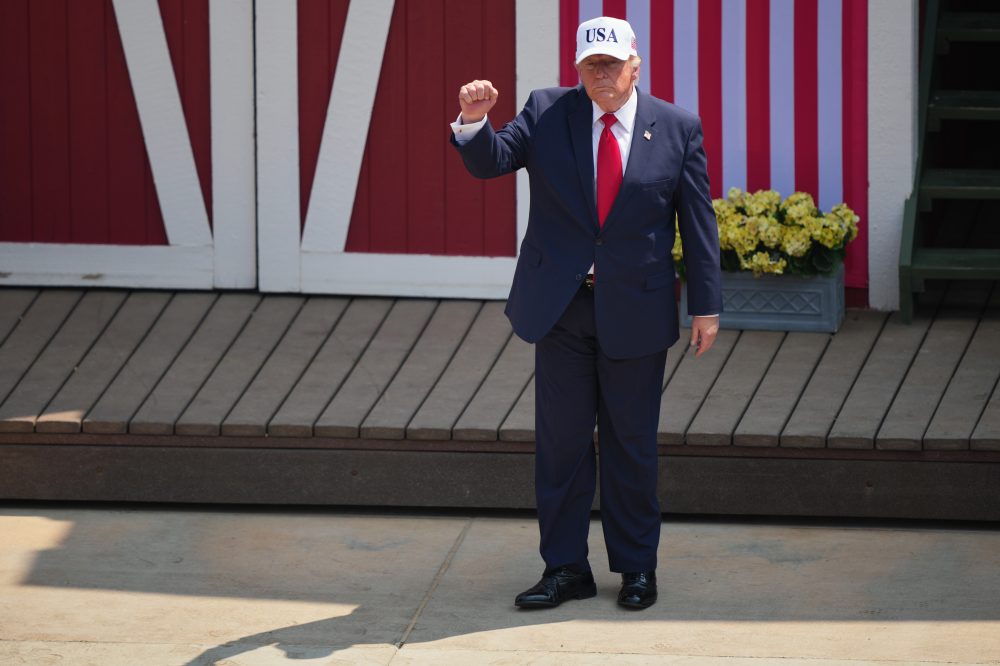
The issue was clearly still on Trump’s mind Wednesday when he visited the newly built Theodore Roosevelt Presidential Library in North Dakota, where he praised the former president as a “ferocious opponent of a thing called communism.”
“It’s the biggest threat to our country, including World War I, World War II, Pearl Harbor, September 11,” Trump said. “It’s a bigger threat, potentially a bigger threat than that, because it’s like a cancer that spreads, and you better stop it fast.”
Beverly Gage, a history professor at Yale University who has written about the rise and fall of Sen. Joe McCarthy, noted that earlier waves of anti-communism politics were fueled by a large, active Communist Party in the U.S. and the Soviet Union’s role as America’s chief adversary. She said Trump’s focus on the issue is particularly notable given his connections to Roy Cohn, a former Trump confidant who earlier worked alongside McCarthy.
“It’s not very many steps to get from McCarthy to Roy Cohn to Donald Trump,” she said.
California Gov. Gavin Newsom, a potential Democratic presidential candidate, dismissed Trump’s communist framing as “bunk.” He said the internal tensions playing out in the party are nothing new to him after decades in California politics.
“I governed in an environment where the DSA was otherwise known as progressives,” Newsom said. “This dialectic is so deeply familiar to me, and I don’t over read any of it.”