
WASHINGTON — The Trump administration is set to officially launch Trump Accounts on Saturday, timing the rollout to coincide with America’s 250th birthday. The goal of the program is to help build long-term financial security for children across the country.
Through the program, parents can open investment accounts for children born during President Trump’s second term and receive an automatic $1,000 contribution from the federal government. Accounts can also be opened for older children — provided they don’t turn 18 before the end of the current calendar year — though those children will not receive the $1,000 seed money.
Once deposited, that money — along with any additional contributions from employers, charitable organizations, or family members — is placed into the stock market through private investment firms. Children cannot access the funds until they reach age 18, and even then, withdrawals are limited to specific purposes such as paying for college tuition, starting a business, or making a down payment on a home.
The program has already attracted significant private donations beyond the government’s initial contribution. Michael Dell, founder of Dell Technologies, and his wife Susan pledged $6.25 billion to benefit children who don’t qualify for the government’s $1,000. On Wednesday, President Trump announced via Truth Social that Sanjay Mehrotra, CEO of Micron Technology, would contribute $250 million to the effort.
Trump wrote that the donation “will help jumpstart the American Dream for these fabulous children as we celebrate America’s 250th Anniversary! This MASSIVE Investment will help MILLIONS of American children and families get a strong start in life, and give them REAL Financial Security.”
The launch is happening at a time when many Americans are feeling financial pressure. The Federal Reserve’s preferred measure of inflation climbed to a three-year high in May, driven in part by rising gas prices during the conflict with Iran. Food prices have also gone up since the start of the current administration. At the same time, some Americans are concerned about potential reductions to programs like Medicaid and the Supplemental Nutrition Assistance Program, known as SNAP — both of which were trimmed under the same legislation that established Trump Accounts.
Families can already sign up at trumpaccounts.gov. After a parent or guardian opens an account, the U.S. Treasury Department will deposit $1,000 for qualifying newborns. Private banks and brokerages will manage the funds, which must be invested in U.S. equity index funds that track the broader stock market and charge no more than 0.10% in annual fees.
Parents can contribute up to $2,500 each year using pretax income — similar to how retirement accounts work. Employers, relatives, friends, local governments, and charitable organizations can also add money. Annual contributions are capped at $5,000, though donations from governments and charities do not count toward that limit.
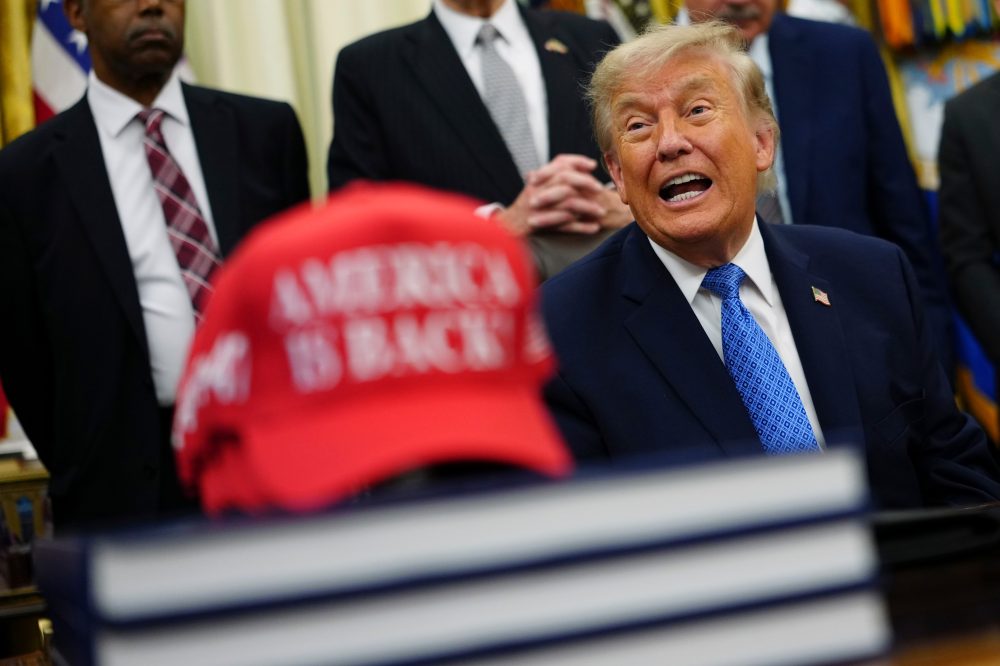
“We’re doing something much better than giving the next generation a handout,” Trump said. “We’re giving them ownership of America’s future.”
To be eligible for the $1,000 from the government, a child must be a U.S. citizen, have a Social Security number, and be born between January 1, 2025, and December 31, 2028. Any parent can open an account for a qualifying child, regardless of the parent’s immigration status.
It’s worth noting that children cannot touch the money until they turn 18, except in rare situations, meaning the funds cannot help cover immediate household expenses. Withdrawals from the accounts will also be subject to taxes.
Some children who are too old to receive the $1,000 government contribution may still benefit from private donations. The Dells’ $6.25 billion pledge will provide $250 in seed money to some children age 10 or under whose parents live in ZIP codes with a median family income of $150,000 or less.
Hedge fund founder Ray Dalio and his wife Barbara pledged $75 million for children under age 10 in Connecticut, where Dalio lives. That funding would amount to $250 for roughly 300,000 children in qualifying areas.
In January, Trump announced that investor Brad Gerstner would donate $250 to Trump Accounts for every child under age 5 in Indiana.
Several major corporations — including Uber, Intel, IBM, Nvidia, and Steak ‘n Shake — have also announced plans to include Trump Account contributions as part of their employee benefits packages. The administration has been encouraging such corporate giving through what U.S. Treasury Secretary Scott Bessent refers to as the “50 State Challenge.”
Supporters of the program say it will introduce more Americans to the stock market and give children born into poverty a chance to build wealth. Backers also argue the accounts reinforce capitalism at a time when openly socialist political candidates are gaining popularity.
“The answer to more socialism is more capitalism,” investor Brad Gerstner said at a White House event in January. “This makes every child in America a capitalist from birth.”
According to the U.S. Securities and Exchange Commission, about 58% of American households owned stocks or bonds in 2022, though the wealthiest 1% held nearly half of all stock value that year.
Before Trump Accounts were created, California, Connecticut, and the District of Columbia had already been piloting similar so-called baby bond programs. Several other states, including Maryland, are weighing comparable efforts. However, those existing programs are targeted specifically at children growing up in poverty or foster care, as well as children who lost a parent to COVID-19 — and they are managed by state governments rather than private firms.
Critics of Trump Accounts argue the program does little to help children during their earliest and most financially vulnerable years. They also say the accounts don’t make up for cuts to programs like food assistance and Medicaid that benefit young children and their families — cuts that were included in the same legislation that created Trump Accounts.
Opponents also warn the program could widen the wealth gap. Families who can afford to make the maximum pretax contribution each year will see the greatest financial gains, while lower-income families who can’t set aside extra money will benefit the least. Based on a projected 7% annual return, the $1,000 in seed money alone would grow to roughly $3,570 over 18 years.