
LOS ANGELES (AP) — California is approaching the finish line on counting ballots from its June 2 primary election, a drawn-out process that stems largely from a series of reforms introduced over the years to make voting more accessible and increase participation.
However, state data and researchers who study voting behavior indicate those reforms have not produced any meaningful boost in turnout. Meanwhile, the state’s slow counting has drawn sharp criticism from President Donald Trump and become a focal point for those pushing baseless claims about election fraud.
Preliminary figures from the secretary of state’s office show turnout reached 40.8% in the June primary, with counties required to finish their counting by Thursday. While that figure was higher than the two previous primary elections, it fell short of participation levels seen in several primaries going back to 2000 — and was far below the 1970s, when primary turnout sometimes exceeded 70%.
According to the Center for Inclusive Democracy, a nonpartisan research organization, significant gaps in participation persist among younger voters and voters of color. The most reliable California voters continue to be older, white, wealthier homeowners.
Mindy Romero, director of the center, said the state has seen only modest progress from its election changes over the past decade or more.
“We haven’t seen significant jumps in turnout,” she said. “We still have very significant disparity in turnout with race and ethnicity. The numbers don’t lie.”
Over time, heavily Democratic California has introduced a range of measures aimed at increasing voter participation — but those changes have often come at a cost, adding to the time needed to tally ballots.
Every registered voter now receives a mail-in ballot, which can be accepted up to seven days after Election Day as long as it carries an Election Day postmark. Residents who missed the registration deadline or need to update their registration can also sign up on Election Day itself, with those ballots counted once their registration is confirmed.
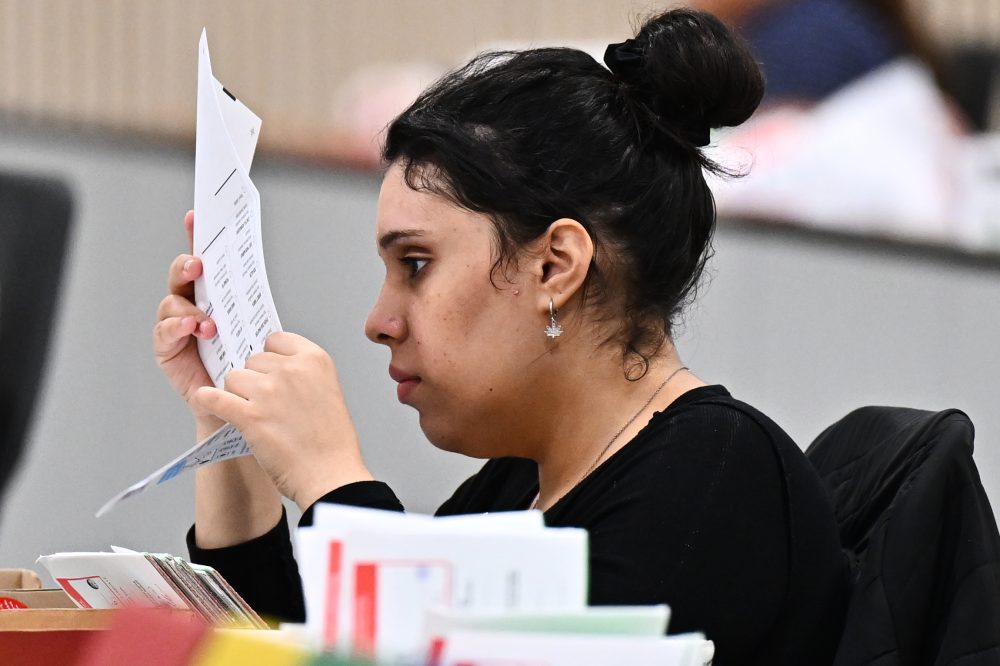
Each mail ballot envelope must have a signature that matches the one on file — a time-consuming process. If signatures don’t match, election officials must give voters the opportunity to come in and verify their identity before their ballot can be counted, adding further delays.
In that way, California’s unusually lengthy counting timeline is largely self-created. A report released last month by the nonpartisan California Voter Foundation found that the share of California ballots counted within two days of Election Day has generally dropped over time — from 81% in 2004 to 66% in 2024.
That shift closely mirrors the steady growth of mail voting in the state. In a special statewide election held last year, nearly nine out of every ten voters cast their ballots by mail.
States like Florida and Texas finish their vote counting quickly. California lags far behind the rest of the nation, with close races sometimes remaining undecided for weeks.
While election officials maintain their focus is on getting the count right, the extended process has given losing candidates an opening to imply wrongdoing. Following the June primary, Trump used California’s reputation as the nation’s slowest vote-counter to revisit his longstanding attacks on the state’s elections, while his administration’s Department of Justice launched an investigation into Los Angeles County’s election operations.
Even Democratic Gov. Gavin Newsom’s office has expressed frustration with the pace of counting. The state’s newly approved budget sets aside $29 million to help accelerate the process.
“We wish the votes were counted faster, too,” Newsom’s press office posted on the social platform X last month.
One of the most significant reforms came in 2016 with the passage of what was known as the Voter’s Choice Act. The law was designed to make voting more convenient and increase participation, particularly among younger voters of color.
It set California on a path toward universal vote-by-mail and, in some counties, replaced traditional neighborhood polling places with community voting centers and ballot drop boxes — giving voters more flexibility in when and where they cast their ballots.
The law does not appear to have achieved what it set out to do.
A comparison of elections two decades apart tells the story clearly: Turnout in California’s 2024 presidential election was 71%, five percentage points lower than in the 2004 presidential race. The 2022 midterm turnout was 51%, identical to the midterm rate 20 years earlier.
A 2025 study by the nonpartisan Public Policy Institute of California concluded that “turnout did not consistently improve or worsen for any racial or ethnic group.”
“The effects of the (act) have generally fallen short of the reform’s original goal of a larger and more representative electorate,” the study stated.
Separate 2025 research from the same institute found that white residents make up 36% of California’s adult population but account for 50% of likely voters. Latinos represent 38% of adults but only 29% of likely voters. Black residents make up 5% of adults and 4% of likely voters.
“You can’t definitely, clearly say the (act) had an overall, positive impact on turnout,” said Romero, adding that more research is still needed.
A growing consensus is emerging that more must be done to reach and energize infrequent voters — many of them people of color who are often ignored by political campaigns.
U.S. Sen. Alex Padilla, a Democrat who served as the state’s top elections official when the Voter’s Choice Act was signed into law by Democratic Gov. Jerry Brown, said in a statement that while California leads on voting access, “candidates and political parties must do more to motivate voters to get out and vote.”
Kim Alexander, president of the California Voter Foundation, said part of California’s challenge is simply the enormous scale of its electorate. The state has more than 23 million registered voters — more than any other state — a number that has grown steadily over two decades even as turnout has not kept pace.
The state has made real progress in registering voters — nearly 85% of eligible residents are now registered, up from 70% two decades ago. But that also means more ballots to count, adding to the challenge of delivering timely results. California has roughly 7.5 million more registered voters than it did in 2006.
Alexander noted that a voter’s decision to actually submit a ballot involves many factors. Primary elections are often seen as optional, with the general election still months away. She also pointed to California’s notoriously long and complicated ballots — packed with dozens of races and ballot measures — as a potential deterrent that can overwhelm some voters.
Despite all the reforms California has enacted, experts say the method of voting may matter far less than the reasons people choose to vote in the first place.
“The public’s level of trust in government and institutions, who and what’s on the ballot and how well-financed their get-out-the-vote campaigns are, have a much greater impact on voter participation than the election model used,” said Bob Page, Orange County’s registrar of voters.