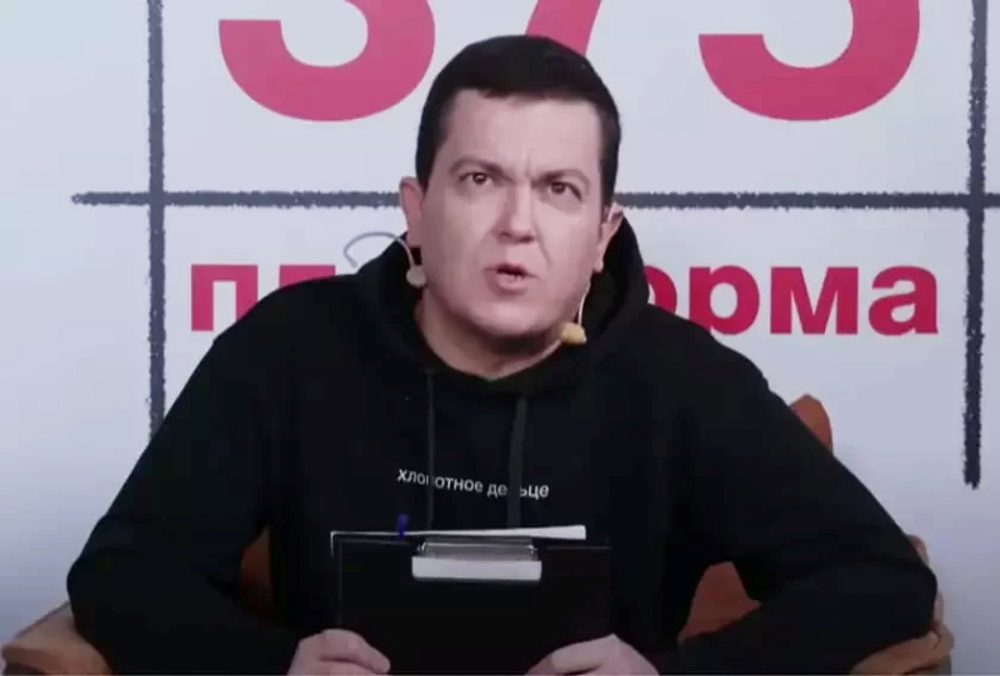

Reporting from Tallinn, Estonia — A court in Belarus has found journalist Kiryl Pazniak guilty and handed him a three-and-a-half-year prison sentence, the latest move in an ongoing campaign against freedom of the press in that country, according to the Belarusian Association of Journalists, which announced the verdict Thursday.
Pazniak, 49, was well known for hosting a widely followed political program on YouTube. He was convicted on charges of discrediting Belarus and helping to form an extremist organization — charges that human rights observers say are routinely used by Belarusian authorities to silence critics. In addition to the prison term, Pazniak was ordered to pay a fine amounting to approximately $8,500.
He was taken into custody in September 2025. His former wife, Elena, has said that Pazniak became gravely ill while incarcerated, contracting both pneumonia and COVID-19, and that he was transferred to a prison hospital in serious condition. Human rights defenders have classified him as a political prisoner.
Belarus is governed by authoritarian president Alexander Lukashenko, who has ruled the nation of 9.5 million people with an iron grip for more than three decades. Western countries have repeatedly imposed sanctions on Belarus — both because of its human rights abuses and because Lukashenko allowed Russia to use Belarusian territory when Moscow launched its full-scale invasion of Ukraine on February 24, 2022.
Lukashenko’s hold on power was tested following a disputed 2020 presidential election, when hundreds of thousands of people flooded the streets to protest what they believed was a rigged vote. Authorities responded with a sweeping crackdown, detaining tens of thousands of people — many of whom were beaten by police. Key opposition leaders either fled the country or were thrown in prison.
Since U.S. President Donald Trump returned to the White House in January 2025, Lukashenko has freed hundreds of political prisoners under American-brokered agreements that resulted in the easing of some U.S. sanctions, as part of the isolated leader’s push to rebuild relationships with Western nations.
Despite those releases, human rights organizations say the Belarusian government has not stopped cracking down on dissent. According to the Viasna human rights center, Belarus still holds 863 political prisoners.
Andrei Bastunets, who leads the Belarusian Association of Journalists, condemned the conviction in strong terms. “Pazniak nearly died behind bars, but was convicted and is forced to continue suffering simply for fulfilling his professional duty,” he said. “Repressions against journalists in Belarus are not abating, and the situation with freedom of speech remains the worst in Europe.”
The Belarusian Association of Journalists says a total of 21 journalists are currently imprisoned in Belarus.
Separately, the Committee to Protect Journalists reported this week that six Belarusian media organizations operating in exile have been repeatedly hit with DDoS attacks — coordinated efforts to flood their websites with traffic and knock them offline.
“While it can be difficult to pinpoint those responsible for DDoS attacks, editors and journalists at the outlets targeted in the recent wave told CPJ they believed Belarusian authorities might have sought to squash reporting on particular political topics, including events linked to Belarus’ exiled opposition,” the Committee to Protect Journalists said in a statement published online.