
Former CIA Director John Brennan took legal action against the Trump administration Wednesday, filing a lawsuit that demands a court order compelling officials to preserve records tied to investigations he says are going after him for what he calls “phantom criminal conduct.”
According to the lawsuit, those records would help reveal why government officials are investigating Brennan and would serve as the foundation for any future legal defense aimed at getting a potential indictment thrown out on the grounds that the prosecution is being pursued out of spite.
Brennan’s attorneys argued that such a defense would be backed by more than 100 statements — both spoken and written — that President Donald Trump has made since 2017 attacking Brennan, as well as the president’s reported directives to his Justice Department to launch investigations of Brennan “without regard to factual or legal justification.”
The lawsuit further warns that if no court order is issued, those records face the real possibility of being lost or intentionally erased.
In other news from Washington, Trump’s most recent mandatory financial disclosure report revealed he brought in roughly $1.2 billion last year from various cryptocurrency holdings — a figure that dwarfs the income from the real estate empire that made him famous. The more than 900-page report showed the bulk of that crypto wealth was accumulated in just over a year, raising questions about whether the president is financially benefiting from his position in office.
The report also showed Trump collected tens of millions of dollars from new property holdings in foreign nations and from lawsuits against media companies. He also pulled in millions by licensing his name to products including Bibles, guitars, and watches — with watches alone generating $4.7 million.
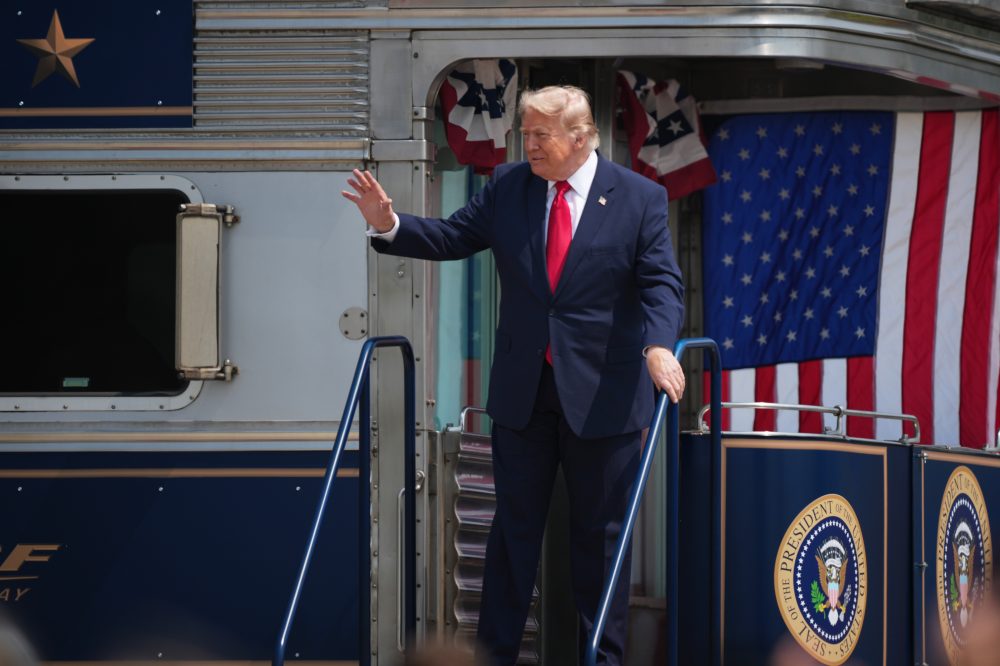
Meanwhile, Trump traveled to North Dakota on Wednesday to visit the newly completed Theodore Roosevelt Presidential Library, a sprawling 96,000-square-foot facility dedicated to the life of America’s 26th president. The library sits in the rugged landscape where Roosevelt developed his well-known conservation values during the 1880s.
During a tour of the facility and a speech that followed, Trump praised Roosevelt and drew comparisons between himself and the former president, describing Roosevelt as the embodiment of the American spirit and applauding his toughness both as a leader and outdoorsman.
“He had a freakin’ wild life,” Trump told the crowd gathered at a Western-themed amphitheater. “He didn’t want to be quiet. He wanted to be great.”
The library’s official opening is scheduled for Saturday, timed to coincide with July 4th festivities marking the 250th anniversary of the signing of the Declaration of Independence.
On the southern border, the Trump administration is rapidly constructing what it has branded a “smart wall” — a combination of 30-foot steel fencing paired with advanced surveillance tools including sensors, cameras, and monitoring towers. The effort follows a significant infusion of funding from Congress.
The project has drawn criticism given that border crossings are currently at some of their lowest levels in decades. Opponents argue the U.S. is effectively militarizing the border region and that the technology is having a harmful effect on nearby communities.
“We are seeing a massive expansion of surveillance and surveillance technology across the borderlands,” said Ricky Garza, border policy counsel at the Southern Border Communities Coalition. “The wall in all its forms is harmful to communities.”
Federal officials have defended the approach, saying the technology works alongside the physical barrier and allows Border Patrol agents to focus on other duties. “It’s a smart wall. It’s not just a barrier,” Customs and Border Protection Commissioner Rodney Scott said during recent congressional testimony.