
Secretaries and administrative assistants were already watching their profession shrink before artificial intelligence entered the picture. Now, tools like ChatGPT and Claude are capable of handling parts of their daily workload with minimal effort — raising fresh questions about the future of the role.
Employment forecast data paints a tough picture for this largely female profession, which researchers say may face greater risk from AI-driven job losses than many other fields. Even so, a growing number of admins are not sitting on the sidelines — they are actively embracing the technology and using it to their advantage.
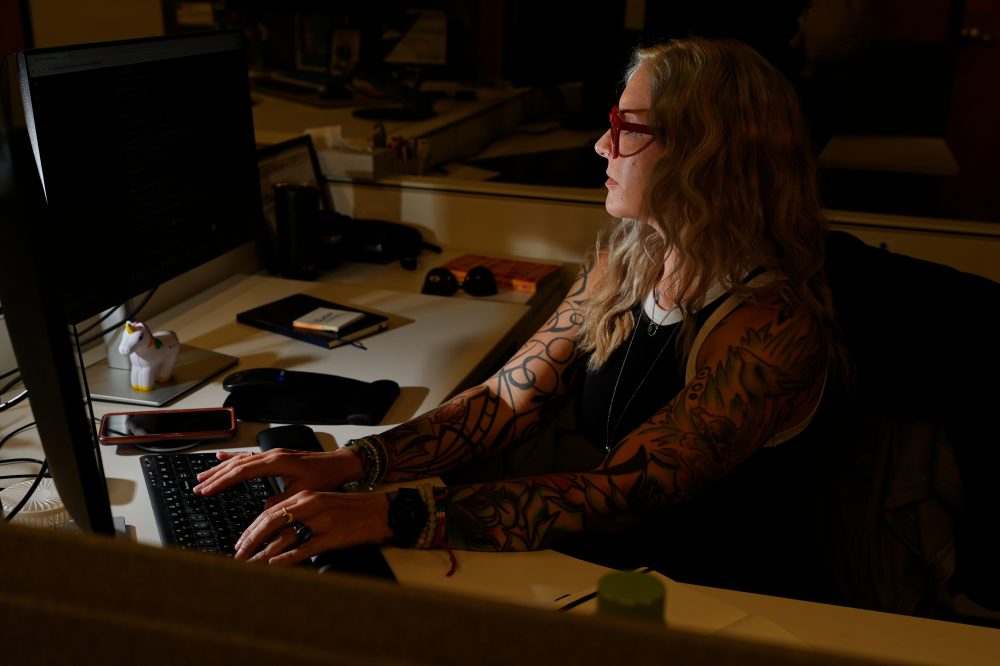
Deanna Danger, 43, has held administrative roles since 2003 and sees constant adaptation as central to the job. For her, AI is simply the latest shift to navigate.
“All you do is have to evolve,” she says.
Danger began incorporating AI into her professional life in 2022, learning the tools through trial and error alongside fellow admins. These days, she lets Copilot and ChatGPT handle meeting notes entirely, freeing her to be an active participant rather than a transcriptionist. As executive assistant to the chief information officer at Vanderbilt University, she says the impact has been dramatic. “Honestly, what used to take me hours I’m now done with in under five minutes,” she says.
The broader picture for the profession is sobering. Around 3.5 million people worked as secretaries or administrative assistants in 2004 — nearly 97% of them women, according to Current Population Survey figures. By 2024, that number had dropped to 2.1 million, even as the overall workforce expanded during the same stretch.
Economists at the U.S. Bureau of Labor Statistics project that decline will continue. The lone bright spot is medical secretaries and administrative assistants, a category expected to grow 4% by 2034 due to expansion in the healthcare sector.
“The overall story in office and admin occupations from the projection standpoint for the last several cycles has been one of productivity-enhancing technologies, limiting demand for employment,” said Emily Rolen, lead economist for the division of employment projections at the BLS. She noted that advances like word processing, speech-to-text tools, and scheduling apps have steadily reshaped the role over time.
A January report from the Brookings Institution found that clerical and administrative workers — about 6 million people, roughly 86% of them women — may be especially exposed to AI-related job displacement. The report cited factors including limited savings, older age, few local job alternatives, and narrower skill sets as reasons this group may struggle to adapt.
The numbers back that up: 34% of secretaries and administrative assistants are 55 or older, compared to 23% of the broader workforce. Median pay in the field sits at $47,460, below the national median of $49,500, and many entry-level positions require only a high school diploma.
Still, the Brookings report acknowledged that raw labor statistics cannot measure an individual’s ability to navigate change. Danger herself insists that admins “are way more capable than people think.”
She co-hosts a twice-monthly virtual coffee chat for peers through the American Society of Administrative Professionals, a group that says it serves around 132,000 members. At a recent May session, participants shared how they are putting AI to work — creating flyers, researching restaurant options for executive events, drafting social media captions, writing standard operating procedures, and more.
The mood was largely upbeat, though some attendees raised concerns about data security and the absence of AI regulation. Others stressed that the emotional intelligence and relationship-building skills that define a great admin are things AI simply cannot replicate.
Fiona Young, founder of Carve, a business that trains executive assistants on AI, says demand for her services has seen “a massive shift” since 2023. A former executive assistant herself, Young says she has delivered AI training to administrative professionals at major companies including Google, Amazon, Uber, Salesforce, and LinkedIn. In her experience, employers want staff who are genuinely weaving AI into their daily work — “not just loosely understanding it, but genuinely using it as an integral part of how people are working every day.”
Oana Manolache takes an even blunter position. The founder and CEO of Sequel.io, a platform that lets companies host webinars on their own websites, declared in a LinkedIn post last year: “I will fire anyone who doesn’t use AI.”
Even so, Manolache says AI could never replace her executive assistant, Stephanie Martinez. In Manolache’s view, Martinez uses AI to offload tasks like note-taking and meeting preparation so she can focus on the human side of the job — building team connections, exercising judgment, and managing relationships with stakeholders.
“It doesn’t replace what an executive assistant does now as the role has evolved,” Manolache says, adding that AI might replace the “traditional” assistant but not the modern one.
Martinez works remotely from El Salvador through Viva Talent, a service that trains and connects assistants from Latin and South America with primarily U.S.-based technology companies — itself a sign of how the role continues to evolve.
“The people who truly want to succeed in this role have a massive opportunity,” Manolache says. “This person has access to information across the entire organization.”
As one example, when Manolache’s company wanted to generate more customer reviews on a software review platform, Martinez — who handles most invoices and billing — used AI to comb through customer communications, identify strong candidates for outreach, and draft the emails. Without AI, Manolache says, “it would have taken her so long to do this,” and it also gave Martinez the space to “think creatively.”
That freedom to experiment with AI strategically matters just as much as formal training, says Melissa Peoples, an executive assistant coach and former C-suite executive assistant based in Austin, Texas. Many admins are eager to adopt AI but simply lack the time and space to do so, she says.
Gender dynamics add another layer of complexity in a field dominated by women who are often paired with male leaders, Peoples notes.
“You see those that are early adopters, and are crushing it, and are partnered with really empowering executives, and can do all of these things,” she says. “And then you see the other side of this, where literally assistants are being told, ‘You’re not smart enough to be in the room. Just bring me my coffee.’”
With the right AI training, Peoples says admins can “find their voice” and “have higher impact so they are protected against what is going to happen as agentic AI becomes more commonplace and more easily accessible.”