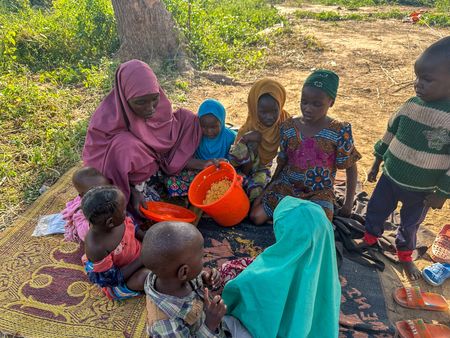

More than 17 million people living across nine conflict-torn states in northern Nigeria are now struggling with severe hunger, the United Nations food agency warned on Thursday, saying the situation has deteriorated to its worst point in nearly ten years.
According to the World Food Programme (WFP), the most recent food security analysis revealed that the number of people experiencing crisis-level, emergency-level, or catastrophic hunger has climbed by nearly two million compared to earlier projections.
The alarming figures highlight the growing humanitarian toll in Africa’s most populous nation, where Islamist insurgents operating in the northeast and armed criminal groups in parts of the north have uprooted entire communities, prevented farmers from working their land, and blocked humanitarian organizations from delivering aid.
The situation is being made worse by the timing — the current lean season is a period when families typically run out of food stores before the next harvest comes in.
WFP identified Borno state, the center of a long-standing Islamist insurgency, as one of the hardest-hit areas, with more than 3 million residents facing acute food insecurity. Of those, more than 750,000 are enduring severe hunger conditions.
WFP regional director for West and Central Africa Kinday Samba stressed the broader dangers of the food crisis, saying: “When people lose access to food, the risks of displacement, exploitation and instability increase.” Samba also noted that violence is expanding into new areas, pushing more people off their farmland.
The agency disclosed that it is currently able to assist fewer than half of the 1.3 million people it helped last year in three northeastern states, where 6.2 million residents are now food insecure.
To sustain food assistance, nutrition programs, and logistics operations across northern Nigeria over the next six months, WFP said it requires $89 million in funding.