
PHOENIX (AP) — For many years, little more than barbed wire stood between the United States and Mexico along much of their shared border.
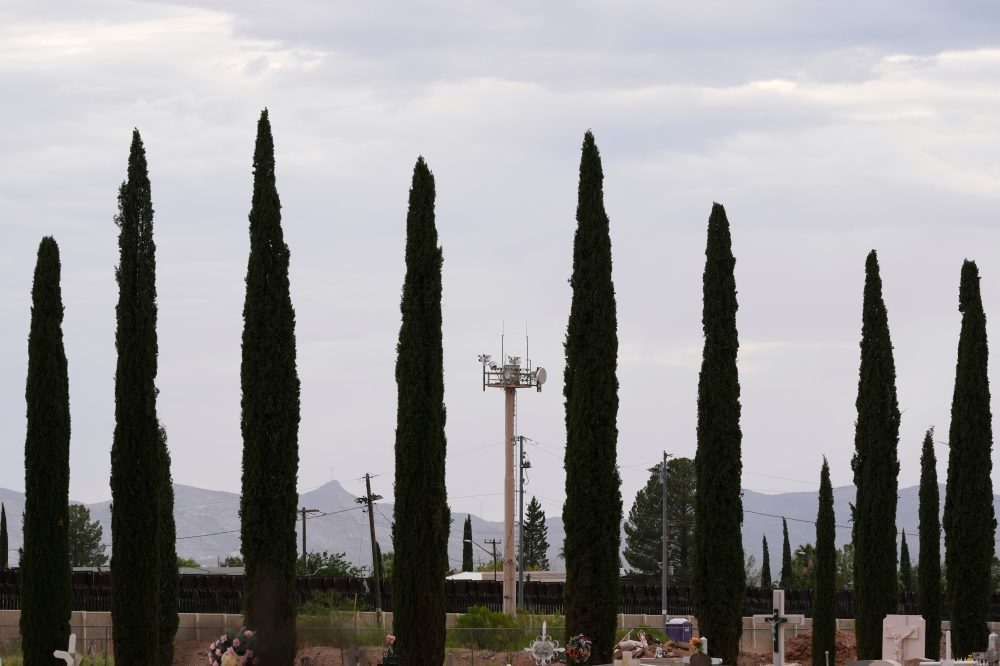
That landscape is changing dramatically. Armed with a massive congressional funding boost, President Donald Trump’s administration is rapidly constructing what it calls a “smart wall” — a combination of 30-foot-tall steel fencing paired with an extensive array of high-tech tools including sensors, cameras, and surveillance towers that give Border Patrol broad visibility over the surrounding terrain.
The project is drawing significant criticism given that the tens of billions of dollars being spent come at a time when illegal border crossings have dropped to their lowest levels in decades. Opponents argue the effort amounts to a militarization of the border, with advanced surveillance systems increasingly affecting everyday life for people living in nearby communities.
“We are seeing a massive expansion of surveillance and surveillance technology across the borderlands,” said Ricky Garza, border policy counsel at the Southern Border Communities Coalition, an advocacy group. “The wall in all its forms is harmful to communities.”
Federal officials counter that the technology works hand-in-hand with the physical barrier, allowing agents to be deployed more effectively rather than stationed in front of monitors.
“It’s a smart wall. It’s not just a barrier,” Customs and Border Protection Commissioner Rodney Scott said during recent congressional testimony. “It maximizes the use of our most valuable resource, which is our agents.”
Completing the border wall has been a central goal for Trump since his first presidential campaign. During the administration of President Joe Biden, border crossings surged into the thousands daily, becoming a major political flashpoint. The numbers began declining shortly before Trump returned to the White House and have since slowed considerably, with his aggressive immigration enforcement acting as a deterrent for many would-be migrants.
With $46 billion now available following the congressional funding package for immigration enforcement, Customs and Border Protection is signing tens of billions of dollars in contracts to advance the president’s signature initiative.
Homeland Security Secretary Markwayne Mullin recently indicated that an initial phase of the wall would be completed “this time next year.” Commissioner Scott said his agency is currently installing 6 miles of fencing per week.
Hundreds of miles of wall were already standing before Trump’s return to office. As of mid-June 2026, CBP has added another 74 miles and is aiming to build hundreds more. Approximately 535 miles of the roughly 2,000-mile border will not receive a physical wall, as the rugged natural landscape already acts as a deterrent. Ground sensors and surveillance towers will cover those stretches instead.
CBP is also revisiting previously built sections of the wall to upgrade them with additional technology, lighting, and roads. Along the lengthy river stretches in Texas that form the border with Mexico, the agency is placing cylinder-shaped buoys — ranging from 12 to 15 feet in length — in the water to prevent migrants or smugglers from crossing.
Technology is taking on an ever-larger role in the administration’s border enforcement strategy. Critics warn this represents a concerning shift, arguing that surveillance tools can drive migrants toward more hazardous routes to avoid detection.
Garza also cautioned that the surveillance systems infringe on the privacy of border-area residents, noting that ground sensors meant to detect smuggler or migrant movement have been found placed on private property without the landowners’ knowledge or permission.
Nayda Alvarez, who owns land along the Rio Grande roughly 125 miles inland from the Gulf of Mexico with her relatives, said she has discovered cameras on her family’s property. Just last week, she spotted a surveillance tower about a quarter of a mile from her home.
“Are we expecting a war or something?” she said. “It doesn’t make me feel safer.”
Dave Maass, director of investigations for the Electronic Frontier Foundation — a nonprofit focused on civil liberties in the digital age — said the technology has turned the border region into “a hostile environment” for both local residents and migrants attempting to cross.
The foundation has released a guide to help border-area residents identify the various types of surveillance towers being used. These range from fixed structures equipped with video, infrared, and radar capabilities — with a range of about 8 miles — to portable systems mounted on trucks that can be relocated to different sections of the border. Some towers also feature cameras and spotlights.
Increasingly, these towers operate autonomously, using artificial intelligence to scan their surroundings, assess what they detect, and alert Border Patrol agents to suspicious activity. While supporters say this keeps agents in the field rather than behind screens, experts have raised concerns about AI-driven decision-making and its potential for bias or errors.
A major spending bill passed by Congress last summer requires CBP to purchase only autonomous towers going forward, and the agency is in the process of deploying an additional 95 of them.
Beneath the ground, buried fiber-optic cables can sense movement and feed that data to AI systems for analysis.
“We follow the contour of the land. We go through trees. We go down into the river banks. We can go absolutely everywhere,” said Magnus McEwen-King, CEO of Sintela, a company with a contract to install the cables for CBP. He made the remarks at a recent border security expo in Phoenix where some of the technology was showcased.
CBP also continues to rely on ground sensors and trail cameras to identify smuggling routes.
The nonpartisan watchdog group Taxpayers for Common Sense has raised questions about the enormous sums being spent and whether the public is receiving adequate value in return. The group pointed to a cautionary precedent: in 2011, under President Barack Obama, Homeland Security Secretary Janet Napolitano shut down a “virtual wall” project involving integrated radar, sensors, and cameras after it ran over budget, experienced technical failures, and fell behind schedule.
Josh Sewell, director of research and policy at Taxpayers for Common Sense, said his organization wants to see more thorough evaluation of the technologies being deployed to avoid repeating past mistakes. He also criticized the Trump administration for what he described as insufficient oversight of spending — a charge CBP has disputed, saying it has oversight mechanisms in place.
In the Big Bend area of southern Texas, plans to build a full 30-foot bollard wall generated strong bipartisan opposition, particularly in environmentally sensitive areas running through a state park, a national park, and a wildlife area. CBP has since announced it will not build that type of wall in those locations, opting instead for patrol roads, vehicle barriers, and detection technology.
Clara Benson, one of the founders of the No Big Bend Wall coalition, expressed concern that bright lights intended to illuminate the border could harm the area’s famously dark skies, which draw visitors from around the country for stargazing. Even without the towering steel wall, she said, anxiety remains high.
“There’s still a lot of fear and dread that the plan is still going to be quite damaging,” she said.