
A Canadian court has ordered a near-total blackout on media coverage surrounding an alleged plot by an anti-government militia to seize land near Quebec City, and the move is drawing sharp criticism from press-freedom advocates and legal experts who say citizens deserve to know about threats to their safety.
The Quebec Superior Court issued the publication ban in February, according to court documents reviewed by Reuters. The order came just days after a lower court had released more than a thousand pages of police investigation records related to four men — including two active-duty soldiers — who were arrested last summer. Three of the men face accusations of taking “concrete actions to facilitate terrorist activity,” while the fourth faces weapons charges.
Legal experts say publication bans are sometimes used to shield sensitive investigative details or protect vulnerable victims, but one expert described this particular ban as unusually sweeping.
“Rights, including freedom of the press, are not absolute. But restrictions need to be reasonable,” said Wayne MacKay, emeritus professor of law at Dalhousie University. “The broader the ban and the more sweeping it is, the harder it is to justify.”
The judge’s order offered no explanation for the decision, and a spokeswoman for the Quebec Superior Court said the court and its judges are not permitted to comment on rulings.
Reuters was unable to establish why the ban was put in place. The prosecution and two of the four defense attorneys involved in the cases told Reuters they had not sought to restrict public access to information about the proceedings.
James Turk, director of the Centre for Free Expression at Toronto Metropolitan University, said the court’s refusal to explain its reasoning makes it nearly impossible to evaluate whether the ban is appropriate or legally defensible.
“The problem in this case,” he said, “is that we can’t assess whether this ban is legitimate or not without knowing why it was imposed.”
Attorney Maxime Chevalier, who represents defendant Marc-Aurèle Chabot, said the court issued the ban “of its own volition.” Jean-Marc Fradette, the lawyer for defendant Matthew Forbes, said his team not only never requested the ban but had actually been pushing for more court documents to be made available without redactions. The other two defense attorneys did not respond to requests for comment.
Reuters has joined a coalition of media organizations challenging the publication ban at Quebec’s second-highest court. The news organization declined to make further comment. The coalition’s attorney, Marc-André Nadon, also declined to comment. A hearing on the coalition’s request to lift the ban is scheduled for September 23 at the Quebec Superior Court.
Peter Jacobsen, a lawyer with expertise in media, defamation, and constitutional law, warned that the ban puts public safety at risk by keeping citizens uninformed about a far-right militia group facing criminal charges.
“Keeping that information secret means Canadians won’t have a full understanding of how the far right is operating in the country,” he said.
The Royal Canadian Mounted Police announced last July that they had arrested and charged three men — Chabot, Simon Angers-Audet, and Raphaël Lagacé — with terrorism-related offenses connected to an alleged plan to take over land near Quebec City for militia purposes. Authorities alleged the group had stockpiled weapons and “took part in military-style training, as well as shooting, ambush, survival and navigation exercises.” Forbes was separately charged with weapons offenses.
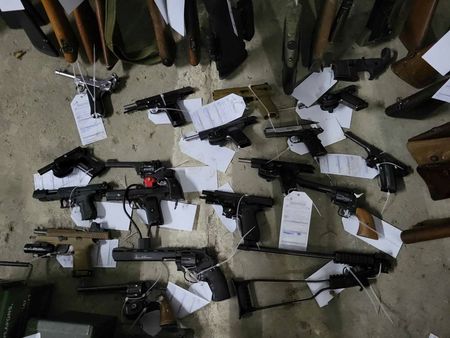
Police said searches carried out in January 2024 turned up a massive arsenal: 16 explosive devices, 83 firearms, roughly 11,000 rounds of ammunition, nearly 130 magazines, four pairs of night-vision goggles, and various military equipment.
Both Chabot and Forbes are members of the Canadian Armed Forces. Chabot is believed to be the first active-duty Canadian military member ever charged with terrorism offenses under the country’s criminal code.
Earlier police press releases and news coverage published before the publication ban took effect remain accessible online. After the charges were announced in July 2025, several Canadian news outlets filed for access to thousands of pages of police documents, which a lower Quebec City court released last August to those who requested them.
Following the release of a second batch of documents earlier this year, Quebec Superior Court Judge François Huot issued an order on February 2 — effective immediately — “prohibiting the media or anyone else from publishing in any form whatsoever, information regarding the facts of this case, regardless of whether or not such information has already been disclosed.”