Motorists traveling on Commerce Street will encounter lane restrictions today due to ongoing construction work.
The eastbound right lane is currently blocked between Farmington Road and Brown Street, with the closure expected to remain in effect until 4 PM today.
Drivers are advised to plan for potential delays and consider alternate routes if possible while crews complete their work in the area.
Motorists traveling on Route 13 northbound should expect lane restrictions due to ongoing construction work in the area.
The right shoulder is currently closed on S DuPont Boulevard (Route 13) in the northbound direction between Big Woods Road and Big Oak Road. The construction-related closure is set to continue until 6 PM today.
Drivers are advised to use caution when traveling through the work zone and allow extra time for their commute.
Motorists traveling on Walt Messick Road should plan for potential delays this afternoon as construction crews have shut down the right lane in the eastbound direction.
The lane closure affects the stretch of roadway at Vernon Road, also known as Route 14, specifically between Farmington Road and Whiteleysburg Road. Traffic restrictions will remain in place until 4 PM today.
Drivers are advised to allow extra travel time and exercise caution when passing through the construction zone.
The New York Knicks dominated Cleveland with a commanding 130-93 victory Monday night, completing a four-game sweep of the Eastern Conference finals and earning their first trip to the NBA Finals since 1999.
Karl Anthony-Towns led the charge with 19 points and 14 rebounds, while OG Anunoby contributed 17 points in the decisive win over the Cavaliers. Landry Shamet added 16 points coming off the bench, and both Mikal Bridges and Jalen Brunson chipped in 15 points each for New York, which has now won 11 straight games during their playoff run. Only three other teams have achieved such a streak in postseason play, with Golden State being the most recent in 2017 during their 15-game run to their second championship in three years.
Despite Donovan Mitchell’s 31-point effort for Cleveland, the Cavaliers were completely outmatched and suffered their first postseason sweep since falling to Golden State in the 2018 NBA finals.
In other tennis news from Paris, players and fans at the French Open are dealing with unusually hot conditions as temperatures have reached 33 degrees Celsius (91 degrees Fahrenheit) during the opening days of the clay-court tournament. The extreme heat has created faster playing conditions on the courts and sent spectators seeking relief at water fountains. Russian-born Australian player Daria Kasatkina noted the exceptional conditions, saying “I don’t remember the last time it was so hot at Roland Garros.”
The mental pressures of professional tennis were highlighted as the tournament continues, with recent racket-smashing incidents by players like Daniil Medvedev and Daniel Altmaier drawing attention to the sport’s psychological challenges. Former top-five player Andrey Rublev explained the unique pressure, saying “you are alone and they are watching you” and admitting he’s “one of those guys” who let emotions “take over me.”
In baseball, Houston Astros pitcher Tatsuya Imai combined with relievers Steven Okert and Alimber Santa to throw a no-hitter against the Texas Rangers in a 9-0 victory. This marked the first no-hitter in major league baseball since Shota Imanaga and two Chicago Cubs relievers accomplished the feat against Pittsburgh on September 4, 2024. The 23-year-old Santa made history by becoming the first pitcher to complete a no-hitter in his major league debut, throwing two perfect innings and striking out Brandon Nimmo to end the game.
In hockey action, Andrei Svechnikov scored at 14:06 of overtime to give the Carolina Hurricanes a 3-2 victory over the Montreal Canadiens, putting Carolina ahead 2-1 in their Eastern Conference Final series. Shayne Gostisbehere and Taylor Hall scored in regulation for the Hurricanes, while Frederik Andersen made 11 saves. Montreal got goals from Mike Matheson and Lane Hutson, with goaltender Jakub Dobes stopping 35 shots.
Knicks point guard Jalen Brunson was named Eastern Conference finals MVP, earning the Larry Bird Trophy after averaging 25.5 points and 7.8 assists during the sweep of Cleveland. The All-Star guard, who signed with New York as a free agent four years ago, has justified the team’s decision to build around him by leading them to their first Finals appearance in a quarter-century.
In legal news, a Dominican judge ruled that Tampa Bay Rays shortstop Wander Franco is criminally responsible for sexual and psychological abuse of a minor but will not serve a sentence. Judge José Antonio Núñez determined that Franco was a victim of extortion by the minor’s mother, who received a ten-year sentence for trafficking her daughter. Franco was arrested in January 2024 in connection with a relationship involving a 14-year-old girl, and full sentencing is scheduled for June 16.
Soccer news features Crystal Palace and Rayo Vallecano preparing for Wednesday’s Conference League final, with the winner earning a spot in the Europa League for the 2026-27 season. The match represents Palace’s chance to win their first European trophy in a competition they initially didn’t want to participate in after being demoted from the Europa League.
Finally, Inter Miami announced that Lionel Messi is dealing with a left hamstring issue described as “an overload associated with muscle fatigue.” The team confirmed Messi underwent testing Monday but did not provide a timeline for recovery, adding uncertainty as Argentina prepares to open training camp for this year’s tournament on June 1 in Kansas City.
ISTANBUL — Turkish authorities deployed water cannons Tuesday to disperse crowds attempting to attend a rally featuring the ousted head of Turkey’s primary opposition political organization.
A court directive issued Thursday stripped Ozgur Ozel and the central leadership team of the Republican People’s Party, known as CHP, from their positions in what many observers view as a decision driven by political considerations.
Ozel planned to speak to his supporters Tuesday in Izmir, a western Turkish municipality, but attendees found steel barricades and law enforcement officers blocking access to Cumhuriyet Square.
Broadcasting network Halk TV, which supports the opposition, documented numerous attendees, primarily middle-aged individuals, getting drenched by water cannons while attempting to access the square. Regional news outlets additionally reported authorities used pepper spray.
The governmental turmoil began last week after an Ankara appeals court reversed a 2023 party convention decision that selected Ozel to lead the CHP. The judicial ruling reinstated his former colleague, Kemal Kilicdaroglu, creating anger among party members.
The 51-year-old Ozel, who replaced the 77-year-old Kilicdaroglu following 13 years of largely unsuccessful resistance to President Recep Tayyip Erdogan, appealed Tuesday for Kilicdaroglu to conduct a new leadership election. “Don’t divide the party, don’t stop our march to power,” he stated. “Let’s ask the 2 million members (and) whoever they choose, let’s hold the congress immediately.”
Critics of the president regard the legal proceedings, which focused on voting irregularities during the convention, as another judicial assault on the CHP, during which numerous elected representatives and party participants have faced imprisonment.
After the court’s determination, Ozel and his allies fortified themselves within CHP headquarters in Ankara. Authorities raided the facility Sunday, using plastic pellets and pepper spray to violently conclude the standoff.
Ozel, who has promised to continue the fight in public spaces, announced upon reaching Izmir that he would “go wherever the people are waiting.” He subsequently appeared at Cumhuriyet Square before moving to an adjacent square where he addressed thousands of enthusiastic supporters.
The clash in Izmir — Turkey’s third-most populous city and historically a CHP fortress — occurred one day before the official Eid al-Adha celebration, though many citizens had also taken Monday and Tuesday as vacation days.
During a broadcast Eid address, Erdogan expressed hope the holiday would serve as “an occasion for hearts to soften, for those who are estranged to reconcile, for grievances to be resolved.”
Recent polling shows the CHP tied with the governing Justice and Development Party, known as AKP, and while the next election isn’t scheduled until 2028, many anticipate Erdogan will seek earlier voting.
Ozel inflicted significant damage on the AKP during 2024 municipal contests, reinforcing the opposition’s control over major cities it had captured five years prior, including Istanbul and Ankara.
Istanbul’s CHP mayor, Ekrem Imamoglu, has become the most probable opponent to Erdogan, who has governed Turkey since 2003, in the upcoming presidential contest. However, he has been incarcerated since March of last year while confronting multiple criminal charges that could result in decades of imprisonment.
Numerous analysts have stated the legal actions targeting the CHP — primarily focusing on corruption accusations — are designed to weaken the party. Government officials maintain that Turkey’s judicial system remains impartial and operates without political interference.
British petroleum company BP has dismissed its chairman following what the company described as significant concerns regarding “important governance standards, oversight and conduct.”
The removal was sudden and came as a surprise, given that Albert Manifold had only been named to the role last year.
On Tuesday, BP’s board immediately installed Ian Tyler as interim chair, effective right away.
The energy firm announced it would start searching for a permanent replacement.
Headquartered in London, BP ranks among the world’s five largest oil production and exploration corporations by both revenue and profit, earning it “supermajor” status.
The energy giant operates in approximately 60 nations worldwide.
Stock prices dropped 6% in pre-market trading on the New York Stock Exchange.
A leading French financial institution is reinforcing its digital security infrastructure as artificial intelligence technology creates new challenges for cybersecurity professionals, according to the bank’s top technology executive.
Marc Camus, chief information officer at the French bank, explained that financial institutions across Europe are worried about falling behind American banks in accessing cutting-edge AI-powered cybersecurity tools, which could create significant operational gaps.
The executive emphasized that the velocity and magnitude of AI systems’ ability to detect security weaknesses represents a major transformation for cybersecurity professionals, noting that the current challenge is fundamentally practical in nature.
“There is a lot of noise in the market on Mythos and the fact that Mythos is accessible or not accessible for some banks, particularly European banks,” Camus stated on Tuesday during a joint media briefing with French startup Mistral.
The Mythos model from Anthropic, introduced in April, was created to detect system vulnerabilities with extraordinary speed and scope, sparking concerns that such technology might enable broader cyber threats against banking institutions.
“The game changer is the speed at which we have to address vulnerabilities and the scale. There are lots of them discovered at once,” Camus explained.
“So we need to prepare ourselves for that and that’s something we are really working on very, very hard,” he continued.
Security professionals now must handle and resolve numerous vulnerabilities simultaneously.
The bank and Mistral announced they have broadened a collaboration that started in 2023, during the startup’s early development phase.
Corentin Petit, Mistral’s global head of solutions, indicated the company was concentrating on performance measures important to regulated sectors like banking.
“We will optimise on benchmarks that matter for our customers in the industry,” Petit commented regarding Mythos, noting additional information would be provided later.
The bank employs Mistral technology for internal systems and customer virtual assistants in France and Belgium, plus compliance operations at its Belgian Fortis division, according to Sophie Heller, chief transformation officer at the bank’s retail and consumer division.
Within the investment banking section, additional implementations assist with document processing, equity analysis and internal information access for thousands of employees, said Charles Holive, chief AI officer at the division.
Engineers and data specialists from Mistral work directly alongside bank teams to jointly develop and expand these initiatives.
The chief executive of JW Therapeutics stated Tuesday that China’s pharmaceutical sector remains unaffected by the government’s increased oversight of technology-related business deals.
International pharmaceutical companies are increasingly looking to China-developed experimental treatments as they work to reduce expenses before patent protections expire, with industry experts forecasting biotech licensing agreements could reach new highs this year.
However, Chinese authorities recently forced U.S. technology company Meta to reverse its acquisition of artificial intelligence company Manus, valued at more than $2 billion, as part of stricter reviews of American investments in Chinese companies working on advanced technologies. This action has created concerns across multiple industries.
“For us, everything is business as usual. Our cross-border collaborations, especially in CGT (cell and gene therapies), are particularly dependent on international cooperation. So far, I have not seen any impact,” Chief Executive Leo Tian told Reuters.
The company, whose majority owner is American pharmaceutical firm Bristol Myers Squibb through its subsidiary Juno Therapeutics, focuses on cell immunotherapy treatments. Tian noted that JW was “actively seeking cooperations” with international companies for products in its development pipeline.
Previous reporting indicated that China’s decision to block Meta’s purchase of Manus could increase risks for international investors considering investments in advanced technology companies with Chinese connections.
Energy company BP announced Tuesday the immediate termination of Chairman Albert Manifold, stating the decision was based on what the company called “unacceptable” governance oversight and conduct issues.
Manifold had taken on the chairman position in October, though his appointment came with less support than typically seen for such roles. During his tenure, he had been advocating for the company to accelerate its return to oil and gas investment strategies.
The oil and gas giant has named Ian Tyler to serve as temporary chairman as the company begins its search process for a permanent leader to fill the position.
A German gas engine manufacturer announced Tuesday its plans to go public on US stock exchanges, seeking a company valuation of as much as $20.25 billion as it capitalizes on investor interest in businesses that support artificial intelligence infrastructure.
Innio, headquartered in Munich, Germany, plans to raise up to $2.03 billion through its stock market debut by selling 75 million shares at a price range of $24 to $27 each. The offering is being conducted by AI Alpine, the company’s main shareholder, which is jointly owned by investment funds operated by Advent International and Abu Dhabi Investment Authority.
While investors continue to express concerns about artificial intelligence’s potential to disrupt various industries, attention has turned to the “picks and shovels” that support the technology’s expansion, including power infrastructure and data center supply chains.
The company produces gas engines through its Jenbacher and Waukesha product lines for essential infrastructure including data centers, and has experienced growth from increased electricity needs connected to AI development.
Equipment orders for data centers increased approximately 16 times from 2020 to 2025 for the company.
American private equity firm Advent International separated General Electric’s distributed power division to create Innio as an independent entity through a $3.25 billion transaction in 2018. The sovereign wealth fund ADIA acquired a minority ownership position in the company in 2023.
During Advent’s ownership period, Innio has expanded its presence in North America, increasing investments in US-based manufacturing and assembly operations.
Goldman Sachs, J.P. Morgan and Morgan Stanley serve as the primary underwriters for the stock offering. The company plans to trade on the Nasdaq exchange using the ticker symbol “INIO.”
Dutch authorities announced Tuesday they will prevent the acquisition of a critical cloud computing firm by an American technology company, citing national security risks.
The Netherlands will block US-based software firm Kyndryl from purchasing Solvinity, a Dutch cloud services provider that operates the country’s essential DigiD digital identity platform. Citizens rely on this system to interact with government agencies and access personal medical, insurance, and tax records.
Junior Economic Affairs Minister Willemijn Aerdts informed parliament in a written statement that government officials determined the proposed acquisition could threaten public interests. The decision follows implementation of legislation aimed at limiting foreign oversight of telecommunications infrastructure.
Parliamentary representatives had expressed concerns that allowing Kyndryl to complete the purchase might enable US authorities to gain access to all data managed by Solvinity’s systems.
Officials from the Economic Affairs ministry indicated they are currently coordinating with Solvinity and its existing ownership to determine how to proceed following this ruling.
Visibility issues are affecting drivers across Sussex County as dense fog conditions have been observed in several locations throughout the area.
The weather phenomenon is creating hazardous driving conditions for motorists traveling through the affected regions. Drivers are advised to reduce speed, use low-beam headlights, and maintain increased following distances when encountering these foggy conditions.
Weather conditions can change rapidly, and additional areas may experience similar visibility challenges as atmospheric conditions continue to develop.
Drivers using Doncaster Road are experiencing periodic lane restrictions today due to ongoing construction work in the area.
The intermittent closures affect the stretch of roadway between East Edinburgh Drive and the cul de sac, with work expected to wrap up by 6 PM this evening.
Motorists are advised to plan for potential delays and consider alternate routes if possible while crews complete their work in the area.
Motorists traveling on Route 40 should expect delays this afternoon due to ongoing construction work that has forced the closure of the right lane.
The affected area spans the section of the highway between Geissler Park and Walther Road, where construction crews are working that has necessitated blocking off one lane of traffic.
Officials indicate the lane restriction will remain active until 4 PM today. Drivers are advised to plan for potential delays and consider alternate routes if possible during the closure period.
Motorists traveling on Abelia Lane should plan for delays as construction crews continue work that requires periodic lane restrictions.
The roadway between Oakridge Court and Willow Creek Lane is experiencing intermittent lane closures that are expected to remain in effect until 5 PM today.
Drivers are advised to use alternate routes when possible or allow extra travel time when navigating through the construction zone.
Motorists traveling on Janice Road should expect traffic delays today as construction crews have implemented intermittent lane restrictions along a busy stretch of roadway.
The lane closures are affecting the section of Janice Road that runs between Nassau Park Road and Nassau Commons Boulevard. According to traffic officials, the construction-related restrictions will remain active until 5PM today.
Drivers are advised to allow extra travel time when using this route and to exercise caution while navigating through the work zone area.
Motorists traveling on Elderon Drive should prepare for potential delays as construction crews work in the area today.
According to traffic officials, intermittent lane restrictions are affecting the Elderon Drive loop section, with crews expected to continue their work until 5 PM this afternoon.
Drivers are advised to allow extra travel time and consider alternate routes if possible while the construction activity continues in the area.
The childhood fear of monsters under the bed eventually fades, but for many adults, it’s replaced by a different kind of anxiety: the worry about having enough money to last through retirement.
This anxiety makes sense considering that today’s Americans must not only accumulate retirement funds but also figure out how much they can safely withdraw each year. Many people feel unprepared for this challenge, particularly since miscalculating could mean financial hardship later in life.
New research from Morningstar’s Behavioral Insights Group reveals that half of all retirees choose very basic methods for determining their annual spending, including calculating current living costs, withdrawing only dividend payments, or basing decisions on required minimum distributions.
While a simple, hands-off strategy might seem like a wise response to financial uncertainty, these basic methods fail to consider important factors like total assets, personal objectives, or economic changes such as rising prices. The result is typically an inflexible and excessively cautious spending plan.
Surprisingly, despite widespread concerns about running out of money, retirees with at least average asset levels typically spend less than they safely could. Many actually watch their wealth grow rather than shrink throughout retirement. This pattern remains consistent even when considering retirees who plan to leave inheritances or expect lengthy retirement periods.
The problem affects even those using more sophisticated approaches like safe withdrawal rates. “Even the retirees who spend in line with our ‘base case,’ which in 2025 meant taking 3.9% initially and inflation-adjusting withdrawals each year thereafter, will tend to have significant remaining balances after 30 years of withdrawals,” says Christine Benz, Morningstar’s director of personal finance and retirement planning.
For these retirees, the real risk isn’t poverty, but rather failing to fully enjoy the rewards of their lifetime of work.
You might be spending less than you could afford if you:
1. Use basic, passive approaches like withdrawing only dividends and interest, calculating based on current lifestyle needs, or taking only required minimum distributions.
2. Notice your retirement account balance stays flat or continues growing each year.
3. Put off necessary or desired purchases that you can reasonably afford.
If this sounds familiar, you’re not alone. It’s understandable to think, “The worst outcome would be depleting my savings, and I can prevent that by sticking to this basic spending approach.” But developing a more customized strategy for retirement income could help you avoid underspending and create a more fulfilling retirement experience.
The research indicates that many retirees need personal motivation to embrace more sophisticated income planning methods. Just as goals helped drive your saving habits during your working years, retirement goals can encourage appropriate spending.
To establish your retirement objectives, start by identifying the values you want to honor throughout this life stage. A framework like the PERMA-V model can help you clarify what’s most important to you. Then, create financial targets that support the lifestyle you envision.
For instance, you might discover that you value time outdoors because hiking makes you feel joyful and connected to your surroundings. You could then create a list of the top 10 national parks you’d like to explore and aim to visit them all within the next decade. This goal gives you an exciting reason to use your retirement savings in a way that aligns with your values.
With this new motivation, reconsider your retirement spending approach. Do your current basic strategies support these new objectives? If not, you might explore other slightly more complex guidelines for retirement spending, such as a safe withdrawal rate.
If tackling more sophisticated strategies alone feels overwhelming, working with a financial adviser can help you determine how to access your retirement funds while achieving your goals.
Taking a more active role in planning your retirement spending might seem intimidating, but don’t let that fear prevent you from living the retirement you’ve envisioned.
Emergency crews fought a grass blaze in Edinburgh while temperature records fell across Western Europe as an unseasonably intense heat wave swept through the region, prompting government health warnings.
The British capital experienced an unusual “tropical night” where temperatures stayed above 20 Celsius (68 Fahrenheit), with weather officials predicting southern England could see temperatures reach 35 C (95 F) on Tuesday.
Tragedy struck when a 13-year-old boy lost his life after encountering trouble in a reservoir in Halifax, northern England, on Monday, according to police reports.
Across the channel in France, May temperature records have been shattered as readings climbed well above 30 C (86 F) throughout much of the nation.
Government spokeswoman Maud Bregeon reported at least seven deaths potentially connected to the extreme heat, including five drowning incidents and two fatalities during athletic events.
The United Kingdom set a new May temperature record on Monday when thermometers hit 34.8 C at Kew Gardens in London, crushing the previous mark of 32.8 C (91.4 F) established in 1922 and 1944.
Following a holiday weekend that drew crowds to coastlines, swimming areas and shaded green spaces, London travelers endured sweltering conditions Tuesday in subway cars without air conditioning. Rail service to and from the capital’s major Waterloo hub faced delays due to reports of smoke on railway lines.
Emergency responders worked overnight to extinguish flames that created massive smoke clouds rising from Arthur’s Seat, the prominent rocky formation overlooking Edinburgh.
Health officials issued an amber warning for most of the country lasting through Wednesday morning, cautioning about potential health dangers, especially for older residents, during peak heat hours. Since moderate climates are typical for the region, many residences, educational facilities and workplaces lack cooling systems.
The unseasonable heat wave arrived before the summer period when trained lifeguards typically monitor swimmers at busy coastal areas, creating additional safety concerns.
Along France’s Atlantic coastline, where beautiful beaches also feature dangerous currents, authorities documented numerous water emergencies including two drowning fatalities on Sunday at well-known vacation spots in the southwestern Gironde area.
The region’s top administrator, Sophie Brocas, called on beach visitors “to exercise the utmost caution.”
Unpredictable and severe weather patterns are occurring more often as global temperatures continue rising. Climate specialists warn that unprecedented and dangerous weather events that sometimes occur during unusual seasons and in unexpected locations are placing more people at risk.
Drivers traveling through a section of Depot Street should plan for potential delays due to ongoing construction work affecting traffic flow.
The roadway between Layton Avenue and North Railroad Avenue is experiencing periodic lane restrictions as crews continue their work. These traffic disruptions are expected to continue throughout the day until 6 PM.
Motorists are advised to allow extra travel time when using this route and consider alternate paths if possible to avoid potential delays.
A quantum computing company with ties to industrial giant Honeywell announced Tuesday its plans to go public, seeking a market valuation that could reach $12.7 billion as investors show growing interest in advanced computing technologies.
Quantinuum, headquartered in Broomfield, Colorado, revealed plans to generate as much as $1.05 billion through the sale of approximately 21.05 million shares priced between $45 and $50 each. The company’s previous private funding round valued the business at $10 billion.
The move comes as public stock offerings gain fresh momentum, with investors backing companies in sectors considered strategically crucial such as artificial intelligence infrastructure, defense technologies, and other critical innovations, even amid ongoing geopolitical tensions.
The quantum computing firm was established in 2021 following its split from Honeywell and subsequent combination with Cambridge Quantum. Industrial giant Honeywell’s CEO, Vimal Kapur, serves as chairman, while former Intel executive Rajeeb Hazra leads the company as chief executive.
Investment banking firms J.P. Morgan and Morgan Stanley will serve as the primary underwriters for the offering. Once public, Quantinuum plans to trade on the Nasdaq stock exchange using the ticker symbol “QNT.”
An Australian mining company announced Tuesday that it’s taking a fresh look at its Louisiana manufacturing facility as electric vehicle market conditions continue to evolve.
Element 25, which produces manganese for battery manufacturing, revealed it’s reassessing its strategy for creating high-purity manganese sulphate monohydrate (HPMSM) at its planned U.S. location. The mineral serves as a crucial component in electric vehicle batteries, and the facility was being built with backing from General Motors, Stellantis, and the U.S. Department of Energy.
The mining company disclosed it’s currently negotiating new terms with General Motors following project delays that caused missed delivery deadlines. Similar conversations are underway with Stellantis about their partnership agreement.
“The landscape has shifted materially over the past 12 months, and it is essential that our strategy reflects current demand signals as well as the emerging chemistry mix being adopted by major equipment manufacturers across the EV and other battery markets,” Element 25 Managing Director Justin Brown stated.
The comprehensive review will examine multiple factors including where to locate the facility, financing arrangements, construction schedules, and modifications to funding agreements with the U.S. Department of Energy.
Meanwhile, Element 25 continues developing its Butcherbird mining operations in Western Australia, which will provide materials for both the proposed Louisiana plant and traditional steel industry customers.
Pharmaceutical giant Eli Lilly announced Tuesday its plan to purchase three vaccine development companies in transactions totaling nearly $4 billion, marking the company’s strategic move into infectious disease prevention.
The pharmaceutical company, which has generated substantial revenue from surging sales of its weight-loss medications, continues its buying spree as it diversifies beyond obesity treatment into additional medical fields.
The acquisitions include Curevo, LimmaTech Biologics and Vaccine Co.
Stock prices for Lilly rose 1.6% during pre-market trading sessions.
Under the Curevo agreement, shareholders stand to receive as much as $1.5 billion in cash payments, which includes initial compensation plus additional funds upon reaching certain development goals. Curevo specializes in creating a shingles prevention vaccine for adult patients.
LimmaTech, focused on developing immunizations targeting bacterial infections, will be purchased for as much as $780 million in cash. This amount covers initial payment plus possible additional compensation tied to achieving specific development benchmarks.
Vaccine Co specializes in creating an immunization against Epstein-Barr virus, which spreads easily and affects many people. Lilly has committed to paying up to $1.55 billion for this company, including immediate payment and possible future payments based on clinical trial success and commercial achievements.
The Wall Street Journal first reported these transactions earlier Tuesday.
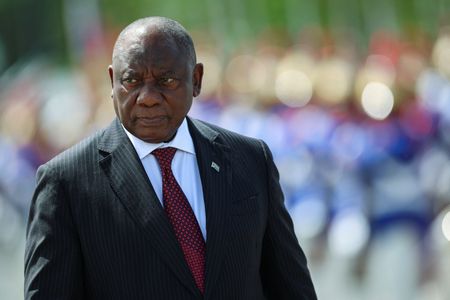
South Africa’s president has taken legal action to overturn a panel’s determination that he potentially engaged in misconduct connected to a controversy involving stolen cash hidden in furniture at his property, according to broadcaster eNCA’s Tuesday report.
The president is seeking to have the 2022 finding that he possibly breached the constitution thrown out, contending the report relied on secondhand information and the panel exceeded its authority, eNCA reported, referencing court documents.
Vincent Magwenya, the president’s spokesperson, has not yet responded to requests for comment from Reuters.
The president, who has held office since 2018, has consistently maintained his innocence regarding the controversy that local news outlets have nicknamed “Farmgate.”
The incident sparked concerns about the president’s acquisition of the $580,000 in cash that he claimed was taken from his property in 2020, questions about proper declaration procedures, and why the money was concealed in furniture instead of being placed in a banking institution.
Before entering politics, the president worked as a successful businessman and explained the funds represented earnings from buffalo sales. A central bank review determined he had not broken exchange control rules.
The controversy has created significant political difficulties for the leader, who assumed power promising to combat corruption and restore the reputation of his African National Congress (ANC) party.
In 2022, ANC legislators prevented impeachment actions against the president, but the constitutional court ruled this month that the parliamentary decision was illegitimate and the accusations warrant additional investigation.
The 73-year-old president has stated he accepts the court’s decision and has resisted pressure from political opponents calling for his resignation.
His current term extends until 2029, and political experts believe he will likely survive any parliamentary impeachment vote.
The ANC reaffirmed its backing for the president this month, improving his prospects of surviving any renewed impeachment attempts.
Any impeachment would need approval from two-thirds of parliament, and despite the ANC losing its parliamentary majority in the 2024 election, the party maintains approximately 40% of National Assembly seats.
WASHINGTON – A Reuters analysis reveals that President Donald Trump has made false assertions about the 2020 election being stolen from him no fewer than 107 times during the past six months, maintaining this grievance as a central focus while facing new political challenges from international conflicts and approaching midterm elections.
The analysis of Trump’s public appearances, interviews and social media activity shows he addresses this topic almost daily, often in concentrated bursts. During one April Saturday, while a delicate ceasefire with Iran was in place, Trump made allegations about the 2020 election – which he lost to his predecessor Joe Biden – seven times on his Truth Social platform.
Trump has brought up these assertions during no fewer than six meetings with international leaders, two professional sports team celebrations, and White House ceremonies for Hanukkah and Christmas. During impromptu comments at the World Economic Forum in Davos, Switzerland, this past January, he stated “people will soon be prosecuted for what they did.”
He brought up his assertions of election manipulation at a White House gathering for lawmakers last week and once more when speaking with reporters before getting on Air Force One.
“If we had Jesus Christ come down and count the votes, I would have won California,” Trump stated about the consistently Democratic state where he lost by 29 percentage points in 2020 and more than 20 percentage points in 2024. “But it’s a rigged vote.”
Staff members and interviewers frequently dismiss his remarks, while critics characterize them as complaints from someone who cannot accept defeat.
However, Trump’s persistent emphasis on 2020 indicates a forward-thinking approach designed to support new voting limitations, strengthen party allegiance and motivate supporters before November elections that will decide Congressional control, according to two White House officials and two people familiar with the situation who received anonymity to speak openly.
By portraying the 2020 election as invalid, he is also preparing to contest Republican defeats and weaken Democrats should they regain power, several election experts stated.
“He’s not looking back; this is about the midterms,” said Alexandra Chandler, an election expert at the nonpartisan advocacy organization, Protect Democracy. “He’s trying to create a fog of disinformation with this. So then if he dials it up further with federal interference, the public will not react as surprised.”
This past April, despite having initiated a nationwide redistricting battle months before, Trump criticized Virginia’s election results for redrawing U.S. congressional district maps as “rigged,” without offering evidence of fraud.
“President Trump is committed to ensuring that Americans have full confidence in the administration of elections, and that includes totally accurate and up-to-date voter rolls free of errors and unlawfully registered non-citizen voters,” White House spokeswoman Abigail Jackson said in a statement.
REPUBLICAN VOTERS SYMPATHETIC TO FALSE CLAIMS
Trump’s messaging has found support among Republican voters. A Reuters/Ipsos poll from April showed that 63% of Republican voters accept Trump’s false assertion that the 2020 election was stolen, a percentage that has stayed mostly consistent in recent years.
An even larger portion of Republicans – 82% – expressed agreement that significant numbers of fraudulent ballots are submitted by non-citizens in U.S. elections.
In contrast, just 9% of Democrats and 21% of independents stated they believed Trump lost in 2020 because of misconduct, and 18% of Democrats and 38% of independents expressed worries about non-citizens submitting fraudulent ballots.
Numerous courts, state officials and previous investigations found no evidence of widespread fraud in the 2020 election.
Despite this, Trump appointed an election-security czar last year to reinvestigate his 2020 defeat. Those new investigations have produced no fresh evidence, Reuters reported in April. Administration officials also attempted last year to prohibit voting machines used in more than half of U.S. states while considering how the federal government could assume control over state-managed elections, Reuters reported last week.
Trump’s 2020 messaging became more intense in December after he attempted to pardon Tina Peters, a Colorado county clerk who was convicted by the state of interfering with voting machines following that election. He repeated the accusations while urging congressional Republicans to approve his Save America Act, which would mandate proof of citizenship for voting, and again while increasing criticism of mail-in voting.
While the U.S. Senate has not moved forward with Trump’s national voting modifications, many states have enacted similar proof-of-citizenship requirements and more stringent identification rules. Trump has also issued executive orders attempting to restrict mail-in voting, but those measures are currently being contested in court by Democrats.
SOME REPUBLICANS PUSH BACK
Meanwhile, Trump has employed his 2020 assertions to shift responsibility for difficult global conflicts and domestic policy disagreements.
In December, as the Ukraine war continued despite Trump’s 2024 campaign promise to end it within a day, the U.S. president informed Ukrainian President Volodymyr Zelenskiy that the “rigged” U.S. election enabled Russia’s 2022 invasion. In February, he told families who had lost relatives in immigration-related crimes that they would be “home with your son, daughter” if the election had not been “rigged.”
The 2020 election has also become a test of allegiance for many of Trump’s nominees for important federal positions, including judicial candidates, who have declined under oath to confirm to Democratic senators that Biden won. Instead, they state only that Congress certified the election in his favor.
However, some Republicans are resisting.
RightCount, a group of Republicans in competitive states, recently restarted a campaign to protect the integrity of state-run elections and oppose Trump’s attempts to federalize them.
“All the accusations that have been made have all been refuted, but he doesn’t want to listen,” said former Arizona Governor Jan Brewer, a supporter of Trump and a member of the group.
After losing his Republican primary in Louisiana last week when Trump declined to endorse him, U.S. Senator Bill Cassidy criticized the president’s election manipulation claims in his concession speech. Cassidy angered the president by supporting his impeachment following the January 6, 2021, Capitol attack by Trump supporters attempting to halt the 2020 election certification.
“When you participate in democracy, sometimes it doesn’t turn out the way you want it to,” Cassidy said. “But you don’t pout. You don’t whine. You don’t claim the election was stolen.”
Dairy farmers are advocating to members of Congress for expanded milk options in school cafeterias, arguing that offering whole milk, reduced-fat options, and flavored varieties delivers better outcomes for students.
A schoolteacher and dairy farmer who operates near Union Bridge, MD, and belongs to Maola Local Dairies expressed support for increased variety during the most recent Dairy Defined podcast episode that was published today. Lauren Schwartzbeck stated: “I think it’s awesome that students and kids have a choice. Giving them more choices just gets more milk out there for them, and the benefits that it has, and the flavor that it has that kids enjoy. I think by giving them those choices and by providing that product to them, that can only do great things, not only just for our dairy industry, but for these kids as well.”
The podcast also featured Frank Doll, who serves as Prairie Farms Chairman and NMPF Executive Committee Member and operates a dairy operation near Greenville, IL. Both farmers highlighted the advantages of incorporating whole milk into school lunch programs and emphasized the importance of flavored milk options, which serve as a widely accepted source of nutrition among students. Doll additionally outlined key priorities for the dairy sector as producers prepare for their upcoming annual Washington visit next month.
The Dairy Defined podcast series is available for listeners through Apple Podcasts, Spotify and Amazon Music by searching for “Dairy Defined.”
President Trump will receive his yearly medical examination on Tuesday at Walter Reed National Military Medical Center, just weeks before celebrating his 80th birthday on June 14th.
The scheduled checkup follows twelve months of heightened public focus on what appear to be minor health concerns affecting the president.
Trump regularly portrays himself as having greater energy and physical fitness compared to his Democratic predecessor, who departed the White House last year at 82 years old amid ongoing discussions about his capacity to serve.
However, recent photos displaying a patchy skin condition on his neck have sparked additional health-related inquiries, coming after July 2025 images revealed swollen ankles and a bruised hand that appeared to be covered with cosmetics.
When Trump started his second presidential term in January 2025, he became the oldest individual ever to take the oath of office.
The president continues playing golf regularly, though he made light of his exercise habits during a recent Oval Office gathering where health secretary Robert F. Kennedy Jr noted that the president covers nine miles each time he plays golf.
“When I am not using the cart,” Trump responded.
White House physician Sean Barbabella has indicated Trump applies a standard topical medication as “a preventative skin treatment” for the neck condition, though he hasn’t provided specifics about what ailment requires treatment.
Following publication of the photographs showing the president’s leg and hand issues last July, Barbabella wrote in a statement that the conditions were harmless and showed no signs of deep vein thrombosis or arterial problems.
White House spokesperson Karoline Leavitt explained to reporters that Trump’s leg swelling resulted from a “common” vein issue, while his hand injury came from extensive handshaking.
Trump revealed last October that he had undergone a magnetic resonance imaging scan that month. The White House initially refused to provide additional information about why the scan was ordered. Leavitt stated only that results showed “exceptional physical health” for Trump.
The president subsequently explained to reporters that he received the MRI during a second physical examination.
“Getting an MRI is very standard. What, you think I shouldn’t have it? Other people get it. … I had an MRI. The doctor said it was the best result he has ever seen as a doctor,” Trump stated.
Healthcare professionals observed that MRIs aren’t normally included in standard physical exams and are typically ordered to obtain detailed internal body images.
In a written statement following the second examination, Barbabella reported that the president’s “cardiac age – a validated measure of cardiovascular vitality via ECG – was found to be approximately 14 years younger than his chronological age.
Trump has also encountered questions after seeming to doze off during multiple meetings, including one with his Cabinet members.
“Some people said, he closed his eyes. Look, it got pretty boring,” Trump told amused officials in February. “I didn’t sleep. I just closed them because I wanted to get the hell outta here.”
His predecessor was diagnosed last year with an “aggressive form” of prostate cancer that had spread to his bones and received radiation treatment.
Financial institutions are working behind the scenes to persuade the Federal Reserve to make permanent its recent regulatory changes, ensuring future Democratic administrations cannot easily undo the lighter oversight rules, according to four sources familiar with the discussions.
Under Republican President Donald Trump’s regulatory team, bank supervision has undergone its most significant transformation since the 2008 financial crisis. Officials have dramatically reduced the use of “matters requiring attention,” or MRAs, which bank examiners have traditionally relied on to compel financial institutions to address risk management problems and control deficiencies.
Recognizing this as a unique chance to reduce what they characterize as an aggressive and burdensome regulatory environment, financial institutions are working to secure their gains. They are pressing the central bank to formally clarify legal uncertainties around the gentler approach that has taken the place of MRAs, providing banks with long-term legal certainty, and the Fed intends to offer additional guidance, the sources said on condition of anonymity.
This initiative, disclosed here for the first time, demonstrates that financial institutions are already working to safeguard these modifications, expecting Democrats who are critical of financial institutions will attempt to overturn them — highlighting what some Fed observers describe as the increasing politicization of Fed oversight and regulatory policy.
Trump’s Fed Vice Chair for Supervision Michelle Bowman, who is spearheading these changes, is “attempting to alter the supervisory culture of the Fed and to shift the power balance … in favor of bank management,” said Todd Baker, senior fellow at the Richman Center for Business, Law and Public Policy at Columbia University.
Bowman has stated that supervisors are too focused on catching footfaults, or small missteps, and that her objective is to direct them toward genuine risks, not to diminish oversight. A Fed spokesperson declined to comment.
An MRA serves as a confidential method for examiners to identify problems they discover at banks and instruct the firms to resolve them. If a firm fails to address the issue, it could eventually escalate into a formal enforcement action and monetary penalties. Most large banks typically must handle numerous MRAs at any given time.
In October, the Fed announced it would reserve MRAs for material financial risks, and begin relying again on “observations,” a tool the central bank eliminated in 2013, as a way to informally flag issues. In a February memo, the Fed said it may also downgrade some existing MRAs to observations.
While MRAs can lead to enforcement actions, observations are nonbinding. While banks have welcomed the new approach, they believe observations are legally ambiguous and it is unclear how supervisors will respond if banks don’t act on them, the sources said. They worry future Democratic Fed leaders may seize upon that ambiguity to escalate observations they believe have not been fixed, to MRAs.
Banks are pushing the Fed for explicit written assurances that supervisors will not do that, and only escalate observations to MRAs if the facts around the issue change, the people said. The Fed has said it will amend public 2013 documentation around observations, and that could provide more clarity, one of the people said.
Banks have long complained supervisors routinely resort to MRAs for minor issues and their overzealous use can distract management. Silicon Valley Bank, they point out, had 19 open MRAs when it collapsed, most of which did not focus on the core issues that brought it down, a Fed post-mortem found.
MRAs became supervisors’ primary cudgel after the 2009 crisis highlighted that lenders were mostly ignoring observations, leading the Fed to scrap them, according to two former officials familiar with the Fed’s thinking at the time.
Arguing red tape is stymieing lending and the economy, the Trump administration is trying to steer softer bank rules and supervision, an effort that could gain steam under Trump’s new Fed Chair Kevin Warsh.
In addition to limiting MRAs, the Fed and other bank watchdogs have scaled back the number and scope of bank exams and this month proposed overhauling the confidential bank rating system. Bowman has also announced plans to reduce regulation and supervision headcount by around 30%, leading to the exit of long-tenured staff, and has brought in her own people.
Democrats say the changes are weakening financial system safeguards at a perilous time for the global economy, and some bankers expect a backlash if they take the White House in 2028.
While it has become typical for the regulatory pendulum to swing between Republican and Democratic administrations, that dynamic has become “supercharged” as Trump’s White House has asserted more control of the regulators, said Baker.
A White House spokesperson said the Trump administration is focused on “objective and measurable risks” to financial markets.
Enshrining the supervision pullback in formal regulations would make them tougher to unravel, said legal experts, but Bowman must put rulemakings to a Fed board vote. While Republicans hold the majority, the central bank has historically strived for consensus, and the board’s Democrats would likely dissent against such a move, according to industry officials.
Still, Bowman’s lieutenants have been peeling back the curtain on supervision by publishing new operating principles for examiners, a move aimed at making the changes more durable, said one of the sources who has direct knowledge of the matter.
Supervision has been shrouded in secrecy, which lenders say has fostered a culture of unaccountability. Publishing supervisory principles does not legally bind the Fed, but it raises the political and legal stakes of reversing course by forcing future policymakers to justify any shift, said the source.
Jeremy Kress, a University of Michigan law professor, said he believed the changes would have staying power, especially as more long-tenured examiners leave.
“It’s going to take a long time for a future Vice Chair for Supervision … to turn that tanker,” said Kress.
Colorado Avalanche captain Gabriel Landeskog has found a high-tech solution to manage his recovery from a serious knee injury that kept him off the ice for three years. The hockey star now relies on tiny sensors placed in his skate insoles during games and practices, and even wears them in his regular shoes while walking his dog.
These devices track every aspect of his movement, creating detailed biomechanical profiles that helped guide his return to professional hockey. The technology monitors everything from his stride patterns to whether he’s putting too much pressure on his surgically repaired right knee.
The system analyzes his workload during games and practices, examining how his feet interact with different surfaces and calculating when he might be approaching his physical limits. This data helps prevent him from pushing too hard during training, which could cause setbacks lasting days or weeks.
“This detects any red flags before I even feel them,” said Landeskog, whose team trails Vegas 3-0 in a Western Conference Final in which he has two of the Avalanche’s six goals. “It’s been super important for me, and a huge help.”
The technology comes from Plantiga, an artificial intelligence company that develops movement analysis platforms for professional athletes. Their system is currently being used by players and teams across the NBA, NFL, WNBA and MLB, as well as college programs, elite runners, recreational athletes, and NHL players like Landeskog.
“What we’re trying to detect is the smoke before the fire,” explained Matthew Jordan, the vice president of performance science at Plantiga as well as an associate professor, faculty of kinesiology/sport medicine center, at the University of Calgary. “Imagine you’re at the point where your knee is just at the cusp of the next day it’s going to be like, ‘My knee’s killing me. I can hardly walk.’ We can see in the data before you reach that tipping point.”
Landeskog’s knee problems started when a skate blade sliced his right knee during the 2020 playoffs in the Edmonton bubble. Despite the injury, he continued playing and contributed to the Avalanche’s Stanley Cup championship in 2022 when they defeated Tampa Bay.
However, that Cup-winning game marked the beginning of a long absence from hockey. Following a missed season, Landeskog had cartilage replacement surgery on May 10, 2023.
In spring 2024, Landeskog was introduced to Plantiga, the Vancouver-based human analytics company founded by Quin Sandler and his late father, Norman McKay. The company was created to monitor athlete movement using wearable technology placed inside shoes.
Landeskog connected with the Plantiga team through strength and conditioning coach Marcin Goszczynski. The 33-year-old player met with Jordan during a game when the Avalanche visited Calgary.
“We discussed his injury and his frustration with the process,” Jordan recounted. “You have to remember at this point the tunnel was dark and long — there was no light … we were miles from the end of the tunnel.”
Jordan introduced Landeskog to a Canadian ski racer who had overcome a similar injury.
“It was a relief for Gabe to know that another athlete out there had been able to conquer this injury,” Jordan said. “Has among the best mindsets, and he is 100% resilient and gritty to the core.”
Using “Norman,” the movement analysis system named after Sandler’s father, potential changes in Landeskog’s movement patterns are identified before they can become problematic.
“We’re trying to put really good data (together) that him and his trainer will use,” Sandler said. “There’s this fine Goldilocks zone that we help him stay in, and honestly he’s been killing it.”
Landeskog made his return last season during Game 3 of the playoffs against Dallas, marking his first NHL appearance in approximately 1,032 days. His comeback continued this season with 14 goals and 21 assists across 60 regular-season games.
During the season, Jordan monitors Landeskog’s skating technique remotely. He sometimes identifies moments that require closer examination when the data shows readings outside the Swedish forward’s typical range.
“Essentially, put out the ‘smoke’ before it turns into a ‘fire,’” Jordan explained. “In an athlete’s world, a fire can mean a new injury, a reinjury to the tissue, a loss of performance or a setback in rehab.”
While similar in concept to health-tracking devices like the Oura Ring, Plantiga uses laboratory-quality sensors that capture 400 data points every second.
This means an athlete’s movement can be measured with 20-to-30 times more precision than typical smartphones or smartwatches.
“A supercharged human movement measuring device,” Jordan said.
Establishing baseline measurements for Landeskog’s walking pattern and body mechanics involved his dogs, the late Zoey and current pet Mila, who enthusiastically joined these data-gathering walks.
“We can see subtle things in your walk patterns well before it manifests as something very clinical or significant,” Jordan said.
The information eliminated uncertainty from Landeskog’s training routine.
“He’d get on the ice and be like, ‘Oh, I feel good today.’” Jordan said. “It’s like, ‘I think I’m just going to go hard. I feel like my knee feels really good. Oh (no), I went too far. My knee’s flared up. I’ve got to take a week off.’ With all these setbacks he couldn’t catch any progression.”
Now, when the data suggests he should rest, he follows that guidance. He’s a finalist for the Bill Masterton Memorial Trophy, which is awarded to the NHL player who exemplifies perseverance, sportsmanship and dedication.
“I’m humbled and honored by it, but I think for me, the ultimate prize I’ve already won,” Landeskog said. “That’s to continue working and getting to play hockey.”
A construction project is causing traffic delays on Bayside Drive, with one lane currently blocked to vehicles.
The right lane closure is in effect along the section of Bayside Drive that runs between South Little Creek Road and Port Mahon Road. This portion of roadway is also known as Route 9.
The lane restriction is expected to remain in place until 6 PM today while construction crews complete their work.
Drivers using this route should plan for possible delays and consider alternate routes if traveling during peak hours.
Drivers traveling eastbound on Millcreek Road will need to find alternate routes for right turns at McKennans Church Road due to ongoing construction work.
The right turn lane closure is expected to last until 4 PM today, according to traffic officials.
Motorists should plan for potential delays and consider using alternative routes during the closure period.
ARAFAT, Saudi Arabia — Thousands of Islamic worshippers assembled at Mount Arafat in Saudi Arabia on Tuesday for what represents the holiest moment of their annual religious journey.
The gathering at the sacred mountain marked the second official day of Hajj and is widely regarded as the spiritual climax of the pilgrimage. Even with scorching temperatures, faithful believers covered the rocky mountainside and nearby flatlands, engaging in fervent worship and deep spiritual reflection.
The scene was filled with devoted worshippers quietly reciting prayers and opening their hearts in earnest appeals to Allah, seeking divine pardon, compassion, blessings and wellness. Many could be seen with uplifted arms in reverent worship, emotions overwhelming them as tears flowed freely across the sacred terrain.
The Islamic pilgrimage represents one of Islam’s Five Pillars and stands as a religious obligation that every Muslim must complete at least once during their lifetime, provided they possess the financial means and physical capability to undertake the journey.
The multi-day religious observance offers believers a profound opportunity for spiritual transformation and the possibility of divine forgiveness for their transgressions.
This year’s pilgrimage takes place amid ongoing regional tensions, including a fragile ceasefire in the Iran war and continuing instability throughout the area.
Federal authorities in Belgium reported Tuesday that multiple individuals sustained injuries when a train struck a minibus transporting children at a railroad crossing in the northern part of the country.
The collision occurred at a railway crossing close to Buggenhout, situated approximately 30 kilometers (20 miles) northwest of Brussels, the nation’s capital. Authorities have not yet released specific information about how the incident developed.
Federal police confirmed that “several people” sustained injuries in the collision, though they stated they cannot release additional specifics at this time. A Belgian private television network, VTM, reported that multiple fatalities occurred in the incident.
Officials said that prosecutors along with forensic investigators and transportation specialists were expected to arrive at the location.
Belgian Interior Minister Bernard Quintin posted on social media expressing “great sadness” regarding “the tragic accident in Buggenhout, where a school bus was struck by a train. My thoughts go out to the victims and their loved ones.”
Ukrainian air force officials reported Tuesday that Russia launched more than 100 drones and two ballistic missiles targeting Ukraine during overnight attacks, while Moscow issued warnings of intensified strikes on the capital city.
Moscow on Monday advised foreign nationals and diplomatic personnel to quickly evacuate the Ukrainian capital and warned civilians to avoid military and government buildings. Russian officials stated they were preparing “systemic strikes” against Kyiv.
According to a foreign ministry statement, Russia’s Foreign Minister Sergey Lavrov contacted U.S. Secretary of State Marco Rubio by telephone Monday, urging America to withdraw its diplomatic personnel from Kyiv. While Rubio did not indicate whether the State Department would follow that recommendation, he expressed concerns during his India visit that the “terrible” conflict in Ukraine might intensify.
The Trump administration has spent more than a year attempting to end the hostilities that began following Russia’s February 2022 invasion. However, these diplomatic efforts have produced no major breakthroughs and are currently suspended as Washington concentrates on the Iran war.
No diplomatic missions announced plans to depart from Kyiv. The European Union, French and Polish delegations publicly declared their intention to remain.
Ukraine’s foreign ministry issued a statement late Monday asserting that security threats from Russia against Kyiv and other Ukrainian cities “remains the same as in previous years and months.”
The ministry emphasized that Russia has consistently conducted missile and drone strikes against the capital for over four years, while noting Ukraine stands ready to help diplomatic missions requiring enhanced security measures.
Moscow characterized its largest missile assault of the year last weekend as retaliation for Friday’s fatal Ukrainian drone attack on what Russia described as a college dormitory in Starobilsk, located in Ukraine’s Russia-controlled Luhansk region.
However, the Ukrainian General Staff stated that its Starobilsk strike targeted the regional headquarters of the Russian military’s specialized drone unit.
Ukrainian President Volodymyr Zelenskyy observed that advanced American-manufactured air defense systems needed by Ukraine to counter Russian ballistic missiles are scarce because of the Iran war.
“Unfortunately, there has been no progress for a long time with America on expanding the production of anti-ballistic capabilities,” Zelenskyy posted on social media late Monday, noting that Kyiv is collaborating with Europe to develop sufficient anti-ballistic defenses.
He highlighted that Ukrainian military successes in recent months have allowed the country to “stabilize” the 1,250-kilometer (780-mile) front line across eastern and southern Ukraine, indicating Kyiv’s forces are maintaining their position against Russia’s larger military.
According to the Institute for the Study of War, Russia’s spring offensive is struggling as Ukraine’s medium-range drone attacks disrupt Moscow’s rear supply operations.
The Washington-based think tank stated late Monday that Moscow’s threats of major strikes are designed to divert public focus from its “poor battlefield performance” and economic strain from war expenses and international sanctions.
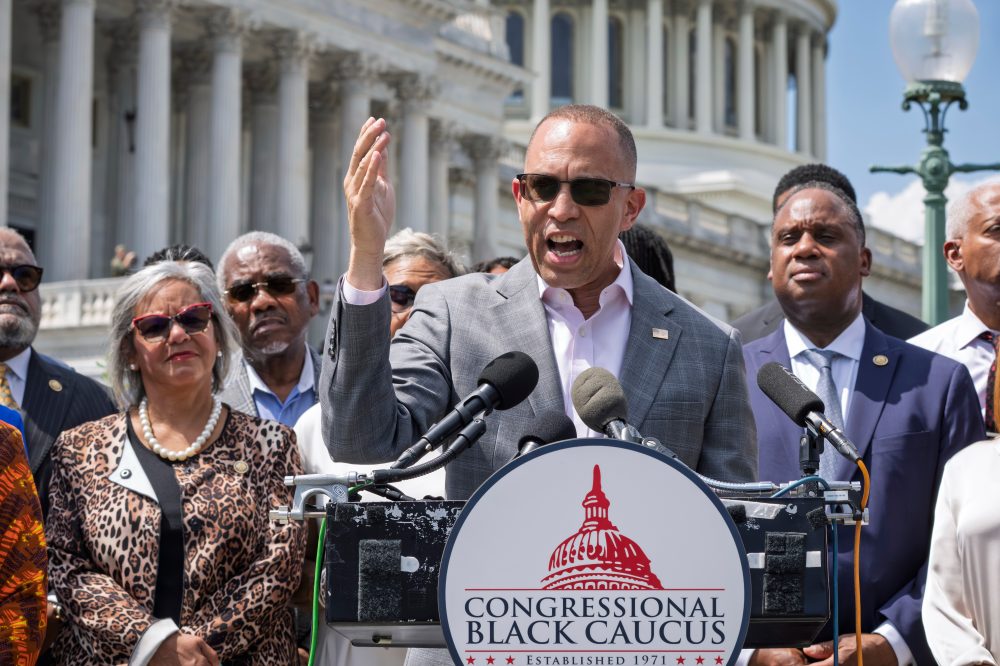
WASHINGTON — Members of the Congressional Black Caucus reached out to major corporations nationwide on Tuesday, asking them to take a stand against Republican-controlled states’ efforts to redraw congressional maps that would eliminate districts with Black majorities.
The lawmakers sent correspondence to more than 250 businesses, including many that have previously voiced support for voting rights and racial justice causes. The letter asks these companies to speak out against what the caucus members characterize as “coordinated efforts to silence Black voices at the ballot box.” Many of these same corporations had joined together five years ago to urge Congress to pass the John Lewis Voting Rights Act, legislation aimed at strengthening voting protections.
The 2021 business coalition, known as Business for Voting Rights, included some of America’s largest and most influential corporations such as Apple, Amazon, Google, Meta, Microsoft, Tesla, Salesforce, Target, PayPal, Intel and Starbucks.
This latest appeal represents another attempt by the Congressional Black Caucus and supporters to build opposition against Republican-controlled states that are redrawing electoral boundaries in ways that could weaken Black political influence. Multiple states have begun eliminating congressional districts currently represented by Black Democratic officials following a recent Supreme Court decision that significantly reduced protections under the Voting Rights Act.
“Corporations that have profited from Black consumers, relied on Black workers, and amassed wealth in part from Black communities cannot look away while Black political power is dismantled in plain sight,” Rep. Yvette Clarke, chair of the Black Caucus, said in an interview.
Clarke characterized the correspondence as “putting corporate America on notice,” though she emphasized the caucus wasn’t seeking confrontation with businesses. The letter recipients included international companies with substantial U.S. operations.
Last week, the caucus also urged Black athletes to boycott public universities in states engaging in gerrymandering to eliminate Black-held districts. The Congressional Black Caucus has 59 members, all Democrats, with more than one-third representing Southern states.
Several lawmakers have suggested that widespread demonstrations and federal legislation may be needed to counter the redistricting efforts in Republican-led states. Any new federal voting rights legislation would likely require Democrats to control both congressional chambers and the presidency.
Company responses to these requests remain uncertain. The Associated Press was making efforts to contact them.
“Many companies that previously issued statements after the murder of George Floyd, pledged billions toward racial equity initiatives, and spoke forcefully in defense of democracy following January 6 now face a defining test of whether those commitments were rooted in principle or convenience,” the caucus’ letter states.
This action also highlights ongoing tensions between the caucus and corporate America. A 2024 Black Caucus analysis found that lawmakers were “troubled that some corporations that made pledges in 2020 have taken several steps in the opposite direction,” including backing away from or failing to implement workplace diversity commitments.
“We understand who the occupant in the White House is and the reality of Republicans being in charge,” Democratic Rep. Steven Horsford of Nevada said of the caucus’ message. “But what corporate America also understands is that there will be a shift at some point.”
The correspondence requests that companies publicly denounce the redistricting plans, schedule meetings with Black Caucus members to discuss corporate responsibility in protecting voting rights, and reveal their political contributions to Republican officials in states conducting congressional redistricting.
President Donald Trump initiated this uncommon mid-decade redistricting wave last year by encouraging Texas legislators to redraw their maps to create additional Republican seats. While Democratic-controlled California also responded, primarily Republican states have been redrawing boundaries as the party works to preserve its House majority in this year’s midterm elections.
The Supreme Court ruling accelerated these efforts by permitting even more Republican states to redraw congressional boundaries that had previously safeguarded minority communities.
Horsford, who led the Black Caucus during President Joe Biden’s Democratic administration, said the caucus is insisting that companies “stand on the side of democracy, fairness and equal representation.”
“This is about power, who holds it and what it’s used for,” he said. “And when you’re diluting Black economic and political power, we need to know where these companies stand in this moment, and what side of history they’re on.”
The president has a medical examination scheduled for Tuesday at Walter Reed National Military Medical Center, bringing fresh attention to ongoing questions about his age and physical condition.
At 79 years old, the president will undergo what the White House calls routine annual preventative medical and dental examinations. This marks his fourth publicly announced medical evaluation since beginning his second term, occurring as he seeks to demonstrate vigor before upcoming midterm elections that will gauge his influence with voters.
Presidential administrations have traditionally shared select findings from these medical checkups for decades, providing citizens with limited insight into their leader’s wellbeing. However, these reports go through White House review and require presidential approval, creating uncertainty about what information reaches the public.
The president will turn 80 next month, making him the oldest individual ever elected to the presidency. His predecessor, former President Joe Biden, was 82 upon leaving office after withdrawing from the 2024 race due to widespread age-related concerns.
A Washington Post/ABC News/Ipsos survey from April revealed that fewer than half of American adults believe the president possesses the mental acuity or physical fitness needed for effective leadership.
“I think concern for the president’s physical health is probably at an all-time high, and I think advanced physical age is the No. 1 concern,” said Dr. Jeffrey Kuhlman, who served as a White House physician for more than a decade under former presidents Barack Obama, George W. Bush and Bill Clinton.
According to Kuhlman, a comprehensive examination for someone of the president’s age would typically encompass advanced cardiac testing, cancer screenings, cognitive evaluation, plus standard measurements including height, weight and blood pressure.
While the White House hasn’t revealed specific details about the upcoming visit, officials expressed optimism about the anticipated results.
“President Trump is the sharpest and most accessible President in American history who is working nonstop to solve problems and deliver on his promises, and he remains in excellent health,” White House spokesperson Davis Ingle said in a statement.
Recently, the president has claimed to feel as energetic as he did fifty years ago, despite joking about his preference for fast food and limited exercise routine. However, he remains conscious of age perceptions, mentioning extra care when walking down Air Force One steps to prevent stumbling headlines.
No legal mandate exists requiring presidents to make their health information public, and transparency levels have differed across administrations. The president’s previous medical reports have drawn criticism for lacking detail and containing statistics that medical professionals questioned.
During public events, the president frequently uses makeup to hide hand bruising, which the White House explains results from handshaking and regular aspirin usage. He has occasionally appeared tired during meetings and closed his eyes for extended periods, though he disputes claims of falling asleep.
The president regularly claims to have “aced” cognitive evaluations while often criticizing Biden, who faced mental acuity questions. Some previous physicals included the Montreal Cognitive Assessment, designed to detect dementia and cognitive problems. His doctors reported perfect 30 out of 30 scores for the president in 2018 and 2025 examinations.
Nevertheless, critics point to the president’s rambling speeches and sometimes aggressive language as indicators of cognitive deterioration.
Last month, over 30 neurologists, psychiatrists and other medical professionals issued a statement declaring the president mentally unfit for office, warning of an “increasingly dangerous decline” in his conduct based on what they termed “objectively observable signs of serious medical concern.” They acknowledged never having examined him personally.
“Any so-called medical professionals engaging in armchair diagnosis or false speculation for political purposes are clearly breaking the Hippocratic Oath they’ve sworn to,” Ingle said.
Like any patient, presidents control what health information becomes public, explained Sara Rosenthal, a bioethicist at the University of Kentucky studying presidential health. Transparency concerns have intensified as America chooses older leaders like the current president and Biden, she noted.
“I think we can expect very little disclosure about the true health status of any president unless they’re in perfect health,” said Rosenthal, who has suggested an independent medical organization to review and report on the health of the president and those in the line of succession.
The president’s initial medical report of his second term appeared last April. In July, he received a diagnosis of chronic venous insufficiency, a typical condition among older adults causing blood to collect in veins. Photos have captured the president with swollen feet, ankles, and calves, which the White House describes as chronic venous insufficiency symptoms causing “mild swelling” in his lower legs.
After his most recent publicly announced examination in October, characterized as a routine follow-up, the president’s doctor released a single-page summary declaring him in “exceptional health” without revealing many concrete findings.
The regularity of the president’s medical appointments is typical for his age group, according to S. Jay Olshansky of the University of Illinois-Chicago, who researches past presidents’ health. This approach helps identify issues while they remain manageable, Olshansky explained.
Olshansky believes citizens deserve more than White House medical summaries that “may be subject to editorial discretion.” Complete, unedited medical records should be released publicly, he argued: “Nothing should be hidden.”
The White House hasn’t indicated whether the president’s appointment will involve procedures requiring anesthesia. His most recent colon examination occurred in 2024 with a recommended three-year follow-up interval.
Should the president receive anesthesia, Vice President JD Vance would temporarily assume office duties under the 25th Amendment. This last occurred in 2021 when Vice President Kamala Harris briefly took control while Biden underwent a colonoscopy. Former President George W. Bush previously transferred power twice to Vice President Dick Cheney.
The American beauty conglomerate Estée Lauder has terminated acquisition discussions with Spanish fragrance company Puig, a decision that industry experts are praising as wise given the company’s current restructuring efforts.
The proposed merger would have formed a luxury beauty powerhouse capable of better challenging market leader L’Oréal. However, shareholders expressed concerns that such a massive deal would divert leadership attention from the company’s ongoing recovery strategy and put additional strain on finances, particularly with net debt already at approximately five times EBITDA.
Stock prices jumped 10% on Friday following news of the talks’ end. While investor opposition played a role in derailing negotiations, Reuters reported that the primary reasons for failure were conflicts between influential family owners and various demands, including those from makeup entrepreneur Charlotte Tilbury. Charlotte Tilbury represents a brand that has gained popularity among TikTok content creators and wealthy millennials, with Puig holding an ownership interest.
The cosmetics company, which operates the Clinique and M.A.C brands, has previously stated that acquisitions serve as tools for portfolio transformation, helping address gaps in regional presence, product lines, and pricing segments.
Chief Executive Stéphane de La Faverie has emphasized that his main focus under the “Beauty Reimagined” reorganization involves repairing organic growth initially, with any potential deals needing to align closely with the restructured operations.
“Although it has walked away from Puig, we think Estée could look to acquire smaller, niche operators to enhance its category or geographic standing,” Morningstar analyst Erin Lash said in a note. “While the deal stood to strengthen Estée’s position in fragrance, we were skeptical, given the potential deal’s size and the distraction it could pose for management amid its ongoing turnaround.”
The restructuring initiative includes expanding product offerings across distribution channels and markets, improving supply chain efficiency, increasing marketing investments, and accelerating launches of high-end products to capitalize on steady demand from wealthy customers. The company announced earlier this month plans to eliminate up to 3,000 additional positions worldwide, raising total anticipated layoffs to as many as 10,000 while targeting up to $1.2 billion in annual cost reductions.
The beauty manufacturer, which also owns the Jo Malone luxury fragrance line, completed its full acquisition of Indian premium brand Forest Essentials this week, demonstrating continued commitment to purchases focused on local, developing markets. The company first invested in Forest Essentials in 2008 and expanded its stake to 49% in 2020.
This Forest Essentials purchase follows recent minority investments in London-based luxury skincare company 111SKIN and Mexico-based fragrance brand Xinu in November.
The Forest Essentials addition has nearly doubled the company’s market presence in India and is “helping us to tap into another consumer that we potentially couldn’t recruit,” Nadine Graf, president of EMEA, UK, Ireland & Emerging Markets at Estée Lauder, said at a Morgan Stanley conference in Paris on Tuesday.
Graf noted the company was customizing the brand for local markets and increasing spending during major shopping seasons, while acknowledging that Europe and the UK presented more challenging environments where premium beauty products were widely accessible, restricting growth opportunities.
“Decision to call off discussions removed a complex transaction that, in our view, would have offered only modest strategic benefit and limited portfolio diversification,” Jefferies analyst Sydney Wagner said in a note.
“With the transaction no longer under consideration, we see the most compelling use of capital in assets positioned down the price ladder” with mass and so-called masstige brands, particularly in color and skin, she said.
During the ongoing conflict with Iran, tensions have emerged between the U.S. military and SpaceX regarding the cost of satellite internet services used in combat operations.
Military officials found themselves paying significantly more for Elon Musk’s Starlink network after SpaceX executives argued they deserved higher compensation for their satellite connectivity services used on kamikaze drones.
According to sources and Pentagon documents, SpaceX representatives met with defense officials shortly after U.S. bombing operations began, claiming the military was paying approximately $5,000 per terminal connection while actually utilizing a premium service tier valued at around $25,000.
The dispute centered on LUCAS suicide drones – an inexpensive American model similar to Iran’s Shahed drones that can hover over target areas before diving to strike. These unmanned aircraft rely on satellite connectivity for guidance and targeting.
SpaceX contended that these drones operated under conditions requiring their aviation-level subscription service rather than the less expensive ground or mobility packages. Military officials countered that the $25,000 monthly aviation fee was intended for traditional aircraft, not kamikaze drones that connect to Starlink for only minutes or hours.
Despite initial resistance, the Pentagon ultimately accepted SpaceX’s pricing demands, nearly doubling the cost of each LUCAS drone from roughly $30,000 per unit to accommodate the increased satellite service fees.
The disagreement highlights broader friction between the defense establishment and SpaceX over satellite service pricing in recent months. Additional conflicts have emerged regarding a proposed plan to provide Iranian civilians with direct cellular connections through Starlink to circumvent government communication restrictions.
SpaceX did not respond to requests for comment on the pricing disputes.
Pentagon representatives declined to discuss the specific pricing increases or their decision to pay higher fees. A military spokesperson stated that the Commercial Satellite Communications Office is actively seeking alternative providers.
However, no competing company offers services comparable to Starlink’s capabilities. The satellite network has become essential for modern military operations since Russia’s invasion of Ukraine in 2022, providing global coverage that enables battlefield communications and precision targeting in remote locations.
SpaceX operates approximately 10,000 satellites, representing more than 60% of all satellites currently in orbit and significantly exceeding constellations being developed by competitors like OneWeb and Amazon Leo.
The military’s dependence on Starlink has created potential vulnerabilities, as demonstrated during the Ukraine conflict when Musk ordered service disconnections in certain areas in 2022, disrupting Ukrainian military advances. More recently, a global Starlink outage last summer interrupted Navy testing, leaving unmanned military vessels stranded at sea.
According to Clayton Swope, a senior fellow at the Center for Strategic and International Studies, SpaceX maintains unusual leverage over the Pentagon because of its substantial commercial market beyond government contracts. The company generates about 20% of its total revenue from U.S. government work, per SEC filings.
“SpaceX certainly has the U.S. government over the barrel,” Swope said.
When U.S. operations against Iran began, Starlink was already integral to military systems, supporting everything from aerial attack drones to unmanned maritime vessels used for surveillance and strike missions. Starshield terminals were deployed across more than a dozen drone platforms when the bombing campaign launched.
Tensions escalated quickly after the February 28 assault on Iran began. On March 1, Musk responded to a social media post showing a LUCAS drone with an apparent Starlink terminal.
“It is a violation of commercial Starlink terms of service to use the terminal for weapon systems. This applies to all users and is shut down when discovered,” Musk posted. “There is a separate network called Starshield, which is operated by the US government.”
Pentagon officials denied any violation of their agreement with SpaceX.
Following this exchange, SpaceX executives met with defense officials to argue for higher service fees, according to sources familiar with the discussions.
While the Pentagon agreed to increased costs for drone satellite connections, senior officials including Deputy Secretary of Defense Steve Feinberg remained concerned about the arrangement. During an April ceasefire, Pentagon representatives met with Terrence O’Shaughnessy, a retired four-star Air Force general now leading SpaceX’s defense operations, to revisit the pricing structure.
Currently, the Pentagon is considering purchasing more than 3,500 additional Starshield terminal subscriptions, including 100 at the higher aviation pricing tier. This potential deal could generate hundreds of millions in annual revenue for SpaceX, though final agreement terms remain unclear.
Starlink has proven crucial for other operations beyond direct military action. After Iran suppressed protests in January, resulting in thousands of deaths, the Trump administration smuggled over 6,000 Starlink terminals into the country to provide internet access to citizens.
As the conflict intensified, Iranian authorities began confiscating terminals and deploying jamming equipment in major cities to disrupt connections. Within a week of fighting beginning, Pentagon officials initiated discussions with SpaceX about implementing direct-to-cell service that could bypass these disruptions.
This capability, similar to 5G cellular service, would allow users to connect without requiring ground-based terminals. SpaceX, which generated $11.4 billion in Starlink revenue in 2025, proposed charging up to $500 million to launch this capability, plus $100 million monthly to operate it – a price that alarmed defense officials.
Whether an agreement has been reached for the direct-to-cell service remains unclear.
A century-old private club in India’s capital faces potential closure after government officials demanded it abandon the prestigious location it has called home since British colonial times, setting off a court fight and public discussion about privilege among India’s wealthy elite.
The Delhi Gymkhana Club has operated continuously since 1913 on a sprawling property adjacent to where the prime minister lives in central New Delhi. The facility features an expansive complex of elegant buildings and perfectly maintained grounds, complete with teakwood furnishings, leather seating, and large artwork adorning the walls.
While the organization and government officials have previously disagreed over how the club is run, authorities issued a notice last Friday demanding return of the leased property, pointing to security concerns and infrastructure requirements.
Through a legal filing exceeding 900 pages that Reuters reviewed, a coalition of club members and staff petitioned the Delhi High Court to stop the action while their legal challenge proceeds.
According to court documents Reuters examined, the government seeks to “illegally gain possession of a hundred-year-old institution in a period of 15 days.”
During Tuesday’s court session, the club’s legal representative asked the judge to block authorities from taking forceful measures, while government attorneys stated no removal would occur without proper procedures. The judge scheduled the next hearing for July.
The exclusive venue serves as a gathering place for high-ranking government workers, military leaders, and influential corporate executives, with membership waiting periods extending over three decades. The Delhi Gymkhana Club has also been the setting for elaborate celebrations, including wedding parties for children of the capital’s wealthy families.
The private facility provides recreational amenities such as an indoor pool and tennis courts with both clay and grass surfaces. Multiple dining establishments and bars operate within the club, which maintains strict clothing requirements that prohibit round-neck T-shirts.
The organization relocated to its present 27-acre location two years following Britain’s designation of New Delhi as India’s capital city.
The conflict with government officials has generated discussion across social media platforms and television broadcasts, with some critics questioning whether such exclusive organizations should exist on subsidized government property, while supporters argue the club provides important cultural and recreational value.
“If ‘elite privilege’ is suddenly the issue . . . why not also question sprawling ministerial residences, endless VIP (very important person) convoys, private aircraft and the entire ecosystem of taxpayer-funded political privilege?” one user wrote on X.
The dismissal of Senegal’s prime minister by President Bassirou Diomaye Faye has injected new momentum into long-stalled negotiations to address West Africa’s most severe debt crisis, though the move brings both opportunities and fresh uncertainties.
Faye’s decision Friday to remove Prime Minister Ousmane Sonko, a vocal opponent of International Monetary Fund policies, could eliminate a key barrier to reaching an IMF agreement. However, financial experts and investors warn that the political upheaval may create new challenges for the ongoing discussions and increase risks for those holding Senegalese bonds.
“The removal of PM Sonko creates additional political uncertainty,” explained Thalia Petousis, portfolio manager at Allan Gray. “There is also a chance that a newly appointed PM might be in favour of a deep debt restructuring, increasing the probability of a negative outcome for Senegalese bondholders.”
On Monday evening, Faye appointed Ahmadou Al Aminou Lo, an experienced economist and former regional central bank official, to take over from the populist Sonko.
Financial markets responded negatively Tuesday, with Senegal’s foreign currency government bonds dropping significantly – falling as much as 5.7 cents on the euro and nearly 4 cents on the dollar, according to Tradeweb data.
Morgan Stanley noted Tuesday that investors were now calculating higher chances of a restructuring following recent developments.
Petousis cautioned that if foreign-currency debt underwent restructuring while local currency debt remained untouched, “the risks are that realised haircuts could be steeper than what is currently priced.”
Over the past three months, Senegalese dollar-denominated bonds have generated losses of 9.7% for investors, contrasting sharply with the 0.1% average return of comparable securities in the JPM EMBI Global Diversified Africa index. Bonds maturing in May 2033 were trading around 50.6 cents on the dollar, reaching historic lows.
Senegal has been pursuing intermittent discussions to secure a new IMF agreement since the Fund suspended a $1.8 billion program in 2024 after discovering previously undisclosed debt that pushed the country’s debt-to-GDP ratio beyond 130%.
The nation is essentially shut out of international capital markets and faces mounting challenges in controlling escalating fuel subsidy costs. Investors are becoming increasingly concerned about the government’s capacity to meet its debt obligations.
Earlier this month, President Faye’s office announced he was assuming direct control of Senegal’s debt portfolio. Cheikh Diba, who served as finance minister until Friday, indicated that IMF discussions would restart during the week of June 8, with a potential agreement on a new program’s framework possible by late June.
In one of his final actions as prime minister, Sonko, who had previously advocated against debt restructuring pressure, criticized the IMF Friday before lawmakers, declaring it had “never developed a country” and arguing Senegal should depend more on domestic resources rather than foreign lenders.
Despite losing his prime ministerial position, Sonko is expected to maintain significant political influence. His party continues to control the National Assembly and plans to meet Tuesday to “reintegrate” him as a legislator.
The sudden resignation of the National Assembly speaker Sunday has sparked rumors that Sonko might assume that position, which would preserve his ability to influence Senegal’s future relationship with the Fund.
Previous government timelines for IMF agreements have proven overly ambitious, with officials initially projecting a program would be established last year.
Responding to emailed inquiries, the IMF told Reuters it was monitoring Senegalese developments closely and anticipated working with the new administration.
“The timing of IMF staff’s next visit to Dakar will be guided by the availability and readiness of the incoming authorities,” the organization stated.
Fuel subsidies will likely dominate future negotiations when talks resume.
Senegal had allocated 250 billion CFA francs ($446.03 million) for subsidies this year before the U.S. and Israel attacked Iran in late February, triggering a conflict that drove oil prices higher.
Former Finance Minister Diba warned Friday that subsidy costs could surpass the 2026 budget by 1.39 trillion CFA francs – approximately $2 billion – should oil prices reach $115 per barrel.
However, Sonko had rejected a proposal to increase fuel prices, Diba informed parliament.
Barclays analyst Michael Kafe wrote that it “seems unlikely that the IMF would sign an agreement with Senegal that would not include the removal of the country’s expensive fuel subsidies.”
Should Sonko become parliament speaker, Kafe added, this could create conditions for future confrontations between executive and legislative branches.
“In many countries, energy prices are incredibly politically sensitive and thus governments will be tempted to alleviate price pressure,” observed Nicholas Sauer, portfolio manager at Robeco.
“There is indeed a long history of inflation-inspired social unrest that can eventually topple governments.”
A Lithuanian communications official reports that Russia has significantly expanded its capability to disrupt GPS signals across large portions of Europe, with interference now extending up to 280 miles from Russian territory.
According to Darius Kuliesius, deputy head of Lithuania’s communications regulator, Russia has dramatically increased its GPS “spoofing” equipment in the Kaliningrad region from just three antennas in early 2025 to 36 currently operating. These devices transmit false location data designed to confuse navigation systems.
The equipment operates from Kaliningrad, a heavily fortified Russian territory located between NATO members Lithuania and Poland along the Baltic Sea.
“The occasional interference began with the 2023 NATO summit in Vilnius. Now they have built up the infrastructure and the interference has become systemic, permanent, unending Russian provocation against European security,” Kuliesius stated.
Since Russia’s 2022 invasion of Ukraine, European countries have repeatedly alleged electronic interference from Moscow, though President Vladimir Putin’s administration rejects these claims, attributing them to Western smear campaigns.
The Russian embassy in Lithuania’s capital Vilnius did not provide an immediate response to requests for comment, though Moscow has consistently denied similar allegations previously.
Lithuanian regulatory data shows the GPS disruption potentially affects Estonia, Latvia, Lithuania, most of Poland, portions of Finland, Sweden, Belarus, and Baltic Sea waters within the 280-mile range.
Several high-profile incidents have occurred, including GPS interference experienced by a Spanish military aircraft carrying Defence Minister Margarita Robles near Kaliningrad, and jamming of a plane transporting European Commission President Ursula von der Leyen while traveling to Bulgaria.
Both Estonia and Finland have also attributed GPS navigation disruptions in regional airspace to Russian interference.
Despite these disruptions, most commercial aircraft and major airports maintain multiple navigation backup systems when GPS becomes unreliable.
Kuliesius noted that mobile phone service quality near Kaliningrad suffers due to frequency interference, with notable increases during Ukrainian drone operations against Russia.
“Online bus schedules in Klaipeda stop working during the spikes, because they rely on tracking buses by GPS,” he explained, referencing a community located 30 miles from the Kaliningrad border.
Good morning, Delmarva! We’re starting this Tuesday with some patchy fog across the peninsula, but don’t worry – it’ll clear out by 9 AM as we settle into a mostly cloudy day. Temperatures will climb to a pleasant 76 degrees with light easterly winds under 5 mph, making it a comfortable day to get outside once that morning fog lifts.
Tonight, we’ll stay mostly cloudy with lows dipping to 64 degrees. Rain chances begin to creep in late tonight, so you might want to grab that umbrella before heading to bed.
Looking ahead to Wednesday, rain showers become likely as temperatures rise to 81 degrees. The wet weather continues into Wednesday night with the possibility of thunderstorms joining the mix, keeping things interesting as we head toward the weekend.
If you have outdoor plans today, it’s looking pretty good once we get past the morning fog. Just keep an eye on the sky tonight and tomorrow as our weather pattern becomes more active. Stay dry out there, Delmarva!
A diverse group of West Texas residents has formed an unexpected partnership spanning different political viewpoints to oppose plans for border wall construction in their region.
Throughout the Big Bend area, opposition messaging has emerged on signs, flyers, and at local establishments, including a liquor store in Marfa, Texas, demonstrating the breadth of community resistance to the proposed barrier.
The coalition represents residents from various backgrounds who have found common ground in their opposition to extending border wall infrastructure through their area along the Mexican border.
A deadly Israeli military strike targeted a village in eastern Lebanon, claiming 12 lives according to state media reports released Tuesday. Israeli officials confirmed the deployment of additional military personnel to the region.
The attack occurred late Monday in Mashghara, located in the Bekaa Valley, Lebanon’s state-run National News Agency reported.
The strike followed Israeli Prime Minister Benjamin Netanyahu’s announcement authorizing more aggressive military operations against the Hezbollah militant organization throughout Lebanon. While Israeli military forces did not provide details about this specific attack, they confirmed Monday that operations were focused on Hezbollah facilities in eastern Lebanon.
A security official from Israel, speaking anonymously due to protocol requirements, confirmed that military leadership had deployed an additional battalion to Lebanon.
Emergency response teams recovered a dozen bodies from debris after a series of overnight bombardments struck multiple areas across southern and eastern Lebanon.
The escalated military action occurs just three days before scheduled direct negotiations between Lebanese and Israeli military representatives in Washington.
Hezbollah forces continue their offensive against Israeli military units in southern Lebanon and northern Israeli communities, pledging to maintain combat operations until Israel ceases daily bombardments and removes military forces from Lebanese territory.
In recent weeks, Hezbollah has claimed success using advanced fiber-optic drone technology that Israeli forces have found difficult to counter, successfully targeting both military personnel and northern border communities.
Israel has revised its security protocols for northern regions in response to current developments, advising residents to avoid large gatherings.
“What this requires of us now is to increase the blows, to increase the intensity. We will smite them hip and thigh,” Netanyahu said in a video posted on social media Monday ahead of the strikes.
Lebanese government officials express hope that upcoming direct negotiations with Israel, which Hezbollah opposes, will result in a ceasefire agreement.
More than one million Lebanese residents have been forced from their homes due to the conflict, which began when Hezbollah launched rockets into northern Israel on March 2 in solidarity with Iran.
Lebanese Health Ministry statistics show 3,185 people in Lebanon have died from Israeli strikes since fighting began, with over 9,600 additional casualties reported as wounded.
The increased military operations have raised concerns throughout Lebanon about the possibility of expanded warfare, leaving the capital vulnerable to potential future attacks.
“By just saying a few words on TV he (Netanyahu) causes everyone to panic and flee their homes,” said Tony Aboud, in Beirut’s bustling Hamra district. “I don’t know what’s going to happen and how long we can live like this.”
A tragic incident in Seoul, South Korea claimed three lives and left three people injured on Tuesday when an aging overpass being demolished partially gave way, according to fire department officials.
The deadly incident happened while safety inspectors were examining the structure after demolition crews had stopped their work when they observed that part of the bridge had begun to sink slightly during concrete cutting operations, according to Lee Jong-woon, an official at Seoul’s Seodaemun District Fire Station. The fatalities occurred when victims were struck by falling debris and wreckage as a portion of the bridge deck suddenly gave way, authorities reported.
Law enforcement and emergency responders blocked off traffic in the surrounding area, where mangled steel supports and broken concrete pieces remained dangerously suspended from the overpass edge.
Falling debris also struck a nearby railroad line, prompting the Korea Railroad Corp. to halt certain train services to Seoul Station.
The overpass, originally constructed in 1966, had been in the demolition process since August of the previous year due to structural safety issues.
At the world’s busiest airport, Delta Air Lines manages an enormous logistical challenge every single day – processing more than 100,000 pieces of luggage at its Atlanta hub during peak operations.
The airline recently provided a behind-the-scenes glimpse into its massive baggage handling system at Hartsfield-Jackson Atlanta International Airport, showcasing how the company is incorporating artificial intelligence technology to enhance its operations and improve efficiency in managing passenger luggage.
The rare look inside Delta’s operations reveals the complex coordination required to ensure thousands of bags reach their proper destinations as travelers pass through the massive transportation hub.
French authorities announced Tuesday that seven fatalities have occurred due to circumstances directly or indirectly connected to the ongoing heat wave affecting the nation, according to French Junior Energy Minister Maud Bregeon.
Among the casualties, five deaths involved individuals who drowned while seeking relief in lakes, rivers, or at beaches, Bregeon reported.
In response to the dangerous conditions, officials have directed local authorities to implement protective measures during sporting events, the minister stated.
The country has been experiencing temperatures above normal levels since Saturday, with weather conditions continuing to deteriorate.
Weather agency Meteo France has issued an orange-level alert for most of Brittany, forecasting temperatures could climb as high as 36 degrees Celsius by Tuesday afternoon.
The extreme heat conditions are anticipated to persist through Wednesday and Thursday, according to Meteo France’s official website.
Environmental advocates and Indigenous Australian protesters are standing their ground at a Brisbane city park slated for Olympic stadium construction, despite government warnings they face forced removal when building begins next week.
The demonstrators have established an Aboriginal tent embassy at Victoria Park, one of Brisbane’s limited downtown green areas, which is set to be cordoned off starting Monday for Olympic stadium development.
Queensland state officials have issued warnings that protesters must leave voluntarily or face removal.
“As it stands, participants say they intend to remain at the site and continue their campaign,” Aboriginal elder Gaja (Aunty) Kerry Charlton said in a phone interview.
“They also point to protections under the (Queensland) Human Rights Act, which they argue supports their right to maintain and defend cultural heritage.”
The building timeline moves forward despite a pending request to Australia’s federal government from Indigenous communities seeking permanent protection for the park as a “significant Aboriginal area.”
Victoria Park, home to numerous mature trees, is called Barrambin (meaning “Windy Place”) by the Yagara and Magandjin peoples, who view the location as holding cultural and spiritual importance.
Premier Steve Crisafulli stated the state cannot accept construction delays for the 63,000-seat venue.
“Queensland is feeling a sense of pride, and we’re not going to have that hijacked by a group of activists, I’m just not going to do that,” he said during media remarks last week.
Crews hired by the organization responsible for 2032 Games facilities started installing barriers at the park Tuesday, in a section next to where the Save Victoria Park advocacy group conducted a news briefing.
The protesters claimed the Games Independent Infrastructure and Coordination Authority (GIICA) attempted to interfere with their media event.
“We old grannies would say there was a bit of humbug happening there. It was probably, in layman’s terms, some sabotage of our media gathering,” Charlton remarked.
GIICA explained it has conducted site survey work since October and uses temporary barriers for safety purposes, while Queensland Deputy Premier Jarrod Bleijie said workers were “left shaken” following confrontations with demonstrators.
Crisafulli announced Victoria Park as the Olympic stadium site more than a year ago, abandoning a campaign pledge that he would not approve a new arena in the city.
He has stated that no more than one-third of the park’s green area will be utilized for the stadium and an aquatics facility being constructed for Australia’s third Olympic Games.
The Save Victoria Park organization commissioned an independent evaluation by hydrogeologist Ted Hamer, who determined the site sits above an active waterway supplied by a natural spring that could be “permanently terminated or unacceptably diminished” by Olympic stadium development.
“The importance of permanent spring-fed freshwater sources, springs and the associated ecology to Aboriginal people and early settlers is undeniable,” Hamer concluded in his evaluation.
Charlton indicated activists are ready for an extended battle to preserve the park.
“My ancestors were in the park, their children, grandchildren. We all visited there and played there,” she explained.
“That cultural heritage is tied to the protection of the spring and the trees — and also those animals and habitats that are connected to that ecosystem.”
DHAKA, May 26 – Border security forces in Bangladesh have stepped up patrol operations and initiated community outreach efforts along sections of the India-Bangladesh frontier amid worries that India is unlawfully pushing individuals across the border, according to government officials.
The ruling Bharatiya Janata Party in India, which controls the frontier states of Tripura, West Bengal and Assam, has indicated it plans to address unauthorized migration as a key objective.
This month, India’s foreign ministry informed journalists that the country has requested Bangladesh confirm the citizenship status of over 2,860 individuals believed to be Bangladeshi nationals residing unlawfully within India’s borders. India’s foreign ministry did not provide a response to requests for comment on Tuesday.
The 60th Battalion of Border Guard Bangladesh initiated outreach efforts on Sunday in frontier regions of the Brahmanbaria district, employing loudspeakers to alert local populations and encourage them to watch for efforts to force people across the boundary.
“We have started miking in border villages to raise awareness among residents and ask them to stay vigilant against any illegal crossings or push-in attempts,” Lieutenant Colonel S. M. Shariful Islam, commander of the battalion, told Reuters.
“Our patrols and surveillance have been strengthened across the border areas. Intelligence operations are also continuing to prevent illegal push-ins, human trafficking, and the smuggling of drugs and other goods,” he said.
The frontier between Bangladesh and India extends for more than 4,000 kilometres (2,485 miles), representing one of the world’s most extensive land boundaries.
Three administrative areas within Brahmanbaria district in eastern Bangladesh encompass approximately 73 kilometres of the frontier with India’s Tripura state.
India’s northeastern Assam state, which borders Bangladesh, has since May 2025 forced hundreds of individuals back into Bangladesh from among the 30,000 people that legal tribunals have determined to be non-citizens. Multiple human rights organizations have stated that officials have randomly expelled people from the nation.
The government in Dhaka has consistently stated that any deportation process must adhere to established diplomatic protocols and has cautioned against one-sided forced movements across the frontier.
A labor organization representing workers in Samsung Electronics’ consumer electronics divisions announced Tuesday it has petitioned a South Korean court to halt voting on a compensation agreement that predominantly advantages employees in the company’s semiconductor operations.
The settlement, brokered by government mediators last week and ending an 18-day work stoppage involving 48,000 employees, offers substantial bonus payments to personnel in Samsung’s memory chip sector, which has experienced significant profit growth during the artificial intelligence surge.
Union members began casting ballots Friday, with the voting process scheduled to end Wednesday morning. The agreement is anticipated to receive approval from participants.
The Samsung Electronics Co Union (SECU), representing approximately 13,000 workers primarily from the corporation’s mobile phone, television, and household appliance sectors, released a statement explaining it pursued legal intervention after learning it was excluded from participating in the vote.
Internal disputes led the SECU to withdraw from the bargaining process before negotiators finalized the agreement.
The Samsung Electronics Labor Union (SELU) spearheaded the talks and reported Tuesday that over 90% of its 57,290 eligible members had already submitted their votes, though results were not revealed.
Ratification requires both majority participation from qualified union members and majority support among those voting. Failure to meet these thresholds would force negotiations to begin anew.
Certain consumer electronics staff belonging to another labor group, the National Samsung Electronics Union (NSEU), which has also expressed dissatisfaction with the agreement’s terms, are opposing the deal, according to NSEU representative Lee Ho-seok.
He noted that some foundry employees within Samsung’s chip operations are similarly dissatisfied with the arrangement and voiced optimism that members might reject it, despite acknowledging this outcome appears improbable.
“We hope to pull off a miracle,” he said.
The NSEU claims roughly 20,000 members according to its website, with most working in chip manufacturing.
Samsung represents approximately 25% of the nation’s export revenue, and the settlement has brought considerable relief throughout South Korea. The labor dispute has nonetheless revealed significant disagreements about distributing profits from the AI industry expansion.
Certain memory chip employees at the company are positioned to earn combined bonuses totaling around $416,000 this year.
Staff in Samsung’s foundry and logic chip design departments will collect smaller but still considerable bonus amounts, while workers in other areas including mobile devices and home appliances will receive more modest payments.
A small coalition of individual investors has also declared intentions to file legal action should union members approve the deal, contending that portions of the agreement violate regulations without shareholder authorization.
Samsung’s stock price closed 2.2% higher Tuesday. Shares have climbed 8% since the agreement was announced last week, though this increase trails the 18% jump recorded by competitor SK Hynix.
Authorities in California have allowed some residents to return to their homes following an incident involving a compromised chemical storage facility, though a significant number of people remain displaced.
While officials have cleared thousands of residents to go back to their neighborhoods near the compromised chemical storage facility, tens of thousands of others continue to wait for permission to return home.
During the busy summer travel period, NPR was granted exclusive access to witness Delta Air Lines’ massive baggage handling operation at Atlanta’s airport, where the carrier processes over 100,000 pieces of luggage daily at the globe’s most active aviation hub.
BANGKOK — Rescue operations for seven villagers stuck in a water-filled cave in central Laos have reached their seventh day Tuesday, with emergency crews facing challenging conditions and harsh weather while attempting to locate the group whose status remains unclear.
The group went into the cave located in Xaisomboun province on May 19, but intense rainfall caused sudden flooding that sealed off their way out, rescue teams from Laos and Thailand reported.
Rescue Volunteer for People, a Lao organization collaborating with local officials, announced on Facebook that Tuesday’s rescue strategy involves examining air shafts located above the cave to find potential entry routes and determine where the trapped individuals might be.
Emergency personnel from Thailand arrived at the location during the weekend to help with rescue efforts.
Rescue teams report that diving specialists have made their way approximately 100 meters into the water-filled, confined cave. Officials believe the villagers could be stuck roughly 30 meters past the farthest reachable location. Teams are operating pumps to remove water from the cave to help their search mission.
The location sits in an isolated section of Longcheng district in Xaisomboun province, positioned approximately 120 kilometers (75 miles) north of Vientiane, the capital city. Emergency workers have documented on social media the difficult mountainous landscape and persistent rainfall creating obstacles for their mission.
Online footage from Thai rescue workers demonstrated that accessing the cave opening demands a challenging uphill trek on foot covering roughly 4 kilometers (2.5 miles). The opening itself features steep, rocky terrain and remains so narrow that only one individual can pass through at any given time.
Within the cave, rescue workers must navigate through muddy corridors, water-filled areas and tight passages requiring them to crawl on their hands and knees.
Officials have not provided formal confirmation regarding the villagers’ purpose for entering the cave, though rescue personnel indicated they went inside searching for gold deposits.
Bounkham Luanglath from the Lao rescue organization informed The Associated Press that local people regularly visited the cave seeking gold, despite repeated safety warnings from authorities advising against cave entry.
Laos maintains one of Southeast Asia’s lowest average individual incomes at approximately $2,000-2,500, with even lower earnings in underdeveloped rural regions.
While Laos doesn’t rank as a significant gold-producing nation, its mining sector represents a substantial portion of the developing country’s economy. Foreign investment, primarily from Thailand and China, drives the mining industry. Copper serves as a major export product, while rare earth element mining for modern technology has grown increasingly prevalent in Laos.
The Laos Foreign Ministry stated Tuesday that no official details are available for media distribution. The Southeast Asian country operates as a single-party communist government without organized political opposition and maintains strict control over information release.
The situation gained attention in Thailand due to similarities with the dramatic 2018 cave rescue in northern Thailand, where 12 boys and their soccer coach remained trapped for over two weeks before successful rescue in an operation that captured worldwide attention. A former Thai navy SEAL diver died during that search and rescue mission.
Another recent tragedy occurred this month when five Italian divers were discovered dead after disappearing while cave diving in the Maldives. A Maldivian military diver participating in the body recovery operation was killed during the dangerous retrieval mission.
Cave entrapment poses significant health dangers, with cold temperatures rapidly causing hypothermia. While the human body can survive weeks without food, clean water remains essential to prevent dehydration. Contaminated water sources may trigger diarrhea, accelerating dehydration.
Reduced oxygen levels create symptoms resembling altitude sickness and can eventually harm lungs and other vital organs, while carbon dioxide accumulation leads to fatigue and potential loss of consciousness.
Continuous darkness affects time awareness and disrupts the body’s natural sleep cycles. It also creates extreme light sensitivity when eyes must readjust to illumination.
Spanish regulators have issued a temporary shutdown order against two American prediction market platforms, Polymarket and Kalshi, after determining they were operating without proper gambling licenses, according to the country’s official state gazette published Tuesday.
The Consumer Rights Ministry announced that its gambling oversight agency has launched an investigation into the U.S.-based firms for allegedly violating domestic regulations by failing to obtain required administrative permits.
Officials estimate the prohibition will remain in effect for approximately three to four months while the investigation runs its course.
These prediction market platforms allow participants to purchase and trade positions based on anticipated results of upcoming events, with market prices indicating the likelihood of various outcomes.
Spanish authorities — similar to other European regulators — classify prediction markets as gambling activities when participants wager on uncertain results.
According to the ministry, unlicensed operators are missing essential technical and regulatory protections including identity verification processes, age restriction controls for minors, blocking mechanisms for individuals who have self-banned or been prohibited from gambling, plus necessary user protection standards.
What began as a specialized internet sector has expanded into a multi-billion-dollar market after establishing significant presence in American political betting during 2024.
Rescue operations in Laos are showing promising signs as teams work around the clock to reach seven individuals who have been stuck underground for nearly a week, according to the mission leader.
The group became stranded inside a cave located in Laos’ central Xaisomboun province on May 20 when heavy rainfall caused a landslide that blocked their path out, local rescue organizations and state-run Lao Phattana News reported.
International assistance arrived Sunday when a Thai rescue squad joined the mission, bringing expertise that has led to major advances in reaching the chamber where the trapped individuals are believed to be located.
“From this moment on, I believe our success is not far away,” said Kengkard Bongkawong, who leads the rescue operation, in a statement posted to social media Monday.
The rescue effort is being conducted in partnership with a local organization called the Laos Rescue Volunteer for People, which reported that the seven people had gone into the cave system while searching for gold. Attempts to contact the country’s disaster management agency were unsuccessful.
Video shared on the Facebook account of Lao Phattana News revealed the challenging conditions facing rescuers, showing helmet-wearing team members crawling through narrow passages by flashlight, struggling to breathe, while others moved slowly through muddy water that reached their chests in the cave’s depths.
Among the rescue personnel is a diver who participated in the 17-day mission at a flooded mountain cave in Thailand during 2018 that drew worldwide attention, when experts from multiple countries, including American military forces and Thai Navy SEALs, converged on Chiang Rai province to free a youth soccer team called the “Wild Boars.”
Kengkard, who leads a volunteer emergency response organization in northeastern Thailand, announced that water removal operations would proceed continuously, following the team’s breakthrough of sand and rock barriers that brought them closer to an underwater passage they believe will provide access to the trapped group.
He reported that an examination of the terrain above the cave system identified four potential shafts that might connect to the underground network and offer an alternative rescue route.
“We estimate that less than 20 metres remain before we reach the key target area,” he stated.
BEIJING, May 26 – Beijing voiced its concerns Tuesday regarding the four-nation alliance between Australia, India, Japan, and the United States, emphasizing that international partnerships should promote regional stability and prosperity without singling out specific nations.
“We also do not support the formation of exclusive cliques or bloc confrontation. No cooperation should undermine mutual trust and cooperation among regional countries,” China’s foreign ministry spokesperson, Mao Ning, told a daily press conference.
Foreign ministers from the four Quad nations met Tuesday in India, where they reached agreements to jointly construct a port facility in Fiji and established agreements focused on critical minerals and energy security matters.
The chief executive of OpenAI expressed relief Tuesday that artificial intelligence hasn’t triggered the widespread employment catastrophe he initially anticipated.
During remarks at a Commonwealth Bank of Australia conference in Sydney, the company leader acknowledged his earlier concerns about AI’s potential to devastate global job markets have not materialized as expected.
The executive noted that while OpenAI accurately predicted the technological advances that followed ChatGPT’s 2022 debut, the company misjudged the social and economic consequences.
“I’m delighted to be wrong about this, I thought there would have been more impact on entry-level white-collar jobs being eliminated by now than has actually happened,” he told the bank’s chief executive during an on-stage interview.
“I now think I understand more about why it hasn’t, and I’m obviously grateful but that is an area where my intuitions were just off.
“People are like ‘oh you could have saved the world a lot of fear mongering and a lot of doom and gloom’ but at the time I was like ‘I see this is a real risk we should probably talk about it’ and it still may.”
While the OpenAI leader didn’t provide specific employment statistics during his Tuesday appearance, he has previously discussed potential industry-wide workforce reductions linked to AI advancement.
Multiple major corporations worldwide, including HSBC, Amazon, Standard Chartered and the Commonwealth Bank, have announced certain positions within their organizations are being automated through AI systems.
According to recent reports, OpenAI plans to privately submit paperwork for a U.S. stock market debut in the coming weeks. The company may seek a $1 trillion market value while attempting to raise a minimum of $60 billion.
The tech executive explained he has come to understand that despite AI’s expanding presence across various sectors and roles, certain human aspects of work remain impossible to replicate.
He shared his personal experience using AI to handle workplace messaging platforms and emails, but eventually returning to personal responses for some communications.
“I had it reply to messages, saying ‘this is Sam’s AI’ and it was an amazing example to me of we really do care about people,” he said.
“We really do care about our interactions with people and this thing, which is a huge amount of my time, is not something that I can imagine myself outsourcing to an AI anytime soon.”
This insight led him to conclude that human connection requirements in many professions will resist AI replacement.
“It really, in both positive and negative ways, updated me to thinking that the jobs picture is likely to be very different than we thought,” he said.
“I don’t think we’re going to have the kind of jobs apocalypse that some of the companies in our space advocate or talk about.”
WILER, Switzerland – One year has passed since a catastrophic glacier collapse wiped out the Swiss village of Blatten, and residents are demonstrating remarkable resilience as they work to rebuild their shattered community.
Standing prominently above Switzerland’s Loetschen Valley, Hotel Momentum represents hope and determination in the face of devastating loss. The wooden structure, completed in just 105 days near the adjacent town of Wiler, serves as a powerful example of how displaced villagers are piecing their lives back together following the natural disaster.
A German-language wooden plaque at the hotel’s front desk delivers a poignant message that captures the spirit of many who lost everything: “The past is no longer, the future is not here yet, life is here and now.”
Through the hotel’s windows, visitors can gaze across rugged mountain peaks toward the site where Blatten previously existed — now transformed into a gray expanse of rubble and a turquoise lake, with rooftops of buried homes still protruding from the water.
The catastrophe unfolded after several days of official warnings. Government officials ordered the evacuation of more than 300 village residents when falling rocks destabilized the Birch glacier positioned above their community. On May 28, 2025, an avalanche of stone, earth and ice thundered down the slope in an enormous dust cloud, covering most of Blatten.
Scientists have connected the glacier failure to climate change impacts throughout the Alps. Melting permafrost undermines rock formations that were once permanently frozen — creating concerns about whether settlements like Blatten can be safely restored.
Despite these challenges, reconstruction blueprints target completion around 2030. Meanwhile, former villagers such as hotel proprietor Lukas Kalbermatten have been forced to begin anew.
Kalbermatten’s family lost the Hotel Edelweiss, which served as both their residence and a three-generation family enterprise. Following their safe evacuation, he partnered with another displaced Blatten hotel operator to establish Hotel Momentum.
BEGINNING AGAIN
Almost twelve months later, Kalbermatten describes his journey using grief as a comparison.
“In the grieving process, there’s always that first time, isn’t there? For us, it was the first church service, then the kids’ first St. Nicholas Day that wasn’t spent at home, then the first Christmas,” he explained. “And now this anniversary is coming up, and I think then we’ve made it once around, right?”
Welcoming visitors once more has created conflicted feelings. “Now you’re welcoming them back in a different place and it’s difficult,” Kalbermatten noted. “Some of them are very sad themselves, still almost in shock.”
Throughout Momentum’s interior, subtle touches honor Blatten — including throw blankets designed to match those from the destroyed village — though the facility itself is planned as temporary. Stairwell walls remain incomplete, and the building serves as a five-year interim measure before potential disassembly and relocation.
RESTORATION ‘WILL TAKE TIME’
Authorities report that progress toward reconstructing Blatten remains on schedule. Road reconstruction commenced last month, and if everything proceeds as planned, residents whose properties survived could potentially return this year. By 2029, major benchmarks should enable wider resettlement.
Manfred Ebener, construction project lead of the Blatten 2030 coordination group, emphasized that the focus involves creating a village capable of lasting for coming generations, regardless of whether all former residents choose to return.
“Rebuilding Blatten will take time before the village can return to a size similar or the same as what it was before. We realise that some of us may not live to see that happen,” he stated.
With climate change threats increasing, surrounding mountains, including those near Kandersteg, face continuous monitoring. Several kilometers from Blatten, isolated fragments breaking from the Oigschtchummun glacier triggered preventive road closures this month.
However, specialists indicate that the collapse that devastated Blatten was uncommon. Matthias Huss, head of the Swiss glacier monitoring network, informed the media outlet Swissinfo that the Birch glacier collapse resulted from an exceptional accumulation of rock, and warned against making direct comparisons.
RETURNING HOME?
For Daniel and Karin Ritler, reconstruction has involved transforming their means of earning a living.
Prior to the catastrophe, their work encompassed everything from sheep farming to glamping accommodations and food service. One month following the upheaval of their world, they started planning a fresh beginning.
They are currently launching a new hotel within the Loetschen Valley, explaining that additional lodging is essential — not just for visitors, but also for homeless residents. Through April, they remained in temporary housing.
The pair has since relocated to an apartment within their new hotel, scheduled to debut later this year under the name Zeitlos, meaning “timeless.”
While official statistics are unavailable, Kalbermatten believes approximately 80% of Blatten’s previous residents continue living in the valley. Students from the village still attend identical schools in Wiler.
As reconstruction efforts advance, the mountainside’s stability cannot be assumed, and Blatten’s future remains unclear.
“We’re not saying we will never go back to Blatten, and we also can’t say we will be back in Blatten at this or that time. That will have to unfold,” Daniel Ritler explained.
For others, the choice is more definite.
“Personally, we will certainly go back. That’s not really up for debate for us,” said Kalbermatten.
The Carolina Hurricanes are developing a pattern in their playoff series.
Carolina claimed their second consecutive overtime victory against the Montreal Canadiens on Monday night, securing a 3-2 triumph in Game 3 of the Eastern Conference finals thanks to Andrei Svechnikov’s goal at 14:06 of the extra period.
The Hurricanes now hold a 2-1 advantage in the best-of-seven series as they prepare for Game 4 on Wednesday in Montreal.
Carolina previously captured a 3-2 overtime victory on Saturday when Nikolaj Ehlers found the back of the net in the extra frame.
Svechnikov fired a wrist shot from above the right faceoff circle that deflected off goaltender Jakub Dobes before finding the corner of the net. Officials initially credited Sebastian Aho with the goal on a deflection from the crease area, but later changed the scoring to give Svechnikov the winner.
“In the room, we don’t care who gets it done,” Aho said. “We just go in wave after wave.”
Shayne Gostisbehere and Taylor Hall provided the other goals for Carolina, while Frederik Andersen stopped 11 shots, just one more than his previous game total. The Hurricanes, who suffered a 6-2 defeat in Game 1 of the series, have compiled a 10-1 record in the postseason.
“There’s two really good teams going at it right now,” Aho said. “Just stick with the process and play our game and trust that it’ll give us the result we want at the end. That’s been the case the last two games, and just keep on going.”
Mike Matheson and Lane Hutson tallied for Montreal, which suffered consecutive losses for the first time in 17 games during their current postseason run. Dobes turned aside 35 shots while also recording an assist.
“You need everything working against a team like that,” Montreal coach Martin St. Louis said of Carolina. “At this stage, you’ve got to put it all together. Execution is part of that, jam is part of that. It’s not one thing, you’ve got to put it all together and I know we can.”
Carolina opened the scoring at 8:24 of the first period.
The puck emerged from the corner in Montreal’s zone to Carolina forward Mark Jankowski, who fired a shot from the bottom of the right faceoff circle that deflected off Canadiens forward Kirby Dach’s stick blade. The puck found Gostisbehere as he moved through the left circle, and he converted with a one-timer.
Montreal evened the score 1-1 at 15:28 of the opening period.
The Canadiens won a puck battle behind Carolina’s net, with Ivan Demidov feeding the puck out front to Matheson, who beat Andersen’s glove with a wrist shot from above the right hashmarks.
The Hurricanes quickly regained their lead after Dobes made consecutive saves on Hall from close range, but Hall converted on his third attempt to put Carolina ahead 2-1 at 16:22 of the first period.
Montreal earned its second power play opportunity at 4:18 of the second period.
Cole Caufield delivered the puck to Hutson as they entered the Carolina zone, received it back, then passed to Hutson again just above the crease. Hutson redirected the puck home to level the score 2-2 at 4:43.
Noah Dobson seemingly scored at 8:27 of the third period for the Canadiens, but Carolina successfully challenged that Caufield was offside entering the zone 29 seconds before the goal.
“I feel like at times we’re playing too slow and sometimes we play at the right pace but we don’t execute,” St. Louis said. “We didn’t expect this to be easy, and we’re OK with that.”
Western nations pouring massive funding into critical mineral development to reduce dependence on China should heed historical lessons about government intervention in commodity markets, industry professionals warn.
More than a dozen mining executives, investment specialists, and market analysts told Reuters that current government spending patterns risk creating oversupply situations reminiscent of past market disasters.
“There needs to be some coordination between Western governments as they seek to incentivise new production,” said Brett Beatty, a partner at Resource Capital Funds, a mining-focused private equity firm that supplies the U.S. government with niobium and tantalum via its holdings in Global Advanced Metals.
“The biggest risk is we all do our own thing,” Beatty added. “We all generate multiples of volumes the world needs and then you just crush everything, because you’ve got an oversupply.”
Washington has committed more than $20 billion toward supporting domestic critical mineral capabilities through various initiatives and funding mechanisms, including $10 billion designated for its reserve program, Project Vault. Australia has committed at least A$13 billion ($9.42 billion) for critical mineral development through no fewer than five separate initiatives including its own stockpile program.
Rare earth elements represent just a fraction of the $320 billion critical minerals industry that the International Energy Agency projects will grow to twice its current size by 2040. The rare earths industry that manufactures powerful magnets for military applications, sophisticated manufacturing and healthcare equipment generated approximately $6.4 billion in revenue during 2024, based on IEA data. However, combined financial commitments from the U.S., European Union, Australia and Japan to rare earth initiatives worldwide already exceed that total market value, Reuters analysis reveals.
Historical precedents from the 1980s and early 1990s demonstrate how subsidies, discounted energy costs and price supports created massive overproduction of European dairy products – known as “butter mountains” – Russian aluminium “floods” and Australian wool, overwhelming global markets, causing price collapses and creating economic disruption beyond national boundaries.
Current Western investment trends are already positioned to push certain rare earth elements, a collection of 17 metallic elements, into oversupply within the next few years, according to David Merriman of Project Blue, a consultancy. However, he noted that massive surpluses might not materialize because governments could adjust their support levels.
“Government-led stockpiles can stop purchasing, which can have a market-balancing impact and there is only limited capacity supported by price floors or guaranteed purchasing by governments at present,” he said.
Currently, stockpiles do not pose any threat of overwhelming markets, said Amanda Lacaze, the CEO of Lynas Rare Earths, the world’s top rare earths producer outside China, on May 6.
“I’m pretty alert to how much rare earths are sitting in stockpiles around the world right now and it’s not very much,” she said.
Australian Minister for Resources Madeleine King told Reuters earlier this year that the country’s stockpile support was “very different from the wool situation.”
“This is about a targeted, project-based investment to make something work, for creating secure supply chains for Australian manufacturing, but also for our neighbours and like-minded partners,” she said.
International coordination efforts are underway. The Group of Seven countries are discussing establishment of a permanent administrative body to ensure critical mineral supply enhancement plans continue beyond their rotating leadership terms, five sources with knowledge of the negotiations revealed earlier this month.
Government market intervention has produced significant achievements for some nations, including the Democratic Republic of Congo (DRC), which has accumulated cobalt reserves and established export limits to increase mining revenues.
Initially, these policies elevated global prices, boosting government income, but extended restrictions threaten to accelerate movement toward alternative materials as purchasers pursue more dependable supply sources, said Geraud-Christian Neema, the Africa editor at the China Global South Project, a non-profit focused on Beijing’s role in emerging economies.
Officials now confront a challenging equilibrium: relaxing quotas might prompt export surges from companies like China’s CMOC and eliminate gains, while maintaining strict limits threatens long-term demand erosion, he said.
The DRC adopted a strategy pioneered by Indonesia, which in 2020 prohibited nickel ore exports to promote domestic processing and boost resource revenues.
Within three years, output tripled and the country solidified its dominance as the world’s leading producer. However, it has subsequently imposed mining quota restrictions to control overproduction and declining prices – and last week, it announced plans to centralize commodity export oversight.
One approach to reduce oversupply risks would involve adding processing capabilities at current operations so target metals are manufactured as secondary products, rather than responding to price incentives, said Huw McKay, a visiting fellow at The Australian National University who previously served as BHP’s chief economist.
This approach is being implemented in Western Australia through Alcoa and Japan’s Sojitz, which includes support from Japanese, Australian and U.S. governments. They are installing a facility to extract gallium at Alcoa’s alumina operations near Perth. Trafigura has begun extracting antimony from its Nyrstar lead smelter in South Australia.
Considering the capital expenditure requirements of major mining companies, McKay said Western government investments were “more like seed funding.”
Three Houston Astros pitchers delivered the first no-hitter in Major League Baseball since 2024, blanking the Texas Rangers 9-0 on Monday night in Arlington, Texas.
Tatsuya Imai (2-2) issued four walks while recording two strikeouts across a career-best six innings. Steven Okert navigated around a leadoff walk in the seventh inning. Alimber Santa completed two flawless innings in his big league debut to finish off Houston’s 18th franchise no-hitter and fifth combined no-hitter in team history.
The previous no-hitter was thrown by three Chicago Cubs pitchers against the Pittsburgh Pirates in a 2-0 victory on Sept. 4, 2024. Houston’s last no-hitter came when Ronel Blanco shut down the Toronto Blue Jays 10-0 on April 1, 2024. The Rangers were previously no-hit by the New York Yankees’ Corey Kluber in a 2-0 defeat on May 19, 2021.
Christian Walker launched a three-run home run while Yordan Alvarez contributed a solo blast for Houston, which secured its fourth consecutive victory. Kumar Rocker (2-5) surrendered four runs on four hits across five innings as Texas suffered its fourth straight defeat.
Orioles 9, Rays 7 (13 innings)
Colton Cowser delivered a two-run home run in the 13th inning, marking his second walk-off homer in consecutive days, as Baltimore defeated Tampa Bay to start a three-game series.
Cedric Mullins drove in the go-ahead run with a single in the top of the 13th before Nick Fortes pushed Tampa Bay’s advantage to 7-5 with a sacrifice fly. Baltimore then mounted a comeback. Leody Taveras opened the bottom of the 13th with an RBI double and Jackson Holliday’s sacrifice fly evened the score once more. Cowser connected off Jesse Scholtens (5-3).
Pete Alonso and Blaze Alexander each collected three hits for the Orioles. Dietrich Enns (3-0) worked the top of the 13th. Jonathan Aranda and Victor Mesa Jr. went deep while Chandler Simpson contributed three hits for the Rays.
Brewers 5, Cardinals 1
Power pitcher Jacob Misiorowski surrendered one run on two hits across seven innings and equaled his career best with 12 strikeouts while guiding Milwaukee past visiting St. Louis.
Misiorowski (5-2) carried a no-hitter into the sixth before Pedro Pages broke it up with a leadoff single, leading to the Cardinals’ lone run. The Brewers ace fired 57 pitches of at least 100 mph, the most since the majors began tracking velocity in 2008. Aaron Ashby closed out the contest with two shutout innings.
Milwaukee plated three runs in the first against Matthew Liberatore, highlighted by Christian Yelich’s two-run homer. Liberatore (2-3) gave up three runs on seven hits in five innings, fanning a career-high 10.
Pirates 2, Cubs 1
Henry Davis crushed a go-ahead home run in the seventh inning to propel host Pittsburgh to a victory over Chicago.
Davis’ fourth homer of the season, off Cubs reliever Trent Thornton (2-1), provided the Pirates their fourth win in six games and handed Chicago its ninth straight loss. The Cubs’ current losing streak is their longest since dropping 10 consecutive games from July 7-16, 2022.
Pirates pitchers held the Cubs to just a solo home run by Michael Busch in the fifth inning. Following starter Carmen Mlodzinski’s five-inning effort that allowed one run and five hits, Wilber Dotel (1-0) fired three scoreless frames for his first career victory. Gregory Soto notched his sixth save after a clean ninth inning.
Phillies 3, Padres 0
Kyle Schwarber and Brandon Marsh homered while Jesus Luzardo delivered six solid innings as visiting Philadelphia shut out San Diego.
Luzardo (4-4) allowed four hits in a 104-pitch performance. Three relievers completed the game, with Jhoan Duran working the ninth inning for his 10th save of the year and 100th of his career.
Griffin Canning (0-3) pitched a season-high 6 2/3 innings and yielded three runs on three hits.
White Sox 3, Twins 1
Munetaka Murakami and Drew Romo homered to support six strong innings from Anthony Kay as Chicago defeated visiting Minnesota. Kay (4-1) captured his third consecutive decision and Seranthony Dominguez worked the ninth to secure his 11th save.
Both teams exchanged solo home runs in the first inning, with Brooks Lee connecting for Minnesota two batters into the game before Murakami responded in the bottom half. Romo launched a two-run blast for the White Sox in the second.
Twins starter Zebby Matthews (1-2) produced his third quality start in as many appearances this season. He allowed three runs and five hits in six innings.
Yankees 4, Royals 3
Anthony Volpe lined a two-run, go-ahead single in the ninth inning as visiting New York won for the 12th consecutive time over Kansas City. Tim Hill (2-2) earned the victory in relief, and David Bednar collected his 12th save.
Cody Bellinger homered and J.C. Escarra went 3-for-4 for the Yankees. Starter Will Warren allowed two runs on three hits over six innings.
Lucas Erceg (3-2) blew his fourth save chance of the season for the Royals. Salvador Perez and Bobby Witt Jr. hit solo homers.
Reds 7, Mets 2
Spencer Steer drove in three runs and Tyler Stephenson hit a two-run homer to highlight a four-run fourth inning for visiting Cincinnati, which defeated struggling New York.
JJ Bleday went deep and Eugenio Suarez finished 2-for-3 with two runs for the Reds, who have won four of five. Nick Lodolo (1-1) allowed one run on six hits in six innings.
Marcus Semien, batting cleanup for the first time this season, went 2-for-4 with a homer as the Mets suffered their sixth loss in seven games. Nolan McLean (2-4) surrendered seven runs on five hits over 3 1/3 innings.
Diamondbacks 6, Giants 2
Ketel Marte maintained his hot streak with four hits and three RBIs, Merrill Kelly threw seven sharp innings and Arizona opened a three-game series with a win at San Francisco.
Gabriel Moreno homered and scored twice for the Diamondbacks, who swept a three-game home series over the Giants last week. Corbin Carroll contributed two of Arizona’s 11 hits as the Diamondbacks won for the eighth time in nine games.
Giants starter Landen Roupp (5-5) lasted five innings while giving up four runs (two earned) on seven hits.
Nationals 10, Guardians 2
Curtis Mead hit two of Washington’s six home runs and the visiting Nationals cruised past Cleveland for their third straight win.
James Wood collected four hits, including a home run, for Washington. Luis Garcia Jr. accumulated three hits, including a two-run homer and a two-run single. Jacob Young and CJ Abrams also went deep, and Zack Littell (4-4) allowed one run in a season-high seven innings.
Rhys Hoskins homered for the Guardians, who have lost two of three. Tanner Bibee (0-7) surrendered seven runs in three innings.
Marlins 8, Blue Jays 2
Kyle Stowers, Javier Sanoja and Owen Caissie each recorded two hits and two RBIs as visiting Miami defeated Toronto for its season-best fourth consecutive win.
Janson Junk (3-5) gave up one run on eight hits in five innings for the Marlins. Toronto native Liam Hicks singled, walked and scored twice.
Ernie Clement homered for the Blue Jays, who have lost two straight. Trey Yesavage (2-2) allowed five runs on five hits in 6 2/3 innings.
Dodgers 5, Rockies 3
Freddie Freeman hit a go-ahead double in a four-run seventh inning and Los Angeles rallied for a victory over visiting Colorado to open a three-game series.
Shohei Ohtani, Mookie Betts and Andy Pages also recorded RBIs in the seventh as the Dodgers returned home following a 7-2 road trip. Los Angeles right-hander Emmet Sheehan surrendered two runs over six innings, and Kyle Hurt (1-0) allowed a run as the bullpen’s franchise-record 38-inning scoreless streak came to an end.
Ezequiel Tovar hit a solo home run and had two RBIs for the Rockies, while Tanner Gordon threw five innings of one-run ball in his first start of the season. Willie Castro and Tovar had two hits apiece for Colorado, which lost for the sixth time in its past seven games.
Mariners 9, Athletics 2
Luke Raley and Dominic Canzone belted two-run homers during a six-run third inning, powering Seattle to a victory over the Athletics at West Sacramento, Calif.
Randy Arozarena went 3-for-5 with a homer and three RBIs while J.P. Crawford belted a solo shot. The Mariners hit a season-best four homers for the fourth time. Raley and Josh Naylor had two hits apiece for the Mariners, who had lost six of their previous nine games. Nick Kurtz drew a third-inning walk to tie the Athletics’ single-season record of reaching base in 48 consecutive games.
Shea Langeliers homered for the Athletics, who lost for the third time in four games. The A’s lead the American League West despite having a .500 record one-third into the season.
South Korea’s Defense Minister Ahn Gyu-back announced Tuesday that the nation plans to develop its first nuclear-powered submarine by the mid-2030s as part of efforts to address submarine-launched nuclear and missile threats from North Korea.
According to Ahn, the submarine will utilize low-enriched uranium fuel and will be constructed domestically within South Korea. The defense minister outlined South Korea’s fundamental strategy for obtaining nuclear-powered submarine capabilities.
The initiative will leverage South Korea’s existing nuclear technology, shipbuilding expertise, and defense manufacturing sectors, Ahn explained, while preserving Seoul’s pledge to avoid acquiring or developing nuclear weapons.
During the process of obtaining low-enriched uranium fuel, South Korea plans to collaborate closely with the United States to ensure non-proliferation standards are met and will also coordinate with the International Atomic Energy Agency, according to Ahn.
The defense minister confirmed that the timeline calls for deploying the first submarine by the mid-2030s.
Government officials have stated that nuclear propulsion technology would allow these new submarines to remain submerged for significantly longer periods and provide enhanced mobility compared to South Korea’s current submarine fleet.
SEOUL, May 26 – A portion of a bridge in South Korea’s capital city came down Tuesday during demolition operations, leaving six people injured, according to reports from the Yonhap News Agency.
Authorities are working to determine if additional individuals were caught in the incident, according to the news report.
North Korea conducted a missile test Tuesday, firing several short-range ballistic missiles into the sea from its western coastline, according to South Korean military officials.
The missiles were launched from Jongju city along North Korea’s western shore, South Korea’s Joint Chiefs of Staff reported.
In response to the weapons test, South Korean military officials said they have increased their surveillance operations and are sharing intelligence with both U.S. and Japanese counterparts.
Tuesday’s missile launch marks the first weapons test conducted by North Korea since April 19, when the nation fired several short-range missiles that state media characterized as testing cluster bomb warheads.
North Korean leader Kim Jong Un has prioritized building up his country’s nuclear and missile capabilities following the breakdown of nuclear negotiations with U.S. President Donald Trump in 2019. While Trump has publicly stated his interest in restarting diplomatic talks with Kim, North Korea has dismissed these attempts and insists Washington must abandon its demands for nuclear disarmament before any negotiations can proceed.
Kim has adopted an increasingly aggressive approach toward South Korea, labeling it his nation’s permanent and most hostile enemy while working to sever all diplomatic connections.
During a Cabinet session earlier Tuesday, South Korean President Lee Jae Myung called for enhanced military development efforts. He highlighted the need for advances in artificial intelligence and drone technology, as well as the possible procurement of a nuclear-powered submarine, which has been a topic in discussions with Washington.
Lee, who advocates for better relations with North Korea, did not directly address the northern threat. However, he emphasized South Korea’s need to show “resolve to take responsibility for and protect our own security ourselves,” arguing that such independence would also strengthen the alliance with the United States.
South Korean military authorities reported Tuesday that North Korea launched multiple missiles, including at least one short-range ballistic missile, into waters along the nation’s western shoreline.
According to a statement from South Korea’s Joint Chiefs of Staff, the weapons were fired around 1 p.m. local time (0400 GMT) from Chongju, located in North Korea’s North Pyongan Province.
This represents the first documented missile test by North Korea since April 19, when the nation launched several short-range ballistic missiles that officials claimed were fitted with cluster bomb technology.
Earlier in April, Pyongyang announced it had conducted tests of a new cluster-bomb warhead attached to a ballistic missile along with an electromagnetic weapon. Military analysts characterized these tests as demonstrations of North Korea’s capabilities for contemporary warfare.
In March, North Korean leader Kim Jong Un declared that his nation’s nuclear weapons status could not be reversed and emphasized that building up a “self-defensive nuclear deterrent” remained crucial for the country’s security.
North Korea has intensified its weapons development programs under Kim’s leadership in recent years, despite facing U.N. sanctions on its nuclear and ballistic missile activities since 2006. These efforts have drawn criticism from South Korea, Japan and the United States.
A federal agency is moving forward with plans to extend its data gathering efforts aimed at keeping deadly bird diseases out of the country.
The Animal and Plant Health Inspection Service has announced its intention to seek renewed authorization for information collection activities tied to rules designed to block highly pathogenic avian influenza and Newcastle disease from entering the United States.
Under the Paperwork Reduction Act of 1995, the agency is required to provide public notice of its request to revise and extend approval for the data collection program.
The information gathering focuses on imports of pet, performing, and research birds, as well as poultry and unprocessed bird products, particularly bird carcasses that could potentially carry these dangerous diseases across U.S. borders.
CLEVELAND (AP) — Four years ago, the New York Knicks took a chance on Jalen Brunson, bringing him aboard as a free agent and constructing their roster with him as the centerpiece.
Brunson validated their faith by guiding the franchise to its first NBA Finals appearance in 25 years.
The All-Star floor general posted averages of 25.5 points and 7.8 assists as New York completed a four-game sweep of the Cleveland Cavaliers in the Eastern Conference championship round, capturing the Larry Bird Trophy for series MVP honors. During Monday’s decisive 130-93 victory in Game 4, he contributed 15 points and five assists.
“It’s an honor to be here in this city and this organization,” Brunson said, flanked by former Villanova University teammates Josh Hart and Mikal Bridges. “I wouldn’t trade it for the world.
“We’re still writing our story, but I like the journey that we’re on right now.”
Doubts circulated throughout the NBA when New York offered a four-year, $104 million deal to the former Dallas Mavericks guard in 2022. Brunson quieted numerous doubters by posting 24.0 points per game in his debut season, followed by three consecutive All-Star nods.
Following New York’s Eastern Conference finals appearance in 2025, where they fell to the surprising Indiana Pacers, Brunson dominated the Cavaliers series from beginning to end. His 38-point performance in the opener sparked the Knicks’ remarkable rally from a 22-point fourth-quarter deficit.
“He just puts in the work. He’s a testament of that,” Knicks center Karl-Anthony Towns said. “He believes in that, and he showcases that every single day to all of us and it drives us to be better.”
Brunson’s dedication immediately caught the attention of New York coach Mike Brown following his hiring last summer, eventually forcing the coach to modify his own sleep schedule as the 29-year-old’s intensity during morning practice sessions became legendary. Brown drew comparisons between Brunson’s drive and basketball icons Stephen Curry and Tim Duncan.
“Their quiet strength, all the time, is what they all have in common,” Brown said. “Jalen’s work ethic is off the chart and he makes me adjust because he goes so hard every day. When your leader is that way, it’s easy to be a coach.”
New York later added Bridges and Hart through trades, then completed their roster by obtaining Towns from the Minnesota Timberwolves as the finishing touch. This quartet now stands four victories from delivering the organization’s first championship since 1973.
“There is no player, no other guard I’d want to be in this position with than J.B.,” Bridges said.
Financial markets across Asia showed varied results Tuesday following U.S. military operations in southern Iran that targeted missile launch facilities and vessels deploying mines, according to military officials who described the actions as defensive measures.
The military operations occurred despite President Donald Trump’s social media statements indicating that peace negotiations were “proceeding nicely.”
American market futures experienced significant gains while petroleum prices showed mixed movement, with Brent crude trading under $95 per barrel.
Military officials stated the Monday operations aimed “to protect our troops from threats posed by Iranian forces.” They noted exercising restraint due to an existing ceasefire agreement with Iran, which has not provided an official statement. Additional information regarding specific Iranian threats and negotiation implications remained unavailable.
Financial markets continue responding to various developments and Trump’s statements as the future of peace discussions with Iran remains uncertain.
“Markets are behaving as though a full Iran breakthrough already exists, even though the hardest parts of the negotiation remain unresolved,” Stephen Innes of SPI Asset Management wrote in a commentary. “Washington continues to signal optimism, while Tehran insists no agreement is imminent.”
Japan’s Nikkei 225 declined 0.4% to 64,897.64, retreating from Monday’s record closing high.
Hong Kong’s Hang Seng index climbed 0.3% to 25,668.55, while Shanghai’s Composite index dropped 0.7% to 4,122.87.
South Korea’s Kospi surged 2.9% to 8,075.71, making up ground after Monday’s holiday closure.
Australia’s S&P/ASX 200 fell 0.4% to 8,653.80.
Early Tuesday trading showed S&P 500 and Dow Jones Industrial Average futures rising 0.6%.
U.S. benchmark crude oil dropped $5.01, more than 4%, reaching $91.59 per barrel. International standard Brent crude increased $1.57 to $94.99 per barrel following Monday’s nearly $5 decline.
American markets remained closed Monday for Memorial Day while European exchanges posted gains.
The increases followed indications of peace agreement progress. Regional officials reported Sunday that the United States was approaching a deal with Iran to conclude the conflict, reopen the Strait of Hormuz, and secure Iran’s surrender of highly enriched uranium stockpiles.
The Strait of Hormuz reopening will significantly influence petroleum pricing direction. War-related closure has blocked oil tankers from leaving the Persian Gulf and delivering crude to global customers. Japan, which imports nearly all its oil primarily through the strait, exemplifies this impact.
Early Tuesday currency trading showed the U.S. dollar rising to 158.94 Japanese yen from 158.91 yen. The euro traded at $1.1634, down from $1.1645.
A devastating construction site accident in the Philippines has left families heartbroken as rescue teams officially ended their search for survivors following a building collapse that occurred early Sunday morning.
Lea Casilao, 47, described the daily routine she shared with her husband Joselito – morning text messages that began each day with her “Good morning” greeting and his response of “Good morning, love.” However, Sunday brought only silence.
Casilao explained that her spouse had been staying overnight in the workers’ housing facility on Saturday, as they had been texting until evening hours. This meant he was likely inside when the structure under construction in Angeles, located north of Manila, came crashing down at daybreak on Sunday.
Officials terminated search and rescue activities Monday night after emergency responders used specialized life detection equipment and found no indications of survivors trapped in the wreckage.
Recovery operations for the deceased began Tuesday.
“My hope of still finding him alive has collapsed,” Casilao expressed, her voice filled with emotion.
The grieving wife recounted how she and her husband had arranged to meet at the construction location Sunday afternoon, where he was supposed to collect her. When she couldn’t contact him, she traveled directly to the site and witnessed the destruction of concrete debris, twisted metal, and fallen scaffolding.
“I kept calling his number, but nothing,” Casilao shared while sitting in a temporary shelter as heavy machinery worked outside to remove debris from the roadway.
Other families sat nearby, anxiously awaiting updates about their missing relatives.
“We know how hard this is for you,” stated Maria Leah Sajili, information officer at the regional Bureau of Fire Protection, during a Tuesday news conference.
“We sympathise with what you are going through. Rest assured, we did everything we could to save lives, and now we have to move forward,” she added.
The confirmed death toll stands at four people, including one Malaysian citizen whose body was retrieved Sunday from an adjacent hotel structure also damaged in the collapse. Sixteen individuals, primarily construction workers, are still unaccounted for.
Among the fatalities was the father of 19-year-old Evelyn Alicaway. She learned about the accident from her uncle, and after viewing footage on social media, she recognized her father among those rescue workers were trying to extract from the debris.
“Even with his face blurred, I knew right away it was him. It hurt me so much to see my father like that,” Alicaway said through tears during her father’s funeral service.
Officials have initiated an investigation into the cause of the structural failure and whether the project exceeded its approved construction permits. While authorization was granted for only nine floors, a swimming pool was being built on a tenth level.
The Philippine labor agency had halted construction at the location in September 2025 due to safety infractions, but removed the work stoppage order one month later after the company addressed regulatory requirements.
“We hope the owner will take responsibility and address what happened to the workers. The families are also suffering. This is not what we wanted, but they need to coordinate with us,” said Rosenda, Alicaway’s mother.
Energy markets experienced volatility Tuesday as diplomatic efforts between Washington and Tehran encountered new obstacles, according to financial analysts tracking global developments.
Crude oil values increased following U.S. military operations in southern Iran, which American officials characterized as defensive measures. The timing proved particularly significant as negotiators had been pursuing diplomatic solutions to end the ongoing three-month conflict.
Iran’s chief negotiator and foreign minister traveled to Doha on Monday for discussions with Qatar’s prime minister regarding a possible agreement with the U.S. to conclude the war. However, both Washington and Tehran have tempered expectations for any immediate diplomatic breakthrough.
This cautious approach has influenced financial markets, with the dollar strengthening as investors seek safer assets while stock markets showed mixed performance.
Market participants remain focused on the potential reopening of the Strait of Hormuz, a critical shipping corridor. Japan’s Nikkei newspaper indicated that both nations are exploring a framework to reopen this waterway approximately 30 days following any peace agreement, though specific details have not been disclosed.
The continued uncertainty is expected to keep energy costs elevated, creating challenges for policymakers and increasing financial pressure on businesses and consumers as inflationary concerns mount.
In other economic developments, Sri Lanka’s central bank surprised markets by implementing a substantial 100 basis point increase to its benchmark policy rate, aiming to address inflation and currency pressures.
Bank of Japan Deputy Governor Ryozo Himino noted that Middle Eastern developments would influence the central bank’s decisions regarding interest rate adjustments.
Financial markets are now anticipating a 25-basis-point rate increase from the Federal Reserve by December, marking a significant shift from the two rate reductions that were expected at the beginning of the year. Similar policy tightening is anticipated from the European Central Bank and Bank of England.
Tuesday’s economic calendar includes the release of the Conference Board’s U.S. Consumer Confidence Index for May, with economists projecting a decline of eight-tenths of a point to 92. Rising gasoline prices related to the Iran conflict are expected to continue affecting consumer sentiment.
NEW DELHI (AP) — Top diplomats from four allied nations convened in India’s capital Tuesday to address ways to bolster their partnership across the Indo-Pacific region amid shared concerns over China’s expanding regional influence.
The diplomatic gathering brought together India’s Foreign Minister Subrahmanyam Jaishankar, U.S. Secretary of State Marco Rubio, Japanese Foreign Minister Toshimitsu Motegi and Australian Foreign Minister Penny Wong. According to India’s foreign ministry, the diplomats planned to review current Indo-Pacific developments and explore enhanced collaboration between their countries.
The diplomatic leaders are also anticipated to address the Iran war and disrupted energy shipments through the Strait of Hormuz.
These four countries comprise the Quad group, an important strategic alliance focused on maritime security collaboration, supply chain coordination and regional planning as China extends its military and economic reach throughout the Indo-Pacific.
The Quad has consistently criticized China for demonstrating military strength in the South China Sea and forcefully advancing its ocean territorial demands. Beijing argues that its military presence serves defensive purposes to safeguard what it considers China’s rightful sovereignty and characterizes the Quad as an effort to limit its economic development and regional power.
The diplomatic session occurs following U.S. President Donald Trump’s recent visit to China, a journey that New Delhi officials monitored carefully for potential changes in Washington’s strategy toward Beijing.
Rubio, who touched down in India on Saturday, stated that Washington seeks to transform the Quad from a discussion forum into an organization that implements concrete measures on topics such as maritime security and critical minerals. He also mentioned that officials are planning a summit of the four leaders sometime this year, though no specific date has been set.
The four nations had previously planned to conduct a leaders’ summit in India last year, but those arrangements were postponed due to tensions in U.S.-India diplomatic relations, including disputes over tariffs.
MELBOURNE, Australia — Nineteen Australian women and children with ties to the Islamic State group have arranged flights back from Syria, with some potentially facing criminal charges upon arrival, according to Australia’s government on Tuesday.
The group consists of seven women and 12 children who were scheduled to land in Sydney and Melbourne on Tuesday. This comes less than three weeks following the return of 13 individuals in comparable circumstances to Australia’s two most populous cities.
Among the four women from the previous flights, three were hit with slavery and terrorism charges and are currently incarcerated.
Home Affairs Minister Tony Burke stated that any of the 19 individuals heading to Australia who committed crimes “can expect to face the full force of the law.”
“The government has not and will not provide any assistance to this group,” Burke declared in a statement.
“These are people who have made the horrific choice to join a dangerous terrorist organisation and to place their children in an unspeakable situation,” he continued.
Burke explained that Australian law enforcement and intelligence agencies have been making preparations for their return since 2014 and have established long-term plans to manage and monitor them.
“The priority of the government, as always, is the safety of the Australian community,” he stated.
Following this latest group’s departure, a minimum of two Australians will stay at Roj camp, a facility in northeastern Syria close to the Iraq border where individuals connected to IS have been detained since IS forces in the Middle East were defeated in 2019.
A mother who was blocked from returning to Australia in February through a temporary exclusion order was not part of this traveling group.
The government previously disclosed that one woman at Roj was subject to an order that can be utilized to prevent high-risk citizens from returning for as long as two years.
These exclusion orders were established through legislation passed in 2019 to stop defeated IS fighters from coming back to Australia.
The most recent Australian group returned from Syria on May 7, also without government assistance.
Kawsar Ahmed, also known as Kawsar Abbas, 53, and her daughter Zeinab Ahmed, 31, were taken into custody upon landing in Melbourne regarding allegations that their family had purchased a female Yazidi slave.
Janai Safar, 32, was arrested at Sydney Airport when she arrived with her 9-year-old son on charges of membership in a terrorist organization and entering or remaining in territory controlled by a terrorist organization.
Australian governments have brought Australian women and children back from Syrian detention camps on two separate occasions. Other Australians have returned discreetly without government support.
WASHINGTON — Each morning, Anna Gomez reaches for her phone with the same question: Has the president terminated her employment today?
As the only remaining Democratic member of the Federal Communications Commission, Gomez finds herself in an increasingly urgent battle against what she characterizes as government efforts to silence media outlets and restrict free expression.
Disney, which owns ABC, has become her primary concern as the company faces multiple FCC investigations initiated under Chairman Brendan Carr, an ally of the current administration.
Earlier this month, Gomez sent an extraordinary four-page communication to Disney CEO Josh D’Amaro, detailing what she termed the FCC’s “sustained, coordinated campaign of censorship and control” targeting the entertainment giant. Her letter highlighted investigations spanning diversity policies, ABC’s handling of a 2024 presidential debate, guest selections on “The View,” and administrative demands for late-night host Jimmy Kimmel’s dismissal.
Gomez expressed particular alarm over the FCC’s decision to expedite reviews of ABC’s broadcasting licenses for its owned stations, viewing this as an intimidation tactic. She characterized this move as “the most egregious assault on the First Amendment this FCC has taken to date.”
Her core message was direct: Resist these pressures. Gomez criticized Disney’s controversial choice to settle a $15 million defamation case just before the administration change, arguing it failed to protect the company and established a dangerous industry precedent.
“That settlement did not buy you peace,” she stated in her letter, which she simultaneously shared on social media platforms. “It only bought you time.”
While D’Amaro has not publicly addressed Gomez’s letter, he has indicated a shift in strategy through recent filings, claiming the FCC’s actions threaten to “chill critical protected speech.”
Speaking from her Washington headquarters, Gomez expressed encouragement about Disney’s new stance and urged other broadcasting companies to prepare for similar confrontations. She represents a rare presence in the capital – among the few Democrats retaining federal agency positions after widespread dismissals aimed at reshaping government bureaucracy.
The Supreme Court is currently examining the legality of these dismissals, with a ruling expected in coming weeks.
Gomez’s current term concludes June 30, though she can continue serving unless dismissed or replaced. Her continued presence enables the commission to maintain quorum, allowing Carr to advance his policy objectives. Given the Senate’s tight margins and limited time before midterm elections, securing a replacement would prove challenging.
Key excerpts from her recent interview:
When asked about her motivation for contacting Disney, Gomez explained: “At the beginning of this administration, I was growing increasingly alarmed by what I saw as this administration’s campaign to control and censor speech. And so I embarked on a tour across the country where I was talking to journalists, local broadcasters, legal scholars, press freedom advocates. And what I came back with was more of a conviction that we really needed to do something.”
She continued: “Then I started watching the capitulation. We saw CBS settle its lawsuit with the president and then agree to terms that basically require an ombudsperson to oversee the content of the network in order to get its transaction approved by the FCC. We saw ABC, of course, settle its lawsuit and I grew more and more and more concerned about the fact that this capitulation breeds capitulation.”
Regarding her strategy, Gomez stated: “I wrote the letter and the letter had two goals in mind. One was to basically put on the record and call out everything that this FCC has done to try to bring Disney to heel but also to encourage it and other broadcasters to stiffen their spine. We know, based on the record of this administration, every time it gets taken to court for these violations of the First Amendment and against the freedom of the press, it loses.”
On potential court challenges, she said: “In the end, what I want is for companies to push back because if this gets to court, any entity that challenges what this FCC is doing is going to win.”
Discussing the FCC’s proper role, Gomez explained: “Traditionally, the FCC has licensed the local broadcast stations, and what we license is actually their spectrum, their airwaves over which they broadcast their television, their radio. And it has done so with three basic principles in mind. Competition, because competition’s always good for consumers and for viewers and for the market. Localism, which really means serving your local market, whether that means actually airing 24 hours a day the content, but truly local content. And finally, viewpoint diversity. We want to encourage more voices, not fewer. And that is, I think, the right role for the FCC. Being a censor is not the right role for the FCC.”
Reflecting on her unexpected role, she noted: “No, never in my entire career did I think that I would be having to speak up this strongly for the First Amendment in our Constitution and our democracy. As you said, I’m a bit of a technocrat. I’m used to talking about the airwaves and I’m used to talking about broadband and how important it is for everyone to have access to broadband. I’m used to talking about really boring things like how to attach to light poles. But media wasn’t something that I particularly thought I would have to really delve into. But, like I said, this administration has just been alarming me so much and so I’ve had to pivot.”
On maintaining professional relationships despite disagreements: “You know, we do have a collegial relationship and we do work well together. He has been in my position and he understands my need to speak out and I do so freely, knowing that some day I may face the consequences for it. But we do work at maintaining a cordial relationship.”
Regarding potential dismissal: “Yes, especially when I saw last year when the administration was firing all the Democratic members of different independent commissions and bodies. I just checked my email every day. Literally every day I pick up my phone and I say, ‘Am I going to work today?’ And so far, so good.”
About her future plans: “I can continue serving for another year and a half-ish after my term expires as long as no one else is nominated and confirmed for my particular slot. So I intend to continue working and to continue speaking out as long as I can.”
Authorities in Southern California have allowed some residents to return to their homes after temperatures decreased sufficiently in a compromised tank holding dangerous chemicals, reducing the threat of a major explosion.
Emergency management officials announced that the risk of a significant blast at the GKN Aerospace Transparency Systems facility in Garden Grove has been eliminated, though smaller explosion or fire hazards persist, according to Orange County Fire Authority division chief Craig Covey during a Monday briefing.
A nighttime assessment of the container holding 6,000 to 7,000 gallons (22,700 to 26,500 liters) of methyl methacrylate, a highly combustible substance, revealed decreased internal pressure due to a fracture found on Sunday. This development allowed approximately two-thirds of displaced residents — around 34,000 people — to return home, Covey explained.
“It’s not over yet. We still have work to do,” Covey said. “We still have to mitigate a fire and very small explosion concern, and also a spill potential.”
Evacuation directives for Garden Grove residents, located near Los Angeles, began on Thursday when the tank experienced overheating, eventually affecting roughly 50,000 people by the weekend.
Authorities worked to reduce the tank’s temperature to prevent toxic discharge or detonation. The container’s internal temperature dropped to 93 degrees F (33.9 degrees C) on Monday, down from 100 degrees (37.7 degrees C) the previous day, Covey reported.
Orange County Health Director Regina Chinsio-Kwong emphasized safety assurances for returning residents. The federal Environmental Protection Agency warns that methyl methacrylate exposure can lead to severe breathing difficulties, neurological complications, and irritation of skin, eyes, and throat.
“There was no contamination. There were no fumes. There were not vapors that came from this incident,” she said at the news conference. “There was not a leak. So it should be, you should feel comfortable going home even if you’re across the street from that new zone line.”
Andrew Whelton, a Purdue University engineering professor specializing in environmental contamination research, suggested the tank might eventually cool sufficiently for crews to safely stabilize and empty the remaining contents without creating sparks or ignition.
Whelton warned that explosion risks continue while the chemical remains heated and reactive. He indicated temperatures must decrease to ambient conditions — approximately 60 to 70 degrees Fahrenheit (15.6 to 21.1 degrees C) — before safety conditions improve significantly.
Rising internal tank temperatures caused methyl methacrylate — utilized in plastic manufacturing — to transform from liquid to vapor, increasing pressure and explosion potential, Whelton explained.
Portions of the methyl methacrylate may have already solidified into stable plastic resembling plexiglass, decreasing internal tank dangers, he noted.
Orange County Supervisor Janet Nguyen announced that the South Coast Air Quality Management District will conduct air monitoring for several months while the EPA examines sewer and storm drainage systems.
County health authorities indicated the chemical produces a distinctive odor that people can detect across wide areas without experiencing harm.
Officials have not specified what constitutes a catastrophic explosion but confirmed Monday that worst-case scenarios are no longer possible.
Kim Yen, a retired resident forced to evacuate her Garden Grove residence, said she has monitored news coverage closely and feels relieved learning the worst dangers have passed.
“I am happy and many of us are happy but, still, we are still on our evacuation,” she said.
Yen, whose home sits two blocks from the facility, expressed readiness to return while wanting safety confirmation first. She also voiced concern for emergency personnel.
“They are really our heroes,” Yen said.
A large Fountain Valley park, located southwest of Garden Grove, had a crowded parking lot Monday as displaced individuals sought temporary shelter or erected tents outside. Other visitors used the park for Memorial Day activities.
GKN Aerospace Transparency Systems, the plant’s owner, operates as a British corporation manufacturing cockpit windows, canopies, and windshields for military and commercial aviation.
Technical experts from GKN Aerospace and the Orange County Fire Authority stripped external insulation from the tank to assist cooling efforts, according to a Monday company statement.
“We apologize for the ongoing disruption this incident is causing and our priority remains its safe resolution, so that residents can return to their homes as quickly as possible,” the statement said.
GKN Aerospace reports on its website employing approximately 16,000 workers across 32 production facilities in 12 countries, supplying technologies and components to major commercial and military aircraft manufacturers globally.
The facility’s reopening timeline remains undetermined.
GKN Aerospace agreed in 2025 to pay state regulators more than $900,000 to settle violations involving recordkeeping, permitting issues and nitrogen oxide emissions, according to a report on the South Coast Air Quality Management District website.
Interruptions at specialized aircraft component manufacturing sites create absorption difficulties for the global aerospace industry due to highly concentrated and already stressed supply chains, explained Richard Aboulafia, managing director of aerospace consulting firm AeroDynamic Advisory.
Aboulafia noted aerospace manufacturing differs from other industries because aircraft production volumes remain relatively limited, resulting in few suppliers for specialized components and systems.
“There’s just not a lot of margin in the system,” he said.
PLANO, Texas (AP) — Texas Republicans are deciding their U.S. Senate nominee in Tuesday’s runoff election, concluding a prolonged, contentious and costly primary campaign where President Donald Trump made a late intervention to influence the outcome in his ongoing effort to remove GOP officials he considers insufficiently loyal.
Trump’s backing of state Attorney General Ken Paxton against four-term Sen. John Cornyn provides the challenger with crucial momentum and threatens to make Cornyn the first Republican senator in Texas to lose a primary battle for renomination.
This comes even though Cornyn’s campaign and supporting organizations have invested approximately $90 million in television advertisements since last year, with most of those funds used to attack Paxton.
The race represents another GOP primary where Trump has attempted to retaliate against a Republican he views as not sufficiently faithful. This month, he has successfully supported challengers against sitting officials in Louisiana, Kentucky and Indiana, demonstrating his continued sway over primary election voters.
Paxton’s campaign team and a supportive super PAC launched advertisements highlighting the endorsement within one day of Trump’s announcement. Cornyn recognized that Trump’s intervention would affect the race but indicated he would continue fighting.
“I know who gets to choose our senators, and it’s the people of Texas,” he said hours after the endorsement.
The victor will face Democratic state Rep. James Talarico in November’s general election.
Tuesday’s runoff elections will also determine Democratic U.S. House candidates for districts in Dallas and Houston that strongly favor Democrats, plus a San Antonio-area seat the party aims to capture.
Cornyn outpaced Paxton in the March primary but couldn’t secure a majority in the three-candidate race that also featured U.S. Rep. Wesley Hunt, who placed a distant third.
This occurred following a sustained advertising effort by Cornyn’s campaign and allied organizations, primarily targeting Paxton over ethical and personal controversies. The two-term attorney general was cleared in a 2023 impeachment proceeding when accusations of extramarital relationships emerged. Last year, Paxton’s wife initiated divorce proceedings, citing “biblical grounds.”
The coalition of pro-Cornyn organizations has maintained its offensive strategy, outspending Paxton’s campaign and two allied super PACs $16.5 million to $5.9 million since March 3, according to ad-tracking firm AdImpact.
Trump had promised to make an endorsement right after the primary, requesting the unselected candidate to step aside. However, he delayed action until after early voting commenced on May 18.
“Ken Paxton has gone through a lot, in many cases, very unfairly, but he is a Fighter, and knows how to win,” Trump wrote in a social media post endorsing him. “Our Country needs Fighters, and also Loyalty to the Cause of Greatness.”
Pro-Cornyn organizations recently have broadcast advertisements criticizing the attorney general office’s management of a Waco sex abuse case. Pro-Paxton organizations have highlighted Cornyn’s strained relationship with Trump.
The hostile atmosphere could reduce participation in an election already challenged by occurring one day after Memorial Day, Texas Republican strategist Tyler Norris said. Approximately 2 million of Texas’ 18.7 million voters took part in the GOP primary.
The situation could benefit Paxton, whose supporters come more from the most dedicated Trump base in Texas, said Norris, who isn’t connected with either campaign.
“The defining battle lines are based around hyper-negative messaging, which dampens turnout to begin with,” he said. “So who is going to show up is the hardest of the hard core.”
Trump in his endorsement also criticized Cornyn, as he has done with other Republicans who don’t align completely with the president.
He attacked Republican Louisiana Sen. Bill Cassidy as “a Disloyal Disaster” on May 16, before Cassidy lost a GOP primary for the position he has occupied since 2015. The two-term senator had voted to find Trump guilty after his 2021 impeachment trial regarding the Jan. 6, 2021, attack on the U.S. Capitol. Trump supported U.S. Rep. Julia Letlow, who moved forward to a runoff with John Fleming, the state treasurer. Cassidy placed far behind them.
Last week, Trump expressed satisfaction as Kentucky Rep. Thomas Massie, a critic of the Trump administration’s approach to the Jeffrey Epstein files, lost his primary to Ed Gallrein. Trump labeled Massie “the worst congressman in the history of our country.”
In supporting Paxton, Trump said Cornyn “was not supportive of me when times were tough” and that “John was very late in backing me.”
Cornyn indicated in 2023 that Trump couldn’t secure the presidency again in 2024 and that his “time has passed him by.” He also initially opposed Trump’s proposal for a border wall between the U.S. and Mexico — a project he now endorses.
Senate GOP leadership supported Cornyn, arguing he would perform better in the general election. Some GOP strategists have contended a Paxton nomination would require millions of additional dollars to promote in the fall, when resources could be used defending Republican seats in more competitive states. Democrats need to gain a net of four seats to control the majority.
Newly elected Rep. Christian Menefee and veteran Rep. Al Green are competing for the party nomination in Texas’ 18th District, which the Republican-controlled Texas Legislature redesigned last year to assist the GOP. The new boundaries created a race between incumbents and concludes a complex series of elections in the Houston region. Menefee was elected in a special runoff in January to the seat previously held by the late Rep. Sylvester Turner, who died in March 2025.
Menefee finished slightly ahead of Green in the March 3 primary but didn’t achieve a majority to prevent the runoff.
Former Rep. Colin Allred and U.S. Rep. Julie Johnson are contending in the Dallas-area 33rd District. Johnson was elected to the position in 2024, the year Allred lost his U.S. Senate challenge to Republican Sen. Ted Cruz. Allred was seeking Senate office again this cycle but abandoned his campaign and instead is attempting to return to the House.
Near San Antonio, Democratic leadership is working to stop Maureen Galindo, who has made antisemitic statements, from winning the party’s runoff against Johnny Garcia. While Texas lawmakers redrew the 35th District to favor Republicans, Democrats consider it attainable and don’t want Galindo’s previous remarks to hinder them.
Not too long ago, public schools nationwide were in a race to provide every student with a laptop computer. Los Angeles middle school educator Anna Soffer recalls those days clearly: “The idea was that technology is the future, so we need to put tech in every child’s hands.”
Today, that discussion has completely reversed course. Following massive investments in laptops, tablets and educational applications, numerous schools are confronting a technological reality check. Screen usage has overwhelmed classrooms, and increasing numbers of parents, educators and school systems are demanding a reduction.
“The Chromebook is just a world of distraction,” explains Soffer, who instructs 6th grade English and history. While she prefers traditional pen-and-paper work, she must utilize laptops and digital applications for specific classroom activities. “Every day, I’m battling, ‘Who would you rather listen to, Ms. Soffer or Minecraft?’”
The district where Soffer works, Los Angeles Unified, recently made history as the first major school system to announce it will discontinue providing devices to its youngest learners. This decision is part of comprehensive screen-time regulations being implemented this fall throughout the nation’s second-largest educational system.
An extensive resolution approved last month by the Los Angeles school board mandates the district to remove devices through second grade; establish daily and weekly screen limitations for all upper grades; restrict YouTube access on school equipment; and prohibit device usage during lunch and recess at elementary and middle school levels. The district will also examine its educational technology agreements, which the teachers union reports total $1.6 billion.
The Los Angeles restrictions are strengthening reform movements emerging nationwide. In numerous instances, parents who previously advocated for school cellphone prohibitions, which have now become standard practice, have shifted their focus to a different concern: school-provided devices.
This movement for change is evolving into a public policy matter. According to Ballotpedia, at least 14 states have introduced legislation to restrict screen time in educational settings. Federal authorities issued an advisory last week cautioning that excessive screen usage among young people is developing into a significant public health issue.
In Los Angeles, worried parents established a coalition called Schools Beyond Screens last year and applied pressure on the district through school board appearances, social media campaigns and private discussions with administrators. Many express frustration about attempting to control screen time at home while schools mandate screen usage.
Katie Pace, a mother of three children, works diligently to minimize screen exposure. Her household contains one shared iPad and one television, prohibits screen time on weekdays, and bans screens from bedrooms. Her 8th grade daughter, Clementine, does not own a phone.
However, once Clementine boards the wifi-equipped school bus, her day becomes digitally focused.
During the 30-minute journey to school, Clementine views YouTube videos on her school Chromebook.
In Spanish class, coursework utilizes the Duolingo application, though many students rely on Google Translate for answers, Clementine reported. Frequently, children play games on their phones, which should be secured. In algebra, Clementine uses her finger on a touch screen to work through equations. In history, quizzes, tests and writing tasks are computer-based.
Nearly all homework assignments are digital. Previously, Clementine would return home and read books, her mother noted, but this no longer occurs. Reviewing her daughter’s device activity, Pace discovers she spends hours daily streaming music, creating Spotify playlists, and viewing makeup tutorials and cat videos on YouTube.
“It makes me furious,” stated Pace, a Schools Beyond Screens member. “My daughter went to middle school and was sent home with a screen addiction in her backpack.”
The initiative to provide every child with a device and bridge the “digital divide” began more than ten years ago but gained significant momentum during the COVID-19 pandemic.
Education transitioned online immediately in March 2020. Schools hurried to supply students with necessary devices for remote learning. When the 2021-2022 academic year began, 96% of U.S. public schools reported providing digital devices to students requiring them, according to the National Center for Education Statistics.
Many schools redirected funding from textbooks, workbooks and printed materials to digital options. Educational technology, or edtech, grew into a multibillion dollar sector.
“During the pandemic, getting kids devices was a lifeline. Now, it’s time that we reset,” said Nick Melvoin, the school board member who authored the new resolution.
Melvoin believes few Los Angeles classrooms utilize screens effectively to enhance learning. Too frequently, he noted, teachers substitute instruction with online applications and employ screens “as a crutch.”
The difficulty, educators explain, is that technology has become so integrated with learning, particularly for older students, that disconnecting from screens at school is complex.
In the wealthy Philadelphia suburb of Lower Merion, parents initiated a petition drive for the option to remove their children from digital device requirements during school, questioning edtech’s advantages. The district has stated that opting out is impossible.
“If there’s really no evidence that it helps, and in fact there’s evidence that it’s harmful, what are we doing? Test scores are at their lowest point,” said Alex Bird Becker, one of the founders of PA Unplugged.
Other schools are discovering financial benefits to discontinuing home device distribution for every child.
The third-largest district in California, Fresno Unified, spends $4 million annually on laptop repairs and replacements. Partially to reduce expenses, the district has instructed its 40,000 elementary students to return their take-home laptops and will limit computer access to classroom use only this fall, spokesperson AJ Kato reported.
Near Los Angeles, the district stopped sending devices home for younger students this year partly due to expensive repairs, but also because they were used for “inappropriate Google searches” and video games, according to a parent memo. The district now keeps the devices in school storage carts.
A group of parents in Arlington, Virginia, met on a recent Saturday evening to discuss their children’s battles with screen addictions and other consequences of school-issued devices.
“None of us are Luddites. I know that technology adds value, but I also don’t want my son on YouTube all the time,” said LuAnn Oliver, who hosted the gathering in her living room. Her 6th-grade son has difficulty tracking online assignments and resisting the iPad’s temptation for video games. “We get reports on websites he’s visited. He’s visiting a game site in nearly every class.”
The district has ceased distributing iPads before first grade and is implementing new elementary school restrictions, but students in 6th through 12th grades will continue to receive mandatory school-issued devices.
Another mother, Jenny Sullivan, reported noticing her 4th grade son capitalizing random letters without correction because paper-based work is minimal. She also has social concerns: Her 6th grader avoids the afterschool program because everyone uses their iPad. “I’d rather be home,” he tells his mother.
Following a three-hour meeting, the parents developed a strategy to approach the school in the fall with a collective request to “opt-out of technology and opt-in to textbooks and paper.”
“Ten years from now,” said one mother, Kristina Jackson, “I can’t imagine us looking back with any other reaction than: How could we have been so naive that we just handed these devices to our kids.”
NEW ORLEANS (AP) — Multiple states have enacted new legislation this year criminalizing the disruption of religious services, responding to a controversial demonstration at a Minnesota church that sparked anger among religious leaders nationwide.
Republican legislators behind most of these measures argue that worshippers in religious sanctuaries need stronger protections than current trespassing statutes offer. They contend these new regulations will help prevent escalating confrontations between congregants and demonstrators, as houses of worship across the country remain anxious following recent mass shootings and violent incidents targeting faith communities.
“People should go to church to be able to sit in peace, worship as they please, without having to worry about people coming in and harassing them,” said Idaho Sen. Mark Harris, a Republican who co-sponsored legislation criminalizing protests inside places of worship. “I think the thing that happened in Minnesota was kind of a shock to some of us, that churches would be used as a place to berate people.”
However, critics from both political parties have cautioned that these measures could violate constitutional free speech protections.
The following provides an overview of these developments.
New legislation has been enacted in Republican-controlled Idaho, Louisiana and Oklahoma. Kansas will see its bill become law despite Democratic Gov. Laura Kelly declining to sign it.
Comparable measures have been proposed during this year’s legislative sessions in at least seven additional states and in Congress. Nassau County, New York, approved similar legislation this year. In 1994, President Bill Clinton signed federal legislation making it a crime to intentionally harm, interfere with, or intimidate individuals entering houses of worship or reproductive health facilities.
While the specifics vary among the bills, all establish criminal penalties for interfering with religious gatherings.
Current trespassing statutes already cover disruptions on church grounds or other private property. However, lawmakers argue these new measures would increase penalties and prohibit additional protest activities such as displaying signs near worship facilities.
The punishments could be more severe than those for trespassing. In certain states, offenders could receive up to one year imprisonment and fines reaching $10,000 for initial violations. These laws also provide states with authority to pursue prosecutions when local officials choose not to.
Thirty-nine individuals, including two journalists, faced charges in February for their involvement in a demonstration during a St. Paul, Minnesota, church service. The demonstrators had discovered that one of the church pastors also served as an official at U.S. Immigration and Customs Enforcement who had been supervising an intensive Minnesota operation.
The U.S. Department of Justice charged the protesters with conspiracy against religious freedom and interfering with the right of religious freedom. The protestors and journalists have pleaded not guilty and the cases are pending in federal court.
Louisiana Rep. Gabe Firment, a Republican, said he was inspired to introduce legislation that allows protestors to be forcibly removed from churches and other places of worship after seeing videos showing the fearful expressions of children at the Minnesota church.
“The first thought that came to my mind was those poor kids,” Firment said. “You certainly have a right to protest, but just like you don’t have the right to come into someone’s home and act like that, you don’t have the right to come into private church property to do that.”
Oklahoma Sen. Todd Gollihare, a Republican, wrote his bill after anti-abortion protestors disrupted his church service last year. His law bars blocking highways within one mile of a service or approaching someone to hand them a flyer within 100 feet of a place of worship.
His Republican colleague, Sen. Kendal Sacchieri, described the law as extreme and said she was afraid of the precedent it would set.
The Nassau County ordinance is already facing a court challenge from the New York Civil Liberties Union, which says there’s no history of residents facing intimidation, harassment or violence outside places of worship — and that the statute denies people their constitutionally protected rights of expression in public places.
Kevin Goldberg, vice president at Freedom Forum, which advocates for First Amendment rights, said that if the laws are challenged in courts, governments would have to show there’s a need for them. “You can’t be guessing, you can’t be speculating,” he said. “There has to be some evidence that there’s an actual threat going on — that there’s been a problem there, that you can reasonably forecast there will be a problem.”
In Louisiana, Democrats raised concerns about mandatory jail time for disrupting services and warned that the laws were too arbitrary, suggesting that they could be applied against a congregant for singing out of turn as a pastor delivers a homily.
“If the spirit just hits me and I start singing during the middle of his homily, and it disrupts his homily in a way where he’s got to say ‘Hey, take a seat’, I mean that would materially disrupt his service and now I’m going to jail for 30 days,” Rep. Edmond Jordan said during a March hearing in the Louisiana Legislature.
The law’s proponents said police officers and judges would have discretion about how to apply the law.
TACOMA, Wash. — A group of four immigration judges in Washington state implemented a controversial detention policy years before it became a nationwide immigration enforcement strategy that overturned decades of established practice.
The refusal to grant bond for numerous individuals facing immigration charges has triggered more than tens of thousands of legal challenges since July, with plaintiffs claiming their constitutional protections against unlawful detention have been violated. The current administration faced a significant legal defeat this month when an appeals court struck down the policy, though two other appeals courts had previously upheld it, potentially leading to a Supreme Court review.
This approach had been in effect for years in Tacoma, where immigration judges at the Northwest ICE Processing Center began refusing bond requests early this decade. Outside of local immigration lawyers, the practice received little attention. However, when the Trump administration implemented the policy last year, it mirrored the judges’ legal reasoning.
Neil Floyd, the sole judge among the four Tacoma officials willing to speak with The Associated Press, explained that court clerks spent approximately six months researching before the judges concluded that Congress had not given them authority to approve bond requests.
“We made the decision that we were going to do it collectively because it was too big a decision for someone to step out that far on their own,” said Floyd, who became the top federal prosecutor in Seattle during President Donald Trump’s second term.
The judges based their decision on a 1996 statute declaring that “applicants for admission” to the United States must remain in custody. This law had traditionally been understood to apply to individuals who recently crossed the border illegally. Those who had lived in the country for extended periods fell under different regulations that permitted bond hearings.
The Tacoma judges appear to be unexpected leaders of such significant policy changes. All four officials — Theresa Scala, who served as chief Tacoma judge at the time; John Odell; Tammy Fitting; and Floyd — began their legal careers representing U.S. Immigration and Customs Enforcement, yet each approved asylum requests at rates somewhat above national averages.
Floyd, who departed Tacoma following Trump’s inauguration last year to provide immigration law guidance to the FBI before assuming his current role, described the judges’ determination as a fairness issue rooted in legal interpretation.
“It is the right interpretation of the law, and it’s the only fair one, because if you enter the United States the right way, by coming and knocking on the door to ask for asylum at a port of entry, the law is 100% clear,” Floyd said. “And it has been from the beginning that you are detained until we decide whether or not we’re going to let you in.”
Immigration attorneys in Tacoma expressed shock at the development. They searched nationwide for similar practices but found none.
“It was from our perspective, a pretty blatantly prosecutorial push to keep people locked up,” said Matt Adams, an attorney for Northwest Immigrant Rights Project, which sued over the practice. The case has not yet been scheduled for trial.
The lawsuit, filed in March 2025, alleges that the Tacoma judges ignored decades of precedent.
The Justice Department’s Executive Office for Immigration Review, which operates more than 70 immigration courts nationwide, did not respond to requests for comment.
In July, ICE announced a major change that mirrors the Tacoma judges’ view, stating that immigrants who have been in the U.S. for years are “applicants for admission” if they didn’t enter the U.S. legally and, as a result, were subject to mandatory detention.
The agency started opposing all bond hearings. The Justice Department’s Board of Immigration Appeals, which establishes policy for courts, supported ICE’s position in September.
The population in ICE custody approximately doubled last year, reaching a peak of around 75,000 in January. ICE intends to spend $38.3 billion to expand detention capacity to 92,300 beds by November’s end, primarily through opening warehouses, or “megacenters,” designed to hold up to 10,000 individuals each. Judges report that extensive ICE raids have intensified the burden.
Previously eligible for bond consideration, approximately 2 million immigrants now face mandatory detention if apprehended. Immigrant detainees have submitted more than 40,000 lawsuits since Trump returned to office 16 months ago, according to an AP tally.
Despite the Trump administration’s position, many immigrants have found success in federal courts. Some federal judges have ordered immediate release, while others return cases to immigration court for bond proceedings.
Victor Cruz, a handyman in Portland, Oregon, spent 24 days in the Tacoma detention center after ICE agents arrested him without a warrant. An immigration judge granted him a bond hearing, and he was released in October. He won his immigration case in February.
Cruz, 56, has U.S. citizens in his immediate family and spends weekends playing with his grandchildren. He keeps a folder in his car with all his immigration documents, wary that immigration authorities could detain him again. He said that he met people in detention who had “been there six months, nine months.”
On a recent Friday in Tacoma, Fitting — one of the original four judges — held bond hearings under orders of a federal judge.
She denied bond for an Oregon dishwasher with a 2002 drunken-driving conviction. But she granted $14,000 bond to another immigrant with no criminal record, while saying that his pathway to legal status is tenuous.
A tragic residential fire in Russia’s Omsk region has claimed the lives of six individuals, with four children among the deceased, according to reports from the TASS news agency citing regional officials.
The deadly blaze occurred at a private residence in the region, which is situated in southwestern Siberia approximately 1,370 miles east of Moscow.
Secretary of State Marco Rubio announced Tuesday that reaching an agreement with Iran might require “a few days” more, diminishing expectations for a swift resolution to the conflict following new American military strikes in southern Iran on Monday.
The strikes targeted various locations including vessels attempting to place mines and sites for launching missiles, according to Rubio, who emphasized that the Strait of Hormuz must remain accessible “one way or the other.”
“The straits have to be open, they’re going to be open one way or the other, so they need to be open,” Rubio stated while speaking to journalists aboard his aircraft in India’s Jaipur.
U.S. Central Command announced Monday that despite an April ceasefire remaining in effect, American forces executed additional strikes intended “to protect our troops from threats posed by Iranian forces.”
Iranian officials reported Monday that their military had shot down what they described as a “hostile” stealth drone using newly deployed air defense technology, though they did not specify the aircraft’s origin, according to Iranian media outlets.
The American military action occurred while Iran’s chief negotiator and foreign minister were meeting in Doha with Qatar’s prime minister to discuss a possible agreement with the United States to conclude the three-month conflict, according to a source familiar with the visit.
Speaking to reporters in New Delhi earlier, Rubio indicated the U.S. would exhaust diplomatic options before exploring alternative approaches to dealing with Iran.
He described having a “pretty solid thing on the table” regarding discussions about reopening the strait and a “very real, significant, time-limited negotiation on the nuclear matter.”
President Donald Trump posted extensively on Truth Social Monday, stating that discussions with Iran were progressing “nicely” while cautioning about potential additional attacks if negotiations collapse. “It will only be a Great Deal for all, or no Deal at all,” he posted.
Highlighting regional tensions, Israeli Prime Minister Benjamin Netanyahu announced Monday that Israel would escalate attacks against the Iran-supported Hezbollah militia operating in Lebanon.
Israeli military forces subsequently confirmed they were striking Hezbollah facilities in Lebanon’s eastern Bekaa Valley and additional locations.
While Israel and Lebanon established a ceasefire in mid-April, Israeli airstrikes have continued, with Israel characterizing them as defensive measures against Hezbollah, which was not included in the truce agreement.
The source briefed on the Iranian delegation’s Doha visit told Reuters that conversations centered on the Strait of Hormuz and Iran’s stockpile of highly enriched uranium, with Iran’s central bank governor participating to address potentially unfreezing Iranian assets as part of any final agreement.
Iranian foreign ministry spokesperson Esmaeil Baghaei stated earlier that nuclear discussions would only commence after establishing the framework agreement.
Trump has identified preventing Iran from creating nuclear weapons using its highly enriched uranium as his primary objective in the conflict. Tehran has repeatedly rejected claims that it intends to develop such weapons.
Baghaei noted that the proposed Iran agreement lacks specific provisions for managing the Strait of Hormuz, the waterway through which roughly one-fifth of global oil and liquefied natural gas typically passes.
Iran would not impose transit fees for ships but would charge for services like navigation assistance and environmental protection measures, he explained, under a protocol to be established with Oman, located on the waterway’s opposite side.
Japan’s Nikkei newspaper, citing a Middle East diplomatic source, reported that the U.S. and Iran were considering a proposal to reopen the strait approximately 30 days after reaching a hostilities agreement.
Following U.S. and Israeli strikes on Iran beginning February 28, vessel traffic through the Strait of Hormuz has dropped to only dozens of ships compared to the previous daily average of 125 to 140.
This standoff has triggered rising oil prices and increased costs for fuel, fertilizer, and food products.
During early Tuesday Asian trading, U.S. West Texas Intermediate crude showed slight gains from Monday’s closing price but remained 5.5% below Friday’s close.
The Australian stock exchange operator experienced its steepest stock decline in over a decade on Tuesday after announcing plans for substantial technology spending increases that will drive up costs in 2027.
The company’s shares dropped more than 12% following the announcement, representing the worst single-day performance since August 2012. The operator disclosed that overall expenses would climb by as much as 21% in 2027 compared to the prior year.
Capital spending projections were revised upward to between A$180 million and A$200 million ($128.97 million to $143.30 million), an increase from the previously estimated A$160 million to A$180 million range. For 2028, capital expenditures are anticipated to fall between A$170 million and A$190 million.
The dramatic cost increases stem from multiple technology initiatives, including system upgrades, artificial intelligence investments, enhanced internal systems and automation improvements. Additional expenses will result from operating both legacy and updated systems simultaneously during the transition period.
Regulatory compliance is also driving higher spending. The Australian Securities and Investments Commission released findings in April documenting various operational failures, budget overruns, and delayed technology upgrade schedules at the exchange operator.
The regulatory report concluded that the company had focused on maximizing shareholder returns while implementing short-term fixes rather than solving underlying operational problems.
In response to the criticism, the exchange operator stated: “Final ASIC Inquiry Panel Report identified historical underinvestment compared to global peers, which ASX has committed to address with a faster pace and greater ambition.”
The projected expense growth of up to 23% for 2026 incorporates costs related to addressing the regulatory investigation findings.
Trading data showed shares fell as low as A$51.40, down 12.6%, while the broader ASX200 index declined only 0.4% as of 0315 GMT.
Despite the spending increases, the exchange operator maintained its previously reduced dividend payout ratio of 75% to 85% of underlying net profit after tax. The company also reported that preliminary revenue for the ten months ending April 30 increased 12.5% to A$1.03 billion.
French tennis veteran Gael Monfils expressed his desire to follow in the footsteps of sports legends Cristiano Ronaldo and LeBron James by competing into his 40s, as he outlined plans for upcoming tournaments at Wimbledon, Montreal and the U.S. Open before concluding his career at home during the Paris Masters.
The tennis player, who will celebrate his 40th birthday in September, said his emotional goodbye to Roland Garros following a first-round defeat to fellow Frenchman Hugo Gaston on Monday, with scores of 6-2 6-3 3-6 2-6 6-0. He departed the court to thunderous applause from fans honoring his two-decade professional journey.
Monfils plans to conclude his playing career at season’s end as he works to maintain his physical condition through his 40s.
“Why do I want to get to the States? Because I want to play until 40. My wish is to be an athlete that plays until 40 years old,” Monfils said.
“Like Stan (Wawrinka), LeBron, Cristiano, (Patrice) Evra, like all of the athletes who have managed to continue their sport until the age of 40.
“That’s what I want to do. You know that whatever happens this summer, I’m locked in to train.”
The player, who achieved a career-high ranking of world number six and has found particular success on clay courts, noted that competing on the clay surface has become increasingly difficult in recent years.
He intends to request a wildcard entry for the U.S. Open while also scheduling appearances at Wimbledon and Montreal.
“Hopefully Wimbledon. Then need to decide if we go to Washington or not,” he said.
“I think we will ask Montreal, hopefully. I want to say goodbye to Montreal. Obviously I will ask the French Federation to have the U.S. Open wildcard. Hopefully I will have this one.
“Asia is a bit blurry, to be honest. Then the end of the year, I can tell you I will play Lyon, the new tournament. Nicolas (his agent) wants me to play Vienna, and then hopefully, Paris.”
Throughout his career, the 13-time ATP champion advanced to the French Open semi-finals in 2008 and contributed significantly to France’s Davis Cup campaigns in 2010 and 2014.
A labor organization representing workers in Samsung Electronics’ consumer product divisions filed a court petition on Tuesday seeking to stop a vote on a compensation package that disproportionately benefits employees in the company’s semiconductor operations.
The compensation agreement, brokered by government mediators last week, brought an end to an 18-day work stoppage involving 48,000 employees. The package offers substantial bonus payments to staff in Samsung’s memory semiconductor unit, which has experienced significant profit growth due to artificial intelligence demand.
Union members started casting ballots on Friday, with the voting period scheduled to end Wednesday morning.
The Samsung Electronics Co Union (SECU), representing approximately 13,000 workers primarily from smartphone, television and household appliance departments, issued a statement explaining their legal challenge came after being excluded from participation in the vote.
Internal disputes led the SECU to withdraw from the bargaining process before negotiators finalized the agreement.
The Samsung Electronics Labor Union (SELU) spearheaded the talks and announced Tuesday that over 90% of its 57,290 eligible members had submitted votes, though the results remain undisclosed.
The agreement requires both a simple majority of qualified union members to support the deal and majority participation in the voting process. Failure to meet these thresholds would force negotiators to begin discussions anew.
Another labor group, the National Samsung Electronics Union (NSEU), plans to skip the vote entirely due to dissatisfaction with the agreement terms, according to Yonhap news reports.
The NSEU represents both semiconductor and non-semiconductor employees and claims roughly 20,000 members based on its website information.
Samsung contributes approximately 25% of the nation’s export revenue, making the resolution of this labor dispute significant for South Korea’s economy. However, the controversy has highlighted sharp disagreements about distributing profits from the artificial intelligence industry surge.
Certain memory chip employees stand to collect total bonus payments reaching approximately $416,000 during the current year.
Staff members in Samsung’s foundry and logic chip design departments will earn considerably smaller but still noteworthy bonuses, while employees in divisions such as smartphones and home appliances will receive even more modest payments.
A small coalition of individual investors has also threatened legal action if union members approve the deal, claiming portions of the agreement violate regulations without shareholder consent.
Samsung’s stock price climbed 2.7% during morning trading sessions. Share values have increased nearly 9% since the agreement announcement last week, though this performance trails the 19% jump experienced by competitor SK Hynix.
The NBA Finals won’t begin until June 3, meaning the schedule will accomplish what the Atlanta Hawks, Philadelphia 76ers and Cleveland Cavaliers couldn’t manage in recent weeks.
It will stop the New York Knicks from winning.
At least for several days.
The Knicks have secured their spot in the NBA Finals, arriving there with one of the most impressive runs in league history. New York completed a four-game sweep of the Eastern Conference finals Monday evening, defeating the Cavaliers 130-93 and pushing their winning streak to 11 games.
Knicks coach Mike Brown gave all praise to his players.
“They’re just great, great human beings and they’re obviously fantastic basketball players,” Brown said.
The Knicks defeated the Hawks in six games during Round 1, then swept both Philly in Round 2 and Cleveland for the Eastern Conference championship.
Now, the Knicks await either Oklahoma City or San Antonio. The Western Conference title won’t be decided until Thursday at the earliest, and whichever team wins that Thunder-Spurs matchup will host the Knicks for Game 1 of the NBA Finals next week.
The Knicks, who last suffered a defeat on April 23 (they were actually down 2-1 to the Hawks in that opening-round series following consecutive one-point defeats), have joined an exclusive group of teams entering the championship round with such a lengthy winning streak.
Just three other franchises — the Los Angeles Lakers in 1989, the Lakers once more in 2001 and Golden State in 2017 — have entered the NBA Finals riding postseason winning streaks of 11 games or longer.
The Lakers posted an 11-0 record through the first three playoff rounds in 1989 (when the opening round was best-of-five) before Detroit swept them in the finals. The 2001 Lakers also went 11-0 in the initial three rounds, then dropped Game 1 of the finals to Philadelphia before sweeping the remaining games to claim the championship.
Golden State achieved a 12-0 mark in Rounds 1-3 during 2017, then captured the first three finals games against Cleveland — reaching 15-0 for the playoffs — before losing Game 4 of the finals and closing out the series in Game 5.
New York isn’t simply winning. The team is winning decisively. Overwhelmingly so.
The Knicks have outscored their opponents by 262 points during this 11-game winning streak. This represents the most dominant 11-game stretch in NBA history — whether regular season or playoffs.
Boston outscored opponents by 243 points across an 11-game period in 2024. Milwaukee recorded 11-game stretches where they outscored teams by 230, 231 and 236 points (with some games overlapping between two of those runs) during 1970-71.
Those Celtics and Bucks teams both captured NBA championships in their respective seasons.
The Knicks’ average scoring margin in playoff rounds leading up to the Finals this season stands at 19.4 points per game. The previous best combined differential for all pre-Finals rounds was Golden State’s 16.3-point average per game in 2017.
The Knicks have captured six straight road playoff games by double digits. No franchise in NBA history has ever achieved such a postseason streak.
They’ve won those contests by a remarkable combined total of 161 points.
The former record for consecutive double-digit road playoff victories was five, accomplished twice — by Miami in 2013 (by a combined 75 points) and Golden State in 2017 (by a combined 88 points). Both franchises won NBA championships in those years.
The Cleveland Cavaliers’ promising season came crashing down Monday night as they suffered a crushing 130-93 defeat to the New York Knicks in Game 4 of the Eastern Conference finals.
The lopsided loss completed New York’s series sweep and secured the Knicks their first trip to the NBA Finals since 1999, while leaving Cleveland facing difficult questions about their future.
After finally breaking through to reach the conference finals, Donovan Mitchell and his teammates appeared overwhelmed by the moment and outmatched by their opponents. The pressure of the big stage seemed too much for a Cleveland squad that looked exhausted from grueling seven-game battles against Toronto and Detroit in previous playoff rounds.
The Cavaliers’ fate was essentially decided when they surrendered a 22-point fourth-quarter advantage in Game 1 at Madison Square Garden. From that point forward, New York controlled every aspect of the series, outperforming Cleveland in shooting, rebounding, and coaching.
Cleveland now enters what promises to be a chaotic offseason filled with major personnel decisions and potential roster reconstruction.
The team’s February trade deadline gamble – sending guard Darius Garland from their “Core Four” to the Los Angeles Clippers in exchange for James Harden – failed to produce the desired results. While Mitchell supported the Garland trade, the chemistry between him and Harden never developed as hoped, and the team struggled with consistency throughout the season.
Harden holds a $42.3 million player option for next season but is anticipated to decline it and potentially re-sign with Cleveland as a free agent. However, the 36-year-old’s performance fell short of offensive expectations while his defensive play was particularly problematic.
Mitchell’s situation presents even greater complexity. Cleveland can offer him a five-year, $350 million super-max extension as soon as this offseason, but financial considerations may lead the organization to delay that decision while evaluating whether the seven-time All-Star justifies such an enormous investment.
As the Knicks built a 33-point lead in the fourth quarter, Mitchell and Cleveland’s other key players were pulled from the game. The 29-year-old sat on the bench watching a franchise he once supported as a child celebrate their 11th consecutive playoff victory.
The disappointing conference finals exit will intensify questions surrounding coach Kenny Atkinson’s job security. Despite leading the team to a No. 1 seed in his debut season, last year ended with a frustrating second-round elimination against Indiana.
While Atkinson guided the Cavaliers one round deeper this postseason, it remains unclear whether that progress will satisfy owner Dan Gilbert, who has invested over $400 million in a franchise that has yet to deliver him a second championship.
New York’s dominant performance highlighted every weakness in Cleveland’s roster and may prompt Gilbert to pursue even more dramatic changes. The sight of his team being thoroughly dominated in Game 4 – with thousands of visiting fans chanting “Knicks in 4!” – likely left a lasting impression.
The Cavaliers will keep close tabs on superstar Giannis Antetokounmpo’s uncertain future in Milwaukee, as the Bucks have previously shown interest in 24-year-old Cleveland forward Evan Mobley.
Another intriguing possibility involves LeBron James and the chance for the NBA’s all-time scoring leader to complete another homecoming. Currently a free agent dealing with tensions in Los Angeles Lakers, James is exploring his options while Cleveland could certainly use his services once again.
A prominent international human rights organization released findings Tuesday alleging that the United Arab Emirates provided military instruction to Colombian fighters before deploying them in Sudan’s ongoing conflict.
Human Rights Watch’s latest findings represent another accusation against the Gulf nation, claiming it has provided financial and military assistance to the Rapid Support Forces, a paramilitary organization facing widespread allegations of committing serious violations including war crimes, crimes against humanity and genocide.
The UAE rejected these new claims when contacted by The Associated Press for comment.
“The recruitment of Colombian private military contractors adds to a growing body of evidence that the UAE provides military support to the Rapid Support Forces, which have repeatedly carried out heinous atrocities in Sudan,” said Mausi Segun, executive director of HRW’s Africa Division.
The conflict in Sudan began on April 15, 2023, after tensions between the country’s military leadership and the RSF escalated into armed confrontations in Khartoum and other areas throughout the large northeastern African nation.
The RSF emerged from the Janjaweed militias, Arab groups that gained infamy for brutal acts committed against East and Central African populations in Sudan’s Darfur region during the early 2000s.
According to Human Rights Watch’s investigation, hundreds of Colombian fighters received instruction from UAE citizens at a military installation in the Al Dhafra region, located approximately 250 kilometers west of Abu Dhabi, as well as at a second location in Abu Dhabi, before being sent to Sudan to support RSF operations.
The organization cited an unidentified Colombian fighter who said he provided training to RSF personnel at facilities near Nyala, South Darfur’s main city, in April of the previous year.
Numerous trainees were “young children,” according to the fighter’s account. The rights organization reported conducting interviews with another Colombian fighter and additional sources, including former Colombian military personnel.
A United Nations expert panel reported to the U.N. Security Council in September that Colombian fighters participated in combat operations across various regions of Sudan, including Khartoum, the neighboring city of Omdurman, and the Darfur and Kordofan areas. The panel noted that these fighters’ responsibilities included operating RSF unmanned aircraft, artillery equipment and armored vehicles, while also taking part in direct military operations.
In February video statements, RSF commander Gen. Mohammed Hamdan Dagalo confirmed that Colombian fighters have assisted his organization with drone operations.
Human Rights Watch identified Global Security Services Group, a private security company based in Abu Dhabi, as the entity responsible for hiring the fighters. The U.N. experts reported that Mohammed Hamdan Al-Zaabi, a UAE citizen, led the company.
While UAE authorities and the security firm did not respond to Human Rights Watch’s inquiries, the UAE’s Foreign Ministry disputed the claims in correspondence with the AP.
“The UAE does not permit its territory to be used for the recruitment, training, financing or transit of foreign fighters to any conflict, including Sudan,” the ministry stated.
The ministry added that any individual or organization, whether Emirati or foreign, providing assistance to non-state armed organizations “would be doing so without state authorization, in violation of Emirati law, and would be subject to criminal investigation and prosecution.”
Human Rights Watch reported authenticating video evidence showing fighters, believed to be Colombian, supporting RSF forces during their seizure of el-Fasher in Darfur this October. U.N.-commissioned experts characterized this military campaign as displaying “the hallmarks of genocide.” The United Nations reported that no fewer than 6,000 people died within three days.
The rights organization urged the global community, including the European Union, to pressure the UAE to cease its RSF support by halting military cooperation and weapons transactions.
“Other countries need to stop accepting the UAE’s blanket denials of support to the RSF which fly in the face of the facts, and should put an end to its impunity for war crimes and crimes against humanity,” Segun said.
The United States has placed sanctions on numerous individuals and companies in Colombia’s capital, Bogota, for allegedly recruiting and sending Colombian fighters to support the RSF. However, it has not responded to reports regarding the UAE’s alleged RSF assistance, despite accusing the group of conducting “summary executions, ethnically motivated attacks, sexual and gender-based violence, and torture throughout areas under its control” during the conflict.
The Armed Conflict Location and Event Data Project reported that at least 59,000 people have died during the three-year period. The U.S.-based monitoring organization acknowledged that its casualty count likely underrepresents the actual toll due to reporting challenges.
CLEVELAND – The New York Knicks crushed the Cleveland Cavaliers 130-93 in Game 4 of the Eastern Conference finals Monday night, completing a sweep and earning their first trip to the NBA Finals in 25 years. Karl-Anthony Towns led the way with 19 points and 14 rebounds in the decisive victory.
New York’s championship series berth ends a drought dating back to 1999, while their current postseason surge has reached 11 consecutive wins – a new franchise playoff record that ties the third-longest single-postseason streak in NBA history.
The Knicks received balanced scoring throughout their roster. OG Anunoby contributed 17 points while Landry Shamet came off the bench to add 16 points, connecting on all four of his three-point attempts. Jalen Brunson and Mikal Bridges each chipped in 15 points, and Josh Hart recorded six points along with 11 rebounds and six assists.
For Cleveland, Donovan Mitchell paced the scoring with 31 points and Evan Mobley added 15 points with seven rebounds. The Cavaliers had reached their first Eastern Conference finals since 2018 before falling to New York. James Harden struggled significantly, managing just 12 points while committing five turnovers and missing all six three-point attempts.
New York’s head coach Mike Brown will make his second NBA Finals appearance as a coach, having previously guided the Cavaliers to their first Eastern Conference title in 2007.
The 37-point margin of defeat represented the worst playoff home loss in Cavaliers franchise history.
The Knicks controlled the boards completely, out-rebounding Cleveland 60-33. Backup center Mitchell Robinson was particularly effective, collecting 10 rebounds in just 18 minutes of action.
New York seized control early with a devastating 20-0 scoring run spanning 5 minutes and 52 seconds from the end of the first quarter into the second period. Towns capped the surge with a thunderous dunk, pushing the score to 50-26.
The lead continued to grow as New York eventually stretched their advantage to 61-32 following Shamet’s third three-pointer of the opening half.
Cleveland started strong as Mitchell tallied 10 points and Mobley scored seven in the game’s first six minutes, giving the Cavaliers a 17-14 edge. However, a 9-0 New York run flipped the momentum permanently. Robinson’s entrance sparked the Knicks with six points and four rebounds, fueling a 24-9 run to close the first quarter.
Cleveland was dealt an additional blow when backup point guard Dennis Schroder was ruled out due to illness shortly before tipoff.
Several notable celebrities attended the game courtside to support the Knicks, including comedian Tracy Morgan, filmmaker Spike Lee and actor Timothee Chalamet.
Authorities in Malaysia took 51 men into custody during weekend operations at a Kuala Lumpur hotel, where officials say drugs were being used during what they characterized as illegal activities.
The arrests occurred across four different raids on Sunday, according to narcotics investigations department director Hussein Omar Khan, who released details in a Monday evening statement. The detained individuals ranged in age from 21 to 52 years old, with 28 being foreign nationals.
Officers confiscated illegal substances valued at approximately 103,070 ringgit ($26,021), which included MDMA, ecstasy in both pill and powder forms, and ketamine, Khan reported.
“This group was found to be using rooms in upscale hotels for entertainment, drug abuse, and is believed to be involved in immoral activities,” Khan stated, noting that investigators are proceeding under the Dangerous Drugs Act.
Before the raids took place, authorities discovered an unconscious man in the hotel lobby who they suspect was connected to the gathering. Emergency responders transported him to Kuala Lumpur Hospital, where medical staff declared him deceased upon arrival. Khan did not reveal information regarding what caused the death.
The detained men are being held for three to six days while the investigation proceeds, Khan explained, and drug tests came back positive for 36 of those arrested.
In Malaysia, a nation with a Muslim majority, homosexuality remains illegal under a dual legal framework that combines Islamic law for Muslims with civil statutes. Sodomy carries criminal penalties, while sharia law prohibits same-sex relationships and cross-dressing.
Advocacy organizations have cautioned that LGBT individuals in Malaysia are experiencing heightened surveillance and growing hostility.
In the previous year, Kuala Lumpur law enforcement announced they would examine their protocols following an incident where 171 people detained on suspicion of same-sex conduct were released without charges when no prosecutable evidence emerged. LGBT rights organizations criticized police for allegedly holding some detainees illegally for almost two days despite a court order for their release.
America’s top diplomat declared Tuesday that the Strait of Hormuz must remain accessible following U.S. military strikes against Iran the previous day.
Secretary of State Marco Rubio made the emphatic statement while speaking with reporters aboard his aircraft in Jaipur, India.
“The straits have to be open, they’re going to be open one way or the other, so they need to be open,” Rubio declared.
The Secretary of State also indicated that finalizing the language for an agreement with Iran could require “take a few days” to complete.
The SEC’s top official tried to manage expectations Monday, making clear his conference won’t be making any decisions about College Football Playoff expansion during this week’s spring meetings taking place in Destin, Florida.
SEC commissioner Greg Sankey supports growing the current 12-team format to 16 teams, while the Big Ten, ACC and Big 12 are all backing a larger 24-team structure.
Just last week, Big Ten Commissioner Tony Petitti indicated his conference’s schools are prepared to support the 24-team proposal and would be willing to hold off if the SEC doesn’t agree.
Both commissioners face a December 1 deadline to reach consensus if any playoff growth is to take effect for the 2027-28 season.
Speaking to the media, Sankey acknowledged his conference wouldn’t “have a unanimous vote right now on a number.”
Rather than rushing to a decision, Sankey explained his league plans to examine every element of the 24-team proposal during this week’s meetings, including potential drawbacks.
“Four to 12 was monumental, I think it was justifiable, and you want to be careful about how far you go,” he stated.
Moving to 24 teams would likely mean the end of conference championship games, which Sankey strongly opposes. He pointed to existing SEC television deals as a barrier to such expansion, along with the significant financial hit from losing the SEC championship game.
Georgia president Jere Morehead publicly opposed the 24-team format last week.
“I was OK with going to 16,” he told The Athletic. “I thought that was a good number. But 24 scares me, particularly jumping from 12 to 24. If we went to 16 and tried that for a few years, see how it goes, and then we can evaluate whether we should go to 24. And from my standpoint, I would just stay at 12 then, if we can’t get an agreement on 16.”
Still, he left the final call to Sankey, and their shared perspective became clear Monday.
SEC presidents, athletics directors and coaches will also discuss their concerns this week about the lack of progress from the College Sports Commission in Washington, D.C. regarding NIL enforcement and oversight.
SEOUL, South Korea (AP) — The chairman of South Korea’s Starbucks operations delivered his second public apology within two weeks on Tuesday, following intense criticism over a marketing promotion that many interpreted as disrespectful to victims of a 1980 military assault on democracy advocates.
Chung Yong-jin, who leads Shinsegae Group that controls a 67.5% ownership in Starbucks Korea, performed three ceremonial bows during a broadcast appearance while seeking forgiveness from relatives of democracy fighters killed under the nation’s previous military regime and from citizens at large.
The controversy erupted when the coffee company tried to market a large tumbler called a ‘tank’ by designating May 18 as ‘Tank Day.’ This date marks the anniversary of a democratic revolt in Gwangju, a southern city where military forces using troops, armored vehicles and aircraft violently crushed the movement, resulting in hundreds of deaths and injuries.
The marketing effort further inflamed public anger by featuring the phrase ‘Thwack it on the table!,’ which many interpreted as referencing an infamous 1987 police explanation that sought to conceal the torture killing of student protester Park Jong-chol. Authorities had claimed Park suddenly died after investigators ‘hit the desk with a thwack.’
Public fury was swift, prompting Shinsegae to halt the campaign within hours and dismiss Starbucks Korea’s chief executive. Law enforcement also launched an inquiry following complaints from families of Gwangju victims.
‘I take it very seriously the fact that many people felt deep pain and anger because of Starbucks Korea’s inappropriate marketing campaign,’ Chung stated Tuesday.
He additionally urged the public not to direct their anger toward store employees, emphasizing that leadership bears the responsibility. No significant incidents at retail locations have been reported.
Chung’s initial apology came on May 19, when he released a statement acknowledging the campaign brought ‘deep pain to the victims and bereaved families of the May 18 Democratization Movement as well as to the public.’
Jeon Sangjin, a top Shinsegae Group official, indicated the company hasn’t discovered definitive proof that Starbucks Korea marketing staff deliberately intended to ridicule the pro-democracy movement, claims the workers have rejected.
Nevertheless, he noted some staff members declined management’s requests to surrender their mobile phones during a seven-day internal investigation. Jeon stated the company would review findings from the police examination and terminate any employee proven to have intentionally mocked protesters.
The campaign backlash has generated widespread boycott demands, supported by government leaders including Interior and Safety Minister Yoon Ho-jung, who announced Starbucks items would be banned from government functions and criticized the company’s ‘anti-historical behavior.’
President Lee Jae Myung posted on X last week that the campaign demonstrated ‘inhumane and disgraceful behavior by cheap profiteers who deny the values of the South Korean community, basic human rights and democracy.’
The Gwangju suppression occurred months following General Chun Doo-hwan’s power seizure through a late 1979 military takeover. Official documents indicate approximately 200 deaths in Gwangju, though activists believe the actual casualty count was significantly higher. Chun’s administration also jailed tens of thousands under the guise of eliminating social problems.
Public fury regarding Chun’s authoritarian rule sparked massive nationwide demonstrations in 1987, compelling him to approve constitutional changes establishing direct presidential voting, commonly regarded as the beginning of South Korea’s democratic transformation.
Top diplomats from four major Indo-Pacific nations are convening Tuesday in New Delhi, working to breathe new life into their strategic alliance that observers say has lost steam during President Donald Trump’s administration.
The foreign ministers gathering represents the third such diplomatic meeting since September 2024, bringing together Australia’s Penny Wong, India’s S Jaishankar, Japan’s Toshimitsu Motegi and U.S. Secretary of State Marco Rubio.
Plans for a leadership summit in India last year fell through as tensions mounted between Trump and Indian Prime Minister Narendra Modi over Washington’s trade tariffs and other disagreements.
Despite these challenges, the four countries remain united in their concerns about China’s expanding influence in the region. Rubio, who touched down in India Saturday for a four-day diplomatic mission focused on strengthening ties with New Delhi, has emphasized the critical need to preserve a “free and open Indo-Pacific.”
Speaking to Indian media Sunday, Rubio outlined his vision for the partnership’s future. “We don’t just want the Quad to be a semi-annual meeting of like-minded countries,” he explained. “We want it to actually be a forum on which we continue to partner on things.”
The U.S. Secretary of State called for the Quad to pursue “concrete actions” in areas such as maritime security and critical minerals cooperation, while diplomatic teams work toward arranging a leaders’ summit before year’s end.
“I don’t have a date on that yet, but hopefully this year we’ll find a time for all four leaders to get together,” Rubio stated.
Japan has particular urgency in diversifying its critical mineral sources after Beijing halted shipments of materials essential for aerospace, defense and semiconductor manufacturing following a recent diplomatic clash.
The diplomatic gathering occurs amid ongoing U.S.-Iran negotiations potentially aimed at resolving their three-month standoff and reopening the Strait of Hormuz.
Tehran’s blockade of this vital shipping lane has thrown energy markets into chaos and disrupted the worldwide economy, creating an issue expected to dominate Quad discussions.
Earlier Quad initiatives have focused on preserving “the free and open maritime order” throughout the Indo-Pacific by enhancing intelligence-sharing about regional maritime activities.
A Japanese foreign ministry official indicated last week that Japan anticipates discussions will address the U.S.-Israeli conflict with Iran, alongside rising tensions in the East China Sea and South China Sea, where China’s increased military activity in contested waters has heightened friction with Tokyo, the Philippines and neighboring nations.
Beijing has denounced the Quad as a Cold War-era mechanism designed to restrict its growth and development.
India also faces territorial disagreements with China, though Modi had indicated openness to improving relations with Beijing during his disputes with Trump.
New Delhi has advocated for a Trump visit to India, a trip that would likely coincide with a Quad summit. Political analysts have raised concerns that the absence of high-level leadership engagement may have diminished the Quad’s strategic significance.
The Japanese official noted that India, as the host nation, would determine when a leaders’ meeting could be scheduled.
“It is quite difficult to get all four leaders together,” the official acknowledged.
Trump’s attention has been divided by the Iranian conflict, failed attempts to resolve the Ukraine situation, and strained relationships with Quad partners due to his broad tariff policies.
However, Trump recently praised Modi during a phone call to a U.S. reception in New Delhi Sunday, expressing his affection for the Indian prime minister.
The U.S. dollar experienced weakness on Tuesday as investors expressed growing optimism about potential diplomatic efforts to resolve the three-month Iran conflict and reopen the strategically important Strait of Hormuz, despite continued American military strikes against Iranian positions affecting market confidence.
Although the likelihood of an immediate agreement remains low, peace prospects have driven oil prices under $100 per barrel, reduced strain on emerging market currencies, and enhanced appetite for riskier investments.
Top Iranian diplomatic officials and the foreign minister traveled to Doha for discussions with the prime minister of Qatar regarding a possible agreement. The U.S. president characterized negotiations with Iran as proceeding “nicely,” while cautioning about additional military action should talks collapse.
U.S. Central Command released a statement confirming it conducted additional strikes intended “to protect our troops from threats posed by Iranian forces.”
Currency markets showed the euro maintaining strength at $1.16365 on Tuesday, with the Japanese yen trading at 158.95 against the dollar. American financial markets remained closed Monday for a holiday observance. The dollar index against multiple currencies stood at 99.031.
“Markets are right to price some optimism because even a path toward reopening Hormuz lowers the extreme tail risk around oil, inflation and global growth,” said Charu Chanana, chief investment strategist at Saxo in Singapore.
“I would not confuse positive negotiation noise with a durable de-escalation yet, the real test is not the headline deal, but whether tankers can move freely, insurance premiums can fall, and energy flows can normalize,” Chanana added.
“Until then, this is likely to remain a stop-start risk-on trade.”
The Australian currency, frequently considered a risk indicator, remained stable at $0.71665, staying close to a one-week peak following Monday’s 0.65% increase.
New Zealand’s currency traded at $0.58575, declining 0.25% before Wednesday’s monetary policy announcement from the nation’s central bank, where a survey of economists shows 28 of 29 expect rates to remain unchanged.
“With so much of the good news around a peace deal now likely priced into risk markets, there’s certainly room for a ‘buy the rumour, sell the fact’ type reaction,” said Tony Sycamore, market analyst at IG.
Energy prices recovered some early Tuesday losses following reports of new American strikes against Iranian facilities. Brent crude futures climbed 1.5% to $97.76 per barrel after Monday’s 7% decline.
Market experts don’t anticipate energy costs returning to pre-conflict levels soon, even with near-term diplomatic progress, as supply networks will require time to stabilize, maintaining inflation and interest rate pressures.
“We still expect a slow oil unwind, even if prices fall sustainably below $100 per barrel in the second half of 2026. This suggests the USD’s terms of trade support should not fade quickly,” said OCBC strategists in a note.
“There is no strong case to be bearish USD,” they said, citing resilient U.S. growth and AI-driven inflation pressures that have nudged Federal Reserve rhetoric in a more hawkish direction.
Motorists traveling on westbound Route 4 should expect delays due to construction-related lane closures affecting traffic flow in the area.
The right travel lane and right turning lane are currently shut down on the westbound side of Route 4 between Route 273 and Salem Church Road while construction crews complete their work.
The lane restrictions are scheduled to remain in place until 5 a.m., according to traffic officials.
Drivers are advised to use caution when traveling through the construction zone and to allow extra time for their commute while the lane closures are active.
CLEVELAND — New York supporters turned Monday night’s Eastern Conference finals Game 4 into their own celebration at Rocket Arena, as the Knicks stood just one victory away from completing a sweep of the Cleveland Cavaliers.
Standing on the brink of their first NBA Finals berth since 1999, the Knicks drew massive support from thousands of traveling fans, including several high-profile celebrity supporters who made the trip to Cleveland.
The volume of “Let’s Go Knicks!” cheers during pregame warmups suggested New York supporters may have actually outnumbered local fans, leaving Cleveland supporters clinging to slim hopes their team could achieve the impossible by overcoming a 3-0 series deficit. No NBA team in history has accomplished such a comeback, with teams holding a perfect 164-0 record when leading 3-0 in best-of-seven playoff series.
The star-studded New York contingent included actor Timothée Chalamet with his girlfriend Kylie Jenner, filmmaker Spike Lee, comedian Tracy Morgan, several rappers, and former Knicks legends Walt “Clyde” Frazier and Allan Houston.
Cleveland countered with rapper Machine Gun Kelly representing the home team, while also bringing back fan-favorite guard Matthew Dellavedova from their 2016 championship squad for good luck. The Cavaliers had previously hosted pop superstar Taylor Swift and her fiancé, Kansas City Chiefs tight end Travis Kelce, during Game 3.
New York fans had already made their presence felt during the Knicks’ Game 3 victory, prompting Cavaliers guard Donovan Mitchell to acknowledge the crowd dynamics were affected by Cleveland’s poor performance.
“I’m from New York, this doesn’t shock me. They do it in every arena,” Mitchell said. “That’s how Knicks fans are. I was one back in the day.”
ARLINGTON, Texas — Houston Astros right-handed pitcher Tatsuya Imai completed six innings without surrendering a hit Monday night in his team’s game against the Texas Rangers.
The rookie hurler struggled with his control early, issuing walks to three of the initial four batters he encountered, though a double play in the opening frame helped limit the damage. From that point forward, Imai found his rhythm and set down 16 consecutive Rangers hitters.
Imai’s control issues continued sporadically as he walked Brandon Nimmo to start the fourth inning, marking his fourth free pass of the contest. However, Ezequiel Duran immediately followed with a ground ball that resulted in another double play.
The 28-year-old pitcher is experiencing his debut major league campaign after making the transition from professional baseball in Japan. Through his initial five outings with Houston, Imai had compiled a 1-2 record alongside an 8.31 earned run average. During Monday’s six-inning performance, he delivered 57 strikes among his 97 total pitches while recording two strikeouts. The Astros maintained a 4-0 advantage.
Texas leadoff man Joc Pederson was denied a hit in the third inning thanks to an impressive defensive sequence when shortstop Jeremy Peña executed a backhand stop followed by an off-balance throw to first base for the out. The Rangers came closest to breaking through in the fifth inning when Justin Foscue and Danny Jansen each made solid contact that resulted in deep fly balls.
The Los Angeles Dodgers welcomed back their veteran utility player Kiké Hernández on Monday night as he made his season debut against the Colorado Rockies following a lengthy recovery from elbow surgery.
Hernández, who calls himself the team’s “clown in the clubhouse,” was scheduled to start at third base batting ninth, filling in for the injured Max Muncy in the series opener.
“Just getting his energy back is going to be good for our group,” manager Dave Roberts commented.
The 34-year-old veteran missed the season’s opening 53 games while recovering from offseason elbow surgery to address an injury that had plagued him throughout the previous campaign.
“It’s fixed and I’m feeling pretty good right now,” Hernández stated from the dugout before Monday’s game.
The versatile player will contribute at second and third base, potentially fill in at outfield positions when needed, and serve as a pinch-hitting option from the bench. Muncy remains out with a right wrist problem but may return by Wednesday.
During the offseason, Hernández underwent surgery to repair damaged muscle tissue and a torn extensor tendon in his left elbow. The procedure addressed an injury he initially sustained during the season that progressively worsened over time.
“He’s a tough competitor, tough player,” Roberts noted. “I don’t think anyone appreciated how severe the injury was.”
Despite playing with the torn tendon, Hernández persevered through the discomfort and contributed to the Dodgers’ second straight World Series championship. He participated in all 17 playoff contests, posting a .250 batting average with nine runs scored, one home run, and seven RBIs. However, continuing to play caused the tendon to separate from the bone, necessitating surgical intervention.
“It was a rough year,” he explained. “The best description that I can put on it is every time I would get in my batting stance I would feel like I had a blowtorch on.”
Following the World Series victory, an MRI scan showed significant swelling, leaving Hernández to choose between rehabilitation or surgery. Uncertain about the decision, he allowed his family and agent to make the final call.
They reminded him of his previous attempt to play through a core injury for three seasons, which resulted in additional damage and multiple operations. They encouraged him to have another procedure performed by Dr. Neal ElAttrache.
“I woke up with ElAttrache telling me, ‘This is the worst injury I’ve ever seen of this kind and I don’t know how you played,’” he recalled. “I told him, ‘Thank you, I take it as a compliment.’”
While still under the influence of post-surgery medication, Hernández contacted Andrew Friedman via FaceTime and asked ElAttrache to share his assessment with the president of baseball operations.
Before his phone was confiscated, Hernández told Friedman: “I did this for you so you better bring me back.”
In February, Hernández secured a $4.5 million, one-year deal to return for his 10th season with the organization.
Due to his surgery and rehabilitation schedule, Hernández was unable to participate in the World Baseball Classic representing his homeland of Puerto Rico.
“That hurt my soul a little more than I was in pain physically last year just because I’ve been dreaming about playing in the WBC in Puerto Rico since I was 13 years old and it kind of felt like it got taken away from me,” he shared. “You got to find a way to look at positives in life. I was like, it would have sucked a lot more if we’d lost the World Series and I still didn’t get to play in the WBC. It was a fair trade.”
Last October, Hernández set a franchise record with his 87th postseason appearance. He currently holds the eighth position in major league history with 103 playoff games.
Among players of Puerto Rican heritage, he ranks fourth with over 100 career postseason appearances, behind Jorge Posada (125), Bernie Williams (121), and Yadier Molina (104).
“Doing that as a Latino is very important, especially in the city where there’s such a big Latino community and we’re living in some rough times,” he said. “Especially in this city, the last two years there’s been a lot of weird things going on, so I take the responsibility to not only represent this organization but the Latino community, the Puerto Rican community. It’s something that’s very touching to my heart.”
Beginning the season on the injured list provided an unexpected benefit, allowing Hernández to spend quality time with his newborn son born in February and his daughter.
Once he stopped experiencing daily pain, he realized he could return by the end of his IL period.
“It didn’t feel like I had to rush, it didn’t feel like I was going to lose my spot,” he said. “That was very key.”
He completed 12 rehabilitation games with Triple-A Oklahoma City, hitting .214 with two doubles and three RBIs.
“I had lot of fun with those guys,” he said. “Now I’m back with my guys here and I’m ready to go.”
As the Dodgers pursue a third consecutive World Series title, Hernández plans to mentor younger teammates when he’s not providing comic relief.
“I’m in charge of checking guys,” he said. “I think guys know if I’m on them, and I’m tough on them, it means I care a lot about them.”
To make room for Hernández on the roster, utility player Santiago Espinal was designated for assignment.
The 31-year-old former All-Star recorded a .220 batting average with three doubles, one home run, and four RBIs across 26 games with the Dodgers.
“I’ll lob a call to him in the next couple days to thank him for everything he did for us,” Roberts said. “He was fantastic. Obviously, we had a tough decision to make. We were very forthright up front about the expectations. I think he respected that.”
Stock prices for South Korean retail company Shinsegae dropped on Tuesday following a public apology from Chairman Chung Yong-jin regarding a controversial Starbucks Korea marketing effort that appeared to reference a deadly 1980 military assault on democracy activists.
The retail company, which runs Starbucks operations in Korea, encountered significant public criticism over its “Tank Day” promotional campaign featuring tumblers on May 18, coinciding with the nation’s remembrance of the student-led Gwangju Uprising from May 1980.
“I take it very seriously that Starbucks Korea’s inappropriate marketing hurt and angered many people,” Chung said. “I will take all responsibility for the incident.” While Shinsegae stock initially rose Tuesday morning, it subsequently declined 2.6% after the chairman’s statement.
Military forces and tanks were deployed by the military dictatorship of Chun Doo-hwan to suppress the demonstrations, resulting in an estimated hundreds of deaths and disappearances.
Last week, Shinsegae dismissed the leader of Starbucks Korea following an apology for “inappropriate marketing.” The global Starbucks corporation has also issued an apology and announced the start of an investigation.
In response to the controversy, South Korea’s Interior Minister announced that his department would cease purchasing products from businesses that “make light” of the nation’s democratic heritage.
According to company documents, Starbucks Korea ownership is split between E-Mart at 67.5% and Singapore’s sovereign wealth fund GIC at 32.5%.
A labor organization representing Samsung Electronics workers outside the semiconductor business has petitioned a South Korean court to halt an ongoing compensation vote, according to reports from Newsis on Tuesday.
The labor group includes approximately 13,000 employees from the smartphones, television and home appliances divisions, the news agency reported.
The non-chip union pursued legal action after being informed it could not participate in the ballot by unionized workers in the semiconductor division, Newsis reported, quoting a union representative.
Approximately 57,000 Samsung employees started casting ballots on Friday regarding a compensation package that would provide substantial bonuses for memory chip workers to prevent a planned 18-day work stoppage.