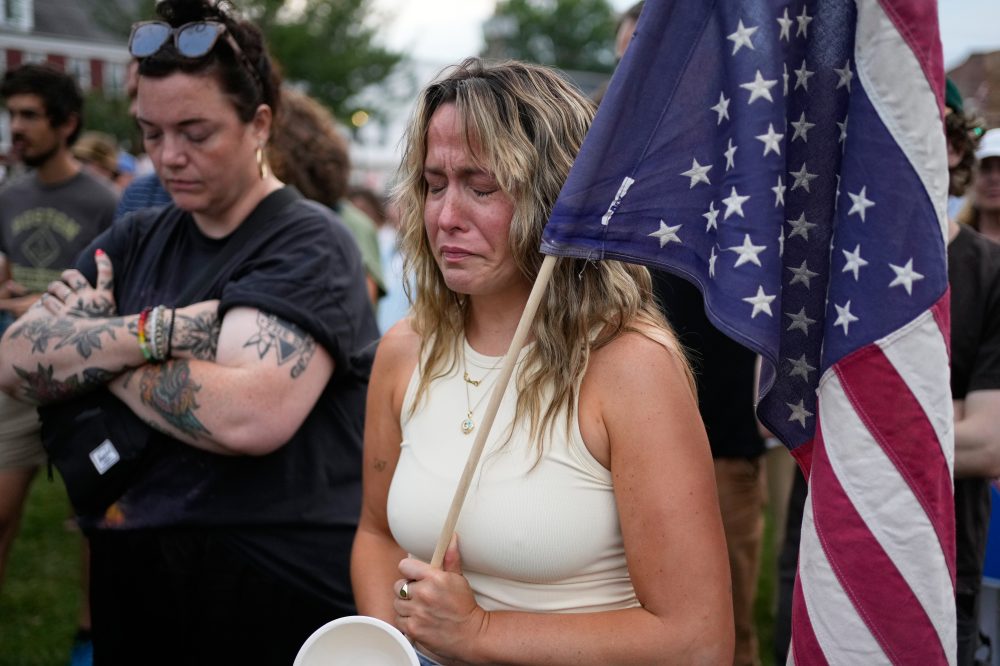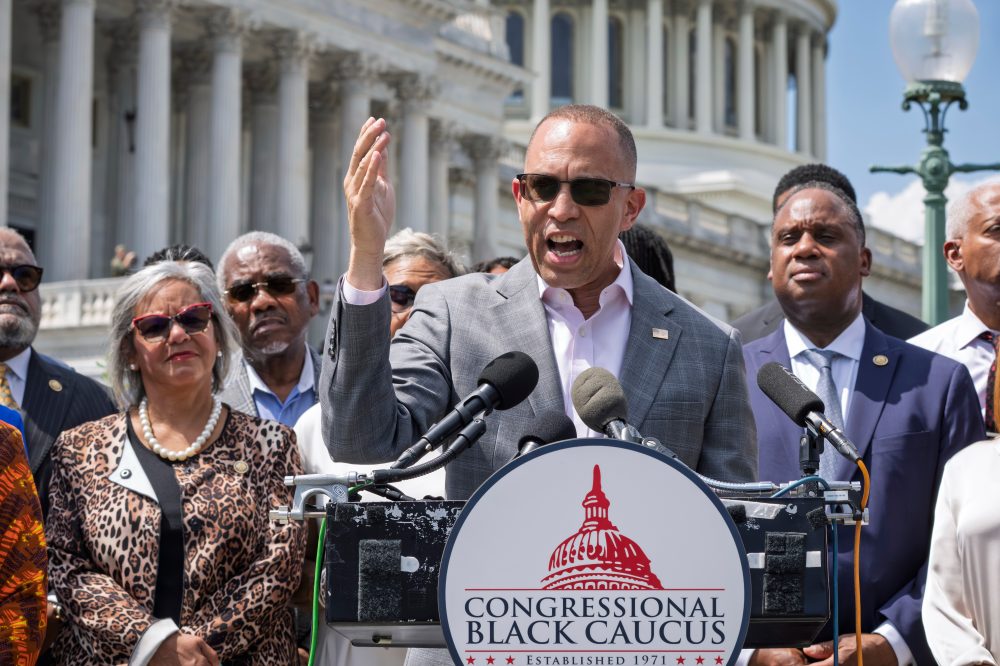

WASHINGTON — Members of the Congressional Black Caucus reached out to major corporations nationwide on Tuesday, asking them to take a stand against Republican-controlled states’ efforts to redraw congressional maps that would eliminate districts with Black majorities.
The lawmakers sent correspondence to more than 250 businesses, including many that have previously voiced support for voting rights and racial justice causes. The letter asks these companies to speak out against what the caucus members characterize as “coordinated efforts to silence Black voices at the ballot box.” Many of these same corporations had joined together five years ago to urge Congress to pass the John Lewis Voting Rights Act, legislation aimed at strengthening voting protections.
The 2021 business coalition, known as Business for Voting Rights, included some of America’s largest and most influential corporations such as Apple, Amazon, Google, Meta, Microsoft, Tesla, Salesforce, Target, PayPal, Intel and Starbucks.
This latest appeal represents another attempt by the Congressional Black Caucus and supporters to build opposition against Republican-controlled states that are redrawing electoral boundaries in ways that could weaken Black political influence. Multiple states have begun eliminating congressional districts currently represented by Black Democratic officials following a recent Supreme Court decision that significantly reduced protections under the Voting Rights Act.
“Corporations that have profited from Black consumers, relied on Black workers, and amassed wealth in part from Black communities cannot look away while Black political power is dismantled in plain sight,” Rep. Yvette Clarke, chair of the Black Caucus, said in an interview.
Clarke characterized the correspondence as “putting corporate America on notice,” though she emphasized the caucus wasn’t seeking confrontation with businesses. The letter recipients included international companies with substantial U.S. operations.
Last week, the caucus also urged Black athletes to boycott public universities in states engaging in gerrymandering to eliminate Black-held districts. The Congressional Black Caucus has 59 members, all Democrats, with more than one-third representing Southern states.
Several lawmakers have suggested that widespread demonstrations and federal legislation may be needed to counter the redistricting efforts in Republican-led states. Any new federal voting rights legislation would likely require Democrats to control both congressional chambers and the presidency.
Company responses to these requests remain uncertain. The Associated Press was making efforts to contact them.
“Many companies that previously issued statements after the murder of George Floyd, pledged billions toward racial equity initiatives, and spoke forcefully in defense of democracy following January 6 now face a defining test of whether those commitments were rooted in principle or convenience,” the caucus’ letter states.
This action also highlights ongoing tensions between the caucus and corporate America. A 2024 Black Caucus analysis found that lawmakers were “troubled that some corporations that made pledges in 2020 have taken several steps in the opposite direction,” including backing away from or failing to implement workplace diversity commitments.
“We understand who the occupant in the White House is and the reality of Republicans being in charge,” Democratic Rep. Steven Horsford of Nevada said of the caucus’ message. “But what corporate America also understands is that there will be a shift at some point.”
The correspondence requests that companies publicly denounce the redistricting plans, schedule meetings with Black Caucus members to discuss corporate responsibility in protecting voting rights, and reveal their political contributions to Republican officials in states conducting congressional redistricting.
President Donald Trump initiated this uncommon mid-decade redistricting wave last year by encouraging Texas legislators to redraw their maps to create additional Republican seats. While Democratic-controlled California also responded, primarily Republican states have been redrawing boundaries as the party works to preserve its House majority in this year’s midterm elections.
The Supreme Court ruling accelerated these efforts by permitting even more Republican states to redraw congressional boundaries that had previously safeguarded minority communities.
Horsford, who led the Black Caucus during President Joe Biden’s Democratic administration, said the caucus is insisting that companies “stand on the side of democracy, fairness and equal representation.”
“This is about power, who holds it and what it’s used for,” he said. “And when you’re diluting Black economic and political power, we need to know where these companies stand in this moment, and what side of history they’re on.”