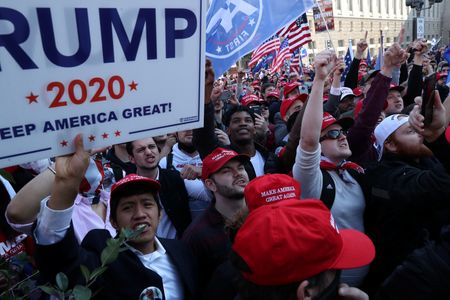

WASHINGTON – A Reuters analysis reveals that President Donald Trump has made false assertions about the 2020 election being stolen from him no fewer than 107 times during the past six months, maintaining this grievance as a central focus while facing new political challenges from international conflicts and approaching midterm elections.
The analysis of Trump’s public appearances, interviews and social media activity shows he addresses this topic almost daily, often in concentrated bursts. During one April Saturday, while a delicate ceasefire with Iran was in place, Trump made allegations about the 2020 election – which he lost to his predecessor Joe Biden – seven times on his Truth Social platform.
Trump has brought up these assertions during no fewer than six meetings with international leaders, two professional sports team celebrations, and White House ceremonies for Hanukkah and Christmas. During impromptu comments at the World Economic Forum in Davos, Switzerland, this past January, he stated “people will soon be prosecuted for what they did.”
He brought up his assertions of election manipulation at a White House gathering for lawmakers last week and once more when speaking with reporters before getting on Air Force One.
“If we had Jesus Christ come down and count the votes, I would have won California,” Trump stated about the consistently Democratic state where he lost by 29 percentage points in 2020 and more than 20 percentage points in 2024. “But it’s a rigged vote.”
Staff members and interviewers frequently dismiss his remarks, while critics characterize them as complaints from someone who cannot accept defeat.
However, Trump’s persistent emphasis on 2020 indicates a forward-thinking approach designed to support new voting limitations, strengthen party allegiance and motivate supporters before November elections that will decide Congressional control, according to two White House officials and two people familiar with the situation who received anonymity to speak openly.
By portraying the 2020 election as invalid, he is also preparing to contest Republican defeats and weaken Democrats should they regain power, several election experts stated.
“He’s not looking back; this is about the midterms,” said Alexandra Chandler, an election expert at the nonpartisan advocacy organization, Protect Democracy. “He’s trying to create a fog of disinformation with this. So then if he dials it up further with federal interference, the public will not react as surprised.”
This past April, despite having initiated a nationwide redistricting battle months before, Trump criticized Virginia’s election results for redrawing U.S. congressional district maps as “rigged,” without offering evidence of fraud.
“President Trump is committed to ensuring that Americans have full confidence in the administration of elections, and that includes totally accurate and up-to-date voter rolls free of errors and unlawfully registered non-citizen voters,” White House spokeswoman Abigail Jackson said in a statement.
REPUBLICAN VOTERS SYMPATHETIC TO FALSE CLAIMS
Trump’s messaging has found support among Republican voters. A Reuters/Ipsos poll from April showed that 63% of Republican voters accept Trump’s false assertion that the 2020 election was stolen, a percentage that has stayed mostly consistent in recent years.
An even larger portion of Republicans – 82% – expressed agreement that significant numbers of fraudulent ballots are submitted by non-citizens in U.S. elections.
In contrast, just 9% of Democrats and 21% of independents stated they believed Trump lost in 2020 because of misconduct, and 18% of Democrats and 38% of independents expressed worries about non-citizens submitting fraudulent ballots.
Numerous courts, state officials and previous investigations found no evidence of widespread fraud in the 2020 election.
Despite this, Trump appointed an election-security czar last year to reinvestigate his 2020 defeat. Those new investigations have produced no fresh evidence, Reuters reported in April. Administration officials also attempted last year to prohibit voting machines used in more than half of U.S. states while considering how the federal government could assume control over state-managed elections, Reuters reported last week.
Trump’s 2020 messaging became more intense in December after he attempted to pardon Tina Peters, a Colorado county clerk who was convicted by the state of interfering with voting machines following that election. He repeated the accusations while urging congressional Republicans to approve his Save America Act, which would mandate proof of citizenship for voting, and again while increasing criticism of mail-in voting.
While the U.S. Senate has not moved forward with Trump’s national voting modifications, many states have enacted similar proof-of-citizenship requirements and more stringent identification rules. Trump has also issued executive orders attempting to restrict mail-in voting, but those measures are currently being contested in court by Democrats.
SOME REPUBLICANS PUSH BACK
Meanwhile, Trump has employed his 2020 assertions to shift responsibility for difficult global conflicts and domestic policy disagreements.
In December, as the Ukraine war continued despite Trump’s 2024 campaign promise to end it within a day, the U.S. president informed Ukrainian President Volodymyr Zelenskiy that the “rigged” U.S. election enabled Russia’s 2022 invasion. In February, he told families who had lost relatives in immigration-related crimes that they would be “home with your son, daughter” if the election had not been “rigged.”
The 2020 election has also become a test of allegiance for many of Trump’s nominees for important federal positions, including judicial candidates, who have declined under oath to confirm to Democratic senators that Biden won. Instead, they state only that Congress certified the election in his favor.
However, some Republicans are resisting.
RightCount, a group of Republicans in competitive states, recently restarted a campaign to protect the integrity of state-run elections and oppose Trump’s attempts to federalize them.
“All the accusations that have been made have all been refuted, but he doesn’t want to listen,” said former Arizona Governor Jan Brewer, a supporter of Trump and a member of the group.
After losing his Republican primary in Louisiana last week when Trump declined to endorse him, U.S. Senator Bill Cassidy criticized the president’s election manipulation claims in his concession speech. Cassidy angered the president by supporting his impeachment following the January 6, 2021, Capitol attack by Trump supporters attempting to halt the 2020 election certification.
“When you participate in democracy, sometimes it doesn’t turn out the way you want it to,” Cassidy said. “But you don’t pout. You don’t whine. You don’t claim the election was stolen.”