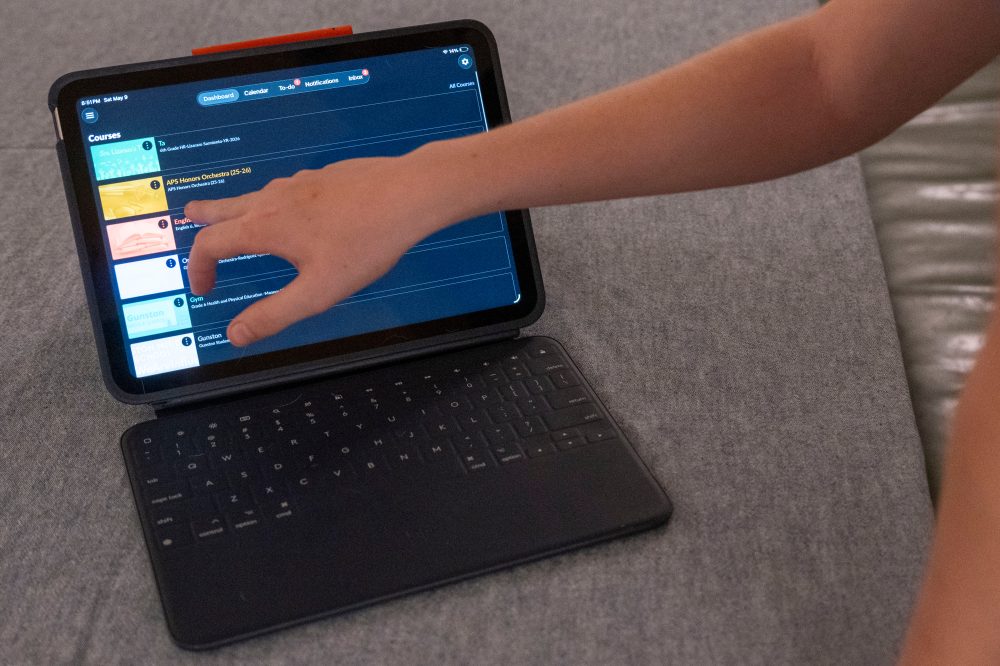

Not too long ago, public schools nationwide were in a race to provide every student with a laptop computer. Los Angeles middle school educator Anna Soffer recalls those days clearly: “The idea was that technology is the future, so we need to put tech in every child’s hands.”
Today, that discussion has completely reversed course. Following massive investments in laptops, tablets and educational applications, numerous schools are confronting a technological reality check. Screen usage has overwhelmed classrooms, and increasing numbers of parents, educators and school systems are demanding a reduction.
“The Chromebook is just a world of distraction,” explains Soffer, who instructs 6th grade English and history. While she prefers traditional pen-and-paper work, she must utilize laptops and digital applications for specific classroom activities. “Every day, I’m battling, ‘Who would you rather listen to, Ms. Soffer or Minecraft?’”
The district where Soffer works, Los Angeles Unified, recently made history as the first major school system to announce it will discontinue providing devices to its youngest learners. This decision is part of comprehensive screen-time regulations being implemented this fall throughout the nation’s second-largest educational system.
An extensive resolution approved last month by the Los Angeles school board mandates the district to remove devices through second grade; establish daily and weekly screen limitations for all upper grades; restrict YouTube access on school equipment; and prohibit device usage during lunch and recess at elementary and middle school levels. The district will also examine its educational technology agreements, which the teachers union reports total $1.6 billion.
The Los Angeles restrictions are strengthening reform movements emerging nationwide. In numerous instances, parents who previously advocated for school cellphone prohibitions, which have now become standard practice, have shifted their focus to a different concern: school-provided devices.
This movement for change is evolving into a public policy matter. According to Ballotpedia, at least 14 states have introduced legislation to restrict screen time in educational settings. Federal authorities issued an advisory last week cautioning that excessive screen usage among young people is developing into a significant public health issue.
In Los Angeles, worried parents established a coalition called Schools Beyond Screens last year and applied pressure on the district through school board appearances, social media campaigns and private discussions with administrators. Many express frustration about attempting to control screen time at home while schools mandate screen usage.
Katie Pace, a mother of three children, works diligently to minimize screen exposure. Her household contains one shared iPad and one television, prohibits screen time on weekdays, and bans screens from bedrooms. Her 8th grade daughter, Clementine, does not own a phone.
However, once Clementine boards the wifi-equipped school bus, her day becomes digitally focused.
During the 30-minute journey to school, Clementine views YouTube videos on her school Chromebook.
In Spanish class, coursework utilizes the Duolingo application, though many students rely on Google Translate for answers, Clementine reported. Frequently, children play games on their phones, which should be secured. In algebra, Clementine uses her finger on a touch screen to work through equations. In history, quizzes, tests and writing tasks are computer-based.
Nearly all homework assignments are digital. Previously, Clementine would return home and read books, her mother noted, but this no longer occurs. Reviewing her daughter’s device activity, Pace discovers she spends hours daily streaming music, creating Spotify playlists, and viewing makeup tutorials and cat videos on YouTube.
“It makes me furious,” stated Pace, a Schools Beyond Screens member. “My daughter went to middle school and was sent home with a screen addiction in her backpack.”
The initiative to provide every child with a device and bridge the “digital divide” began more than ten years ago but gained significant momentum during the COVID-19 pandemic.
Education transitioned online immediately in March 2020. Schools hurried to supply students with necessary devices for remote learning. When the 2021-2022 academic year began, 96% of U.S. public schools reported providing digital devices to students requiring them, according to the National Center for Education Statistics.
Many schools redirected funding from textbooks, workbooks and printed materials to digital options. Educational technology, or edtech, grew into a multibillion dollar sector.
“During the pandemic, getting kids devices was a lifeline. Now, it’s time that we reset,” said Nick Melvoin, the school board member who authored the new resolution.
Melvoin believes few Los Angeles classrooms utilize screens effectively to enhance learning. Too frequently, he noted, teachers substitute instruction with online applications and employ screens “as a crutch.”
The difficulty, educators explain, is that technology has become so integrated with learning, particularly for older students, that disconnecting from screens at school is complex.
In the wealthy Philadelphia suburb of Lower Merion, parents initiated a petition drive for the option to remove their children from digital device requirements during school, questioning edtech’s advantages. The district has stated that opting out is impossible.
“If there’s really no evidence that it helps, and in fact there’s evidence that it’s harmful, what are we doing? Test scores are at their lowest point,” said Alex Bird Becker, one of the founders of PA Unplugged.
Other schools are discovering financial benefits to discontinuing home device distribution for every child.
The third-largest district in California, Fresno Unified, spends $4 million annually on laptop repairs and replacements. Partially to reduce expenses, the district has instructed its 40,000 elementary students to return their take-home laptops and will limit computer access to classroom use only this fall, spokesperson AJ Kato reported.
Near Los Angeles, the district stopped sending devices home for younger students this year partly due to expensive repairs, but also because they were used for “inappropriate Google searches” and video games, according to a parent memo. The district now keeps the devices in school storage carts.
A group of parents in Arlington, Virginia, met on a recent Saturday evening to discuss their children’s battles with screen addictions and other consequences of school-issued devices.
“None of us are Luddites. I know that technology adds value, but I also don’t want my son on YouTube all the time,” said LuAnn Oliver, who hosted the gathering in her living room. Her 6th-grade son has difficulty tracking online assignments and resisting the iPad’s temptation for video games. “We get reports on websites he’s visited. He’s visiting a game site in nearly every class.”
The district has ceased distributing iPads before first grade and is implementing new elementary school restrictions, but students in 6th through 12th grades will continue to receive mandatory school-issued devices.
Another mother, Jenny Sullivan, reported noticing her 4th grade son capitalizing random letters without correction because paper-based work is minimal. She also has social concerns: Her 6th grader avoids the afterschool program because everyone uses their iPad. “I’d rather be home,” he tells his mother.
Following a three-hour meeting, the parents developed a strategy to approach the school in the fall with a collective request to “opt-out of technology and opt-in to textbooks and paper.”
“Ten years from now,” said one mother, Kristina Jackson, “I can’t imagine us looking back with any other reaction than: How could we have been so naive that we just handed these devices to our kids.”