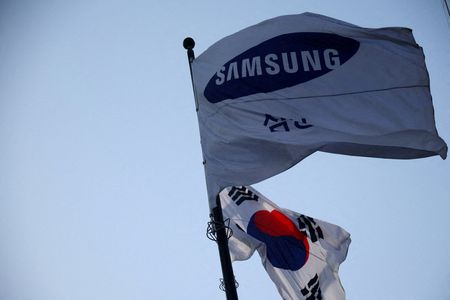

A labor organization representing workers in Samsung Electronics’ consumer electronics divisions announced Tuesday it has petitioned a South Korean court to halt voting on a compensation agreement that predominantly advantages employees in the company’s semiconductor operations.
The settlement, brokered by government mediators last week and ending an 18-day work stoppage involving 48,000 employees, offers substantial bonus payments to personnel in Samsung’s memory chip sector, which has experienced significant profit growth during the artificial intelligence surge.
Union members began casting ballots Friday, with the voting process scheduled to end Wednesday morning. The agreement is anticipated to receive approval from participants.
The Samsung Electronics Co Union (SECU), representing approximately 13,000 workers primarily from the corporation’s mobile phone, television, and household appliance sectors, released a statement explaining it pursued legal intervention after learning it was excluded from participating in the vote.
Internal disputes led the SECU to withdraw from the bargaining process before negotiators finalized the agreement.
The Samsung Electronics Labor Union (SELU) spearheaded the talks and reported Tuesday that over 90% of its 57,290 eligible members had already submitted their votes, though results were not revealed.
Ratification requires both majority participation from qualified union members and majority support among those voting. Failure to meet these thresholds would force negotiations to begin anew.
Certain consumer electronics staff belonging to another labor group, the National Samsung Electronics Union (NSEU), which has also expressed dissatisfaction with the agreement’s terms, are opposing the deal, according to NSEU representative Lee Ho-seok.
He noted that some foundry employees within Samsung’s chip operations are similarly dissatisfied with the arrangement and voiced optimism that members might reject it, despite acknowledging this outcome appears improbable.
“We hope to pull off a miracle,” he said.
The NSEU claims roughly 20,000 members according to its website, with most working in chip manufacturing.
Samsung represents approximately 25% of the nation’s export revenue, and the settlement has brought considerable relief throughout South Korea. The labor dispute has nonetheless revealed significant disagreements about distributing profits from the AI industry expansion.
Certain memory chip employees at the company are positioned to earn combined bonuses totaling around $416,000 this year.
Staff in Samsung’s foundry and logic chip design departments will collect smaller but still considerable bonus amounts, while workers in other areas including mobile devices and home appliances will receive more modest payments.
A small coalition of individual investors has also declared intentions to file legal action should union members approve the deal, contending that portions of the agreement violate regulations without shareholder authorization.
Samsung’s stock price closed 2.2% higher Tuesday. Shares have climbed 8% since the agreement was announced last week, though this increase trails the 18% jump recorded by competitor SK Hynix.