
Top diplomats from four major Indo-Pacific nations are convening Tuesday in New Delhi, working to breathe new life into their strategic alliance that observers say has lost steam during President Donald Trump’s administration.
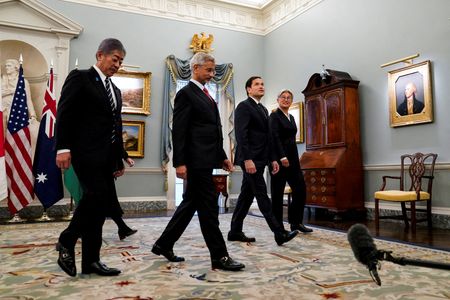
The foreign ministers gathering represents the third such diplomatic meeting since September 2024, bringing together Australia’s Penny Wong, India’s S Jaishankar, Japan’s Toshimitsu Motegi and U.S. Secretary of State Marco Rubio.
Plans for a leadership summit in India last year fell through as tensions mounted between Trump and Indian Prime Minister Narendra Modi over Washington’s trade tariffs and other disagreements.
Despite these challenges, the four countries remain united in their concerns about China’s expanding influence in the region. Rubio, who touched down in India Saturday for a four-day diplomatic mission focused on strengthening ties with New Delhi, has emphasized the critical need to preserve a “free and open Indo-Pacific.”
Speaking to Indian media Sunday, Rubio outlined his vision for the partnership’s future. “We don’t just want the Quad to be a semi-annual meeting of like-minded countries,” he explained. “We want it to actually be a forum on which we continue to partner on things.”
The U.S. Secretary of State called for the Quad to pursue “concrete actions” in areas such as maritime security and critical minerals cooperation, while diplomatic teams work toward arranging a leaders’ summit before year’s end.
“I don’t have a date on that yet, but hopefully this year we’ll find a time for all four leaders to get together,” Rubio stated.
Japan has particular urgency in diversifying its critical mineral sources after Beijing halted shipments of materials essential for aerospace, defense and semiconductor manufacturing following a recent diplomatic clash.
The diplomatic gathering occurs amid ongoing U.S.-Iran negotiations potentially aimed at resolving their three-month standoff and reopening the Strait of Hormuz.
Tehran’s blockade of this vital shipping lane has thrown energy markets into chaos and disrupted the worldwide economy, creating an issue expected to dominate Quad discussions.
Earlier Quad initiatives have focused on preserving “the free and open maritime order” throughout the Indo-Pacific by enhancing intelligence-sharing about regional maritime activities.
A Japanese foreign ministry official indicated last week that Japan anticipates discussions will address the U.S.-Israeli conflict with Iran, alongside rising tensions in the East China Sea and South China Sea, where China’s increased military activity in contested waters has heightened friction with Tokyo, the Philippines and neighboring nations.
Beijing has denounced the Quad as a Cold War-era mechanism designed to restrict its growth and development.
India also faces territorial disagreements with China, though Modi had indicated openness to improving relations with Beijing during his disputes with Trump.
New Delhi has advocated for a Trump visit to India, a trip that would likely coincide with a Quad summit. Political analysts have raised concerns that the absence of high-level leadership engagement may have diminished the Quad’s strategic significance.
The Japanese official noted that India, as the host nation, would determine when a leaders’ meeting could be scheduled.
“It is quite difficult to get all four leaders together,” the official acknowledged.
Trump’s attention has been divided by the Iranian conflict, failed attempts to resolve the Ukraine situation, and strained relationships with Quad partners due to his broad tariff policies.
However, Trump recently praised Modi during a phone call to a U.S. reception in New Delhi Sunday, expressing his affection for the Indian prime minister.
“India can count on me, 100%,” Trump declared.