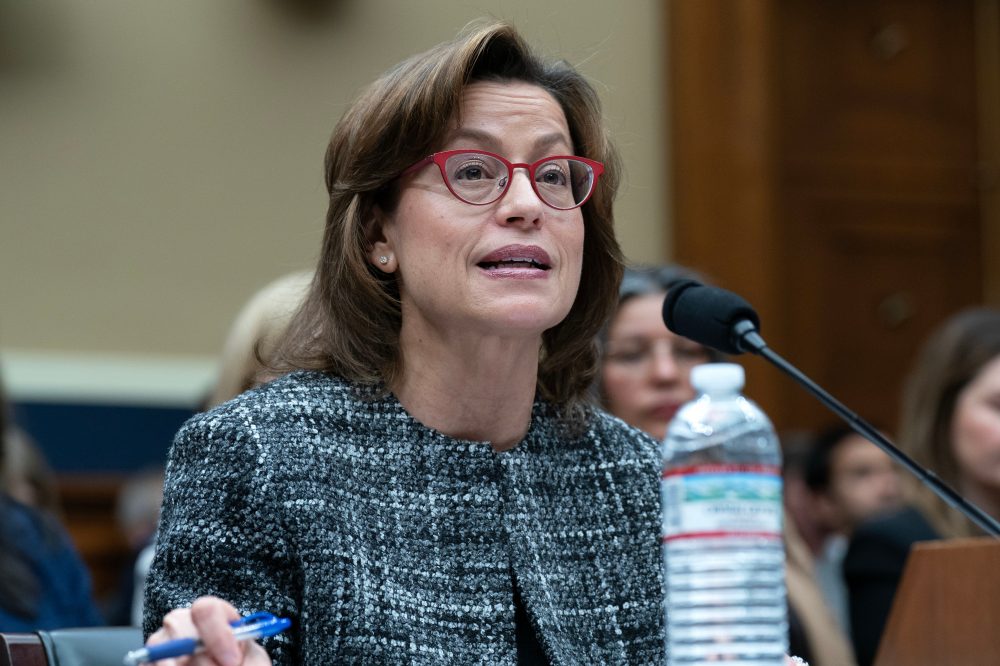

WASHINGTON — Each morning, Anna Gomez reaches for her phone with the same question: Has the president terminated her employment today?
As the only remaining Democratic member of the Federal Communications Commission, Gomez finds herself in an increasingly urgent battle against what she characterizes as government efforts to silence media outlets and restrict free expression.
Disney, which owns ABC, has become her primary concern as the company faces multiple FCC investigations initiated under Chairman Brendan Carr, an ally of the current administration.
Earlier this month, Gomez sent an extraordinary four-page communication to Disney CEO Josh D’Amaro, detailing what she termed the FCC’s “sustained, coordinated campaign of censorship and control” targeting the entertainment giant. Her letter highlighted investigations spanning diversity policies, ABC’s handling of a 2024 presidential debate, guest selections on “The View,” and administrative demands for late-night host Jimmy Kimmel’s dismissal.
Gomez expressed particular alarm over the FCC’s decision to expedite reviews of ABC’s broadcasting licenses for its owned stations, viewing this as an intimidation tactic. She characterized this move as “the most egregious assault on the First Amendment this FCC has taken to date.”
Her core message was direct: Resist these pressures. Gomez criticized Disney’s controversial choice to settle a $15 million defamation case just before the administration change, arguing it failed to protect the company and established a dangerous industry precedent.
“That settlement did not buy you peace,” she stated in her letter, which she simultaneously shared on social media platforms. “It only bought you time.”
While D’Amaro has not publicly addressed Gomez’s letter, he has indicated a shift in strategy through recent filings, claiming the FCC’s actions threaten to “chill critical protected speech.”
Speaking from her Washington headquarters, Gomez expressed encouragement about Disney’s new stance and urged other broadcasting companies to prepare for similar confrontations. She represents a rare presence in the capital – among the few Democrats retaining federal agency positions after widespread dismissals aimed at reshaping government bureaucracy.
The Supreme Court is currently examining the legality of these dismissals, with a ruling expected in coming weeks.
Gomez’s current term concludes June 30, though she can continue serving unless dismissed or replaced. Her continued presence enables the commission to maintain quorum, allowing Carr to advance his policy objectives. Given the Senate’s tight margins and limited time before midterm elections, securing a replacement would prove challenging.
Key excerpts from her recent interview:
When asked about her motivation for contacting Disney, Gomez explained: “At the beginning of this administration, I was growing increasingly alarmed by what I saw as this administration’s campaign to control and censor speech. And so I embarked on a tour across the country where I was talking to journalists, local broadcasters, legal scholars, press freedom advocates. And what I came back with was more of a conviction that we really needed to do something.”
She continued: “Then I started watching the capitulation. We saw CBS settle its lawsuit with the president and then agree to terms that basically require an ombudsperson to oversee the content of the network in order to get its transaction approved by the FCC. We saw ABC, of course, settle its lawsuit and I grew more and more and more concerned about the fact that this capitulation breeds capitulation.”
Regarding her strategy, Gomez stated: “I wrote the letter and the letter had two goals in mind. One was to basically put on the record and call out everything that this FCC has done to try to bring Disney to heel but also to encourage it and other broadcasters to stiffen their spine. We know, based on the record of this administration, every time it gets taken to court for these violations of the First Amendment and against the freedom of the press, it loses.”
On potential court challenges, she said: “In the end, what I want is for companies to push back because if this gets to court, any entity that challenges what this FCC is doing is going to win.”
Discussing the FCC’s proper role, Gomez explained: “Traditionally, the FCC has licensed the local broadcast stations, and what we license is actually their spectrum, their airwaves over which they broadcast their television, their radio. And it has done so with three basic principles in mind. Competition, because competition’s always good for consumers and for viewers and for the market. Localism, which really means serving your local market, whether that means actually airing 24 hours a day the content, but truly local content. And finally, viewpoint diversity. We want to encourage more voices, not fewer. And that is, I think, the right role for the FCC. Being a censor is not the right role for the FCC.”
Reflecting on her unexpected role, she noted: “No, never in my entire career did I think that I would be having to speak up this strongly for the First Amendment in our Constitution and our democracy. As you said, I’m a bit of a technocrat. I’m used to talking about the airwaves and I’m used to talking about broadband and how important it is for everyone to have access to broadband. I’m used to talking about really boring things like how to attach to light poles. But media wasn’t something that I particularly thought I would have to really delve into. But, like I said, this administration has just been alarming me so much and so I’ve had to pivot.”
On maintaining professional relationships despite disagreements: “You know, we do have a collegial relationship and we do work well together. He has been in my position and he understands my need to speak out and I do so freely, knowing that some day I may face the consequences for it. But we do work at maintaining a cordial relationship.”
Regarding potential dismissal: “Yes, especially when I saw last year when the administration was firing all the Democratic members of different independent commissions and bodies. I just checked my email every day. Literally every day I pick up my phone and I say, ‘Am I going to work today?’ And so far, so good.”
About her future plans: “I can continue serving for another year and a half-ish after my term expires as long as no one else is nominated and confirmed for my particular slot. So I intend to continue working and to continue speaking out as long as I can.”