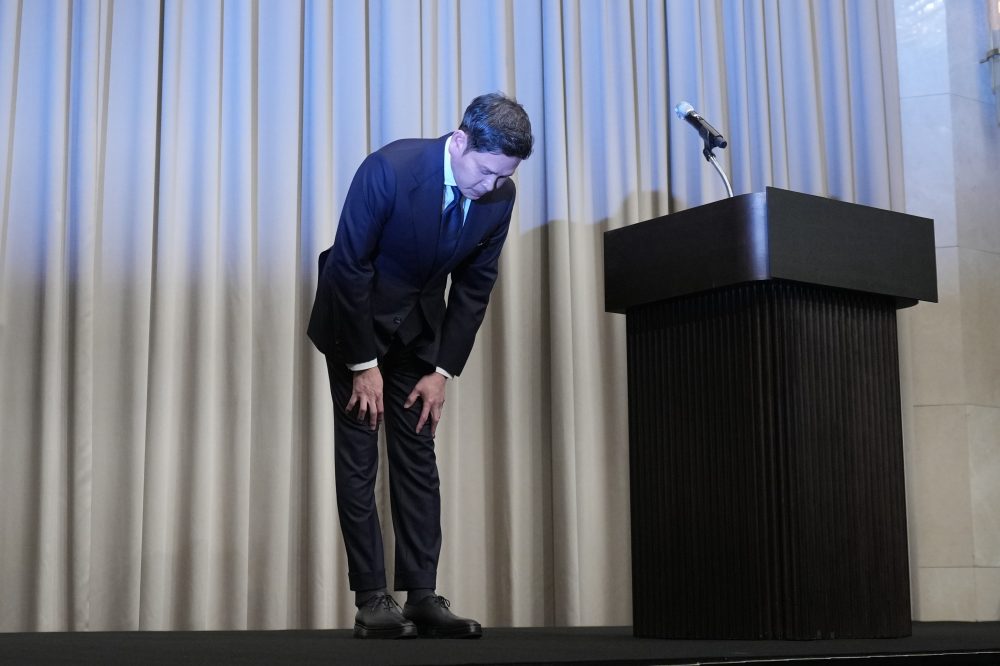

SEOUL, South Korea (AP) — The chairman of South Korea’s Starbucks operations delivered his second public apology within two weeks on Tuesday, following intense criticism over a marketing promotion that many interpreted as disrespectful to victims of a 1980 military assault on democracy advocates.
Chung Yong-jin, who leads Shinsegae Group that controls a 67.5% ownership in Starbucks Korea, performed three ceremonial bows during a broadcast appearance while seeking forgiveness from relatives of democracy fighters killed under the nation’s previous military regime and from citizens at large.
The controversy erupted when the coffee company tried to market a large tumbler called a ‘tank’ by designating May 18 as ‘Tank Day.’ This date marks the anniversary of a democratic revolt in Gwangju, a southern city where military forces using troops, armored vehicles and aircraft violently crushed the movement, resulting in hundreds of deaths and injuries.
The marketing effort further inflamed public anger by featuring the phrase ‘Thwack it on the table!,’ which many interpreted as referencing an infamous 1987 police explanation that sought to conceal the torture killing of student protester Park Jong-chol. Authorities had claimed Park suddenly died after investigators ‘hit the desk with a thwack.’
Public fury was swift, prompting Shinsegae to halt the campaign within hours and dismiss Starbucks Korea’s chief executive. Law enforcement also launched an inquiry following complaints from families of Gwangju victims.
‘I take it very seriously the fact that many people felt deep pain and anger because of Starbucks Korea’s inappropriate marketing campaign,’ Chung stated Tuesday.
He additionally urged the public not to direct their anger toward store employees, emphasizing that leadership bears the responsibility. No significant incidents at retail locations have been reported.
Chung’s initial apology came on May 19, when he released a statement acknowledging the campaign brought ‘deep pain to the victims and bereaved families of the May 18 Democratization Movement as well as to the public.’
Jeon Sangjin, a top Shinsegae Group official, indicated the company hasn’t discovered definitive proof that Starbucks Korea marketing staff deliberately intended to ridicule the pro-democracy movement, claims the workers have rejected.
Nevertheless, he noted some staff members declined management’s requests to surrender their mobile phones during a seven-day internal investigation. Jeon stated the company would review findings from the police examination and terminate any employee proven to have intentionally mocked protesters.
The campaign backlash has generated widespread boycott demands, supported by government leaders including Interior and Safety Minister Yoon Ho-jung, who announced Starbucks items would be banned from government functions and criticized the company’s ‘anti-historical behavior.’
President Lee Jae Myung posted on X last week that the campaign demonstrated ‘inhumane and disgraceful behavior by cheap profiteers who deny the values of the South Korean community, basic human rights and democracy.’
The Gwangju suppression occurred months following General Chun Doo-hwan’s power seizure through a late 1979 military takeover. Official documents indicate approximately 200 deaths in Gwangju, though activists believe the actual casualty count was significantly higher. Chun’s administration also jailed tens of thousands under the guise of eliminating social problems.
Public fury regarding Chun’s authoritarian rule sparked massive nationwide demonstrations in 1987, compelling him to approve constitutional changes establishing direct presidential voting, commonly regarded as the beginning of South Korea’s democratic transformation.