
WILER, Switzerland – One year has passed since a catastrophic glacier collapse wiped out the Swiss village of Blatten, and residents are demonstrating remarkable resilience as they work to rebuild their shattered community.
Standing prominently above Switzerland’s Loetschen Valley, Hotel Momentum represents hope and determination in the face of devastating loss. The wooden structure, completed in just 105 days near the adjacent town of Wiler, serves as a powerful example of how displaced villagers are piecing their lives back together following the natural disaster.
A German-language wooden plaque at the hotel’s front desk delivers a poignant message that captures the spirit of many who lost everything: “The past is no longer, the future is not here yet, life is here and now.”
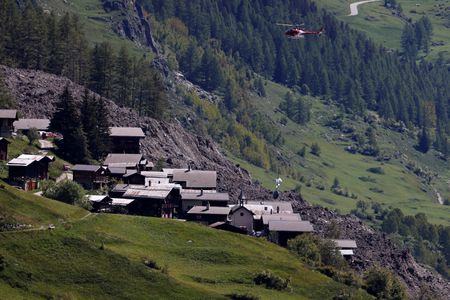
Through the hotel’s windows, visitors can gaze across rugged mountain peaks toward the site where Blatten previously existed — now transformed into a gray expanse of rubble and a turquoise lake, with rooftops of buried homes still protruding from the water.
The catastrophe unfolded after several days of official warnings. Government officials ordered the evacuation of more than 300 village residents when falling rocks destabilized the Birch glacier positioned above their community. On May 28, 2025, an avalanche of stone, earth and ice thundered down the slope in an enormous dust cloud, covering most of Blatten.
Scientists have connected the glacier failure to climate change impacts throughout the Alps. Melting permafrost undermines rock formations that were once permanently frozen — creating concerns about whether settlements like Blatten can be safely restored.
Despite these challenges, reconstruction blueprints target completion around 2030. Meanwhile, former villagers such as hotel proprietor Lukas Kalbermatten have been forced to begin anew.
Kalbermatten’s family lost the Hotel Edelweiss, which served as both their residence and a three-generation family enterprise. Following their safe evacuation, he partnered with another displaced Blatten hotel operator to establish Hotel Momentum.
BEGINNING AGAIN
Almost twelve months later, Kalbermatten describes his journey using grief as a comparison.
“In the grieving process, there’s always that first time, isn’t there? For us, it was the first church service, then the kids’ first St. Nicholas Day that wasn’t spent at home, then the first Christmas,” he explained. “And now this anniversary is coming up, and I think then we’ve made it once around, right?”
Welcoming visitors once more has created conflicted feelings. “Now you’re welcoming them back in a different place and it’s difficult,” Kalbermatten noted. “Some of them are very sad themselves, still almost in shock.”
Throughout Momentum’s interior, subtle touches honor Blatten — including throw blankets designed to match those from the destroyed village — though the facility itself is planned as temporary. Stairwell walls remain incomplete, and the building serves as a five-year interim measure before potential disassembly and relocation.
RESTORATION ‘WILL TAKE TIME’
Authorities report that progress toward reconstructing Blatten remains on schedule. Road reconstruction commenced last month, and if everything proceeds as planned, residents whose properties survived could potentially return this year. By 2029, major benchmarks should enable wider resettlement.
Manfred Ebener, construction project lead of the Blatten 2030 coordination group, emphasized that the focus involves creating a village capable of lasting for coming generations, regardless of whether all former residents choose to return.
“Rebuilding Blatten will take time before the village can return to a size similar or the same as what it was before. We realise that some of us may not live to see that happen,” he stated.
With climate change threats increasing, surrounding mountains, including those near Kandersteg, face continuous monitoring. Several kilometers from Blatten, isolated fragments breaking from the Oigschtchummun glacier triggered preventive road closures this month.
However, specialists indicate that the collapse that devastated Blatten was uncommon. Matthias Huss, head of the Swiss glacier monitoring network, informed the media outlet Swissinfo that the Birch glacier collapse resulted from an exceptional accumulation of rock, and warned against making direct comparisons.
RETURNING HOME?
For Daniel and Karin Ritler, reconstruction has involved transforming their means of earning a living.
Prior to the catastrophe, their work encompassed everything from sheep farming to glamping accommodations and food service. One month following the upheaval of their world, they started planning a fresh beginning.
They are currently launching a new hotel within the Loetschen Valley, explaining that additional lodging is essential — not just for visitors, but also for homeless residents. Through April, they remained in temporary housing.
The pair has since relocated to an apartment within their new hotel, scheduled to debut later this year under the name Zeitlos, meaning “timeless.”
While official statistics are unavailable, Kalbermatten believes approximately 80% of Blatten’s previous residents continue living in the valley. Students from the village still attend identical schools in Wiler.
As reconstruction efforts advance, the mountainside’s stability cannot be assumed, and Blatten’s future remains unclear.
“We’re not saying we will never go back to Blatten, and we also can’t say we will be back in Blatten at this or that time. That will have to unfold,” Daniel Ritler explained.
For others, the choice is more definite.
“Personally, we will certainly go back. That’s not really up for debate for us,” said Kalbermatten.