
Marie Lansley recently relocated to San Francisco for a new job while simultaneously navigating the world of dating. As she searches for a partner, the 36-year-old said she has been “trying everything” — and that includes turning to artificial intelligence for a little help.
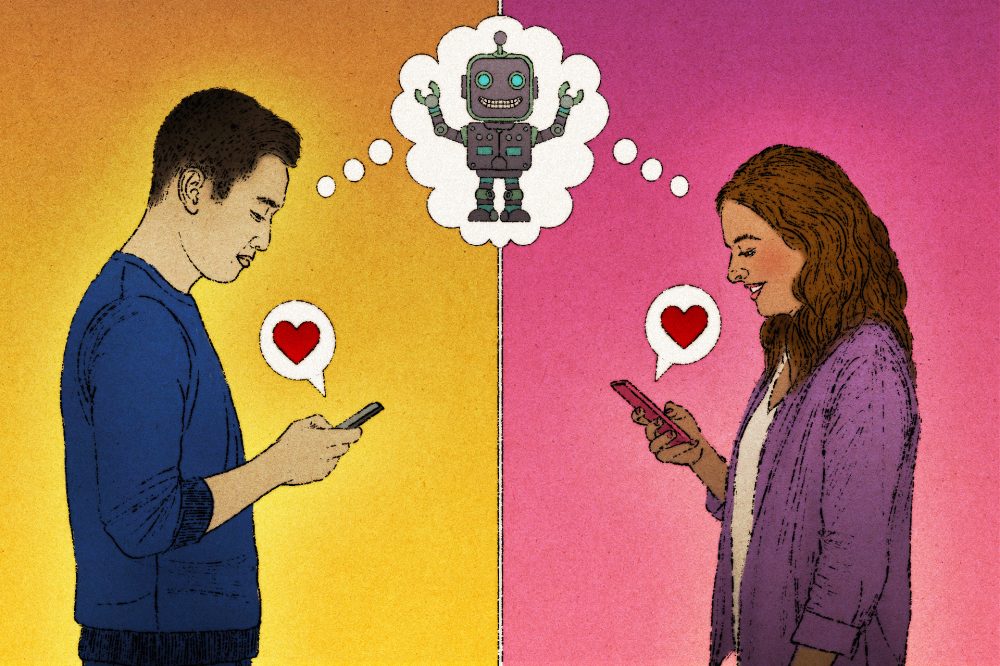
For Lansley and a growing number of singles, AI chatbots have stepped into the role of informal dating coach and relationship advisor.
She consults AI chatbots to help her get conversations going — something she finds awkward on dating apps, even though she has no trouble striking up chats with people face to face. While she remains hopeful about what the technology can offer, she recognizes the tension between romance and algorithms.
“I am open to AI finding me the love of my life, but I’m also not fully convinced that it can,” Lansley said. “AI is great at making dating more efficient. But the chemistry — that’s always going to be analog.”
People are using AI in a variety of ways to pursue romance. Some sign up for AI-powered matchmaking services. Others lean on the technology to polish their dating profiles. The most widespread use, however, is having chatbots write opening messages to potential partners or help decode messages received from them.
Lansley switches between OpenAI’s ChatGPT and Anthropic’s Claude depending on her needs. Other daters rely on tools like Elon Musk and X’s Grok, Google’s Gemini, and similar platforms. Dating apps and AI companies are embracing this trend — both ChatGPT and Gemini have shared content on TikTok highlighting their chatbots’ personalized, character-driven relationship tips.
Dating coach Carey Gaynes drew a literary comparison to describe the phenomenon. “Claude is the new Cyrano,” she said, pointing to the 19th century French play “Cyrano de Bergerac,” in which the main character secretly supplies the romantic words another man uses to woo a woman. “You’re using a voice that isn’t yours.”
Gaynes said she has heard from daters of all age groups who are turning to AI — both through her coaching clients and her YouTube channel, Coffee with Carey. She can see its usefulness but shares a common concern about people depending on it too heavily.
People’s feelings about AI in the dating world span a wide spectrum, from genuine enthusiasm to outright resistance and plenty of skepticism in between.
Lansley said she was caught off guard by how emotionally aware chatbots can seem. When she went through an onboarding process with the AI matchmaker on an app called Known, she said the questions asked by the bot went “one or two levels deeper” than what typical dating apps ask, and the bot appeared to be genuinely trying to show empathy. That said, it didn’t guarantee a great outcome — her first match through the service wasn’t the right fit.
Mason Naung, a 25-year-old student in Los Angeles, said he personally doesn’t use chatbots to come up with messages, but he can understand how they might help with “icebreakers” in those early exchanges with someone new.
“I’ve been on Hinge on and off for a year or two, and sometimes I kind of struggle to think about what the opening line should be like with this girl, right?” he said. Still, he noted that if AI-written messages continued beyond those first few exchanges, that would be a “small red flag” in his view.
Chatbots aren’t just helping people start conversations — they’re also being used to end them. Dani Cohen, a 27-year-old business owner in San Diego, said she would far prefer receiving an AI-written goodbye message from someone she had dated a few times over being “ghosted” — cut off entirely without any explanation.
“Obviously, in a perfect world, everyone knows exactly what they want to say and how to say it in the kindest way possible and they do that. That’s not the world we live in,” she said. “Anything to get people to communicate, and to communicate their thoughts kindly and effectively, is great.”
A number of people who spoke with The Associated Press — including some who have used AI for dating purposes — said they had reservations about applying the technology to such a deeply personal area of life. Many said there was a point at which using AI in dating would feel inappropriate to them.
Others said they wouldn’t consider using a chatbot for their love life at all.
Clara Sullivan, a 22-year-old student in Los Angeles, said she would not respond to a potential partner if she found out their messages had been written by AI. “I think it’s really scary how reliant people are on it,” Sullivan said. “It’s completely gotten rid of people’s ability to think creatively and on their own.”
That concern is widely shared. A 2025 survey from the Pew Research Center found that 53% of American adults believe AI will diminish people’s ability to think creatively. Half of those surveyed said they think AI will make it harder for people to build meaningful relationships.
Despite the unease, the blending of AI with the highly profitable dating industry was probably inevitable. Many dating platforms have been quietly incorporating AI features for years.
Tinder offers an AI-powered tool called Chemistry that recommends profiles based on a user’s preferences. Hinge has AI-driven conversation starters and profile-building tools designed to make interactions easier. Meanwhile, the founder of Bumble recently announced the app will move away from its well-known swipe feature in favor of AI-driven matchmaking. After some pushback, Bumble CEO and founder Whitney Wolfe Herd released a statement saying what they are building “is rooted in a simple belief: technology should make love and connection feel more human, not less.”
Mohammed Nizami, 23, said he uses AI for certain things in his daily life — but romance isn’t one of them. “We’re all craving for some degree of authentic connection. Certainly with your partner, you want that,” he said. “If there’s some filter or barrier between you and your partner or potential partner, I think that’s just not a great way to start a relationship.”
Nizami also questioned whether chatbots even offer the best advice, noting that many tend to be agreeable rather than honest — which might feel reassuring but doesn’t always lead to sound guidance.
Despite all the hesitation, AI’s footprint in modern dating is expected to grow.
“It’s kind of a sad commentary on the state of the world. Dating is supposed to be one of the things that cannot be replaced, right?” said Jake Clay, a 30-year-old content creator in New York City. “It’s kind of sad to think that something so pivotal to your life journey is being outsourced to an AI who can’t understand the emotions around it.”
Clay did note one silver lining: his friends have stopped texting him as often to help them interpret messages from people they’re seeing, since they now go straight to chatbots instead. He joked that he appreciates AI “lifting the load” in that regard — but also called it a “Catch-22,” since it bypasses “some of the normal processes in life that I feel like should be a little bit more sacred.”