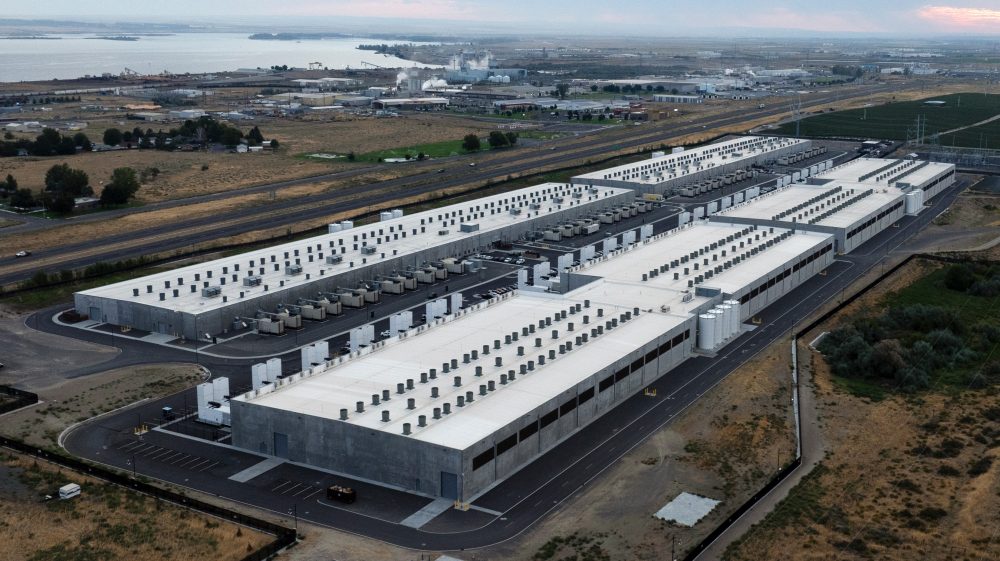

WASHINGTON (AP) — Every online search powered by artificial intelligence is quietly adding to our environmental burden, consuming energy and water at a scale most people never consider.
AI technology and the massive data centers that support it are voracious consumers of both electricity and water — and the companies behind them offer little transparency about just how much of those resources they’re burning through, according to experts. That means every time you ask an AI tool a question, precious natural resources are being used up.
“AI is going in the opposite direction to decarbonization efforts,” said cognitive computer scientist Sasha Luccioni, co-founder and chief scientific officer of the Sustainable AI Group. “We should be thinking about where we are going towards. If you’re recycling and a vegan but then you’re using ChatGPT to do your multiplication for you, well that’s kind of against the trend.”
Luccioni also offered a more hopeful perspective: “It’s like one other thing among many to think about when you’re like developing these daily habits. It is not too late. You are not obliged to use AI for everything. You can opt out, you can have a say and you can kind of just like think about how you engage with this technology.”
At the same time, she noted that major technology companies are making it increasingly difficult by “integrating generative AI into everything. … There’s like this bait-and-switch going on. I feel that nowadays you use the same tools that you used to use, but now they’re generative AI.”
Several experts in water use, artificial intelligence, data center placement, and environmental sustainability say individuals aren’t completely without options.
Their primary recommendation is straightforward: use AI less.
“The cleanest form of AI use is no use,” said Kaveh Madani, a water scientist and director of the United Nations University Institute for Water, Environment and Health in Canada. “So when you could avoid using AI, don’t use it.”
Experts say people should avoid turning to AI for simple everyday tasks like math calculations, getting directions, checking store hours, finding recipes, or building a shopping list — things people handled just fine before AI existed.
“Yeah, it’s great. You can generate a chocolate chip cookie recipe with Claude, or you can open a damn book. Like, those still exist. You really don’t need Claude,” Luccioni said. “You really don’t need all of these generative AI technologies to do day-to-day tasks. I do agree there are some productivity gains to be had but I think that it’s a pretty small percentage of what people are currently using.”
When you do need to use AI, experts advise keeping your queries short and to the point. More words mean more computing power, which means more energy and water consumed. There’s no need to be polite or provide unnecessary background details, Madani and others said.
The scale of the problem is enormous. Last year, data centers worldwide consumed 448 trillion watt-hours of electricity — more than all but 10 countries on Earth — and that figure is projected to more than double within the next four years, according to a new report from the United Nations University. By that point, data center electricity use would rank just behind five nations globally.
By 2030, the electricity alone needed to run data centers — not even counting the water used to cool them — would require nearly 2.5 trillion gallons (9.3 trillion liters) of water to generate. That’s enough drinking water to supply the entire world for nearly two years, according to Madani, who co-authored the study.
To put individual queries in perspective: receiving a text-based AI response uses about as much energy as running an efficient light bulb for two and a half minutes. That may sound small, but it’s happening 2.5 billion times every day on ChatGPT alone, according to the report. Generating a complex AI video, meanwhile, is the equivalent of burning that same bulb for 42 hours and uses about a gallon of water (4 liters).
Adding to the frustration, private AI companies provide almost no meaningful data about how much energy and water their tools consume, said Luccioni and other researchers who have attempted to calculate those figures. That forces experts to rely on estimates drawn from less common open-source AI systems.
“We have no way of knowing and getting a sense of the amount of energy,” said a University of Michigan computer science professor who tracks energy consumption of open-source models.
“If there’s no transparency, we have no choice. We’re really not choosing. We are being given whatever is being given to us,” said a former top sustainability official for Amazon Web Services, who also previously directed a university water security center and worked as a data scientist at NASA and the National Oceanic and Atmospheric Administration. “That’s the power. The power is to say ‘I actually want to understand what I’m consuming’.”
Many popular search engines, including Google, now automatically route queries through AI without users requesting it. Luccioni argues that users should have to actively choose AI — not opt out of it.
“End users, you and me, we have absolutely no control other than saying ‘OK we don’t want to use any of it’ and even then the companies force it onto us,” said the University of Michigan professor.
There are practical workarounds available. In Google, you can disable AI responses by adding “-ai” to the end of your search, or by selecting “Web” from the search options, Luccioni said. Search engines like Ecosia work to offset their carbon footprint by planting trees and use less energy-intensive AI. DuckDuckGo and Startpage both offer options to search without AI.
The former Amazon Web Services sustainability official believes consumer pressure can genuinely move the needle. “The big power I think the consumer has is the market message because I’ve seen that when I worked at Amazon. They listen. They listen if everybody suddenly starts caring about not having a footprint,” she said.
Community pushback against data centers is already growing. Where these facilities once went up without much resistance, residents near high-population areas are now speaking out. As one example, data centers in two Virginia counties near Washington consumed 2.1 billion gallons (8 billion liters) of water in 2023.
The chief operating officer of a company that builds energy-ready data center campuses acknowledged the shift: “The moment you say that you’re building a data center, there’s a backlash. The data center is the new boogeyman.”
He said that community pressure is actually driving improvements. “AI is not going anywhere. It has to be done. But it has to be with the help of the community, where we’re understanding the concerns of the community,” he said.