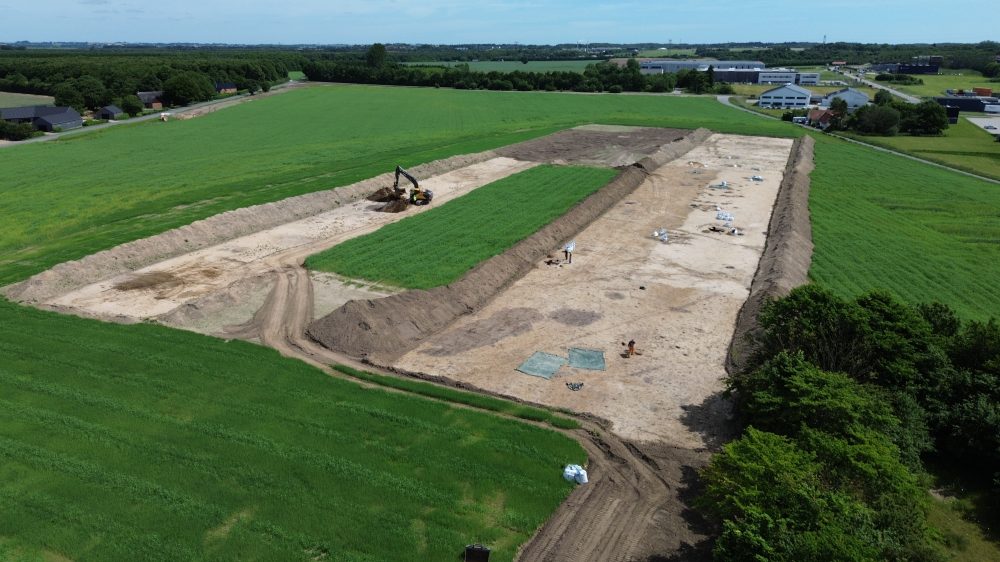

A remarkable archaeological find in Denmark is shedding new light on just how advanced Viking society really was. Experts from the Moesgaard Museum announced this week the discovery of a massive textile production site from the Viking Age, covering more than 100,000 square meters — equivalent to over one million square feet.
The site is located in Søften, about 10 kilometers, or roughly 6 miles, north of Aarhus — Denmark’s second-largest city — on the Jutland peninsula. Based on its features, researchers believe it was active sometime between A.D. 600 and 950, placing it in the late Iron Age through the early Viking Age.
Archaeologist Liv Stidsing Reher-Langberg, who led the 10-month excavation, described what sets this location apart from others of the same period. “We have a clear focus on textile production, which makes this settlement different from other kinds of settlements of this period,” she said.
Among the artifacts uncovered were spindle whorls and weight looms — tools that point directly to weaving and fabric-making activities. Reher-Langberg noted that researchers also turned up silver coins, glass beads, and pottery at the site. More than 80 pit houses — partially underground structures used during Viking times as both workshops and living quarters — were found across the sprawling location, along with a dedicated flax processing area.
The layout of the site is also telling. Separate zones for crafts and production were identified, along with a single residential home. Archaeologists believe this arrangement suggests the operation was run by a powerful individual who controlled both the resources and the production process.
Reher-Langberg explained that interest in the area had been building for some time. Over the past 30 years, hobbyists using metal detectors had been finding silver coins nearby. A smaller trial excavation conducted about a year and a half ago — ahead of planned road and industrial construction — gave archaeologists reason to dig deeper.
“We could see in the trenches that it just keeps on going, with these houses and pit houses and textile production features,” she said.
Moesgaard Museum historian Kasper Andersen called the Søften discovery “another piece in the puzzle” for understanding the economic, cultural, and political landscape of the time. He noted that during the Viking era, the nearby city of Aarhus — then called Aros — served as a hub for royalty and international commerce. Just last year, a separate Viking site was found in Lisbjerg, only about 4 kilometers, or 2.5 miles, away, believed to have been home to members of the nobility.
Andersen suggested that goods produced at places like Søften were likely funneled into a broad international trade network. “When you have a production site of this scale, it cannot be only because of the local area. It needs to be understood as part of a greater network, a much bigger international perspective,” he said.
Reher-Langberg said future carbon dating and pollen analysis could help answer remaining questions, including details about the specific types of textiles made at the site.
The Viking Age is generally recognized as spanning from A.D. 793 to 1066, a period during which Norse peoples carried out widespread exploration, raiding, trade, and settlement across Europe and even into North America.
For Andersen, the Søften site challenges outdated stereotypes about Viking culture. He said the discovery shows Vikings were “not just simple, uncivilized, barbaric hordes, rambling about Europe.” He added: “To have a place like Søften, you need a very well-organized society with a production line, and you also need a market to have the production. The textiles from Søften go into a market that’s much bigger than just the local area.”