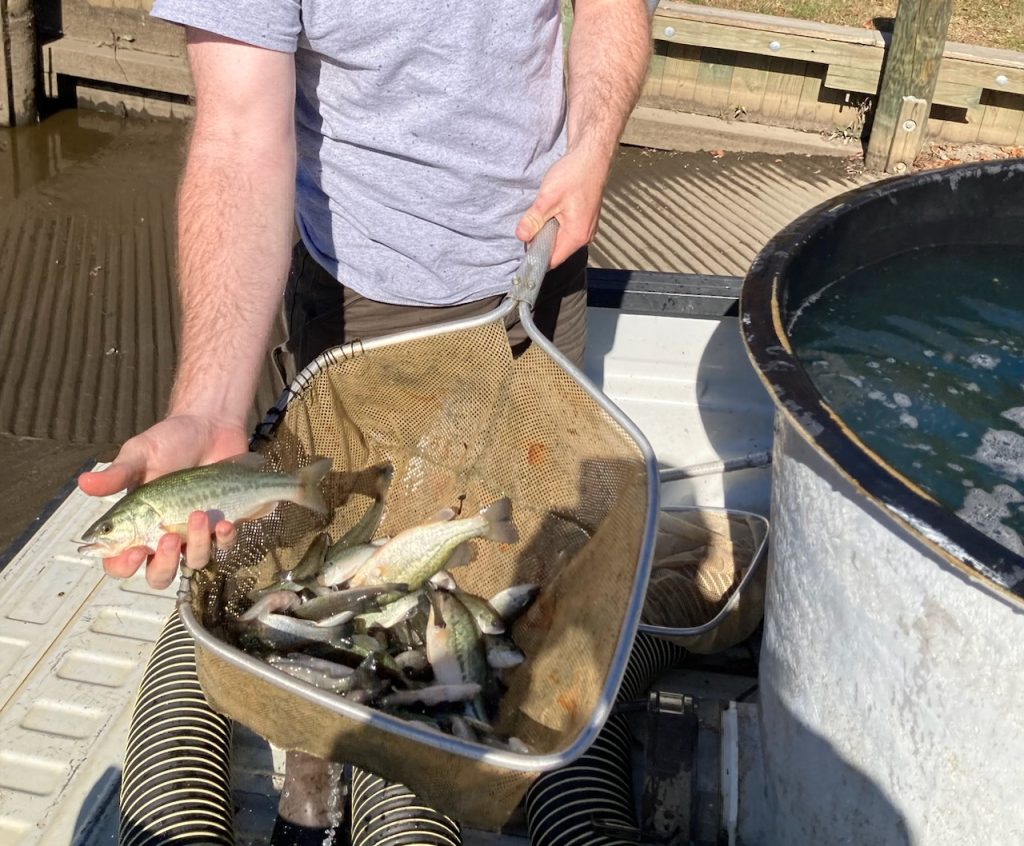

For more than four decades, the Maryland Department of Natural Resources has been working to give largemouth bass a fighting chance in the state’s tidal rivers. Since the early 1980s, the agency has released more than six million of the fish into those waterways, with the goal of boosting existing populations and creating better fishing opportunities for Maryland anglers.
The program carries real economic weight. Each year, the DNR issues permits for more than 400 fishing tournaments centered on black bass — the broader genus that includes largemouth bass — making tidal bass fishing a significant recreational and economic driver for the state.
The stocking effort runs year-round and is funded through state fishing license fees.
Spring: Where It All Begins
The process kicks off each April when fisheries biologists take an electrofishing boat onto the Potomac River to collect adult largemouth bass. Between 20 and 30 fish are gathered, with a ratio of two to three males for every female. These adult fish — known as broodstock — are then brought to the Joseph Manning Hatchery at Cedarville State Forest, where they spawn naturally in hatchery ponds. The young fish are left in a predator-free setting until they’ve used up their yolk sacs, the built-in nutrient supply they’re born with. The adult fish are then returned to their original spots on the Potomac.
The number of newly hatched fish — called fry — produced each season depends heavily on factors outside the hatchery’s control, including water temperature, spawn timing, and the availability of zooplankton for the fry to feed on. In 2025, conditions were nearly ideal, and the Manning Hatchery ponds turned out far more fry than the facility could raise to larger sizes. Those extra fry became the first batch stocked for the year, released into areas of Maryland’s tidal waters with the best habitat for young fish — typically shallow areas with plenty of underwater vegetation and large pieces of woody debris that offer cover from predators and easy access to food. In 2025, a total of 40,000 bass fry were stocked in prime habitat areas along the Potomac and Patuxent rivers.
Summer: A Second Wave
Fish not released in May are either kept in hatchery ponds or moved to large indoor tanks, depending on the size they’re being raised to reach. Those grown in the ponds are targeted to reach two to four inches in length. At that size, they have a better chance of survival than newly hatched fry, though they still need quality habitat to find food and avoid predators. These fish are typically released in June, when underwater vegetation in tidal areas is more plentiful. In 2025, more than 26,000 fish in that size range were stocked across the Nanticoke, Choptank, Potomac, Wicomico, and Patapsco rivers, along with Marshyhope Creek.
Fall: The Largest Fish
Fish transferred to indoor tanks are raised to four inches or more and are generally released in October or early November, since reaching that size takes additional time and feeding. These fish are grown with the help of a bead filter — a piece of equipment purchased through donations to the Black Bass Conservation Fund — which keeps water quality high and allows a large number of fish to grow in tanks much smaller than outdoor hatchery ponds. The filter makes it possible for the DNR to stock roughly 4,000 additional fish of four inches or more each year. Because of their larger size, these fish have the best survival odds and can be placed in waterways that may not have ideal young-fish habitat but can still support healthy fisheries thanks to abundant food sources and good adult habitat. In 2025, a total of 4,375 fish were stocked in the Middle, Choptank, and Patapsco rivers, as well as Marshyhope and Tuckahoe creeks.
Making Every Fish Count
As the target release size goes up, so does the time and food needed to get there — creating a trade-off between the number of fish stocked and their individual size. Decisions about where to stock, when to do it, and what size fish to use are guided by available habitat data and findings from the department’s Tidal Bass Survey, which tracks the long-term health of Maryland’s tidal bass fisheries. Results from the survey are published in the Black Bass Annual Review on the DNR’s website.
By matching fish size to habitat conditions and directing stocking efforts toward waterways most in need of supplementation, the DNR aims to give every stocked fish the best possible shot at survival — and give Maryland anglers the most value for the license fees that make the program possible.
The program is supported by Maryland fishing license sales, the Sportfish Restoration Act, and the Black Bass Conservation Fund. Information about the conservation fund and how to contribute is available on the DNR website.