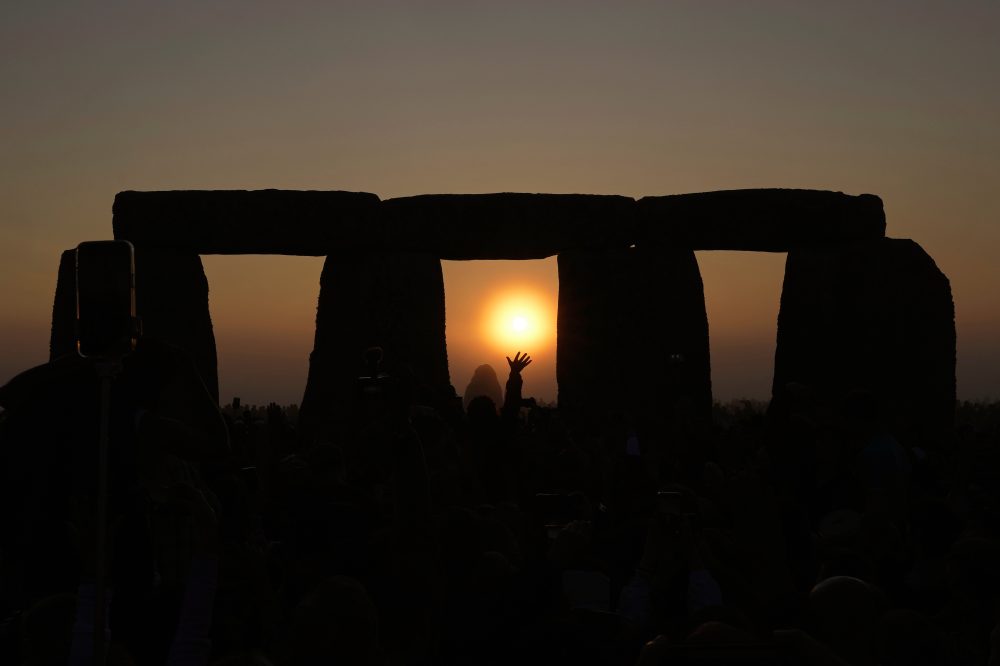

Sunday is a big day for the sun — it’s the longest day of the year across the Northern Hemisphere.
This Sunday marks the summer solstice, the official beginning of astronomical summer for those of us north of the equator. On the other side of the world, it’s the opposite: the Southern Hemisphere will experience its shortest day of the year, and winter will begin there.
The word “solstice” traces back to Latin roots — “sol,” meaning sun, and “stitium,” which translates roughly to “pause” or “stop.” The summer solstice represents the peak of the sun’s climb higher across the sky throughout the year, when it travels its longest and highest path from horizon to horizon. For those who love the long days, here’s the catch: starting after Sunday, the sun will begin retreating, and each day will grow slightly shorter until late December.
Cultures around the world have recognized the solstice for thousands of years. Sweden holds its traditional midsummer eve celebrations around this time, and the ancient monument Stonehenge was deliberately constructed to line up with the sun’s position at both the summer and winter solstices.
To understand why the solstice happens, it helps to know a little about how Earth moves. As our planet orbits the sun, it does so on a tilt, which causes sunlight and warmth to be distributed unevenly between the northern and southern halves of the globe for most of the year.
The solstices occur at the two moments when Earth’s tilt is at its most extreme — either leaning toward the sun or away from it. During these times, the two hemispheres receive very different amounts of daylight, making days and nights as unequal as they get all year.
At the Northern Hemisphere’s summer solstice, Earth’s upper half is angled toward the sun, producing the year’s longest stretch of daylight and shortest night. The summer solstice typically falls somewhere between June 20 and 22. This year, it lands on June 21.
The flip side occurs at the Northern Hemisphere’s winter solstice, when Earth’s upper half tilts farthest away from the sun. That produces the shortest day and longest night of the year, and it falls between December 20 and 23.
In between the solstices are the equinoxes, when Earth’s tilt is neither toward nor away from the sun. During an equinox, both hemispheres receive roughly equal amounts of sunlight, and the sun rises almost exactly due east while setting almost exactly due west.
The word “equinox” comes from Latin words meaning “equal” and “night” — because on that day, daylight and darkness last nearly the same amount of time, though the exact split can vary by a few minutes depending on your location.
The Northern Hemisphere’s fall, or autumnal, equinox can occur anywhere from September 21 to 24, depending on the year. The spring, or vernal, equinox falls between March 19 and 21. The precise moment of an equinox is when the sun is directly overhead at the equator.
It’s also worth noting that there are two different ways people define the seasons. Astronomical seasons are based on Earth’s movement around the sun — which is what the solstices and equinoxes mark. Meteorological seasons, on the other hand, are based on temperature patterns. Meteorologists divide the year into four three-month periods: spring begins March 1, summer on June 1, fall on September 1, and winter on December 1.