
CAPE CANAVERAL, Fla. — NASA is in a race against time to prevent a valuable space telescope from tumbling back into Earth’s atmosphere, and a bold rescue mission is set to begin as early as this week.
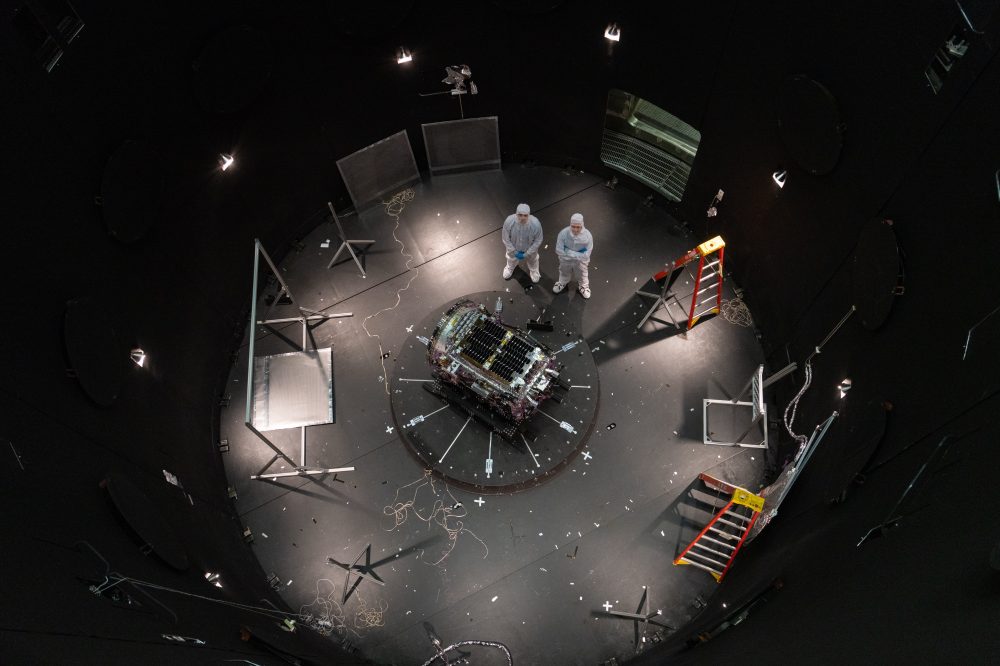
The agency has committed $30 million to the salvage effort, which involves launching a robotic spacecraft designed to push the Swift Observatory into a higher, safer orbit. NASA contracted startup company Katalyst Space Technologies for the job, and the firm has built a three-armed robotic craft to chase down and grab the telescope once it reaches space.
The rescue vehicle will launch aboard a Pegasus rocket — a system carried aloft by an airplane — lifting off from an atoll in the Marshall Islands in the Pacific Ocean. Liftoff could happen as early as Tuesday.
Swift has been scanning the skies since 2004, but a recent surge in solar activity has been pulling it closer to Earth at an increasing rate. The telescope must be moved to a higher, more stable orbit before it’s too late.
Katalyst’s autonomous spacecraft, called Lift, is roughly the size of a small kitchen refrigerator and has a solar panel wingspan of about 40 feet (12 meters). It features three arms, each stretching just over 3 feet (1 meter), tipped with two finger-like pinching grippers that resemble the hands of a Lego mini figure.
Once Lift launches, it will take roughly a month to catch up with Swift and latch on, followed by another two months to raise the telescope’s orbit from its current altitude of 224 miles (360 kilometers) up to 373 miles (600 kilometers). The critical threshold is 185 miles (300 kilometers) — if Swift drops below that point before the rescue is complete, the mission fails. Current estimates put that deadline around October.
Katalyst Space CEO Ghonhee Lee said this is uncharted territory for American space operations. “This is the first American space robot to go up and do anything like this,” he told the Associated Press. “NASA has all these big senior observatories … all of them can benefit from a service like this. So what we’re proving with this mission is this is a new play in the playbook that’s available.”
Only China has previously attempted something similar, successfully moving a satellite to a higher orbit four years ago.
Swift, which weighs 1.6 tons (1.4 metric tons), was never built to be serviced or retrieved — making the operation particularly difficult. NASA officials acknowledge there are no guarantees. The agency signed its contract with Katalyst last September with two basic conditions: move fast, and don’t make things worse. Nine months later, the company is ready to proceed.
“I have to be honest. No one thought it was going to be possible. No one thought we would get as far as we’ve already gotten today,” said Shawn Domagal-Goldman, NASA’s astrophysics director.
To buy more time, NASA shut down all of Swift’s scientific instruments in February to slow its descent. NASA’s science mission chief Nicky Fox said the effort is absolutely worth it.
“If we let Swift reenter, we would lose that telescope. We would lose a lot of capability,” Fox said. “We don’t currently have the budget to build another one to replace that.”
Swift earned its name — the telescope is built to swiftly pivot and capture fleeting cosmic events like gamma ray bursts and exploding stars. With more discoveries expected from the Webb Space Telescope and the soon-to-launch Roman Space Telescope, a rescued Swift would be busier than ever, serving as what NASA describes as its “first responder” in space.
Katalyst views this mission as the foundation for a new space repair industry. The company’s next-generation robotic rescuer, expected to fly next year, will be capable of reaching satellites as high as 22,300 miles (35,800 kilometers) above Earth. Lee envisions a future with hundreds of robots in orbit — not just repairing and repositioning satellites, but also refueling them and helping construct solar farms, data centers, and other space-based platforms.
NASA’s Hubble Space Telescope, now 36 years old, could be the next candidate for a Katalyst rescue mission, potentially in 2028. Like Swift, Hubble is also losing altitude due to heightened solar activity. Lee said his company’s next-generation robot, currently in development, could extend Hubble’s life within a couple of years.
“It’s a national treasure,” Fox said of Hubble. “People love Hubble.”
If everything goes according to plan with the Swift mission, Lee says the telescope could be back in scientific operation by September.