
A French robotics company is entering the rapidly growing AI robot market with a machine that deliberately avoids looking like a human being.
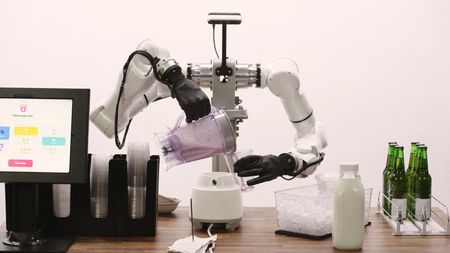
Genesis AI, a Paris-based startup backed by former Google CEO Eric Schmidt, introduced its first general-purpose robot on Tuesday. The robot, called Eno, features a wheeled base instead of legs, a foldable tower structure, and hands designed to match the shape of a human hand.
While many leading robotics manufacturers have favored humanoid designs, Genesis AI took a different approach. The company says Eno is built not to resemble humans, but to expand on what humans can do.
Vivian Sun, Vice President of Commercial and Strategy at Genesis AI, told Reuters that the wheeled base was a deliberate choice because most industrial customers work on flat floors. She noted that legs would only be practical in situations involving stairs or similar obstacles.
“We are mimicking humans in capabilities, not in form,” Sun said. “Humans can go up and down, and so does the robot, but through this foldable design.”
Eno operates using Genesis AI’s own artificial intelligence model. The company was founded in early 2025 and has already raised $105 million — equivalent to about €90.6 million — making it one of France’s largest fundraising rounds and matching the record seed round previously set by Mistral AI, considered Europe’s top AI company. The company’s overall valuation has not been disclosed.
Genesis AI has built dozens of units so far and plans to ramp up production in the second half of 2026. The company intends to begin targeted customer deployments by the end of that year, starting with logistics and manufacturing businesses before expanding to hotels, hospitals, and eventually everyday consumers.
In a statement, Schmidt said the robot would not replace human expertise but would instead “amplify it,” calling the technology “one of the largest economic opportunities of the AI era.”
The robot’s debut comes as the global robotics industry is expanding quickly, fueled by advances in artificial intelligence. That growth has sparked widespread concern about job security. A Reuters/Ipsos poll conducted this month found that 53% of Americans were worried that AI could put them or someone in their household out of a job.
Technical hurdles, including limitations around processing power and battery life, continue to be challenges for the industry as a whole.