Alabama’s top prosecutor has launched a civil investigation into the Southern Poverty Law Center’s fundraising operations following federal criminal charges against the organization.
Attorney General Steve Marshall revealed Monday that his office has issued a subpoena to the civil rights organization, requesting details about its donation practices and payments made to informants. The investigation aims to determine whether the group violated Alabama laws governing charitable organizations or engaged in deceptive business practices.
“We look forward to learning more about the inner workings of an organization that we have long believed was rotten, but until recently, has been impervious,” Marshall stated in a news release.
The Southern Poverty Law Center provided a short response to the state action. “We have received notice of a subpoena and are currently reviewing,” a spokesperson wrote in an emailed statement.
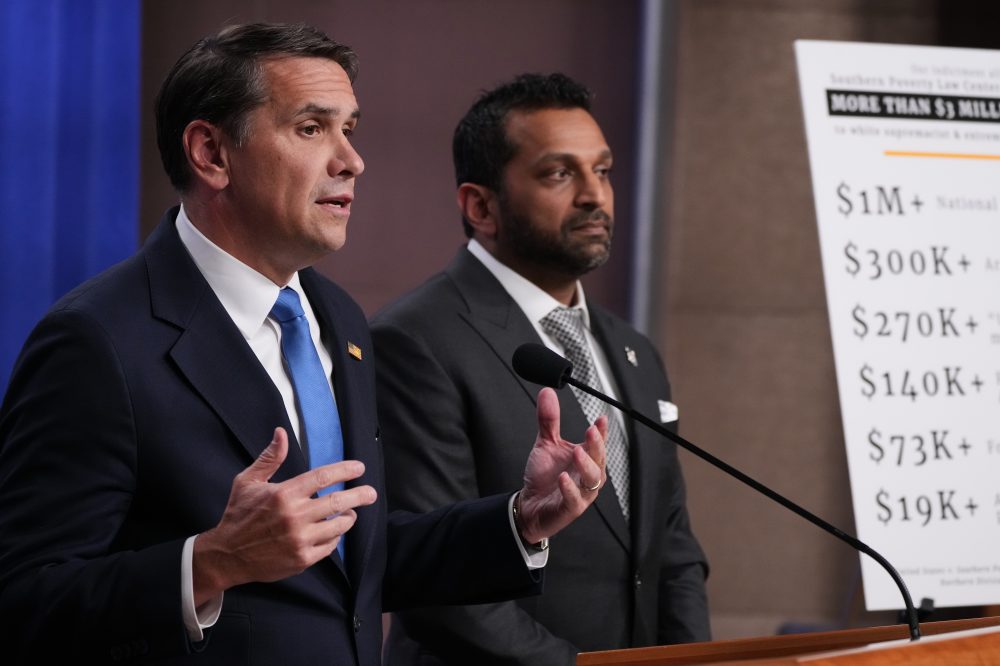
This state-level probe follows the Justice Department’s announcement of criminal charges against the organization, alleging fraud through the use of donated funds to pay informants operating within extremist organizations. Acting Attorney General Todd Blanche has accused the group of “manufacturing racism to justify its existence.”
The SPLC has rejected these allegations as “provably wrong” and defended its informant operations as intelligence-gathering efforts designed to prevent attacks and disrupt hate group activities. The organization maintains that federal authorities have been aware of these programs and that gathered information has been shared with law enforcement agencies.
The Southern Poverty Law Center, widely recognized for its work monitoring hate groups, has frequently found itself in legal disputes with conservative organizations, the Trump administration, and Marshall’s office. The center has been an outspoken opponent of various Trump administration policies.
WASHINGTON — Democratic Party officials submitted an urgent petition to the U.S. Supreme Court on Monday, seeking to overturn a Virginia court decision that eliminated a ballot initiative potentially worth four additional congressional seats for their party.
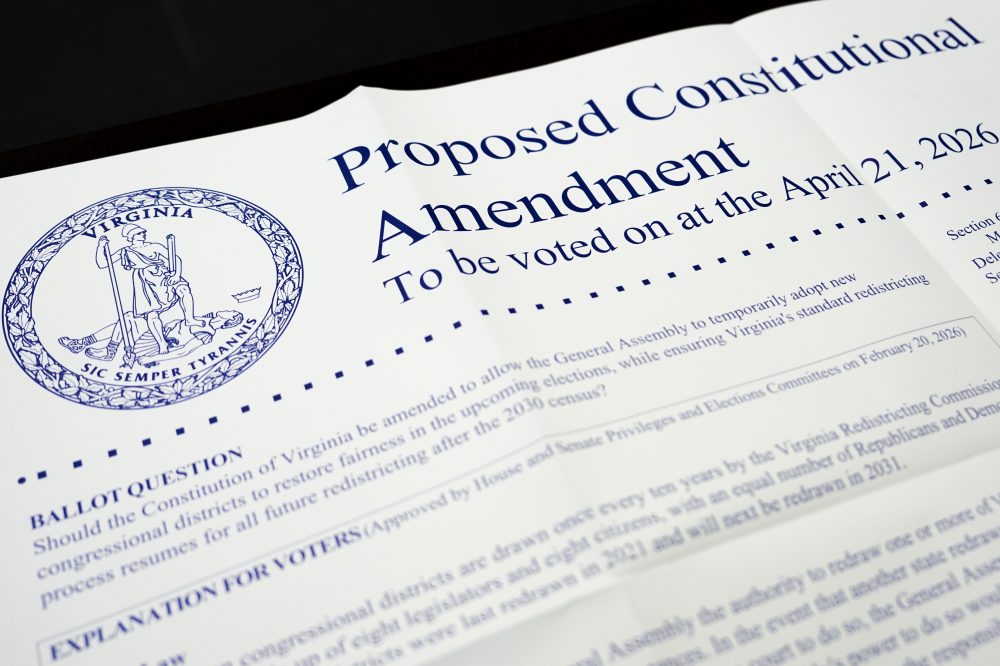
The petition follows Friday’s Virginia Supreme Court ruling that invalidated a constitutional amendment voters approved by a narrow margin last month. The state’s highest court ruled 4-3 that the Democratic-led legislature violated proper procedures by initiating the amendment process while early voting was already in progress during Virginia’s fall general election.
Democratic attorneys contended without success that federal Supreme Court precedent establishes that elections don’t officially occur until Election Day, regardless of early voting activity.
This legal challenge represents another development in the ongoing nationwide redistricting battle that began last year when President Donald Trump encouraged GOP-controlled states to redraw their electoral maps. The situation intensified following a recent Supreme Court decision that significantly diminished Voting Rights Act protections.
The Democratic petition faces steep odds, as the Supreme Court typically avoids overruling state courts’ interpretations of their own state constitutions. In 2023, the justices rejected a similar request from North Carolina Republicans seeking to overturn a state court decision that blocked their congressional map.
From a political standpoint, this appeal could benefit a party that has struggled to keep pace with Republican redistricting efforts nationwide, potentially providing ammunition for campaign messaging about Supreme Court partisanship. The court recently permitted Louisiana Republicans to move forward with redistricting after striking down a majority-Black district as unconstitutional racial gerrymandering.
Democrats found themselves at a disadvantage when, shortly after the Virginia ballot measure succeeded, the Supreme Court’s conservative majority overturned decades of precedent and essentially weakened the Voting Rights Act. This decision enabled Southern states to eliminate certain majority-Black districts and strengthen Republican congressional advantages.
The Virginia constitutional amendment originated well before that Supreme Court ruling. It was designed to counter Republican redistricting victories in Texas, Missouri, North Carolina, and Ohio, while offsetting a new Florida map that recently took effect. When the Virginia amendment initially passed, it temporarily balanced the national redistricting competition between both parties.
The Virginia Supreme Court’s decision disrupted that balance. Legislative appointments determine the court’s composition, with control alternating between parties over recent decades, and the court generally lacks a clear ideological reputation.
WASHINGTON — The nation’s highest court has issued a temporary order maintaining current access to mifepristone, a commonly prescribed abortion medication, while justices deliberate on potential new limitations set to begin this week.
Justice Samuel Alito issued Monday’s directive, which ensures women can continue receiving the medication through pharmacies or mail delivery without requiring face-to-face medical appointments. The order blocks federal appeals court restrictions from going into effect temporarily.
This latest reproductive rights battle comes four years following the conservative-majority court’s decision to overturn Roe v. Wade, enabling more than a dozen states to implement near-total abortion bans.
The legal challenge originates from Louisiana’s lawsuit targeting Food and Drug Administration regulations governing mifepristone prescriptions. State officials argue these policies weaken their abortion ban and raise safety concerns about the medication, despite FDA approval in 2000 and repeated scientific validation of its safety and effectiveness.
Federal trial courts determined Louisiana would likely succeed in their challenge, leading a three-judge 5th U.S. Circuit Court of Appeals panel to rule that mail delivery and remote medical consultations should be halted during ongoing litigation.
Mifepristone is typically combined with misoprostol for medication-based abortions. These procedures represented nearly two-thirds of all U.S. abortions during 2023, according to the most recent available data.
The current legal battle mirrors a similar case from three years prior.
Previous lower court decisions also attempted to limit mifepristone availability through litigation filed by anti-abortion physicians shortly after Roe’s reversal.
The Supreme Court previously prevented the 5th Circuit’s restrictions from taking effect, despite opposition from Alito and Justice Clarence Thomas. The high court later unanimously rejected the physicians’ lawsuit in 2024, determining they lacked proper legal standing to file suit.
Major medical organizations, pharmaceutical companies, and Congressional Democrats have urged the court against restricting drug access in the current case. Industry representatives warned that siding with abortion opponents could destabilize the entire drug approval system.
The FDA has gradually removed various initial restrictions on the medication, including prescriber qualifications, distribution methods, and mandatory safety reporting requirements.
Despite these regulatory determinations, abortion opponents have contested mifepristone’s safety for over 25 years through multiple petitions and lawsuits, consistently claiming the agency violated federal law by ignoring safety concerns.
President Donald Trump’s administration has maintained notable silence at the Supreme Court level, choosing not to submit written recommendations despite federal regulations being central to the case.
The situation creates challenges for Trump’s Republican administration, which depends on anti-abortion group support while facing ballot measures and polling data showing broad American support for abortion rights.
Both legal sides interpreted the administration’s silence as implicit support for the appeals court decision. Alito oversees emergency appeals from Louisiana and authored the 2022 ruling declaring abortion lacks constitutional protection, returning decisions to individual states.
Democratic officials in Virginia have filed an appeal with the nation’s highest court, seeking to restore a congressional redistricting plan that could shift political control in the upcoming midterm elections.
The appeal, submitted Monday, comes after Virginia’s Supreme Court rejected the new electoral boundaries in a narrow 4-3 ruling on May 8. The proposed map had been designed to convert four currently Republican-held congressional seats to Democratic ones, potentially impacting the balance of power in Washington where Republicans maintain slim majorities in both chambers of Congress.
This redistricting battle represents an uncommon mid-decade effort to redraw district lines, departing from the traditional practice of adjusting boundaries only after each ten-year census. The dispute highlights how closely divided Congress has become, with even small shifts in seat allocation carrying significant political weight.
Virginia’s state Supreme Court sided with Republican opponents who challenged the Democratic-supported ballot initiative that voters had approved in April. The court’s majority determined that Democratic legislators had failed to follow required procedures when they expedited the referendum process last year to meet election deadlines.
Don Scott, who serves as the Democratic speaker of Virginia’s House of Delegates, is leading the federal appeal effort. In their Supreme Court filing, the Democratic lawmakers argue that the state court’s decision has “deprived voters, candidates, and the Commonwealth of their right to the lawfully enacted congressional districts.”
The Virginia Democrats are invoking a 2023 Supreme Court precedent that cautioned state courts against overstepping “the ordinary bounds of judicial review” in ways that would undermine state legislatures’ constitutional authority over federal election regulations.
This mid-decade redistricting conflict gives Republicans a strategic edge in the broader national picture. The current fight traces back to efforts initiated by former President Donald Trump, who encouraged Texas Republicans to abandon their existing electoral map and create new district boundaries aimed at capturing up to five seats currently held by Democrats.
Democratic redistricting efforts nationwide have faced additional obstacles following a Supreme Court decision that weakened key protections in the 1965 Voting Rights Act. That ruling, decided by the court’s 6-3 conservative majority, has enabled Republican-controlled Southern states to eliminate districts where Black and Latino voters—who typically support Democratic candidates—held majorities.
The redistricting process typically occurs once per decade, with state legislatures redrawing district boundaries to account for population shifts revealed by the national census. However, this Virginia case represents part of an unusual wave of mid-decade redistricting efforts that could reshape congressional representation before the traditional timeline.
The nation’s highest court has prolonged a temporary freeze on a lower court decision that would have restricted how the abortion medication mifepristone can be obtained by patients across the country.
Justice Samuel Alito announced Monday that the hold will remain in place until May 14, allowing the medication to continue being delivered by mail while the court weighs its next steps.
The Supreme Court is reviewing appeals from two drug manufacturers seeking to overturn a May 1 decision by the 5th U.S. Circuit Court of Appeals in New Orleans. That ruling would have brought back an older rule requiring patients to meet with a healthcare provider face-to-face before receiving mifepristone.
The appeals court had blocked a 2023 Food and Drug Administration regulation implemented during former President Joe Biden’s administration that allowed the medication to be prescribed via telemedicine and sent through the mail.
Pharmaceutical companies Danco Laboratories and GenBioPro challenged the 5th Circuit’s restrictions on mifepristone access. The Supreme Court initially stepped in on May 4 with a temporary hold to allow more time for deliberation.
Medical abortion procedures, which typically involve a combination of mifepristone and misoprostol, represent approximately two-thirds of all abortions performed in the United States. Any limitations on how these medications are distributed could substantially impact access across the nation.
This legal battle brings the divisive abortion issue before the Supreme Court again as November’s congressional elections approach and President Donald Trump’s Republican allies work to maintain their congressional majority.
In 2024, the Supreme Court unanimously turned down an earlier effort by anti-abortion organizations and physicians to reverse FDA policies that had made the drug more accessible.
These ongoing legal disputes stem from the Supreme Court’s 2022 decision that struck down the landmark 1973 Roe v. Wade ruling, which had established nationwide abortion rights. Following that reversal, 13 states have implemented nearly complete abortion prohibitions, while several others have imposed significant restrictions.
Louisiana filed suit against the Food and Drug Administration in 2025, arguing that the 2023 rule removing in-person dispensing requirements violated federal law and had led to a surge in medication abortions despite the state’s comprehensive abortion ban.
WASHINGTON – Federal officials have quietly scrubbed their website of information regarding a newly announced security testing partnership with major technology companies and their artificial intelligence systems.
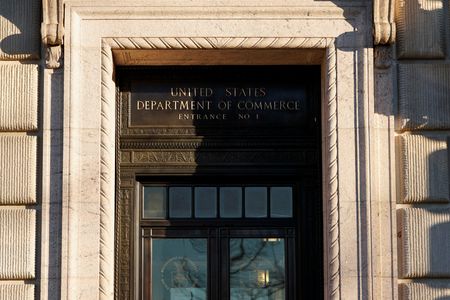
The U.S. Commerce Department has taken down details about an agreement requiring Google, Microsoft, and xAI to submit their AI models for government security evaluation, according to a website review. A link that formerly displayed the department’s announcement now shows an error message stating “Sorry, we cannot find that page.”
The webpage was later redirected to the Center for AI Standards and Innovation’s site, which is the federal organization overseeing these evaluations.
Just six days ago on May 5, the Commerce Department had publicly revealed that these technology firms would provide their newest AI systems to government researchers before releasing them to consumers. This arrangement was designed to allow federal scientists to examine the models for potential security weaknesses.
Federal authorities have expressed mounting concerns about national security threats from advanced artificial intelligence technology, including systems like Anthropic’s Mythos. Through early access to these cutting-edge models, government officials hoped to detect risks spanning from cyber threats to potential military exploitation.
The reason behind the website’s removal remains unclear. Representatives from both the Commerce Department and the Trump White House have not yet provided responses to requests for comment.
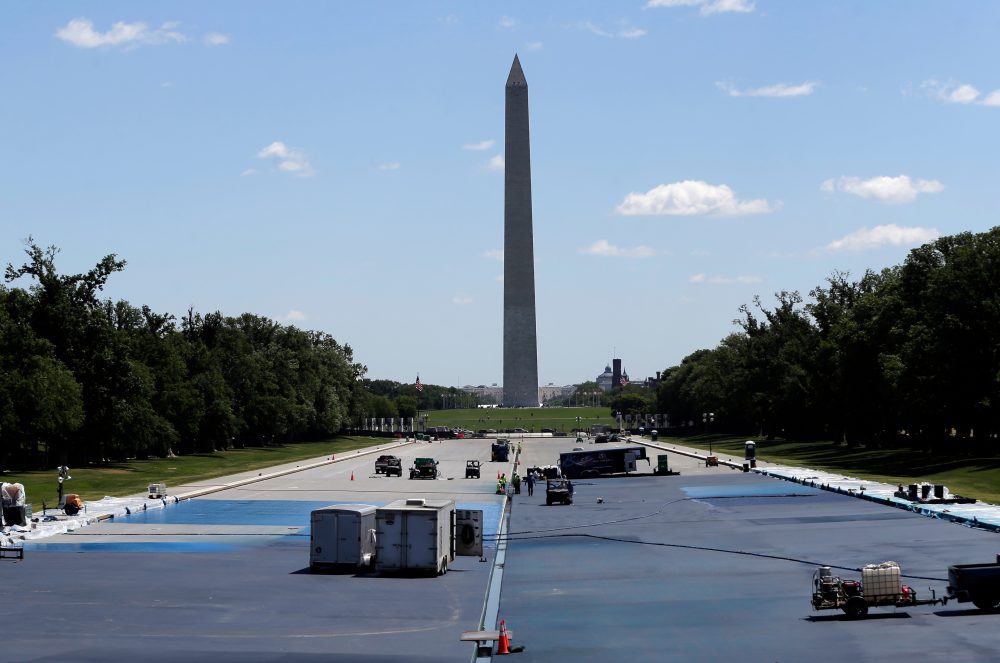
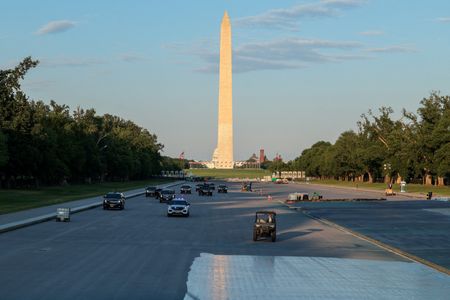
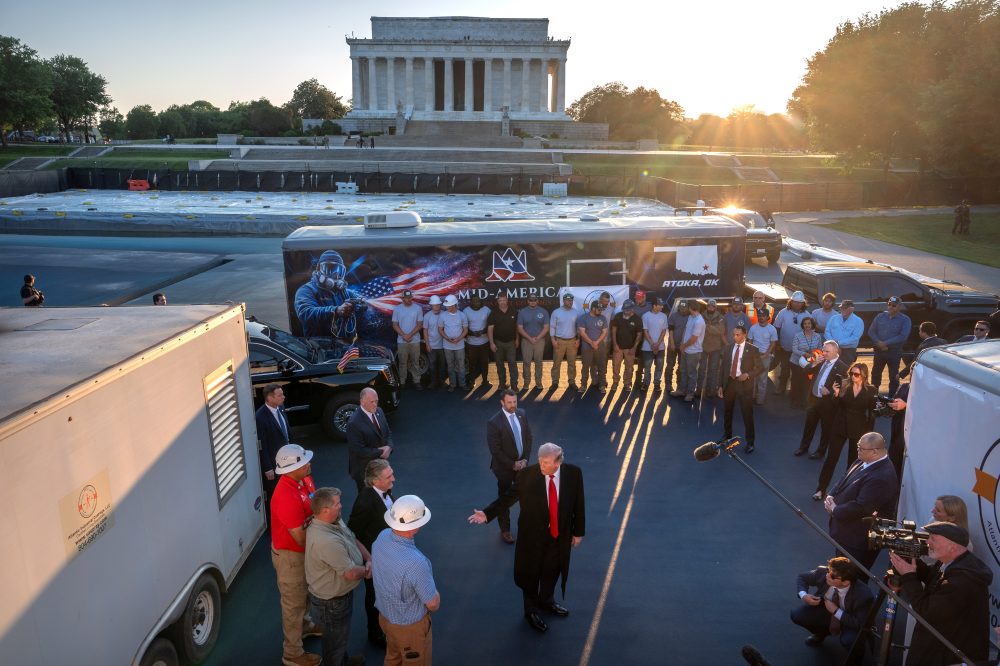
WASHINGTON — A preservation organization based in the nation’s capital is seeking court intervention to stop the Trump administration from continuing work on the Lincoln Memorial Reflecting Pool and to reverse historic modifications at one of America’s most recognizable landmarks on the National Mall.
The Cultural Landscape Foundation filed legal action on Monday, contending that the administration’s decision to paint the pool’s bottom blue without conducting required evaluations violates federal laws protecting historic locations. The organization maintains that these alterations to the Reflecting Pool represent part of President Donald Trump’s wider campaign to implement sweeping Washington renovations while bypassing proper review processes and altering the area’s character.
“The design intent, to create a reflective surface that is subordinate, is fundamental to the solemn and hallowed visual and spatial connection between the Washington Monument and the Lincoln Memorial,” stated Charles A. Birnbaum, the organization’s president and CEO. “A blue-tinted basin is more appropriate to a resort or theme park.”
The president has shown direct involvement in this initiative, previously describing the location as “filthy” before crews applied what he terms “American flag blue” paint to the pool. Trump’s presidential convoy traveled across the drained and freshly painted Reflecting Pool during the previous week, allowing him to personally inspect the work’s progress.
The legal challenge targets the Interior Department and National Park Service, agencies responsible for overseeing numerous renovation projects currently underway throughout Washington. Interior Department spokesperson Katie Martin responded that Trump “has done more to make our nation’s capital a shining beacon than any other president in the history of this country.”
“The Department is proud of the work being carried out by our Park Service to ensure this magical spot can be enjoyed for not only our 250th, but for many generations to come,” Martin stated.
During the previous year, Trump has demolished the East Wing to create space for a ballroom. His name has been placed on the exteriors of the U.S. Institute of Peace and Kennedy Center, which he intends to shut down for a two-year renovation period. His image appears on a banner at the Department of Justice headquarters, among other locations. He is advocating for a triumphal arch near Arlington Cemetery and has shut down parks, including Lafayette Square opposite the White House, for rehabilitation work.
Numerous other projects face similar legal challenges.
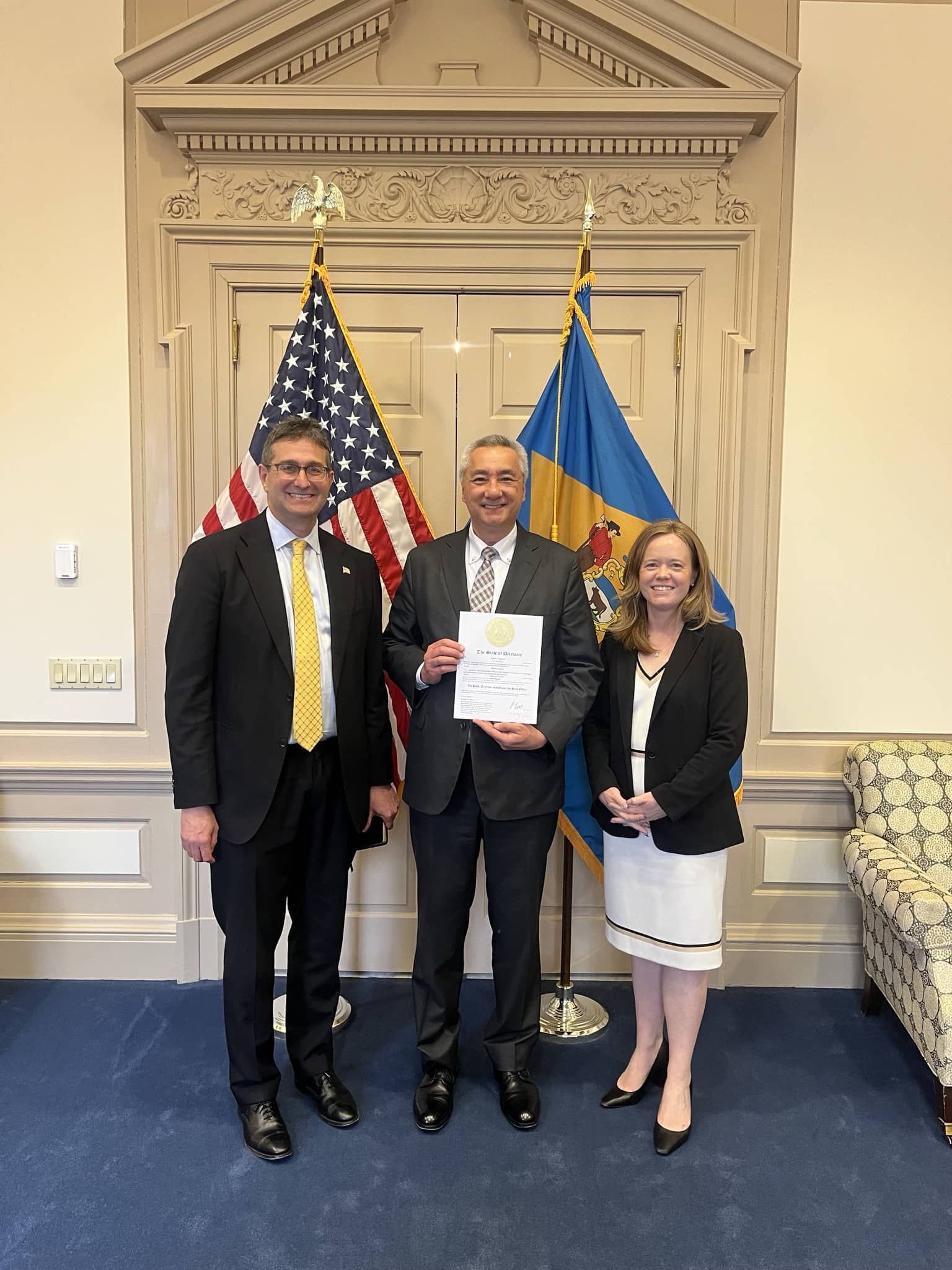
The Delaware Department of Services for Children, Youth and Their Families has selected Sarah Azevedo to lead its Division of Family Services as the new director.
Azevedo steps into the position following the retirement of Trenee Parker, who concluded her career after serving the department for 30 years. Parker’s departure marks the end of three decades of commitment to Delaware’s children and families.
The newly appointed director brings extensive experience to her new role, having worked within DFS for more than 27 years in various capacities throughout her career with the division.
President Donald Trump plans to issue executive orders on Monday designed to tackle rising beef costs by increasing imports and helping rebuild America’s cattle population, according to a White House official.
The administration official did not reveal specific details about the two planned orders, which are being introduced as the nation’s cattle herd has declined to its smallest size in seven and a half decades while beef costs keep rising.
According to earlier reporting by The Wall Street Journal, Trump plans to temporarily lift tariff-rate quotas on imported beef, which would permit greater quantities of meat to enter the country with reduced tariff costs. The publication also indicated that the president would instruct the Small Business Administration to expand lending opportunities for cattle ranchers and decrease protections for gray wolves and Mexican wolves that attack livestock under current Endangered Species Act provisions.
A preservation organization filed a federal lawsuit Monday aimed at stopping President Donald Trump’s renovation project at the Lincoln Memorial’s reflecting pool in Washington D.C.
The Cultural Landscape Foundation claims the ongoing construction project breaks federal law under the National Historic Preservation Act, which Congress enacted in 1996 to establish guidelines for modifications to historically significant sites.
The organization is requesting an immediate court order to stop the Trump administration’s work, which involves changing the pool’s traditional “gray stone” look to an industrial coating that resembles a blue swimming pool.
According to the legal filing, “The dark grey, achromatic basin was not incidental to the design. It was the design.”
The Department of the Interior, which oversees the renovation work, faces the lawsuit. The agency defended the project in a statement, claiming Trump “has done more to make our nation’s capital a shining beacon than any other president in the history of this country.”
The former president revealed the renovation plans last month, describing the project as something that’s “going to be fantastic” and “really beautiful.” Trump made an unexpected visit to observe the construction progress via his motorcade.
According to Trump, a visiting German friend’s criticism of the reflecting pool’s condition inspired the renovation project.
“He said, ‘It’s filthy, dirty. The water is disgusting-looking. It’s not representative of the country,’” Trump explained to reporters during a White House gathering last month.
This legal challenge joins several others targeting Trump’s Washington D.C. improvement projects, including golf course renovations and a proposed White House ballroom addition.
A federal judge temporarily blocked the ballroom construction on March 31, stating that “unless and until Congress blesses this project through statutory authorization, construction has to stop!”
However, an appeals court subsequently removed that restriction, permitting ballroom construction to continue during ongoing legal proceedings.
A new national survey reveals that most Americans believe President Donald Trump has failed to provide clear justification for the ongoing military conflict with Iran, according to Reuters/Ipsos polling data released this week.
The nationwide poll, which wrapped up on Monday, found that 66% of respondents feel Trump has not adequately outlined the objectives behind U.S. military engagement in Iran. This sentiment crosses party lines, with roughly one-third of Republican voters and nearly all Democratic voters expressing this view.
The military action commenced on February 28 with coordinated U.S.-Israeli airstrikes and has now stretched beyond two months. While recent weeks have seen decreased hostilities as both nations have proposed potential peace agreements, the conflict has significantly impacted American consumers at the gas pump.
Fuel costs have surged approximately 50% nationwide as Iran successfully blocked the Strait of Hormuz, cutting off one-fifth of global oil supplies. Despite U.S. naval efforts to reopen this crucial shipping lane for oil tankers, Tehran maintains control over the waterway.
The economic impact on American families has been substantial. Survey results show 63% of households report that rising gasoline prices have negatively affected their personal finances, representing an increase from 55% when the same question was asked in mid-March.
Trump’s overall job performance rating has seen a modest uptick to 36%, climbing two points from his term-low of 34% recorded in late April polling. However, this figure remains below his 40% approval rating from before the Iranian conflict began. When Trump took office in January 2025 following his 2024 election victory on a platform promising to reduce costs for Americans, he enjoyed 47% approval.
Public opinion regarding responsibility for escalating fuel prices shows significant concern for the current administration. Three-quarters of those surveyed, including half of Republican respondents, believe Trump’s team bears considerable responsibility for the gas price surge. When asked to assign partisan blame, 65% pointed to Republicans while 27% blamed Democrats.
Looking ahead, four out of five Americans anticipate further increases at the pump. This expectation is already affecting summer plans, with roughly 30% of respondents indicating they may need to modify vacation arrangements if current prices persist. Many are considering trip cancellations or shorter travel distances.
The economic pressures could have significant political implications for Republicans, who currently hold slim majorities in both the House of Representatives and Senate heading into November’s midterm elections. Political analysts suggest the party’s chances of retaining control depend heavily on whether gasoline prices decline before voters head to the polls.
With no resolution visible between Washington and Tehran, the economic and political ramifications continue to unfold. The Reuters/Ipsos survey collected responses from 1,254 American adults through online polling methods, with results carrying a margin of error of three percentage points in either direction.
WASHINGTON — Federal officials are instructing American banks and financial institutions to keep watch for Iranian money laundering operations that utilize shell corporations and digital currency networks to illegally transport sanctioned petroleum products.
This directive essentially enlists the worldwide banking system to help dismantle Iran’s sanctions-dodging infrastructure, occurring as US-Iran relations have reached another deadlock regarding ending their conflict while their current truce becomes more fragile.
On Monday, President Donald Trump declared the Iranian ceasefire is on “life support” following his dismissal of Tehran’s most recent peace proposal.
The Trump administration is urging financial institutions to identify specific clients who might be washing money for Iran’s Revolutionary Guard — this includes recently established businesses transferring exceptionally large sums, organizations that channel payments through numerous middlemen, or deals linked to Iranian cryptocurrency companies, along with other warning signs.
Within the US effort to track Iranian petroleum sales, banks receive instructions to look for oil marked as “Malaysian blend” to hide its Iranian source, absent or fake transport paperwork, or vessel-to-vessel oil transfers that mask cargo origins.
A Monday report from Treasury’s Financial Crimes Enforcement Network indicates that petroleum companies tied to Iran handled approximately $4 billion in deals during 2024.
Additionally, multiple shipping firms headquartered in Iraq, the United Arab Emirates, and Hong Kong — all linked to moving sanctioned Iranian petroleum — moved roughly $707 million through American bank accounts in 2024.
Beyond conducting bombing operations in Iran, the Trump administration has shifted toward an economically-centered strategy designed to pressure Tehran into surrender through sanctions and threats of secondary penalties against Iran’s partners.
Last April, Treasury delivered correspondence to financial organizations in China, Hong Kong, the UAE, and Oman warning of potential secondary sanctions for conducting Iranian business and claiming these nations permit Iranian illegal operations to pass through their banking systems.
WASHINGTON — On Monday, President Donald Trump announced his intention to pursue a suspension of the federal gasoline tax as Americans face climbing fuel costs linked to the Iran conflict.
However, the president lacks the authority to eliminate the federal tax independently. Such action would require Congressional authorization.
Bipartisan legislators have advocated for eliminating the gas tax temporarily, arguing it would deliver essential financial relief to families and businesses depending on vehicles for commuting to work and school, as well as daily activities.
According to AAA data from Monday, national gas prices averaged $4.52 per gallon, representing a 50% increase from the roughly $3 per gallon average before the Iran war began under Trump’s administration.
Currently, the federal levy stands at 18.4 cents per gallon for gasoline and 24.4 cents per gallon for diesel, figures that exclude state taxes, which are typically higher.
When White House reporters questioned Trump about the duration of such a suspension, he responded, “Until it’s appropriate.” Although the tax adds approximately 18 cents per gallon to gas costs, “it’s still money,” Trump stated.
In response to escalating gas prices, the Trump administration has authorized the release of millions of barrels from the U.S. Strategic Petroleum Reserve and temporarily eased sanctions on certain Russian and Iranian oil shipments currently in transit. The U.S. is in discussions with nations dependent on Middle Eastern crude to form a coalition for monitoring the Strait of Hormuz, through which roughly one-fifth of global oil trade typically passes.
The gasoline tax generates over $23 billion annually in funding for federal highway and public transportation initiatives.
Missouri Republican Senator Josh Hawley announced on social media Monday his plans to propose legislation suspending the gas tax. Democratic lawmakers have previously backed comparable measures.
Florida Republican Representative Anna Paulina Luna also posted on X that she would introduce legislation “to suspend the federal gas tax in light of Trump’s recent remarks.”
The continuing surge in fuel prices has raised concerns among some Republicans about potential negative impacts on the party’s midterm election prospects. Trump has previously stated that higher fuel costs are acceptable to prevent Iran from acquiring nuclear weapons.
This firm stance appeared to moderate Sunday when Energy Secretary Chris Wright indicated the Trump administration was “open to all ideas,” including gas tax suspension, during his appearance on NBC’s “Meet the Press.”
Democratic Senators Richard Blumenthal of Connecticut and Mark Kelly of Arizona have sponsored legislation that would halt the federal tax until October 1. A comparable House measure was introduced by Democratic Representative Chris Pappas of New Hampshire.
“Trump’s war of choice with Iran is driving up gas prices across the country — and Americans shouldn’t have to bear the additional economic burden of Trump’s reckless decision making,” Blumenthal stated when introducing the legislation.
Several states, including Indiana and Georgia, have recently paused their taxes to reduce high prices during the conflict. Additional states are considering similar suspensions.
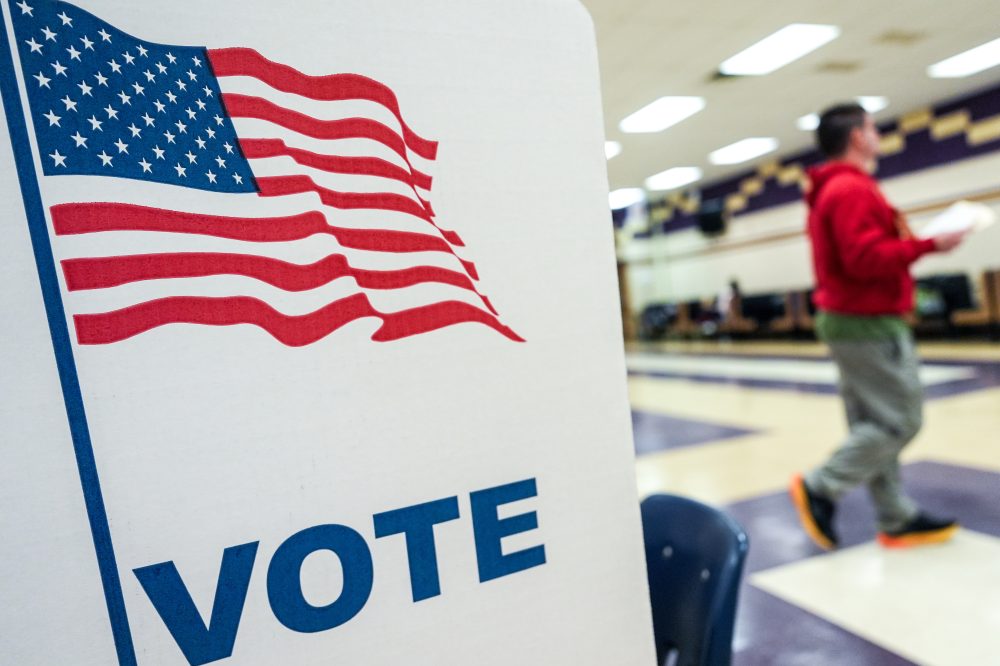
Northampton County, Virginia officials are encouraging residents to consider running for local municipal offices in the upcoming 2026 elections.
The county is actively seeking individuals interested in serving as mayor or town council members in various municipalities throughout the region. Those considering a run for local office must complete and submit their candidacy filing documents by the established deadline.
The filing period for prospective candidates closes on June 16, 2026, giving interested residents several months to prepare their campaigns and meet all necessary requirements for candidacy.
Municipal elections provide opportunities for community members to directly participate in local governance and help shape policy decisions that affect their neighborhoods and towns.
Former President Donald Trump is advocating for the temporary elimination of federal gasoline taxes as Americans face escalating fuel costs during the current conflict with Iran.
The proposal to halt federal gas tax collection would require legislative action from Congress to become reality.
Gas stations across the country, including locations in Los Angeles, California, are displaying prices exceeding $6 per gallon, highlighting the financial burden on consumers nationwide.
The federal gas tax suspension represents one potential approach to providing relief to drivers dealing with surging costs at the pump during this period of international tension.
According to Bloomberg News, the Trump administration has extended invitations to several prominent business executives to join President Donald Trump during his upcoming state visit to China, a White House official confirmed Monday.
Among the high-profile attendees will be Tesla CEO Elon Musk and Apple’s chief executive Tim Cook, Bloomberg reported. The business delegation also includes Goldman Sachs Group CEO David Solomon, Blackstone’s Stephen Schwarzman, BlackRock leader Larry Fink, Citigroup’s Jane Fraser, and Meta Platforms’ Dina Powell McCormick.
According to the report, Trump plans to bring more than twelve leading corporate executives as part of his strategy to negotiate new commercial agreements and purchasing deals with Beijing during his meeting with Chinese President Xi Jinping.
None of the mentioned corporations provided immediate responses when contacted for comment by Reuters.
China’s official Xinhua news agency announced that Trump’s state visit is scheduled to take place from May 13 through May 15.
WASHINGTON – President Donald Trump announced Monday his intention to temporarily suspend the federal gas tax of 18 cents per gallon as American drivers continue facing elevated fuel costs during the ongoing Iran conflict, according to CBS News.
“We’re going to take off the gas tax for a period of time, and when gas goes down, we’ll let it phase back in,” Trump stated during his interview with CBS.
When asked about potential assistance for airlines struggling with increased jet fuel expenses, Trump indicated no such relief package had been formally proposed. “The airlines are doing not badly,” he remarked to CBS, suggesting the industry doesn’t require a bailout at this time.
The announcement follows comments made Sunday by Energy Secretary Chris Wright, who confirmed during NBC’s “Meet the Press” that the administration was considering a federal gas tax suspension.
Meanwhile, individual states have begun implementing their own relief measures. Indiana, Kentucky, and Georgia have all moved forward with reductions to their state gasoline taxes to help ease the burden on consumers filling up at gas stations.
Fuel costs have climbed steadily since the Iran war commenced on February 28th. According to AAA data released Monday, the national average price for a gallon of gasoline has reached $4.52.
Delaware’s top prosecutor is turning to the courts to compel a home improvement contractor to comply with a legal demand for information after months of silence.
Attorney General Kathy Jennings has asked the Superior Court to force Mastercraft Contracting, LLC to honor a subpoena issued by her Consumer Protection Unit. The company has ignored the legal request for almost three months without providing any meaningful response, according to court filings.
The contractor has been the subject of numerous consumer complaints, prompting the Attorney General’s investigation. Mastercraft Contracting operates as a home improvement business that has drawn scrutiny from state regulators.
The Consumer Protection Unit’s subpoena was part of an ongoing investigation into the company’s business practices. When companies fail to comply with subpoenas, prosecutors can ask courts to step in and enforce compliance through legal orders.
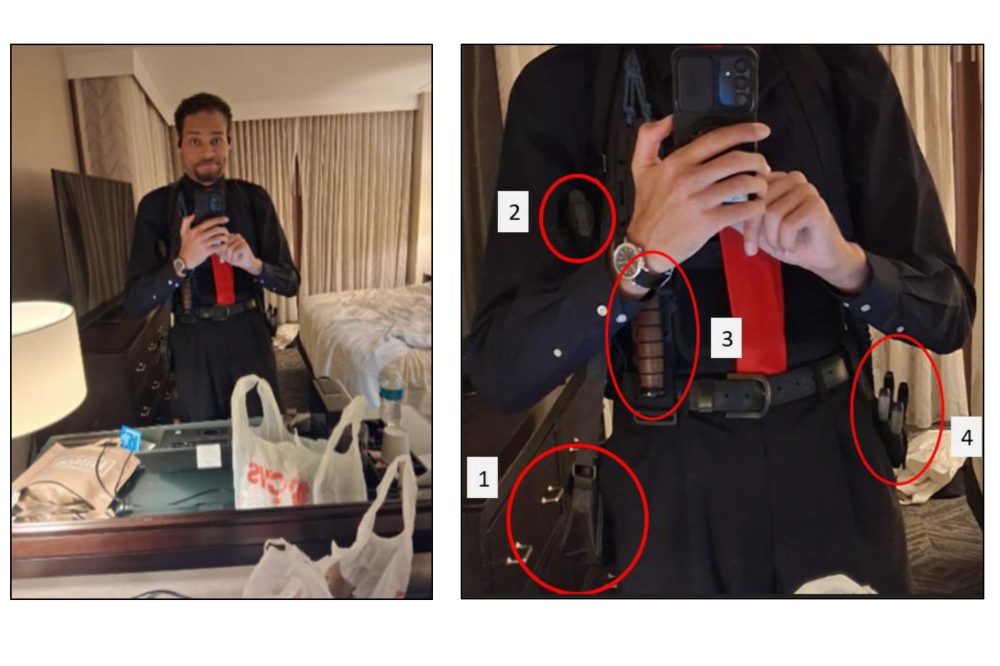
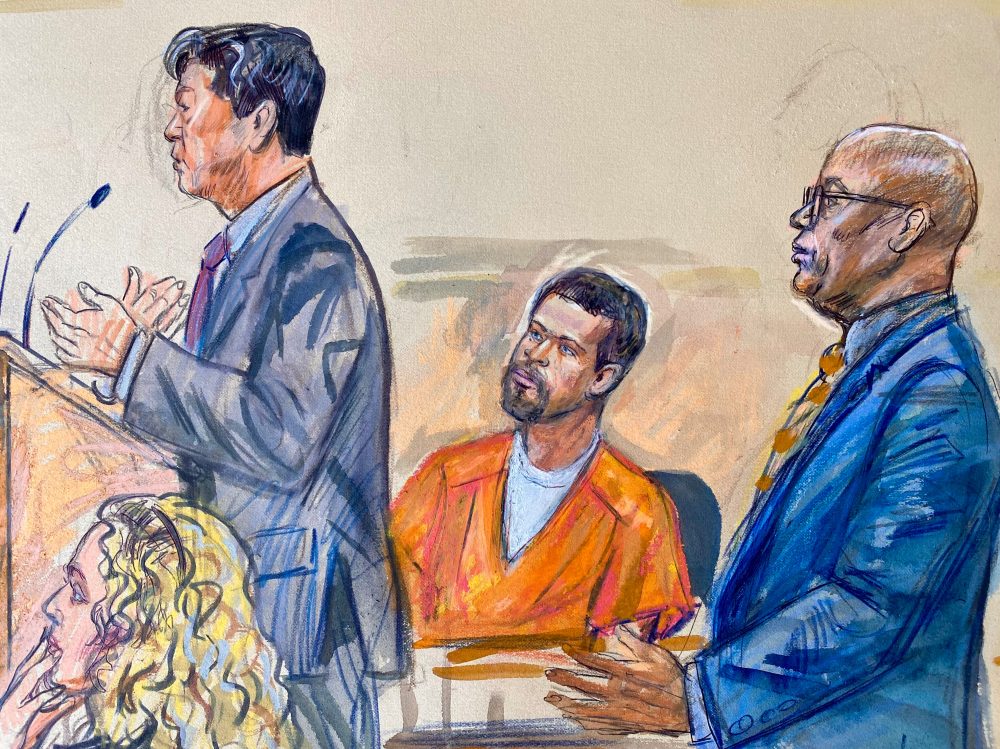
A California resident facing federal charges for an armed assault at the White House Correspondents’ Association dinner entered a not guilty plea during his Monday court appearance in Washington.
Cole Tomas Allen, 31, from Torrance, California, appeared before a federal judge in restraints and jail clothing for his formal arraignment. Allen remained silent throughout the proceedings while his legal team submitted the plea on his behalf.
Federal prosecutors allege Allen breached security at the April 25 event while carrying firearms and bladed weapons, then discharged a shotgun at a Secret Service agent attempting to halt his advance. The charges against him include attempting to assassinate President Donald Trump.
Allen’s defense team has requested that U.S. District Judge Trevor McFadden remove key Justice Department figures from the prosecution due to potential conflicts of interest. Defense attorney Eugene Ohm argued that Acting Attorney General Todd Blanche and U.S. Attorney Jeanine Pirro should be disqualified since both were present during the incident and could serve as witnesses or be considered victims.
The judge did not immediately decide on the recusal motion but requested additional details from the defense regarding the extent of their request. Ohm indicated they may seek to exclude Pirro’s entire office from the case.
The attack occurred at the Washington Hilton during one of the capital’s most prominent annual gatherings. A Secret Service officer sustained a gunshot wound to their protective vest during the confrontation, while Allen suffered injuries but was not struck by gunfire. The incident forced organizers to conclude the event prematurely.
Allen’s next court date is set for June 29.
The defendant faces multiple federal charges beyond the assassination attempt, including assault on a federal officer with a deadly weapon and additional firearms violations. If found guilty on the assassination charge alone, he could receive a life sentence.
Following his arrest, Allen was initially monitored for suicide risk but was later removed from that status. His attorneys have criticized his treatment in custody, citing concerns about his confinement conditions including constant illumination, frequent searches, and restraint usage.
According to prosecutors, Allen informed FBI investigators that he did not anticipate surviving the assault, which officials cite as justification for the initial suicide precautions.
An unusual political drama is unfolding in Nebraska’s primary election Tuesday, where two Democratic candidates seeking to challenge Republican Senator Pete Ricketts are trading accusations of being fraudulent contenders with no genuine intention to win.
The peculiar Senate primary battle features pharmacy technician and community college instructor Cindy Burbank facing off against pastor Bill Forbes. Each claims the other is a disingenuous candidate who won’t seriously compete in November’s general election.
Senator Ricketts, who took office in 2023 after being appointed to fill Ben Sasse’s seat and winning a special election in 2024, is expected to cruise through his Republican primary despite facing four challengers. Political observers anticipate his main November opponent will be independent Dan Osborn, an industrial mechanic and veteran who nearly defeated Senator Deb Fischer in 2024, losing by just 7 percentage points.
The Nebraska Democratic Party has endorsed Burbank for the primary while simultaneously backing independent Osborn for the fall campaign. Party officials initially planned to avoid fielding any general election candidate to unite behind Osborn’s independent bid. Forbes’ late entry into the race, combined with his previous statements and political stances, has led party leaders to suspect he joined the contest to ensure a Democrat appears on November’s ballot, potentially splitting anti-Ricketts votes and benefiting the incumbent.
Forbes has rejected these accusations, and official records confirm his Democratic Party registration.
Burbank also entered the race late and has made preventing Forbes from reaching the November ballot a central campaign goal. Her website states that Osborn “deserves a fair shot against Ricketts.”
In March, Republican Secretary of State Bob Evnen removed Burbank from the ballot after the state Republican Party filed a complaint claiming she wasn’t campaigning sincerely. The Nebraska Supreme Court subsequently restored her ballot position.
Neither Democratic candidate has raised significant funds, with Burbank collecting approximately $4,300 through April 22 while Forbes reported no monetary contributions.
Republicans have controlled both Nebraska Senate seats since 2012, and the state isn’t considered a priority target for Democrats aiming to regain Senate control in 2026. However, a strong showing against Ricketts could provide Democrats additional flexibility as they pursue potentially winnable seats in Alaska, Maine, North Carolina, and Ohio.
The gubernatorial race features incumbent Republican Governor Jim Pillen against five primary opponents, while former state Senator Lynne Walz competes with perennial candidate Larry Marvin for the Democratic nomination. Marvin has unsuccessfully sought the Senate four times since 2012.
In Omaha’s 2nd Congressional District, six active candidates are pursuing the Democratic nomination to challenge Republican Omaha City Councilmember Brinker Harding, who faces no primary opposition. The seat, currently held by retiring Republican Representative Don Bacon, represents a crucial opportunity for Democratic efforts to reclaim the House.
Additionally, eleven state legislative primaries are occurring. Though officially nonpartisan, most candidates align with either party. These contests will send two finalists to November’s general election, with voters selecting only one candidate in the primary.
Nebraska spans both Central and Mountain time zones, but all polling locations close simultaneously at 9 p.m. Eastern Time. The Associated Press will report results and call winners in competitive primaries for Senate, House, governor, secretary of state, and legislative seats.
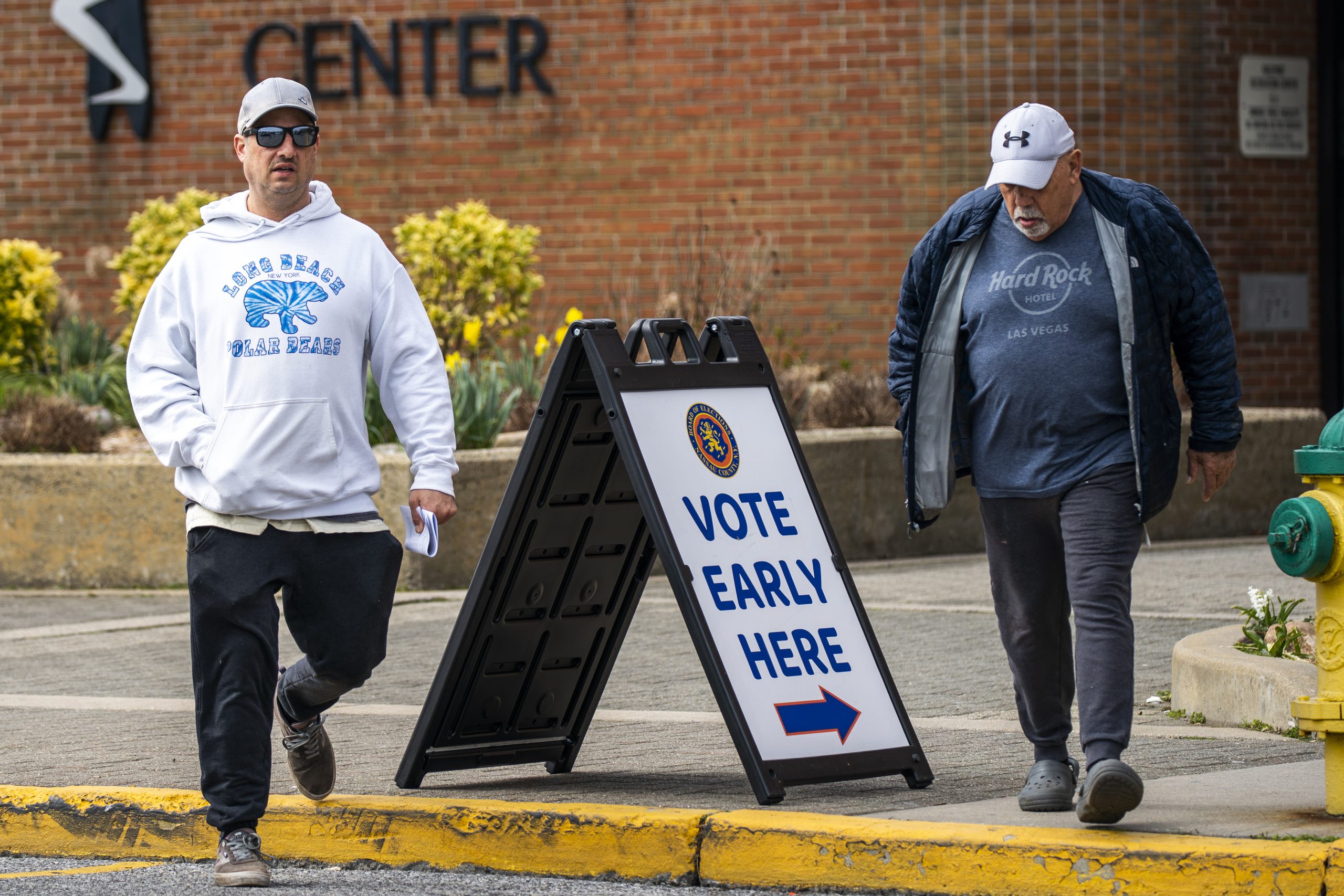
Primary voting is restricted by party registration, preventing crossover voting between Republican and Democratic contests. The Democratic and Libertarian parties permit unaffiliated voters to participate in their primaries, while Republicans and the Legal Marijuana NOW party allow independents to vote only in federal races. Photo identification is mandatory for all voters.
Current registration totals approximately 1.3 million voters statewide, including roughly 621,000 Republicans and 328,000 Democrats. Historical turnout suggests about 18-22% of registered voters typically participate in Republican primaries, while Democratic primary participation runs around 8% of registered voters.
Early voting data shows approximately 39% of Republican ballots and 65% of Democratic ballots were cast before Election Day in recent elections. As of Thursday, about 56,000 Republican and 49,000 Democratic primary ballots had already been submitted.
Most of Nebraska’s 93 counties typically release early and absentee results in their initial reports, often before any Election Day totals become available. The most populous counties, Douglas and Lancaster, usually provide limited Election Day results in their first updates.
During Ricketts’ 2024 Senate primary, initial results appeared at 9 p.m. Eastern Time when polls closed, with 90% of votes counted by 12:10 a.m. and final tallies around 1:35 a.m. The Associated Press declared Ricketts the winner at 9:10 p.m.
The Associated Press only declares winners when no mathematical possibility exists for trailing candidates to overcome their deficits. Automatic recounts occur when margins fall within 1% of total votes cast in races exceeding 500 votes.
Tuesday’s primary results will set the stage for November elections that remain 175 days away.
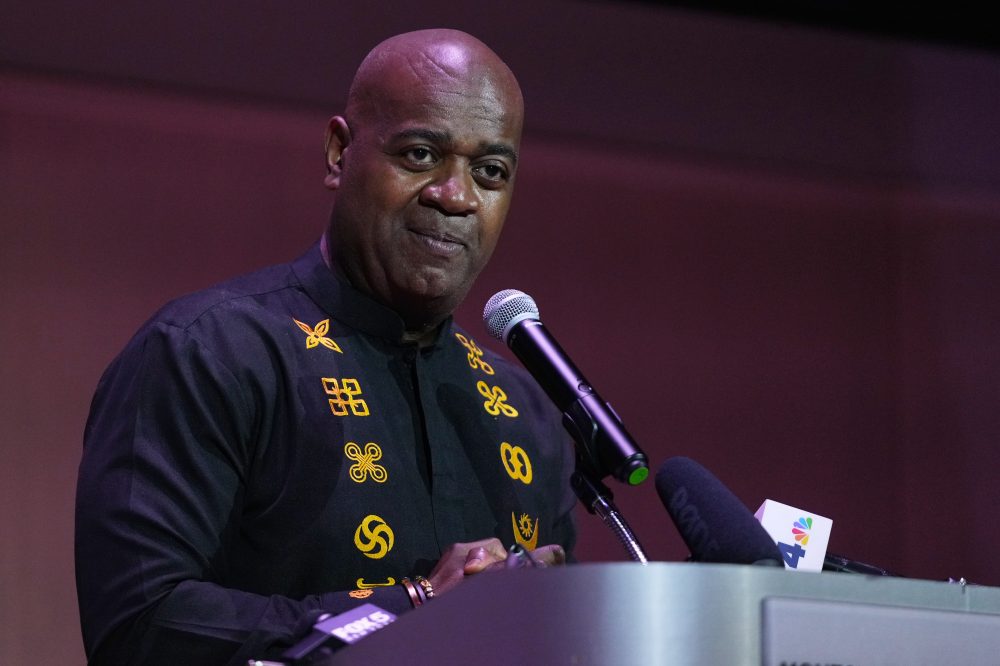
Newark, New Jersey’s incumbent Mayor Ras Baraka will compete against seven opponents on Tuesday as he pursues his fourth consecutive term leading New Jersey’s most populous city.
This election follows a turbulent year for the Democratic mayor. Nearly 12 months ago, Baraka was taken into custody during a demonstration outside a federal immigration detention facility. Those charges were subsequently dismissed, prompting him to file a lawsuit against the federal prosecutor, claiming wrongful arrest and vindictive prosecution.
Earlier this year, Baraka campaigned for governor in the Democratic primary, finishing as runner-up to former U.S. Representative Mikie Sherrill, who ultimately won the general election. While Baraka is affiliated with the Democratic Party, Newark’s mayoral position operates on a nonpartisan basis without party designations.
Seven individuals are vying to unseat Baraka: artist Tanisha Garner, developer and contractor Noble Milton, community organizer Sheila Montague, community activist Debra Salters, former Newark Municipal Court administrator Nasheedah Singleton, tech entrepreneur Jhamar Youngblood, and Douglas “Rodney” Davis, who has proposed eliminating “casual Fridays” at City Hall as part of his campaign agenda.
Montague previously ran against Baraka in 2022, capturing approximately 17% of votes in a second-place finish that was well behind the mayor. Both Montague and Salters competed for the Democratic nomination to succeed the late U.S. Representative Donald Payne in 2024, finishing in seventh and eleventh places respectively.
Should no candidate secure more than 50% of votes cast, the two highest vote recipients will proceed to a runoff election scheduled for June 9.
Voting concludes at 8 p.m. Eastern Time on Tuesday. The Associated Press will track vote totals and announce the winner of Newark’s mayoral contest.
All registered Newark voters are eligible to participate in this election. Registration records show approximately 159,000 voters were registered in Newark for the 2025 general election.
Turnout in the previous mayoral election in 2022 reached about 18,000 votes, with roughly 16% of those ballots submitted prior to Election Day. As of Thursday, nearly 2,700 early votes had already been recorded for Tuesday’s contest, with the vast majority coming from Democratic voters.
In Essex County, where Newark serves as the county seat, initial vote reports typically encompass almost all early and mail-in ballots, while same-day voting results come later. During the 2025 general election, Essex County’s first results appeared at 8:06 p.m. Eastern Time, just six minutes after polls closed. The final vote update occurred at 10:10 p.m. Eastern Time, representing about 93% of total votes.
The Associated Press follows strict protocols for declaring winners, only making calls when no mathematical possibility exists for trailing candidates to overcome the lead. New Jersey does not conduct automatic recounts, though candidates and voters may request and fund recounts, with costs reimbursed if results change.
If a runoff becomes necessary, it will take place 28 days after Tuesday’s election on June 9.
Live Action, a prominent anti-abortion advocacy organization, has released several reports alleging that the National Abortion Federation collaborated with the Biden administration to target pro-life activists. According to Live Action’s claims, the NAF gathered comprehensive personal details about anti-abortion advocates, including their names and private information. The organization states that this data collection extended to information about activists’ family members, including spouses and children, and in certain instances included travel schedules and driver’s license information. Live Action references documentation from the previous Trump administration that allegedly shows how President Biden conducted what they characterize as a campaign against pro-life advocates.
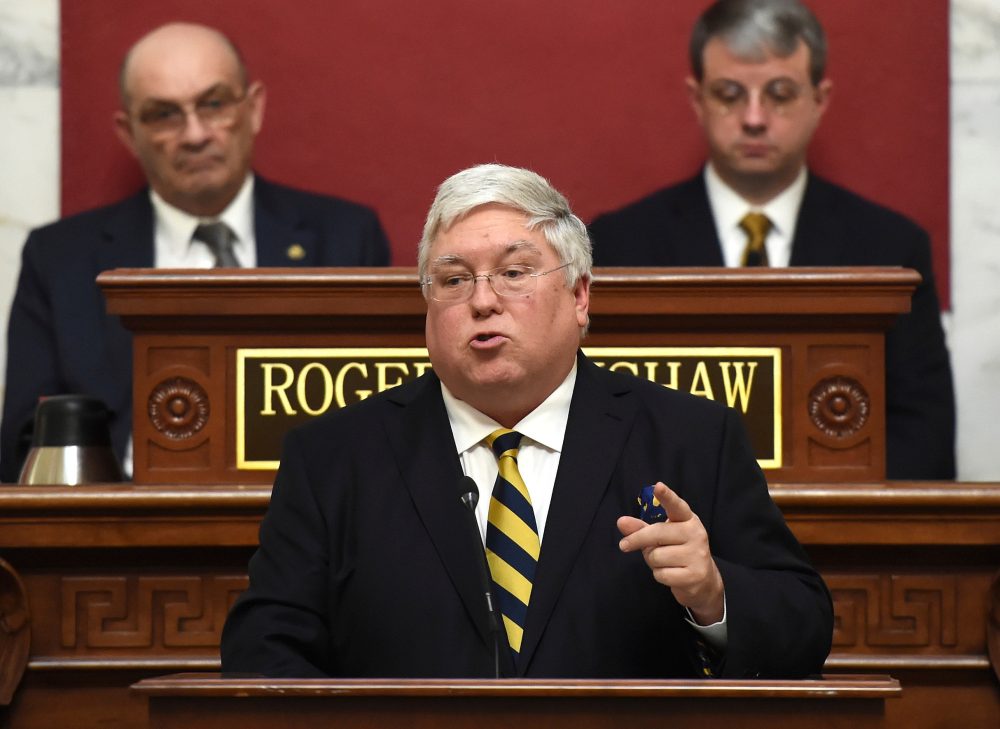
West Virginia Governor Patrick Morrisey is taking a page from former President Donald Trump’s political playbook, working to remove Republican state lawmakers he considers disloyal in Tuesday’s primary elections.
While Morrisey’s name won’t appear on any ballot, the Republican governor is putting his political reputation on the line by endorsing challengers against multiple GOP incumbents in the state legislature. His goal is to reshape the party’s overwhelming majorities to better align with his vision.
The primary results will serve as a crucial measure of Morrisey’s influence halfway through his gubernatorial term.
Tuesday’s elections will also determine nominees for federal offices including the U.S. Senate and House of Representatives. Additionally, Charleston’s Democratic mayor will face a primary challenger, while two state Supreme Court justices and an appeals court judge must defend their positions.
Morrisey’s legislative endorsements have created tension with fellow West Virginia Republican U.S. Sen. Shelley Moore Capito, who is running for her third term. The two party leaders are supporting different candidates in several races.
A prime example is state Senate District 10, where Capito backs incumbent Republican Sen. Vince Deeds while Morrisey supports challenger Jonathan Comer, a local pastor.
This political split isn’t new for the two Republicans. In 2024, Morrisey edged out Capito’s son Moore Capito in a close race for the GOP gubernatorial nomination.
For the U.S. Senate seat, Capito confronts five primary opponents, with state Sen. Tom Willis emerging as her most significant challenger. Willis has secured backing from six Republican state senators, including Senate President Randy Smith. However, Capito holds endorsements from 15 state senators plus a crucial nod from Trump, which could blunt Willis’ criticisms of her voting record.
In Charleston’s mayoral race, Democratic incumbent Amy Goodwin is seeking her third term but must first overcome primary challenger Martec Washington, a community organizer who finished far behind Goodwin in their 2022 primary matchup. Republican Brian Hunt faces no opposition for his party’s nomination.
Two state Supreme Court justices, Tom Ewing and Gerald Titus, are defending their seats in special elections after being appointed in 2025 to fill vacant positions. Intermediate Court of Appeals Chief Judge Dan Greear is also fighting to keep his position against challenger Jim Douglas for a 10-year term.
Voting concludes at 7:30 p.m. Eastern Time on Tuesday.
The Associated Press will report results and announce winners in competitive primaries for federal and state legislative seats, Charleston’s mayoral race, and judicial elections. Three special state Senate elections are also on the ballot.
West Virginia’s primary system restricts registered party members to voting only in their own party’s contests. Independent and unaffiliated voters can participate in Democratic or Mountain Party primaries but are excluded from Republican primaries. All voters must present identification.
Current registration figures show approximately 1.2 million eligible voters statewide as of late April, with Republicans leading at 520,000, followed by 327,000 Democrats and 302,000 unaffiliated voters.
Last year’s GOP primaries for president, governor, and U.S. Senate each drew roughly 225,000 participants, representing about 19% of registered voters. Democratic primary turnout ranged from 90,000 to 102,000 voters depending on the race.
Early voting accounted for approximately 30% of all ballots cast in 2024’s primaries.
Through May 5, more than 36,000 voters had already cast ballots for Tuesday’s election, including over 17,000 Republicans, about 13,600 Democrats, and roughly 3,600 unaffiliated voters.
Most of West Virginia’s 55 counties typically release their early and absentee voting results in the first report of election night, with about 60% reporting complete or near-complete totals initially.
During 2024’s Republican U.S. Senate primary, initial results appeared at 7:41 p.m. Eastern Time, just 11 minutes after polls closed. Vote counting reached 90% completion around 10:06 p.m., with final updates released at 12:40 a.m. showing more than 99% of votes tallied.
The Associated Press only declares winners when no mathematical possibility exists for trailing candidates to overcome the deficit. For undecided races, coverage continues for significant developments like candidate concessions while clearly noting no winner has been declared.
West Virginia law doesn’t mandate automatic recounts, though candidates may request and fund recounts regardless of victory margins. Costs are reimbursed if recounts alter outcomes. The AP may call races subject to potential recounts if leads are mathematically insurmountable.
Tuesday’s results will set the stage for the 2026 midterm elections, now 175 days away.
A unique gubernatorial campaign is taking shape in Oregon, where someone identifying as “Pencil” has launched a write-in bid for the state’s highest office.
The unconventional candidate, whose real name is J. Schuberth, has been making rounds through downtown Portland to connect with voters and curious onlookers. Schuberth’s campaign centers on advocating for significant changes to Oregon’s kindergarten through 12th-grade education system.
The motivation behind this unusual political approach stems from alarming statistics about the state’s academic performance. National testing data reveals that Oregon students score lowest in the nation for fourth-grade reading comprehension.
By running under the “Pencil” moniker, Schuberth hopes to serve as an alarm bell for current political leaders about the urgent need to address educational shortcomings in the state. The symbolic campaign represents a call to action for meaningful reform in Oregon’s struggling school system.
BATON ROUGE, La. — Election chaos is spreading across multiple Southern states as Republican lawmakers rush to redraw congressional boundaries in the middle of primary season, leaving thousands of voters uncertain whether their ballots will even count.
The frantic redistricting push comes after a recent Supreme Court decision that significantly weakened the Voting Rights Act, prompting GOP-controlled legislatures to move quickly on new maps that could eliminate several Democratic-held seats.
In Louisiana, the situation has become particularly confusing for voters like 66-year-old New Orleans resident Sallie Davis, who cast an early ballot last week only to discover a handwritten X crossing out her preferred candidate’s name on a polling station sign.
“I was supposed to believe a piece of paper with an X on it marking out the person I wanted to vote for,” she said, her voice breaking as she recounted her experience later. “I think I have been disenfranchised. I think my vote, that I just voted on, it’s not going to count or something. I think it’s illegal.”
Louisiana’s governor declared an emergency and halted congressional primaries just two days into early voting, but not before nearly 179,000 ballots were cast, including approximately 53,000 absentee votes returned by mail. Secretary of State Nancy Landry’s office confirmed those congressional votes will not be tallied.
The turbulent election season stems from an aggressive gerrymandering campaign initiated by President Donald Trump last year to safeguard Republicans’ narrow House majority. The Supreme Court’s recent ruling required Louisiana to reconsider its 2024 map that created two majority-minority districts electing Black representatives, despite the state’s roughly 30% Black population.
Similar disruptions are unfolding in Alabama, where lawmakers approved legislation Friday to redo congressional primaries just a week before the May 19 election date. Voters will still cast ballots in House races using current district lines, but those votes may be discarded if courts approve new boundaries.
Tennessee became the first state to enact revised maps following the Supreme Court decision, forcing election coordinators to warn county officials about reprogramming voting systems, retraining poll workers, and potentially relocating polling sites for some voters.
The state’s elections coordinator outlined the challenges in a memo: adjusting precinct boundaries and updating election infrastructure with compressed timelines before the August 6 congressional primaries.
South Carolina faces similar pressures, with lawmakers considering whether to postpone all June 9 primaries to August or just the congressional races. More than 6,800 mail ballots have already been distributed to voters, with 260 returned as of Friday, according to the state Elections Commission.
Conway Belangia, the commission’s executive director, warned lawmakers Friday that conducting separate congressional primaries would cost $3 million with extremely tight preparation schedules.
“It will be difficult, but it will be possible,” he said.
The redistricting efforts target multiple Democratic seats across the region. Republicans in Alabama, Mississippi, South Carolina and Tennessee are considering eliminating four Democratic districts combined, three represented by Black lawmakers. Florida has already implemented a new map designed to cost Democrats four of their eight congressional seats out of 28 total.
Voter confusion is widespread, according to Michael McClanahan, president of the NAACP’s Louisiana State Conference, who says constituents are calling with questions about whether elections are even happening.
“People say, ‘I ain’t going to vote because the governor’s suspended the election,’” he said. “But he didn’t, he only suspended one aspect of it.”
Alabama Senate Democratic leader Bobby Singleton reports similar confusion among election officials themselves.
“These are the people who are the head of elections,” he said. “They don’t know what to do.”
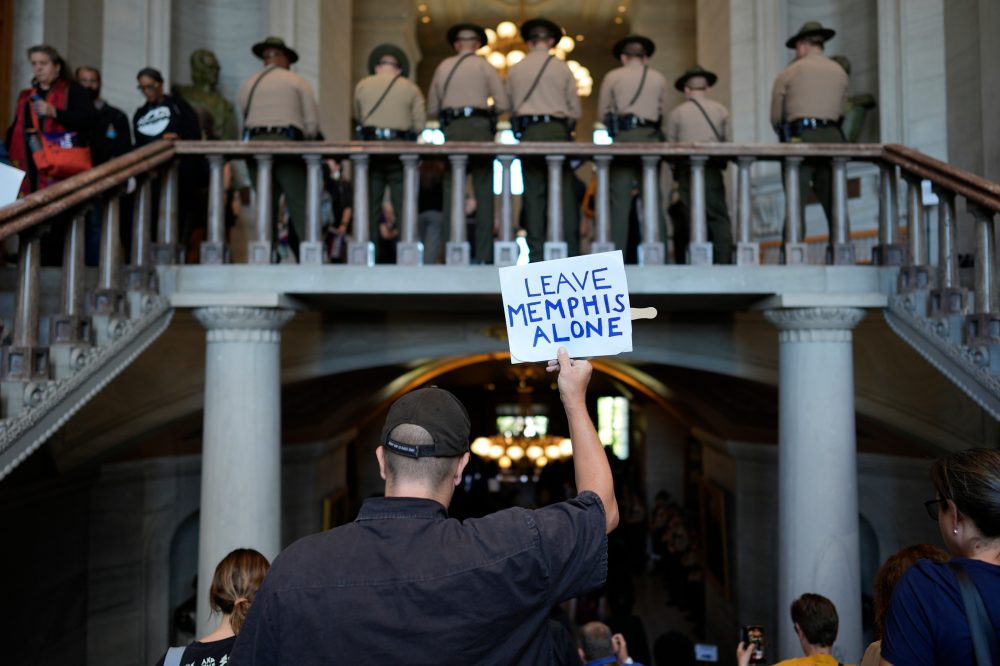
Voting rights advocates point to Nashville’s 2022 experience as a warning sign for what Memphis voters might face this year. When Republican legislators split Tennessee’s capital city across three congressional districts to capture a Democratic seat, more than 3,000 Nashville-area voters were placed in incorrect districts and over 430 cast ballots in wrong races during the November 2022 election.
“It’s going to be really hard for the election commissions to be able to keep up with this short timeline,” Matia Powell, executive director of voting rights nonprofit Civic TN, said during a Friday conference call with other Southern voting rights activists.
Anneshia Hardy, executive director of Alabama Values, which supports voting and civil rights organizations, warned that frequent rule changes could undermine public faith in elections.
“Once people stop believing that the process is stable and fair, disengagement is going to increase, and that’s one of the biggest dangers here,” she said. “Democracy doesn’t just depend on voting systems existing but really on people believing that their participation matters.”
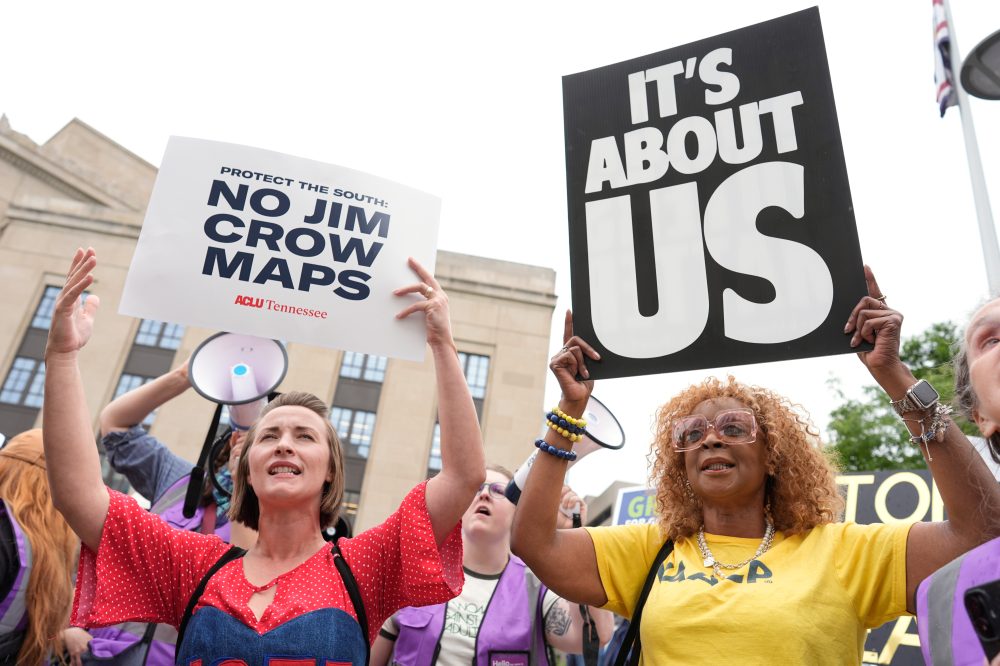
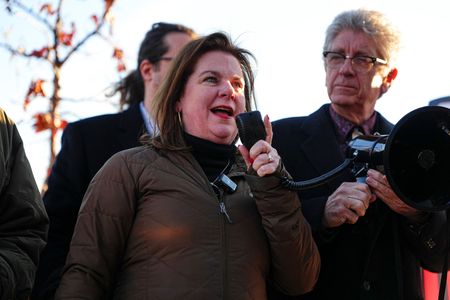
The uncertainty has driven some voters to protest at state capitols. Davis joined demonstrators at Louisiana’s State Capitol in Baton Rouge Friday, using a bullhorn to chant “Whose vote? Our vote!”
David Victorian, a 79-year-old Vietnam veteran from Baton Rouge, expressed broader concerns about democratic institutions.
“I’m concerned for the survival of the democracy that we’re supposed to be living in,” he said.
Mississippi, which completed its primaries in March, now faces a federal court order to redraw state Supreme Court districts, while Trump pushes Republicans to revise the state’s four congressional districts. A special legislative session scheduled for May 20 will convene at the Old State Capitol due to House chamber renovations — the same building where lawmakers once passed Jim Crow voting restrictions decades ago.
“Modern-day voter suppression relies on election administration errors and chaos, and that’s what we’re going to see play out in all of these states,” said Amir Badat, a Jackson, Mississippi, voting rights attorney and activist.
A watchdog organization is pushing the Trump administration to implement mandatory security evaluations for advanced artificial intelligence systems before companies can secure federal contracts.
Americans for Responsible Innovation submitted recommendations to government officials on Monday, calling for comprehensive screening processes that would examine AI technology for potential cybersecurity threats and weapons development risks before public deployment.
The proposal comes as the White House confronts concerns about Anthropic’s Mythos system, which experts worry could streamline sophisticated cyber operations and create national security vulnerabilities.
Under the advocacy group’s plan, AI developers would need to successfully complete security assessments to qualify for government contracting opportunities. The organization emphasized that these evaluations should focus on preventing the creation of tools that could facilitate cyberattacks or military applications.
Currently, the U.S. Center for AI Standards and Innovation conducts voluntary assessments of certain AI systems through partnerships with major technology companies including OpenAI, Anthropic, Google, Microsoft and xAI.
The advocacy group recommends expanding CAISI’s role to include developing binding standards, while suggesting Congress establish a dedicated enforcement division within the Department of Commerce to oversee compliance.
The proposed regulations would target companies investing at least $100 million annually in computational resources for training advanced AI models, or those generating $500 million or more yearly from artificial intelligence products and services.
This framework mirrors safety reporting standards that California implemented in the previous year, establishing similar financial thresholds for regulatory oversight.
WASHINGTON — Congressional Republicans face mounting opposition this week over a billion-dollar security funding proposal tied to President Donald Trump’s planned White House ballroom, with Democrats promising an aggressive fight against the measure.
The substantial security allocation was inserted by Senate Republicans into spending legislation that would also reinstate funding for immigration enforcement agencies previously blocked by Democrats since February. This security funding proposal emerged following charges against a man accused of attempting to assassinate Trump during last month’s White House Correspondents’ Association dinner.
GOP leaders plan to advance the spending measure through Congress using partisan budget procedures that bypass Democratic support entirely. However, Senate Democratic leader Chuck Schumer announced Monday that his party will mount opposition through alternative strategies, including urging the Senate parliamentarian to remove the ballroom security funds and introducing amendments that force Republicans into difficult votes.
“The Republican-controlled Congress is preparing to answer this moment with a deficit-busting, party-line bill that pours billions more taxpayer dollars into a rogue ICE operation and a billion-dollar ballroom, while doing nothing to end the illegal war in Iran or ease the Republican affordability crisis bearing down on working families,” Schumer stated in a letter to colleagues.
Republican support for the security funding remains uncertain. The House version of the bill has not been released, though the Senate is anticipated to begin voting on its version this week.
Several GOP lawmakers have expressed reservations about the proposal during the recent congressional recess, with some publicly questioning their potential support.
“I’m going to look at it very carefully and make sure those things are in the national interest,” stated Rep. Rob Wittman, a Virginia Republican who was at the Capitol last week for a brief House session.
“I want to know the exact nature of the expenditures that would go there for security. So I think it’s a little premature to look at that and say, you know, yes or no to it,” Wittman explained.
Wittman emphasized his desire to understand the Senate proposal’s specifics and “how it’s part of what the total construction cost is,” he noted.
Trump has estimated the ballroom construction at $400 million using private funding, though he had not previously specified security-related expenses.
The Senate legislation would allocate the funds to the U.S. Secret Service for “security adjustments and upgrades” connected to the ballroom project, which Trump and Republican allies have championed since Cole Tomas Allen was charged with attacking the April 25 media dinner at the Washington Hilton while armed with guns and knives.
The proposed legislation indicates the funding would support ballroom project enhancements, “including above-ground and below-ground security features,” while explicitly prohibiting use for non-security components.
White House spokesperson Davis Ingle commended Republicans last week for incorporating funding for the “long overdue” project, stating it would “provide the United States Secret Service with the resources they need to fully and completely harden the White House complex, in addition to the many other critical missions for the USSS.”
Court filings from the White House describe the East Wing project as “heavily fortified,” featuring bomb shelters, military installations and underground medical facilities beneath the ballroom. Trump has advocated for bulletproof glass and drone attack resistance capabilities.
The National Trust for Historic Preservation has filed a lawsuit challenging the project’s construction, though a federal appeals court ruled last month that work may proceed during the legal proceedings.
American automotive leaders and politicians from both parties are sending a unified message to President Trump ahead of his scheduled meeting with Chinese President Xi Jinping: keep Chinese vehicles out of the United States market.
The push comes after Trump’s January remarks to the Detroit Economic Club, where he expressed enthusiasm about Chinese manufacturers establishing US production facilities. “I love that. Let China come in, let Japan come in,” Trump stated, describing such investments as “great” for American employment.
Those statements triggered widespread concern throughout an industry that has consistently worked to prevent Chinese automobiles from entering the American marketplace through stringent data protection regulations and substantial electric vehicle tariffs.
Now, automotive manufacturers, parts suppliers, steel producers, labor unions, and elected officials are intensifying their advocacy efforts. They contend that Chinese car companies, backed by unlimited government subsidies, enormous production capacity, superior EV capabilities, and extremely low pricing, would devastate both domestic and international competitors while undermining America’s manufacturing foundation.
Michigan’s Democratic Senator Elissa Slotkin addressed the same Detroit venue Thursday, specifically urging Trump to reject any agreement with Xi that would permit Chinese automotive investment resulting in Chinese-branded vehicles appearing in American showrooms.
“Please don’t make a bad deal,” Slotkin stated, while highlighting her bipartisan legislation with Ohio Republican Senator Bernie Moreno that would explicitly prohibit Chinese vehicles due to data security risks.
Their Connected Vehicle Security Act, which includes a companion measure in the House, would formally establish a data protection rule that effectively blocks Chinese vehicles – a policy implemented under former President Biden that would become extremely difficult to overturn.
The House version extends further by prohibiting industry partnerships with Chinese corporations. Congressional staff members informed reporters that with widespread backing, the legislation could advance this year, potentially as part of transportation funding legislation.
“Every vehicle on American roads is a rolling data collection device, capturing information on location, movement, people, and infrastructure in real time, and we cannot allow Chinese vehicles or components to be a part of that system,” stated sponsoring representatives Debbie Dingell, a Democrat, and John Moolenaar, a Republican, in their joint announcement.
Both legislators represent Michigan districts with significant automotive presence. Recently, 74 House Democrats and 52 House Republicans signed correspondence urging Trump to prevent Chinese automakers from accessing the American marketplace.
The automotive sector has demonstrated remarkable consensus supporting the prohibition.
Organizations representing domestic and international automakers, dealerships, and component manufacturers informed the administration in March that China’s campaign to control global vehicle production and penetrate the US market “pose a direct threat to America’s global competitiveness, national security and automotive industrial base.”
Steel industry associations issued similar correspondence on April 30, while the Information Technology and Innovation Foundation, despite previously criticizing Trump’s Chinese import tariffs, endorsed the Chinese vehicle ban legislation.
“Chinese automakers are not normal market competitors. Their EVs are the product of decades of state-backed mercantilism designed to help China capture global leadership in advanced industries,” explained ITIF vice president Stephen Ezell.
“Once China’s subsidized firms are embedded in the U.S. market, the economic and national security damage would be far harder to reverse — and it would not be limited to Detroit,” Ezell continued.
US Trade Representative Jamieson Greer announced in Detroit during April that no modifications to the connected vehicle regulation were planned, and automotive issues would not be discussed at the Beijing summit. Commerce Secretary Howard Lutnick has similarly dismissed Chinese investments in America’s automotive sector.
However, Scott Paul, who leads the Alliance for American Manufacturing, expressed ongoing worry that Trump, who frequently discusses attracting additional vehicle assembly facilities to the US, might act independently.
“He’s left wiggle room in dealing with the auto sector,” Paul observed.
Any approved facility would require two to three years before beginning production, leaving the outcomes for Trump’s eventual successor.
Neither the White House nor China’s Washington embassy provided responses to inquiries about this issue.
Industry representatives want to prevent repeating Chinese automakers’ progressive market expansion in Europe and Mexico. America’s growing vehicle affordability challenge, where Kelley Blue Book reports average vehicle prices now surpass $51,000, creates particular vulnerability to less expensive Chinese alternatives.
Chinese brands expanded their European market presence to 6% last year, doubling their previous share, while capturing 14% in Norway, 9% in Italy, 11% in Britain, and 9% in Spain. Consumer interest in Chinese electric vehicles continues growing as Middle East conflicts drive up gasoline costs.
Canada has begun importing 49,000 Chinese electric vehicles annually, while 34 Chinese automotive brands now operate in Mexico, representing approximately 15% of that market at prices significantly below American offerings.
Geely’s EX2 electric vehicle begins around $22,700 in Mexico – more than double its Chinese market price but substantially less than Tesla’s cheapest Model 3 at $38,630 in the US.
Even Toyota, which previously undercut Detroit manufacturers during the 1980s and 1990s, faces challenges competing with Chinese pricing in Mexico, according to Toyota Motor North America division manager David Christ.
“Obviously there’s some level of government support, or else they couldn’t transact at that price,” Christ stated during an interview. “So it has a huge impact on business.”
The State Department is experiencing a significant departure of diplomatic personnel during the current Trump administration. Officials cite increasing political interference in foreign policy decisions as a primary factor driving the departures.
Career foreign service officers are leaving their positions at an accelerated rate, with many pointing to what they describe as unprecedented political involvement in diplomatic matters that were traditionally handled by career professionals.
The departures represent a notable shift in the traditionally stable ranks of America’s diplomatic corps, raising questions about the long-term impact on U.S. foreign relations and institutional knowledge within the department.
During a recent interview, NPR host Ayesha Rascoe engaged in conversation with historian Kevin Levin regarding President Trump’s proposal for a victory arch to mark America’s upcoming 250th anniversary celebration.
The discussion centered on how this proposed commemorative structure would compare and contrast with the existing collection of monuments and memorials currently located throughout Washington, D.C.
Levin provided expert perspective on the historical significance and potential impact of adding such a triumphal arch to the nation’s capital, offering insights into how it might complement or differ from other patriotic landmarks in the area.
PORTLAND, Ore. — Democratic leaders across the country are focusing their campaign messages on rising living costs as they prepare for midterm elections. However, in Oregon, a ballot question is creating complications for that political strategy.
Last fall, Oregon’s Democratic-led Legislature approved higher gas taxes and various fees to finance road infrastructure projects and address gaps in the state’s transportation funding. GOP lawmakers responded by gathering petition signatures to challenge these increases, resulting in a referendum scheduled during a period when gas prices are surging nationwide due to the Iran conflict.
“It is a hell of a time to be raising gas taxes on people,” said Jeanine Holly, filling up her tank on a recent morning in Portland.
Oregon’s May 19 primary ballot will include the gas tax repeal question during widespread oil market disruptions caused by the Iran war initiated by Israel and President Donald Trump. American consumers across party lines are expressing frustration, with national gas prices exceeding $4.50 per gallon on Friday and Oregon averaging roughly 80 cents higher per gallon.
This referendum allows voters to address an issue directly affecting their wallets while costs for housing, food, and other necessities remain high. Across the nation, Democrats have emphasized affordability concerns similar to those that contributed to Trump’s 2024 victory. Several Democratic candidates have even suggested tax reduction proposals to advance their platform and challenge typical Republican tactics.
“It’s difficult to imagine a worse situation for … a gas tax increase than right now in American politics,” said Chris Koski, professor of political science and environmental studies at Portland’s Reed College.
GOP leaders quickly mobilized voters after the Legislature and Democratic governor approved the tax hike, which also encompassed increased payroll taxes for transit initiatives and higher vehicle registration and title fees.
The referendum required 78,000 voter signatures for ballot qualification. Republicans collected 250,000 signatures.
“That is a remarkable number,” said Republican strategist Rebecca Tweed.
Oregon Republicans have challenged Democrats’ affordability messaging by characterizing the tax and fee increases as worsening high living costs.
“Do Oregonians want to pay more? The answer is no,” said GOP state Sen. Bruce Starr, who helped lead the referendum campaign. “Everything they’re looking at is expensive.”
The legislation would increase Oregon’s gas tax from 40 cents to 46 cents per gallon. This would tie Oregon with Maryland for the eighth-highest state gas tax when including other state taxes and fees, based on U.S. Energy Information Administration data.
At the Portland gas station, Michael Burch said he previously spent $70 to fill three-quarters of his pickup truck’s tank, but now pays $80 for just over half a tank.
“I’m sick and tired of taxes,” the 76-year-old retiree said. “Gas is certainly dampening the spirits and the coffers of folks that aren’t as well off.”
Hannah Coe, a 30-year-old student, said she was uncertain about her vote on the primary ballot referendum.
“I think I would be in favor of it if it was going to go to the things that it was saying it was going to go to, such as fixing our roads,” she said. “I also kind of feel like that’s just a grab at trying to get more money from the people who live here.”
Oregon Democrats dedicated much of last year to advancing transportation funding legislation to generate revenue for services including road maintenance and snow removal. The discussion occurred amid forecasts of declining gas tax income as more drivers choose electric, hybrid, and fuel-efficient vehicles.
They ultimately approved a reduced version of their proposal during a special legislative session convened by Democratic Gov. Tina Kotek.
She recently recognized the difficult timing of the referendum.
“Certainly, the conversation at the ballot this year … is a tough sell right now, because I think everyone is feeling a pinch on their household budgets,” she told reporters.
However, she and fellow Democrats argued that Trump’s decision to engage in war with Iran is the primary cause of gas price spikes. She proposed that the federal government consider lowering the federal 18 cent-per-gallon gas tax to provide pump relief for Americans.
Some Oregon residents support the Democrats’ rationale for last year’s legislation. Kurt Borneman, 68, said he would back the gas tax increase, despite now paying at least $10 more to fill his tank.
“I realize that money’s tight and roads need to be improved,” he said at the Portland gas station. “I want less government, but I also want nice roads.”
Democratic state Rep. Paul Evans said his party failed to effectively communicate the gas tax increase to the public. No organized Democratic opposition to the ballot referendum has emerged.
“When anything is reduced to, ‘Do you want a tax or not?’ Most people are going to say no,” he said. “The messaging got away from us, and it became focused upon the price instead of the value.”
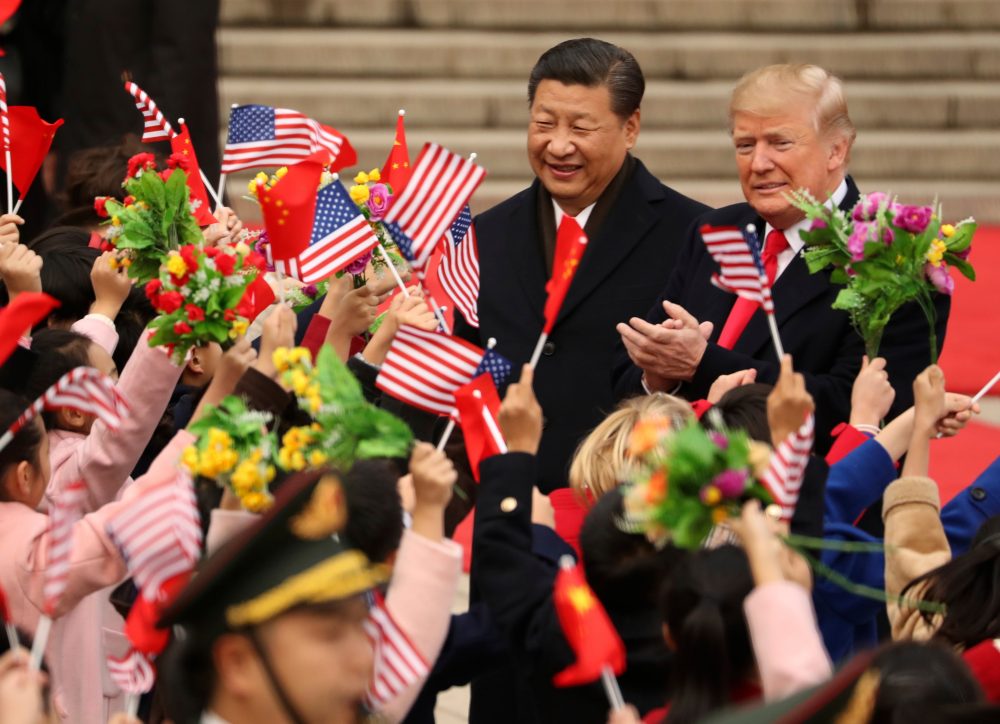
WASHINGTON (AP) — Just weeks ahead of his scheduled Beijing trip, President Donald Trump took to social media to forecast that Chinese President Xi Jinping would “give me a big, fat hug when I get there.”
However, China’s substantial financial connections to Iran, combined with ongoing trade disputes and tariff concerns dating back to Trump’s previous presidency, may dampen the atmosphere during Trump’s Beijing visit this week. This comes despite the Republican president’s years of lavish praise for Xi, demonstrating his view of China’s leader as a formidable competitor deserving of his respect and admiration.
Given Trump’s dislike of lengthy flights and extended periods away from the White House or his Florida and New Jersey residences, he’s anticipated to remain in China for only portions of three days.
While ceremonial elements will be present, the magnificence isn’t anticipated to match Trump’s initial 2017 China visit, which Beijing characterized as a “state visit-plus.”
“Even before this whole conflagration with Iran, they weren’t going to go state visit-plus like last time, just because things are tense,” said Jonathan Czin, a former director for China at the National Security Council during the Biden administration.
During Trump’s previous presidential term visit, China provided an elaborate welcome featuring a military band and children with flags chanting “Welcome.”
Xi provided a Forbidden City tour, where Trump and first lady Melania Trump enjoyed a private dinner. Trump became the first foreign leader since the People’s Republic of China’s 1949 establishment to receive treatment once exclusively reserved for emperors.
The next day included another welcome ceremony at the Great Hall of the People with a military parade. A state banquet honored Trump, featuring video highlights from Xi’s prior Florida visit and footage of Trump’s granddaughter Arabella performing Chinese songs.
Beijing rarely provides such elaborate treatment for visiting foreign dignitaries. When British Prime Minister Keir Starmer toured the Forbidden City in January, Xi was absent and the location stayed open to tourists, forcing Starmer to navigate around sightseers.
Ali Wyne, senior U.S.-China research and advocacy adviser for the Washington nonprofit the Crisis Group, said the “Chinese delegation will likely do its utmost to ensure that Trump leaves Beijing believing that he has just concluded the most extraordinary state visit of his two presidencies.”
However, he noted that the “pomp and circumstance would serve a different role now than they did when he first visited Beijing” because “Xi has a much better understanding of Trump, and the administration’s own national security strategy and national defense strategy recognize China as a near-peer.”
Achievement expectations may be diminished this time, according to Czin, currently a Brookings Institution fellow. He anticipates the Chinese may withhold significant trade breakthroughs or other major concessions because they are “working backward from our midterm elections” with the belief that approaching Election Day will increase “the more leverage they are going to have.”
The GOP focuses on maintaining Congressional control, while polling indicates most Americans disapprove of Trump’s economic policies and believe the United States overreached in Iran. Nevertheless, the White House contends that Trump’s previous tough stance with Beijing regarding tariffs — later overturned by the Supreme Court — positions the U.S. favorably.
“President Trump cares about results, not symbols,” White House spokesperson Anna Kelly said. “But even still, the president has a great relationship with President Xi, and the upcoming summit in Beijing will be both symbolically and substantively significant.”
Trump may encounter China’s leader four times within eight months.
Following his Beijing visit, Trump plans to welcome Xi at the White House. Trump might also participate in November’s Asia-Pacific Economic Cooperation meeting in Shenzhen, China. Xi could attend the subsequent month’s Group of 20 summit at Trump’s Doral, Florida resort.
Czin observed that Xi also dislikes travel, suggesting not all planned meetings may occur. He noted China’s leader doesn’t engage in “personal connections” that Trump enjoys, pointing to Xi’s January military purge that removed officials with longstanding family ties.
Wyne, however, said Xi “appreciates that he is unlikely to deal with another U.S. president who admires him as greatly and embraces as narrow a view of strategic competition.”
This means Xi may “attempt to pocket as many economic and security concessions from Trump as possible,” Wyne said.
Trump told The Wall Street Journal’s editorial board in 2024 that Xi “was actually a really good … I don’t want to say ‘friend.’ I don’t want to act foolish. ‘He was my friend.’ But I got along with him great.”
Trump even indicated that military intervention might be unnecessary to prevent Chinese forces from threatening Taiwan, simply because China’s leader “respects me,” despite recent discussions about potentially providing arms to Taiwan.
Trump has maintained praise for the bilateral relationship since returning to the White House, even after his Beijing visit was rescheduled from March due to early Iran war developments.
He unsuccessfully encouraged China to help reopen the Strait of Hormuz after Iranian forces blocked it, disrupting global economies. However, China leveraged its position as Iran’s largest oil customer to encourage Iran toward what remains a fragile ceasefire.
Beijing maintains strong economic relationships with Tehran, and the conflict could damage its economy, which was already expected to experience slower growth. If China successfully helps establish lasting peace, this might improve its position in trade negotiations with the Trump administration.
During his 2017 visit, Trump announced $250 billion in non-binding trade agreements, some of which never materialized. A 2020 round of trade deals worth $200 billion largely failed to materialize before Trump’s first term concluded.
More recently, Trump’s announcement of significant global tariffs last year prompted China to halt U.S. soybean purchases and restrict rare earth mineral exports essential for American manufacturing.
Tensions have somewhat decreased since the U.S. achieved a trade truce last fall limiting tariffs on both sides. The administration continues prioritizing reduction of the U.S. trade deficit with China while encouraging bilateral trade.
“I expect great stability in the relationship,” Treasury Secretary Scott Bessent said. “But that doesn’t mean our trade deficit can’t continue dropping.”
Kelly, the White House spokeswoman, said Trump “doesn’t travel anywhere without bringing deliverables home to our country.”
“Americans can expect the president to deliver more good deals for the United States while in China,” she said.
Recent primary elections in Ohio demonstrated that economic concerns remain at the forefront of voters’ minds, particularly in contested congressional races around the Toledo area.
When residents cast their ballots in last week’s primaries, candidates and voters alike emphasized that rising costs for essential items like fuel and food have become the dominant political issue in competitive districts.
The electoral outcomes in Toledo’s congressional district reflected a broader trend where economic pressures and household budget concerns are driving political decisions across the state.
A nationwide fight over congressional district boundaries shifted in favor of Republicans Friday, following a Virginia Supreme Court decision that struck down Democratic redistricting efforts and new legislation in Alabama setting up potential primary elections if courts approve GOP-drawn maps for November’s midterm contests.
Republican Governor Kay Ivey quickly signed Alabama’s legislation into law, marking another step in a broader Republican strategy across Southern states to take advantage of a recent Supreme Court decision that substantially reduced Voting Rights Act safeguards for minority communities.
Tensions ran high at Alabama’s state capitol, where security personnel removed a demonstrator from the crowded House viewing area. Similar confrontations occurred in Louisiana and South Carolina, where Republican legislators faced strong pushback from civil rights advocates and Democratic opponents while unveiling their congressional redistricting proposals Friday.
These developments followed Thursday’s passage of new congressional boundaries in Tennessee that split apart a Democratic-controlled, majority-Black district in Memphis. The Tennessee Democratic Party filed a lawsuit Friday, arguing the maps should not take effect until after this year’s elections due to timing constraints.
The redistricting conflict had already intensified before last week’s Supreme Court decision in a Louisiana case, with both major parties fighting for advantages in midterm elections that will decide control of the narrowly divided House. Republicans gained further momentum when Virginia’s highest court ruled Friday that Democratic legislators had broken constitutional procedures when putting a redistricting measure before voters.
Republican strategists believe they could pick up as many as 14 House seats through new district maps across multiple states, while Democrats estimate they might gain up to six seats following redistricting efforts that began after former President Donald Trump supported Texas redistricting plans last summer.
Alabama’s special primary elections would only occur if courts agree to remove an injunction that currently keeps a court-approved map in place through the 2030 census. That judicial order mandated a second district with a Black majority or near-majority, leading to the 2024 election victory of Democratic Representative Shomari Figures, who is Black. Should courts remove the injunction, Republican leaders plan to implement a 2023 legislative map that federal courts previously rejected, potentially allowing them to regain control of Figures’ district.
“With this special session successfully behind us, Alabama now stands ready to quickly act, should the courts issue favorable rulings in our ongoing redistricting cases,” Ivey said in a statement.
However, a three-judge panel rejected Alabama’s Friday evening request to remove their injunction and clear the path for new maps. The matter remains under consideration by the U.S. Supreme Court.
Virginia Democrats had anticipated gaining up to four additional House seats under new districts that voters narrowly approved in April. The state Supreme Court invalidated the measure, determining that the Democratic-controlled legislature failed to follow proper procedures.
Virginia’s Constitution mandates that lawmakers approve constitutional amendments during two separate legislative sessions, with a state election occurring between the votes. The legislature’s first approval of the redistricting amendment happened last October while early voting was already underway but had not yet concluded for the general election. The second legislative vote took place after the new session began in January.
The state’s highest court determined the initial approval came too late, pointing out that more than 1.3 million ballots had already been submitted, representing approximately 40% of all votes eventually cast.
In Louisiana, a Senate committee reviewed multiple redistricting proposals Friday from Republican state Senator John “Jay” Morris that would eliminate one or both existing Black-majority House districts.
“Every one of these maps reduces Black voting power in every one of the districts. And I think that’s a problem,” Democratic state Senator Sam Jenkins told Morris.
Morris rejected claims that his proposed redistricting maps discriminated based on race. He explained his objective was to be “respectful of the traditional boundaries” of Louisiana’s six congressional districts.
“I don’t think we should care that much about race,” Morris said.
South Carolina legislators convened an unusual Friday session to examine a proposed congressional map designed to give Republicans control of all seven of the state’s House seats.
The House hearing represented the initial phase of redistricting. However, the proposal’s future remains uncertain, as the state Senate has not yet agreed to consider new districts later this month, which requires a two-thirds majority vote.
Members of President Trump’s Religious Liberty Commission are developing recommendations that would fundamentally challenge the constitutional principle separating church and state, according to discussions from their recent meetings.
The advisory panel’s proposals include establishing a federal hotline with an automated message stating “There is no separation of church and state,” along with awarding a Presidential Medal of Freedom to a baker who declined to make a wedding cake for a same-sex couple.
Additional recommendations involve Department of Justice court interventions supporting Amish families opposing New York vaccination mandates and Catholic nuns challenging state requirements to accommodate hospice patients’ gender identities.
These suggestions emerged during the commission’s April meeting, where members outlined their priorities for the panel’s upcoming final report. The commission, established by Trump last year, consists primarily of conservative Christian supporters with minimal internal disagreement on proposed initiatives.
The recommendations align with conservative Catholic and evangelical perspectives on religious freedom, emphasizing expanded religious expression in public education, increased public funding opportunities for faith-based organizations, and broader religious exemptions spanning labor law, educational curricula, and healthcare requirements.
These viewpoints mirror recent Supreme Court rulings issued by the court’s conservative majority.
However, critics argue the commission represents a biased perspective favoring Trump’s supporters while threatening established constitutional church-state separation principles.
A progressive interfaith coalition has filed a lawsuit claiming the commission violates federal requirements for advisory panels to include diverse membership and varied viewpoints.
The legal challenge highlights that most commissioners are conservative Christian clergy and commentators, with one Orthodox Jewish rabbi. The coalition notes commissioners have declared America a Judeo-Christian or Christian nation, with most meetings held at Washington’s Museum of the Bible, an institution with Christian leadership.
The Republican administration has requested federal court dismissal of the lawsuit, citing legal technicalities and arguing the law doesn’t specify how commissions should achieve fair balance or whose perspectives require representation.
Another Trump-created entity, the Task Force to Eradicate Anti-Christian Bias, released a report claiming Christians experienced discrimination under President Biden’s administration in education, tax law, and anti-abortion protester prosecution. Progressive organizations dismissed this report as lacking systematic discrimination evidence and functioning as advocacy rather than investigation.
Several Religious Liberty Commission members are scheduled to participate in a May 17 prayer event commemorating the nation’s approaching 250th anniversary. Many also joined a recent Bible-reading marathon primarily staged at the Museum of the Bible.
The commission has generally maintained member consensus, with one notable exception. Commissioner Carrie Prejean Boller was removed in February following a contentious antisemitism hearing.
Commission Chair Dan Patrick stated Prejean Boller attempted to “hijack” the hearing, engaging in heated exchanges with witnesses about antisemitism definitions and defending commentator Candace Owens while denying her antisemitic statements record. Prejean Boller, a Catholic, claimed wrongful removal for expressing her beliefs.
During other hearings, witnesses described defying workplace regulations they believed conflicted with their conservative religious values regarding gender, abortion, COVID-19 vaccines, and other issues. Some reported temporary prevention from displaying religious symbols at work or singing Christian songs at school talent shows.
The antisemitism hearing featured Jewish witnesses describing harassment and threats during campus pro-Palestinian protests against Israel. The commission has also heard from Hindu, Muslim, Sikh, and other religious representatives.
Nevertheless, critics maintain the commission primarily focuses on conservative Christian and right-leaning political grievances.
Rev. Paul Brandeis Raushenbush, president of the progressive Interfaith Alliance and one of the groups challenging the commission’s composition, emphasized the panel’s omissions are as significant as its focus areas.
Raushenbush noted the commission has inadequately addressed anti-Muslim efforts in Texas and elsewhere, plus rising antisemitism from the right, not just the left.
He expressed particular concern about the commission chair’s challenge to church-state separation principles.
Patrick, a Republican serving as Texas lieutenant governor, repeatedly criticized a concept established in Supreme Court precedent.
“We need to say there is no separation of church and state,” Patrick declared at the April meeting. “That’s a lie.” He proposed printing “a million bumper stickers” conveying this message.
No commission meeting attendees disagreed with Patrick’s statement.
Trump made similar remarks at a 2025 White House prayer event. “They say separation between church and state,” Trump stated. “I said, all right, let’s forget about that for one time.”
Although “separation of church and state” doesn’t appear in the Constitution, 20th-century Supreme Court decisions referenced Thomas Jefferson’s description of the First Amendment creating “a wall of separation between church and state.” The court extended the First Amendment’s prohibition of church “establishment” to states beyond federal government, citing the 14th Amendment’s ban on states denying citizens’ rights.
Courts have subsequently balanced religious freedom with freedom from government-sponsored religion.
Patrick has advocated for prayer and Ten Commandments displays in public schools.
“I don’t have any malice towards anyone that doesn’t believe in any type of faith,” Patrick told fellow commissioners. “That’s fine. That’s what America is about. But these organizations that are pushed by some ideology and pushed by someone’s bank account who wants to remove God from our country? We need to push back.”
Regarding other issues, various commissioners requested mandatory school and workplace postings of religious expression rights and exemption notices.
Some advocated restoring full compensation and pension benefits for military personnel discharged for refusing COVID-19 vaccines.
Bishop Robert Barron of the Catholic Diocese of Winona-Rochester, Minnesota, called for enabling religious organizations like Catholic Charities to receive federal funding without compromising traditional church family teachings.
He also advocated humane treatment and sacrament access for Catholic immigrants in detention, requesting immigration agents avoid disrupting worship services during enforcement actions. The administration previously eliminated a policy against immigration enforcement in sanctuaries, which other religious leaders said should never occur.
Kelly Shackelford, president and chief executive officer of First Liberty Institute, proposed new requirements for governments to pay all legal expenses when losing religious liberty cases. He noted many individuals lack financial resources to challenge government actions in court.
“That would be a huge shifting of power in favor of citizens,” he stated.
MEMPHIS, Tenn. — Two longtime bandmates who have entertained crowds on Memphis’ famous Beale Street for over two decades are discovering that being neighbors doesn’t guarantee they’ll share the same voting district anymore.
Steve Fowler and Sam Wilson, who have lived across the street from each other for ten years, will now cast ballots in completely different congressional districts starting Thursday due to Tennessee’s newly redrawn electoral map.
The Republican-dominated state legislature has carved up Memphis, eliminating the city’s traditional Democratic-leaning House seat that served the community for generations. Instead, the city’s predominantly Black population has been divided among three districts that lean Republican, connecting urban voters with largely white, rural, and conservative areas stretching far from their East Memphis street.
The new boundary literally runs down the middle of Fowler and Wilson’s road. Fowler finds himself assigned to the 8th Congressional District, which stretches hundreds of miles across a dozen counties into central Tennessee. Meanwhile, Wilson belongs to the 9th District, which spans most of the state’s southern border before curving northward to include predominantly white, wealthy Nashville suburbs.
“I think it’s horrible,” Fowler, who is white, expressed. “This isn’t just going to be bad for Black folks in Memphis, but poor whites in these new districts also aren’t going to get services. How are any of these congressmen going to serve all these different counties?”
This redistricting effort stems from a recent U.S. Supreme Court decision that could spell the end for congressional representation of majority-Black Southern communities like Memphis.
For six decades, a key section of the historic Voting Rights Act required map creators to demonstrate they weren’t discriminating against racial minorities when drawing district boundaries. This often resulted in political lines that enabled minority communities to elect their preferred candidates rather than having their voting power weakened by surrounding white majorities.
This protection had its strongest impact across Southern states, where Black and white communities often remain sharply divided along partisan lines.
On April 29, the Supreme Court significantly undermined this safeguard, determining that courts had improperly introduced racial considerations into redistricting processes in ways that violated the Constitution. Republicans throughout the South quickly seized this opportunity to redraw their maps before November’s elections, aiming to eliminate as many Democratic-held, majority-minority congressional seats as possible.
Tennessee’s legislature became the first GOP-controlled state to complete a new map under this ruling. However, it joins several other Southern states — including Alabama, Florida, Louisiana, Mississippi, and South Carolina — participating in a widespread partisan redistricting effort across the nation.
Republicans have long argued that the Voting Rights Act prevented them from applying the same tactics to Democratic, majority-Black districts that Democrats use in states they control against conservative-leaning, white, and rural communities — essentially scattering opposing voters for political advantage. Tennessee Republicans previously employed this strategy in their 2021 congressional map against Nashville’s Democratic voters, where they faced fewer constraints since that city has a white majority.
“Tennessee is a conservative state and our congressional delegation should reflect that,” stated Republican state Sen. John Stevens, who guided the legislation creating the new map that makes all nine congressional districts solidly Republican.
Wilson, the Black Memphis musician, appeared less troubled by his neighborhood’s division for political purposes. He viewed this action as another challenge facing the city, following an influx of federal agents deployed by President Donald Trump to address crime and ongoing narratives about Memphis’ safety from surrounding suburbs and Republican state officials.
“It’s a hustling community. We’re going to make ends meet for our families,” Wilson said. “The legacy of Memphis is music and our civil rights history,” he continued, noting their connection. “Hard times mean you’re going to try and find your gift. That’s what we do here; music in Memphis is a way of life.”
Memphis’ congressional district existed long before the Voting Rights Act. For at least a century, well before Congress moved to protect minority voting rights, Tennessee recognized it made sense for its Mississippi River metropolis to maintain its own House district. However, since the 1965 law’s passage, anyone attempting to divide the district for partisan benefit could face lawsuits and have their maps overturned. Legal experts now say this risk has largely disappeared.
Despite this, Democrats and civil rights organizations are pursuing legal action to stop the map. The symbolism carries particular weight given the city houses the National Civil Rights Museum, constructed around the motel where Rev. Martin Luther King Jr. was killed in 1968. When lawmakers approved the new maps, Democrats and demonstrators chanted “hands off Memphis!” while displaying signs accusing Republicans of reviving Jim Crow policies.
“Memphis is not just any city; it holds a central place in the national story of our quest for racial justice in this country and how, over time, we have increasingly achieved civil, voting, and economic rights for all Americans,” said Eric Holder, former U.S. attorney general who leads the National Democratic Redistricting Committee. “Black citizens protested, marched and died there for the right to vote.”
Memphis has experienced contrasting narratives recently. While billions in private investment and federal funding have poured into the area, many local businesses continue expressing concerns about a sluggish regional economy.
Residents interviewed by The Associated Press voiced worries about safety and public services while rejecting stereotypes about widespread crime. These contrasting realities are visible throughout the river city, where pothole-riddled streets connect empty storefronts to elaborate mansion-filled neighborhoods and tree-lined college campuses just blocks apart.
The city has maintained a tense relationship with the rest of the state, which supported Trump in 2024 by approximately a 2-1 margin.
The conservative Nashville legislature has repeatedly clashed with Memphis, accusing city leaders of widespread mismanagement. Lawmakers passed legislation blocking numerous police reform efforts Memphis implemented following Tyre Nichols’ death, an unarmed Black man killed by city officers in 2023. They also approved measures seizing control of Memphis’ airport board and others statewide, while granting the Republican state attorney general authority to remove Memphis’ elected district attorney.
“The state legislature is trying to take it over,” said U.S. Rep. Steve Cohen, the white Democrat currently representing the city until the new boundaries take effect after the midterms. “And that’s absurd. It was all partially because it’s a majority Black city.”
Thomas Goodman, a politics and law professor at Rhodes College in Memphis, observes that the new congressional districts may create greater tension over who receives attention — and funding — from elected officials. Memphis residents will soon share districts with Republican communities having vastly different economies, geographies, and demographics. Whoever represents those congressional seats will have incentives to focus on those voters rather than Memphis’ population.
“It would not only deprive Black Tennesseans of proper representation,” Goodman explained. “These changes also break up the city of Memphis as an entity into multiple districts, thereby removing a dedicated agent in government who knows the people, who understands their concerns and can speak for them and deliver on behalf of their interests and desires.”
Chris Wiley’s residence sits on what was previously a peaceful Midtown Memphis street featuring duplexes, well-maintained lawns, and sports fields. Now his neighborhood is divided among three congressional districts. This doesn’t surprise him, he said, because “Tennessee is all about the dollar” rather than residents.
“Memphis is majority Black, so if you mess with that, what’s the point of even voting in Tennessee?” said Wiley, a 29-year-old sports stadium employee who is Black. “Whatever the congressional numbers, whatever that is, we don’t count on the scale as high, anyway.”
WASHINGTON — A federal judge considering the fate of a large Washington park joked this week that she had no plans to become Amy Poehler, the comedian famous for portraying a parks department director on television.
However, President Donald Trump appears eager to take on that responsibility.
Following military exchanges between the United States and Iran on Thursday, Trump visited the National Mall to inspect the Lincoln Memorial Reflecting Pool, which he had ordered repainted in what he calls “American flag blue.”
This renovation has captured the president’s attention recently. During a lengthy address to small-business owners on Monday, Trump dedicated approximately nine minutes to discussing the paint work, describing the granite flooring and claiming he reduced the project’s price tag to $1.9 million from an original estimate of $350 million.
Trump’s upcoming focus may shift to East Potomac Park, which houses an affordable public golf facility offering Washington Monument views.
The Republican commander-in-chief has discussed converting it into an upscale “U.S. Open-caliber course.” Warning notices appeared this week announcing upcoming disruptions, and preservation groups filed legal action after debris from White House East Wing demolition showed lead contamination.
By Friday evening, the nonprofit managing the golf facility announced it would continue operations until the National Park Service starts a “historic restoration.”
Separately, the White House informed a planning committee that taxpayers would face at least $7.5 million in costs to execute Trump’s vision of painting the granite Eisenhower Executive Office Building white.
This represents just one week’s worth of Washington’s dramatic transformation.
Throughout the past year, Trump has demolished the East Wing to create space for a ballroom. His name now appears on the U.S. Institute of Peace and Kennedy Center buildings, with the latter scheduled for a two-year closure for renovations. His image is displayed on banners at Department of Justice headquarters and other locations. He advocates for a victory arch near Arlington Cemetery and has shuttered parks, including Lafayette Square opposite the White House, for rehabilitation.
Trump is ensuring his permanent mark on a city where he captured only 6.5% of votes in 2024. He is exercising remarkable executive authority while revealing how he allocates his time, arguably a president’s most precious resource.
While these Washington initiatives progressed this week, the Iranian ceasefire faced potential collapse, AAA reported gasoline prices exceeding $4.50 per gallon, and election results demonstrated growing Democratic momentum before November voting.
“It’s not a zero-sum game but obviously all presidents have limited amounts of capital they can use and limited amounts of attention that they have to give,” said presidential historian Julian Zelizer of Princeton University. “And he’s deciding, in a moment of war, a moment of economic instability, that this is a priority.”
Trump dismisses such criticisms.
When questioned at the Reflecting Pool about his project focus during U.S. military operations in Iran, he responded, “Our country is about beauty, cleanliness, safety, great people. Not a filthy capital.”
For Republicans protecting narrow congressional control, the situation proves more complex. Many prefer highlighting policy victories like tax reductions rather than expensive Washington construction initiatives.
Though few openly criticize Trump, party members acknowledge economic concerns must be addressed.
“A lot of Americans are very worried about the cost of living and we need to address it,” Sen. John Kennedy, R-La., said recently.
A Washington Post-ABC News-Ipsos survey from late April revealed 52% of Americans oppose Trump’s proposed arch, including roughly 60% of independents. About 51% of Republicans support it.
Americans reject the ballroom concept by a 2-to-1 ratio, primarily driven by Democrats and independents. Approximately 20% of Republicans oppose the project, the poll showed. The survey found no significant support change following a shooting at last month’s White House Correspondents’ Association Dinner. Trump has referenced that incident while pushing for secure facilities, though he didn’t mention security when initially ordering East Wing demolition.
Trump shows no indication of abandoning any projects. Demonstrating GOP loyalty, Republican senators added $1 billion in White House security improvements for the ballroom to an unrelated bill this week. Trump previously claimed taxpayer funding wouldn’t be necessary.
In a city where historic preservation holds sacred status, the transformation pace has been overwhelming.
Rebecca Miller, executive director of DC Preservation League, has worked 23 years at the organization that sued to prevent the golf course takeover and joined efforts forcing Kennedy Center compliance with preservation regulations. She has collaborated with both parties’ administrations and describes Trump’s actions as “highly unusual.”
“One of the problems that we have right now is an administration that seems to think that it can just plow ahead without any input,” she said. “These assets are owned by the people of the United States. They’re not anybody’s personal portfolio.”
White House spokeswoman Taylor Rogers stated Trump is “laser-focused on lowering costs for working families, deporting illegal criminals, keeping our cities safe, beautifying our nation’s capital, and protecting our national security by ensuring Iran can never possess a nuclear weapon all at the same time.”
This isn’t the first instance of White House interest in Washington’s aesthetics.
Under Lyndon Johnson’s presidency, first lady Lady Bird Johnson supervised beautification campaigns including tree and flower planting across the District of Columbia.
Her initiatives sometimes faced criticism as diversions from urgent matters like the Vietnam War, but she coordinated with local authorities.
“Lady Bird Johnson was trying to bring out the natural beauty of Washington,” said Mark Updegrove, chairman of the LBJ Foundation and presidential historian. “Donald Trump is trying to remake the nation’s capital in his own image.”
Trump’s control assertion over Washington, including ongoing National Guard deployment, has energized the city’s Democratic primary next month for crucial local positions, including mayor and congressional delegate.
The opening question at a mayoral candidate forum this week addressed protecting the Home Rule Act, the 1973 legislation granting the city limited self-governance. Candidates pledged to resist Trump when necessary, though contender Vincent Orange noted national Democrats had also disappointed the district.
“The two times that we had an opportunity at statehood, it was the Democrats who let us down,” he said, referencing failed congressional attempts to grant the city full representation rights.
In an interview, Janeese Lewis George, a D.C. Council member and leading mayoral candidate, said city officials must better advocate in Congress for statehood. She described Trump’s city impact as extending beyond renovations, calling troop deployments a “federal occupation” while noting immigration enforcement and federal workforce reduction consequences.
“The people of our city are afraid,” she said. “It’s the mayor’s job to really let the nation know that D.C. has uniquely been left vulnerable.”
Tom Davis, a Virginia Republican who frequently supported city autonomy during his congressional service, said renovations provide an “opportunity to bring some money into the city and spruce up stuff that you wouldn’t have had otherwise.”
“But this is tough,” he said. “This is not a city that is in love with the president.”
An immigration detention facility in Florida that has earned the infamous moniker ‘Alligator Alcatraz’ could be shutting its doors in the coming period. Officials indicate that the high costs associated with running the facility are driving the potential closure decision.
Louisiana’s Republican-controlled legislature is moving forward with plans to eliminate at least one majority-Black congressional district, sparking intense opposition and emotional testimony from civil rights advocates.
The effort follows a recent U.S. Supreme Court ruling that weakened voting rights protections, giving GOP lawmakers the opportunity to redraw congressional boundaries that could eliminate one or both of the state’s Democratic-held districts where Black voters hold the majority.
During a contentious eight-hour hearing at the state capitol in Baton Rouge on Friday, Leona Tate, one of the “New Orleans Four” who helped desegregate Southern public schools as a child, delivered powerful testimony against the redistricting proposal.
“I need you to understand what it feels like to stand here, to have walked through that mob as a child, and to now watch elected officials do the same thing that mob was trying to do – just with better suits and a parliamentary procedure,” Tate addressed the senate committee.
The hearing grew heated as protesters gathered outside the chamber, at one point chanting “Let him speak!” after Republican committee Chairman Caleb Kleinpeter shut off a Democratic colleague’s microphone during a heated exchange. Security personnel prevented Mike McClanahan, head of Louisiana’s NAACP chapter, from entering the hearing room.
The redistricting battle has created electoral turmoil across Louisiana. Governor Jeff Landry canceled the May 16 U.S. House primary elections just one day after the Supreme Court decision, despite thousands of absentee ballots already being distributed to voters.
Early voters this week discovered notices posted on polling station doors informing them that House races had been suspended while other elections continued as scheduled. Officials have not clarified what will happen to votes already submitted or when new primaries might take place.
“The truth of the matter is the Supreme Court came down and said that the maps are unconstitutional,” Kleinpeter explained to reporters following the hearing. “So we’re going forward with drawing new maps.”
Black voters comprise approximately one-third of Louisiana’s electorate and predominantly support Democratic candidates. Republicans currently hold four of the state’s six congressional seats.
The Louisiana controversy represents part of a broader national redistricting battle affecting multiple Southern states including Tennessee, Alabama, and South Carolina, where Republican officials are pursuing similar efforts to reduce Black voting power following the Supreme Court ruling.
Voting rights organizations have filed lawsuits challenging Landry’s decision to suspend the elections, arguing it creates widespread voter confusion.
“Folks are unsure of what is happening with these ballots, what elections are or are not happening,” explained Sarah Whittington from the American Civil Liberties Union of Louisiana. “Invalidating a single part of a ballot and alleging that the rest of it is valid, I think, just undermines the entire faith in the system.”
Democratic Representative Cleo Fields, whose district was declared unconstitutional by the Supreme Court, warned that the redistricting effort could expand beyond congressional races.
“This is about congressional elections today; tomorrow, it’ll be state legislatures, it’ll be city council, it’ll be school boards,” Fields said.
During Friday’s proceedings, civil rights leaders drew parallels to historical discrimination, with Fields noting the limited Black representation in Congress from Louisiana.
“Since Reconstruction, Louisiana has elected four African Americans to Congress – and you’re looking at all of them,” Fields stated, sitting with current Representative Troy Carter and former Representatives Cedric Richmond and William Jefferson.
Republican state Senator Jay Morris presented several redistricting proposals, including options that could result in Republicans winning five or all six of the state’s House seats.
“Neither race nor party affiliation nor voting patterns were considered when this was prepared,” Morris claimed regarding his most aggressive redistricting plan. However, Democratic senators and activists argued these maps would significantly diminish Black political representation.
Tate issued a direct challenge to lawmakers during her testimony: “You have a choice in front of you. You can draw a map that reflects who Louisiana actually is: a state where Black voices belong in the halls of Congress. Or you can draw a map that tells my grandchildren, ‘Your voices don’t count.’”
Baptist pastor Brandon Boutin warned Republican lawmakers they would face consequences for proceeding with the redistricting effort.
“This redistricting issue is not just about lines on a map,” Boutin testified. “It’s about whether democracy is sacred. It’s about whether every citizen has equal value in the eyes of the law.”
A recent Supreme Court ruling that reduced protections for minority voters has triggered redistricting efforts by Republican officials across four states, while Democrats in Virginia suffered a significant setback when a court struck down their redistricting plans.
The high court’s decision has cleared the way for GOP lawmakers to redraw electoral maps as part of broader political maneuvering. The ruling represents a shift in how voting rights protections are interpreted at the federal level.
In Virginia, Democratic redistricting efforts have been dealt a major blow after a court determined their map redrawing violated legal standards. The nullification of the Democratic redistricting plan adds to the party’s challenges in maintaining electoral advantages.
These developments come as part of ongoing political battles over electoral boundaries that could significantly impact future election outcomes across multiple states.
Political boundary lines across America are being redrawn at a rapid pace this week through court decisions and legislative actions, with the majority of these modifications anticipated to help Republicans maintain their grip on Congress during November’s voting.
The most significant developments occurred in Southern states, stemming from an important Virginia state court decision and ongoing consequences from a U.S. Supreme Court ruling issued last month.
Virginia’s Supreme Court delivered a narrow 4-3 ruling on Friday that overturned a Democratic congressional redistricting plan that voters had endorsed in April.
The rejected map would have positioned Democrats to potentially capture 10 of Virginia’s 11 House seats — a substantial increase from their current six seats. These boundary adjustments were part of both parties’ efforts to redraw districts favorably before the 2026 midterm elections.
The court’s majority pointed to procedural violations when dismissing the constitutional amendment that enabled the new maps. Constitutional amendments require lawmakers to approve them twice — before and after a legislative election. The court determined this requirement wasn’t met because the first approval occurred in October after early voting for the general election had already started.
Consequently, Virginia’s existing district maps will stay in effect for this year’s elections.
Several Republican-led Southern states moved this week to redesign their congressional boundaries following the April 29 U.S. Supreme Court decision that invalidated a Louisiana congressional district created with a Black majority population.
This Supreme Court decision was viewed as damaging to a Voting Rights Act provision that mandates political maps include districts where minority communities’ preferred candidates have winning opportunities.
Louisiana immediately postponed its May 16 primaries to allow legislators time to develop new districts. Voting rights advocates filled the state capitol to resist proposals for new maps that might eliminate one of the two existing majority-Black districts.
Alabama Republicans passed legislation Friday that would disregard their May 19 congressional primary results and conduct a new election instead — contingent on a federal court agreeing to remove an order requiring the state to establish a second congressional district with a Black majority or near-majority population. Republicans presently control four of Alabama’s six House seats and prefer using a map that could help them secure an additional seat.
South Carolina’s Republican-controlled legislature convened Friday to consider a proposal for a new map giving the party an opportunity to win all seven of the state’s House seats. However, some expressed concerns that dismantling the sole Democratic-held district might make other districts susceptible to Democratic victories.
Tennessee approved legislation Thursday establishing a new House map that divides a majority-Black House district in Memphis, currently the only seat held by a Democrat. This change would provide Republicans a strong opportunity to capture all nine of the state’s seats.
Typically, House districts undergo revision only after results from the ten-year U.S. Census are completed.
This situation represents a departure from normal practice.
President Donald Trump encouraged Texas officials to create new districts to improve his chances of maintaining Republican Congressional control following the 2026 midterm elections. Texas officials responded with a plan designed to deliver up to five additional seats.
Democratic-controlled California countered with a map aimed at gaining five new seats for their party. Additional states have implemented similar strategies. Following the Supreme Court decision, the tempo has intensified, though primarily in states where Republicans already hold nearly all seats, limiting potential gains.
Excluding the potential map modifications in Alabama, Louisiana and South Carolina, the mid-decade redistricting has generated 14 additional House seats that Republicans expect to win and six that could favor Democrats. This would create a potential eight-seat Republican advantage heading into a midterm election, when the president’s party typically loses seats.
However, as modifications and legal challenges continue — along with voter input — the outcomes remain uncertain.
Republicans currently hold 217 House seats compared to Democrats’ 212. One independent member serves, with five seats currently vacant.
Federal officials and the nonprofit organization managing Washington DC’s public golf facilities announced a new partnership agreement on Friday, resolving uncertainty over the future of the capital’s three municipal courses.
According to a joint announcement released Friday, National Links Trust will secure extended lease agreements to manage and improve both Langston Golf Course and Rock Creek Park Golf Course moving forward.
The arrangement also addresses East Potomac Golf Links, where National Links Trust will maintain temporary operations while the National Park Service prepares for what officials describe as a “historic restoration” of the waterfront facility.
Officials confirmed that golfers will continue to have access to all three Washington DC public courses throughout the transition period.
The new partnership comes after the Trump administration terminated National Links Trust’s previous management contract in December of last year.
Some observers viewed that earlier cancellation as part of broader efforts by the Trump administration to transform various aspects of the nation’s capital city.
Federal lawmakers are preparing to vote on groundbreaking cryptocurrency legislation next week that could reshape how digital assets are regulated across the United States.
The Senate Banking Committee will meet May 14 at 10:30 a.m. in Washington D.C. to review the Clarity Act, according to Committee Chairman Tim Scott. The proposed law would establish clear regulatory boundaries for the expanding cryptocurrency market and could resolve ongoing tensions between digital asset firms and traditional financial institutions.
If enacted, the legislation would determine which federal agencies oversee different aspects of the crypto industry and specify whether various digital tokens qualify as securities, commodities, or other asset types. This classification system would provide much-needed legal certainty for companies operating in the space.
A key component of the bill addresses a contentious issue between cryptocurrency platforms and banks regarding stablecoins – digital tokens backed by the U.S. dollar. The compromise, negotiated by Republican Senator Thom Tillis and Democratic Senator Angela Alsobrooks, would ban customer rewards on inactive stablecoin holdings due to their similarity to traditional bank deposits. However, rewards tied to active stablecoin transactions, like payment processing, would remain legal.
Banking organizations oppose this arrangement, arguing it provides cryptocurrency firms excessive freedom and could draw deposits away from the regulated banking sector. Industry representatives have intensified lobbying efforts targeting Republican committee members ahead of the scheduled vote.
Traditional financial institutions want the Clarity Act to address what they call a regulatory gap from previous legislation that permits intermediaries to offer interest payments on stablecoins. Banks warn this could trigger a mass exodus of deposits from federally insured institutions, potentially undermining financial stability.
Cryptocurrency advocates counter that blocking third-party platforms like exchanges from providing stablecoin interest would stifle competition.
The digital asset sector hopes Congress will approve the Clarity Act before November’s midterm elections, when Democrats might regain control of the House. While the House approved its version of the bill in July 2023, the Senate must pass the legislation by late 2026 to send it to President Trump.
Many Democratic lawmakers have criticized the proposal as insufficient regarding anti-money laundering requirements and believe it should include stronger measures preventing political figures from profiting through cryptocurrency investments. The bill would require support from at least seven Senate Democrats to advance.
President Trump actively courted cryptocurrency industry support during his campaign, promising to serve as a “crypto president.” His family’s involvement in digital asset projects has helped bring the sector into mainstream political discourse.
OCEAN CITY, MD – Election officials in Ocean City, Maryland have released the official results from Friday’s municipal special election held on May 8, 2026.
Voters cast their ballots at the Roland E. Powell Convention Center during a 13-hour voting period that began at 7 a.m. and concluded at 8 p.m.
Following the completion of vote counting, the Ocean City Board of Supervisors Elections made the results public. The special election focused on filling two vacant council positions.
A Delaware federal court has rejected a defamation case brought by a former Trump supporter against Fox News, marking the second dismissal of his claims that the network destroyed his life with false conspiracy theories.
Raymond Epps, who served as a Marine, sued Fox News after the network incorrectly portrayed him as a federal agent who instigated violence at the U.S. Capitol on January 6, 2021, to frame Trump supporters. The harassment that followed Fox’s coverage became so severe that Epps and his wife were forced to sell their Arizona property and live in an RV, according to court documents.
U.S. District Judge Jennifer L. Hall ruled on Friday that Fox’s request to dismiss should be granted, determining that Epps had not provided sufficient proof that the network deliberately spread information they knew to be untrue.
This marks the second time Hall has thrown out the case in 2024, though she had previously allowed Epps an opportunity to refile his complaint. Her latest decision concluded that his revised filing still did not meet the legal standard.
The lawsuit specifically targeted former Fox host Tucker Carlson, who lost his job at the network in April 2023, as the primary person pushing the unfounded theory. During his tenure hosting Fox’s highest-rated program, Carlson featured Epps in over twenty segments, the court filing stated.
“In the aftermath of the events of January 6th, Fox News searched for a scapegoat to blame other than Donald Trump or the Republican Party,” lawyers for Epps wrote in their lawsuit. “Eventually, they turned on one of their own.”
Epps admitted guilt to a misdemeanor offense connected to the January 6 events and received one year of probation as his sentence. He later received a presidential pardon from Trump, who granted clemency to approximately 1,500 individuals involved in the Capitol incident.
Government prosecutors have supported Epps’ strong denials about being a federal informant or undercover operative. According to federal authorities, Epps has never worked for any government agency except for his military service in the Marines between 1979 and 1983.
A Utah judge has decided to keep television cameras rolling during court proceedings for the man charged with murdering conservative activist Charlie Kirk, while agreeing to push back a crucial hearing.
District Court Judge Tony Graf on Friday turned down Tyler Robinson’s legal team’s request to eliminate live television broadcasts and photography from the courtroom. The judge stated that streaming video provides the greatest public transparency for court proceedings and ensures accountability within the judicial system. Graf noted the court has implemented safeguards to protect potential jurors from bias, including keeping Robinson’s restraints out of camera view.
Robinson’s defense attorneys had contended that live courtroom broadcasts were generating biased and sensationalized news reports that might influence prospective jurors in the aggravated murder case.
Erika Kirk, the victim’s widow, along with news organizations and prosecuting attorneys, pushed for continued camera access during hearings. They maintained this approach would best combat false information and conspiracy theories circulating about the case.
Judge Graf did approve the defense’s motion to reschedule a preliminary hearing from mid-May to July 6-10. During this hearing, prosecutors must demonstrate adequate evidence for Graf to determine whether a crime occurred and if proceeding to trial is warranted. Robinson’s attorneys explained they required additional time to analyze data files that allegedly contain Robinson’s DNA evidence on the weapon used to kill Kirk, along with other crucial evidence. The court’s next session is scheduled for May 19.
If convicted of Kirk’s September 10 killing, prosecutors plan to pursue capital punishment for Robinson.
The 23-year-old defendant was pursuing electrician training when the shooting occurred. Authorities allege he discharged a single shot from a building rooftop that fatally wounded Kirk while the activist was engaging in debate with students at Utah Valley University in Orem.
Kirk had gained recognition for encouraging young voter participation that contributed to President Donald Trump’s 2024 electoral victory. His public assassination before thousands of witnesses represented a disturbing example of escalating political violence across America.
Virginia’s highest court delivered a significant blow to Democrats on Friday, invalidating their congressional redistricting effort that had been approved by voters earlier this year.
In a narrow 4-3 decision, the Virginia Supreme Court determined that the Democratic-controlled legislature failed to follow proper procedures when they put the constitutional amendment before voters. Although the amendment passed by a slim margin on April 21, the court’s decision nullifies that electoral outcome.
Justice D. Arthur Kelsey, speaking for the majority, stated the legislature presented the proposed constitutional amendment to voters “in an unprecedented manner.”
“This violation irreparably undermines the integrity of the resulting referendum vote and renders it null and void,” Kelsey explained in his written opinion.
The invalidated redistricting plan could have potentially secured up to four additional U.S. House seats for Democrats in Virginia, which party leaders viewed as crucial for countering Republican redistricting victories elsewhere.
This decision, along with a recent U.S. Supreme Court ruling, has strengthened Republican advantages in congressional redistricting as the midterm elections approach.
Former President Trump celebrated the outcome on his social media platform, calling it a “Huge win for the Republican Party, and America, in Virginia.”
National Republican Congressional Committee Chairman Richard Hudson characterized the ruling as evidence of growing GOP momentum before the midterms.
“We’re on offense, and we’re going to win,” Hudson declared in his statement.
Virginia House of Delegates Speaker Don Scott, a Democrat, acknowledged his party’s acceptance of the court’s decision while expressing disappointment that it overruled voter preferences: “They voted YES because they wanted to fight back against the Trump power grab.”
The Virginia case represents part of an unusual wave of mid-decade redistricting efforts that began when Trump endorsed Republican redistricting initiatives in Texas last year.
This trend has spread nationwide, with California implementing new voter-approved districts favoring Democrats, while Utah’s supreme court mandated a congressional map that also benefits Democratic candidates. Conversely, Republicans have gained advantages through new House district maps in Florida, Missouri, North Carolina, Ohio and Tennessee. Additional Republican gains may emerge following the U.S. Supreme Court’s recent Voting Rights Act decision, which has encouraged other Republican-led states to consider map revisions before this year’s elections.
Republicans have scored a major victory in Virginia’s contentious map-drawing dispute after the state’s highest court ruled against Democratic efforts in the redistricting fight.
The Virginia Supreme Court’s decision represents a significant setback for Democrats who have been battling Republicans over how electoral boundaries should be redrawn in the state.
The ruling marks the latest development in the ongoing redistricting conflict that has pitted the two major political parties against each other as they fight for control over the map-drawing process.
NEW YORK — ABC has submitted a forceful legal response to federal regulators, claiming the Trump administration is attempting to suppress constitutionally protected speech and obstruct open political debate.
At the center of the controversy is the morning talk show ‘The View’ and questions about whether it must comply with equal time broadcasting regulations.
The network’s submission to the Federal Communications Commission, released publicly on Friday, stems from a disagreement involving ABC’s Houston affiliate, KTRK-TV. However, the language suggests the network is preparing for a wider confrontation with the administration.
‘The Commission’s actions threaten to upend decades of settled law and practice and chill critical protected speech, both with respect to The View and more broadly,’ the document stated on behalf of both KTRK-TV and ABC.
The FCC responded through a statement sent to The Associated Press, saying equal time regulations ‘encourage more speech and empower voters to decide the outcome of elections. The FCC will review Disney’s assertion that ‘The View’ is a ‘bona fide news program’ and thus exempt from the political equal time rules.’
This filing represents another clash in the ongoing tensions between American news media and the Trump White House regarding what reporters view as presidential attacks on press freedom and journalism. Trump has consistently criticized news organizations whose coverage conflicts with his policies and preferences.
Current court battles include conflicts between the Pentagon and The New York Times regarding access rights, disagreements between the White House and The Associated Press about Gulf of Mexico terminology, and Trump’s criticism of The Wall Street Journal’s Jeffrey Epstein coverage.
The controversy involves material broadcast on ‘The View,’ ABC’s established morning program that blends entertainment with political interviews and frequently includes commentary opposing Trump. The filing referenced the FCC’s renewed examination of whether ‘The View’ should be governed by equal time requirements, which mandate providing equivalent airtime to rival political candidates.
News programming receives exemptions from these regulations. Trump’s FCC chairman, Brendan Carr, has signaled his intention to challenge ‘The View’s’ classification as a legitimate news program. This determination could impact other shows that similarly mix entertainment with political content.
ABC contended in its filing that ”The View’ has been broadcasting under a bona fide news exemption granted to it more than twenty years ago, consistent with longstanding Commission interpretations designed to minimize the serious First Amendment problems inherent in the equal time regime.’
The network further maintained that the decades-old equal time doctrine fails to reflect current media consumption patterns, noting that ‘the broadcast airwaves account for a slice of the numerous media options through which Americans get their political information. Indeed, the marketplace of ideas has never been more robust, and people can hear virtually any brand of political commentary by listening to a podcast, watching cable, scrolling social media, or streaming on a phone, computer or connected TV. The free flow of ideas flourishes on these non-broadcast platforms even though the equal opportunities rule does not apply there.’
Restricting the FCC’s established approach to news exemptions, the network argued, ‘would risk restricting political discourse exactly when it is needed most.’
The administration’s objections to ‘The View’ mirror its dissatisfaction with late-night television hosts who mock Trump, particularly ABC’s Jimmy Kimmel.
Both Donald and Melania Trump recently demanded ABC terminate Kimmel following a joke where the comedian characterized the first lady as having ‘the glow of an expectant widow.’
This joke aired two evenings prior to the White House Correspondents’ Association dinner, which ended abruptly when an armed individual attempted to breach the Washington venue where the Trumps were present alongside much of the nation’s political leadership and Washington press corps. Kimmel explained the joke was a lighthearted reference to the couple’s age gap and definitely not an assassination reference.
In a footnote, ABC emphasized that ‘The View’ has historically featured a diverse panel of women discussing current events.
‘Although the lineup of the co-hosts has changed over the years, ‘The View’ has consistently prioritized having a panel of women from different backgrounds in order to facilitate interesting discourse and the exchange of divergent perspectives,’ the filing stated.
The Biden administration is reportedly weighing the appointment of Kyle Diamantas, currently the FDA’s Deputy Commissioner overseeing food operations, to serve as interim leader of the federal agency, according to three individuals with knowledge of the deliberations.
This potential move comes as the White House has already approved plans to dismiss current FDA Commissioner Marty Makary, as Reuters reported earlier Friday. The Wall Street Journal was first to break this development.
Sources indicate that several candidates are under consideration for the permanent position leading the agency. Among those being evaluated are Stephen Hahn, who previously served as FDA commissioner, and Brett Giroir, who held roles as both acting commissioner and assistant Health Secretary.
The leadership shake-up at the Food and Drug Administration represents a significant change for the federal agency responsible for regulating food safety, pharmaceuticals, and medical devices across the United States.
The Trump administration is directing managers of national parks, wildlife refuges and wilderness areas across the country to significantly reduce hunting limitations, sparking concerns about public safety and wildlife conservation.
Interior Secretary Doug Burgum signed a directive in January instructing federal agencies to eliminate what he called “unnecessary regulatory or administrative barriers” to hunting and fishing activities, while requiring justification for any restrictions they wish to maintain.
“Expanding opportunities for the public to hunt and fish on Department-managed lands not only strengthens conservation outcomes, but also supports rural economies, public health, and access to America’s outdoor spaces,” Burgum wrote. “The Department’s policy is clear: public and federally managed lands should be open to hunting and fishing unless a specific, documented, and legally supported exception applies.”
The directive affects 55 locations in the continental United States overseen by the National Park Service, according to the National Parks Conservation Association. Site administrators have already removed bans on tree stands that harm vegetation, dog training for hunting, using motorized vehicles to transport harvested animals, and hunting near recreational trails, based on an NPCA analysis of updated site rules conducted after the organization learned about the order.
Specific changes include extending the hunting period at Cape Cod National Seashore in Massachusetts into spring and summer months. At Lake Meredith National Recreation Area in Texas, hunters would be permitted to process their harvested animals in public restrooms. Meanwhile, alligator hunting would become permissible at Jean Lafitte National Historical Park and Preserve in Louisiana.
The directive comes amid a continued decrease in hunting participation as the nation becomes more urbanized. Federal data from the Fish and Wildlife Service and Census Bureau shows only approximately 4.2% of Americans over age 16 identified as hunters in 2024, reducing funding for state wildlife departments that depend on license fees and taxes from firearms and ammunition sales.
Supporters of hunting and conservative officials have pursued various strategies to maintain interest in the activity, including outreach to women and youth, establishing seasons for additional species, and increasing hunter access to government-owned property.
Currently, hunting is permitted on roughly 51 million acres managed by the National Park Service across 76 locations, though only about 8 million of those acres are in the continental United States, with the remainder in Alaska. Fishing is authorized at 213 locations. Park Service sites generally follow state hunting and fishing rules but can implement additional restrictions to ensure public safety and protect natural resources, such as prohibiting firearms use near trails or facilities.
Dan Wenk, who previously served as Yellowstone National Park superintendent and National Park Service deputy operations director, explained that park administrators developed their current rules through stakeholder consultation, resulting in widespread acceptance of most restrictions. He questioned the Trump administration’s decision to dismantle this framework without extensive public input.
“Process never seems to stand in the way of many things with this administration,” Wenk said in a telephone interview with The Associated Press. “This was never a big issue. I’d love to know the problem we’re trying to solve. Then I could understand the costs that it’s going to take to solve it in terms of resources and visitor safety.”
Interior Department spokesperson Elizabeth Peace described the order as a “commonsense approach to public land management” in an email statement, emphasizing that necessary closures or limitations for public safety, resource protection or legal compliance would continue.
“For decades, sportsmen and women have been some of the strongest stewards of our public lands,” she said, “and this order ensures their access is not unnecessarily restricted by outdated or overly broad limitations that are not required by law.”
Peace did not respond to additional questions about whether the department conducted public outreach before issuing the directive.
The Theodore Roosevelt Conservation Partnership, which advocates for hunting and fishing access, released a statement online in January describing the order as balancing wildlife management with outdoor traditions supported by hunters and anglers. Ducks Unlimited issued a statement in March saying Burgum’s directive acknowledges duck hunters’ “vital role.”
“This process will streamline federal regulations, make them more consistent with existing state rules, and provide more public-land access for outdoor recreation. Thank you, Secretary Burgum, for prioritizing America’s hunters and anglers,” the statement said.
Elaine Leslie, former director of the National Park Service’s biological resources department, criticized Trump for undermining a well-intentioned process, arguing the order lacks scientific foundation.
“I don’t want to take my young grandchildren to a park unit only to have a hunter drag a gutted elk they shot across a visitor center parking lot. Nor enter a restroom where hunters are cleaning their game,” Leslie said in a text to the AP. “There is a time and place for hunting, trapping and fishing … but that doesn’t mean every place has to be open to every activity especially at the expense of others and degrading our public resources.”
NEW YORK – Federal officials filed an appeal Friday following a judicial decision that rejected the legal foundation for a 10% worldwide tariff implemented in February.
The U.S. Court of International Trade determined Thursday in a split 2-1 ruling that Section 122 of the 1974 Trade Act was not designed to tackle trade imbalances that result when America purchases more foreign goods than it sells abroad. The judicial decision specifically prevented tariff collection from three parties that filed suit – two smaller companies and Washington state.
Although the decision affects levies scheduled to end in approximately two months, it represents another judicial obstacle to Trump’s worldwide tariff strategy and arrives one week before his planned trade discussions with Chinese President Xi Jinping in Beijing.
The ruling establishes groundwork for an extended legal fight concerning billions of dollars in potential tariff reimbursements, occurring three months following the U.S. Supreme Court’s rejection of Trump’s broad international tariffs enacted through national emergency legislation.
Speaking with reporters Thursday, Trump criticized the trade court’s decision, attributing it to “two radical left judges.”
In February, the Supreme Court determined Trump lacked legal power to enact the previous tariffs through the International Emergency Economic Powers Act, prompting Trump to establish substitute 10% levies on all imports through Section 122 of the Trade Act.
These newer tariffs served as an interim measure, scheduled to end July 24 without congressional extension.
President Donald Trump has reportedly approved the dismissal of Food and Drug Administration Commissioner Marty Makary, according to a Wall Street Journal report published Friday that cited sources with knowledge of the situation.
Neither the White House nor the Department of Health and Human Services, which has oversight of the FDA, responded immediately to requests for comment.
Speculation about Makary’s possible removal has grown over the past week amid criticism related to disputed choices regarding drug approvals, vaccine policies, and the agency’s approach to mifepristone, commonly known as the abortion pill.
A White House insider indicated they were informed the FDA commissioner “is done” and that Trump had given his approval for the dismissal.
This departure would continue a pattern of turnover within federal health organizations, as top officials have already left positions at the Centers for Disease Control and Prevention, National Institutes of Health, and other agencies. The FDA currently has interim leadership overseeing its primary drug development divisions.
Makary, who serves as a surgical oncologist at Johns Hopkins University School of Medicine, received confirmation as FDA commissioner in March of last year. He has authored popular books addressing healthcare expenses and what he characterized as shortcomings in contemporary medical practice, and has served as a prominent supporter of the Make America Healthy Again initiative championed by Health Secretary Robert F. Kennedy Jr.
The Wall Street Journal noted that these plans remain preliminary and subject to modification.
WASHINGTON — Defense attorneys for the man accused of opening fire at the White House Correspondents’ Association dinner want senior Justice Department leaders removed from his prosecution, claiming their presence at the event creates a conflict of interest.
Cole Tomas Allen’s legal team filed court documents Thursday evening requesting that Acting Attorney General Todd Blanche and U.S. Attorney Jeanine Pirro be barred from making prosecutorial decisions in the case. Both officials were at the Washington Hilton on April 25 when Allen allegedly breached security and discharged a shotgun at a Secret Service agent.
Defense lawyers Eugene Ohm and Tezira Abe, both assistant federal public defenders, contend that having potential victims oversee the prosecution raises serious ethical concerns.
“As this case proceeds closer to trial, the country and the world will continue to wonder — how can the American justice system permit a victim to prosecute a criminal defendant in a case involving them?” defense attorneys Eugene Ohm and Tezira Abe wrote.
The defense team suggested appointing a special prosecutor and asked U.S. District Judge Trevor McFadden, nominated by Trump, to remove Pirro, Blanche and potentially other department officials from direct participation in the case.
“Both heard gunshots, which presumably forced them to duck below the tables with the rest of the occupants. They were quickly evacuated. Shortly thereafter, they learned that law enforcement believed the target was certain administration officials,” Ohm and Abe wrote.
Pirro announced her office would file a response to the defense motion and issued a strong statement about the case.
“We will not tolerate people who come to the District of Columbia to engage in antidemocratic acts of political violence; and we will prosecute all such acts to the fullest extent of the law,” Pirro said in a statement.
Allen faces arraignment Monday following Tuesday’s grand jury indictment in Washington. The charges include attempting to kill President Donald Trump, who maintains a close friendship with Pirro. Blanche previously represented Trump as a private lawyer before joining the Justice Department last year.
When contacted for comment, Blanche’s spokesperson directed inquiries to Pirro’s office.
Additional charges against Allen include assaulting a federal officer with a deadly weapon and two firearms violations. The attempted assassination charge alone carries a potential life sentence upon conviction.
During the incident, the targeted Secret Service officer sustained one gunshot to his bulletproof vest and returned fire five times without striking anyone. Allen, 31, from Torrance, California, suffered injuries but was not shot.
Pro-life advocates are set to gather with White House officials on Friday amid mounting concerns that President Trump hasn’t pursued their agenda with sufficient intensity, particularly regarding enhanced abortion restrictions and stronger enforcement of current regulations.
The scheduled discussion follows recent criticism from Marjorie Dannenfelser, who leads Susan B. Anthony Pro-Life America, a prominent advocacy organization. Speaking to the Wall Street Journal, Dannenfelser pointed out that abortion numbers have increased nationwide following the Supreme Court’s 2022 decision to overturn Roe v. Wade, stating bluntly that “Trump is the problem.”
These developments highlight rising friction between Trump and segments of the anti-abortion community that previously served as crucial political supporters during his initial White House bid.
Though activists acknowledge Trump’s role in facilitating Roe’s reversal through his Supreme Court nominees, several organizations argue his administration hasn’t delivered on promised federal measures to limit abortion availability, particularly regarding stricter controls on the abortion medication mifepristone and crackdowns on internet-based pill distribution.
White House representative Allison Schuster pushed back against these criticisms, defending the administration’s accomplishments.
“President Trump is the most pro-life and pro-family president in American history, and his Administration has announced a series of bold actions to safeguard life and uphold Americans’ fundamental freedoms, including ending federal funding of abortion abroad,” Schuster stated.
Susan B. Anthony Pro-Life America declined to provide additional comments when contacted.
Research from the Guttmacher Institute indicates abortion procedures have actually increased since the high court’s 2022 decision that eliminated nationwide abortion protections. The organization estimates approximately 1,126,000 abortions were performed by medical providers in 2025, marking the highest total since 2009. This surge stems primarily from greater reliance on abortion medications, which now represent 65% of all procedures in states where abortion remains legal.
Political pressure has intensified recently as Republican legislators and anti-abortion organizations urge the Food and Drug Administration to reconsider safety protocols for mifepristone, the drug involved in more than half of American abortions. Senate Republicans initiated an investigation into abortion pill manufacturers in March while calling on the FDA to restrict online medication sales.
The mifepristone controversy has grown following multiple court decisions regarding mail-order availability of the medication.
Earlier this week, the U.S. Supreme Court issued a temporary order maintaining access to the drug via telemedicine and postal delivery while legal challenges proceed.
DOVER – Delaware has a new leader for its technology operations after Governor Matt Meyer officially installed Robert Osmond as the state’s Chief Information Officer on Thursday.
The appointment of Osmond to head the Department of Technology & Information came after Delaware State Senate members approved his nomination in a confirmation vote earlier in the day.
In his new role, Osmond will direct Delaware’s technology initiatives, oversee cybersecurity operations, and manage digital government services for residents across the state.
The Department of Technology & Information serves as the central hub for Delaware’s technological infrastructure and digital transformation efforts.
A Virginia court has delivered a setback to Democratic Party efforts to redraw congressional boundaries, rejecting a redistricting plan that could have added four House seats for the party.
The court decision blocks a redistricting initiative that Virginia voters had previously approved. Democratic leaders had promoted the plan as a necessary response to electoral advantages that former President Trump and Republican officials have secured in states where the GOP controls the redistricting process.
State Senate Minority Leader Ryan McDougle addressed reporters following court proceedings on the proposed congressional maps, which were heard by Virginia’s Supreme Court in Richmond back in April.
The ruling represents a significant political defeat for Democrats who viewed the redistricting effort as a strategic move to balance what they consider unfair Republican gains in congressional representation nationwide.
Virginia’s highest court delivered a crushing blow to Democratic congressional ambitions on Friday, invalidating a redistricting plan that voters had approved just months earlier.
The state’s top justices determined that Democratic lawmakers broke constitutional procedures when they put the redistricting amendment before voters. Although citizens narrowly backed the measure on April 21, the court’s decision has now nullified that outcome entirely.
“This violation irreparably undermines the integrity of the resulting referendum vote and renders it null and void,” the court declared in its written decision.
The invalidated redistricting scheme could have delivered Democrats up to four new congressional seats from Virginia, part of a broader strategy to counter Republican map-drawing efforts championed by former President Donald Trump across the nation. With this setback, combined with recent federal court decisions weakening voting rights protections, Republicans have gained a stronger position in the national redistricting battle ahead of November’s elections.
While congressional boundaries are normally redrawn every ten years following the census, Trump launched an unprecedented wave of mid-decade map changes last year by pushing Texas Republicans to redraw their districts for additional House seats to preserve their slim majority.
Other states have followed suit in this redistricting scramble. California has implemented new voter-backed districts favoring Democrats, while Utah’s supreme court imposed a congressional map also helping Democratic candidates. Conversely, Republicans are positioned to benefit from fresh House districts approved in Florida, Missouri, North Carolina, Ohio and Tennessee. Additional GOP gains could emerge following the Supreme Court’s voting rights decision, which has encouraged other Republican-controlled states to consider new maps before this year’s voting.
Virginia’s current House delegation includes six Democrats and five Republicans, all elected from court-imposed districts after a bipartisan redistricting panel couldn’t reach agreement following the 2020 census. The proposed Democratic map could have positioned the party to capture all but one of the state’s eleven congressional seats.
The Democratic design would have created five districts centered in northern Virginia’s Democratic stronghold, including one that stretched like a lobster claw to encompass Republican-leaning rural territory. Changes to four additional districts spanning Richmond, southern Virginia and Hampton Roads would have weakened conservative voting strength in those regions. A reconfigured western Virginia district would have combined three Democratic-friendly college communities to counterbalance other Republican voters.
Virginia’s Supreme Court consists of seven justices selected by the state legislature, which has shifted between Democratic, Republican and divided control in recent years. Legal scholars note the court lacks a clear ideological lean.
The legal challenge centered on the procedural steps lawmakers used to authorize the new districts, rather than questioning the maps themselves.
Since Virginia’s redistricting commission was created through a constitutional amendment approved by voters, legislators needed to propose another amendment to redraw the districts. This process required passing a resolution in two separate legislative sessions, with a state election occurring between them, before placing the amendment on the ballot.
Lawmakers first approved the amendment last October while early voting was already underway but before it ended on election day. The legislature’s second vote happened after the new session began in January. A separate February bill outlined the new districts, contingent on voter approval of the constitutional amendment.
Legal arguments centered on whether lawmakers’ initial amendment approval came too late, since early voting had already begun for the 2025 general election.
Defense attorney Matthew Seligman, representing the legislature, contended that “election” should be interpreted narrowly as referring only to the Tuesday general election date. Under this definition, he told judges, the legislature’s first redistricting vote occurred before the election and met constitutional requirements.
Plaintiff attorney Thomas McCarthy argued that “election” should encompass the entire voting period, which extends several weeks in Virginia. If correct, he told justices, then lawmakers’ initial redistricting endorsement violated the state constitution’s timing requirements.
In January, Circuit Judge Jack Hurley Jr. from rural Tazewell County in southwestern Virginia ruled that lawmakers violated their own procedures for adding the redistricting amendment to last fall’s special session. Hurley also determined that legislators failed to approve the amendment initially before public voting began in last year’s general election and didn’t publish the amendment three months before the election as legally required. He declared the amendment invalid and void.
The Virginia Supreme Court suspended Hurley’s ruling and permitted the redistricting vote to proceed while hearing arguments on the case.
Secretary of State Marco Rubio expressed confidence Friday that America can maintain strong ties with the Catholic Church, even as President Donald Trump continues his public disagreements with Pope Leo.
Following his Thursday visit to Vatican City, Rubio described his meeting with church officials as “very positive” while speaking to reporters before departing Rome on Friday.
When questioned about the president’s public criticism of Pope Leo regarding his statements on the Iran conflict and other matters, Rubio defended Trump’s approach, saying the president acts in America’s best interests and “will always speak clearly about how he feels about the U.S. and U.S. policy.”
“I think we can do that and continue to also have a very productive and fruitful and important relationship with the church, because it plays an important role in the world as well,” Rubio stated.
Regarding Cuba’s ongoing energy shortage amid U.S. restrictions on oil deliveries to the island nation, Rubio announced America’s willingness to increase humanitarian assistance.
The announcement came as Washington imposed fresh sanctions Thursday targeting a Cuban military-run business conglomerate and a mining partnership, part of ongoing efforts to pressure the communist government toward implementing reforms.
According to Rubio, America has already delivered $6 million in humanitarian assistance to Cuban citizens through church channels and had proposed providing $100 million directly to the Cuban government, which declined to handle the distribution.
DOVER — Delaware welcomed its inaugural Inspector General on Thursday as Governor Matt Meyer administered the oath of office to Robert Storch at Legislative Hall.
The ceremony followed Storch’s confirmation by the Delaware State Senate earlier in the day, officially establishing the new oversight position within state government.
Governor Meyer expressed confidence in the appointment, stating that Storch’s seasoned background will enhance government operations. “With Robert Storch’s experienced leadership guiding the new OIG, I am confident the office will strengthen transparency and accountability across state government for the benefit of our” residents, Meyer said during the swearing-in ceremony.
The creation of the Inspector General position represents a significant step in Delaware’s efforts to increase oversight and accountability within state agencies and operations.
WASHINGTON — The Department of Defense has started making new UFO documents available to the public, allowing Americans to form their own opinions about what officials call “unidentified anomalous phenomena.”
The transparency initiative involves multiple federal agencies working together, including the White House, national intelligence director, Energy Department, NASA and FBI.
In a Friday social media post, the Pentagon stated that while previous administrations attempted to discredit or discourage the American people, President Donald Trump “is focused on providing maximum transparency to the public, who can ultimately make up their own minds about the information contained in these files.” Defense officials indicated more documents will be made available gradually.
The Republican president has been hinting at this announcement since February. Trump has previously made public records concerning the killings of President John F. Kennedy, Sen. Robert F. Kennedy and Martin Luther King Jr., though those releases contained little new information beyond what was already public knowledge.
Defense Department officials have spent years working to declassify UFO-related documents, and lawmakers established a dedicated office in 2022 for declassifying this material. The office’s initial 2024 report documented hundreds of additional UAP incidents but discovered no proof that the U.S. government had ever verified a sighting of extraterrestrial technology.
Lawmakers directed the Pentagon to start making decades of UFO sighting files public in 2022 after military personnel began sharing encounters with unexplained aircraft.
A small group of Republican lawmakers has pushed for greater transparency, claiming the Pentagon has withheld documents. Rep. Anna Paulina Luna sent a March letter requesting 46 UAP videos that whistleblowers had identified. Luna announced on social media Friday that those videos are anticipated to be included in a future Pentagon release.
Rep. Tim Burchett expressed gratitude to Trump for “keeping his word” on transparency and disclosure.
“I would like to remind people that transparency won’t all happen at once, it will take some time,” Burchett said in a statement.
Specialists have recommended caution regarding the new file releases, noting that UAP videos are frequently misunderstood and misrepresented by people unfamiliar with sophisticated military equipment. The Pentagon’s 2024 report disputed assertions that the U.S. government has obtained alien technology or verified evidence of extraterrestrial life.
Illinois voters will not see an abortion rights measure on their ballots this November after the state’s Democratic-controlled legislature missed the deadline to advance a constitutional amendment. Lawmakers were unable to produce legislation that would have permanently protected abortion access in the Illinois state constitution by the required cutoff date.
The development represents an unexpected setback in a state where abortion access has been widely expanded and protected. Illinois has positioned itself as a regional hub for women seeking abortion services, drawing patients from across the Midwest and other areas where access has been restricted.
While Illinois will not have an abortion-related ballot question this fall, voters in multiple other states across the nation will be deciding on similar constitutional measures during the November election.
Preservation specialists and historic building experts are sounding alarms over President Trump’s proposal to apply white paint to the Eisenhower Executive Office Building, citing concerns that such action could inflict lasting harm on the structure’s historic granite exterior.
The plan has drawn opposition from those who work to protect historically significant architecture, who argue that painting over the building’s original granite surface would compromise its integrity and could not be undone without causing additional damage to the federal landmark.
Massachusetts Democratic Representative Bill Keating recently participated in an interview with NPR’s Leila Fadel regarding ongoing U.S. military operations against suspected drug smuggling vessels.
The conversation centered on the military’s continued efforts to intercept and strike suspected narcotics trafficking boats operating in both Pacific and Caribbean waters.
Keating, who serves as a Democratic representative from Massachusetts, provided his perspective on these ongoing maritime interdiction operations during the NPR interview.
A special review panel created by President Trump has issued a call for sweeping reforms to the Federal Emergency Management Agency, the nation’s primary disaster response organization.
The council, tasked with examining FEMA’s operations and effectiveness, has put forward proposals for substantial changes to how the agency functions during national emergencies and natural disasters.
President Donald Trump will travel to Beijing next week with a considerably reduced group of American business executives, according to five sources familiar with the planning process. The smaller delegation signals internal disagreements within the administration regarding economic strategy toward China and modest hopes for the upcoming diplomatic meetings.
The White House and Treasury Department considered extending invitations to representatives from roughly twelve American corporations for the May 14-15 summit, a sharp contrast to Trump’s previous 2017 Beijing trip when 29 prominent business leaders joined the presidential entourage.
While Reuters could not verify the complete roster of invited companies, Semafor reported that executives from major firms including Nvidia, Apple, Qualcomm, Citigroup, and Boeing received invitations to participate in the diplomatic visit.
The business leaders would participate in an official state dinner hosted by Chinese President Xi Jinping alongside Trump, according to two sources briefed on the arrangements.
Sources indicated that invitation offers were distributed unusually late due to disagreements within the administration about both the delegation’s size and which executives should receive invitations.
The scaled-back American business presence contrasts sharply with recent visits by other Western leaders to Beijing. British Prime Minister Keir Starmer brought 60 business and cultural representatives during his January trip, while German Chancellor Friedrich Merz traveled with 29 industry leaders the following month.
U.S. Trade Representative Jamieson Greer had expressed reluctance about bringing a large group of high-profile CEOs to Beijing when the summit was originally scheduled for March, preferring to maintain focus on “managed trade” discussions, Reuters previously reported.
Reva Goujon, a geopolitical strategist with consulting firm Rhodium Group, commented on the approach: “A small CEO delegation that aligns with the actual concessions and negotiating points would make sense… Greer seems very conscious of not setting expectations too high.”
Nvidia CEO Jensen Huang, whose company has faced obstacles selling artificial intelligence chips to China, told CNBC Tuesday that he would participate in Trump’s China visit “if invited.”
Three sources revealed that major American beef and soybean producers were also being considered for inclusion in the delegation.
All individuals who spoke with Reuters requested anonymity because state visit planning remains in progress.
Trump’s 2017 Beijing visit emphasized ceremony and commercial agreements. Xi Jinping provided Trump with an exclusive private tour of the Forbidden City, and the trip featured deals valued at more than $250 billion, including a $37 billion agreement for 300 Boeing aircraft and energy projects worth $69 billion.
However, many of those agreements consisted of non-binding memoranda of understanding or multi-year purchasing frameworks rather than immediate contracts.
The 2017 American delegation included ten companies from the gas and energy sectors. Qualcomm, a chip supplier that considers China its largest market, was among the few technology companies that participated.
Boeing CEO Kelly Ortberg stated last month that this year’s summit represents a crucial opportunity for securing China’s first major Boeing order since 2017. Industry sources indicate that Boeing and China have conducted extended negotiations for a potential deal involving 500 737 MAX aircraft plus additional widebody jets.
Summit discussions will also address the possibility of extending October’s trade truce, during which both nations suspended retaliatory export controls. Beijing seeks at least a one-year extension while Washington prefers a six-month timeline, according to two sources.
China additionally wants the Trump administration to pledge against future retaliatory trade measures such as technology export controls and to eliminate existing restrictions on chipmaking equipment and advanced memory chips, according to individuals briefed on summit preparations.
A Libyan physician who treats approximately 1,000 patients in rural southwestern Indiana faces an uncertain future as he awaits renewal of his green card under immigration policies that have frozen applications from dozens of nations considered high-risk.
Dr. Faysal Alghoula’s current authorization expires this September if officials reject his renewal request.
However, federal authorities recently created a special exception for physicians awaiting visa or green card decisions, potentially enabling Alghoula’s case to proceed. Medical associations and immigration lawyers had advocated for this change for months, pointing to severe physician shortages and the fact that foreign-educated doctors often serve communities with limited medical access, data from the National Library of Medicine shows.
The doctor shortage concerns Alghoula deeply, as he works as a lung specialist and ICU physician serving rural communities across Indiana, Illinois and Kentucky.
“It is about four to five months wait to get the pulmonologist here,” he said.
However, immigration lawyers and affected individuals express uncertainty about the exemption’s actual impact. While doctors can now have their cases evaluated, approval isn’t guaranteed. Questions also remain about whether immigration officials can process these applications before critical deadlines like Alghoula’s arrive.
Alghoula expressed distrust of the administration’s intentions, citing reports of immigrants being detained during renewal appointments similar to his upcoming interview.
“I’m still scared to go to my interview,” said Alghoula, who has resided in America since 2016.
The application freeze continues affecting thousands of others, including scientists and business owners from 39 nations such as Iran, Afghanistan and Venezuela. During this suspension, many cannot legally work, obtain health coverage or driver’s licenses. Leaving the United States means they cannot return.
Federal officials implemented the review suspension last year for applicants from countries labeled high-risk, later expanding it to cover visa seekers from over 75 nations due to concerns about potential public assistance dependency. These actions align with broader immigration restrictions under the current administration.
The suspension followed a shooting incident involving two National Guard members by an Afghan national, which officials said demonstrated “what a lack of screening, vetting, and prioritizing expedient adjudications can do to the American people.”
The Department of Homeland Security, which supervises immigration agencies, declined to address questions about the suspension or physician exemption but stated via email that proper applicant screening is essential after determining previous administrations failed in this area.
“There are lots of bans and lots of pauses that are happening right now,” said Greg Siskind, a Memphis-based immigration lawyer. “It is all about making life miserable for people who are here legally so they will choose other countries.”
The exact number of affected physicians remains unknown, though an American Academy of Family Physicians representative confirmed multiple doctors have contacted the organization seeking assistance.
Prior to the exemption, numerous immigrants pursued federal litigation demanding decisions on their pending cases.
Among them was Iranian physician Dr. Zahra Shokri Varniab, who arrived in America three years ago for radiology research. While awaiting green card approval to enter a residency program, her application became trapped in the suspension. After filing suit for a decision, a federal judge ordered immigration authorities to review her case.
Officials reviewed and rejected her application. The 33-year-old doctor suspects retaliation for her lawsuit motivated the denial.
Government attorneys argued in court documents that Shokri Varniab’s application contained contradictions regarding her plans to practice medicine versus conduct research. She maintains she intends to pursue both paths.
Since her case received a decision, the physician exemption may not apply to her situation, though she continues seeking court intervention.
Highly skilled workers in science and technology report inability to work during the suspension while awaiting employment authorization paperwork. Some describe depleting funds for housing and food while fearing career destruction if forced to leave America.
Iranian nationals face particular anxiety about returning home amid ongoing conflicts with U.S. and Israeli forces. They report difficulty contacting family due to government internet restrictions and cannot depend on relatives for financial assistance.
Kaveh Javanshirjavid arrived from Iran seven years ago to pursue doctoral studies in agriculture. Though scheduled to begin laboratory work in January, he requires employment authorization and his application remains frozen.
The 41-year-old borrows money from friends for rent while depending on his wife’s graduate stipend for essentials. However, this arrangement’s sustainability is questionable since she also needs work authorization after completing her degree this summer as another Iranian national.
MONTGOMERY, Ala. — Republican legislators in Alabama may vote Friday on legislation allowing new congressional primaries if federal courts permit the state to implement different U.S. House district boundaries before November’s midterm elections.
The proposed Alabama bill, requiring just one final Senate approval before reaching Republican Governor Kay Ivey, attempts to capitalize on a recent Supreme Court decision in a Louisiana case that substantially diminished Voting Rights Act safeguards for minority communities.
GOP officials across Southern states have rapidly moved to exploit this court decision. Tennessee passed new congressional boundaries Thursday that divide a Democratic-controlled, predominantly Black district in Memphis. Louisiana has delayed its House primaries while legislators craft new district lines. South Carolina House Republicans have also introduced a fresh congressional map.
Even prior to the Supreme Court decision, both major parties were already locked in intense redistricting fights, with each side pursuing advantages in midterm contests that will decide control of the narrowly divided House.
Following former President Donald Trump’s push for Texas to redraw its congressional boundaries last summer, nine states total have implemented new House districts. Republicans believe they could secure up to 14 additional seats from these changes, while Democrats estimate they might gain as many as 10. However, aggressive gerrymandering could potentially harm both parties in highly contested districts.
Alabama officials have petitioned federal judges to remove a court mandate requiring the state to maintain a second district where Black voters constitute a majority or near-majority. This district resulted in the 2024 election of Democratic Representative Shomari Figures, who is Black.
Instead, Republicans seek to implement a map that state lawmakers created in 2023 — previously rejected by federal courts — that could enable them to regain control of Figures’ district. Black residents currently comprise approximately 48% of the district’s voting-age population, which would decrease to roughly 39% under the 2023 proposal.
Republicans anticipate federal courts might view their case more favorably following the Supreme Court’s Louisiana ruling. Should a court approve Alabama’s petition, the pending legislation would bypass the May 19 primary for certain congressional races and authorize the governor to organize new primaries using the revised districts.
“It is an if, and only if, the courts take action,” stated Republican state Senator Chris Elliott.
The House approved the measure along party lines Wednesday, and a Senate committee advanced it to the full chamber Thursday.
Speaking before the Senate committee, Figures expressed that his concern extends beyond his own position to people who have struggled for decades “to have a voice in what government looks like.”
“I ran into a gentleman last night, and he said, ‘Hey man, I hear your job is on the line.’ And I told him, ‘No, Shomari Figures is going to be OK. Your voice is on the line,’” Figures testified.
Several Democrats emphasized that the state’s segregationist history remains relatively recent, noting that districts established under the Voting Rights Act enabled Black representation following centuries of voter disenfranchisement.
“How long are we going to have to repeat history before we realize that all people deserve to be respected and deserve to have the feeling that they are valued?” questioned Democratic state Senator Linda Coleman-Madison, who is Black.
South Carolina House Republicans unveiled a proposed new congressional map Thursday that would enhance GOP prospects for winning the sole seat currently held by a Democrat.
The plan would remove Democratic Representative Jim Clyburn from the 6th District he has served since 1992, while dividing the district among four separate ones. Clyburn’s existing district contains nearly 50% Black voters, and in the 2024 presidential race, more than 60% of residents supported Democrat Kamala Harris.
The suggested map would also separate the Democratic stronghold of Columbia and its more conservative suburbs across four different districts.
The state House Wednesday passed a resolution authorizing lawmakers to reconvene after their regular session ends May 14 to continue redistricting discussions. However, the Senate Thursday postponed action on the resolution because members wanted clarity about potential new district configurations, according to Republican Senate Majority Leader Shane Massey.
Following the House plan’s release, Massey voiced ongoing concerns. He noted that up to four districts might become competitive, demanding significant resources for Republican candidates and potentially damaging down-ballot party races.
“If we get too cute with this, we could end up losing seats,” Massey warned.
The state’s primary elections are scheduled for June 9.
A federal judge delivered a sharp rebuke Thursday to the Trump administration’s cancellation of hundreds of humanities grants, declaring the actions unconstitutional and discriminatory.
U.S. District Judge Colleen McMahon ruled that last April’s elimination of more than 1,400 grants — worth over $100 million in congressional funding to scholars, writers, research institutions and humanities organizations — violated constitutional protections.
The grant cancellations were conducted as part of cost-reduction efforts overseen by billionaire Elon Musk through the Department of Government Efficiency.
“The Government engaged in blatant viewpoint discrimination,” McMahon stated in her ruling, criticizing what the Trump administration described as efforts to eliminate diversity programs.
According to the judge’s decision, the cancellations breached both First Amendment free speech protections and Fifth Amendment equal protection guarantees. The court also determined that DOGE lacked legal standing to cancel the grants.
“What mattered to DOGE was not whether a grant lacked scholarly merit, failed to comply with its terms, or fell outside NEH’s (National Endowment for the Humanities) statutory purposes. What mattered was that the grant concerned a ‘minority group’,” McMahon wrote in her opinion.
“DOGE swept in race and ethnicity – including grants concerning Black, Asian, Latino, and Indigenous communities – as well as national origin and immigration status; religion and religious identity (including Jewish, Christian, and Muslim subjects); sex; and sexual orientation, as criteria for grant termination.”
The judge additionally noted that DOGE personnel’s reliance on the artificial intelligence platform ChatGPT to justify certain grant terminations did not excuse the government’s actions.
“The government cannot escape liability for DOGE’s work by scapegoating ChatGPT,” McMahon stated.
Civil rights organizations have expressed alarm over Trump’s targeting of educational and cultural institutions, diversity programs, and historical sites and museums, warning these actions could reverse decades of social advancement and diminish recognition of important periods in American history.
Trump has claimed that numerous cultural, arts and educational organizations serve as strongholds of liberal and “anti-American” ideologies that fail to present U.S. history favorably.
The former president has threatened to eliminate federal funding for institutions over pro-Palestinian demonstrations protesting U.S. ally Israel’s military campaign in Gaza, transgender policies, climate programs and diversity initiatives.
His criticism has encompassed prestigious universities, the Smithsonian Institution and the Kennedy Center, as well as media organizations such as National Public Radio and the Public Broadcasting Service.
WASHINGTON – The White House announced late Thursday evening that President Donald Trump will hold a public address in the Rose Garden on Friday afternoon at 12:00 p.m. Eastern time.
Officials have not revealed the subject matter that the president plans to discuss during his scheduled appearance. The announcement came as part of Trump’s official calendar released by White House staff.
The Rose Garden address is set to take place at 4:00 p.m. Greenwich Mean Time for international audiences.
WASHINGTON (AP) — A federal judge ruled Thursday that current guidelines directing immigration officers on how to conduct arrests without warrants fail to satisfy legal requirements for probable cause and should be discontinued.
U.S. District Judge Beryl A. Howell in Washington, D.C., extended a preliminary injunction she first granted in December, stating that immigration enforcement agents operating in her district cannot use the probable cause standards outlined in a five-page directive from Immigration and Customs Enforcement’s former acting director when making civil immigration arrests without warrants.
The judge identified several problems with the guidance, particularly noting that it did not require officers to evaluate an individual’s ties to their local community before determining whether that person posed a flight risk warranting immediate detention.
This ruling represents another development in litigation brought by four non-citizens and the advocacy group CASA in Washington during 2025, challenging their detentions during federal immigration operations that were part of an enforcement initiative directed by President Donald Trump.
Judge Howell granted the plaintiffs’ request for additional documentation to clarify how the policy would be carried out, though she dismissed certain arguments and acknowledged the government had complied with portions of her earlier injunction.
When asked about Thursday’s decision, the Department of Homeland Security stated in an email that “ICE has authority for lawful arrests.”
“Law enforcement officers use ‘reasonable suspicion’ to investigate immigration status and probable cause to make arrests consistent with the Fourth Amendment to the U.S. Constitution,” the DHS statement continued. “The Supreme Court has already vindicated us on these practices.”
Madeline Gates, associate counsel with the Washington Lawyers’ Committee for Civil Rights and Urban Affairs, said “We got what we were asking for essentially.” She explained the decision “reaffirms that federal agents have to comply with the law. They do not get a pass in doing immigration enforcement.”
“This particular case is all about what happens at the outset, before the arrest is made,” Gates added.
WASHINGTON — Federal officials are examining Mexico’s network of 53 diplomatic facilities throughout America, an evaluation that may result in some locations being shuttered, according to a State Department source who spoke Thursday.
The anonymous official, who lacked authorization for public statements, provided no explanation for the assessment’s purpose or scope, though the development threatens to escalate already strained relations between the neighboring nations. CBS News first disclosed the review.
Trump has pursued an unusually assertive approach toward Latin American affairs compared to recent presidents, conducting military operations that captured Venezuela’s leadership, demanding sweeping Venezuelan changes, implementing petroleum sanctions against Cuba, intervening in elections across Argentina and Honduras, and issuing military threats against Mexican drug organizations.
Mexican leader Claudia Sheinbaum has worked to preserve positive ties with Trump while countering American pressure through intensified anti-cartel enforcement, which has contributed to declining murder rates. However, recent controversies have triggered significant political turbulence in Mexico.
Initially, two CIA operatives perished during anti-drug operations alongside local forces in northern Chihuahua state, prompting days of conflicting statements from Mexican officials. Subsequently, American prosecutors filed drug trafficking charges against multiple members of Sheinbaum’s political party, including a close associate.
Trump reiterated his position earlier this week, stating: “If Mexico doesn’t act, we will.”
These developments have intensified Trump administration pressure on Sheinbaum while sparking debate about her commitment to protecting Mexican independence.
Mexico operates the largest foreign diplomatic presence within American borders. These facilities assist Mexican nationals residing in the US through document services, legal support, and various citizen needs.
Dylan Johnson, assistant secretary of state for public affairs, explained: “The Department of State is constantly reviewing all aspects of American foreign relations to ensure they are in line with the President’s America First foreign policy agenda and advance American interests.”
Washington has previously shuttered diplomatic facilities from other nations, including a Chinese consulate in Houston and three Russian locations spanning San Francisco, Washington area, and New York region.
LOS ANGELES (AP) — Federal authorities conducted a sweeping drug enforcement operation near downtown Los Angeles at a location notorious for narcotics activity and homeless camps, timing that coincided with the start of mayoral election voting in a city grappling with ongoing public safety challenges.
Democratic Mayor Karen Bass, who has faced a challenging first term marked by devastating wildfires and recovery efforts, has been pushing city council members to fast-track police department hiring as she campaigns for another four-year term. The primary voting period concludes on June 2.
The Wednesday operation led to 18 people being taken into custody and focused on disrupting fentanyl and methamphetamine trafficking in the MacArthur Park area, situated in a heavily populated immigrant community west of the city center. The enforcement action followed years of neighborhood residents voicing concerns about criminal activity, drug dealing, and gang presence in the vicinity.
Municipal officials have faced mounting pressure to halt a needle distribution initiative at the park that critics argue perpetuates rather than addresses local problems. These harm reduction programs supply clean syringes to drug users with the intention of preventing HIV and other bloodborne disease transmission.
At a Wednesday candidate forum, Bass indicated she would terminate the park’s needle program, aligning her position with Republican challenger Spencer Pratt, who has called for eliminating needle exchanges throughout the city. Democratic City Councilmember Nithya Raman, also running for mayor, stated she would continue the program.
Department-wide police data indicates both property crimes and violent offenses have decreased this year compared to 2025.
“No matter what these crime statistics are telling anybody, it’s not how people feel on the street,” Pratt said.
Security concerns extend beyond local boundaries. World Cup matches are scheduled to begin in Southern California next month, and Los Angeles will serve as host for the 2028 Olympics. While federal agencies lead Olympic security planning, questions already exist about whether the Los Angeles Police Department will have sufficient funding and staffing to fulfill its responsibilities.
President Donald Trump has maintained a contentious relationship with heavily Democratic California. In 2019, he made threats to intervene in the state’s homelessness situation but took no action. California serves as headquarters for the so-called Trump resistance, and Trump frequently portrays California as embodying everything he considers problematic about America.
Los Angeles specifically has drawn administration criticism. Trump sent National Guard troops and Marines to the city last summer over objections from Bass and Gov. Gavin Newsom following protests that erupted after immigration enforcement sweeps throughout the region. A newly established federal anti-fraud unit has focused attention on Los Angeles regarding extensive hospice fraud, although Newsom maintains his administration has been working on the issue for an extended period.
However, federal officials did collaborate with the LAPD on the drug enforcement operation.
First Assistant U.S. Attorney Bill Essayli, appointed during the Trump administration, released a statement saying authorities were “reclaiming MacArthur Park from criminals and drug addicts to return this public space to the citizens.” Bass stated the operation had been in development for “many months.” Pratt expressed support for increased federal participation, describing the joint operation as “unbelievable.”
The mayoral campaign in the nearly 4 million-person city is unfolding during a particularly difficult period, with persistent complaints about homelessness, deteriorating infrastructure, and rising housing costs. The previously growing region is experiencing population decline — Los Angeles County saw approximately 54,000 residents leave between July 2024 and July 2025, representing the nation’s largest numerical population decrease for any county, according to federal statistics.
When campaigning four years ago, Bass discussed expanding police department size. However, officer numbers have declined significantly from a peak of 10,000 sworn officers in 2020 to approximately 8,700 currently.
Bass highlights statistics showing her administration has decreased the homeless population, but deteriorating tent camps and rows of abandoned recreational vehicles continue to be common sights across much of the city.
The race in strongly Democratic LA — which also features tech entrepreneur Adam Miller and community activist Rae Huang — resembles the 2022 election, when billionaire developer Rick Caruso campaigned on promises to increase police spending amid widespread worries about crime and homelessness. Bass won that contest decisively.
Norm Langer, who operates Langer’s Delicatessen across from the park, had contemplated shuttering the well-known restaurant due to drug activity and encampments that he claimed were deterring customers.
He informed reporters Wednesday he was “absolutely thrilled” about the federal operation but also seemed to doubt Bass’ dedication to ending the needle distribution at the park.
The program, he said, is “prolonging these people getting help.”
John Alle, who owns the restaurant building, said the LAPD had reduced patrols in the park.
“We’ve got a day or two where we don’t have MacArthur Park patrolled. And we’re suffering the consequences,” Alle said. “The crime has not gone down.”
A Manhattan federal judge has permanently blocked the Trump administration from eliminating more than $100 million in humanities funding, declaring the grant cancellations violated constitutional protections and exceeded the Department of Government Efficiency’s legal authority.
U.S. District Judge Colleen McMahon ruled Thursday in favor of The Authors Guild and other organizations whose grants were terminated, issuing a permanent injunction against the administration and condemning DOGE’s reliance on artificial intelligence to identify programs for defunding.
Federal attorneys had defended the elimination of over 1,400 congressionally-approved grants as lawful implementation of President Donald Trump’s executive orders, arguing the cuts targeted diversity, equity and inclusion initiatives while reducing discretionary expenditures aligned with administration goals.
Neither the White House nor the Department of Justice, which represented the government in the litigation, responded to requests for comment Thursday night. Officials have not indicated whether they plan to appeal the decision.
In her ruling, McMahon determined the government breached First Amendment protections and Fifth Amendment equal protection guarantees, finding DOGE lacked proper authorization to terminate the funding. She characterized the DEI-based grant cancellations as “a textbook example of unconstitutional viewpoint discrimination.”
“The public interest favors permanent relief,” McMahon stated in her decision. “The public has a strong interest in ensuring that federal officials act within the bounds set by Congress and the Constitution.”
Organizations that challenged the government’s actions, including the American Council of Learned Societies, American Historical Association and Modern Language Association, celebrated the outcome in a collective statement.
“This ruling in an important achievement in our effort to restore the NEH’s ability to fulfill the vital mission with which Congress charged it: helping to create and sustain ‘a climate encouraging freedom of thought, imagination, and inquiry’ through the humanities,” stated Sarah Weicksel, executive director of the American Historical Association.
Authors Guild attorney Yinka Ezekiel Onayemi characterized the funding terminations as “a direct assault on constitutional free speech and equal protection.”
“We’re pleased with the Court’s decision, which vindicates our clients: the brilliant academics, writers, and institutions doing work that is deeply important to our democracy,” Onayemi declared. “It also reaffirms that Congress’s 60 year old commitment to the humanities cannot be dismantled by an overreaching executive.”
The judge examined how administration officials categorized grant programs as DEI-related and employed ChatGPT to identify them for budget elimination. McMahon noted one instance where officials used the AI system to classify an anthology called “In the Shadow of the Holocaust: Short Fiction by Jewish Writers from the Soviet Union” as a diversity initiative, among numerous other examples.
McMahon dismissed the government’s contention that constitutional violations were avoided because ChatGPT, rather than human officials, made the viewpoint determinations.
“ChatGPT was the Government’s chosen instrument for purposes of this project, and DOGE’s use of AI to identify DEI-related material neither excuses presumptively unconstitutional conduct nor gives the Government carte blanche to engage in it,” she explained.
The funding cancellations were announced in April 2025, following Trump’s January executive order called “Ending Radical and Wasteful Government DEI Programs and Preferencing.” A February 2025 executive order implemented DOGE’s “cost efficiency initiative.”
Michael McDonald, serving as interim National Endowment for the Humanities chairman, notified grant recipients of their funding terminations through written correspondence.
In an April 1, 2025 letter to one recipient organization, he stated, “The NEH has reasonable cause to terminate your grant in light of the fact that the NEH is repurposing its funding allocations in a new direction in furtherance of the President’s agenda.”
Most terminated grants had been approved during the Biden presidency, with approximately 40 Biden-era grants surviving the elimination process, according to the judge’s findings.
McMahon acknowledged that incoming administrations may legitimately pursue different funding priorities, but emphasized “it has no license to suppress disfavored ideas.”
In an earlier temporary restraining order addressing First Amendment concerns, the judge determined that “defendants terminated the grants based on the recipients’ perceived viewpoint, in an effort to drive such views out of the marketplace of ideas.”
WASHINGTON — President Donald Trump made a surprise visit Thursday to the Lincoln Memorial, where he inspected the Reflecting Pool following renovations that added what he describes as an ‘American flag blue’ coating to the water feature.
During the unannounced visit, Trump not only examined the work but also drove his vehicle across the pool while speaking with reporters who had been brought to the scene ahead of his arrival.
The Republican commander-in-chief indicated he has additional plans for modifications to the Lincoln Memorial structure itself, though he declined to provide specific details about those proposals.
‘We have a beautiful plan for that too,’ Trump stated when discussing potential changes to the memorial honoring President Abraham Lincoln. However, construction crews have already been working for several years on developing an underground visitors’ center at the site.
Trump first revealed the reflecting pool renovation plans last month during an unrelated appearance in the Oval Office. He explained that the project was motivated by criticism from a German friend who visited Washington and described the pool’s water as dark, dirty and unsightly.
This renovation represents yet another effort by Trump to implement his vision for changes throughout the nation’s capital, following his previous decision to tear down the White House East Wing to construct a large ballroom in that location.
Reproductive rights advocates have successfully gathered the required number of petition signatures to bring a ballot measure before voters this November that would modify the state’s existing abortion restrictions. The proposed initiative seeks to remove criminal penalties currently imposed on medical professionals who violate abortion laws.
The collected signatures are now awaiting official verification before the measure can be formally placed on the ballot. If voters approve the initiative, it would eliminate the threat of imprisonment for healthcare providers who perform procedures that violate current abortion statutes.
Existing state law currently subjects medical professionals to potential prison sentences of up to five years for conducting abortions that violate statutory restrictions. The ballot measure joins similar reproductive rights questions that voters in multiple states will consider during the upcoming November election cycle.
OCHOPEE, Fla. — Florida Governor Ron DeSantis announced Thursday that the controversial immigration detention facility dubbed ‘Alligator Alcatraz’ was designed from the start to be a temporary operation.
The Republican governor’s remarks coincided with reports from The New York Times indicating that state and federal authorities have begun preliminary discussions about closing the Everglades facility, which DeSantis stated has handled and deported 22,000 individuals since beginning operations last summer.
‘At some point, we will, of course, break it down. That was always the goal,’ the governor told reporters during a press conference in Lakeland.
According to DeSantis, the facility will cease operations if the Department of Homeland Security determines it has adequate resources to accommodate detainees at other locations.
While DHS officials haven’t explicitly requested the facility’s closure, such discussions have occurred since Markwayne Mullin became the new secretary in late March, and ‘you take a fresh look at these things,’ the governor explained.
Individuals held at the facility have reported substandard living conditions and challenges in obtaining legal representation.
The Department of Homeland Security issued a statement Thursday refuting claims that it was pressuring Florida to shut down operations at the site.
‘Florida continues to be a valuable partner in advancing President Trump’s immigration agenda, and DHS appreciates their support,’ the department stated. ‘DHS continuously evaluates detention needs and requirements to ensure they meet the latest operational requirements.’
The state has invested over $1 million daily to operate the facility, with DeSantis expecting federal reimbursement. Florida has yet to receive the $608 million it has requested.
According to a handbook released during litigation concerning detainee access to legal counsel, individuals are separated based on their criminal background and flight risk assessment. The document reveals that detainees must remain silent and motionless during routine head counts, with violations resulting in punishment for both the individual and their entire dormitory through confinement to housing units.
WASHINGTON — A federal trade court delivered a blow to the Trump administration Thursday, declaring that worldwide tariffs implemented by the president violated federal law.
The Court of International Trade in New York issued a divided ruling, with two of three judges determining that 10% tariffs imposed globally were unlawful following legal action brought by small business owners.
In their majority opinion, two judges concluded that Trump exceeded the authority Congress granted to the executive branch regarding tariff implementation. They described the tariffs as “invalid” and “unauthorized by law.”
The dissenting judge believed federal law provides the president with broader discretion in tariff matters.
Legal experts anticipate the administration will challenge Thursday’s ruling, which would move the case to the U.S. Court of Appeals for the Federal Circuit in Washington before potentially reaching the Supreme Court again.
The disputed tariffs were implemented as a temporary measure following the Supreme Court’s February decision that overturned more extensive tariffs the administration had placed on nearly all nations worldwide last year. These worldwide 10% tariffs, established under Section 122 of the Trade Act of 1974, were scheduled to end on July 24.
NEW YORK (AP) — New York’s governor is standing firm against warnings from President Donald Trump’s immigration enforcement leader, who has vowed to significantly increase federal agents in the state if lawmakers approve restrictions on local cooperation with deportation efforts.
Governor Kathy Hochul made clear Thursday that intimidation tactics won’t change her course of action.
“I don’t take well to threats,” Hochul stated. “We’re going to pass what we think is important to protect New Yorkers.”
The confrontation highlights growing friction as Democratic leaders work to establish boundaries around the Trump administration’s immigration enforcement following what they describe as disorganized and aggressive deportation operations.
The pending legislation would prohibit state and local police from forming partnerships with U.S. Immigration and Customs Enforcement or serving in immigration enforcement roles. The measures would also require ICE agents to obtain court orders before entering protected areas like educational institutions and medical facilities.
Additional proposals from the Democratic governor include prohibiting law enforcement officers from covering their faces with masks during operations and establishing legal pathways for citizens to file lawsuits against ICE personnel.
After announcing Thursday that she had secured agreement from legislative leadership to incorporate the immigration measures into the state’s budget plan, Hochul emphasized her willingness to collaborate on serious criminal cases.
“This does not restrict our ability to help in criminal situations and I want people to understand that, but my God, it has gone too far,” she explained, adding that the state would “help you go after the hardened criminals, the violent, the worst of the worst.”
Border enforcement chief Tom Homan responded to the proposed restrictions during a Fox News appearance, promising substantial increases in federal personnel.
“Of course we’re going to increase manpower, a lot” if New York proceeds with the legislation, Homan declared.
“They can put up all the roadblocks they want, but we’re going to do this job,” he added.
The two officials previously met face-to-face at New York’s state Capitol earlier this year. While their discussion remained private, Hochul revealed Thursday that Homan had assured her “the era of the surges is over” during their conversation.
Republican gubernatorial candidate Bruce Blakeman opposed the governor’s initiative, arguing that his Long Island county’s partnership with ICE has effectively removed “bad people out of our community” while maintaining organized immigration enforcement procedures.
WASHINGTON — Despite President Donald Trump’s ongoing warnings that ‘Cuba is next’ and his suggestions about positioning American naval vessels near the Caribbean island, federal officials confirm no immediate military intervention against Havana is currently being planned.
Government sources involved in early-stage discussions with Cuban leadership told reporters they hold little hope that Cuba’s communist administration will agree to accept an American proposal worth tens of millions of dollars. The package includes humanitarian assistance, two years of complimentary Starlink internet service for Cuban citizens, farming support, and infrastructure development.
However, these officials noted that Cuba has not yet completely rejected the proposal, even after the Trump administration implemented additional economic penalties on Thursday targeting Havana. The aid package comes with requirements that Cuba’s government has historically opposed.
Speaking anonymously to discuss confidential negotiations, the sources emphasized that time remains for Cuba’s leadership to consider the offer. They warned that Trump maintains the flexibility to alter his approach and that military alternatives remain available.
The new economic penalties followed Trump’s executive order from last week that broadened his administration’s power to impose restrictions on Cuba. Both the Treasury and State departments announced these measures.
Cuba’s Foreign Minister Bruno Rodríguez characterized the sanctions as ‘collective punishment’ and criticized what he called the U.S. government’s ‘genocidal intent against Cuba.’
‘These actions rely on the assumption that the United States can impose its will on the world while threatening foreign citizens and businesses with illegitimate coercion,’ Rodríguez wrote on X.
During a Friday speech following the executive order signing, Trump referenced that ‘Cuba’s got problems’ and hinted at potential military demonstrations near the island.
He said one of the U.S. aircraft carriers on its way back from the Middle East could ‘come in, stop about 100 yards offshore, and they’ll say: Thank you very much. We give up.’
An official participating in the discussions explained that the expanded sanctions authority was designed to communicate to Cuban leaders that the Trump administration’s primary objective is ‘not regime change, but changing the regime’s failed policies.’
Secretary of State Marco Rubio, whose parents emigrated from Cuba and who has consistently opposed Cuba’s current leadership, has repeatedly stated that the island’s government has been unsuccessful. This week, he argued that Cuba’s economic system is broken and current leaders ‘can’t fix it.’
‘And the reason that they can’t fix it is not just because they’re communist. That’s bad enough,’ he told reporters Tuesday at the White House. ‘But they’re incompetent communists. The only thing worse than a communist is an incompetent one.’
Rubio is currently visiting Rome and Vatican City, scheduled to meet Pope Leo XIV on Thursday partly to address Cuban matters, where the Catholic Church maintains considerable influence.
One federal official described uncertainty about whether Cuba’s senior leadership would agree to American requirements, which encompass freeing political detainees, ending political and religious oppression, and allowing American private sector investment.
Simultaneously, the official indicated that opportunities for dialogue remain open that could benefit both nations given Cuba’s geographic closeness to America. The United States views China and Russia’s growing presence on the island as a national security concern, including intelligence gathering and logistical cooperation.
Cuban representatives firmly maintain that the country’s internal governance remains non-negotiable.
‘Negotiations on issues like regime change or removing the president are out of the question,’ Cuban Ambassador to the United Nations Ernesto Soberón Guzmán told reporters last week. ‘No internal affairs of Cuba are on the table.’
Guzmán also informed reporters last month that Havana would not comply with any American ‘ultimatums’ regarding political prisoner releases and that Cuban leadership is ‘preparing for all scenarios’ should Trump follow through on intervention threats.
The White House did not immediately respond when asked about potential military action concerning Cuba.
Communication between the Trump administration and Cuba has intensified, including an earlier meeting this year in St. Kitts and Nevis between Rubio and Raúl Guillermo Rodríguez Castro, who reportedly holds substantial influence in Havana as the grandson of former Cuban leader Raúl Castro.
More recently, two high-ranking State Department officials — Jeremy Lewin, who oversees all American foreign assistance, and Michael Kozak, the senior U.S. diplomat for Latin America — headed a delegation to Havana on April 10 and met with Castro’s grandson, according to one federal official familiar with the encounters.
The senior State Department participants had not been previously disclosed. This marked the first U.S. government aircraft to land in Cuba outside of the U.S. Naval Base at Guantanamo Bay since 2016, during former President Barack Obama’s period of improved relations with the island.
The meeting was described as ‘professional and cordial’ but failed to yield concrete outcomes, leaving American delegates doubtful that Cuban leadership would consider even minor reforms that might improve worsening humanitarian circumstances, the official stated.
American officials have frequently dismissed Cuban assertions that the U.S. trade embargo and, more recently, the Trump administration’s energy restrictions are causing the country’s difficulties.
However, Cuba’s problems have worsened following the energy restrictions, implemented after the U.S. removed Nicolás Maduro as Venezuela’s leader in January, eliminating Cuba’s primary energy source.
Cuban officials have condemned American dismissal of their grievances.
‘Traveling 4,500 miles to meet with the Pope, supposedly to request his good offices in delivering U.S. humanitarian assistance to the Cuban people through the Church, while at the same time claiming that the blockade does not exist, is a blatant insult to human intelligence,’ Guzmán said Thursday in a statement.
Family members of Raphael Lemkin, the Polish Jewish scholar who created the word “genocide,” are calling on Pennsylvania state officials to examine a nonprofit organization that bears his name and has accused Israel of committing genocide in Gaza.
The controversy involves a Pennsylvania-based charitable organization called the Lemkin Institute for Genocide Prevention, which claims to focus on preventing mass atrocities and protecting human security. Those opposing the group argue it has exploited Lemkin’s reputation to give credibility to statements critical of Israel. The organization has dismissed these claims and characterized the effort against it as politically motivated.
According to initial reporting by The Algemeiner, Joseph Lemkin, a descendant of Raphael Lemkin, joined forces with the European Jewish Association to petition Pennsylvania Governor Josh Shapiro and the state’s Bureau of Corporations and Charitable Organizations. Their complaint seeks formal action under Pennsylvania’s charitable organization laws rather than simply voicing public opposition to the institute’s stance.
The Washington Free Beacon subsequently revealed that over 100 academics specializing in Holocaust and genocide studies endorsed a letter backing the Lemkin family’s concerns. These scholars contend that the organization’s appropriation of the Lemkin name misrepresents the heritage of a Holocaust survivor who supported Zionism and contributed to developing the Genocide Convention.
The institute made genocide accusations against Israel soon after the October 7, 2023 Hamas assault on Israel, during which militants murdered approximately 1,200 individuals and kidnapped over 250 others. Israeli officials have firmly rejected any genocide allegations, maintaining that their military operations in Gaza constitute legitimate self-defense against Hamas. Meanwhile, South Africa’s genocide lawsuit against Israel continues at the International Court of Justice, which has implemented temporary protective orders but has yet to issue a final determination.
Efforts to strip the organization of its federal tax-exempt standing would encounter significant legal obstacles. The Internal Revenue Service manages federal 501(c)(3) designations, while Pennsylvania’s charitable oversight bureau handles state registration requirements and fundraising regulations. Typically, advocacy work alone, even when highly controversial, does not result in the loss of nonprofit tax benefits.
NEW YORK (AP) — Wealthy individuals who purchase expensive second residences in New York City while maintaining their primary residence elsewhere will face a new property tax under a preliminary agreement announced as part of Governor Kathy Hochul’s budget proposal Thursday.
The measure represents a compromise that falls short of Mayor Zohran Mamdani’s broader goal of implementing sweeping income tax increases on New York’s wealthiest residents — a campaign promise that helped propel him to office with supporters chanting demands to “tax the rich.”
This proposed levy on multi-million-dollar secondary residences, commonly called pied-à-terres, emerges as Democratic leaders attempt to balance voter concerns about cost of living with maintaining positive relationships with the business sector ahead of upcoming midterm elections.
Opposition has come from various quarters, including influential business figures, Republican officials, and centrist Democrats, who argue that imposing additional taxes on wealthy individuals who own apartments and homes in New York without claiming them as primary residences will simply drive the ultra-rich away from the city.
While specific details remain under development, Hochul indicated the tax would target properties exceeding $5 million in value. The policy would exclusively affect second homes within New York City limits, excluding other wealthy enclaves across the state such as the Hamptons on Long Island.
Governor Hochul projected the tax would generate a minimum of $500 million in annual revenue for the city.
Following the governor’s announcement, state legislative leaders cautioned that significant negotiations remained ahead. Democratic Assembly Speaker Carl Heastie emphasized that “There is no budget deal,” noting that crucial financial components of the budget still required resolution.
The New York City chapter of the Democratic Socialists of America, which counts Mamdani among its members, criticized the budget proposal through text messages to supporters, arguing it inadequately addresses the city’s multi-billion-dollar budget shortfall or provides sufficient funding for essential social programs.
“Hochul is trying to shove a deal down our throats with no new taxes on the rich besides the pied-a-terre tax, which only fills 10% of NYC’s deficit,” stated organization co-chair Gustavo Gordillo.
Governor Hochul, a Democrat seeking reelection, has rejected broader tax increases on wealthy residents, expressing concerns that such measures could prompt affluent individuals and businesses to relocate to states with lower tax burdens.
“We were able to accomplish this extraordinary budget, with all these accomplishments, without raising statewide taxes at all,” Hochul explained to reporters Thursday.
Mayor Mamdani has characterized the pied-a-terre tax as a political win while continuing to advocate — sometimes through personal appeals — for additional targeted tax increases on the extremely wealthy.
In a publicity move last month designed to generate enthusiasm for the new tax proposal, the mayor filmed himself outside a luxury building where billionaire hedge fund executive Ken Griffin acquired a penthouse for approximately $239 million.
“When I ran for mayor, I said I was going to tax the rich,” Mamdani declared in the video, which garnered over 52 million views on X, before specifically naming Griffin. “Well today, we’re taxing the rich.”
Griffin subsequently expressed alarm about the video, describing it as “frightening” and potentially compromising his personal security. He referenced the recent shooting death of UnitedHealthcare CEO Brian Thompson in the same area, allegedly by someone motivated by anger toward corporate greed. Griffin announced his company’s decision to expand operations in Miami.
“What the mayor of New York has made clear to my partners, and principally my New York partners, is we need to double down on our bet in Miami,” he commented at an economic conference in California this week. “Because we want to be in a state that embraces business.”
MINNEAPOLIS — A Minnesota resident who attacked Democratic Congresswoman Ilhan Omar by dousing her with vinegar during a public meeting entered a guilty plea Thursday in federal court following negotiations with prosecutors.
Anthony Kazmierczak, 55, now faces sentencing after admitting to the assault charge.
Appearing in court wearing bright orange detention attire, Kazmierczak offered only limited details Thursday about the January 27th incident, which occurred during heightened tensions in Minneapolis following deadly encounters between federal agents and civilians during an immigration enforcement operation that brought thousands of officers to Minnesota.
When asked by U.S. District Judge Joan N. Ericksen to describe his recollection of the attack, Kazmierczak responded: “It’s fuzzy.”
During Omar’s January public forum, Kazmierczak suddenly stood up from his seat in the audience when the congresswoman demanded the removal of then-Homeland Security Secretary Kristi Noem. Court records indicate he discharged liquid from a syringe while yelling that Noem would remain in her position and accusing Omar of “splitting Minnesota apart.”
Security personnel immediately subdued Kazmierczak, who informed them the substance was vinegar.
“I didn’t want anybody to think she was in danger,” he stated Thursday.
Omar sustained no injuries and proceeded with the town hall following Kazmierczak’s detention.
Investigation revealed he had sprayed her with a combination of water and apple cider vinegar. Federal prosecutors charged him with assaulting a government official.
Legal filings reveal that Kazmierczak, who opposed Omar politically and posted content supporting President Donald Trump online, previously told an acquaintance years earlier that “somebody should kill” her.
Omar, who came to the United States as a Somali refugee, has frequently been targeted by Trump’s anti-immigration messaging. Following her election seven years ago, Trump suggested she should “go back” to Somalia. He has called her “garbage” and demanded investigations into her conduct.
Trump has additionally claimed Omar orchestrated the attack herself, telling ABC News, “She probably had herself sprayed, knowing her.”
During Thursday’s proceedings, Kazmierczak informed Judge Ericksen that he receives treatment for Parkinson’s disease and has been diagnosed with ADHD and a type of post-traumatic stress disorder.
Following his detention, his former legal counsel indicated he lacked access to necessary medications for Parkinson’s and other serious medical conditions.
Minnesota court files show Kazmierczak was found guilty of felony vehicle theft in 1989 and has faced multiple drunk driving arrests along with numerous traffic violations. Records also suggest he has experienced substantial financial difficulties, including two bankruptcy proceedings.
In online posts, Kazmierczak had attacked former President Joe Biden and labeled Democrats as “angry and liars.” He wrote that Trump seeks to make America “stronger and more prosperous.”
Congressional security data shows threats against lawmakers have risen in recent years, reaching a high point in 2021 after the January 6 Capitol riot by Trump supporters, then declining briefly before increasing again.
Federal courts are currently reviewing cases that could eliminate telemedicine options for obtaining mifepristone, a key medication in abortion procedures that involves two different pills.
The 5th U.S. Circuit Court of Appeals in New Orleans is among the judicial bodies examining this issue, with recent developments occurring this week that could shape future access to the medication.
The legal proceedings focus specifically on whether patients should continue having the ability to receive mifepristone prescriptions through remote medical consultations rather than requiring in-person visits.
These court decisions could have widespread implications for how reproductive healthcare is delivered across the United States, particularly affecting patients in areas with limited access to medical facilities.
The ongoing litigation represents part of broader legal challenges surrounding reproductive healthcare access and the role of telemedicine in modern medical practice.
MILFORD — Delaware Governor Matt Meyer made a special trip to Milford today to honor National Small Business Week, touring two locally-owned establishments and putting his signature on a pair of executive orders designed to boost opportunities for small and minority-owned enterprises statewide.
During his visit, Meyer emphasized the critical role these businesses play in Delaware’s economic landscape. “Small businesses are the life blood of the economy. At a time when small businesses are getting squeezed, this” action demonstrates the state’s commitment to supporting local entrepreneurs, the governor noted.
The two executive orders signed during the Milford visit are specifically crafted to expand access and create new pathways for small and diverse business owners across Delaware. The timing of the announcement coincides with the national recognition week dedicated to celebrating the contributions of small business owners.
Meyer’s choice to visit Milford businesses for this announcement underscores the administration’s focus on supporting local entrepreneurs throughout Delaware’s communities.
Delaware high school students from New Castle, Kent, and Sussex counties got a hands-on civics lesson during County Government Day on April 7, 2026, participating in a simulated County Council meeting.
The educational initiative gave students the opportunity to experience local government operations firsthand by taking on the roles of council members in a mock legislative session.
A video recording of the student-led mock council session is available for viewing online through the county’s media portal.
Delaware Attorney General Kathy Jennings joined forces with 23 other states Monday to challenge a controversial U.S. Postal Service proposal that would permit firearms to be shipped through the mail system.
The coalition submitted a formal comment letter expressing strong opposition to what they describe as an illegal plan that would enable prohibited weapons to cross state lines via mail delivery.
Current federal regulations have prohibited the U.S. Postal Service from handling firearm shipments since 1927, when the restriction was enacted by a Republican-controlled Congress and approved by a Republican president.
The multistate effort represents a significant pushback against the postal service’s proposed policy change, with Jennings serving as a co-leader of the opposition coalition.
WASHINGTON — Following a phone conversation he characterized as positive with European Commission President Ursula von der Leyen, President Donald Trump issued an ultimatum Thursday via social media, warning that European Union products will be subject to increased tariff rates unless the 27-nation alliance finalizes last year’s trade agreement by Independence Day.
The president expressed frustration that the European Parliament has not yet completed approval of the trade framework negotiated in the previous year. The situation became more complex in February when the Supreme Court determined that Trump did not possess the constitutional power to declare an economic emergency as justification for the original tariffs that pressured the EU into negotiations.
In his social media statement, Trump wrote: “A promise was made that the EU would deliver their side of the Deal and, as per Agreement, cut their Tariffs to ZERO! I agreed to give her until our Country’s 250th Birthday or, unfortunately, their Tariffs would immediately jump to much higher levels.”
The United States Postal Service may soon allow private citizens to ship handguns through the mail system, marking a potential end to restrictions that have been in place for almost a century. The proposed regulation has drawn strong opposition from Democratic attorneys general across 24 states who submitted a formal letter of protest this week.
The current prohibition dates back to 1927 when lawmakers banned the postal service from handling concealable weapons unless shipped by licensed firearms dealers, a measure designed to reduce criminal activity. This past January, the Department of Justice challenged the nearly century-old restriction, declaring it unconstitutional and claiming it infringes upon Second Amendment rights, prompting officials to push for regulatory changes.
Justice Department officials stated that when Congress operates a shipping service, “the Second Amendment precludes it from refusing to ship constitutionally protected firearms to and from law-abiding citizens, even if they are not licensed manufacturers or dealers.”
The postal service introduced its proposed regulation last month, which would permit anyone to ship concealable weapons including pistols and revolvers through the mail. While the USPS already accepts certain firearms such as long-barrel rifles and shotguns for shipping, these must be unloaded and properly secured. The same safety measures would apply to handguns under the new proposal, acknowledging that firearm technology has advanced significantly since the original 1927 ban. Postal officials indicated they are currently examining public feedback submitted by Monday’s deadline before finalizing any modifications.
Nevada’s Attorney General Aaron Ford, who is seeking the governor’s office, expressed concern that the regulatory change would undermine state efforts to reduce gun violence. Nevada was the site of America’s most devastating mass shooting in recent history when a gunman fired from the Mandalay Bay hotel in Las Vegas on October 1, 2017, resulting in 60 deaths. In response to that tragedy, Nevada enacted legislation requiring state-conducted background checks for most private firearm sales and transfers.
“Our state has suffered enough, and to suggest we make it easier for criminals and abusers to access firearms is a slap in the face to gun violence survivors and law enforcement,” Ford stated.
The proposed regulations would permit intrastate gun sales and shipments between individuals within the same state. Interstate shipping rules would be more restrictive, allowing people to mail firearms only to themselves in care of another person, with the requirement that the original owner personally retrieve the package. This provision aims to help travelers who want to transport firearms to other states for recreational activities.
Justice Department representatives argue that the complex web of varying state gun laws creates obstacles for lawful firearm transportation across state boundaries for legitimate activities including target practice, hunting, and personal protection. Officials noted that many people lack alternatives for traveling with firearms, making postal delivery the “only viable method of transportation.”
In their Monday letter, Ford and fellow attorneys general from approximately two dozen states called on the postal service to abandon the proposed rule, warning it would facilitate gun access for prohibited individuals such as convicted felons and domestic violence offenders. They also expressed concern that the change would complicate criminal investigations involving firearms. The state officials argued that the executive branch lacks authority to disregard congressional legislation and that the rule would supersede state firearms laws.
According to the attorneys general, state regulations encompass requirements such as firearms training courses, background investigations, and mental health evaluations. These safeguards are administered through state agencies that would be circumvented if the proposed rule takes effect. They contended there would be no mechanism to ensure compliance or prevent illegal interstate handgun shipments to unauthorized recipients.
The state officials also noted that law enforcement agencies would need to develop new tracking systems for postal firearm shipments, creating additional financial strain on state budgets.
Private shipping companies including UPS and FedEx currently limit firearm shipments to customers holding federal firearms licenses, such as importers, manufacturers, dealers, and collectors. FedEx policy requires licensed shippers to collaborate with company account representatives to secure shipping approval, according to their website.
The proposed change has received praise from firearms advocacy organizations while drawing criticism from gun safety groups.
National Rifle Association lobbying executive John Commerford hailed the development as a significant win for responsible gun owners.
“Thanks to President Trump and his administration, USPS will finally allow these firearms to be shipped under the same commonsense safety conditions as rifles and shotguns,” Commerford declared in a Wednesday statement.
Everytown for Gun Safety president John Feinblatt warned the rule change would transform the postal service into a “gun trafficking pipeline” for illegal weapons “while stripping law enforcement of the tools they need to prevent and investigate gun crime.”
ATLANTA — A federal appeals court based in Atlanta has struck down the Trump administration’s policy that denies bond hearings to immigrants facing deportation proceedings, adding to a growing disagreement among federal courts nationwide on this immigration enforcement strategy.
The 11th U.S. Circuit Court of Appeals delivered its 2-1 decision on Wednesday. This marks the second federal appeals court to reject the policy, following a similar ruling by the 2nd Circuit in April. However, the 8th and 5th circuit courts have previously supported the administration’s approach that took effect in July. Adding to the confusion, a 7th Circuit panel issued a three-way split decision Tuesday, with judges reaching different conclusions on the matter.
Given the widening disagreement among federal circuits, the U.S. Supreme Court may need to step in to settle the dispute.
The Atlanta court’s decision arose from cases involving two Mexican nationals who had been residing in the United States without legal status since 2019 and 2015. Both men were detained during traffic stops in Florida in September and subsequently entered into removal proceedings.
Under the Department of Homeland Security’s current approach, bond hearings are being refused for individuals in immigration custody, including those who have lived in the country for extended periods without any criminal background. Before this policy change, most non-citizens without criminal records who weren’t apprehended at the border could request a bond hearing while their immigration matters proceeded through the courts.
Bonds were frequently approved when individuals weren’t considered likely to flee. Mandatory custody was typically limited to people who had recently crossed into the U.S.
Senior Circuit Judge Stanley Marcus, nominated by former Democratic President Bill Clinton, authored the majority opinion with support from Circuit Judge Robin Rosenbaum, an Obama appointee. Circuit Judge Barbara Lagoa, appointed by Trump, wrote the dissenting opinion.
The majority decision stated they were “unpersuaded by the Government’s re-interpretation” of federal law provisions that the administration claims authorize indefinite detention without bond for people “seeking admission” to the country.
“Simply put, the language that Congress has chosen to use does not grant to the Executive unfettered authority to detain, without the possibility of bond, every unadmitted alien present in the country,” the court wrote. The judges noted that based on the statutory language, “it appears to us that Congress has instead preserved the longstanding border-interior distinction for the purposes of detention, a position it has taken for over a hundred years.”
Judge Lagoa disagreed with her colleagues, stating, “There is no dispute that unlawfully present aliens are applicants for admission pursuant to the deeming provision.”
“The majority’s argument amounts to the claim that the provision fits arriving aliens better. Maybe so,” she wrote, while adding that “a more comfortable fit does not allow us to read an exception” into existing law.
Government attorneys have maintained that the Illegal Immigration Reform and Immigrant Responsibility Act of 1996 justifies the mandatory detention approach. That legislation streamlined deportation procedures for recent arrivals lacking proper documentation, though separate laws permitted people already residing in the country to request bond from immigration judges.
However, Todd Lyons, acting director of U.S. Immigration and Customs Enforcement, announced in July that all individuals in removal proceedings would receive the same treatment as recent border crossers.
Without access to immigration judges for bond requests, detained individuals are filing habeas corpus petitions in federal court to contest their confinement. This has created an overwhelming caseload for federal courts, with over 30,000 lawsuits submitted by people held without bond as the Trump administration implements widespread deportation efforts.
Former FBI Director James Comey is asking a federal judge to cancel his scheduled Monday court appearance in North Carolina, arguing the hearing is redundant since he has already surrendered to authorities in Virginia on charges stemming from an alleged threat against President Donald Trump.
Federal prosecutors filed a two-count criminal indictment against Comey last week, accusing him of “knowingly and willfully” making threats against Trump through an Instagram photograph showing seashells arranged to form the numbers “86 47.”
According to the indictment, investigators believe the image was intended as a threat against Trump, who serves as the nation’s 47th president. Comey maintains he discovered the shell formation on a beach and viewed it as political commentary rather than incitement to violence, adding that he deleted the post after realizing some viewers interpreted it as threatening.
Defense attorneys filed paperwork Thursday requesting the cancellation of Monday’s hearing in Greenville, North Carolina federal court. They emphasized that Comey has already completed the surrender process and appeared before a Virginia judge near his residence, with Justice Department officials agreeing to the request.
This marks the second criminal case Trump’s Justice Department has initiated against Comey, who has long been viewed as an opponent by the Republican president. A previous unrelated case charging Comey with providing false testimony to Congress was thrown out after a judge determined the prosecutor lacked proper appointment authority.
Several legal analysts have raised doubts about whether prosecutors can satisfy the demanding burden of proof required to show Comey genuinely intended his social media post as a threat. Acting Attorney General Todd Blanche claims investigators possess additional evidence beyond the Instagram image alone, though he has declined to provide specifics.
The Merriam-Webster dictionary, which The Associated Press uses as its standard reference, defines “86” as slang meaning “to throw out,” “to get rid of” or “to refuse service to.” The dictionary notes that while the term has recently been extended to mean “to kill,” this definition is not officially included due to its limited and recent usage.
PORTLAND, Maine — Maine’s Republican Senator Susan Collins has publicly revealed she lives with a benign essential tremor, marking the first time she has addressed this health matter during her extensive political tenure as she campaigns for reelection in a competitive Senate battle.
Collins confirmed her condition to Maine’s WCSH-TV on Wednesday following inquiries about her health sparked by recent video appearances, including footage from her campaign launch.
The medical condition results in shaking that affects Collins’ hands, head, and voice, something she has experienced throughout her almost 30-year Senate tenure. The disorder impacts millions of Americans beyond age 40 and “does not interfere” with her professional duties, Collins explained in a Thursday statement to The Associated Press. She emphasized it is not a progressive neurological disease.
“The tremor is occasionally inconvenient, and sometimes the subject of cruel comments online, but it does not hinder my ability to work and, as I said, is something that I have lived with for decades,” her statement read.
Candidate health and age have become prominent topics in major elections after Democratic President Joe Biden chose not to pursue reelection in 2024 at 81 years old. Similar concerns persist regarding Republican President Donald Trump, age 79, who has recently appeared with hand bruising, sometimes covered with cosmetics. The White House confirmed last year that Trump received a diagnosis of chronic venous insufficiency.
Collins faces reelection in a seat that Democrats must win to potentially regain Senate control. Her expected challenger is Democrat Graham Platner, an oyster farmer and military veteran, following Democratic Governor Janet Mills’ campaign suspension last week. Age has emerged as a campaign factor, with Collins at 73 and Mills at 78 being more than three decades senior to the 41-year-old Platner.
Platner has been transparent about his own health challenges from early in his campaign. He has discussed ongoing pain in his shoulder and knees resulting from combat duty, and has shared his post-traumatic stress disorder diagnosis following wartime service. Platner holds a 100% disability designation from the U.S. Department of Veterans Affairs while maintaining his work as an oyster farmer.
“There are a lot of disabled combat veterans, or just disabled vets, at 100%, who still work,” Platner explained to WCSH last year. “It’s a very normal thing.”
Collins began her Senate service in 1996 and confirmed in her statement that the condition has been present throughout her tenure. The tremor has been observable during Collins’ debates and numerous public engagements over the years.
Serving as chair of the Senate Appropriations Committee, Collins has taken a leading role in the chamber’s numerous budget battles this Congress, frequently directing floor discussions and delivering the GOP’s final arguments. She regularly speaks with media in the Capitol corridors. Her record of consecutive Senate votes has reached 9,966, representing the second-longest unbroken voting record in the chamber’s history.
Tremors occur when nerve signals fail to communicate properly with specific muscles. Essential tremor, also known as benign essential tremor, ranks among the most prevalent movement conditions, according to the National Institutes of Health.
The likelihood of developing this condition grows with age, though at least half of instances are hereditary, indicating family history, and these typically emerge earlier in life. The condition nearly always includes hand trembling or shaking but may also impact the head, voice, or legs.
WASHINGTON – Federal appeals court judges voiced skepticism Thursday about the Pentagon’s efforts to discipline Arizona Democratic Senator Mark Kelly over public comments he made encouraging military personnel to reject unlawful commands.
During more than an hour of arguments before a three-judge panel at the U.S. Court of Appeals for the District of Columbia Circuit, the judges questioned the government’s position against Kelly, a former Navy captain.
“These are people who serve their country. Many of them put their lives on the line,” Circuit Judge Florence Pan questioned a Justice Department attorney. “You’re saying that they have to give up their retired status in order to say something that is a textbook example — taught at West Point and the Naval Academy — that you can disobey illegal orders?”
Speaking to reporters outside the Washington courthouse following the proceedings, Kelly emphasized the broader implications. “This was a day in court not just for me, but for the First Amendment rights of millions of us,” Kelly said.
Neither the Pentagon nor White House provided immediate responses when asked for comment.
Kelly filed a lawsuit against the Pentagon in January, claiming the Trump administration’s decision to strip his rank and cut his retirement benefits constituted retaliation that violated First Amendment free speech protections.
The Pentagon challenged a February ruling by U.S. District Judge Richard Leon, who issued a temporary order preventing the administration from proceeding with its disciplinary action against Kelly.
Defense Secretary Pete Hegseth initiated sanctions against Kelly, a former astronaut, following Kelly’s participation in a November 2025 video. The recording came amid growing controversy over the Trump administration’s use of National Guard forces in American cities and approval of deadly force against suspected Latin American drug trafficking vessels. In the footage, Kelly declared: “Our laws are clear: you can refuse illegal orders.”
During Thursday’s hearing, the government’s representative argued that constitutional protections don’t extend to military officers who encourage defiance of legitimate orders, regardless of retirement status.
“It’s very clear that this is about a pattern and totality of conduct, not any one line or any one statement taken in isolation,” Justice Department lawyer John Bailey told the court.
The Trump administration maintains that retired officers continue as part of the military structure, remain eligible for reactivation, and possess influence over active service members.
Kelly’s legal team argued the Pentagon’s response constituted punishment for constitutionally protected political expression on issues of public importance.
“The punishments imposed on Senator Kelly are textbook retaliation against disfavored speech,” Kelly’s attorney, Benjamin Mizer, told the appeals panel. “The censure letter says on its face that it’s targeting the Senator for his public statements.”
WASHINGTON — The Environmental Protection Agency under the Trump administration plans to introduce changes that would relax certain drinking water regulations for PFAS chemicals established during the Biden presidency, according to a top agency official.
Jessica Kramer, who leads the EPA’s Office of Water, announced Thursday at a Washington conference that the agency intends to eliminate and reconsider specific restrictions she claims the previous administration implemented incorrectly. This action follows through on commitments the EPA made a year earlier.
The upcoming proposal will initiate the official process to roll back portions of the nation’s first comprehensive PFAS drinking water standards, which Biden administration officials determined could reduce risks of heart disease, certain cancer types, and low birth weight in newborns.
While complete details remain under wraps, agency leaders have previously indicated they would eliminate regulations covering three PFAS categories, including GenX chemicals discovered in North Carolina waters. The agency also plans to remove a standard addressing combinations of multiple PFAS types before reconsidering these restrictions.
‘We need drinking water rules that are legally defensible. We need drinking water regulations that are not susceptible to legal challenge because the explicit process in the Safe Drinking Water Act wasn’t followed. And so that is a huge concern,’ Kramer stated during the conference focused on ensuring universal access to clean drinking water and wastewater services.
Kramer explained the goal involves restarting the regulatory process while adhering to proper legal procedures. The Biden administration faced criticism for allegedly bypassing correct legal protocols by rushing regulations on less common PFAS types that are now targeted for elimination.
The agency maintains its dedication to supporting water utilities in reducing PFAS contamination through technical guidance and billions in additional funding to help with expensive and complex treatment systems required to eliminate these chemicals.
The previous administration’s regulations established stringent limits of 4 parts per trillion for two prevalent PFAS types known as PFOA and PFOS. The EPA plans to maintain these standards while extending the compliance deadline by two years to 2031.
EPA Administrator Lee Zeldin previously described the deadline extension as ‘common-sense flexibility’ when the agency first announced this approach.
‘This will support water systems across the country, including small systems in rural communities, as they work to address these contaminants,’ he stated at that time.
Regarding broader drinking water policy, the Trump administration has committed to maintaining strong lead reduction standards for tap water, contrasting with their approach to environmental protections for coal and other polluting energy industries.
‘Where they may have taken a wrecking ball to those rules, this is a little more surgical and measured in part because of the resonance of these issues among voters,’ said Melanie Benesh, vice president of government affairs with the Environmental Working Group nonprofit.
According to the organization, requiring utilities to treat multiple PFAS types helps ensure other potentially dangerous substances are also filtered from water supplies.
Benesh also questioned the legality of the proposed changes, noting that the Safe Drinking Water Act, which gives EPA authority to regulate drinking water contaminants, prohibits officials from creating weaker regulations than existing ones.
The announcement comes as the agency faces pressure from the Make America Healthy Again movement regarding PFAS and pesticide issues. This group, supported by Health Secretary Robert F. Kennedy Jr., advocates against corporate environmental damage.
Public comment periods will be available before any final changes take effect.
WASHINGTON – According to a Thursday report from Semafor, the Trump administration is reaching out to chief executives from several major American corporations to join the president during his scheduled visit to China next week.
The potential business delegation includes top leaders from technology giant Nvidia, iPhone maker Apple, and oil company Exxon Mobil, along with aerospace manufacturer Boeing, the report indicates.
Additional corporate executives receiving invitations include those from chip manufacturer Qualcomm, investment firm Blackstone, financial services company Citigroup, and payment processor Visa, according to the same reporting.
When contacted for verification, White House officials have not yet provided a response to requests for comment regarding the reported corporate invitations.
A group of twelve Democratic senators has formally requested answers from U.S. Central Command regarding American involvement in Israel’s controversial evacuation zone policies across Lebanon and Iran, raising concerns about potential violations of international law.
The inquiry highlights the growing divide within the Democratic Party regarding Israel’s military operations and U.S. support for them.
Throughout the ongoing conflicts with Iran and the Israel-Hezbollah conflict in Lebanon, Israeli forces have consistently released maps designating extensive territorial areas while instructing all residents within these zones to evacuate immediately. This strategy mirrors tactics previously employed in Gaza.
According to the senators, these broad displacement orders have “been used to permanently displace people and destroy homes and towns” and noted that civilians who chose to remain in designated areas have been killed in subsequent military strikes.
Vermont Senator Peter Welch spearheaded the May 4th correspondence to CENTCOM commander Admiral Brad Cooper, obtained by The Associated Press, asserting that Israel’s unilateral mass evacuation declarations in Lebanon and Iran “likely contravene international laws the United States has helped develop around humane warfare.”
Additional signers include Vermont’s Bernie Sanders, Massachusetts Senator Elizabeth Warren, and Wisconsin’s Tammy Baldwin.
The correspondence seeks clarification on whether U.S. forces have coordinated military objectives with Israeli forces during recent Iranian conflicts, if they provided support or intelligence for Israel’s evacuation zone implementation in Lebanon and Iran, and whether CENTCOM approved U.S. military backing for targeting individuals or infrastructure within these zones. The letter also inquires about any military review of the practice’s legality.
Israeli military officials declined comment regarding the letter, while CENTCOM has not yet responded to inquiries.
Israeli authorities have previously stated that evacuation maps serve to protect civilian populations from harm, noting that Hezbollah has established fighters, tunnel networks and weapons throughout civilian areas in southern Lebanon, launching hundreds of drones and missiles into northern Israel without advance warning.
Political observers describe this action as part of a broader transformation in Democratic Party leadership’s position on U.S. military aid to Israel. Democrats have also criticized the Trump administration’s military involvement in the Iranian conflict alongside Israel.
This letter arrived nearly three weeks following more than three dozen Democrats backing Sanders’ initiative to halt arms sales to Israel, demonstrating increasing party dissatisfaction with Israeli Prime Minister Benjamin Netanyahu and the conflicts in Gaza and Iran.
Both resolutions aimed at blocking U.S. sales of bulldozers and bombs to Israel faced unanimous Republican opposition and were defeated 40-59 and 36-63.
Jon Finer, former deputy national security adviser under President Joe Biden, explained that recent Democratic senator actions reflect “growing concern about Israeli conduct of various wars that cause civilian harm and U.S. complicity in that” throughout the Democratic Party spectrum.
When asked about the timing of these Democratic actions, rather than during the initial outbreak of Gaza and Israel-Hezbollah conflicts under the Democratic Biden administration, Finer stated: “our operational integration with Israel appears to be growing, which is part of it, but the truth is the Democratic base has been moving in this direction for some time and Washington has been catching up.”
Andrew Miller, former senior State Department official for Israel and Palestinian Affairs, characterized the letter as “represents a shift among congressional Democrats moving from questions of the legality of Israeli military operations to concerns about the complicity of the U.S. military.”
“It demonstrates that Democrats are taking international law very seriously and that is a welcome development,” Miller added.
Since the current Israel-Hezbollah conflict began March 2nd, Israel has issued numerous evacuation warnings throughout Lebanon. More than one million Lebanese residents have abandoned their homes during this conflict.
Similar warnings have been issued to Iranian civilians during both the 12-day Israel-Iran conflict last year and the U.S.-Israeli military action launched against Iran February 28th. In one instance last year, they warned 300,000 Tehran residents to evacuate the Iranian capital.
Wednesday saw Israeli military Arabic-language spokesperson Avichay Adraee issue evacuation notices to residents of 12 southern Lebanese villages, citing Hezbollah’s use of these locations for launching attacks. These warnings occurred despite a ceasefire nominally established April 17th, though Israel and Hezbollah continue daily attacks.
The senators emphasized that declaring evacuation zones does not release Israeli and U.S. forces “from the absolute legal responsibility to determine that each individual person or civilian facility targeted by drones, jets, and gunfire is, in fact, a military target.” They connected the zone usage to “the deaths of thousands of civilians,” characterizing them as “kill zones.”
Responding to Associated Press inquiries last month, Israeli military officials stated they issue warnings through phone calls, text messages, radio broadcasts, social media and air-dropped leaflets, following “principles of distinction, proportionality and feasible precautions” under international law.
WASHINGTON — Health Secretary Robert F. Kennedy Jr. held a press conference early in his tenure to announce plans for eliminating synthetic food dyes from American food products.
FDA Commissioner Marty Makary began the event by stating his agency would be “removing all petroleum-based food dyes” from the nation’s food supply. However, the details remained unclear until Kennedy disclosed in the closing moments that officials had reached “an understanding” with food manufacturers to voluntarily discontinue use of these chemicals. According to an FDA statement, a “national standard and timeline” for completion would be established soon.
Over a year has passed since that announcement, yet the FDA has not released any comprehensive, science-based regulatory documentation required to establish safety concerns with the approximately six commonly used dyes. The FDA instead maintains a web-based list of companies that have committed to eliminating these chemicals.
This approach to food dye regulation exemplifies the administration’s strategy for various health initiatives. Rather than pursuing the lengthy federal rulemaking process that often spans multiple presidential terms, officials under Republican President Donald Trump have adopted a different method: make broad policy announcements first, then address regulatory details afterward.
“It speaks volumes that the administration has yet to produce a document articulating the scientific basis for the voluntary request,” said Susan Mayne, a Yale University public health expert and former director of the FDA’s food program. The FDA’s website still displays the government’s longstanding position that “the totality of scientific evidence” demonstrates no connection between synthetic dyes and health issues.
“If FDA has changed its position, then FDA should document why and pursue a ban,” Mayne said.
A Kennedy spokesperson stated the administration has employed “multiple approaches” to achieve more rapid progress on food dyes “than at any point in the past.”
“FDA engaged industry early in this effort to encourage timely changes while continuing its scientific and regulatory work,” said Emily Hilliard of the U.S. Department of Health and Human Services. “The agency maintains its role in evaluating safety and will continue to use its regulatory authorities, guidance, and review processes as appropriate.”
The absence of formal regulation development is especially notable at the FDA. Federal law requires the agency to avoid announcing major policy changes through press releases, speeches or other unofficial channels.
However, numerous policy shifts from Makary and his team have first appeared in medical journal opinion pieces, television appearances or social media posts, including new limitations on COVID-19 vaccines and other treatments.
Conventionally, such changes would first be published in the Federal Register, allowing consumers, experts, and companies opportunities to provide feedback and suggest modifications to FDA proposals.
Equally surprising as the agency’s departure from standard rulemaking is the minimal resistance from the powerful companies under FDA oversight.
Throughout decades, the FDA has faced hundreds of legal challenges from pharmaceutical companies, pharmacies, tobacco manufacturers and others claiming the agency failed to follow legally mandated procedures for new regulations and guidelines.
Yet pharmaceutical companies and other multibillion-dollar corporations are remaining passive, at least currently.
“Does the government have the ability to basically bully companies?” asked Dan Troy, the FDA’s former chief counsel. “Yes, and I think we’re seeing that.”
A significant policy shift occurred last May when Makary and then-FDA vaccine director Dr. Vinay Prasad published a medical journal piece announcing the FDA would discontinue routine approval of COVID-19 vaccines for healthy adults under 65 and children without underlying medical conditions. For approval in that demographic, vaccine manufacturers would need to conduct extensive studies that many experts believe may not be practical in the current post-pandemic landscape.
Similar to other vaccine decisions, Makary and Prasad circumvented the agency’s external advisors, who traditionally provided consultation on major vaccine-related choices. Makary contends FDA advisory panels often exhibit bias and require excessive time and resources to organize.
“We had all of this experience looking at the safety of how these vaccines work, and then these two cowboys come and say: ‘We’re going to make this policy’,” said Dr. Kathryn Edwards, who previously chaired the FDA’s vaccine panel.
Edwards and other specialists suggest the lack of resistance from vaccine manufacturers may reflect the substantial authority the FDA wields over them.
“Ultimately, you need the FDA to license your product,” said Edwards, a retired vaccine researcher at Vanderbilt University. “If you’re going to try and buck the FDA — especially in this environment — the likelihood of your product getting a positive review is going to be pretty low.”
Earlier this year, the FDA temporarily declined to review a new mRNA influenza vaccine from Moderna. The agency changed its position following objections from the company and the White House.
Additional factors may explain why typically litigation-prone companies are not confronting the agency.
Several FDA initiatives could potentially benefit companies, including a program providing expedited reviews for medications favored by the Trump administration.
Even apparently restrictive changes may lack permanence since the agency is not pursuing formal processes to establish them as federal regulations or guidelines. This includes rigorous new approval standards for CAR-T therapies previously authorized for various cancer types based on preliminary data.
“Anything that this administration does that they don’t embody in law can easily be undone by a future administration,” Troy said.
Nevertheless, with over two years remaining in Trump’s term, indications suggest some companies may be prepared to voice concerns.
The FDA began publishing rejection letters for disapproved medications last year. This information was previously confidential and belonged to pharmaceutical companies.
Last month, an unidentified pharmaceutical company submitted a formal petition challenging this practice, noting the FDA had provided “only a two-sentence explanation addressing its purported legal authority” to release the correspondence.
While the petition lacks the authority of a lawsuit, it uses identical language found in numerous legal challenges against the agency, describing the FDA’s action as “arbitrary and capricious.”
Secretary of State Marco Rubio conducted diplomatic talks at the Vatican Thursday, meeting with Pope Leo XIV in an effort to repair strained relations following President Donald Trump’s public criticism of the pontiff over Middle East policy.
The diplomatic mission included a 2½-hour session where Rubio sat down with both Pope Leo XIV and Vatican Secretary of State Cardinal Pietro Parolin to address tensions that have emerged between the Trump administration and the Holy See.
Meanwhile, Iran announced it is examining new American proposals to conclude the ongoing conflict, while Trump issued fresh warnings of military strikes unless Tehran agrees to terms that would reopen the strategically important Strait of Hormuz for global shipping. These developments come after several days of conflicting signals from the Trump administration regarding its war strategy.
State Department spokesman Tommy Pigott confirmed that Rubio and the Pope covered Middle Eastern developments “and topics of mutual interest in the Western Hemisphere. The meeting underscored the strong relationship between the United States and the Holy See and their shared commitment to promoting peace and human dignity,” Pigott stated.
Regarding the separate discussion with Cardinal Parolin, Pigott noted the diplomats addressed “ongoing humanitarian efforts in the Western Hemisphere and efforts to achieve a durable peace in the Middle East. The discussion reflected the enduring partnership between the United States and the Holy See in advancing religious freedom,” according to the statement.
The Vatican visit by Rubio, who practices Catholicism, was arranged to address ongoing friction after Trump’s public attacks on Pope Leo XIV regarding the Chicago-born pontiff’s stance on Iran and nuclear weapons policy. The Pope has responded by defending his biblical message of peace and challenging Trump’s characterizations of his positions.
Cardinal Parolin defended the Pope on the eve of Rubio’s arrival, stating in diplomatic language: “Attacking him like that or criticizing what he does seems a bit strange to me, to say the least.” Parolin confirmed that Washington had initiated the request for Rubio’s audience and that the Pope remained willing to continue diplomatic dialogue.
The Trump administration’s messaging on the Iran situation has shifted dramatically in recent days, moving from declarations that a fragile ceasefire was maintaining stability and military actions had concluded, to renewed threats of bombing campaigns against the Islamic Republic.
Defense Secretary Pete Hegseth began Tuesday by describing how U.S. forces were safeguarding stranded vessels attempting to navigate the Strait of Hormuz. Later that day, Rubio announced at the White House that the military mission was “concluded” and objectives had been met, while simultaneously noting Trump continued pursuing a “path of peace” requiring Iranian agreement to reopen the critical shipping lane.
By Tuesday night, Trump declared the ship protection effort was suspended pending potential agreement negotiations. Wednesday morning brought another warning that bombing operations would restart if Tehran rejected American conditions.
Iran’s announcement that it is studying the newest American proposals for ending the two-month conflict provided some optimism to international markets Thursday, despite U.S. military forces firing on an Iranian oil tanker that attempted to break through an American port blockade just hours earlier.
Trump posted on social media that the prolonged war might soon conclude and that disrupted oil and natural gas shipments could resume, contingent on Iran accepting an undisclosed agreement he referenced.
“If they don’t agree, the bombing starts,” Trump wrote.
WASHINGTON — Supreme Court Justice Clarence Thomas reached a historic benchmark Thursday, securing his place as the second longest-tenured justice in the nation’s highest court’s history after serving more than 34 years on the bench.
Thomas, now 77 and the court’s first baby boomer member, has evolved from being considered an outsider to wielding tremendous power within the conservative legal establishment during the past ten years, playing a key role in major decisions affecting gun rights, reproductive access, and electoral laws.
Liberal Justice William O. Douglas remains the only member to serve longer than Thomas. Should Thomas continue in his position, he would surpass Douglas’s record by 2028, though he has shown no indication of stepping down.
“I think he’s more energized and excited now than when I first met him,” explained John Yoo, a University of California, Berkeley law professor who previously worked under Republican President George W. Bush and clerked for Thomas thirty years ago.
Thomas joined the court in 1991 following turbulent confirmation proceedings that featured accusations of sexual harassment. In recent years, his receipt of expensive vacations has sparked significant ethical concerns. Despite these controversies, he has transformed from rarely speaking during oral arguments to frequently asking initial questions and authoring a pivotal decision that broadened Second Amendment protections.
With the addition of three conservative justices appointed by former Republican President Donald Trump, Thomas now leads a supermajority that has eliminated constitutional abortion protections, dismantled affirmative action in higher education admissions, and significantly weakened the Voting Rights Act.
“The court has radically moved in his direction over the course of his time on the court,” observed Stanford University law professor Pamela Karlan. Thomas’s senior status allows him to assign opinion-writing responsibilities when he’s part of a majority that excludes Chief Justice John Roberts, which can influence other justices’ votes during private deliberations, Karlan noted.
Beyond his courtroom duties, Thomas has built substantial influence through his extensive network of former law clerks, many of whom served in the Trump administration and increasingly occupy federal judgeships.
“That is an important legacy that he will leave,” stated Sarah Konsky, director of the Supreme Court and Appellate Clinic at the University of Chicago Law School. “Even as justices’ own time on the court winds down, significant influence lives on through their clerks.”
Thomas shows no signs of slowing down. During a recent address, he connected America’s founding principles to a conservative philosophy of restricted government while criticizing progressive ideology in remarks that opponents viewed as inappropriate and biased. However, his comments received enthusiastic applause from the University of Texas audience.
As the court’s second Black justice, Thomas has now served longer than Justice Stephen J. Field, who was selected by Lincoln during the Civil War era and remained the sole 10th justice until 1897.
For Thomas, this milestone represents a dramatic journey from the confirmation hearings where Republican President George H.W. Bush’s nomination nearly failed due to Anita Hill’s harassment allegations, which Thomas vehemently rejected.
More recently, Thomas has faced criticism for accepting unreported luxury travel from a Republican major donor and his wife’s conservative political involvement, including her support of false claims about the 2020 election being fraudulent. The justice maintained he had no obligation to report trips with friends and rejected demands to remove himself from election-related cases.
However, recent years have also featured some of Thomas’s most impactful judicial work, particularly his 2022 ruling establishing that Americans generally possess the right to publicly carry firearms. The justice declined to comment on his tenure when contacted.
Scott Gerber, author of “First Principles: The Jurisprudence of Clarence Thomas,” noted that Thomas’s legal philosophy has remained remarkably stable throughout his career. While the court’s majority has shifted toward his positions, he continues writing notable dissenting opinions.
“He’s incredibly consistent,” Gerber observed. Previously famous for writing solitary dissents, “now he writes majority opinions.”