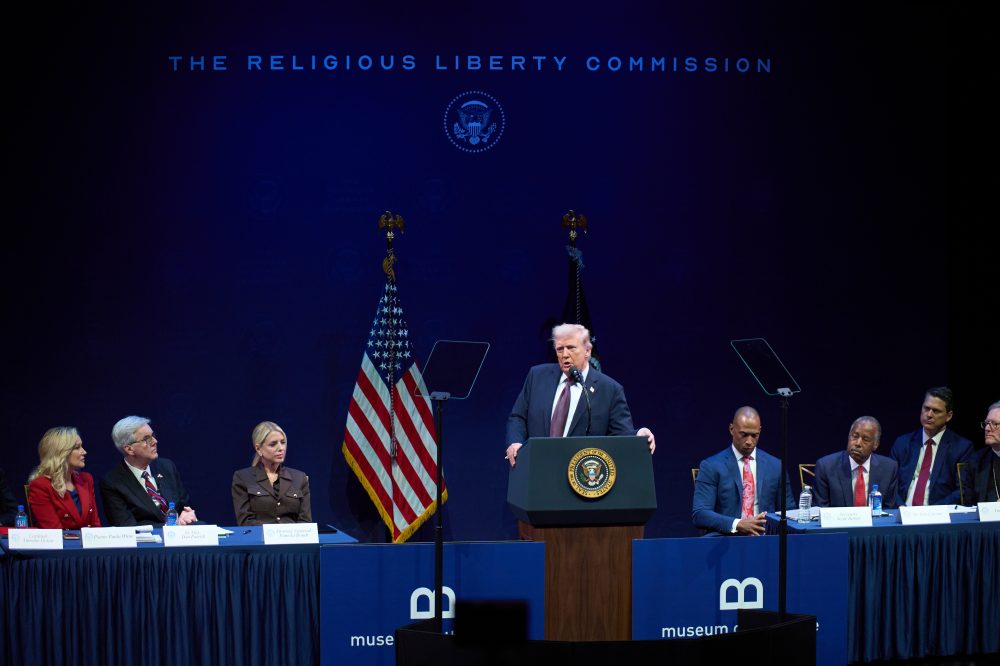

Members of President Trump’s Religious Liberty Commission are developing recommendations that would fundamentally challenge the constitutional principle separating church and state, according to discussions from their recent meetings.
The advisory panel’s proposals include establishing a federal hotline with an automated message stating “There is no separation of church and state,” along with awarding a Presidential Medal of Freedom to a baker who declined to make a wedding cake for a same-sex couple.
Additional recommendations involve Department of Justice court interventions supporting Amish families opposing New York vaccination mandates and Catholic nuns challenging state requirements to accommodate hospice patients’ gender identities.
These suggestions emerged during the commission’s April meeting, where members outlined their priorities for the panel’s upcoming final report. The commission, established by Trump last year, consists primarily of conservative Christian supporters with minimal internal disagreement on proposed initiatives.
The recommendations align with conservative Catholic and evangelical perspectives on religious freedom, emphasizing expanded religious expression in public education, increased public funding opportunities for faith-based organizations, and broader religious exemptions spanning labor law, educational curricula, and healthcare requirements.
These viewpoints mirror recent Supreme Court rulings issued by the court’s conservative majority.
However, critics argue the commission represents a biased perspective favoring Trump’s supporters while threatening established constitutional church-state separation principles.
A progressive interfaith coalition has filed a lawsuit claiming the commission violates federal requirements for advisory panels to include diverse membership and varied viewpoints.
The legal challenge highlights that most commissioners are conservative Christian clergy and commentators, with one Orthodox Jewish rabbi. The coalition notes commissioners have declared America a Judeo-Christian or Christian nation, with most meetings held at Washington’s Museum of the Bible, an institution with Christian leadership.
The Republican administration has requested federal court dismissal of the lawsuit, citing legal technicalities and arguing the law doesn’t specify how commissions should achieve fair balance or whose perspectives require representation.
Another Trump-created entity, the Task Force to Eradicate Anti-Christian Bias, released a report claiming Christians experienced discrimination under President Biden’s administration in education, tax law, and anti-abortion protester prosecution. Progressive organizations dismissed this report as lacking systematic discrimination evidence and functioning as advocacy rather than investigation.
Several Religious Liberty Commission members are scheduled to participate in a May 17 prayer event commemorating the nation’s approaching 250th anniversary. Many also joined a recent Bible-reading marathon primarily staged at the Museum of the Bible.
The commission has generally maintained member consensus, with one notable exception. Commissioner Carrie Prejean Boller was removed in February following a contentious antisemitism hearing.
Commission Chair Dan Patrick stated Prejean Boller attempted to “hijack” the hearing, engaging in heated exchanges with witnesses about antisemitism definitions and defending commentator Candace Owens while denying her antisemitic statements record. Prejean Boller, a Catholic, claimed wrongful removal for expressing her beliefs.
During other hearings, witnesses described defying workplace regulations they believed conflicted with their conservative religious values regarding gender, abortion, COVID-19 vaccines, and other issues. Some reported temporary prevention from displaying religious symbols at work or singing Christian songs at school talent shows.
The antisemitism hearing featured Jewish witnesses describing harassment and threats during campus pro-Palestinian protests against Israel. The commission has also heard from Hindu, Muslim, Sikh, and other religious representatives.
Nevertheless, critics maintain the commission primarily focuses on conservative Christian and right-leaning political grievances.
Rev. Paul Brandeis Raushenbush, president of the progressive Interfaith Alliance and one of the groups challenging the commission’s composition, emphasized the panel’s omissions are as significant as its focus areas.
Raushenbush noted the commission has inadequately addressed anti-Muslim efforts in Texas and elsewhere, plus rising antisemitism from the right, not just the left.
He expressed particular concern about the commission chair’s challenge to church-state separation principles.
Patrick, a Republican serving as Texas lieutenant governor, repeatedly criticized a concept established in Supreme Court precedent.
“We need to say there is no separation of church and state,” Patrick declared at the April meeting. “That’s a lie.” He proposed printing “a million bumper stickers” conveying this message.
No commission meeting attendees disagreed with Patrick’s statement.
Trump made similar remarks at a 2025 White House prayer event. “They say separation between church and state,” Trump stated. “I said, all right, let’s forget about that for one time.”
Although “separation of church and state” doesn’t appear in the Constitution, 20th-century Supreme Court decisions referenced Thomas Jefferson’s description of the First Amendment creating “a wall of separation between church and state.” The court extended the First Amendment’s prohibition of church “establishment” to states beyond federal government, citing the 14th Amendment’s ban on states denying citizens’ rights.
Courts have subsequently balanced religious freedom with freedom from government-sponsored religion.
Patrick has advocated for prayer and Ten Commandments displays in public schools.
“I don’t have any malice towards anyone that doesn’t believe in any type of faith,” Patrick told fellow commissioners. “That’s fine. That’s what America is about. But these organizations that are pushed by some ideology and pushed by someone’s bank account who wants to remove God from our country? We need to push back.”
Regarding other issues, various commissioners requested mandatory school and workplace postings of religious expression rights and exemption notices.
Some advocated restoring full compensation and pension benefits for military personnel discharged for refusing COVID-19 vaccines.
Bishop Robert Barron of the Catholic Diocese of Winona-Rochester, Minnesota, called for enabling religious organizations like Catholic Charities to receive federal funding without compromising traditional church family teachings.
He also advocated humane treatment and sacrament access for Catholic immigrants in detention, requesting immigration agents avoid disrupting worship services during enforcement actions. The administration previously eliminated a policy against immigration enforcement in sanctuaries, which other religious leaders said should never occur.
Kelly Shackelford, president and chief executive officer of First Liberty Institute, proposed new requirements for governments to pay all legal expenses when losing religious liberty cases. He noted many individuals lack financial resources to challenge government actions in court.
“That would be a huge shifting of power in favor of citizens,” he stated.