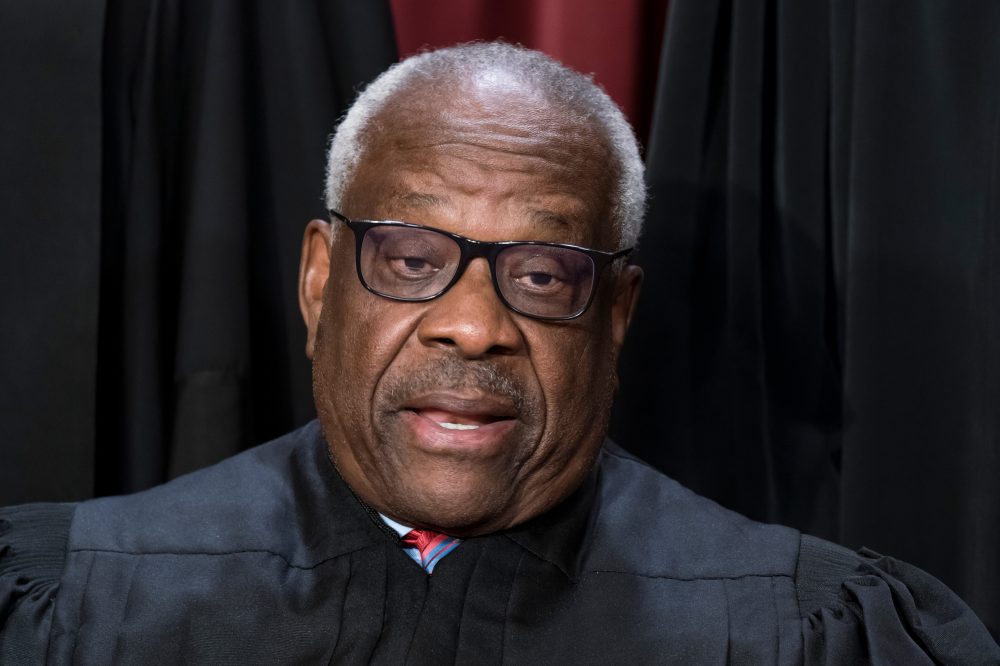

WASHINGTON — Supreme Court Justice Clarence Thomas reached a historic benchmark Thursday, securing his place as the second longest-tenured justice in the nation’s highest court’s history after serving more than 34 years on the bench.
Thomas, now 77 and the court’s first baby boomer member, has evolved from being considered an outsider to wielding tremendous power within the conservative legal establishment during the past ten years, playing a key role in major decisions affecting gun rights, reproductive access, and electoral laws.
Liberal Justice William O. Douglas remains the only member to serve longer than Thomas. Should Thomas continue in his position, he would surpass Douglas’s record by 2028, though he has shown no indication of stepping down.
“I think he’s more energized and excited now than when I first met him,” explained John Yoo, a University of California, Berkeley law professor who previously worked under Republican President George W. Bush and clerked for Thomas thirty years ago.
Thomas joined the court in 1991 following turbulent confirmation proceedings that featured accusations of sexual harassment. In recent years, his receipt of expensive vacations has sparked significant ethical concerns. Despite these controversies, he has transformed from rarely speaking during oral arguments to frequently asking initial questions and authoring a pivotal decision that broadened Second Amendment protections.
With the addition of three conservative justices appointed by former Republican President Donald Trump, Thomas now leads a supermajority that has eliminated constitutional abortion protections, dismantled affirmative action in higher education admissions, and significantly weakened the Voting Rights Act.
“The court has radically moved in his direction over the course of his time on the court,” observed Stanford University law professor Pamela Karlan. Thomas’s senior status allows him to assign opinion-writing responsibilities when he’s part of a majority that excludes Chief Justice John Roberts, which can influence other justices’ votes during private deliberations, Karlan noted.
Beyond his courtroom duties, Thomas has built substantial influence through his extensive network of former law clerks, many of whom served in the Trump administration and increasingly occupy federal judgeships.
“That is an important legacy that he will leave,” stated Sarah Konsky, director of the Supreme Court and Appellate Clinic at the University of Chicago Law School. “Even as justices’ own time on the court winds down, significant influence lives on through their clerks.”
Thomas shows no signs of slowing down. During a recent address, he connected America’s founding principles to a conservative philosophy of restricted government while criticizing progressive ideology in remarks that opponents viewed as inappropriate and biased. However, his comments received enthusiastic applause from the University of Texas audience.
As the court’s second Black justice, Thomas has now served longer than Justice Stephen J. Field, who was selected by Lincoln during the Civil War era and remained the sole 10th justice until 1897.
For Thomas, this milestone represents a dramatic journey from the confirmation hearings where Republican President George H.W. Bush’s nomination nearly failed due to Anita Hill’s harassment allegations, which Thomas vehemently rejected.
More recently, Thomas has faced criticism for accepting unreported luxury travel from a Republican major donor and his wife’s conservative political involvement, including her support of false claims about the 2020 election being fraudulent. The justice maintained he had no obligation to report trips with friends and rejected demands to remove himself from election-related cases.
However, recent years have also featured some of Thomas’s most impactful judicial work, particularly his 2022 ruling establishing that Americans generally possess the right to publicly carry firearms. The justice declined to comment on his tenure when contacted.
Scott Gerber, author of “First Principles: The Jurisprudence of Clarence Thomas,” noted that Thomas’s legal philosophy has remained remarkably stable throughout his career. While the court’s majority has shifted toward his positions, he continues writing notable dissenting opinions.
“He’s incredibly consistent,” Gerber observed. Previously famous for writing solitary dissents, “now he writes majority opinions.”