
BATON ROUGE, La. — Election chaos is spreading across multiple Southern states as Republican lawmakers rush to redraw congressional boundaries in the middle of primary season, leaving thousands of voters uncertain whether their ballots will even count.
The frantic redistricting push comes after a recent Supreme Court decision that significantly weakened the Voting Rights Act, prompting GOP-controlled legislatures to move quickly on new maps that could eliminate several Democratic-held seats.
In Louisiana, the situation has become particularly confusing for voters like 66-year-old New Orleans resident Sallie Davis, who cast an early ballot last week only to discover a handwritten X crossing out her preferred candidate’s name on a polling station sign.
“I was supposed to believe a piece of paper with an X on it marking out the person I wanted to vote for,” she said, her voice breaking as she recounted her experience later. “I think I have been disenfranchised. I think my vote, that I just voted on, it’s not going to count or something. I think it’s illegal.”
Louisiana’s governor declared an emergency and halted congressional primaries just two days into early voting, but not before nearly 179,000 ballots were cast, including approximately 53,000 absentee votes returned by mail. Secretary of State Nancy Landry’s office confirmed those congressional votes will not be tallied.
The turbulent election season stems from an aggressive gerrymandering campaign initiated by President Donald Trump last year to safeguard Republicans’ narrow House majority. The Supreme Court’s recent ruling required Louisiana to reconsider its 2024 map that created two majority-minority districts electing Black representatives, despite the state’s roughly 30% Black population.
Similar disruptions are unfolding in Alabama, where lawmakers approved legislation Friday to redo congressional primaries just a week before the May 19 election date. Voters will still cast ballots in House races using current district lines, but those votes may be discarded if courts approve new boundaries.
Tennessee became the first state to enact revised maps following the Supreme Court decision, forcing election coordinators to warn county officials about reprogramming voting systems, retraining poll workers, and potentially relocating polling sites for some voters.
The state’s elections coordinator outlined the challenges in a memo: adjusting precinct boundaries and updating election infrastructure with compressed timelines before the August 6 congressional primaries.
South Carolina faces similar pressures, with lawmakers considering whether to postpone all June 9 primaries to August or just the congressional races. More than 6,800 mail ballots have already been distributed to voters, with 260 returned as of Friday, according to the state Elections Commission.
Conway Belangia, the commission’s executive director, warned lawmakers Friday that conducting separate congressional primaries would cost $3 million with extremely tight preparation schedules.
“It will be difficult, but it will be possible,” he said.
The redistricting efforts target multiple Democratic seats across the region. Republicans in Alabama, Mississippi, South Carolina and Tennessee are considering eliminating four Democratic districts combined, three represented by Black lawmakers. Florida has already implemented a new map designed to cost Democrats four of their eight congressional seats out of 28 total.
Voter confusion is widespread, according to Michael McClanahan, president of the NAACP’s Louisiana State Conference, who says constituents are calling with questions about whether elections are even happening.
“People say, ‘I ain’t going to vote because the governor’s suspended the election,’” he said. “But he didn’t, he only suspended one aspect of it.”
Alabama Senate Democratic leader Bobby Singleton reports similar confusion among election officials themselves.
“These are the people who are the head of elections,” he said. “They don’t know what to do.”
Voting rights advocates point to Nashville’s 2022 experience as a warning sign for what Memphis voters might face this year. When Republican legislators split Tennessee’s capital city across three congressional districts to capture a Democratic seat, more than 3,000 Nashville-area voters were placed in incorrect districts and over 430 cast ballots in wrong races during the November 2022 election.
“It’s going to be really hard for the election commissions to be able to keep up with this short timeline,” Matia Powell, executive director of voting rights nonprofit Civic TN, said during a Friday conference call with other Southern voting rights activists.
Anneshia Hardy, executive director of Alabama Values, which supports voting and civil rights organizations, warned that frequent rule changes could undermine public faith in elections.
“Once people stop believing that the process is stable and fair, disengagement is going to increase, and that’s one of the biggest dangers here,” she said. “Democracy doesn’t just depend on voting systems existing but really on people believing that their participation matters.”
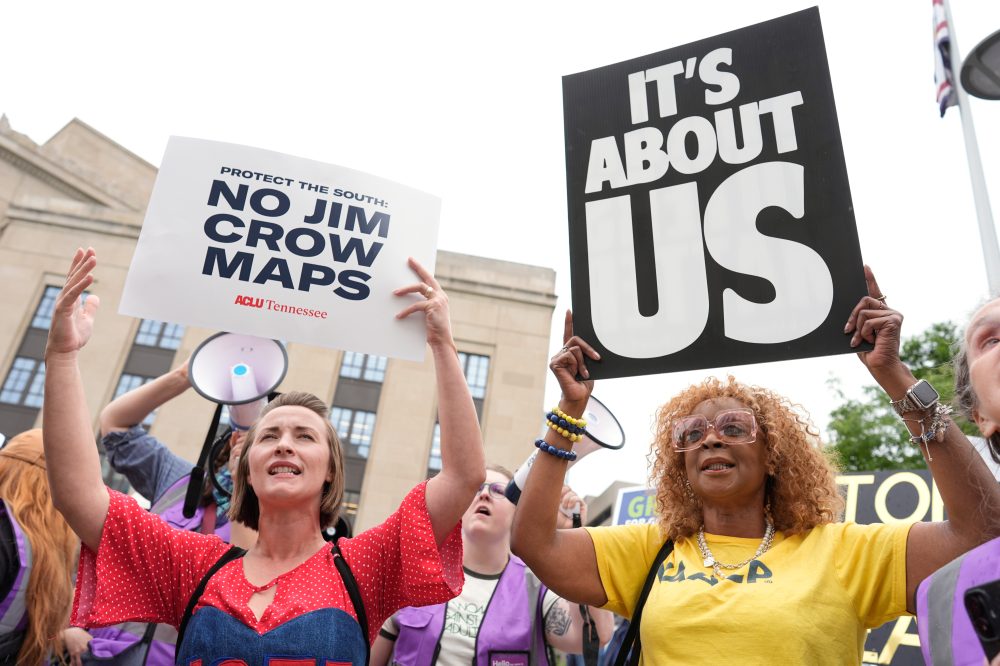
The uncertainty has driven some voters to protest at state capitols. Davis joined demonstrators at Louisiana’s State Capitol in Baton Rouge Friday, using a bullhorn to chant “Whose vote? Our vote!”
David Victorian, a 79-year-old Vietnam veteran from Baton Rouge, expressed broader concerns about democratic institutions.
“I’m concerned for the survival of the democracy that we’re supposed to be living in,” he said.
Mississippi, which completed its primaries in March, now faces a federal court order to redraw state Supreme Court districts, while Trump pushes Republicans to revise the state’s four congressional districts. A special legislative session scheduled for May 20 will convene at the Old State Capitol due to House chamber renovations — the same building where lawmakers once passed Jim Crow voting restrictions decades ago.
“Modern-day voter suppression relies on election administration errors and chaos, and that’s what we’re going to see play out in all of these states,” said Amir Badat, a Jackson, Mississippi, voting rights attorney and activist.