
WASHINGTON — A federal judge considering the fate of a large Washington park joked this week that she had no plans to become Amy Poehler, the comedian famous for portraying a parks department director on television.
However, President Donald Trump appears eager to take on that responsibility.
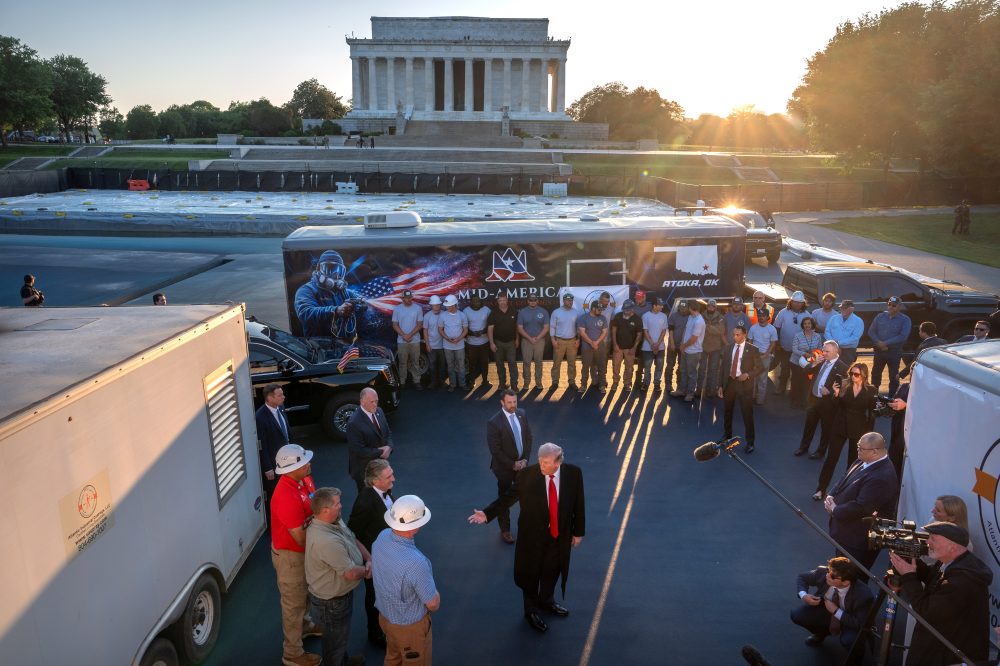
Following military exchanges between the United States and Iran on Thursday, Trump visited the National Mall to inspect the Lincoln Memorial Reflecting Pool, which he had ordered repainted in what he calls “American flag blue.”
This renovation has captured the president’s attention recently. During a lengthy address to small-business owners on Monday, Trump dedicated approximately nine minutes to discussing the paint work, describing the granite flooring and claiming he reduced the project’s price tag to $1.9 million from an original estimate of $350 million.
Trump’s upcoming focus may shift to East Potomac Park, which houses an affordable public golf facility offering Washington Monument views.
The Republican commander-in-chief has discussed converting it into an upscale “U.S. Open-caliber course.” Warning notices appeared this week announcing upcoming disruptions, and preservation groups filed legal action after debris from White House East Wing demolition showed lead contamination.
By Friday evening, the nonprofit managing the golf facility announced it would continue operations until the National Park Service starts a “historic restoration.”
Separately, the White House informed a planning committee that taxpayers would face at least $7.5 million in costs to execute Trump’s vision of painting the granite Eisenhower Executive Office Building white.
This represents just one week’s worth of Washington’s dramatic transformation.
Throughout the past year, Trump has demolished the East Wing to create space for a ballroom. His name now appears on the U.S. Institute of Peace and Kennedy Center buildings, with the latter scheduled for a two-year closure for renovations. His image is displayed on banners at Department of Justice headquarters and other locations. He advocates for a victory arch near Arlington Cemetery and has shuttered parks, including Lafayette Square opposite the White House, for rehabilitation.
Trump is ensuring his permanent mark on a city where he captured only 6.5% of votes in 2024. He is exercising remarkable executive authority while revealing how he allocates his time, arguably a president’s most precious resource.
While these Washington initiatives progressed this week, the Iranian ceasefire faced potential collapse, AAA reported gasoline prices exceeding $4.50 per gallon, and election results demonstrated growing Democratic momentum before November voting.
“It’s not a zero-sum game but obviously all presidents have limited amounts of capital they can use and limited amounts of attention that they have to give,” said presidential historian Julian Zelizer of Princeton University. “And he’s deciding, in a moment of war, a moment of economic instability, that this is a priority.”
Trump dismisses such criticisms.
When questioned at the Reflecting Pool about his project focus during U.S. military operations in Iran, he responded, “Our country is about beauty, cleanliness, safety, great people. Not a filthy capital.”
For Republicans protecting narrow congressional control, the situation proves more complex. Many prefer highlighting policy victories like tax reductions rather than expensive Washington construction initiatives.
Though few openly criticize Trump, party members acknowledge economic concerns must be addressed.
“A lot of Americans are very worried about the cost of living and we need to address it,” Sen. John Kennedy, R-La., said recently.
A Washington Post-ABC News-Ipsos survey from late April revealed 52% of Americans oppose Trump’s proposed arch, including roughly 60% of independents. About 51% of Republicans support it.
Americans reject the ballroom concept by a 2-to-1 ratio, primarily driven by Democrats and independents. Approximately 20% of Republicans oppose the project, the poll showed. The survey found no significant support change following a shooting at last month’s White House Correspondents’ Association Dinner. Trump has referenced that incident while pushing for secure facilities, though he didn’t mention security when initially ordering East Wing demolition.
Trump shows no indication of abandoning any projects. Demonstrating GOP loyalty, Republican senators added $1 billion in White House security improvements for the ballroom to an unrelated bill this week. Trump previously claimed taxpayer funding wouldn’t be necessary.
In a city where historic preservation holds sacred status, the transformation pace has been overwhelming.
Rebecca Miller, executive director of DC Preservation League, has worked 23 years at the organization that sued to prevent the golf course takeover and joined efforts forcing Kennedy Center compliance with preservation regulations. She has collaborated with both parties’ administrations and describes Trump’s actions as “highly unusual.”
“One of the problems that we have right now is an administration that seems to think that it can just plow ahead without any input,” she said. “These assets are owned by the people of the United States. They’re not anybody’s personal portfolio.”
White House spokeswoman Taylor Rogers stated Trump is “laser-focused on lowering costs for working families, deporting illegal criminals, keeping our cities safe, beautifying our nation’s capital, and protecting our national security by ensuring Iran can never possess a nuclear weapon all at the same time.”
This isn’t the first instance of White House interest in Washington’s aesthetics.
Under Lyndon Johnson’s presidency, first lady Lady Bird Johnson supervised beautification campaigns including tree and flower planting across the District of Columbia.
Her initiatives sometimes faced criticism as diversions from urgent matters like the Vietnam War, but she coordinated with local authorities.
“Lady Bird Johnson was trying to bring out the natural beauty of Washington,” said Mark Updegrove, chairman of the LBJ Foundation and presidential historian. “Donald Trump is trying to remake the nation’s capital in his own image.”
Trump’s control assertion over Washington, including ongoing National Guard deployment, has energized the city’s Democratic primary next month for crucial local positions, including mayor and congressional delegate.
The opening question at a mayoral candidate forum this week addressed protecting the Home Rule Act, the 1973 legislation granting the city limited self-governance. Candidates pledged to resist Trump when necessary, though contender Vincent Orange noted national Democrats had also disappointed the district.
“The two times that we had an opportunity at statehood, it was the Democrats who let us down,” he said, referencing failed congressional attempts to grant the city full representation rights.
In an interview, Janeese Lewis George, a D.C. Council member and leading mayoral candidate, said city officials must better advocate in Congress for statehood. She described Trump’s city impact as extending beyond renovations, calling troop deployments a “federal occupation” while noting immigration enforcement and federal workforce reduction consequences.
“The people of our city are afraid,” she said. “It’s the mayor’s job to really let the nation know that D.C. has uniquely been left vulnerable.”
Tom Davis, a Virginia Republican who frequently supported city autonomy during his congressional service, said renovations provide an “opportunity to bring some money into the city and spruce up stuff that you wouldn’t have had otherwise.”
“But this is tough,” he said. “This is not a city that is in love with the president.”