
Louisiana’s Republican-controlled legislature is moving forward with plans to eliminate at least one majority-Black congressional district, sparking intense opposition and emotional testimony from civil rights advocates.
The effort follows a recent U.S. Supreme Court ruling that weakened voting rights protections, giving GOP lawmakers the opportunity to redraw congressional boundaries that could eliminate one or both of the state’s Democratic-held districts where Black voters hold the majority.
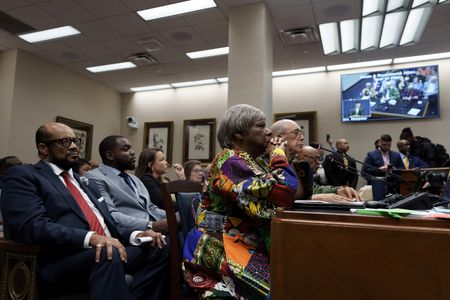
During a contentious eight-hour hearing at the state capitol in Baton Rouge on Friday, Leona Tate, one of the “New Orleans Four” who helped desegregate Southern public schools as a child, delivered powerful testimony against the redistricting proposal.
“I need you to understand what it feels like to stand here, to have walked through that mob as a child, and to now watch elected officials do the same thing that mob was trying to do – just with better suits and a parliamentary procedure,” Tate addressed the senate committee.
The hearing grew heated as protesters gathered outside the chamber, at one point chanting “Let him speak!” after Republican committee Chairman Caleb Kleinpeter shut off a Democratic colleague’s microphone during a heated exchange. Security personnel prevented Mike McClanahan, head of Louisiana’s NAACP chapter, from entering the hearing room.
The redistricting battle has created electoral turmoil across Louisiana. Governor Jeff Landry canceled the May 16 U.S. House primary elections just one day after the Supreme Court decision, despite thousands of absentee ballots already being distributed to voters.
Early voters this week discovered notices posted on polling station doors informing them that House races had been suspended while other elections continued as scheduled. Officials have not clarified what will happen to votes already submitted or when new primaries might take place.
“The truth of the matter is the Supreme Court came down and said that the maps are unconstitutional,” Kleinpeter explained to reporters following the hearing. “So we’re going forward with drawing new maps.”
Black voters comprise approximately one-third of Louisiana’s electorate and predominantly support Democratic candidates. Republicans currently hold four of the state’s six congressional seats.
The Louisiana controversy represents part of a broader national redistricting battle affecting multiple Southern states including Tennessee, Alabama, and South Carolina, where Republican officials are pursuing similar efforts to reduce Black voting power following the Supreme Court ruling.
Voting rights organizations have filed lawsuits challenging Landry’s decision to suspend the elections, arguing it creates widespread voter confusion.
“Folks are unsure of what is happening with these ballots, what elections are or are not happening,” explained Sarah Whittington from the American Civil Liberties Union of Louisiana. “Invalidating a single part of a ballot and alleging that the rest of it is valid, I think, just undermines the entire faith in the system.”
Democratic Representative Cleo Fields, whose district was declared unconstitutional by the Supreme Court, warned that the redistricting effort could expand beyond congressional races.
“This is about congressional elections today; tomorrow, it’ll be state legislatures, it’ll be city council, it’ll be school boards,” Fields said.
During Friday’s proceedings, civil rights leaders drew parallels to historical discrimination, with Fields noting the limited Black representation in Congress from Louisiana.
“Since Reconstruction, Louisiana has elected four African Americans to Congress – and you’re looking at all of them,” Fields stated, sitting with current Representative Troy Carter and former Representatives Cedric Richmond and William Jefferson.
Republican state Senator Jay Morris presented several redistricting proposals, including options that could result in Republicans winning five or all six of the state’s House seats.
“Neither race nor party affiliation nor voting patterns were considered when this was prepared,” Morris claimed regarding his most aggressive redistricting plan. However, Democratic senators and activists argued these maps would significantly diminish Black political representation.
Tate issued a direct challenge to lawmakers during her testimony: “You have a choice in front of you. You can draw a map that reflects who Louisiana actually is: a state where Black voices belong in the halls of Congress. Or you can draw a map that tells my grandchildren, ‘Your voices don’t count.’”
Baptist pastor Brandon Boutin warned Republican lawmakers they would face consequences for proceeding with the redistricting effort.
“This redistricting issue is not just about lines on a map,” Boutin testified. “It’s about whether democracy is sacred. It’s about whether every citizen has equal value in the eyes of the law.”