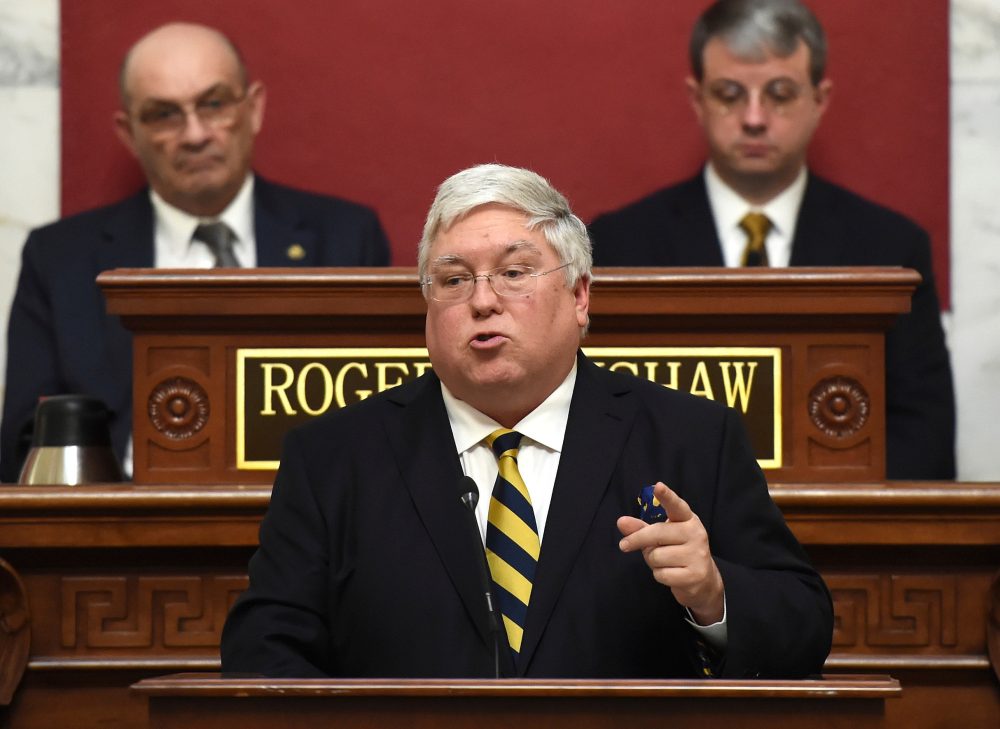

West Virginia Governor Patrick Morrisey is taking a page from former President Donald Trump’s political playbook, working to remove Republican state lawmakers he considers disloyal in Tuesday’s primary elections.
While Morrisey’s name won’t appear on any ballot, the Republican governor is putting his political reputation on the line by endorsing challengers against multiple GOP incumbents in the state legislature. His goal is to reshape the party’s overwhelming majorities to better align with his vision.
The primary results will serve as a crucial measure of Morrisey’s influence halfway through his gubernatorial term.
Tuesday’s elections will also determine nominees for federal offices including the U.S. Senate and House of Representatives. Additionally, Charleston’s Democratic mayor will face a primary challenger, while two state Supreme Court justices and an appeals court judge must defend their positions.
Morrisey’s legislative endorsements have created tension with fellow West Virginia Republican U.S. Sen. Shelley Moore Capito, who is running for her third term. The two party leaders are supporting different candidates in several races.
A prime example is state Senate District 10, where Capito backs incumbent Republican Sen. Vince Deeds while Morrisey supports challenger Jonathan Comer, a local pastor.
This political split isn’t new for the two Republicans. In 2024, Morrisey edged out Capito’s son Moore Capito in a close race for the GOP gubernatorial nomination.
For the U.S. Senate seat, Capito confronts five primary opponents, with state Sen. Tom Willis emerging as her most significant challenger. Willis has secured backing from six Republican state senators, including Senate President Randy Smith. However, Capito holds endorsements from 15 state senators plus a crucial nod from Trump, which could blunt Willis’ criticisms of her voting record.
In Charleston’s mayoral race, Democratic incumbent Amy Goodwin is seeking her third term but must first overcome primary challenger Martec Washington, a community organizer who finished far behind Goodwin in their 2022 primary matchup. Republican Brian Hunt faces no opposition for his party’s nomination.
Two state Supreme Court justices, Tom Ewing and Gerald Titus, are defending their seats in special elections after being appointed in 2025 to fill vacant positions. Intermediate Court of Appeals Chief Judge Dan Greear is also fighting to keep his position against challenger Jim Douglas for a 10-year term.
Voting concludes at 7:30 p.m. Eastern Time on Tuesday.
The Associated Press will report results and announce winners in competitive primaries for federal and state legislative seats, Charleston’s mayoral race, and judicial elections. Three special state Senate elections are also on the ballot.
West Virginia’s primary system restricts registered party members to voting only in their own party’s contests. Independent and unaffiliated voters can participate in Democratic or Mountain Party primaries but are excluded from Republican primaries. All voters must present identification.
Current registration figures show approximately 1.2 million eligible voters statewide as of late April, with Republicans leading at 520,000, followed by 327,000 Democrats and 302,000 unaffiliated voters.
Last year’s GOP primaries for president, governor, and U.S. Senate each drew roughly 225,000 participants, representing about 19% of registered voters. Democratic primary turnout ranged from 90,000 to 102,000 voters depending on the race.
Early voting accounted for approximately 30% of all ballots cast in 2024’s primaries.
Through May 5, more than 36,000 voters had already cast ballots for Tuesday’s election, including over 17,000 Republicans, about 13,600 Democrats, and roughly 3,600 unaffiliated voters.
Most of West Virginia’s 55 counties typically release their early and absentee voting results in the first report of election night, with about 60% reporting complete or near-complete totals initially.
During 2024’s Republican U.S. Senate primary, initial results appeared at 7:41 p.m. Eastern Time, just 11 minutes after polls closed. Vote counting reached 90% completion around 10:06 p.m., with final updates released at 12:40 a.m. showing more than 99% of votes tallied.
The Associated Press only declares winners when no mathematical possibility exists for trailing candidates to overcome the deficit. For undecided races, coverage continues for significant developments like candidate concessions while clearly noting no winner has been declared.
West Virginia law doesn’t mandate automatic recounts, though candidates may request and fund recounts regardless of victory margins. Costs are reimbursed if recounts alter outcomes. The AP may call races subject to potential recounts if leads are mathematically insurmountable.
Tuesday’s results will set the stage for the 2026 midterm elections, now 175 days away.