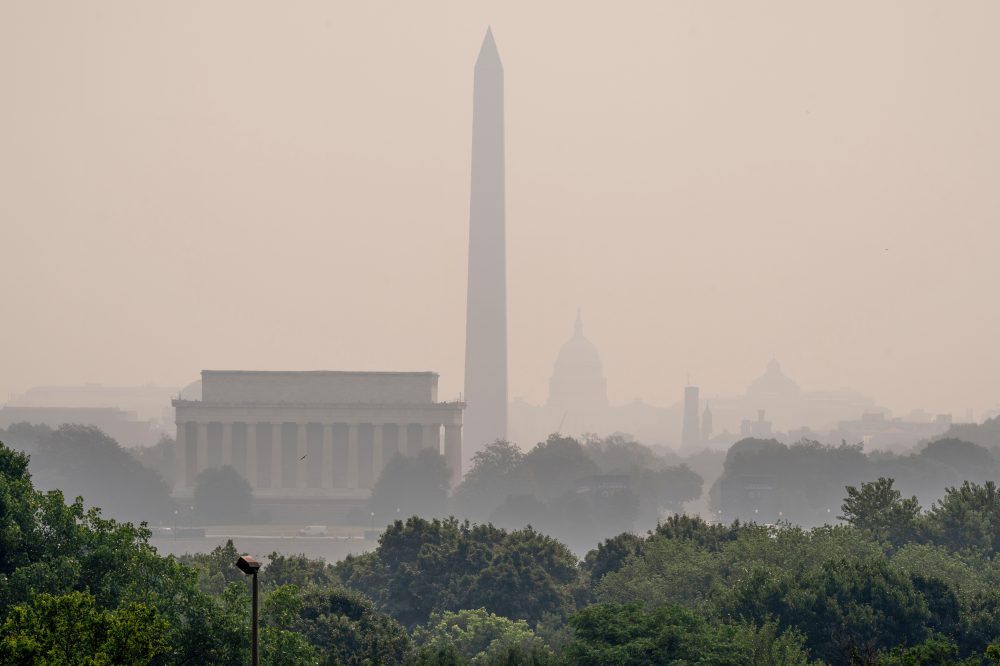

Millions of Americans across the Great Lakes, Northeast, and Mid-Atlantic regions endured another difficult day of hazardous air Friday, as out-of-control wildfires sent a thick, eerie haze drifting over Washington, D.C. and surrounding areas.
Air quality alerts were set to remain in place through Saturday across a large portion of the country, though forecasters say weekend rainfall and thunderstorms could provide some temporary relief to affected communities.
Don’t expect the smoky skies to disappear quickly, however. Bob Oravec, a lead forecaster with the National Weather Service based in Maryland, warned that fires continue to burn unchecked across remote areas of Canada, with additional blazes in a Minnesota wilderness area adding to the problem.
“The source of the smoke is going to continue on for certainly a week, probably,” Oravec said. “So in some form, there’s going to be smoke that gets transported from the fires downstream, and it’s just going to depend upon which way the wind’s blowing as to where the smoke is going to affect the most.”
On Friday, communities in Minnesota, Michigan, and Illinois near the Canadian border and the Boundary Waters Canoe Area Wilderness in Minnesota recorded some of the worst air quality readings on the planet, according to IQAir, an air quality monitoring website.
Washington, D.C. was not far behind. The Washington Monument, Lincoln Memorial, and other iconic national landmarks were swallowed up in a dense, orange-tinted haze early Friday morning.
Stewart Verdery, a former assistant secretary at the U.S. Department of Homeland Security, captured the scene in a sunrise panorama he posted on X. “Wow that Canadian smoke haze is no joke,” he wrote. “Almost nothing visible — no sun, no monuments, no Reagan Airport.”
Air quality in and around the nation’s capital was expected to deteriorate further throughout the day, potentially reaching “very unhealthy” and even “hazardous” levels on the air quality index, according to regional officials.
Health authorities urged residents — especially those with heart or lung conditions, older adults, and children — to stay indoors as much as possible until conditions improve.
There is also growing concern about how the poor air quality could affect the World Cup final match between Spain and Argentina at MetLife Stadium in New Jersey on Sunday. Oravec noted that while Saturday is expected to be rough, conditions should improve somewhat by game day.
Just one day earlier, skies over several states turned dark with an orange and yellow tinge, partially obscuring Manhattan’s skyline in a now-familiar haze.
Officials in New York, New Jersey, Pennsylvania, and other Northeastern states handed out free KN95 face masks, scrapped outdoor events, and opened libraries and public buildings as indoor refuges from the polluted air.
By Friday afternoon, air quality readings had improved from “unhealthy” to “moderate” in parts of the New York City area. Bright sunshine broke through a thin layer of smoke, and stretches of clear blue sky returned to much of the region.
Saturday is forecast to bring a strong chance of thunderstorms across the Northeast and Mid-Atlantic, which should help clear the air temporarily. How long that improvement lasts depends largely on what happens far to the north, where roughly 100 wildfires continue to burn with no end in sight, primarily in Ontario, Canada. In the U.S., authorities have closed the Boundary Waters area while battling several fires there.
Health experts warn that prolonged exposure to smoky air can worsen existing medical conditions and lead to serious long-term health issues, including respiratory illness, cardiovascular and neurological disease, and even premature death.