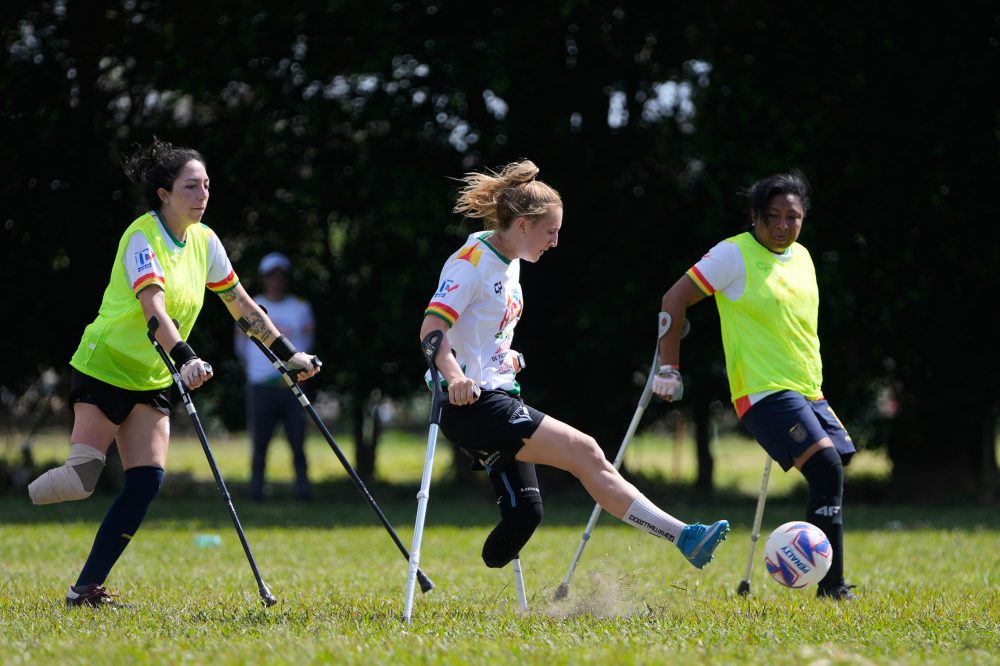

At first glance, the women sprinting across the soccer field in the eastern Bolivian city of Santa Cruz on Friday looked like any other squad gearing up for a major tournament. Look closer, though, and you’d notice goalkeepers making saves with just one arm and field players using crutches to race down the pitch.
This was no ordinary training session. It marked the first-ever soccer training camp in South America designed specifically for female amputees with aspirations of competing at the international level. Close to three dozen women representing 10 nations — among them Argentina, Bolivia, Brazil, Ecuador, and Colombia — gathered in Santa Cruz for five days of intensive preparation, wrapping up Friday with a round of friendly matches. The majority of the participants lost their limbs due to infections or traumatic injuries.
The sport operates under a unique set of rules. In this seven-a-side format, all artificial limbs must come off before the opening whistle. Athletes use crutches to move around the field but are not permitted to make contact with the ball using them. The camp was put together by the World Amputee Football Federation — the organization that oversees global competition — along with local government officials and nonprofit groups. Top-level players, including members of the U.S. Women’s National Amputee Soccer Team, served as coaches throughout the week.
“The life of amputees can sometimes be hard, but we adapt really fast,” said Amie Donathan, 21, a member of the U.S. squad who was born with one leg. “The way I feel about this camp, honestly, can’t be described.”
The training sessions covered a wide range of skills — from balance, coordination, and movement on crutches to ball control, game strategy, and the specific rules that govern amputee soccer. All of this unfolded as global attention remained fixed on the final week of the 2026 FIFA World Cup.
Men have been competing in international amputee soccer since the 1980s and now play in a World Cup held every four years. The sport has steadily expanded its reach, especially in regions affected by conflict, such as Gaza and Rwanda. The women’s side of the game, however, is much newer — the inaugural Women’s Amputee Football World Cup was held only in 2024, with Colombia winning the first-ever title. The next edition is set for Poland in 2027, though a specific date and host city have not yet been announced, according to camp organizers.
“It’s so that women with amputations can realize their dream through sports, through soccer,” said Lidia Mayser, president of the sports council for the Santa Cruz region, which is working toward establishing a national federation and fielding a team to represent Bolivia at next year’s tournament.
For Filomena Luna, the week of training opened a door she never expected to walk through. The mother of six lost her leg at age 11 after an infection escalated when her parents first turned to a traditional healer rather than seeking medical care. Now 50 years old, she carries hopes of one day wearing Bolivia’s colors on the world stage.
“This practicing and training has helped me improve tremendously,” she said. “Soccer is an escape for me.”