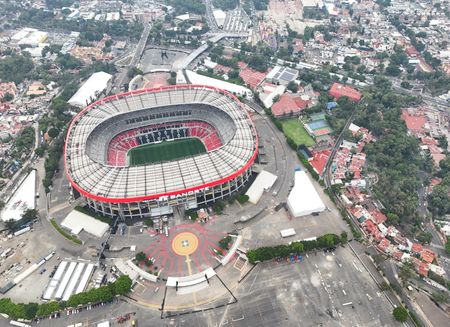

The World Cup brought sold-out venues and millions of celebrating fans to Mexico, but the monthlong soccer spectacle did little to energize a struggling economy already burdened by sluggish investment and anxiety over the upcoming review of the North American trade agreement, known as the USMCA.
The tournament, which concludes Sunday after more than a month of competition spread across Canada, the United States, and Mexico, saw Mexico host 13 of the 104 total matches. Despite high hopes from government officials who had set ambitious tourism targets, the event fell short of those goals — and Mexico’s gross domestic product actually shrank during the first quarter of the year.
“The World Cup will not structurally change the trajectory of the Mexican economy,” said Humberto Calzada, chief economist at Rankia.
Calzada added that the competition offers only a brief, short-term jolt for an economy the government projects will grow between 1.8% and 2.8% this year — a rosier outlook than the 1.1% growth analysts are forecasting.
The financial gains from the tournament were concentrated in only a few areas. Banorte reduced its estimate of the World Cup’s contribution to Mexico’s GDP to between 0.4% and 0.5%, walking back an earlier projection of up to 0.62%. Meanwhile, Banamex put the total economic impact at $2 billion — roughly 0.1% of GDP and less than half of the $5.6 billion Mexico received in remittances during May alone.
Consulting firm Deloitte estimated the event generated around 100,000 temporary jobs, which was 10% below its earlier projection. Financial institution BBVA reported that its household consumption index dropped 0.2% from May to June, with hotel spending falling 10.5% and restaurant spending declining 4.9%, even as entertainment spending surged 16.5%.
The economic benefits were not shared equally among the three host cities — Mexico City, Guadalajara, and Monterrey. The Mexican Restaurant Association said that half of its member restaurants performed worse than during a normal week, citing low hotel occupancy and local protests in the capital as contributing factors.
Airline passenger data told a similarly uneven story. Flight traffic ticked upward in June at airports in Guadalajara and Monterrey, but dropped at Mexico City’s primary airport.
Economists say the real engine of Mexico’s economic fortunes lies beyond the soccer pitch: trade stability under the USMCA. With businesses holding off on investment while awaiting the outcome of the trade deal’s review, and the economy having contracted 0.6% in the first quarter, the International Monetary Fund recently cut its growth forecast for Mexico to 1.2%, down from a prior estimate of 1.6%.