Motorists traveling on DE-4 westbound are experiencing lane restrictions due to a fallen tree blocking traffic.
The obstruction is located on the stretch of roadway between Marrows Road and DE-72, with the right westbound lane currently closed to traffic.
Drivers in the area should expect delays and are advised to use caution while navigating around the closure. Crews are working to remove the tree and restore normal traffic flow.
Motorists traveling northbound on US-202 should expect delays as construction crews have shut down the right shoulder between Righter Parkway and Rocky Run Boulevard.
The lane closure is scheduled to remain in effect until 5 PM today as work continues in the area.
Drivers are advised to allow extra travel time and exercise caution when passing through the construction zone.
The Department of Justice has announced it will follow a federal court ruling that temporarily halts its $1.8 billion anti-weaponization initiative.
Acting U.S. Attorney General Todd Blanche previously testified during a Senate Committee hearing on Capitol Hill on May 19, 2026, regarding the program.
In addition to the court ruling, six states are conducting primary elections today, with political observers monitoring several important contests across the nation.
California conducted primary elections Tuesday that will determine the final two candidates for governor and Los Angeles mayor, while simultaneously evaluating redrawn congressional districts that might alter the balance of control in the U.S. House of Representatives.
The primary contest centers on the open gubernatorial race, as the current governor faces term limits and is widely viewed as positioning for a potential White House bid in 2028. Sixty-one candidates are vying for position under the state’s jungle primary system, where the top two vote recipients proceed to the general election regardless of their party affiliation.
Recent polling indicates that Democrat and former cabinet secretary Xavier Becerra holds the lead, while Democratic billionaire Tom Steyer and Republican television figure Steve Hilton are also contending for advancement to the November 3 general election.
Tuesday’s outcomes will reveal whether Democrats can prevent internal division and if a Republican can take advantage of a split voter base. Additionally, the primary represents the initial evaluation of new congressional boundaries that could transform the midterm competition into a crucial fight for Congressional control.
Following encouragement for Texas to create new district boundaries aimed at securing five Republican seats last year, the current governor responded by guiding a voter initiative designed to shift five California seats toward Democratic control. Under California’s previously independent redistricting process, Democrats already maintained a 43-9 majority within the state’s congressional delegation.
Despite California’s strong Democratic lean, early polling in the governor’s race indicated two Republicans might secure the top positions, as Hilton and Riverside County Sheriff Chad Bianco were leading.
However, Democrats may now be positioned to claim both spots, according to current polls showing Becerra and Steyer near the front.
Since implementing the jungle primary in 2014, California has not nominated two Democrats for governor, although this outcome has occurred in other contests, including a U.S. Senate election in 2016.
Among Republicans, Hilton, a former television news host, gained separation from Bianco after receiving an endorsement from a former president.
The Democratic field seemed to unite behind Becerra after previous frontrunner Eric Swalwell withdrew from the race and resigned from the U.S. Congress in April amid sexual assault allegations from a former staff member. Swalwell has denied these claims.
Mark Baldassare, survey director at the Public Policy Institute of California, indicated that voters appeared to value Becerra’s experience, viewing him as a reliable choice following Swalwell’s exit.
“His message about his time as attorney general defending California, particularly around issues involving the Trump administration, seems to have resonated with many Democratic voters who overwhelmingly are disapproving of President Trump’s job performance,” Baldassare said.
Steyer, who has presented himself as the most progressive among the Democratic frontrunners, has maintained strong polling position after investing approximately $200 million of personal funds in his campaign. He has pledged to increase taxes on billionaires, including himself.
In other races across the state, Los Angeles Mayor Karen Bass confronts more than a dozen opponents amid voter worries about homelessness, housing costs, and consequences from the 2025 Palisades fire.
She faced competition from within her party by city Councilmember Nithya Raman, while surveys indicate the top Republican contender is reality television figure Spencer Pratt.
Regarding congressional races, political analysts consider the 22nd district contest in the agricultural Central Valley the most competitive, with Republican Representative David Valadao pursuing reelection against two Democrats, state Assemblymember Jasmeet Bains and educator Randy Villegas.
Democrats are targeting the 48th district as a potential pickup opportunity, after liberal Palm Springs was relocated from its Riverside County district to inland San Diego County, where Republican incumbent Darrell Issa chose not to seek reelection.
Voting locations operated from 7 a.m. to 8 p.m. PDT on Tuesday, though final results in tight contests may require several days as California permits voters to submit mail-in ballots through Election Day.
Discount chain Dollar General boosted its yearly earnings outlook Tuesday as customers continue turning to affordable options during ongoing economic pressures.
The retailer’s stock climbed approximately 3% during premarket trading following the announcement.
Increasing fuel costs linked to the Iran conflict are adding strain to household budgets already facing challenges from U.S. import tariffs and AI-driven employment market volatility, creating advantages for discount chains such as Dollar General.
Competitor Dollar Tree similarly increased its earnings projection the previous week.
Dollar General projected fiscal 2026 earnings per share between $7.20 and $7.45, an increase from its previous estimate of $7.10 to $7.35, noting the forecast excludes potential effects from tariff refund payments.
The company maintains its expectation for yearly same-store sales growth of 2.2% to 2.7%.
Following the release of his comprehensive statement demanding strong oversight of artificial intelligence, the pontiff found himself at the center of internet buzz when Saint Hoax, an Instagram account with over 3 million followers, shared content about his call to “disarm” AI technology. The post’s caption declared: “Love my woke pope (I’m not even Catholic).”
Another social media user on X referenced a popular internet joke in response to the religious document, posting: “The atheism leaving my body the moment the pope starts talking about how AI is an affront to God and the new Tower of Babel.”
Such responses to the papal leader’s inaugural encyclical, titled “Magnifica Humanitas” (Magnificent Humanity), have flooded social platforms since its publication last week. The widespread excitement stems partly from a belief, particularly among younger generations, that few political or international figures truly understand or seriously address the known and possible consequences of AI’s swift advancement. Many leaders have typically worked to support the technology sector, pointing to economic growth needs while critics argue they’ve grown too close to affluent executives.
“People have really been looking for a response to AI,” commented Isabel Thurston, a 27-year-old comedian from Boston. “This was the first — at least in my sphere of the world — world leader to make an announcement to this magnitude.”
The first pontiff born in the United States has shown readiness to adopt elements of modern culture. He was recently seen wearing Nike sneakers beneath his religious robes, and in his encyclical, the pope referenced the wise wizard Gandalf from the “Lord of the Rings,” a work by Catholic writer J.R.R. Tolkien.
“It’s clear that this is written by an American pope. There’s a spirit breathing through this document of an emphasis on individual freedom, on human happiness and human dignity,” stated Robert Orsi, a professor of religious studies and history at Northwestern University, regarding the papal document. “At times, I thought the language really resonates with the Declaration of Independence.”
This particular type of cultural understanding may help clarify some of his internet fame as head of the centuries-old faith.
Just weeks before, a group of young visitors to the Vatican persuaded the 70-year-old religious leader to perform a popular hand movement on camera called the 6-7 meme — a nonsensical “brain rot” joke among youth. While the video clearly shows the pontiff, like most older adults, doesn’t grasp what they’re requesting or its meaning, he complies anyway and receives excited applause. Seven days later, he repeated the gesture while smiling and greeting crowds from his vehicle.
The image emerging from these moments shows both playfulness and purpose. The religious leader emphasizes throughout “Magnifica Humanitas” that the church must address current questions and difficulties.
“Her mission has a historical scope and entails a responsibility for the way in which social relations are built,” the pope wrote about the Catholic Church. “She cannot consider herself a stranger to the forces shaping society. On the contrary, the Church actively participates in the processes by which society grows and is organized.”
Since his selection last year, the pontiff has made efforts to directly communicate with — and sometimes criticize — various elements of society, from politics to entertainment and athletics.
Orsi examines the connection between Catholicism and modernity, which he notes have frequently clashed throughout history. He explained that the pope’s encyclical and his overall leadership, similar to his predecessor’s, draws heavily from the still-controversial Second Vatican Council, which introduced modernizing changes to the church over 60 years ago.
“It’s speaking with a Vatican II voice to the modern world. So, it’s not a voice of condemnation, but it’s a voice of respect,” Orsi said about the papal document. “Pope Francis, in a sense, was the necessary prelude to this kind of encyclical. I think Francis gave a really strong encouragement to take a clear critical voice on these urgent questions.”
However, not everyone has supported the pope’s methods. Some criticized his choice to unveil his encyclical alongside Anthropic co-founder Christopher Olah. The Vatican chose to include the technology company as part of its ten-year initiative to engage Silicon Valley in discussions about AI’s human impact.
In the approximately 42,300-word document, the religious leader urges all “men and women of goodwill” to not fear getting their “hands dirty on the ‘construction site’ of our time.”
This readiness has occasionally resulted in careful but public criticism of policies, actions and leaders, including U.S. President Donald Trump and the continuing conflict in Iran. Some conservatives including Vice President JD Vance, who converted to Catholicism, have referenced “just war” theory in response to the pope’s criticisms.
Church doctrine has historically permitted “just wars” — using force to prevent unjust aggression — when specific requirements are satisfied. But the pontiff directly challenged this teaching in his encyclical, labeling it “outdated.” “Humanity possesses far more effective and capable tools for promoting human life and resolving conflicts, such as dialogue, diplomacy and forgiveness,” he wrote.
Last November, the religious leader held a “World of Cinema” event at the Vatican with performers and directors including Cate Blanchett, Viggo Mortensen, Gus Van Sant and Spike Lee, who presented him with a personalized New York Knicks jersey featuring the number 14 and the name Pope Leo on the back.
“Cultural facilities, such as cinemas and theaters, are the beating hearts of our communities because they contribute to making them more human,” the pope told his Hollywood guests. “The logic of algorithms tends to repeat what ‘works,’ but art opens up what is possible.”
He has also openly expressed his affection for the Chicago White Sox, occasionally wearing baseball caps or posing with bats — the latter inspiring a category of papal memes. “POV: you’re a priest who just asked ChatGPT to write your Sunday homily,” the Rev. Harrison Ayre shared on X with a photo of the pope holding a bat and smiling.
Soon after “Magnifica Humanitas” was published, Thurston, who is Catholic, uploaded a video of herself and a friend drinking margaritas while carefully examining and discussing printed copies of the encyclical. The content has accumulated over 3 million views on Instagram.
“An aspect that made the video going viral really joyful for me was to represent all of the Catholics or lapsed Catholics or adjacent interested parties as really celebrating what Pope Leo is saying in his encyclical,” she explained.
Orsi noted this approach arrives at a critical moment for the Catholic Church after years of confronting its history of clergy sexual abuse. “I think a lot of people who moved away from the church are now saying, ‘Wait, maybe the church does have something to say to the modern world,’” he said.
WASHINGTON — Acting Attorney General Todd Blanche will face lawmakers on Capitol Hill Tuesday as the Trump administration takes a step back from controversial plans for an almost $1.8 billion compensation fund designed to pay allies of President Donald Trump who claim they were wrongfully investigated and prosecuted.
While the House Appropriations Committee hearing was originally scheduled to discuss the Justice Department’s budget, legislators are expected to focus heavily on questioning about the proposed fund that has generated fierce criticism due to concerns that violent pro-Trump demonstrators who attacked the U.S. Capitol on Jan. 6, 2021, might qualify for compensation.
The Republican president is now having second thoughts about proceeding with the fund, which was created to settle his legal case against the Internal Revenue Service regarding the disclosure of his tax documents, according to someone with knowledge of his considerations who spoke Monday. This reconsideration comes amid Republican criticism and court challenges. The Justice Department announced Monday it would follow a Virginia court’s temporary prohibition of the administration’s “Anti-Weaponization Fund,” essentially agreeing to suspend the program for a minimum of two weeks.
A separate judge in Florida suggested potentially reopening the IRS legal case due to “grievous allegations” of inappropriate conduct leveled against the administration by those opposing the settlement.
The Trump administration has justified the fund as a proper remedy for what officials claim was a politicized Justice Department under President Joe Biden’s Democratic administration, an accusation the Biden administration firmly rejected. While some Trump supporters, including those involved in the Capitol demonstration, have welcomed the announcement, Congressional Republicans have responded with considerably more opposition, putting Blanche in the position of trying to calm a GOP base that typically supports the administration closely.
The controversy has particularly created problems in the Senate, where Republicans boldly departed Washington 10 days ago without approving funding legislation for Trump’s immigration enforcement departments. Republicans who came back to Washington on Monday indicated they lack sufficient votes to approve the Homeland Security spending measure until the White House collaborates with them to establish restrictions on the fund. Many have urged the administration to impose limitations or abandon the concept entirely.
During a Senate budget hearing last month, Blanche declined to eliminate the possibility that those who committed violence on Jan. 6 might qualify for compensation and has consistently stated in interviews that anyone who believes they were targeted by the criminal justice system may submit an application. A five-member commission selected by Blanche will determine compensation awards.
However, he appears to have adopted a more cooperative approach in private discussions when facing Republican frustration.
Blanche faced significant resistance last month during a heated closed-door session with GOP senators, where more than half expressed concerns, including by yelling at the Justice Department’s top official, Republican Sen. Ted Cruz of Texas revealed in a recent podcast episode.
“There were fireworks at an epic level — and I’ve got to say, it’s one of the roughest meetings I’ve seen in my entire time in the Senate,” Cruz said.
In private discussions, Blanche was “adamant” that no one who attacked police at the Capitol would receive money, according to Cruz.
“He said not just ‘no,’ but ‘hell no,’” the senator recalled.
Despite gasoline costs climbing well above $6 per gallon in Los Angeles following recent military actions involving Iran, drivers in the traffic-heavy metropolitan area continue using the highways at typical levels, according to government transportation data.
The California Department of Transportation conducted an exclusive study for Reuters examining approximately eight weeks of traffic information through April 23, focusing on major roadways including Interstates 405, 10, and 5 following the February 28 U.S. and Israeli military strikes against Iran.
The analysis revealed no meaningful decrease in vehicle miles driven across Los Angeles-area highways, despite fuel costs that have created significant financial strain for motorists.
Traffic patterns on most major highway segments remained relatively stable, with some areas experiencing increases approaching 9% while others saw decreases reaching nearly 3% during the study timeframe.
“I think we’re immune,” commented 44-year-old Los Angeles resident Marco Falcon when informed about the research findings.
These results align with more than twenty years of studies demonstrating that American gasoline consumption remains largely inelastic, indicating drivers typically maintain their habits regardless of price fluctuations.
Research published by the National Bureau of Economic Research in 2006 revealed that motorists modified their driving patterns far less during fuel price increases in the 2000s compared to the oil crisis of the 1970s.
According to automobile club AAA, regular gasoline averaged $6.07 per gallon in Los Angeles on Monday, representing a nearly 28% increase from the previous year and standing 36% higher than the national average.
Falcon acknowledged that while increased fuel costs are unwelcome, Los Angeles motorists recognize that the country’s highest gasoline prices are simply part of life in car-dependent California.
“You just gotta figure out what your priorities are,” Falcon explained, noting he continues driving because alternative bus transportation would require three to four times longer travel periods. “Time is money for me.”
Public transportation usage showed modest gains, with combined weekday bus and train ridership increasing 1.6% year-over-year during March and April, while passenger miles grew 0.8%, according to the Los Angeles County Metropolitan Transportation Authority.
An agency spokesperson noted that while elevated fuel prices may have influenced these increases, the transit system has also added new stations and expanded service to additional areas.
“People don’t change their behavior much,” observed Brian Taylor, a research fellow at the Institute of Transportation Studies at the University of California, Los Angeles.
Taylor explained that when Los Angeles traffic appears lighter, it results from small vehicle reductions on nearly capacity-filled freeways creating disproportionately large improvements in traffic flow.
“A 10% drop in traffic can result in a 40% or 50% drop in delay,” Taylor stated.
Financial markets appeared calm Tuesday morning despite significant developments in the artificial intelligence sector and ongoing uncertainty surrounding U.S.-Iran diplomatic efforts.
AI company Anthropic made headlines Monday by revealing it had quietly submitted paperwork for a public stock offering, potentially getting ahead of competitor OpenAI and riding the momentum of the massive SpaceX public offering planned for this month.
The move comes as tech giants are seeking enormous amounts of new funding for AI projects. Alphabet revealed plans to secure approximately $80 billion in stock financing, which includes a $10 billion private investment from Berkshire Hathaway. News of the fundraising caused Alphabet shares to drop roughly 2% in after-hours trading.
Technology companies have already borrowed tens of billions through debt offerings to finance their AI initiatives, but turning to stock sales represents a new approach. Market watchers are questioning whether investors have the appetite for all this new equity given the extremely high company valuations, or if the market will experience some difficulty digesting these offerings.
The financial figures are remarkable. Anthropic’s most recent funding round valued the company at approximately $965 billion, surpassing OpenAI’s valuation, while SpaceX’s proposed $75 billion offering puts its worth at $1.75 trillion.
This raises important questions about how these valuations will affect company rankings, index compositions, and the concentration of AI companies in major stock benchmarks. Historical precedent suggests that massive waves of initial public offerings have sometimes coincided with peak periods of market speculation.
Beyond Wall Street, actual AI demand continues showing strength. European semiconductor company STMicroelectronics surged 10% Tuesday to its highest level since 2000 after the company doubled its data-center revenue projection for this year to $1 billion.
The extent to which AI expansion and semiconductor shortages are influencing input costs and consumer prices is becoming an increasing worry, particularly as investors navigate unclear signals regarding energy markets amid stalled U.S.-Iran negotiations.
Oil prices pulled back slightly from Monday’s 5% jump after President Donald Trump suggested that discussions with Iran would proceed and possibly reach resolution this week. However, similar situations have occurred before, and Monday’s concern centered on continued military confrontations and Iran maintaining its firm positions.
Although oil prices declined somewhat today, year-end contracts have shown little movement over the past week and remain more than 30% above pre-war levels.
The intersection of energy concerns and AI developments was reflected in strong U.S. manufacturing data from the ISM survey for May. While the main factory activity measure reached its highest point in four years, questions arose about whether precautionary inventory building inflated the results. The input price component decreased slightly but stays at historically elevated levels.
In Europe, inflation in the euro zone climbed to an anticipated 3.2% in May, with a European Central Bank interest rate increase now broadly expected later this month.
STMicroelectronics helped drive gains in Europe’s primary stock indices early Tuesday, while Asian markets again benefited from Monday’s technology sector enthusiasm on Wall Street.
Before Tuesday’s market opening, Wall Street stock futures had retreated from Monday’s latest record closing high, long-term U.S. Treasury yields were slightly lower, and foreign exchange markets remained subdued.
The S&P 500 software sector index recorded its best monthly performance since October 2002 in May and finished last week at its highest point since late January following strong earnings from Dell and Snowflake.
Following a sharp decline earlier this year due to fears that AI technology could disrupt traditional business operations, the sector has nearly recovered all losses for the year. Companies including ServiceNow, IBM, Adobe, Salesforce and Workday all extended their rallies this week, with the index gaining another 4% on Monday.
Key events scheduled for Tuesday include U.S. April job openings data at 10 a.m. and remarks from Cleveland Fed’s Beth Hammack.
British law enforcement officials are facing intense criticism following the death of an 18-year-old student who was restrained with handcuffs while dying from knife wounds after his attacker made false claims about a racist assault.
Henry Nowak lost his life following a stabbing incident in Southampton, a city in southern England, this past December. On Monday, his killer Vickrum Digwa, age 23 and of Sikh faith, received a life sentence after providing false information to authorities claiming Nowak had attacked him.
Body-worn camera recordings show Nowak on the ground stating “I’ve been stabbed” and “I can’t breathe” while a responding officer replies “I don’t think you have mate”.
Nigel Farage, leader of the anti-immigration Reform party that currently tops polling data, characterized the incident as evidence that ethnic minority rights are prioritized over those of white British citizens.
“The fear of being called racist was greater than dealing with Henry Nowak’s murder,” he stated.
“We should respond to this with pure cold rage.”
During Monday’s court proceedings, Judge William Mousley recognized that the case has generated racial tensions throughout Britain. A demonstration is planned for Tuesday evening in Southampton, with additional protests scheduled online for this week.
Cabinet Office minister Nick Thomas-Symonds described the body camera video as “harrowing” during a BBC Radio interview, stating: “The conduct of the police when you look at it at the scene is shocking”.
Digwa used a knife to attack Nowak, claiming he was allowed to carry the blade under religious exemptions that permit Sikhs to possess ceremonial daggers.
Upon police arrival, Digwa reported that his turban had been removed and that he sustained an eye injury.
The victim’s relatives described his treatment by officers as “inhumane and degrading,” though his father stated outside the courthouse that his son’s death should not be “used to create further division, hatred or tension.”
Farage drew comparisons to the 2020 death of George Floyd in the United States, which ignited the Black Lives Matter movement. Floyd had also said “I can’t breathe” while an officer pressed a knee against his neck for several minutes.
Nowak passed away shortly after being placed in handcuffs. Officers removed the restraints and began CPR once they recognized his injuries.
Hampshire Police, the responding agency that has issued an apology, is under investigation by the Independent Office for Police Conduct.
“The details of the police response raises serious concerns about police impartiality, fairness and judgement,” stated police commissioner Donna Jones, who added that investigation results would be released promptly.
Stock prices for Fulcrum Therapeutics dropped by half during premarket trading Tuesday following the company’s announcement that it would halt development of an experimental medication for sickle cell disease due to cancer risks identified by federal regulators. The firm also stated it would explore strategic alternatives including a possible sale or merger.
The oral medication, pociredir, was undergoing testing as a treatment for sickle cell disease, a hereditary blood condition that causes pain, anemia, organ damage and shortened life spans.
This development represents another obstacle in the ongoing effort to develop sickle cell treatments. Last year, Pfizer pulled its approved medication Oxbryta from the market and halted associated research due to safety issues.
Pociredir was engineered to boost fetal hemoglobin levels by affecting a specific component of the PRC2 protein complex, which typically prevents its production.
Fulcrum’s choice came after receiving guidance from the U.S. Food and Drug Administration regarding safety issues connected to medications that target the protein complex, following the global withdrawal of Ipsen’s cancer treatment, Tazverik, earlier this year due to secondary blood cancer risks.
The company explained it had provided information contending that pociredir, which affects a different part of the PRC2 complex compared to Tazverik, presented a unique risk assessment. However, the FDA determined that all medications affecting the complex carry comparable cancer risks.
Truist analyst Gregory Renza noted that the regulatory agency did not distinguish between different components of the PRC2, instead considering the entire complex as presenting a comprehensive cancer threat.
The FDA also referenced previous preclinical cancer indicators associated with pociredir, according to Fulcrum.
The company’s stock has declined approximately 43% so far this year, based on LSEG information.
The firm additionally announced it would evaluate strategic options, including a possible sale or merger, and has started reducing expenses to maintain cash reserves. It held $333.3 million in cash and investments at the end of March.
Fulcrum stated that no additional safety issues had appeared in clinical studies and that the medication had demonstrated improvements in fetal hemoglobin, which could help lessen disease severity for sickle cell patients.
PARIS – Nineteen-year-old Russian tennis player Mirra Andreeva secured her spot in the French Open semifinals Tuesday, delivering a dominant 6-0, 6-3 performance against Romanian veteran Sorana Cirstea during rainy conditions at Roland Garros.
With defending champion Coco Gauff and four-time winner Iga Swiatek already eliminated from the tournament, Andreeva has emerged as one of the top contenders for her first Grand Slam championship. Her next opponent will be determined by the outcome of an all-Ukrainian matchup between Elina Svitolina and Marta Kostyuk.
Playing under the Court Philippe Chatrier roof before a limited audience, Andreeva dominated from the start with aggressive tactics, completing the opening set in just 24 minutes.
“I’m super happy I was able to play aggressive,” Andreeva commented after the match. With her victory, she set a record as the teenager with the most Paris main draw wins this century, reaching 16 total victories.
“The last time I played her, it was a very tough battle. Every practice with her is very tough. We’ve practised 10 times already this year and we know each other well,” she explained.
“I knew it wouldn’t be easy and I’d have to 200% of my intensity and focus, as she would look to be aggressive and pressure me whenever she could.”
The 36-year-old Cirstea, competing in her third Grand Slam quarter-final during her final season, showed resilience in the second set by recovering a break at 3-3. However, she couldn’t stop Andreeva’s momentum.
Andreeva, who previously reached the semifinals two years ago, secured another break by forcing an error from her opponent. She sealed the victory with a powerful forehand shot before approaching the net to embrace Cirstea in a display of sportsmanship.
Iran’s preparation for their fourth consecutive World Cup has faced major obstacles due to ongoing military conflicts with the United States and Israel, creating significant challenges for coach Amir Ghalenoei as he works to get his veteran-heavy roster ready for competition.
The disruption has been particularly severe because nearly all of Ghalenoei’s players except six compete in Iran’s Persian Gulf Pro League, which has been on hold for several weeks due to the ongoing hostilities.
Ghalenoei has recognized that this World Cup marks the end of an era for many of his veteran players.
“We hope to put on acceptable performances at the World Cup, and then prepare for the Asian Cup, because after the World Cup we will also undergo a generational change,” he said recently.
The team will face New Zealand, Belgium and Egypt in group play during the June 11 to July 19 tournament, which offers what may be the final opportunity for success for many squad members who were previously anticipated to finally break through to the knockout rounds but fell short.
Throughout Iran’s six World Cup participations dating to their first appearance in 1978, the nation has been eliminated during group play every time, managing just three victories across 18 total matches.
The most heartbreaking exits occurred during the previous two tournaments, when Iran secured victories against Morocco in 2018 and Wales in 2022 but still failed to advance to the round of 16.
Several standout players from those campaigns under former coach Carlos Queiroz are still on the roster, with 16 players now 30 or older, including defenders Shoja Khalilzadeh (37) and Ehsan Hajsafi (36).
Veteran striker Mehdi Taremi, who previously starred as a prolific goal scorer in the UEFA Champions League while playing for Porto, remains part of the squad at 33 but no longer poses the same offensive threat he once did.
Taremi will be without his usual attacking partner Sardar Azmoun, who was not chosen for the squad, while captain Alireza Jahanbakhsh prepares for his fourth World Cup tournament.
Even with an older roster showing signs of wear, Iran believes they have a realistic chance of advancing to the round of 32 in the expanded tournament format, where finishing third in their group could be sufficient to continue playing.
Drivers traveling on Bryants Corner Road should prepare for traffic delays as construction crews continue work that requires intermittent lane closures.
The affected stretch runs from Hazlettville Road to Westville Road, where workers are causing periodic lane restrictions throughout the day.
The construction-related closures are scheduled to remain in effect until 6PM today. Motorists are advised to allow extra travel time when using this route.
Egypt’s national soccer team enters the 2026 World Cup with unprecedented expectations as the country seeks its first tournament victory in nearly a century of competition.
The team’s coach, who previously helped Egypt reach the 1990 World Cup as a player by scoring the decisive goal against Algeria, now leads the squad with different pressures. While past World Cup qualifications sparked massive celebrations throughout the soccer-loving nation, this year’s qualification was received with more reserved enthusiasm as fans set their sights on actual performance rather than just participation.
The increased allocation of World Cup spots for African nations has shifted expectations dramatically. Egypt’s track record shows early exits in 1934, 1990, and 2018, a disappointing history for a country that has claimed seven Africa Cup of Nations championships.
The team has been placed in Group G with Belgium, Iran, and New Zealand, presenting what many consider a genuine opportunity to advance beyond the opening round for the first time in the nation’s World Cup history.
“I see the ambition in the players. They want to achieve more than what Egypt did in past World Cups,” Hassan told CAF’s official website. “We need to perform better at the World Cup. This is my main goal.”
Mohamed Salah continues to anchor Egypt’s offensive strategy, though the 33-year-old forward is no longer considered at his prime following a disappointing final season with Liverpool. Salah, who netted Egypt’s only two goals during their 2018 World Cup campaign, remains just two goals away from breaking the national scoring record.
The squad will also count on Manchester City forward Omar Marmoush to provide additional scoring power, with these Premier League players leading a roster predominantly filled with domestically-based athletes.
In a surprising roster decision, Hassan selected 18-year-old striker Hamza Abdelkarim, currently on loan with Barcelona’s U19 squad, while excluding Nantes frontman Mostafa Mohamed from the team.
“I trust my players because their level is very high, whether it’s Mohamed Salah, Marmoush, or the players in the Egyptian league. They have great ambition,” Hassan said.
Egypt’s tournament schedule begins with a match against Belgium on June 15, followed by games against New Zealand one week later and Iran on June 27.
Investment management companies across the nation are supporting a federal initiative that would permit retirement accounts to include alternative investments such as private credit and digital currencies, potentially directing a portion of the $14.2 trillion currently held in 401(k) plans and similar retirement products toward these investment vehicles.
The Department of Labor’s proposed regulation drew more than 33,000 responses from both individuals and organizations, including financial industry groups and investor advocacy organizations, before the public comment deadline concluded on Monday.
While some respondents expressed concerns that the change could expose workers to heightened risks and costly fees on their retirement funds, others highlighted potential advantages for both investors and fund companies.
Jennifer Han, chief legal officer of the Managed Funds Association, a trade organization representing the alternative assets sector, stated: “Including those funds and assets should alleviate certain regulatory burdens and litigation risk that interfere with the ability of American workers to achieve, through their retirement accounts, the competitive returns and asset diversification necessary to secure a comfortable retirement.”
However, numerous commenters questioned whether the proposed changes would truly serve individual investors or primarily benefit asset managers seeking access to a substantial new funding source.
The suggested regulation would provide employers with legal protection from investor litigation, provided they “objectively, thoroughly, and analytically consider, and make determinations on factors including performance, fees, liquidity, valuation, performance benchmarks, and complexity” before making investment decisions, according to the Labor Department’s announcement in late March.
A Labor Department representative explained at that time that the rule wasn’t designed to encourage or discourage specific investments, but rather to provide providers with “the toolkit so that they can follow an analytical, thorough and objective process.”
The comment period has concluded, according to the Labor Department’s official website.
Federal officials will now examine the thousands of submissions received, potentially modify the regulation, and must obtain White House approval before any final version can be released. The process could move quickly, as it originated from an executive order issued by President Donald Trump in August.
The Investment Company Institute (ICI), representing asset managers who have been establishing new partnerships in preparation for such policy shifts, broadly endorsed the initiative. The organization recommended “modest private market allocations” within target-date funds, which serve as standard investment options for most employer-sponsored 401(k) programs.
Several financial advisers expressed support for the proposal’s potential benefits to savers.
Jarrod Winkcompleck, CEO of Gap Financial Services in Austin, Texas, wrote: “The American economy increasingly lives in private markets and most workers have no access to it,” as he encouraged policymakers to proceed with the proposal.
Approximately 57% of working Americans not covered by government retirement plans participate in some form of employer-sponsored retirement savings program, such as a 401(k) plan, based on Bureau of Labor Statistics data. The ICI estimated this capital pool reached $14.2 trillion as of last year.
The CFA Institute, an investment industry educational organization, noted that while institutional investors gain access to low-cost, high-quality investment options due to their market influence, retirement savers would lack “direct control over manager selection, deal access, valuation, liquidity terms or fee arrangements.”
Multiple comment letters examined by Reuters highlighted writers’ concerns regarding the structure of funds they would be able to access.
Michael McCormick, chief investment officer at Centric Wealth Management in Chicago, observed that alternative asset investment vehicles, including interval funds, “often promise more liquidity than their underlying assets can actually support, a mismatch that becomes dangerous in a market downturn.”
BEIRUT (AP) — Eight people lost their lives in Israeli drone attacks across southern Lebanon on Tuesday, coming just one day after U.S. President Donald Trump announced that Israel and Hezbollah had reached an agreement to reduce military operations.
On Monday, Israel had issued warnings about potential strikes on Beirut’s southern neighborhoods, sparking widespread fear in Lebanon’s capital city. Thousands of residents evacuated to more secure locations while Hezbollah launched rocket attacks toward northern Israel. Israeli military forces conducted their most significant advance into Lebanese territory in over two decades, though the capital had largely avoided attacks during the previous six weeks, except for two specific operations targeting southern Beirut neighborhoods in May.
Following discussions with Israeli Prime Minister Benjamin Netanyahu and communications with the Lebanese militant organization through intermediaries, Trump later declared that “there will be no Troops going to Beirut.”
According to Lebanon’s State-run National News Agency, an Israeli drone attack struck a vehicle traveling on the route connecting the southern town of Marjayoun with Nabatiyeh city on Tuesday, resulting in the deaths of James Karam, a dentist from the neighboring Christian community of Qlayaa, and his daughter and son. Lebanese military officials reported that two soldiers sustained minor injuries when another drone attack targeted their position on a road outside the city.
The news agency documented that a drone attack on Jibchit village resulted in the deaths of two Syrian workers employed at a plant nursery, while a separate strike on the adjacent village of Toul claimed two additional lives. A fourth attack targeted a vehicle near Harouf village, killing one person.
The National News Agency also confirmed that an Israeli airstrike on Monday resulted in six fatalities in the southern village of Marwaniyeh.
Hezbollah announced Tuesday that its forces launched anti-tank missiles against Israeli troops advancing into the southern village of Hadatha, located approximately 7 kilometers (4 miles) from the Israeli border. Warning sirens activated across multiple areas in northern Israel, according to military officials, who stated that “a suspicious aerial target” was detected in the region where Israeli forces are conducting operations in southern Lebanon, with no casualties reported.
Even after a Washington-mediated ceasefire agreement established in April, both parties have maintained their exchange of attacks following Israeli operations in Lebanon, which Israel characterized as defensive measures.
These recent confrontations occurred as a second series of negotiations between Israel and Lebanon was set to begin Tuesday and Wednesday in Washington, where Lebanese representatives plan to pursue a comprehensive ceasefire agreement to prevent future hostilities. The Israel-Lebanon discussions that commenced in April marked the first such talks in over thirty years between the nations, which maintain no official diplomatic ties.
The ongoing conflict creates a significant challenge for the developing agreement to extend the ceasefire in the Iran war that began after the United States and Israel conducted strikes against the Islamic Kingdom on February 28. Tehran seeks any deal to incorporate a complete cessation of hostilities in Lebanon.
Hezbollah has declined direct negotiations, relying instead on Iranian influence.
The current cycle of violence between Israel and Hezbollah has resulted in 3,433 deaths in Lebanon and forced over 1 million people from their homes. Data from Netanyahu’s office indicates that at least 27 Israeli soldiers and one defense contractor have died in or around southern Lebanon. Two civilians in northern Israel have also been killed.
Israeli military officials reported late Monday that one soldier was killed in southern Lebanon, with seven additional soldiers wounded in the same incident, three critically.
Hezbollah’s deployment of difficult-to-detect fiber-optic drones has proven particularly lethal against Israeli forces, who continue to face challenges in developing effective countermeasures.
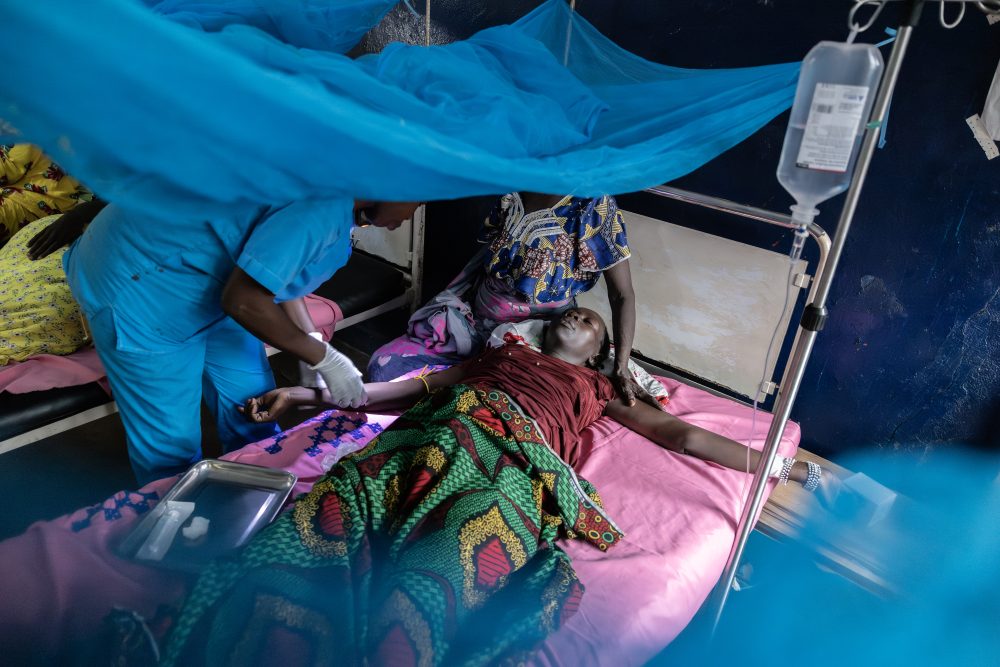
BUNIA, Congo (AP) — In the epicenter of Congo’s Ebola crisis, Arlette Basekawike dedicates her days to cooking meals for patients and medical staff from a modest shelter beside a healthcare center.
Wearing a pink head covering, Basekawike works as a volunteer with the United Nations food agency, creating breakfast dishes like porridge, eggs and bread for those receiving care at the Evangelical Medical Center. For other meals, she might serve fresh fish alongside fufu, a traditional dish made from mashed plantains, topped with fruit.
“Even though the patients have this disease, they still feel better when they eat, and the doctors have the energy to treat the sick and give them medication,” Basekawike explained to The Associated Press on Monday while cooking vegetables and potatoes with goat meat in a large pot. “I’m here for them like a parent, preparing food so they feel comfortable.”
While her work might seem straightforward, it has emerged as vital support for the area confronting the fast-moving rare Bundibugyo virus, the Ebola strain identified in eastern Congo during May.
By Tuesday, the World Health Organization reported 321 confirmed Ebola infections and 48 fatalities across the Central African country’s three eastern provinces: Ituri, North and South Kivu. Uganda has documented nine cases and one death according to WHO data, leading Uganda to seal its border with Congo.
Prior to this health emergency, the troubled region was already experiencing one of the planet’s worst food emergencies because of continuing warfare that has forced millions to flee as government troops battle insurgents. The viral outbreak has created additional complications that the United Nations cautions could hinder efforts to control transmission among a population already filled with distrust.
“We are in a region where we already have large segments of the population suffering from acute food insecurity linked to either war or displacement,” explained Olivier Nkakudulu, who leads the World Food Program in Ituri province. “So there are already needs and Ebola is an additional crisis on top of a crisis.”
The financially strained World Food Program confronts difficult decisions as funding reductions from the U.S. and other key donors have disrupted activities in this vulnerable area. Attempts to control the disease, which the World Health Organization has classified as a global health emergency, have been hindered by insufficient funding as international partners have either pulled out or decreased their commitments.
Additionally, assaults by distrustful community members on medical personnel and delayed aid delivery caused by the persistent conflict have made containing the disease’s spread challenging.
Nevertheless, the agency and healthcare workers report they have successfully maintained patients’ nutritional requirements thus far.
“Today we need to increase the amount because the number of patients has gone up,” stated Esther Bao, a nurse and volunteer. Some patients, due to their medical conditions, “don’t eat just any meal,” she noted.
No approved vaccine or cure exists for the Bundibugyo virus. Treatment focuses on managing symptoms, and five individuals have made recoveries.
The outbreak keeps expanding, growing from three affected health zones initially to 22 as of this past weekend, based on Congo’s Ministry of Health data.
On Sunday, 120 meals were distributed across four medical facilities, totaling 404 meals since food support started on May 28, Nkakudulu reported. However, the financial outlook remains challenging, he said.
“Without more funding, we might not be able to prioritize every suspected case,” Nkakudulu warned. “We might have to focus on some and not have food to give to others.”
Four people were hospitalized Tuesday after a black bear went on a rampage at an industrial complex in northeastern Japan, marking the latest incident in what has become the country’s worst year for bear attacks on record.
According to Japan’s Environment Ministry, bear encounters have claimed 13 lives across more than 230 separate incidents in 2025, surpassing all previous annual totals for both deaths and attacks.
Emergency responders raced to the Sasakino district of Fukushima after the Fukushima Steel Works called for help, reporting that a bear had attacked two of their workers. Surveillance video captured the frightening encounter, showing the animal pursuing an employee in his 20s near the facility’s entrance before knocking him down. The footage then shows the bear entering the factory grounds and mauling a second worker, a man in his 60s.
The animal went on to attack a third victim — another man in his 60s employed at a different company nearby. An 80-year-old neighborhood resident also fell victim to the bear, according to the Fukushima City Fire Department.
Medical officials reported that while the three male victims suffered minor wounds, the elderly woman sustained more serious but non-life-threatening injuries.
As of Tuesday evening, the bear remained at large and was thought to be hiding somewhere within the second company’s premises. Armed police officers carrying long poles had surrounded the area.
Two local schools shut down operations, with Noda Elementary School switching to remote learning and posting an alert on its website warning families to “avoid non-essential outings and stay safe.”
The violent encounter has terrified local residents and brought back memories of last year’s widespread panic that prompted military deployment to Akita prefecture in northern Japan, where bears attacked more than 60 people and killed four.
Wildlife experts attribute the growing problem to Japan’s expanding bear population moving into areas where the human population is rapidly aging and shrinking, leaving fewer people with the skills to hunt the animals.
Government officials estimated Japan’s total bear population at approximately 57,800 in March. Authorities have implemented a management strategy that includes systematic culling efforts. The plan calls for tripling municipal bear control personnel to 2,500 workers over the next five years while doubling the number of bear traps deployed.
Recent bear sightings have been reported even in Tokyo’s western suburbs, particularly around the Okutama hiking region. Park authorities have responded by installing additional traps and issuing bear warnings through social media channels.
Officials have intensified public education efforts, encouraging hikers and mushroom foragers to monitor bear sighting reports and avoid outdoor activities during early morning and evening hours when the animals are most active.
Government safety guidelines recommend that anyone who encounters a bear should remain calm, move deliberately, and resist the urge to turn and run. If attacked, the manual advises victims to lie face down, curl into a ball, and protect their neck area.
“The point is to save yourself from a fatal wound,” the manual states.
Microsoft is set to present its yearly software developer conference on Tuesday, where the technology giant plans to reveal innovative development tools for creating artificial intelligence applications across personal computers and cloud platforms.
During a main presentation in San Francisco, Microsoft CEO Satya Nadella will detail the company’s strategy for competing in cloud computing markets, where it serves as both an investor and competitor to companies like OpenAI, while also expanding its presence in the personal computer sector.
Personal computers are increasingly featuring software like OpenClaw, an open-source program capable of coordinating multiple AI agents to perform routine tasks for users.
However, OpenClaw, which has become popular in China and contributed to Microsoft’s competitor Apple’s Mac computer sales, along with similar technologies, presents security concerns for most business environments.
Industry experts anticipate Microsoft will focus on developing safer AI agent tools for corporate use and for the billion users of its Windows operating system.
Additional details are expected regarding how Microsoft will enable developers to utilize a recently announced chip from Nvidia that was revealed on Monday, designed to integrate AI functionality directly into personal computers.
This new chip will be featured in laptops designed to rival Apple’s high-end products, and its announcement led to stock increases for both Microsoft and major computer manufacturers like Dell Technologies, though experts note business adoption of these new systems may require time.
Industry observers also expect Microsoft to share progress updates on its proprietary AI models, which the company uses to compete in areas like code completion against OpenAI’s Codex and Anthropic’s Claude Code.
Nadella’s presentation is scheduled to begin at 1 p.m. ET.
Cristiano Ronaldo has shattered countless soccer records throughout his career, but competing in a sixth World Cup at age 41 would represent an exceptional achievement even for the Portuguese superstar.
The 2026 tournament will mark another chapter in Ronaldo’s extensive World Cup saga, which started in Germany in 2006 and has taken him through competitions in South Africa, Brazil, Russia and Qatar – all without capturing the championship that continues to elude him.
Only Lionel Messi is expected to equal Ronaldo’s six World Cup appearances, adding another dimension to their legendary rivalry that has spanned from Real Madrid versus Barcelona matches to Ballon d’Or awards ceremonies and now extends into soccer history.
While Messi has claimed eight Ballon d’Or trophies compared to Ronaldo’s five, both players continue adding new accomplishments to their remarkable careers.
The World Cup remains the one major tournament where Ronaldo has struggled to achieve ultimate success.
His most successful campaign occurred in 2006 when Portugal advanced to the semi-finals before falling to France. Since that tournament, he has experienced two round-of-16 eliminations, one quarter-final loss, and a disappointing group-stage exit in Brazil during 2014.
For the upcoming tournament, Portugal will compete against Democratic Republic of Congo, first-time participants Uzbekistan, and Colombia in Group K.
Throughout five World Cup tournaments, Ronaldo has participated in 22 matches while netting eight goals – respectable statistics for most players but relatively modest considering his extraordinary club-level accomplishments.
The 2022 Qatar tournament appeared to signal the conclusion of Ronaldo’s World Cup career. He arrived amid controversy surrounding his Manchester United departure, managed to score but was benched by coach Fernando Santos for the knockout victory against Switzerland following a 2-1 defeat to South Korea.
However, he has made a comeback under former Belgium manager Roberto Martinez, displaying the determination of someone who refuses to acknowledge limitations imposed by age.
Portugal now features an impressive roster including Vitinha, Joao Neves, Bruno Fernandes and Nuno Mendes, though Ronaldo continues to serve as the primary attraction.
Following their disappointing quarter-final elimination at Euro 2024, Portugal bounced back impressively by defeating European champions Spain in last year’s Nations League final and enters the North American tournament in strong form with Ronaldo leading the way.
Martinez points to statistics that demonstrate Ronaldo’s continued value: 25 goals across 30 matches under his leadership – representing a higher goals-per-game ratio than achieved under any previous national team coach – plus significant contributions that don’t appear in scoring statistics.
“He is fantastic at those movements, those runs, opening spaces, splitting centre halves,” Martinez told Reuters in May.
“Somebody that has won everything has the hunger of somebody that hasn’t won a trophy yet,” he added.
The 2026 tournament might represent Ronaldo’s final opportunity on the global stage, though similar predictions have been made previously.
Congressional representatives will have an unusual opportunity this week to publicly question Secretary of State Marco Rubio regarding President Donald Trump’s international policies, amid increasing Republican unease about the ongoing Iran conflict.
Rubio, who simultaneously holds the position of Trump’s national security adviser, is scheduled to appear before multiple committees across two days of hearings. He will address the State Department’s budget proposal to both the Senate Foreign Relations Committee and House Foreign Affairs Committee, along with appropriations subcommittees from both chambers.
The current administration is requesting congressional support for a proposed 30% reduction in foreign affairs funding while simultaneously pursuing a 50% boost in defense spending.
Before assuming his current role in January 2025, Rubio represented Florida in the Senate. Legislators expressed hope that their former colleague will outline a clear plan for concluding the Iran conflict, which began with coordinated strikes by the United States and Israel on February 28.
While Rubio has participated in private congressional briefings alongside other senior administration officials regarding the Iran situation, he has not provided public testimony about the conflict until now.
Speaking on CBS’s Face the Nation program Sunday, Democratic Senator Chris Murphy of Connecticut stated, “We just need this war done, no matter the terms at this point.”
Murphy highlighted how escalating fuel costs are affecting American families and businesses, while also criticizing Trump’s decision to reduce sanctions on Russian oil as a means to address the energy price surge caused by the conflict.
Growing public dissatisfaction with increased costs has prompted Trump’s Republican allies to push for reopening the Strait of Hormuz and reducing domestic fuel prices before November’s elections, which will determine whether their party maintains narrow congressional control.
Simultaneously, Trump faces pressure from hawkish members of his own party who resist making any compromises with Tehran.
Trump and his allies maintain the military action will prove valuable if it prevents Iran from developing nuclear capabilities. The president continues to promise that fuel prices will decrease and has repeatedly claimed he will negotiate a favorable agreement to end the hostilities.
Congressional members from both parties, including some Republicans, have requested additional details from the administration regarding its Iran strategy and other international policy objectives.
Last month, the Senate moved forward with a war powers measure that would terminate the Iran conflict without congressional authorization for Trump’s actions. Subsequently, House leadership suddenly delayed voting on comparable legislation when passage appeared likely.
Legislators have indicated they seek more details about Venezuela following Trump’s deployment of American forces to capture Venezuelan President Nicolas Maduro on January 3. Maduro’s deputy currently serves as Venezuela’s interim leader with no scheduled elections.
Questions also persist about U.S. forces engaging boats near Venezuela’s coastline since September, part of what the administration describes as anti-“narco-traffickers” operations that have resulted in over 200 deaths.
Additional concerns have emerged regarding Trump’s intentions toward Communist-controlled Cuba, as worries mount about potential U.S. military action while his administration intensifies pressure on the island nation.
BECOV NAD TEPLOU, Czech Republic – An extraordinary collection of vintage wine bottles from the late 1800s, concealed beneath a castle chapel during World War Two, is now available for public viewing after an extensive restoration process by the renowned French winery Château d’Yquem.
The remarkable find consists of 133 bottles, with most produced between 1892 and 1899. The wine collection was uncovered in 1985, hidden beneath the chapel floor at Becov castle near the German border, where it had been secretly stored by the castle’s owners at the war’s conclusion.
According to Toni El Khawand, Chateau d’Yquem Cellar Master, the underground hiding spot created ideal storage conditions for preserving the wine’s quality over decades.
Testing conducted in 2016 using a Coravin device – which extracts samples through the cork using a needle without causing damage – confirmed the wine’s remarkable preservation.
“It benefited from very good conditions of conservation, in this old chapel, I think very humid and very cold, with thick walls, and also underground so it preserved the moisture and temperature in a very constant way. Those were excellent conditions to store a wine,” El Khawand explained.
The French winery has carefully recorked multiple bottles during the restoration process, with El Khawand noting that every detail was preserved authentically, including the original dust coating on the bottles.
Becov castle previously served as the residence of the Beaufort-Spontin family before being seized by then-Czechoslovakia after the family was branded as Nazi sympathisers.
Before escaping to Austria, the Beaufort-Spontins concealed their wine collection alongside a reliquary of St. Maurus, believed to contain bones of St John the Baptist.
The discovery came about in 1984 when the family contacted American businessman Danny Douglas for assistance in recovering their hidden valuables. Douglas secretly petitioned authorities on the family’s behalf to retrieve an unspecified object from an undisclosed location.
Following negotiations with officials regarding permits, police eventually determined Douglas’s target location and the nature of the treasure he sought, ultimately leading to the collection’s recovery.
Russia’s Defense Ministry defended its large-scale overnight assault on Ukraine Tuesday, characterizing the attack as retaliation for what Moscow described as terrorist activities carried out by Ukrainian forces against Russian territory.
Officials in Ukraine reported that Russian missiles and drones bombarded the capital city and several other urban areas in the early morning hours Tuesday, resulting in no fewer than 11 fatalities and more than 100 injured civilians. The attack came after days of intelligence warnings about Russia preparing a significant offensive operation.
“Overnight, in response to terrorist acts of the Kyiv regime, the armed forces of the Russian Federation carried out a massive strike using high-precision long-range air-, land-, and sea-based weapons,” the Russian Defence Ministry said in a statement.
According to the ministry’s account, Russian forces deployed hypersonic missiles and unmanned aircraft to strike seven different Ukrainian regions, including the capital, Zaporizhzhia, and Kharkiv. The ministry claimed successful hits on infrastructure supporting Ukrainian military operations, including fuel storage sites, transportation networks, and military aviation facilities.
Moscow had issued threats the previous week, announcing plans to conduct systematic bombardments of targets in the Ukrainian capital as revenge for what Russia characterized as a catastrophic Ukrainian drone assault on a student residence facility in Russian-controlled Luhansk in eastern Ukraine, an attack that claimed 21 lives.
Ukrainian officials countered that their forces had aimed at a drone operations center in that location rather than civilian students. Speaking Monday evening, Putin accused Ukrainian leadership of beginning a fresh chapter in what he called a series of criminal acts, referencing both the dormitory incident and a subsequent attack on residential buildings in a Russian-occupied section of Ukraine’s Kherson region. Each side rejects accusations of intentionally striking civilian populations.
A vehicle accident has resulted in the closure of the right travel lane on Interstate 95 southbound beyond Exit 5, according to traffic officials.
The lane restriction remains in effect as crews work to clear the crash scene. Drivers using this route should anticipate possible delays and consider alternate routes if possible.
Authorities have not released additional details about the collision or when the lane is expected to reopen to traffic.
The president’s campaign promise to remove citizenship from Americans on a large scale is encountering substantial legal and administrative challenges, according to immigration advocates, constitutional experts, and naturalized citizens who are monitoring the situation closely.
Despite the strong campaign rhetoric about revoking citizenship, the actual implementation of such a policy appears to be far more complicated than the initial promises suggested, raising questions about the feasibility of mass denaturalization efforts.
The proposal has generated significant anxiety among immigrant communities and legal experts who are concerned about the potential impact on naturalized Americans and the broader implications for citizenship rights.
Good morning, Delmarva! We’re kicking off this beautiful Tuesday with absolutely gorgeous weather across the peninsula. Expect wall-to-wall sunshine today with comfortable temperatures climbing to a pleasant 74 degrees. A gentle north breeze at 5 to 10 mph will keep things feeling fresh and comfortable – perfect weather for any outdoor plans you might have!
Nothing extreme to worry about today, folks. No storms, no oppressive heat, just that sweet spot of early summer weather we all love. Tonight will be equally delightful with mostly clear skies and temperatures dipping to a comfortable 56 degrees – ideal for leaving those windows open.
Looking ahead to Wednesday, the beautiful pattern continues! We’ll see another sunny day with temperatures warming up just a touch to 78 degrees. Wednesday night stays clear with lows again around 56.
It’s shaping up to be a fantastic couple of days across Delmarva, so get outside and enjoy this perfect June weather! I’m your TV Delmarva meteorologist, and I’ll see you tonight with your extended forecast.
Drivers traveling westbound on the Milford Harrington Highway should expect lane changes today as construction crews work on the right shoulder of the roadway.
The lane shift affects the stretch of Route 14 between Canterbury Road and Church Hill Road, with work expected to wrap up by 5 PM this evening.
Motorists are advised to use caution when traveling through the construction zone and allow extra time for their commute.
A federal appeals court has determined that a policy from the Trump administration that prohibited transgender individuals from serving in the armed forces violated the law.
The decision came from a divided panel of appellate court judges who reviewed the controversial military policy.
The ruling addresses a significant policy that affected transgender service members’ ability to serve openly in the U.S. military during the previous administration.
At the West LA Veterans Affairs Campus, an Iraq war veteran named John Follmer is working to bring new life to a forgotten piece of tranquility.
Follmer is coordinating a group of veteran volunteers who are working to restore a Japanese garden that had fallen into disrepair on the VA grounds. The rehabilitation project aims to create a peaceful retreat space for veterans seeking solace.
The restoration work involves careful pruning and maintenance of the garden’s plants and features. Follmer and his team of volunteers are dedicating their time to transforming the once-neglected space into a place where veterans can find calm and healing.
The Japanese garden project represents more than just landscaping – it’s an effort to provide veterans with a therapeutic environment where they can connect with nature and find respite from their struggles.
WASHINGTON (AP) — President Donald Trump attempted to establish a nearly $1.8 billion taxpayer-funded settlement that would benefit his supporters after filing lawsuits against federal agencies — even claiming he “gave up a lot of money in allowing” the arrangement.
Following significant opposition from Congress and the courts, the White House is now reconsidering the controversial fund. This development could revive the lawsuit — and the potential for the president to benefit financially.
Trump has openly transformed his presidential role into a source of significant personal gain, encompassing everything from product licensing agreements to cryptocurrency investments to expensive political and official gatherings at his properties.
When questioned about potential conflicts of interest involving the president, the White House dismissed such concerns as “the same, tired narrative that Democrats have pushed against President Trump, his family, and his administration for a decade.”
“President Trump only acts in the best interests of the American public — which is why they overwhelmingly re-elected him to this office, despite years of lies and false accusations against him and his businesses from the fake news media,” spokesperson Anna Kelly said in a statement. “There are no conflicts of interest.”
Here are some key ways Trump has reaped rewards for himself, his children and allies in his second term:
The president filed a claim last year demanding $230 million in damages from the Justice Department following an FBI search of his Mar-a-Lago estate in Florida during an investigation into whether he retained classified documents from the White House.
This January, Trump, his two eldest sons and the family’s business, the Trump Organization, filed a $10 billion lawsuit against the IRS and Treasury Department after a former IRS contractor illegally leaked Trump’s tax returns.
To settle these legal disputes, Trump’s administration agreed that $1.776 billion in public funds would be distributed to individuals who claim they were politically targeted for prosecution by previous administrations — including Trump supporters jailed for attacking police during the January 6, 2021 Capitol breach.
Following criticism from even some congressional Republicans, the Justice Department now says it will honor a court order temporarily halting the fund.
However, there was less controversy surrounding another aspect of the agreement that would allow the government to abandon ongoing IRS audits of Trump and his family members.
In separate developments, the Air Force has agreed to buy interceptor drones from Powerus, a Florida-based company connected to Trump’s family. Additionally, ProPublica reported that direct White House intervention led to the Pentagon agreeing to provide $620 million in loans to Vulcan Elements, a North Carolina startup linked to Donald Trump Jr.
Trump Organization spokesperson Kimberly Benza denied any ethical conflicts between the White House and the family business.
“The Trump Organization operates completely separate from the presidency and is in full compliance with all ethics and conflict-of-interest laws,” Benza said in a statement.
Regarding Powerus, Benza said Eric Trump was “a passive investor in a vehicle that, among many others, holds an interest” in the company, but wasn’t involved in its decision-making or management.
Trump has conducted stock and bond trading in ways unprecedented for a sitting U.S. president.
Office of Government Ethics filings show Trump made more than 3,600 stock trades in the first quarter of 2026 alone — transactions far exceeding $100 million in value.
Many of those trades involved sizable purchases of shares of technology and artificial intelligence giants like Nvidia, Dell, Oracle and Palantir before Trump’s administration took policy actions favoring those firms.
Similar disclosures last year show that Trump bought up more than $300 million in bonds issued by companies, states and municipalities even as he repeatedly pressed the Federal Reserve to lower interest rates — a move that could help drive up the value of his holdings.
Trump’s family has generated substantial profits in the cryptocurrency sector since his reelection. A major factor has been the $TRUMP meme coin, announced the day before Trump took office. Some 220 of the top investors were invited to a subsequent, private reception with the president.
Trump’s family also holds a controlling stake in World Liberty Financial, a crypto firm co-founded with the president’s special envoy Steve Witkoff and run by his son Zach. It has its own stablecoin, USD1, and received a major boost when, just before Trump took office, an investment fund linked to the United Arab Emirates bought a large stake in it.
An Abu Dhabi state-backed investment firm, MGX, subsequently pledged to use $2 billion worth of USD1 to purchase a stake in Binance, the world’s largest cryptocurrency exchange — a move that further bolstered World Liberty Financial.
Outside the digital arena, dozens of companies pay to license the president’s name for physical products, from Bibles, guitars and sneakers to watches, fragrances and a gold-hued cellphone.
Trump has promoted many such goods on social media, particularly during his 2024 campaign, but they’ve also made conspicuous appearances at the White House.
When French President Emmanuel Macron and Ukrainian President Volodymyr Zelenskyy visited last summer, Trump showed them a merchandise room off the Oval Office stocked with goods for sale on his website. A few months later, video emerged of Trump at the White House spraying Syrian President Ahmad al-Sharaa with bottles of his “Victory 47” cologne and perfume, which he gave him as a gift.
The president displayed hats emblazoned with “Trump 2028” on the Resolute Desk while meeting with congressional Democrats last year. And, during a televised Cabinet meeting in May, at every seat was a red hat commemorating America’s 250th anniversary.
Each hat sells for $55 on Trump’s website.
The Republican National Committee and various political groups associated with Trump and the GOP have held fundraisers and political events at Mar-a-Lago, as well as Trump’s estate in Bedminster, New Jersey, and his golf clubs in Doral, Florida, and Sterling, Virginia.
The LIV Golf league, controlled by the Saudi Public Investment Fund, which is helmed by Crown Prince Mohammed bin Salman, has held events at Doral. Trump will host the G20 summit there in November.
That means world leaders, support staff, business executives, journalists and the bevies of others involved will be paying the Trump Organization, which purchased Doral in 2012, to attend. The president has already tried to head off criticism of self-dealing around the summit, saying that government attendees will be billed “at-cost” and “We will not make any money on it.”
Meanwhile, conservative groups and Republican committees have spent at least $26 million at Trump properties since 2015. The actual figure is likely higher since some groups don’t have to detail their spending.
Qatar gave Trump a $400 million jet that he intends to employ as Air Force One, then store at his presidential library after he leaves office. The gift has undergone extensive taxpayer-funded rebuilding and security upgrades that lawmakers estimate may exceed $1 billion.
Trump has also ordered up scores of renovation projects meant to leave his mark on Washington while passing on the costs to taxpayers.
He long insisted that wealthy donors would pay for the $400 million ballroom he demolished the White House’s East Wing to build — only to seek $1 billion in federal funding for security upgrades he says the military and Secret Service have sought as part of the project.
At least $15 million in public funds is going for the ceremonial arch Trump wants built at an entrance to the nation’s capital. The National Park Service is also paying a contractor $13.1 million to carry out the Trump-directed renovation of the Lincoln Memorial Reflecting Pool.
Scientists have uncovered the most compelling evidence to date that planets outside our solar system generate magnetic fields, a discovery that enhances our knowledge of distant worlds and their potential for supporting life.
The research, conducted using telescopes located in Chile and Hawaii, focused on seven massive, scorching gas planets and their atmospheric wind patterns. The findings reveal that these distant worlds share a crucial feature found in six of the eight planets within our own solar system.
Magnetic fields form when electrically charged materials move within a planet’s interior – typically molten metal in the core – combined with the planet’s spinning motion. This creates an invisible protective barrier around the world.
Although the gas giants examined in this research cannot support life as we know it, magnetic fields may play a vital role in making rocky worlds like Earth suitable for living organisms.
Each of the studied planets circles extremely close to large, hot stars, with one hemisphere constantly facing the star while the other remains in perpetual darkness, similar to how our moon always shows the same face to Earth.
Scientists classify these worlds as “hot Jupiters” due to their similar size and makeup to our solar system’s largest planet, though they experience much more extreme temperatures. The seven planets studied range from approximately Jupiter’s mass to more than three times heavier.
Powerful winds sweep from the blazing “dayside” to the frigid “nightside” of these worlds. Their close proximity to their host stars results in blistering atmospheric conditions on the sun-facing side. All orbit closer to their stars than Mercury does to our sun.
“What you would expect is that the planets with hotter temperatures would have stronger winds. The more energy you put into the system, the more violent the winds become. But we see the opposite,” explained astronomer Julia Seidel of the Observatoire de la Côte d’Azur’s Lagrange Laboratory in Nice, France, who led the study published Tuesday in Nature Astronomy.
“It’s the hottest planets that have the least strong winds mixing the atmosphere. And that’s really strange from what we know of how atmospheres behave,” Seidel noted. “That means all that energy that the star puts into the planet’s atmosphere has to be dissipated in a different way. And the only possibility to brake the atmosphere that much that fast is via the magnetic field and its interaction with the moving charged particles of the atmosphere.”
Wind velocities on these seven distant worlds reached speeds of up to 15,500 miles per hour (25,000 km per hour), exceeding those found on Jupiter.
Given that most planets in our solar system possess magnetic fields, researchers said the discovery that distant planets also have them makes sense. However, they noted that scientists had previously struggled to find convincing proof.
“We do not look at a singular exoplanet, but we look at a population of them and see a trend emerge,” Seidel stated.
Jupiter possesses the strongest and most extensive magnetic field in our solar system. The seven distant planets produced magnetic fields weaker than Jupiter’s but similar in strength to other solar system planets overall.
Mercury, Saturn, Uranus and Neptune join Earth and Jupiter as our solar system’s planets that create global magnetic fields. Venus and Mars lack magnetic fields, though Ganymede, one of Jupiter’s large moons, produces its own magnetic field. Earth’s moon also once generated its own magnetic field long ago.
Magnetic fields represent one factor that determines whether a planet can preserve its atmosphere over extended periods. Mars, for example, once possessed a magnetic field but lost it billions of years ago when its interior cooled, leaving it with only a thin atmosphere and harsh surface conditions.
“Although it’s a common misconception that magnetic fields directly determine whether a planet is habitable, they can play an important role in how a planet evolves over time,” said astronomer and study co-author Bibiana Prinoth of the European Southern Observatory in Germany. “Life as we know it relies on having an atmosphere. An atmosphere helps maintain surface pressure, regulate temperature and, on Earth, allows liquid water to exist at the surface.”
Motorists traveling on Interstate 95 southbound should expect delays at the Route 896 exit due to ongoing construction work.
The left lane of the ramp leading from I-95 southbound to Route 896 southbound at Exit 1A remains blocked to traffic. The lane restriction is scheduled to continue until Friday, June 5, 2026, with work expected to wrap up by 5 PM that day.
Drivers are advised to allow extra travel time and use caution when navigating through the construction zone.
BRUSSELS — European Union leaders have approved sweeping changes to immigration policy that will accelerate deportation processes and permit controversial agreements to establish detention facilities in foreign countries, according to human rights organizations drawing parallels to hardline U.S. immigration enforcement.
“The new regulation will speed up the return process and increase returns of persons who have no legal right to stay in the EU,” said Nicholas Ioannides, deputy migration minister for Cyprus, which holds the rotating presidency of the 27-nation bloc.
The agreement was reached Monday evening through negotiations between the EU’s primary governing bodies — the European Commission, European Council and European Parliament — in what officials call a “trilogue” session.
Opponents have drawn comparisons between this policy and U.S. immigration strategies under the Trump administration, which established undisclosed agreements with various nations to remove thousands of individuals to countries other than their homelands. The United Kingdom had similar plans to send migrants to Rwanda, though legal challenges stalled the initiative and new leadership abandoned it upon taking office.
“The Regulation is going to create a draconian detention and deportation machine,” said Silvia Carter, spokesperson for the Brussels-based Platform for International Cooperation on Undocumented Migrants.
“Across the Atlantic, we see the violence and fear created by ICE’s brutal immigration enforcement. Europe should be learning from the harms of that model, not building its own version of it.”
The tentative agreement will now advance to EU lawmakers and national leaders, where swift approval is anticipated.
Member countries will gain authority to negotiate bilateral agreements with non-EU nations to establish deportation facilities. At least five EU countries — Germany, Austria, the Netherlands, Denmark and Greece — are currently discussing arrangements with third nations, primarily in Africa, to host “return hubs” similar to Italy’s detention agreement with Albania.
The EU has consistently strengthened migration restrictions following right-wing parties gaining control in several countries during 2024. European Commission President Ursula von der Leyen, representing the center-right European People’s Party coalition, has stated these new policies will avoid repeating the 2015 emergency triggered by Syria’s civil conflict, when approximately 1 million people sought asylum.
Driven by individuals escaping violence and economic hardship throughout Africa and the Middle East, the 2015 refugee emergency and subsequent years of unauthorized migration to Europe have sparked a conservative political shift in the region, mirroring anti-immigration attitudes that contributed to a “red wave” in the 2024 U.S. election.
Center-right political factions joined forces with far-right groups to defeat opposition from moderate and progressive parties, according to Mélissa Camara, a French lawmaker and Green Party member who described the agreement as “a historic setback” for human rights in the region.
“The legalization of return hubs outside the European Union, the green light for the detention of minors, home visits inspired by ICE practices: the legal arsenal serving a xenophobic ideology is now complete,” she said.
Advocacy organizations cautioned the legislation would significantly undermine protections established by the EU fundamental charter on human rights and create dangers for people beyond the bloc’s borders.
“This deal will give governments much broader powers to detain and deport people,” said Marta Welander, a spokesperson for the International Rescue Committee. “It looks set to normalize immigration raids, expand the use of detention in prison-like facilities outside EU territory that are essentially legal black holes, and increase the risk of people being deported to countries where they could face persecution, torture or worse.”
The Democratic Republic of Congo has restored passenger flight service to the main airport serving the province most severely affected by the current Ebola outbreak, according to an official government announcement that reverses a decision some locals said had isolated them from essential resources.
Authorities in Kinshasa had announced the previous month they were halting commercial passenger service to Bunia, the primary airport serving Ituri province, after the initial Ebola infections were identified there. Medical and humanitarian aircraft operations continued with required government authorization.
According to a statement released Monday evening by Congo’s transport ministry, necessary measures are now established “to allow a gradual and safe resumption of air transport activities” with the airport resuming operations without delay.
The ministry outlined that all travelers will undergo temperature checks prior to departure and upon landing, must sanitize their hands before boarding, and anyone displaying fever symptoms will be prohibited from flying.
The Africa Centres for Disease Control and Prevention confirmed the outbreak of the Bundibugyo strain of Ebola, marking Congo’s 17th Ebola outbreak, on May 15, with the World Health Organization quickly designating it a public health emergency of international concern.
Health officials report the outbreak, now ranking as the third-largest on record, went undetected for several weeks, leaving authorities working from behind and facing challenges in containment efforts.
The airport reopening decision came after a visit from WHO Director-General Tedros Adhanom Ghebreyesus, who informed media Monday that he observed positive developments in the response efforts, citing five certified recoveries. However, he emphasized the necessity to expand testing and treatment capabilities while building trust in health workers.
Monday’s latest government data shows 321 confirmed Ebola cases with 48 confirmed fatalities.
The disease has spread to 15 of Ituri’s 36 health zones, with additional cases documented in North and South Kivu provinces as well as in neighboring Uganda.
The International Rescue Committee issued a warning Monday that the outbreak likely exceeds official statistics in both scale and progression.
The humanitarian organization indicated the virus may have been circulating for as long as three months prior to the first official case confirmations in mid-May.
Stock prices for Marvell Technology jumped dramatically in early Tuesday trading, climbing more than 24% after Nvidia’s chief executive made a bold prediction about the company’s future.
During a technology conference presentation at Computex week in Taipei on Tuesday, Nvidia CEO Jensen Huang described the chipmaker as the next “trillion-dollar company.” Huang appeared alongside Marvell CEO Matt Murphy at the event.
The stock surge pushed Marvell shares up 24.4% to $272.9 in premarket trading. If those gains maintain throughout the trading day, the company stands to increase its market value by more than $47.2 billion. Nvidia’s own stock also climbed 1.4% following the comments.
Hewlett Packard Enterprise experienced a dramatic stock surge of nearly 29% during Tuesday’s premarket trading session, as Wall Street celebrated the technology company’s decision to accelerate its long-term financial projections by two years due to robust artificial intelligence infrastructure demand.
The enterprise server manufacturer, which faces competition from Dell Technologies and Super Micro Computer, is experiencing continuous demand as major corporations accelerate their equipment purchases to prevent supply chain disruptions while memory chip costs continue climbing.
Major cloud computing companies including Alphabet and Amazon are projected to invest over $700 billion in AI infrastructure throughout this year, which should increase demand for the company’s server and networking equipment.
The technology firm announced Monday that it elevated its fiscal 2026 revenue growth projection to 29%-33% from the previous 17%-22% range and boosted its networking division growth expectations to 72%-75% from 68%-73%.
“The biggest takeaway from the quarter was that HPE is benefiting from the same pricing dynamic that has recently driven upside at Dell – customers are absorbing materially higher server prices with little evidence of demand destruction,” Morgan Stanley analysts said in a note.
Dell and SMCI stock prices climbed 3% and 5% respectively during the same period.
Company CFO Marie Myers told Reuters the significant development this quarter involved increasing enterprise customer adoption of agentic AI as a primary workload. The organization stated its updated fiscal 2026 projections for adjusted earnings per share and free cash flow exceeded what it previously expected to reach by fiscal 2028.
The company maintains a 12-month forward price-to-earnings ratio of 15.93, while Dell shows 24.14 and Cisco displays 25.56.
The head of cosmetics giant Estee Lauder revealed Tuesday that a potential merger with Puig, the company behind Jean Paul Gaultier, fell apart over pricing concerns, though the beauty manufacturer remains interested in future acquisition opportunities.
Stephane de La Faverie, President and CEO of the U.S. cosmetics maker, explained that negotiations with Puig concluded last month without a deal that would have formed a major beauty conglomerate capable of challenging industry frontrunner L’Oreal.
According to five sources familiar with the negotiations who spoke to Reuters, the discussions broke down due to information leaks, disputes among influential family stakeholders, and various demands, including those from make-up magnate Charlotte Tilbury.
During his remarks at a Deutsche Bank consumer conference in Paris, de La Faverie attributed the failure to financial terms.
“If we cannot reach the growth and the profitability at the right price point, then that is not an option. And this is why, obviously, this deal didn’t go through, because it was not at the right price,” he explained, noting that his company would keep evaluating potential deals.
The parent company of Clinique and M.A.C announced in May plans to eliminate between 9,000 and 10,000 positions worldwide as part of its “Beauty Reimagined” restructuring initiative, targeting up to $1.2 billion in yearly cost reductions.
A French biotechnology company saw its stock price crash Tuesday after releasing clinical trial data for an experimental medication designed to treat inflammatory bowel disease, despite the drug demonstrating impressive effectiveness rates.
Abivax stock fell 30% during early trading in Paris, making it the biggest loser on Europe’s STOXX 600 benchmark index. The decline comes after the company’s shares had surged more than 16-fold during the previous year in a remarkable rally.
The experimental medication, called Obefazimod, is an oral treatment being tested for ulcerative colitis, a long-term condition that leads to inflammation and sores in the colon. During a 44-week maintenance trial, clinical remission was achieved by 50.8% of patients taking the 25 mg dosage and 51.3% of those on the 50 mg dosage, while only 10.4% of patients receiving placebo showed improvement.
Both dosage levels successfully reached the study’s primary endpoint, demonstrating placebo-adjusted remission rates of 39.3% and 40.3% respectively, ranking among the most robust results seen in major ulcerative colitis research programs.
Nevertheless, concerns arose when three participants taking the higher 50 mg dose developed cancer cases – one instance each of prostate cancer, breast cancer and colonic dysplasia. According to Abivax’s study report released Monday, researchers determined these cases were not connected to the treatment.
Jefferies analysts told investors in a research note that the cancer cases “broke” their investment recommendation, as these incidents may continue to affect investor sentiment regardless of the underlying cause.
“Even if proven to be not drug-related or very low incidence, we expect an overhang to investor interest, strategic optionality, and commercial uptake,” the analysts explained.
Truist Securities analysts similarly noted that safety questions, with the relationship to the drug still being debated, would likely cause continued stock price fluctuations, despite the medication’s remarkable effectiveness results.
The company did not respond immediately to requests for further comment regarding concerns about the cancer cases.
However, Yale Jen, senior managing director at brokerage Laidlaw & Company, suggested the stock selloff might represent an excessive reaction to safety worries, while describing the overall trial results as a “homerun” for the drug’s development prospects.
The USS Ford has returned to its home port following almost a year of overseas deployment. The homecoming allows sailors aboard the massive vessel to enjoy some much-deserved time off after their extended mission at sea.
However, the return also presents an opportunity to tackle significant plumbing issues that have plagued the $13 billion aircraft carrier. These repairs can now be properly addressed with the ship back in port.
Correctional facilities in Oklahoma are transforming vacant property into specialized gardens that support wildlife migration patterns.
These habitat areas are being established to provide essential resources for birds and butterflies during their seasonal journeys. The state sits along a major migration corridor, making these conservation efforts particularly valuable for traveling wildlife.
Prison officials are utilizing previously undeveloped areas within their facilities to create these pollinator-friendly environments, turning unused space into beneficial ecosystems for migrating species.
Federal officials announced they will comply with a court order that temporarily stops the establishment of a controversial $1.8 billion anti-weaponization fund that has faced criticism from lawmakers across party lines.
The Justice Department confirmed it will honor the federal judge’s decision to pause the creation of the fund, which has generated opposition from both Republican and Democratic members of Congress.
A former county clerk from Colorado who was imprisoned for election interference has been released from custody earlier than expected. Tina Peters, who served as a county clerk and was found guilty of meddling in the 2020 election process, walked free after President Trump applied pressure to the state’s Democratic governor.
Peters had been serving time for her conviction related to tampering with voting equipment during the 2020 election cycle.
A political analyst who previously worked as a speechwriter for a former president recently discussed the current administration’s approach to marking America’s upcoming 250th anniversary celebration.
During a conversation with an NPR host, David Frum, who served as a speechwriter for former President George W. Bush and currently writes for The Atlantic, provided commentary on how the Trump administration is preparing for the nation’s semiquincentennial milestone.
The discussion centered on the planning and vision behind what will be a historic moment for the United States as the country reaches its 250th year of independence.
Listen to the Morning Delmarva Farm Report Update — June 2, 2026
DELMARVA — Two-thirds of the U.S. corn and soybean crops are in good to excellent condition according to the latest national crop report. The USDA reports 67% of corn is rated good to excellent, down 2% from last year. Soybeans are tracking at 66% good to excellent. While those numbers look solid nationwide, growing conditions vary widely by region, with some areas dealing with drought stress and others facing too much rain.
Markets
Livestock futures climbed Monday at the Chicago Mercantile Exchange. August live cattle gained $1.55 to close at $240.60. October contracts rose $1.90 to $232.32. Feeder cattle showed even stronger gains, with August contracts jumping $3.12 to $351.55.
At local cash markets, corn at Laurel Grain Company in Laurel, Delaware is bringing $4.87 a bushel for July delivery. Soybeans there are $11.37 for November.
Forecast
Sunny skies are expected today with a high near 69°F and northeast winds 5 to 10 mph. Tonight stays mostly clear with a low around 58°F. Wednesday brings more sunshine, warming to 74°F. No rain is in the forecast through the week, with temperatures climbing into the mid-80s by Friday.
This article is based on the Delmarva Farm Report Update Morning Edition, June 2, 2026. Hosted by Tom Bradley.
PARIS (AP) — Following Pope Leo XIV’s election last year, his passion for tennis gained attention when he met with top-ranked player Jannik Sinner during a papal audience.
Since then, Leo has made weekly tennis sessions a priority in his packed schedule, incorporating the sport into his Augustinian approach that combines physical fitness with spiritual growth.
The ancient Rule of St. Augustine, which serves as a guide for religious living, emphasizes the importance of establishing positive habits.
“He’s working to maintain consistency in his routine that stems from the Rule,” explained the Rev. Rob Hagan, Prior of the Augustinian Province of St. Thomas of Villanova and team chaplain for the men’s basketball and football teams at Villanova University — the pope’s alma mater in Pennsylvania.
Leo’s commitment to St. Augustine became clear during his April journey to Africa, when he made a pilgrimage to the archaeological ruins in Algeria where the influential 5th century theologian and philosopher spent his final days and penned some of Western thought’s most significant works.
The pope “emphasizes a very underappreciated Augustinian value — especially in this noisy world — and that is to develop your interior life,” Hagan said in an interview with The Associated Press.
Leo enjoys spending Mondays and Tuesdays at the papal retreat in Castel Gandolfo in the hills outside Rome — where he plays tennis with his secretary, Monsignor Edgard Iván Rimaycuna Inga, and also enjoys swimming and horseback riding.
Prior to his papal election, then-Cardinal Robert Prevost discussed his tennis abilities in an interview with the Augustinian Order.
“I consider myself quite the amateur tennis player,” he said, in the 2023 interview after assuming leadership of the Vatican’s powerful Dicastery for Bishops following years as a missionary in Peru.
“Since leaving Peru I have had few occasions to practice so I am looking forward to getting back on the court,” he added.
Marin Cilic, the Croatian professional player and 2014 U.S. Open champion, expressed that it was “amazing to hear that Pope Leo loves tennis.
“It’s a beautiful game. You enjoy it especially when you are playing without pressure of time, without pressure of tournaments,” Cilic, who comes from the Bosnian pilgrimage town of Medjugorje, said in an interview ahead of the French Open.
Even without tournament pressure, tennis demands significant mental focus. Maintaining concentration and minimizing unforced errors remains crucial for success.
“If your opponent is going beat you, that’s fine. But don’t beat yourself — you know, the double faults, the smash into the net. The play that really had nothing to do with your opponent but had to do with you,” Hagan said. “That does take a certain mental discipline, an ability to create good habits.”
Tennis also demands full-body engagement, requiring excellent hand-eye coordination, cardiovascular endurance and stamina. Additionally, there’s a social component.
This provides ideal preparation for the 70-year-old Leo to fulfill his papal duties of leading prayer services for thousands of believers, continuous public and private greetings, and exhausting papal journeys worldwide.
In April, Leo covered more than 17,700 kilometers (about 11,000 miles) across 18 flights during an 11-day African tour.
“Just look at his schedule. Look at the pace that he is keeping,” Hagan said. “He can sing the mass parts because he has a lung capacity. Hear him because he has a certain strength in his voice. It’s something that they don’t teach you in the seminary: To be a priest, to be a spiritual or really any leader for that matter, it is a physically demanding job.”
Before his papal election, he would also exercise at the Vatican-area Omega gym two to three times weekly, with hourlong sessions focusing especially on posture and cardiovascular health, according to his personal trainer at the time. Prevost’s workouts, described as appropriate for a man in his 50s, would extend up to an hour and concentrate especially on the treadmill and exercise bike, trainer Valerio Masella told The AP last year.
Hagan observed that because of Leo, “people are discovering who St. Augustine is. People are discovering who the Augustinians are.
“And people are discovering and hopefully applying these Augustinian values. We don’t have a monopoly on these values, but certainly Augustine and now Leo are putting them up on a platform that people can see,” added Hagan, who has shared Augustinian values with Villanova teams for more than two decades — including two national championship basketball teams.
“It doesn’t mean you’re going to win every game,” he said. “It doesn’t mean you’re going to win every tennis match. But what we’re trying to be is the best version of ourselves — mind, body, soul, and spirit. St. Augustine says, ‘Do not be content with what you are if you want to become what you are not yet. For where you’ve grown pleased with yourself, there you shall remain.’”
NAIROBI, Kenya (AP) — Kenya’s leader has publicly backed a controversial American-funded Ebola treatment center, even as legal challenges and citizen demonstrations have temporarily halted the project.
President William Ruto spoke out Monday evening in support of the disputed quarantine center planned for Laikipia Air Base, describing it as part of America’s decades-long health collaboration with his nation. He explained the facility represents just one of 24 such centers being developed to prepare for potential Ebola cases within Kenya’s borders.
Public opposition has mounted since American officials announced last week that US Ebola patients would not be permitted to return home for treatment, but would instead receive care at the Kenyan facility. The collaboration involves a $13 million American investment in the partnership.
A high court judge on Tuesday extended emergency orders first issued Friday that suspend both facility construction and any incoming foreign patients. Legal advocates from the Law Society of Kenya and constitutional group Katiba Institute brought the case, arguing Kenya’s struggling healthcare infrastructure cannot adequately serve international patients.
Making his first public remarks about the controversy, Ruto explained his decision stemmed from longstanding diplomatic ties between the nations.
“When President Trump asked the government of Kenya to support them by having a center at Laikipia Air Base, I gave the OK because it was an agreement and a partnership with friends who have worked with Kenya for 30-40 years,” he said.
The president emphasized that facilities created through this partnership would also serve Kenyan citizens should an Ebola outbreak occur domestically.
“We are a responsible government. We know what we are doing. People should relax. Politicians should avoid reckless, unnecessary talk that doesn’t mean anything,” he said.
The World Meteorological Organization issued a warning Tuesday that a moderate to potentially strong El Niño weather pattern could elevate worldwide temperatures and heighten the likelihood of severe weather conditions in the months ahead.
According to the World Meteorological Organization, El Niño represents a cyclical warming of ocean surface temperatures across the central and eastern Pacific Ocean that generally persists for nine to 12 months.
The agency reported that elevated ocean temperatures are fueling El Niño’s formation and projected temperatures above normal levels across most global regions from June through August. Officials expect the El Niño pattern will likely persist through November.
“We need to prepare for a potentially strong El Niño event – which will exacerbate drought and heavy rainfall and increase the risk of heatwaves both on land and in the ocean,” said WMO Secretary-General Celeste Saulo.
Saulo noted that the previous El Niño occurrence during 2023-24 helped make 2024 the warmest year ever recorded.
The WMO documented changes in the Equatorial Pacific region, where ocean surface temperatures climbed sharply between late April and mid-May, indicating El Niño conditions were forming. The organization has recorded exceptionally warm underwater conditions throughout the tropical Pacific, with temperatures surpassing average levels by more than 6 degrees Celsius, establishing a heat reservoir that promotes surface warming.
This climate phenomenon disrupts regional weather systems and may deliver enhanced precipitation to southern South America, the southern United States, portions of the Horn of Africa and central Asia, while triggering dry conditions in Australia, central America, Indonesia, and areas of southern Asia. The pattern can also contribute to global warming effects and strengthen hurricanes across the central and eastern Pacific Ocean, the WMO stated.
“The world must treat it as the urgent climate warning it is. El Niño conditions will pour fuel on the fire of a warming world,” said U.N. Secretary-General António Guterres, calling for a transition from fossil fuels to renewable energy sources.
The WMO noted that while climate change does not appear to increase how often or how intense El Niño events become, it can worsen related consequences including severe heat waves and intense rainfall.
A broken-bat single by Cole Young in the bottom of the 10th inning drove home the decisive run as the Seattle Mariners edged the visiting New York Mets 3-2 on Monday night.
The American League West-leading Mariners extended their winning streak to seven games behind solo home runs from rookie Colt Emerson and Josh Naylor.
New York got home runs from Jared Young and Marcus Semien, but their four-game winning streak came to a halt.
Mariners reliever Gabe Speier (1-2) worked a perfect top of the 10th inning to earn the victory.
Diamondbacks 4, Dodgers 1
Tommy Troy, Nolan Arenado and Ketel Marte connected for home runs as Arizona ended a three-game skid with a victory over Los Angeles in Phoenix.
Troy launched his first major league home run to even the score at 1-1 in the sixth inning. Arenado followed with a solo shot in the seventh, while Marte added a two-run blast in the eighth. Eduardo Rodriguez surrendered one run and five hits across six innings of work.
Dodgers superstar Shohei Ohtani collected three hits and pushed his on-base streak to 17 games. Los Angeles had previously won seven of eight contests and 14 of 17. Emmet Sheehan (3-2) surrendered two runs on three hits over 6 1/3 innings.
Royals 9, Reds 2
Lane Thomas connected for a first-inning grand slam while Luinder Avila delivered five solid innings as visiting Kansas City routed Cincinnati. Avila (1-2) surrendered one run on two hits while fanning five and issuing four walks for the Royals, who ended a six-game slide.
Jac Caglianone and Michael Massey also went deep for Kansas City. Both Massey and Thomas recorded three hits apiece, with Caglianone contributing two RBIs.
Lyon Richardson (0-1) started for Cincinnati in place of an ailing Chase Burns and allowed four runs in just one inning. JJ Bleday launched his third homer in four games for the Reds, who fell for the fourth time in five outings.
Brewers 16, Giants 2
Brice Turang broke out of an 0-for-21 slump with a double and two-run triple to spark Milwaukee’s 18-hit offensive explosion in a rout of visiting San Francisco.
Christian Yelich and David Hamilton each recorded three hits and scored three runs for the Brewers. Jackson Chourio contributed two hits and three RBIs, while five different players drove in two runs apiece for Milwaukee, which captured its sixth victory in seven games.
Matt Chapman launched a two-run homer for all of San Francisco’s offense as the Giants dropped their sixth game in seven tries. The Giants managed only five hits total. Landen Roupp (5-6) was tagged for eight runs on eight hits in four innings.
Twins 9, White Sox 6
Tristan Gray crushed a grand slam and totaled five RBIs as Minnesota held off Chicago in Minneapolis.
Josh Bell went 2-for-4 with a double for the Twins, who halted a five-game losing streak. Trevor Larnach finished 2-for-3 with an RBI. Joe Ryan (4-3) allowed four runs on eight hits across six innings.
Chicago starter David Sandlin (1-1) was hammered for eight runs on eight hits in four-plus innings. Miguel Vargas went 3-for-5 with a pair of homers and four RBIs. Andrew Benintendi finished 2-for-4 with a home run and two RBIs for the White Sox, whose five-game winning streak was snapped.
Rockies 9, Angels 8
TJ Rumfield brought home the go-ahead run with a sacrifice fly in the ninth inning while Hunter Goodman and Jake McCarthy each homered as Colorado rallied past Los Angeles in Anaheim, California.
Troy Johnston, Kyle Karros, Sterlin Thompson and McCarthy each collected two hits and an RBI for the Rockies, who prevailed despite making four errors. Antonio Senzatela (5-0) earned the victory with 1 2/3 innings of scoreless relief, though he allowed the tying run when he entered.
Jose Siri blasted a grand slam to highlight a five-run third inning while Jorge Soler went 3-for-5 with two RBIs for the Angels. Kirby Yates (0-1) surrendered the winning run in the ninth.
Rangers 2, Cardinals 1
Jacob deGrom hurled five scoreless innings to capture his 100th career victory as visiting Texas defeated St. Louis.
Ezequiel Duran doubled home a run among his three hits while Joc Pederson added an RBI single for the Rangers, who tied their season high with a fourth consecutive victory. deGrom (4-4) fanned eight batters, and Jacob Latz worked the ninth inning for his eighth save.
Masyn Winn’s sixth-inning homer was the Cardinals’ only hit over the final five innings as St. Louis lost for the sixth time in eight games. Michael McGreevy (3-5) pitched six innings while allowing two runs.
Tigers 10, Rays 9
Detroit built a six-run early advantage but had to withstand a late Tampa Bay comeback to secure a victory in St. Petersburg, Florida.
The Tigers launched a season-high five home runs while ending a four-game losing streak. Dillon Dingler went 4-for-5 and recorded his first career two-homer game. He also doubled while matching his career-high four RBIs. Riley Greene went 3-for-4 with a homer, double and three RBIs. Kerry Carpenter had a 3-for-5 performance with a homer and double.
Yandy Diaz went 3-for-5 as the only Ray with multiple hits. Junior Caminero finished 1-for-3 with two walks, three runs and two RBIs.
Marlins 7, Nationals 3
Pinch hitter Heriberto Hernandez belted a two-run homer while Sandy Alcantara threw seven strong innings as Miami came from behind to defeat Washington and end a five-game losing streak.
Alcantara (4-4) gave up three runs on seven hits to record his first victory since April 24. Liam Hicks launched a solo homer in the ninth inning before Kyle Stowers followed with a two-run shot. Otto Lopez collected three hits for the Marlins.
Jacob Young hit a two-run homer while Curtis Mead had two hits and an RBI for the Nationals. Richard Lovelady (2-3) allowed two runs in two-thirds of an inning.
BEIJING, June 2 – Beijing has sharply rebuked the Philippines’ top defense official following his characterization of China as a major security concern, despite recent Chinese offers of assistance during supply shortages.
The Philippine Defence Secretary Gilberto Teodoro stated to Reuters on Saturday that China continues to represent a “severe threat” and has shown no indication of genuine long-term goodwill, even as Beijing has recently provided fertilizer and fuel during war-related supply issues.
Beijing’s foreign ministry responded by claiming Teodoro’s statements show he is “solely driven by personal interests” and has ignored what’s best for his country’s citizens.
“If such individuals are allowed to act as they please, how will China continue to provide aid and supplies to the Philippines?” ministry spokesperson Mao Ning asked during a Tuesday press conference.
The leader of South Korea’s SK Group announced Tuesday that the company’s memory chip division, SK Hynix, intends to expand its wafer production capacity by 100% within the next five years.
Chey Tae-won made the announcement during the Computex conference in Taipei, where top technology executives from around the globe, including representatives from Nvidia, have assembled.
Chey, who previously cautioned in March that worldwide chip wafer shortages would likely continue through 2030, also indicated the company seeks additional collaborative relationships in Taiwan beyond its current partnership with TSMC, the globe’s biggest contract semiconductor manufacturer.
He expressed hope that his company could become a primary supplier of high-bandwidth memory (HBM) components for Nvidia’s Vera Rubin system.
Just last week, SK Hynix achieved a market valuation exceeding $1 trillion for the first time, joining competitors Samsung Electronics and Micron Technology in reaching this significant benchmark amid an artificial intelligence-fueled market surge.
As Nvidia’s primary HBM chip supplier, SK Hynix commanded a 58% portion of the worldwide HBM market during the first quarter, with Samsung and Micron each capturing 21% shares, based on data from Counterpoint Research.
Chey’s statements arrive as industry experts suggest the artificial intelligence surge is transforming the historically cyclical memory sector.
Goldman Sachs increased its 2028 operating profit projections for SK Hynix and Samsung Electronics by 24% and 23.3% respectively, reaching 454 trillion won ($299.62 billion) and 610 trillion won, attributing the growth to continued AI-powered demand.
The Vancouver Canucks announced Monday evening that they have selected Manny Malhotra as their new head coach.
The former NHL forward replaces Adam Foote, who was dismissed last month following Vancouver’s last-place finish in the NHL during his sole season leading the team.
Malhotra will serve as the franchise’s 23rd head coach and represents another former player being elevated within the organization as it undergoes reconstruction.
“Manny and I have been in the battle together before, so I know firsthand what a good teacher, leader, and quality person he is,” general manager Ryan Johnson said in a statement.
The two previously collaborated in the minor leagues with the American Hockey League’s Abbotsford Canucks.
“Manny is a great coach who has the right skill set and mentality to help players develop and get better each day,” Johnson said. “We both believe that pressure is a privilege, and learning to become a good pro takes patience, dedication and a ‘be better than yesterday’ mindset.”
Foote was dismissed on May 19 following the Canucks’ 25-49-8 record last season. Malhotra quickly became a leading contender for the position, with Johnson indicating he would meet with the 46-year-old former NHL player to “talk about the future.”
Malhotra’s coaching background includes roles as a development coach and assistant coach for the Canucks, followed by four seasons as an assistant with the Toronto Maple Leafs before taking the head coaching position at Abbotsford.
During his tenure there, he led the AHL squad to a Calder Cup championship in the 2024-25 season. The team failed to reach the playoffs the previous season while dealing with numerous long-term player injuries.
Johnson emphasized that Malhotra’s leadership during Abbotsford’s difficult season demonstrated his character as both a coach and individual.
“To see that when you can rely on the foundation of the consistent environment and the coaching through the worst of times and really continue to propel players forward, even though the wins and losses aren’t there, it tells you a lot about him,” he said.
“That entire staff showed that they’re champions based off of not the year before, but of what they did last year, and what people around them took out of a pretty tough season.”
The appointment brings Malhotra back together with former teammates Daniel and Henrik Sedin, who were appointed Vancouver’s co-presidents of hockey operations on May 14.
The Ontario native played 16 NHL seasons after being selected by the New York Rangers in 1998.
His career statistics include 116 goals and 295 points across 991 regular-season contests with Vancouver, New York, the Dallas Stars, Columbus Blue Jackets, San Jose Sharks, Montreal Canadiens and Carolina Hurricanes.
During his time with the Canucks, Malhotra suffered a serious facial injury from a puck in March 2011, resulting in permanent vision impairment in his left eye. The injury caused him to miss significant time during the team’s Stanley Cup Final appearance that year and led to a diminished role the following season.
“He loves the game and getting to know what makes his players tick, and I am very confident Manny will help us ice a competitive and hard-working team that our fans will be proud of moving forward,” Johnson said.
COPENHAGEN, Denmark (AP) — Denmark’s Social Democrat leader Mette Frederiksen will begin her third tenure as the nation’s prime minister, heading a center-left alliance of four political parties following two months of coalition talks.
The newly formed government consists of Frederiksen’s Social Democrats alongside three other parties: the centrist Moderates led by departing Foreign Minister Lars Løkke Rasmussen, the Green Left (SF), and the Danish Social Liberal Party, according to a Monday announcement from the Danish Royal House.
Speaking Monday evening, Frederiksen described the new administration as one that will serve “the people of Denmark, for the generations to come and for the animals.”
Frederiksen had triggered early elections in February, seemingly anticipating her party would gain support from her direct approach during tensions with U.S. President Donald Trump regarding Denmark’s semiautonomous Greenland territory.
The March parliamentary elections failed to deliver a clear majority for either progressive or conservative political blocs. Denmark’s proportional representation electoral system regularly results in multi-party coalition governments drawn from either the left or right side of the political spectrum.
This ruling coalition emerged after two unsuccessful government formation efforts — one led by Frederiksen herself and another by former Defense Minister Troels Lund Poulsen, who had attempted to establish a center-right administration.
The coalition’s policy agenda will be unveiled Tuesday, with cabinet appointments scheduled for announcement Wednesday.
The 48-year-old leader has governed the EU and NATO member nation since mid-2019. In the recent election, her party secured 38 seats in the 179-member unicameral legislature, representing a decline of 12 seats compared to the 2022 contest.
Frederiksen has gained recognition for her robust backing of Ukraine against Russia’s military aggression and for implementing strict immigration policies.
Responding to pressure from conservative opposition and citing concerns about potential migration increases due to the Iran conflict, Frederiksen proposed measures this year including a possible “emergency brake” on asylum applications and enhanced oversight of undocumented criminals. Her administration had previously announced plans allowing deportation of foreign nationals sentenced to one year or more for serious offenses.
During her second term, public approval declined amid rising living costs. However, she experienced renewed popularity while managing the diplomatic crisis over Trump’s interest in Greenland, which reached its peak in January with brief threats of European tariffs for nations opposing U.S. control of the Arctic territory.
The Greenland situation, which dominated government attention in recent months, played a minimal role in the campaign due to widespread consensus regarding its status within the kingdom.
In January, Frederiksen cautioned that American acquisition of Greenland would effectively destroy NATO. The crisis has since subsided.
Following Trump’s withdrawal of tariff threats against Denmark and other European nations opposing U.S. control of the Arctic island, the United States, Denmark, and Greenland initiated technical discussions for an Arctic security agreement.
Campaign discourse ultimately centered on living expenses, retirement benefits, and possible wealth taxation rather than foreign policy concerns.
A white South African political figure has sought refuge in the United States through a program established by President Donald Trump, driven by concerns about potential future persecution in his home country.
SJ Du Venage, a 56-year-old council member representing the Freedom Front Plus party in the Western Cape province, grew up with concerns about what might happen to white South Africans if political control shifted. Despite not experiencing direct mistreatment, these worries have remained with him throughout his life.
Du Venage previously served as a youth leader in the far-right Conservative Party, which had opposed ending apartheid. He is now among several Afrikaners seeking entry to the United States under Trump’s program designed to assist South Africa’s white minority, whom Trump alleges face racial persecution – claims the South African government dismisses as unfounded.
While Trump’s specific accusations about state-sponsored violence and widespread land confiscations have been debunked, Du Venage continues to feel threatened in his homeland.
“When Trump’s offer came, it was an opportunity from heaven,” Du Venage stated during an interview from his temporary residence in Saint Helena Bay, located north of Cape Town.
The life coach and former personal trainer underwent a seven-hour evaluation with U.S. Citizenship and Immigration Services in Pretoria this past February. He has since disposed of his property and fulfilled medical and security screening requirements mandated by American officials while awaiting a decision on his application.
Du Venage explained that his refugee petition centers on apprehension of future harm rather than past incidents, both of which can serve as grounds for acceptance according to the U.S. embassy. He referenced a menacing communication he received from an unknown individual after he organized a commemoration for a white farmer whose 2020 death became a source of racial tension.
“I was asked in the questionnaire who do I think wants to kill me, and I don’t really know,” he explained, believing his involvement in farm murder advocacy has made him a potential target.
While killings of white farmers represent only a small portion of South Africa’s elevated murder statistics, which predominantly impact Black citizens, these incidents have become rallying points for right-wing movements both locally and globally.
According to State Department figures, the United States has accepted over 6,000 South Africans as refugees since the previous year and recently increased the yearly limit to 17,500 to accommodate more white South Africans, even while other refugee initiatives remain suspended.
South African authorities view this arrangement as preferential treatment for Afrikaners – white South Africans primarily of Dutch ancestry – and challenge assertions that they experience widespread persecution.
“There is a very well-organised lobby in South Africa that is emphasising white victimhood, and that is being hugely emboldened by Donald Trump,” commented Fanie Du Toit, executive director of the Institute for Justice and Reconciliation, a South African research organization.
Du Toit, who belongs to “Afrikaners for South Africa,” a coalition opposing this narrative, noted that available information does not substantiate claims that white South Africans face group-based oppression or danger.
Research conducted by the institute in 2022 revealed that approximately three-quarters of white participants reported rarely or never feeling unsafe in their neighborhoods, with a comparable percentage rating their living situations favorably. In contrast, only one-third of Black participants described their living circumstances positively.
Support for emigration remains minimal even among Afrikaner political groups. Freedom Front Plus leader Corne Mulder expressed to Reuters that while he values Trump’s interest, he would prefer American assistance for Afrikaners remaining in South Africa, since few actually wish to relocate.
Du Venage, who holds a position within the party’s internal organization rather than as an elected official, anticipates challenges in adapting to American life and hopes for placement in an area with climate conditions similar to Cape Town’s.
“The feedback that we get is there is a small percentage that’s very lucky, that land in a nice place with a lot of support, but a lot of our people are really struggling,” he observed.
MOSCOW — Russian military officials announced Tuesday that their extensive nighttime bombardment of Ukraine served as retaliation for what they characterized as “terrorist acts” by Ukrainian forces, claiming they successfully hit numerous Ukrainian military installations.
Officials in Ukraine reported that Russian aerial weapons and missiles hammered the capital city and additional locations during the early morning hours Tuesday, resulting in no fewer than 11 deaths and over 100 injuries after several days of alerts regarding Moscow’s preparations for a large-scale offensive.
“Overnight, in response to terrorist acts of the Kyiv regime, the armed forces of the Russian Federation carried out a massive strike using high-precision long-range air-, land-, and sea-based weapons,” the Russian Defence Ministry said in a statement.
According to Russian officials, the military deployed advanced hypersonic weapons and unmanned aircraft to strike seven regions across Ukraine, including Kyiv, Zaporizhzhia, and Kharkiv, claiming successful hits on locations valuable to Ukrainian military operations including energy infrastructure, transportation hubs, and aviation facilities.
Moscow issued a warning the previous week that it would begin conducting “systematic strikes” against targets in Kyiv as payback for what it described as a catastrophic Ukrainian drone assault on student housing in Russian-controlled Luhansk in eastern Ukraine, resulting in 21 fatalities.
Ukrainian officials maintained they had aimed at a drone operations center in that area rather than students. Putin stated Monday night that Kyiv had “opened a new page in a series of crimes” through the dormitory attack and a subsequent strike on residential buildings in a Russian-controlled section of Ukraine’s Kherson region. Each side rejects accusations of intentionally attacking non-combatants.
NAIROBI, June 2 – Fatal violence broke out Monday in central Kenya as demonstrators rallied against a proposed United States Ebola quarantine facility planned for a military installation in the area, according to protest organizer Patrick Wahome and a security source who spoke with Reuters.
Details surrounding how the two fatalities occurred have not been disclosed. Attempts to reach Kenya’s national police spokesperson for comment were unsuccessful.
Kenya’s leader is standing firm on his decision to allow an American-supported Ebola isolation facility at a military installation in the country’s central region, describing it as part of broader national emergency planning and ongoing health cooperation with Washington.
The East African nation gave approval last week for an American proposal to build the facility at a central Kenya military airfield for U.S. citizens who might have encountered Ebola exposure.
Community members and area officials in Nanyuki, located close to the installation, organized demonstrations on Monday opposing the proposed facility. Protesters expressed concerns about potential community exposure to Ebola and challenged the decision to provide quarantine services for American nationals. The demonstration came amid increasing public opposition and court proceedings aimed at stopping the project.
In his first public comments regarding the facility, the president said such arrangements were routine and comparable to other installations already operating throughout Kenya.
“The facility that is at Laikipia Air Base is not a facility different from all the other facilities that we have across Kenya,” the president told media representatives in northern Kenya late Monday, encouraging citizens not to question the government’s emergency planning.
The Democratic Republic of Congo and Uganda are currently fighting the uncommon Bundibugyo variant of the Ebola virus in an outbreak that has claimed 48 lives and been designated a public health emergency of international concern by the WHO. The outbreak is advancing faster than the international response, which began slowly.
The Kenyan leader said he authorized the facility following a request from U.S. President Donald Trump for Kenya’s support, referencing decades of collaboration with Washington on health initiatives including HIV/AIDS, Ebola and COVID-19.
The president explained that Kenya had established isolation, monitoring and treatment centers in 23 counties, noting the facility would assist Kenyans along with international partners, including Americans, when necessary.
He rejected opposition to the proposal, stating Kenya had an obligation to prepare for potential Ebola cases, including among Kenyans residing or working in the Democratic Republic of Congo.
A court temporarily halted the plan last week following a legal challenge that argued the location could threaten public health. The president did not reference the court’s decision.
A U.S. military C-130 cargo aircraft landed in Nanyuki as late as Friday afternoon, based on flight-tracking service Flightradar24 data.
Two Nanyuki locals also reported observing military planes heading toward the base during the weekend, although Reuters could not verify whether they were American aircraft.
Kenya has strengthened border screening procedures at land and air entry points and is examining approximately 3,000 individuals daily, the president reported, noting that no Ebola cases have been found in the nation.
“We are a responsible government. We know what we are doing,” he stated.
A former U.S. submarine commander is working to solve a critical challenge facing Ukraine’s military: preventing Russian drones from crossing the Black Sea undetected to strike the port city of Odesa.
Charles Maher, who established maritime intelligence and security firm BlueShadow, has partnered with Ukraine’s defense forces to create a system managing fleets of autonomous naval vessels that would establish a defensive perimeter along the Ukrainian coastline.
“When fully deployed, there’ll be four squadrons of 12 vessels … And these squadrons will operate 10 to 12 kilometres offshore,” Maher told Reuters. He noted that the initial squadron — equipped with missiles and interceptor drones — could become operational by early 2027.
The Danish company BlueShadow joined seven other startups in showcasing innovative systems and technologies to military personnel during a recent weekend demonstration. These companies represent part of a growing network of small businesses and investment organizations that have emerged to strengthen Ukraine’s defense capabilities.
All participating companies collaborated with Defence Builder, a private sector accelerator that offers funding, guidance, and resource access to help defense technology startups expand into larger enterprises.
Line Rindvig, CEO of Defence Builder, explained that the organization provides companies with initial funding of $10,000 and a four-month acceleration program. This includes guidance on establishing solid business foundations to attract investors and military connections for product support and feedback.
In exchange, the military receives potentially affordable weapons or systems to deploy against a much better-funded adversary, while the accelerator acquires a small ownership stake in the startup.
“Business is business, but we also all serve a bigger purpose,” Rindvig said. “And it is to make sure that the solutions that are needed to win this war are getting the financial backing they need.”
Defence Builder operates as part of the Ukrainian Council of Defense Industries Investor Club, which includes approximately 25 institutions working to stimulate investment in Ukraine’s defense sector and coordinate deals.
The organization reports that publicly disclosed defense investment in Ukraine surged from merely $1.1 million in 2023 to $105 million in the previous year.
To accelerate procurement processes, military brigades can purchase products directly from manufacturers through the Brave1 Market online platform and DOT-Chain — functioning like an Amazon marketplace for weapons featuring 800 products from 200 manufacturers.
Similar to typical consumers, military units can provide product reviews.
According to Rindvig, one key focus for Defence Builder involves remote-controlled vehicles capable of operating in the “Kill Zone” surrounding the front lines, where numerous drones create increasingly hazardous conditions for human personnel.
Estonian startup Telearmy has been installing remote-control systems in frontline trucks since 2023, enabling operators to drive them from hundreds of kilometers away, according to founder Enn Laansoo.
Positioned next to a modified BRDM-2M — a Soviet-era armoured vehicle — Laansoo explained that Telearmy could retrofit virtually any battlefield vehicle.
“You cannot send any more soldiers to the front line and our technology provides that layer so the soldier doesn’t have to be there,” said Laansoo, whose company seeks capital for expansion.
Recently, Ukraine’s military has deployed “mid strike” drones to attack Russia’s supply bases, air defense systems, and critical transportation routes to the front lines. Addressing a shortage of such drones, startup Wingtech created a reusable fixed-wing bomber called the Haba, which reportedly can travel 300km (190 miles) on missions and resists jamming attempts.
After operating on the battlefield for over a year, Wingtech sought working capital to boost production and meet military demand. Rindvig noted they secured funding when an established Ukrainian defense manufacturer provided financing.
Cambodia announced Tuesday that it has notified both the United Nations and Thailand of its decision to begin a mandatory conciliation procedure under international law to resolve an ongoing maritime boundary disagreement with Thailand.
This action comes after Thailand’s government chose last month to unilaterally end a 2001 accord with Cambodia that had established a negotiation framework for the contested region in the Gulf of Thailand where both nations’ maritime territories overlap.
“We have taken this step to protect Cambodia’s sovereignty and maritime rights in accordance with international law,” Cambodian Prime Minister Hun Manet said.
Thailand’s foreign ministry has not yet responded to requests for comment.
Thailand’s decision to cancel the agreement was part of a campaign promise made by Thai Prime Minister Anutin Charnvirakul, who secured re-election in February amid rising nationalist feelings, following two deadly military confrontations between the nations last year along their contested border.
$300 BILLION IN ENERGY RESOURCES
The United Nations Convention on the Law of the Sea, known as UNCLOS, permits a mandatory conciliation procedure where a group of independent specialists can review a disagreement and provide recommendations, though their conclusions are not legally enforceable for either nation.
Thailand has previously stated it would reference UNCLOS while pursuing direct talks with Cambodia regarding maritime boundary determination.
Both nations claim roughly 26,000 square kilometers of ocean in the Gulf of Thailand, called the Overlapping Claims Area (OCA), which experts believe contains nearly 12 trillion cubic feet of natural gas and substantial oil reserves, valued at approximately $300 billion.
The oil shock from the Iran conflict has heightened the need to resolve the disagreement and access the underwater energy reserves, Cambodia’s energy minister told Reuters last week.
PROCESS TO BE OVERSEEN BY UN CHIEF
Cambodia has designated Foreign Minister Prak Sokhonn as its representative for the proceedings, along with Danish diplomat Peter Taksøe-Jensen and French academic Jean-Marc Thouvenin to serve as conciliators, according to a government statement.
“Thailand now has 21 days to appoint two of its own conciliators. The conciliators will then select a chair to finalize a conciliation commission, overseen by the UN Secretary-General,” the statement added.
Thailand has consistently refused Cambodian attempts to resolve disagreements through international bodies, including the International Court of Justice, maintaining that such matters should be addressed through direct bilateral discussions.
A truce has remained in effect between the two nations since late December after two periods of combat along portions of their 817-kilometer (508-mile) border last year, with the first ending following intervention by U.S. President Donald Trump.
Each side has blamed the other for starting the violence, which resulted in nearly 150 deaths and forced hundreds of thousands to flee their homes.
A senior executive from Japan’s second-largest banking institution is urging the country’s central bank to provide transparent guidance on future monetary policy following an anticipated interest rate increase this month.
Arihiro Nagata, who serves as global markets chief at Sumitomo Mitsui Financial Group, shared his views with Reuters as Japan faces significant financial market pressures. The nation’s 10-year government bond yields have climbed to three-decade peaks, while the yen has declined back toward the critical 160-per-dollar threshold despite substantial government intervention efforts.
“The BOJ should raise interest rates in June, and I expect it will – surely this time,” Nagata stated during an interview. He emphasized that the crucial aspect of the central bank’s upcoming June 15-16 gathering will be the clarity of signals regarding the path toward policy normalization.
“The more clearly it lays out that path, the more the room for further increases in long-term interest rates will likely diminish,” he explained.
According to Nagata, it would be adequate for the central bank to simply indicate alignment with market expectations, which currently anticipate approximately two rate increases this year along with additional tightening measures beyond that timeframe.
Japan’s central bank maintained unchanged interest rates in April while strongly indicating the possibility of an imminent increase due to growing inflationary pressures.
The ongoing Middle East conflict has created additional complexity for monetary policy decisions, as elevated energy costs simultaneously drive up inflation while placing burden on Japan’s import-reliant economy.
During the upcoming June meeting, the central bank will examine its current bond reduction plan extending through March of next year and establish a new framework for fiscal 2027.
With no modifications expected to the existing reduction plan, financial markets are concentrating on whether the central bank will continue decreasing monthly bond purchases in fiscal 2027 or maintain current levels.
Nagata revealed that his institution has recommended the central bank cease further reductions and maintain monthly purchases at approximately 2.1 trillion yen ($13.15 billion) beginning next April.
Scaling back purchases to that amount “would be manageable without causing stress in the market, while allowing market functioning to recover,” he noted.
Concerning his company’s investment strategy, he mentioned the firm would consider purchasing long-term bonds if yields approach 3%, though investment choices will be made cautiously by evaluating overall market supply and demand dynamics.
A recent examination of European corporate earnings reports shows that major companies across the euro zone are finding it difficult to increase prices despite rising costs from the Iran conflict, signaling weakened economic conditions that are restraining their ability to charge more.
Financial analysts and European Central Bank officials have been monitoring whether the region might experience another significant wave of conflict-related inflation similar to what occurred after Russia’s Ukraine invasion.
Current evidence suggests this is unlikely to happen.
An examination of 175 euro zone earnings discussions, conducted with artificial intelligence assistance, revealed that just 56 companies had implemented or were planning price increases in the near future, indicating weak consumer demand throughout the 21-nation monetary union.
This represents a dramatic shift from the nearly two-thirds of companies that raised prices immediately following the Ukraine invasion, when energy disruptions combined with post-pandemic recovery and significant government spending drove inflation to double-digit levels.
“There is a clear difference between spring 2022 and spring 2026,” ECB policymaker Olli Rehn said while discussing the findings in an interview.
“This time around, the labour market is less tight, growth is clearly more subdued, and we don’t have such strong fiscal policy stimulus for the moment,” the Finnish central bank governor added.
Euro zone inflation stood at 5.9% when Russia began its Ukraine invasion in February 2022, compared to just 1.9% at the beginning of the Iran conflict four years later. Upcoming data is anticipated to show inflation climbing to 3.2% in May.
The more challenging economic environment should reduce pressure on the ECB to implement substantial interest rate increases beyond an anticipated initial hike next week, which economists believe is primarily designed to demonstrate commitment to preventing energy-related inflation from spreading to other sectors.
“For monetary policy, the implication is that the ECB can likely afford a bit more patience,” Allianz Global Investors’ chief economist Christian Schulz said of the results.
“The case for further tightening is less clear-cut and will require additional evidence on pass-through and underlying inflation dynamics.”
The analysis examined transcripts from 175 earnings discussions held between April 2 and May 15, using an artificial intelligence system called Claude Cowork with the Opus 4.7 model to identify whether companies mentioned increased energy expenses and plans to transfer these costs to customers.
Among the 175 companies studied, 105 addressed energy costs during their earnings presentations and 91 connected these issues to the Iran conflict.
After removing financial companies, which typically view energy disruptions as broader economic issues rather than pricing concerns, 136 companies remained for analysis. Of these, 55 indicated they had implemented or were planning price increases in coming months.
Most price adjustments were concentrated among businesses directly affected by the conflict’s impact on energy and raw materials, or in industrial sectors. These included German chemical group BASF and French cablemaker Nexans.
Companies serving consumers directly have shown greater reluctance to transfer higher costs to customers. Retailers such as Delhaize have pledged to maintain low prices, while automakers including Volkswagen are focusing on reducing expenses instead.
This differs significantly from spring 2022. Using the same AI-assisted approach for earnings calls from that time period, 108 of 132 non-financial companies passed along increased costs, including many consumer goods businesses, as accumulated demand and government support strengthened the economy.
The study indicated that businesses selling to other companies found it easier to implement price increases than those dealing directly with consumers.
Among 33 industrial companies, 11 reported passing on costs, three were planning to do so, and two were implementing partial increases.
In contrast, Italian tire manufacturer Pirelli was the only company among 26 consumer goods businesses to confirm cost pass-through, with just four others considering similar actions.
Karsten Junius, chief economist at Switzerland’s Bank J. Safra Sarasin, said this difference reflected growth patterns driven more by business investment than household spending.
“The AI development and adoption race may make some companies less price sensitive such that higher input costs can be passed on more easily,” he said.
Nevertheless, economists observed that price pressures continue building in certain economic sectors and should not be overlooked.
Price increases announced by transportation companies such as Lufthansa and Deutsche Post — often through fuel surcharges — will likely contribute to broader business costs over time.
“The jury is still out on how persistent the price effects will be, and it’s far too early to sound the all-clear,” Spyros Andreopoulos, founder of the Thin Ice Macroeconomics consultancy, said.
Research from the Bank of Finland indicates that price increases in specific sectors can take between two and 15 months to affect overall consumer inflation.
The analysis also indicates that companies have learned from the Ukraine crisis experience.
Risk management strategies — securing prices through long-term or derivative agreements — have become more common since 2022, reducing the immediate need for price increases.
Leadership at 74 companies in the study reported having hedging strategies in place, compared to 68 four years earlier.
A slightly higher percentage of companies were utilizing indexation provisions, which enable automatic price adjustments when input costs such as fuel increase.
Twenty-five percent of companies planning price increases were using such provisions, compared to 22% in 2022.
The companies examined are typically large, internationally active corporations listed on the Euro STOXX stock market index, meaning they may not represent the situation of smaller businesses.
However, the results align with a European Commission survey of companies’ selling price expectations, which declined in May after rising in April and remain well below levels reached in spring 2022.
Texas Rangers pitcher Jacob deGrom delivered a memorable birthday present for his family Monday night, reaching a career milestone that will forever be tied to his son’s special day.
The veteran right-hander secured his 100th major league victory by throwing five shutout innings in the Rangers’ 2-1 victory over the St. Louis Cardinals, achieving the feat on his son Nolan’s third birthday.
“It’s really cool,” deGrom said. “As a kid, your goal is to just play major league baseball and for it to become a reality and win 100 games in the major leagues, it’s kind of crazy to think about. Today was Nolan’s third birthday, so I’ll always remember that being my 100th night on his third birthday.”
The two-time Cy Young Award winner had been stuck at 99 victories since his May 10 performance against the Chicago Cubs, where he delivered seven scoreless frames. His pursuit of win number 100 proved challenging, as deGrom struggled through his next three outings, posting an 0-2 record while surrendering 12 runs across 15 innings pitched.
May was particularly difficult for the 37-year-old pitcher, who compiled a 1-3 record with a 5.72 ERA over five starts. However, Monday’s performance marked a return to form as he limited the Cardinals to just four hits while recording eight strikeouts, helping Texas capture their fourth consecutive victory.
“I was trying not to do too much,” deGrom said. “Having the meeting, talking to (catcher) Danny (Jansen) I was like, ‘Hey, tonight we’re hitting the glove as many times as we can. Mechanics are what they are. We’re throwing everything else out the window. We’re going back to how I used to pitch.’”
DeGrom’s professional journey began when he was chosen in the ninth round of the 2010 amateur draft. He made his major league debut with the New York Mets in 2014, earning NL Rookie of the Year honors.
Throughout his career spanning 260 starts, deGrom has compiled a 100-69 record with a 2.61 ERA. However, injuries have limited his availability, as he has reached 30 starts in a season only five times during his first 12 big league campaigns. The 2025 season marked his first time making 30 starts since 2019.
“He’s never really felt 100%,” Rangers manager Skip Schumaker said. “I’ve said it before, he should be a Hall of Famer. I think he’s going to be a Hall of Famer. That’s how dominant he’s been throughout his career, and he’s still got a couple of years left in him, too.”
With his milestone achievement, deGrom becomes the 16th active pitcher to reach 100 career wins, following Texas teammate Nathan Eovaldi, who became the 15th on July 30, 2025, against the Los Angeles Angels.
BIRAO, Central African Republic — When labor pains struck Maude Ahmad Fadala just after dark, she faced an impossible situation.
Her child was ready to be born, but she was trapped in a refugee camp, weakened by typhoid fever. The camp offered no birthing facilities, and she lacked funds for transportation. Despite her condition, she rose and began walking toward help.
Every few steps, contractions forced her to pause in agony until she could move no further.
“I gave birth in the street,” she said. “There was no doctor, no midwife, and no one holding my hand.”
This tragic experience reflects a broader crisis across sub-Saharan Africa, which faces the world’s highest population growth alongside devastating maternal mortality rates. The region accounts for 70% of pregnancy-related deaths globally, claiming approximately 182,000 mothers annually.
According to the World Health Organization, nearly two-thirds of maternal deaths worldwide happen in nations experiencing conflict or instability. For women like Fadala, who escaped Sudan’s ongoing war to seek refuge in Central African Republic, crossing borders doesn’t end their peril.
Being displaced often means skipping prenatal care, undertaking dangerous travel, and relying on weakened healthcare systems in isolated areas.
The United Nations reports that women in Central African Republic face 40 times greater risk of dying during pregnancy or delivery compared to those in the United States. The nation loses 829 mothers for every 100,000 births, making it among the world’s deadliest places to give birth.
Decades of internal warfare have left Central African Republic and its medical infrastructure in shambles. Despite abundant gold reserves, healthcare remains virtually absent outside major urban centers. One-third of residents survive on under $2 daily.
Recognizing the maternal mortality emergency, the government unveiled a 2024 initiative to boost funding for trained birth attendants and related resources. Officials haven’t responded to inquiries about the program’s progress.
Recent dramatic reductions in humanitarian funding from major donors, including the United States, have further complicated women’s access to medical care.
In Birao, a remote border town near Sudan where Fadala now lives, four local midwives supported by the U.N. Population Fund lost their positions last year when the Trump administration terminated all U.S. funding agreements with the U.N. sexual and reproductive health agency.
Across from Fadala’s tent sits an abandoned “safe space” that previously provided transportation for expectant mothers to the district hospital. This facility was among four such centers in Birao that served nearly 50,000 women. All have shuttered due to lost U.S. funding, along with two American-supported health clinics.
“Some women run the risk of dying in pregnancy situations that are not medically managed,” said UNFPA program officer Marie Justine Mamba Ibingui.
UNFPA’s Central African Republic budget has been cut in half over two years to $6.5 million, according to country director Victor Rakoto. The organization was Birao’s sole provider of reproductive health supplies.
“The risk of maternal death is going to increase if there is no solution,” Rakoto said.
The U.N. reports that conflict-affected areas like Birao account for six of every 10 maternal deaths worldwide.
The district hospital Fadala attempted to reach sits several kilometers away over unpaved roads.
During a recent visit, birthing assistant Delphine Zanabe moved between patients as dozens of women waited, packed together on hard benches in oppressive heat. Some had walked for hours to arrive. Others had endangered their pregnancies by riding motorcycles across rough terrain.
From the border area, adjacent to Sudan territory controlled by paramilitary forces battling the Sudanese military, it’s a 65-kilometer journey to the refugee camp.
“They only come when they are about to give birth,” Zanabe said. “It’s a struggle and it’s either the baby or the mother who suffers.” WHO guidelines recommend at least eight prenatal visits during pregnancy.
For refugees living in survival mode in unfamiliar territory, poverty and lack of education create additional complications. Zanabe explained these factors frequently increase women’s risk for pregnancy and delivery problems.
The maternity ward contains eight beds crammed into such a small space they nearly touch. This serves approximately 70,000 local residents plus 22,000 Sudanese refugees.
Medical staff report that 12 employees have been laid off due to aid reductions, with most coming from the maternity department.
Amna Adam Hessen had arrived the previous day with malarial fever. Her unborn baby was discovered to be in breech position, detected late because she had missed prenatal appointments. Transported by motorcycle from the refugee camp, she hemorrhaged during delivery and lost her child.
The following day, her mother, Salet, fanned her in the stifling heat.
“Giving birth here is exhausting,” she said, describing the long and difficult night.
Amna twisted with fever on the bare foam mattress, crying out, “Mama, mama.”
Zanabe expresses concern about additional humanitarian aid reductions affecting expectant mothers.
The United Nations estimates that over 40% of births in Central African Republic already happen outside medical facilities — a traditional practice that risks otherwise preventable complications.
Clara Abessendé was among the four midwives who lost their positions.
She witnessed the daily number of women arriving at the hospital triple after Sudan’s war erupted in early 2023, while staff ran short of essential supplies like antibiotics and malaria medications.
“As a result, there were more cases of infant and maternal deaths,” she said. Abessendé described feeling burdened by guilt over having to abandon her work.
“The children born in my hands … I abandoned them like that,” she said.
Katidje Idrisse Tahire represents one of the women she can no longer assist.
Tahire moved slowly through the refugee camp collecting water, carrying one child while two others walked beside her. In her ninth month of pregnancy, she was preparing for another birth.
She explained that she fled Sudan four months earlier on foot. At the border, armed men stole everything she owned. Her husband hasn’t been seen since they escaped Darfur.
“My whole body aches,” she said. “I am very tired and unwell.”
Without money, she remains uncertain whether medical care will be available when her baby arrives.
ISTANBUL (AP) — Thousands of miles away from the Argentine and Uruguayan neighborhoods where tango first emerged in Buenos Aires and Montevideo, a dedicated group of dancers in Istanbul has created their own thriving and tight-knit community.
Nightly gatherings called milongas — traditional Argentine ballroom dance sessions — take place throughout this sprawling metropolis that spans two continents, bringing people together through rhythm, motion and the intimate connection of tango dancing.
The city’s dance scene remains vibrant thanks to Turkish residents, expatriates, visiting instructors from around the world and tourists, all supported by numerous dance academies and practice spaces.
Gonca Çetin, who began as a student and has become an instructor, characterizes Istanbul’s tango scene as both inclusive and varied.
“It’s possible for everyone to find a tango environment that suits them. There’s a constantly growing and developing community,” she says.
During Istanbul’s milongas, where switching partners throughout the evening is customary, both familiar faces and newcomers enthusiastically share the same dance space.
“I believe tango is a conversation without words,” Çetin added. “What draws me to it is the unique balance between connection and freedom. Through music and embrace, I am able to communicate, create, and express my emotions in a way that feels both deeply personal and profoundly shared.”
The influence of tango in the city reaches beyond just the dancing itself.
Master craftsman Ercan Umay creates custom tango footwear by hand in his small Istanbul atelier, serving the dancers who frequent the city’s milongas and maintaining another vital aspect of tango tradition.
KYIV, Ukraine — Ukrainian authorities report that an overnight Russian assault using missiles and drones has claimed the lives of at least 11 people while injuring dozens more and leaving others trapped in damaged structures.
The capital city of Kyiv bore significant casualties, with four fatalities and 58 wounded, including three children, according to Ukraine’s state emergency service statement released on Telegram. Eight districts throughout the capital sustained damage to residential buildings and civilian infrastructure.
The violence extended beyond Kyiv to other regions throughout the country. In the central Dnipropetrovsk region, Russian strikes on the city of Dnipro resulted in six deaths and 36 injuries, the emergency service reported. A subsequent strike targeting first responders who had arrived at the initial attack site claimed the life of one rescue worker.
The assault damaged a two-story home and portions of a four-story apartment complex, leaving residents buried under debris from the larger structure.
Explosive sounds reverberated throughout most of the nighttime hours and continued into dawn. The capital had been preparing for another large-scale offensive for several days, following Ukrainian President Volodymyr Zelenskyy’s warning that Russia was organizing a fresh assault and his appeal for citizens to stay alert and take cover during air raid warnings.
Within the Podilskyi district, the upper levels of a nine-story structure suffered partial destruction, leaving occupants buried beneath rubble. Emergency crews continued their rescue efforts during the early morning hours while air raid sirens remained active.
Two high-rise buildings in the Solomianskyi district — one with 20 floors and another with 24 floors — sustained damage during the bombardment.
Ukrainian leadership has been appealing to international partners for additional air defense missiles to defend against Russia’s ballistic missile strikes. Although Ukraine successfully intercepts most drone attacks, ballistic missiles continue to pose a significant challenge to the nation’s defensive capabilities.
ŌAMARU, New Zealand (AP) — A rural community in New Zealand has transformed into an unexpected global destination for steampunk enthusiasts and their elaborate Victorian-inspired fantasies.
Each year during a four-day celebration, thousands of costumed participants descend upon this South Island town of 14,000 residents, portraying characters ranging from airship pilots to imaginary nobles. Many attendees dedicate months or years perfecting their elaborate outfits and fictional identities.
The annual gathering unfolds along a historic Victorian boulevard in Ōamaru, which has welcomed its role as an international steampunk destination.
The steampunk movement, which emerged as a recognized term during the 1980s, blends Victorian-era design elements with fantastical science fiction concepts. Enthusiasts envision an alternate reality where steam-powered technology never gave way to modern innovations, continuing to drive scientific progress and exploration. The culture emphasizes repurposed materials and handcrafted items, encouraging followers to master skills like tailoring and various handicrafts to create unique and unusual costumes.
This creative movement provides freedom to reimagine Victorian-era social norms, creating an environment where creativity knows no bounds. Festival-goers showcase brass firearms concealing toy ray guns, leather belt pouches holding delicate porcelain tea sets, and towering decorative headwear.
Unique festival attractions feature teapot races, parasol combat demonstrations, and a procession of ornately dressed participants that draws hundreds of onlookers.
ŌAMARU, New Zealand — A woman wearing a bright pink coat introduced herself as steam billowed from an unusual brass device strapped to her back.
“I am Lady Sarsaparilla Ovabyte, of the Coventry Ovabytes,” she declared. “We are purveyors of fine cordials.”
Standing beside her, a man looked through eyewear crafted from welded forks.
“Captain Bob McSpoon, inventrepreneur,” he announced.
Along a historic Victorian street in rural Ōamaru, New Zealand, these costumed characters — known in everyday life as Juliet and Greg Thorn — blended seamlessly with hundreds of other goggle-wearing, steam-emitting festival-goers. They had traveled to this small community for the yearly steampunk celebration, a four-day tribute to creative eccentricity that attracts thousands of participants from across New Zealand and beyond.
The steampunk movement combines Victorian-era design and engineering with futuristic science fiction elements, creating an alternative reality where steam-powered technology evolved to modern times. This artistic genre thrives on boundless creativity, with more unusual concepts earning greater appreciation.
Festival participants take pride in their recycling abilities and hands-on craftsmanship, developing expertise in tailoring, metalwork, millinery and steam engineering while creating elaborate fictional identities complete with matching costumes. Throughout the year, these enthusiasts work as construction workers, engineers, artists and agricultural workers, with many describing their typical personalities as introverted or quiet. However, they traveled to this festival seeking the spotlight.
“The first time you dress up and go out in public is really scary and then people get such a buzz out of it,” Juliet Thorn explained. “It’s so cool that you take on a different personality.”
Now in its 17th year, the steampunk festival has spawned entire traditions and competitive activities, earning recognition as one of the world’s most prominent events of its kind.
Hundreds gathered in second-floor venues and vintage community centers for steampunk-themed competitions. Contestants rushed to dip biscuits in tea cups and stuff the soggy treats into their mouths faster than their rivals. A parasol-fighting tournament resembled competitive dance moves evaluated on quickness and flair.
Michele Cotten claimed victory in a fashion competition showcasing elaborate and repurposed garments that participants had perfected over months. Cotten merged steampunk elements with the Star Trek franchise to design a bell-shaped gown styled after a navy Starfleet uniform. She equipped it with holiday lights to suggest a cosmic theme, and Cotten, a spectator favorite, walked and posed to cheers from the audience.
The event also featured teapot racing, where participants guided remote-controlled machines topped with teapots through a challenging obstacle course while spectators gasped and groaned.
“If you go out of bounds, that’s a disqualification,” explained Ross McKay, one of the competition’s inventors, who developed it alongside his deceased wife and a friend. He has since brought teapot racing to additional steampunk gatherings around the globe.
“It’s lots of fun and the judges will take bribes,” he joked.
When McKay’s wife first shared photographs of steampunk enthusiasts with him, he remembered thinking, “What a bunch of weirdos,” but the self-described “history geek and science fiction nerd” discovered much to appreciate about the movement. The former banking professional soon registered for evening sewing courses.
Today he performs as Captain Roscoe Dangerfield, Inspector of Nuisances to Her Majesty Queen Victoria III, which blends the historical aspect of an authentic Victorian position with the fantasy of a ruler who never existed.
The steampunk community had become his chosen family, he noted.
Ōamaru serves as the peaceful residence for 14,000 residents and 3,000 threatened native penguins, with the birds inhabiting a colony at the town’s edge that produces such strong odors they can be detected from the overlooking hillside. This South Island community lacks the dramatic landscapes featured in the Lord of the Rings movies that draw tourists to neighboring areas, and for many years served primarily as a rest stop between the larger cities of Christchurch and Dunedin.
A unique architectural feature has established Ōamaru’s reputation as what residents call the global steampunk headquarters. The community boasts a completely intact Victorian street near the waterfront, remaining from the 1800s when Ōamaru functioned as a commercial and trading center, serving as a shipping hub for meat, wool and grain exports from New Zealand to Britain.
These pale stone structures now provide the setting for the festival’s steampunk activities. During other times of the year, the town hosts a Victorian celebration honoring a historically faithful version of that period, with both events coexisting harmoniously after steampunk and Victorian enthusiasts agreed the community could accommodate everyone.
Steampunk, a label created in the 1980s, offers participants a chance to reimagine Victorian social rules based on the principle that if you’re traveling on flying carpets or moving through time, conventional restrictions no longer apply.
“We’re an equal opportunity society,” stated Iain Clark, who helped establish the festival and is recognized throughout the community as Agent Darling. “Women, unlike in Victorian times, can be anything. We have female engineers, captains of industry, captains of airships, adventurers, explorers, scientists.”
Sometimes within the same week. Bringing multiple outfits for each festival day is typical, and changing areas at the event’s headquarters enable rapid costume switches, with nothing too bizarre to surprise anyone.
On the street, a Star Wars soldier walked by, trailed by a group of wolves. A French visitor nervously adjusting his knitted and leather gloves had only learned about steampunk three days prior and instantly embraced the movement.
“You can be creative and you can be somebody else and no one cares,” said John Syben, who was attending his fourth festival.
His partner, Chris Sinclair, explained that the couple had previously been “far too tame, so we’ve gotten more and more outrageous every year.”
“There’s always someone who’s more nuts than you,” she added.
TOKYO (AP) — Stock markets throughout Asia fell on Tuesday as fresh military confrontations between the United States and Iran raised concerns about the stability of their ceasefire agreement.
American market futures also dropped.
Japan’s primary Nikkei 225 index fell 1.6% to close at 65,833.49, while South Korea’s Kospi index declined 1.7% to finish at 8,642.82.
Hong Kong’s Hang Seng bucked the trend, rising 1.2% to 25,698.75, though China’s Shanghai Composite edged down less than 0.1% to 4,056.56.
The S&P/ASX 200 in Australia dropped 0.4% to 8,692.20.
Wall Street saw continued gains on Monday, with U.S. markets reaching new record highs.
The S&P 500 climbed 0.3% to finish at 7,599.96, while the Dow Jones Industrial Average increased 0.1% to 51,078.88. The technology-heavy Nasdaq composite advanced 0.4% to 27,086.81.
Treasury bond yields saw volatility, with the 10-year yield temporarily nearing 4.52% before pulling back to 4.46%, higher than Friday’s close of 4.45%.
Airlines faced pressure as oil prices surged, with United Airlines declining 2.6% and Alaska Air Group dropping 3.3% following overnight increases in Brent crude prices.
During Tuesday’s Asian session, U.S. crude oil fell 39 cents to $91.77 per barrel, while Brent crude decreased 28 cents to $94.70 per barrel. These prices remain significantly above pre-war levels of approximately $70.
Market stability largely depends on whether Washington and Tehran can negotiate an agreement to reopen the Strait of Hormuz, which would restore Persian Gulf oil shipments and reduce inflationary pressures.
Countries like Japan, which relies on imports for nearly all its petroleum needs, have managed to limit price impacts through strategic reserve releases, though this buffer may not last indefinitely.
“Crude shortages have already forced refiners across Asia and Europe to aggressively reduce runs,” said analyst Stephen Innes. “The result is that the squeeze is no longer confined to crude inventories. It is spreading into the fuels that actually power economies: gasoline, diesel, jet fuel, LPG, and naphtha.”
Military tensions escalated Monday when the United States conducted airstrikes on Iranian radar installations and drone facilities following Iran’s downing of an American unmanned aircraft. Iran responded by launching missiles at U.S. personnel in Kuwait, which American forces reportedly intercepted.
Despite these developments, U.S. President Donald Trump announced that Israel and Hezbollah had agreed to reduce hostilities after his discussions with Israeli Prime Minister Benjamin Netanyahu and indirect communications with the Lebanon-based militant organization.
Technology giant Nvidia provided the biggest boost to Wall Street, surging 6.2% after CEO Jensen Huang revealed multiple product announcements at an industry conference. Nvidia’s performance carries outsized influence on broader market movements due to its position as the largest company by market capitalization.
Currency markets saw the dollar strengthen to 159.70 Japanese yen from 159.66 yen, while the euro held steady at $1.1631.
PARIS — Tourists standing in line under the summer heat to visit Notre Dame cathedral have no idea what’s happening just below their feet.
About 13 feet underground, archaeological teams are working their way down through layers of history, uncovering remnants of Roman Paris from 2,000 years ago.
The famous cathedral suffered devastating fire damage in 2019 when its spire collapsed in front of a global audience. After rebuilding efforts, Notre Dame reopened to the public in late 2024. Now city officials want to add trees and cooling shade to the hot, exposed plaza surrounding it.
However, in such an ancient city, construction crews can’t break ground until archaeologists first examine what’s buried below to prevent any damage to historical artifacts.
A section of Notre Dame’s front courtyard has been transformed into an excavation zone — a deep pit surrounded by safety barriers and crossed with wooden walkways, just steps away from the tourist queue.
French news outlets are calling it the “dig of the century.”
“It’s a rare opportunity for us to work on something that’s tangibly going to make a difference to the history of Paris,” Lucie Altenburg, a conservator with the Paris archaeology unit, told The Associated Press.
The hundreds of discoveries include a coin from the 4th century bearing Emperor Constantine’s image, plus fragments of medieval pottery decorated inside with mysterious symbols that researchers haven’t yet decoded — resembling a real-life Da Vinci Code puzzle.
“It makes Notre Dame feel alive again,” said Emily Carter, 34, a tourist from Manchester waiting in line with her two children. “You come to see the cathedral, then realize there’s another city under your feet. That’s almost more moving.”
Archaeological evidence begins appearing just 20 inches down, and the team continues extracting historical items from depths of 13 feet. On productive days, they collect 15 boxes of artifacts from soil that hasn’t been disturbed for decades.
This represents the reality of any ancient city: history isn’t confined to museums — it exists buried beneath the streets.
Urban areas grow upward over time. Every generation constructs new buildings on top of previous ruins, gradually raising the ground level; Rome’s surface has climbed approximately 30 feet since the empire’s fall in the 5th century.
When Athens constructed its subway system for the 2004 Olympics, the project triggered Greece’s most extensive archaeological dig ever, yielding tens of thousands of artifacts now displayed in the metro stations. Paris follows the same pattern.
Everything originates from the Seine river island called Ile de la Cite, where Paris first began.
Notre Dame was later built on this same location.
When the cathedral’s construction started in 1163, the entire plaza was crowded with medieval homes divided by one narrow road, explained Camille Colonna, the archaeologist directing the excavation.
By digging deeper, her team has reached those ancient house foundations — and consequently the historical periods they represent.
Underneath lie grain storage pits from the Merovingian and Carolingian eras spanning the sixth through tenth centuries; even deeper sits a concentrated Roman neighborhood from the fourth and fifth centuries.
Two thousand years of history are compressed into 13 feet of earth — roughly equivalent to stacking two-and-a-half Napoleon Bonapartes on top of each other.
“Here you can see the layers — medieval Paris, Roman Paris, maybe even before that,” said Yasmine Benali, 22, an archaeology student observing from behind the barriers. “It makes the city feel less like a postcard and more like something still being discovered.”
The most valuable discoveries emerge from the most unpleasant locations: deep pits underneath medieval houses that served as both toilets and garbage disposal sites.
From these areas, the team regularly recovers complete jugs and cups — discarded centuries ago but remaining unbroken — mixed among shattered dishes and animal remains.
Finding “complete ceramics” is “rare,” noted Valentine Breloux, an archaeologist with the unit.
The soft waste materials protected these items, allowing them to survive intact through the centuries.
Some discoveries have puzzled experts completely. While cleaning what appeared to be ordinary medieval pottery, conservators discovered faint red writing painted inside — identical mysterious markings appearing on multiple pieces.
The meaning of these symbols remains unknown.
Among everything she’s restored from Notre Dame, Breloux described these as the most “astonishing.”
Coins emerged as blackened circles, corroded by rust. However, X-ray examination revealed a face: Constantine, the Roman emperor who reigned in the early 300s.
Such artifacts also “can be invaluable in giving us the date of the (underground) layer,” Altenberg explained.
The Roman discoveries hold the greatest significance for archaeologists — representing the deepest, oldest, and least understood findings. During Roman occupation, the settlement was named Lutetia, with its main area located across the river on the Left Bank.
When the Roman empire crumbled, residents retreated to the Ile de la Cite, where Notre Dame would eventually stand, and strengthened the island using stone walls salvaged from earlier structures.
Colonna’s team discovered evidence of this: a Roman doorstep unearthed during excavation, originally from a much larger building, transported to the island, flipped over, and installed as street paving.
All discoveries leave the excavation site and travel north to the city’s archaeology center — what Colonna describes as “a huge archaeological store,” serving as Paris’s treasure repository.
For archaeologists, the cathedral dig represents an unusual opportunity. In France, like other countries, they typically work only where construction projects are planned — similar to how quarry workers sometimes accidentally discover dinosaur fossils.
“This only happens because the city of Paris decided it wanted to beautify the area,” Altenburg explained.
The renovated plaza should be largely completed by 2028: designed as a forest-like clearing featuring 160 new trees and a thin water film flowing over stone surfaces for summer cooling — part of Paris’s preparation for increasingly hot summers caused by global warming.
Tourists currently waiting in direct sunlight beneath the gargoyles will soon queue in shaded comfort.
The former underground parking garage will reopen as a visitor center overlooking the Seine.
Meanwhile, the Notre Dame team hopes to dig even deeper — beyond the Romans, toward the earlier inhabitants, the Gauls who first named the city.
“The hope is that we are able to go back in time even further than we’ve ever been before,” Altenburg said.
WASHINGTON — Senate Republicans are planning a Tuesday meeting to chart their course forward after the Justice Department announced it will follow a court ruling that temporarily suspends a $1.776 billion settlement fund intended to provide compensation to President Donald Trump’s political supporters.
GOP lawmakers who opposed the settlement before departing for Memorial Day break two weeks earlier are demanding additional details from the administration regarding the fund’s future. The money could potentially benefit Trump backers who assaulted law enforcement officers and stormed the Capitol on January 6, 2021. Sources close to Trump indicate he is now questioning whether to proceed with the entire settlement.
Immigration enforcement funding legislation has become entangled in this controversy. The bill would provide three years of funding for Trump’s immigration agencies, but Republicans suddenly departed Washington without voting on it. Democrats had threatened to propose amendments eliminating or reducing the settlement fund, which would have forced Republicans to take public positions on the matter and potentially jeopardized funding for Immigration and Customs Enforcement and Border Patrol.
Upon returning to Washington Monday night, Senate Majority Leader John Thune expressed uncertainty about whether the immigration spending measure would advance this week.
“To be determined,” he said to reporters.
This unprecedented conflict emerged after Trump revealed the fund without informing Congress, announcing it as part of a settlement resolving his legal action against the IRS regarding leaked tax documents. When news of the settlement surfaced, the Senate was already managing difficult negotiations on immigration legislation that included an additional $1 billion for White House security expenses, including Trump’s ballroom project.
Angered Senate Republicans removed the White House security funding from the bill and declared they would block the entire legislation unless the administration significantly modified the settlement.
“I do think the best way to handle it is if the administration decides to shut it down themselves,” Thune told reporters Monday, speaking about the fund.
He indicated Republicans will have clearer direction on how to move forward following their weekly conference lunch meeting Tuesday.
The Justice Department confirmed it will honor Friday’s decision by U.S. District Judge Leonie Brinkema, who imposed a two-week temporary suspension on the fund. The judge has set a June 12 hearing to consider arguments about extending her injunction.
The department issued a statement expressing strong disagreement with the ruling while pledging compliance.
Republican senators remained unsatisfied Monday evening, stating they require more comprehensive information from the administration about post-deadline plans before determining their response.
“It’s pretty clear that the president has to say very explicitly that there’s not going to be a weaponization fund,” stated Senate Judiciary Committee Chairman Chuck Grassley, R-Iowa.
Oklahoma Sen. Jim Lankford emphasized that Trump administration officials “need to say what they actually mean.”
“They need to say, we’re setting this whole thing aside,” Lankford stated.
Alaska Sen. Lisa Murkowski indicated that complete withdrawal of the settlement would satisfy her concerns. “But I haven’t heard anybody say that,” she noted.
Republican Sen. John Kennedy of Louisiana pointed out that the administration must already follow the court ruling, “that’s in the Constitution. I have to know more about their position.”
“Right now, the reconciliation bill looks like a broken arm with the bones sticking out,” Kennedy observed. “It won’t move this week, in my opinion, unless we have some resolution on the weaponization account.”
Opposition to the fund reached a breaking point last month during a private meeting between senators and acting Attorney General Todd Blanche. Republican Sen. Ted Cruz of Texas characterized it on a recent podcast episode as “one of the roughest meetings I’ve seen in my entire time in the Senate.”
GOP senators had been exploring various approaches to restrict the fund, including limitations on recipient eligibility, restructuring the commission overseeing settlement decisions, implementing judicial review for applicants, or eliminating the fund entirely.
Following the intense criticism, a source familiar with the situation, who requested anonymity to discuss the president’s deliberations, revealed Monday that Trump was reassessing whether to continue with the fund. However, the president has not made any public statements about his intentions.
The situation is further complicated by Trump’s campaign-year effort to challenge GOP legislators he considers disloyal, including some of Thune’s most dependable Republican supporters in the closely divided 53-47 Senate. Sens. Bill Cassidy of Louisiana and John Cornyn of Texas both suffered primary defeats in May after Trump backed their opponents, raising questions about their future support for the president’s legislative priorities.
“I think it’s hard to divorce anything that happens here from what’s happening in the political atmosphere around us,” Thune commented before the Senate’s departure from Washington.
California’s Democratic Party convinced state voters to allow redistricting changes aimed at potentially securing five additional U.S. House seats as a response to Republican map changes in Texas. The upcoming Tuesday primary will serve as the initial test of whether this strategy will succeed.
The state uses an unusual primary format where the two highest vote recipients move forward to the general election, regardless of their party affiliation. This system creates a risk for Democrats in the San Diego suburban area, where former Republican Rep. Darrell Issa’s district received new boundaries favoring Democratic candidates.
Following Issa’s retirement, Republican San Diego County supervisor Jim Desmond entered the race. Nine Democratic candidates also joined the contest, creating concerns that vote splitting could result in Desmond and fellow GOP candidate Jim O’Neil becoming the top two finishers. Such an outcome would prevent any Democratic candidate from reaching the November election.
“After millions of dollars and a nationwide effort to redraw these districts in response to Texas, Democrats being shut out would be a nightmare,” said Ammar Campa-Najjar, a former Obama administration official who is one of the Democrats running.
The Golden State has provided Democrats with their most successful outcome in a redistricting battle initiated by President Donald Trump to maintain his party’s House control. Following Texas’s map changes that could make five additional seats favorable for the GOP, California voters permitted Democrats to bypass their state’s independent redistricting commission and develop a retaliatory map.
However, when Virginia Democrats attempted similar action, their state Supreme Court prevented them. Additionally, the conservative-controlled U.S. Supreme Court weakened an important Voting Rights Act provision, enabling Republicans to eliminate certain majority-Black congressional districts across the South.
Leading Democratic contenders for Issa’s former seat include Campa-Najjar, San Diego City Councilwoman Marni von Wilpert, and self-funding investor Brandon Riker. Many party members remain hopeful that Democratic voters will unite behind a single candidate, creating a competitive November race against Desmond.
The 48th district represents just one of several potentially competitive fall contests for Democrats.
In the Central Valley region, party leaders modified Republican Rep. David Valadao’s seat to increase Democratic advantages. Valadao has withstood multiple targeted Democratic campaigns and remains one of only two Republican House members who supported Trump’s impeachment following the January 6, 2021, Capitol attack.
Valadao’s advancement to the general election appears likely, making the primary a contest to determine his Democratic opponent — either state Assemblywoman Jasmeet Bains, a moderate receiving Democratic Congressional Campaign Committee support, or Randy Villegas, a College of the Sequoias political science professor and school board member representing the party’s progressive faction.
The divide between establishment Democrats and younger progressive challengers characterizes numerous primaries this election cycle.
In a secure Democratic San Francisco district, state lawmaker and former San Francisco Board of Supervisors member Scott Wiener appears positioned to advance to November’s race for retiring former House Speaker Nancy Pelosi’s seat. The question remains whether he’ll compete against Saikat Charkrabati, a wealthy former technology entrepreneur who backed Rep. Alexandria Ocasio Cortez’s 2018 insurgent primary, or Supervisor Connie Chan, who received Pelosi’s endorsement.
In Sacramento, city council member Mai Vang is challenging 81-year-old Rep. Doris Matsui, who assumed office following her late husband’s death in 2005.
Rep. Brad Sherman, representing a Southern California district spanning from the San Fernando Valley to Malibu, faces opposition from Democrat Jake Levine, a 42-year-old attorney arguing for change from the 15-term incumbent.
In a reconfigured district extending from Napa Valley into conservative Northern California agricultural areas, 14-term Democratic Rep. Mike Thompson confronts a younger opponent, former venture capitalist Eric Jones.
California’s congressional primaries will also decide the future of Republicans targeted through Democratic redistricting efforts.
In Southern California, incumbent Republican Reps. Ken Calvert and Young Kim were placed within the same conservative district and are competing based on their pro-Trump positions.
In Sacramento’s suburban areas, Rep. Kevin Kiley, who departed the GOP to become an independent critic of partisan gerrymandering, seeks survival in one of two Democratic-leaning districts where his previous conservative district’s voters were redistributed.
In the San Francisco suburbs, six Democrats and two Republicans are seeking the seat previously held by Democratic Rep. Eric Swalwell, who resigned and abandoned his gubernatorial campaign amid sexual harassment allegations. The top two candidates will advance to November’s ballot for the seat beginning in 2027, while a special election scheduled for June 18 will fill Swalwell’s remaining term.
SACRAMENTO, Calif. — Voters in California concluded their gubernatorial primary election Tuesday, selecting from approximately 60 candidates seeking to succeed term-limited Democratic Governor Gavin Newsom.
The voting period, which started in early May, wrapped up a disorganized campaign without an obvious leader. Contenders pushed against one another in the campaign’s final days as each attempted to persuade voters they were most qualified to govern the nation’s most populous state and one of the globe’s biggest economies.
The state uses a system where all candidates appear on one primary ballot regardless of political affiliation, with the two highest vote-getters moving forward to the November general election. Around 60 candidates appeared on the ballot, with most remaining largely unfamiliar to the state’s approximately 23 million voters.
Among Democratic frontrunners are Xavier Becerra, a former state attorney general and U.S. health secretary; Tom Steyer, a billionaire climate activist; Katie Porter, a former member of Congress; and Matt Mahan, the mayor of San Jose.
The most notable Republicans in the race are conservative commentator Steve Hilton and Riverside County Sheriff Chad Bianco.
Democratic candidates focused their campaigns on resisting Trump administration attacks on the state’s progressive policies, while Republican hopefuls promised to bring change following more than 15 years of Democratic control in Sacramento. However, the central theme throughout the campaign was addressing the state’s famously expensive cost of living.
Gas prices reached $6.08 per gallon by the end of May, exceeding the national average by $1.65, according to AAA data. The nonpartisan Legislative Analyst’s Office calculated that typical homes cost approximately $775,000, more than twice the national average. California residents also face the nation’s second-highest residential electricity costs, trailing only Hawaii, based on U.S. Energy Information Administration figures.
Various candidates suggested pausing the state’s gas taxes, which amount to roughly 70 cents per gallon, while others considered subsidizing in-state tuition at public universities. Several Democrats proposed eliminating private health insurance in favor of a government-operated system without premiums, while Republican candidates pledged to boost oil and gas production and cut regulations.
“The truth is that we’ve gone off track — we’ve got one-party rule,” Hilton stated during a May debate. “The results have been such a disappointment. It is time for some balance.”
Early in the campaign, Democrats expressed concern about potentially being excluded from the general election despite representing 45% of the state’s registered voters compared to Republicans’ 25%.
The worry centered on their relatively large candidate pool potentially dividing Democratic support enough for both Republicans to advance under the single primary format, which debuted at the statewide level in 2014.
California has never seen two candidates from the same party reach the general election in a gubernatorial race, though this occurred twice in U.S. Senate contests in 2016 and 2018.
Recent developments, however, reduced Democratic concerns as several candidates emerged as frontrunners. In the campaign’s closing days, Hilton cautioned that Republicans might be excluded if they didn’t unite behind his candidacy.
Democratic Representative Eric Swalwell’s resignation and exit from the race following sexual assault allegations created an opportunity for Becerra, who had previously struggled to build momentum.
Emphasizing his extensive political background, Becerra began increasing fundraising and secured endorsements from influential labor organizations and Latino legislative leaders.
However, this progress also made him a target, with opponents criticizing his tenure as health secretary, including his management of an influx of unaccompanied migrant children at the U.S.-Mexico border in 2021, when Becerra’s Department of Health and Human Services oversaw shelters housing them. Some facilities faced criticism for inadequate living conditions, and concerns arose about authorities failing to properly screen sponsors who received some children.
“The secretary has never met a crisis that he couldn’t ignore,” Mahan remarked during an April debate.
Steyer’s campaign invested or reserved more than $203 million for broadcast television, cable, and radio advertisements, according to AdImpact tracking. During campaigning, he faced criticism over previous investments in fossil fuels and private prisons through a hedge fund he established in the 1980s and departed over a decade ago. Some critics accused him of attempting to purchase the election.
“This race will come down to those who’ve earned it versus those who are trying to buy it,” Becerra told CNN in April.
Republicans never unified around a plan to advance both Hilton and Bianco to the general election, with the two competing to consolidate support. President Donald Trump’s April endorsement of Hilton, a former political adviser to a conservative British prime minister, likely strengthened his position among GOP voters and weakened Bianco’s advancement prospects.
Trump reiterated his support for Hilton Monday evening, claiming Democrats have performed an “absolutely horrendous job” governing the state.
“Steve can turn it around, before it is too late, and, as President, I will help him to do so!” Trump wrote on his social media platform.
Every California voter receives a mail ballot, and election officials tally those received up to one week after Election Day provided they bear proper postmarks. This frequently creates extended counting periods, with winners sometimes not declared for days or weeks.
This marks the first time in over twenty years without a political celebrity in the governor’s race. In 2003, A-list actor and Republican Arnold Schwarzenegger surged to victory in a recall election removing then-Governor Gray Davis; in 2010, former Democratic Governor Jerry Brown secured a political comeback by winning nearly three decades after his initial two terms; and in 2018, Newsom had already built a national reputation through roles as lieutenant governor and San Francisco mayor before winning decisively.
Democratic voters in New Jersey headed to the polls Tuesday to select their candidate for a competitive congressional race against Republican incumbent Tom Kean Jr., who has been away from his duties in Washington for several months while addressing an undisclosed health matter.
The contest is taking place in New Jersey’s 7th District, an area that encompasses suburban communities and rural farmland, along with one of President Donald Trump’s golf properties. This primary has drawn significant attention as both political parties view the district as crucial for control of the closely divided House of Representatives.
Four Democratic contenders are seeking the nomination to face Kean, whose staff has indicated he intends to run for a third term. The candidates include Rebecca Bennett, a former Navy helicopter pilot whose background mirrors Gov. Mikie Sherrill’s, Michael Roth, a former Small Business Administration official, Tina Shah, an intensive care unit doctor, and Brian Varela, a businessman with backing from progressive groups.
Kean’s prolonged absence from Congress, with his most recent vote occurring in early March, has intensified focus on this race. The congressman posted on X last month that he’s addressing a “personal medical issue” and expects to return shortly, though he offered no specifics about his condition and his team has refused to provide additional information.
The Democratic primary has been fiercely competitive, with all four candidates raising seven-figure sums while trying to balance appeals to party loyalists and more moderate voters who will be crucial in November.
Bennett’s campaign has faced criticism from a political action committee that has invested approximately $650,000 in attacking her from the left. In a recent interview, Bennett expressed her belief that the organization, which has not revealed its funding sources, is backed by Republicans attempting to damage her prospects because they consider her a formidable general election opponent.
The Democratic candidates are focusing on increasing prices for food and fuel resulting from the Iran war and Trump’s extensive tariff policies. They’re directing criticism toward Republicans, particularly Kean, whom they characterize as unsuitable for the district while highlighting his endorsement of the president’s major tax reduction package.
This district has experienced significant political shifts in recent cycles. Following redistricting after the latest census, the boundaries were adjusted to favor Republicans, though control has alternated between parties. Kean defeated incumbent Democrat Tom Malinowski in 2022, after Malinowski had previously beaten Republican Rep. Leonard Lance in 2018. District voters have removed two sitting representatives during midterm elections in the past ten years.
Tuesday’s elections also feature a Republican Senate primary that political observers are monitoring closely. The party has struggled to find direction in New Jersey following last year’s defeat when its Trump-endorsed gubernatorial candidate lost by a substantial margin. Four candidates are competing: attorney Justin Murphy, surgeon Robert Lebovics, Army veteran Richard Tabor, and former TV reporter Alex Zdan.
The Republican Senate nominee will challenge Democratic Sen. Cory Booker, who is campaigning for a full third term.
Additional House races could generate significant attention during the fall campaign season.
Rep. Jeff Van Drew is pursuing a fifth term representing southern New Jersey’s 2nd District. Originally elected as a Democrat, Van Drew switched his party affiliation to Republican during Trump’s initial presidency.
Rep. Bonnie Watson is stepping down from the strongly Democratic 12th District, where numerous candidates are competing in a crowded primary to replace her.
Dr. Adam Hamawy, a surgeon and Army veteran, has gained prominence through endorsements from independent Sen. Bernie Sanders and other progressive leaders. Recently, some of his primary opponents have criticized his past connection to Sheik Omar Abdel-Rahman, a blind Egyptian cleric who was convicted in 1995 of plotting to bomb the United Nations and other New York-area targets.
Hamawy served as a defense witness during the sheik’s trial but faced no accusations of misconduct. Throughout his campaign, he has denounced violence and separated himself from the sheik’s actions. Abdel-Rahman passed away in federal custody in 2017.
In northern New Jersey’s 9th District, Republicans are selecting between attorney Tiffany Burress and Clifton City Councilwoman Rosie Pino to challenge first-term Democratic Rep. Nellie Pou. Pou’s victory margin in 2024 was smaller than her long-serving predecessor, Rep. Bill Pascrell, achieved, and occurred as Trump carried a county within the district.
STARKE, Fla. — A Florida man who admitted to fatally harming his girlfriend’s 5-month-old daughter and disposing of her body in a pond 30 years ago faces execution Tuesday night.
Andrew Richard Lukehart, 53, is slated to receive a lethal three-drug injection beginning at 6 p.m. at Florida State Prison near Starke. A jury convicted him of first-degree murder and aggravated child abuse in 1997 for killing baby Gabrielle Hanshaw in 1996, leading to his death sentence.
The execution would mark Florida’s eighth this year, coming after a record-breaking 19 executions in 2025. Republican Gov. Ron DeSantis presided over more executions in 2025 than any Florida governor since capital punishment resumed in 1976. The prior record stood at eight executions in 2014.
Court documents reveal that in February 1996, Lukehart was babysitting his girlfriend’s infant while she tended to her sick older daughter at their Jacksonville residence. The girlfriend reported that Lukehart left the home in his vehicle, and baby Gabrielle was nowhere to be found. About half an hour later, Lukehart contacted his girlfriend and instructed her to contact authorities, claiming the infant had been abducted and he was pursuing the kidnapper.
That same evening, authorities located Lukehart in an adjacent county after his vehicle had crashed off the roadway. During interrogation the following day, Lukehart admitted to investigators that Gabrielle died when he dropped her on her head and subsequently shook her. He told officers he became frightened and disposed of the baby’s body in a pond. Authorities searched the water and recovered the child’s remains.
Last week, the Florida Supreme Court rejected Lukehart’s appeals. His legal team argued that kidney disease medication he was taking might interact dangerously with the execution drugs. They also contended that scheduling the execution just one month after the death warrant was signed violated his due process rights.
On Monday, the U.S. Supreme Court turned down Lukehart’s final appeal.
Nationwide, 47 individuals were executed in 2025. Florida topped the list with numerous death warrants issued by DeSantis. Alabama, South Carolina and Texas each carried out five executions, tying for second place.
Florida has another execution scheduled later this month. Dusty Ray Spencer, 74, received a death sentence for the fatal stabbing of his wife in 1992.
The state Department of Corrections reports that all Florida executions use lethal injection involving a sedative, a paralytic agent and a drug that stops the heart.
WASHINGTON — Secretary of State Marco Rubio is scheduled to appear before congressional committees Tuesday, marking his first testimony since the Iran conflict commenced, where he’ll encounter numerous inquiries about the Trump administration’s struggling diplomatic initiatives worldwide.
The former Republican senator will address both House and Senate panels to present the State Department’s yearly budget proposal. However, attention will likely turn rapidly to the fragile truce between Washington and Tehran, which has faced additional strain from recent reciprocal attacks.
Cabinet officials, including Rubio, have supported President Donald Trump’s choice to initiate the conflict, despite previous commitments to avoid “forever wars” in the Middle East. This defense has become more challenging due to Trump’s changing objectives for the conflict.
Although Rubio is appearing before Congress for his first public testimony since the Iran war started on Feb. 28, he participated in a confidential briefing for legislators following the initial U.S. and Israeli strikes. He encountered Democratic criticism regarding the absence of congressional authorization while receiving strong backing from most Republicans for confronting one of America’s long-standing enemies.
In the two months following the war’s beginning, a small yet expanding group of Republicans have aligned with Democrats in challenging the enormous cost and broader economic impact of the conflict as they approach fall midterm elections.
Last month, the Senate succeeded in advancing legislation for the first time that would have compelled Trump to exit the conflict after GOP Sen. Bill Cassidy — following a primary election defeat where Trump supported his rival — united with Democrats to move it forward.
The House had also planned a vote on a war powers resolution, but GOP leadership prevented it from reaching the floor after determining the majority party lacked sufficient votes to block it.
These developments demonstrate the GOP’s difficulty in sustaining political support for Trump’s war management as rank-and-file Republicans increasingly oppose the president regarding the conflict.
After his Tuesday appearances before the Senate Foreign Relations Committee and House Appropriations subcommittee overseeing the State Department, Rubio will return to Capitol Hill Wednesday to testify before the House Foreign Affairs Committee and corresponding Senate Appropriations subcommittee.
Rubio — the son of Cuban immigrants — will likely face questions about the administration’s aggressive stance toward Cuba, as Trump has suggested the small island nation might become the next U.S. target once Iran operations conclude.
Despite multiple meetings between U.S. and Cuban officials, Trump and Rubio have renewed warnings against the island’s government, which carry additional significance following the administration’s announcement of criminal charges against former President Raúl Castro.
Throughout his congressional tenure and now as America’s chief diplomat, Rubio has insisted that Cuba poses a national security threat due to its connections with U.S. adversaries and that Trump is determined to address it.
LOS ANGELES (AP) — Following a turbulent first term marked by catastrophic wildfires and persistent homelessness challenges, Democratic Los Angeles Mayor Karen Bass is seeking re-election Tuesday while confronting opposition from across the political divide.
Republican candidate Spencer Pratt, formerly of the reality show “The Hills,” has criticized Bass for inadequate fire response and insufficient progress addressing homelessness. His campaign has gained national notice as a measure of frustration with progressive city leadership and due to supporter-generated artificial intelligence videos that went viral.
Progressive city council member Nithya Raman, a Democrat who previously supported Bass and won office with backing from the Democratic Socialists of America, is running on a platform to address inequality, revitalize the struggling entertainment sector, and increase housing development.
Bass, who previously served in Congress and became the city’s first Black female mayor, has secured endorsements from most Democratic establishment figures, including former Vice President Kamala Harris and former House Speaker Nancy Pelosi, plus major labor organizations.
Should Bass fail to capture a majority, the contest will advance to a November runoff. Political analysts expect this outcome given the crowded field of 14 candidates, which includes technology entrepreneur Adam Miller and community activist Rae Huang.
The election comes during a period of uncertainty for Los Angeles.
Bass continues dealing with criticism over her absence when the city’s most destructive wildfire erupted in an affluent coastal area in January 2025. The mayor was traveling in Ghana as part of a presidential delegation during the crisis. Pratt’s residence was destroyed in the Palisades Fire, which claimed 12 lives, and some residents believe recovery efforts are progressing too slowly.
Though data indicates Bass has achieved some success reducing homelessness, temporary camps and deteriorating recreational vehicles remain visible throughout the city. Citizens regularly voice concerns about increasing living costs for housing, taxes, and food. Damaged and dirty streets and walkways are widespread.
Additionally, Hollywood employment has been relocating to less expensive production locations for years. Immigration enforcement actions under the Trump administration have also impacted the community.
The previously growing region is experiencing population decline — Los Angeles County saw approximately 54,000 residents leave between July 2024 and July 2025, representing the country’s largest numerical population decrease, according to federal data.
While crime figures have dropped, public safety remains a concern. World Cup matches are scheduled to begin in Southern California in June, and Los Angeles is preparing to host the 2028 Olympics. Although federal authorities lead Olympic security, there are already worries that the Los Angeles Police Department lacks sufficient funding and staffing for its responsibilities.
Bass has admitted to making errors but contends that reduced homelessness and a record-low murder rate demonstrate her effectiveness. “I’ll keep fighting for LA,” she said.
Pratt has centered his campaign on homelessness reduction and police force expansion, claiming an outsider perspective is necessary to reform city government. Appealing to voter dissatisfaction, he describes himself as “an Angeleno who’s had enough” and condemns “homeless drug zombies” in public spaces.
He gained recognition — though not a formal endorsement — from President Donald Trump, who recently stated, “I heard he’s a big MAGA person.”
This comment could damage Pratt’s prospects in a city where Trump lacks popularity outside conservative circles and Republicans comprise fewer than 15% of registered voters.
WASHINGTON — While California has produced Hollywood legends and political superstars, this year’s gubernatorial contest lacks the typical celebrity appeal. Meanwhile, Los Angeles voters will decide whether a reality TV star can challenge the current mayor in a city gearing up for Olympic hosting duties.
Tuesday brings additional primary contests across the nation. Democratic leaders see a unique opportunity to reclaim territory in Iowa, a predominantly rural state that has consistently rejected their candidates in recent election cycles. On the Republican side, concerns mount over a New Jersey representative whose mysterious prolonged absence threatens their fragile House majority.
Voters in six states — California, Iowa, Montana, New Jersey, New Mexico and South Dakota — will make their choices today.
Ronald Reagan. Arnold Schwarzenegger. Jerry Brown. Gavin Newsom.
California’s gubernatorial position has historically drawn some of the most prominent political figures, but this cycle breaks that pattern.
Former Vice President Kamala Harris and Sen. Alex Padilla declined to enter the contest. With Newsom prohibited from pursuing a third consecutive term, the succession battle became an expansive and frequently chaotic affair.
As the campaign concludes, focus has centered on Democrats Xavier Becerra, the former congressman and state attorney general who also served as health secretary under President Joe Biden, and Tom Steyer, a billionaire recognized for his environmental advocacy. Republican Steve Hilton is campaigning with President Donald Trump’s endorsement.
California’s primary structure places all contenders on one ballot, with the leading two vote-getters proceeding to November’s general election regardless of party affiliation. The lack of a clear frontrunner encouraged nearly every politically ambitious individual with basic campaign infrastructure to enter, sparking Democratic concerns about vote splitting that could eliminate their candidates from the autumn race. However, these worries have diminished in recent weeks, with party officials now confident of securing at least one November position.
The outcome may reveal voter sentiment in a state where Democrats have controlled statewide offices for twenty years.
In a community still healing from its most catastrophic wildfire, Mayor Karen Bass faces a challenging reelection battle.
The mayor, who frequently draws Trump’s criticism, was traveling in Ghana with a presidential delegation when the fire started. She has admitted to errors but has built her campaign on themes of rebuilding and advancement.
Bass confronts a vigorous challenge from reality television personality Spencer Pratt, who holds Bass responsible for overseeing devastation that destroyed his residence. Pratt, who gained recognition on “The Hills,” has posted artificial intelligence-generated videos depicting himself as a superhero fighting street crime and Democratic officials.
While officially nonpartisan, the race features Bass as a Democrat, along with progressive city council member Nithya Raman, who recently decided to oppose her former ally. Pratt is a registered Republican who has gained Trump’s approval, though not a formal endorsement.
Without a primary majority winner, the top two candidates will compete in November’s general election.
Los Angeles hasn’t chosen a Republican mayor since Richard Riordan secured his second term in 1997, and observers will scrutinize results for signs of discontent with progressive city leadership. The victor will assume national and international prominence as the city prepares for the 2028 Olympics.
Iowa wasn’t always Republican territory.
Prior to Trump’s political transformation, this state launched Barack Obama’s career and sent Tom Harkin to the Senate for five consecutive terms.
Party leaders are especially enthusiastic about Rob Sand, who faces no opposition for the Democratic gubernatorial nomination. A Decorah, Iowa native, he possesses the rural background increasingly uncommon among Democrats. Most significantly, he’s demonstrated electoral success in Republican-leaning territory, winning auditor races twice.
Republicans enter their primary with five contenders. Trump endorsed Rep. Randy Feenstra last week.
This marks the first open gubernatorial competition since 2006. Democrats believe a combination of economic damage from Trump’s tariff strategies, increased gas costs from the Iran conflict, and the absence of a Republican incumbent creates their strongest chance in years. Sand also maintains a fundraising edge over Republicans, including Feenstra.
State Rep. Josh Turek and state Sen. Zach Wahls are battling in the Democratic primary for the U.S. Senate position being left by incumbent Republican Joni Ernst. The contest has split partly over questions of Washington leadership, with Wahls openly criticizing Senate Democratic leader Chuck Schumer. Republicans have largely united behind U.S. Rep. Ashley Hinson for the Senate position.
During typical pre-election periods, voters sometimes tire of constant candidate messaging. However, in New Jersey’s 7th congressional district, they’re hearing nothing from one candidate.
Republican Rep. Tom Kean Jr. runs uncontested in Tuesday’s primary. Yet he faces increasing criticism for an unexplained medical absence lasting three months, causing him to miss over 100 congressional votes.
This statistic troubles any legislator, but proves particularly damaging for someone seeking reelection in a genuinely competitive district. While redistricting has made most House seats safely Democratic or Republican, Kean’s district has changed parties in both recent midterm cycles. Republican Leonard Lance lost to Democrat Tom Malinowski in 2018. Malinowski fell to Kean in 2022.
With Republicans maintaining a thin House majority, they cannot afford losing districts like Kean’s. Multiple Democrats seeking to challenge Kean this fall have emphasized his absence and the surrounding mystery as core campaign themes.
New Jersey provided early evidence of anti-Trump sentiment last year when Democrat Mikie Sherrill captured the governor’s office by over 14 percentage points. Tuesday’s 7th district turnout may indicate whether Democratic momentum continues.
Democrats hope to seriously challenge Republican Senate candidates in solidly red South Dakota and Montana this fall. However, their strongest prospects may not appear on Tuesday’s primary ballots.
Both states feature prominent independent candidates who, lacking party representation, skip primary competitions.
In Montana, five Democrats seek their party’s Senate nomination. Yet independent Seth Bodnar, the former University of Montana president, has raised more funds than all of them together. He’s also significantly out-fundraised Trump-backed Republican candidate Kurt Alme.
In South Dakota, three-term incumbent Republican Mike Rounds expects easy primary victory Tuesday. He’ll meet Democrat Julian Beaudion, a former highway patrol trooper and small business owner, in November. But former Democrat Brian Bengs, a military veteran now running independently, may pose the greater threat.
ALBUQUERQUE, N.M. — Voters across New Mexico headed to the polls Tuesday to select their party’s candidates for governor while the state faces ongoing struggles with violent crime rates, struggling educational systems, and reductions in federal assistance programs that serve as crucial support for many residents.
Even with these ongoing issues, the primary election occurs during a period of financial opportunity for whoever wins the governor’s office, most likely a Democratic candidate. Global oil prices have risen due to the Iran conflict, bringing significant tax revenue into state accounts. As the country’s second-largest oil producer after Texas, New Mexico uses industry profits to support various progressive social initiatives, including universal childcare programs.
This marks the first primary election where independent voters can participate. The state’s semi-open primary format, enacted by Democratic Gov. Michelle Lujan Grisham last year, permits approximately 23% of New Mexico voters who lack party affiliation to choose either a Democratic or Republican ballot.
Although voters will determine nominees for three congressional positions, one U.S. Senate seat, and numerous statewide positions, the gubernatorial contest draws the most attention.
Former U.S. Interior Secretary Deb Haaland, who previously served one term in the U.S. House of Representatives, and Albuquerque-based district attorney Sam Bregman are competing for the Democratic nomination to succeed Lujan Grisham, who has reached her term limit.
Haaland, a member of Laguna Pueblo, has the potential to become the nation’s first Native American woman elected as governor. Her campaign centers on lowering family expenses, highlighting her deep state connections, and promoting her Washington, D.C. experience.
She maintains a substantial fundraising advantage over Bregman in what has become an increasingly hostile campaign. Haaland’s team has spotlighted Bregman’s personal wealth, portraying him as disconnected from ordinary New Mexico families. Haaland avoided multiple debate invitations from Bregman, who contends his prosecutorial background makes him the strongest Democratic choice to address the state’s persistent high crime problems.
His campaign also attacked Haaland following her appearance in the Jeffrey Epstein documents. She traveled on a private aircraft arranged by one of Epstein’s businesses during her failed 2014 lieutenant governor campaign. Gary King, her running mate then, paid for that flight to a Washington, D.C. fundraising event. King’s family had previously sold Epstein a New Mexico ranch twenty years before.
Haaland stated she had no knowledge of Epstein’s involvement in the flight arrangements and never encountered him.
Bregman, who prosecutes cases for Bernalillo County and is the father of Chicago Cubs All-Star Alex Bregman, has pledged to oppose the Trump administration on matters including healthcare and immigration.
Three contenders are seeking the Republican nomination, with the victor facing difficult odds in a state that has shifted increasingly leftward recently. Democrats have captured every statewide office since 2017, and Republican presidential candidates haven’t won the state in decades.
Gregg Hull previously served as mayor of rapidly expanding Rio Rancho and cites his leadership experience there as a model for his potential governance, vowing to bring major employers to the state. Duke Rodriguez, a former state Cabinet secretary under former Republican Gov. Gary Johnson who now leads a cannabis company, has concentrated on stabilizing the state’s troubled healthcare system, which confronts financial difficulties and a critical physician shortage. Public relations professional Doug Turner has emphasized plans to improve the state’s public education system from its position at the bottom of national rankings.
While Hull and Turner have kept their campaigns separate from the MAGA movement, Rodriguez recently received a cease-and-desist notice from attorneys representing President Donald Trump for “deceptive use” of Trump’s image in campaign materials.
November’s general election winner will receive the oil revenue windfall in the state budget, which has generated competing proposals for its use — ranging from direct taxpayer payments to funding tax credits primarily benefiting low-income residents to completely eliminating the state’s income tax.
The state’s dependence on fossil fuel revenues to support its programs has also created political challenges for Democrats.
Premium fashion companies across Europe have intensified their efforts to capture America’s affluent market, launching numerous boutique locations and high-profile runway presentations to attract wealthy consumers who have benefited from artificial intelligence and technology sector growth, while addressing declining consumer confidence worldwide.
Following a two-year downturn, the premium goods industry had begun showing recovery signals until conflict involving Iran started in late February, disrupting international travel and reducing luxury purchases well beyond Middle Eastern borders.
China, which had driven luxury market expansion for twenty years, continues grappling with deflationary pressures and ongoing real estate sector difficulties, making affluent American consumers more crucial than ever for the industry.
“The U.S. high-end consumer has been much more resilient than we are seeing elsewhere, especially in Europe,” stated Marcus Morris-Eyton, portfolio manager at AllianceBernstein in London, noting that the ongoing AI market surge and strong wage increases have strengthened this spending demographic.
Premium brands including LVMH, Moncler and Gucci have responded swiftly to this opportunity.
Dior and Gucci presented their cruise collections in America last month, while Italian label Zegna plans to unveil its Summer 2027 collection this Friday in Los Angeles.
North America claimed the leading position for new boutique launches for the first time last year, based on real estate company Savills’ international luxury retail analysis, which has monitored this data since 2016.
The analysis revealed North America represented approximately 27% of worldwide luxury boutique openings in 2025, versus 26% in Europe and 19% in China. Internationally, new luxury store launches dropped to their lowest point since 2020.
America maintains fewer luxury boutiques relative to its ultra-wealthy population compared to China, according to Savills analysis.
“Many brands still view the U.S. as unpenetrated relative to the scale of its wealth base,” explained Todd Siegel, Chicago-based president of U.S. retail at real estate company Savills.
Store investments target not only primary East and West Coast metropolitan areas, but extend to secondary states and cities where wealthy individuals have relocated, drawn by more favorable tax structures than California or New York, Siegel noted.
Italian premium outerwear company Moncler, for example, announced most of its new locations will be in America this year.
The company launched a boutique in luxury ski destination Aspen in January and intends to open its largest flagship location worldwide on New York’s Fifth Avenue during the year’s second half, plus new sites in California’s Valley Fair and Dallas, Texas, among other cities.
French luxury company Hermes established its inaugural stores in Nashville, Tennessee, and Scottsdale, Arizona, last year. The brand plans to open in Plaza del Lago shopping center in Wilmette, north of Chicago this summer, and in Williamsburg, Brooklyn, in September.
Consulting firm Bain described the luxury industry as reflecting a “two‑speed world” with the United States and certain Asian regions expanding, while Europe and the Middle East face reduced tourist spending amid the continuing Iran conflict.
Most luxury companies do not publish U.S. data separately, but their first-quarter earnings demonstrate growth in the broader Americas region significantly exceeded other areas.
Cartier parent company Richemont’s revenue increased 18% in the Americas from January through March, marking the company’s ninth straight quarter of double-digit sales expansion in the region.
The robust U.S. luxury market has also benefited American companies Ralph Lauren and Coach parent Tapestry, whose revenue has surpassed competitors.
“Our core customers are loyal and resilient,” Ralph Lauren Chief Product & Merchandising Officer Halide Alagoz told Reuters. “What we see so far is that their behaviours are not changing. On the contrary, consumers during these turbulent times want to come to brands that they can trust.”
Tapestry CEO Joanne Crevoiserat indicated growth opportunities exist in North America. “We’re building emotional connections and bringing new, younger consumers into the market in North America and beyond,” she stated.
Morgan Stanley analyst Edouard Aubin suggested forthcoming U.S. IPOs might stimulate spending on premium timepieces and jewelry, but warned that U.S. citizens represent approximately 20% to 22% of global luxury expenditure.
“It’s nice, it’s helpful, but you need China to get better as well for the sector to really recover,” he concluded.
A major chip design company revealed Tuesday that two technology giants are using its artificial intelligence processors for their data center operations.
During remarks at the Computex technology conference in Taipei, Arm’s chief executive Rene Haas disclosed that ByteDance, the Chinese technology company, and Oracle, the American data center firm, are both purchasing the company’s AGI central processing units.
The announcement highlights the growing demand for specialized AI chips as companies expand their data center capabilities.
The Minnesota Twins completed a cash deal Monday to acquire relief pitcher Justin Lawrence from the Pittsburgh Pirates, who had placed the right-handed pitcher on waivers last Friday.
The 31-year-old Lawrence struggled during his time with Pittsburgh this season, recording no wins against two losses while posting a 5.32 ERA across 23 relief outings. During his 22 innings of work, he recorded 25 strikeouts while issuing 12 walks.
Prior to joining Pittsburgh, Lawrence spent four years with the Colorado Rockies from 2021 through 2024. The Pirates picked him up on waivers this past March.
Throughout his major league career, Lawrence has appeared exclusively as a reliever in 222 games, compiling a 13-14 win-loss record with 14 saves and a 5.05 ERA. Over 233 2/3 innings pitched, he has recorded 236 strikeouts against 130 walks.
Minnesota officials indicated they will make room on their active roster for Lawrence before Tuesday’s home matchup against the White Sox. The Twins ended a five-game skid Monday night with a 9-6 victory over Chicago in the opening game of their series.
Seven people are dead following a series of shootings that occurred across multiple locations in Muscatine, Iowa on June 1, according to local authorities.
The violence ended when the shooter took his own life after killing six others in the Mississippi River community, which sits along the border with Illinois.
According to a statement from the Muscatine Police Department, early findings from their investigation suggest the shootings “stemmed from a domestic-related dispute.”
Texas Rangers starter Jacob deGrom reached a significant career milestone Monday night, recording his 100th professional victory during a 2-1 triumph over the St. Louis Cardinals in the opening game of their three-game series.
The veteran right-hander delivered five innings of shutout baseball, surrendering just four hits while walking one and recording eight strikeouts to secure the historic win.
Ezequiel Duran led the offensive charge for Texas with three hits, including a run-scoring double, while Joc Pederson contributed an RBI single. The victory marked the Rangers’ fourth consecutive win, tying their season-best winning streak. Nicky Lopez chipped in with two hits.
DeGrom (4-4) had fallen short of the milestone in his previous three starts before finally breaking through against St. Louis. The two-time Cy Young Award recipient joins an exclusive group as the 16th active pitcher to achieve 100 career victories and the first since teammate Nathan Eovaldi accomplished the feat on July 30, 2025.
Jacob Latz, working as the fourth Rangers reliever, closed out the Cardinals in order during the ninth inning to secure his eighth save of the season.
Texas pitchers dominated throughout the contest, striking out 14 St. Louis batters. Jordan Walker particularly struggled, going down on strikes in all four plate appearances.
The Cardinals managed only one hit across the final five innings, with Masyn Winn’s sixth-inning home run providing their sole scoring. St. Louis has now dropped six of their past eight contests.
St. Louis mounted an early threat in the second inning, placing two runners on base with one out before deGrom escaped by striking out Walker and Bryan Torres.
Texas broke the scoreless deadlock in the fourth inning against Michael McGreevy (3-5) when Brandon Nimmo crossed home plate on Duran’s two-out double that found the left field corner.
The Rangers extended their advantage in the fifth frame. Danny Jansen worked a one-out walk, successfully stole second base, advanced to third on Lopez’s single, and scored when Pederson delivered a single to center field. With runners positioned at first and third, McGreevy prevented additional damage when Josh Jung hit into a double play.
McGreevy completed six innings for St. Louis, allowing two runs on five hits with two walks and one strikeout.
Peyton Gray took over for deGrom at the start of the sixth inning and recorded two outs before Winn connected for the Cardinals’ only run with a solo blast to left field. The 384-foot shot marked Winn’s second home run of the campaign.
A top college basketball talent has chosen his next destination after stepping back from professional basketball consideration. Milan Momcilovic, who previously played for Iowa State, announced his commitment to the University of Kentucky through social media on Monday.
The decision came less than one week after Momcilovic withdrew his name from consideration for the NBA draft. His commitment provides coach Mark Pope with one of the most sought-after players available in the transfer portal.
Standing 6-foot-8, Momcilovic dominated from beyond the arc during his time with the Cyclones. He topped all college players in three-point accuracy last season, connecting on 48.7% of his attempts while taking 7.5 shots per game from long range. His three-point production ranked fifth nationally among all players.
The forward demonstrated remarkable consistency from deep, sinking five or more three-pointers in 10 different games during the 2025-26 season. His most impressive performance came against Arizona in the Big 12 tournament, where he made eight three-pointers despite his team’s narrow defeat.
During his final season at Iowa State, Momcilovic contributed 16.9 points and 3.1 rebounds per contest. His performance helped guide the Cyclones to their third Sweet 16 appearance in five seasons. Throughout his three years with Iowa State, he maintained a 43% success rate from three-point range.
In April, Momcilovic had announced his intention to explore both the transfer portal and professional basketball opportunities. He ultimately decided against the NBA route, withdrawing his name just before last Wednesday’s deadline.
A judge has approved a mental health evaluation for a man facing murder charges in connection with three brutal deaths on Hawaii’s Big Island that prosecutors are calling extraordinarily vicious and cruel.
Jacob Baker, 36, made a court appearance Monday where the judge approved his defense team’s request for a psychological fitness assessment. Baker stands accused of killing three elderly victims: two men aged 69 and another aged 79.
Court filings describe the murders as demonstrating “exceptional depravity,” with prosecutors characterizing them as “especially heinous, atrocious, or cruel.”
The victims were discovered over several days last week in the remote Puna area. Robert Shine, 69, was discovered submerged in a concrete pond. A day later, authorities found the body of 79-year-old Frederick Morse, known to friends as “Chitta,” located several hundred feet from where Shine was found. Police later that same day discovered 69-year-old John Carse deceased at a location 19 miles away from the other crime scenes.
Authorities conducted an extensive search across the expansive island before capturing Baker. The Puna region where the victims were located is characterized by dense vegetation and volcanic terrain, attracting residents who prefer alternative lifestyles and often exchange labor for housing.
The violent deaths have created anxiety among community members in this area surrounded by tropical forests and hardened lava flows.
Investigation records reveal disturbing evidence, including that Morse was discovered in his bed with multiple severed fingers. Shine suffered broken ribs and additional trauma, having been strangled before being placed in the concrete fish pond where investigators found him floating face-down. Carse was located face-down beneath metal roofing, with an autopsy revealing facial lacerations, damaged neck tissue, a fractured jaw, and other wounds.
A female witness informed police she had transported Baker to a retail location in Hilo, the largest city in eastern Hawaii, prior to the discoveries of the bodies. During their return trip, she reported that Baker displayed a recently bought knife and stated he would “shank all the rapists in Pahoa and anyone who messed with him.” Baker “reportedly spoke about the island being full of rapists and pedophiles and stated that he wanted to ‘chop them up with machetes.’”
The woman characterized Baker’s behavior as unstable, hostile, and excessively talkative, telling authorities he used the Spanish term for assassin when referring to himself. Investigators determined he also bought two sets of brass knuckles.
Following their shopping trip, she accompanied him to a tattoo parlor, where Baker received ink work beneath his left eye.
Baker remains in custody without bond. His psychological evaluation report is scheduled for completion by August 4, with a court hearing set for August 11.
If found guilty and if jurors determine Baker was aware his victims were elderly, or that the killings were particularly savage, he could receive a maximum penalty of life imprisonment without any chance of release. Without these aggravating factors, the possibility of parole would remain.
Minnesota ended their five-game skid Monday night with a 9-6 victory over Chicago, powered by Tristan Gray’s grand slam that drove in five runs total during the contest in Minneapolis.
Josh Bell contributed with a 2-for-4 performance that included a double for the Twins, while Trevor Larnach went 2-for-3 and knocked in one run.
Chicago’s offense was led by Miguel Vargas, who recorded three hits in five at-bats with a pair of home runs and four RBIs. Andrew Benintendi added two hits in four trips to the plate, including a homer and two RBIs for the White Sox, whose five-game winning streak came to an end.
Minnesota’s starting pitcher Joe Ryan (4-3) allowed four runs on eight hits across six innings of work. He issued no walks while recording nine strikeouts.
Chicago starter David Sandlin (1-1) was charged with eight runs on eight hits in four-plus innings. He walked four batters and struck out four.
Minnesota took an early 1-0 advantage in the opening frame when Larnach drove in a run with a single to center field.
Chicago tied the game 1-1 in the third inning. Sam Antonacci reached second base with a double to right field, moved to third on a fly ball, then came home on Benintendi’s two-out single to right.
Gray’s grand slam in the fourth inning put Minnesota ahead to stay. His blast sailed over the right-center field wall for his second grand slam this season, tying him for the major league lead.
Chicago narrowed the gap to 5-4 in the fifth frame. Vargas connected for a two-run homer, followed immediately by Benintendi’s solo shot.
The Twins responded with a four-run rally to extend their lead to 9-4. Minnesota loaded the bases without recording an out on a pair of walks surrounding a single, prompting Chicago to remove Sandlin from the mound.
Relief pitcher Tyler Davis entered for Chicago but struggled as well. He surrendered consecutive RBI singles to Austin Martin and Victor Caratini for the first two runs of the inning, then allowed sacrifice flies to Luke Keaschall and Gray in the following two at-bats.
Vargas pulled Chicago within 9-6 with another two-run home run in the ninth inning, his second homer of the contest and 15th this season.
Detroit built an early six-run advantage but needed to survive a furious late charge from Tampa Bay to secure a thrilling 10-9 victory Monday night in St. Petersburg, Florida.
The Tigers ended a four-game skid by connecting on a season-high five long balls. Dillon Dingler delivered a stellar 4-for-5 performance that included his first career two-homer game. He added a double while matching his career-high four RBIs and setting a personal record with four runs scored.
Riley Greene contributed a 3-for-4 showing with one homer, one double and three RBIs. Kerry Carpenter also had a productive 3-for-5 night featuring a homer and double while driving home two runs.
For Tampa Bay, Yandy Diaz managed a 3-for-5 effort as the only Ray with multiple hits. Junior Caminero finished 1-for-3 but drew two walks while scoring three times and driving in two.
The offensive fireworks began in the third when Dingler launched his first homer of the contest, a towering two-run blast to center field. Carpenter and Greene immediately followed with back-to-back solo shots, staking Detroit to a 6-0 advantage. The consecutive home runs marked the first time three Tigers batters went yard in succession since August 8, 2020.
Rays starter Griffin Jax (1-4) absorbed all that early damage, surrendering six runs on seven hits and one walk across four innings while fanning five batters.
Tampa Bay began mounting their comeback in the fourth when Caminero connected on a two-run homer. Ryan Vilade added a three-run blast in the sixth. However, Detroit answered both rallies as Dingler hit his second homer in the fifth and Hao-Yu Lee contributed a solo shot in the sixth.
RBI doubles from Dingler and Carpenter extended Detroit’s cushion to 10-5 in the eighth inning, which proved crucial as the Rays plated four runs in their half of the frame.
Tampa Bay narrowed the gap to one run in the eighth on a two-run double by Nick Fortes and a two-run single from Ben Williamson. With the go-ahead run on base and just one out, Will Vest escaped the jam by getting Jonathan Aranda on a groundout and Richie Palacios on a fly ball.
Tyler Holton (1-4), one of seven hurlers used by Detroit, earned the victory after tossing 1 2/3 scoreless innings during the fourth and fifth frames. Tigers pitching surrendered only eight hits but issued eight walks.
Vest replaced Beau Briske, who walked three of four batters to open the eighth, then retired the side in order during the ninth to earn his first save of the season and preserve the victory.
A motor coach operator is facing multiple manslaughter charges after a devastating multi-vehicle collision on a Virginia interstate that claimed five lives in a fiery chain-reaction accident.
Jing Sheng Dong, 48, of Staten Island, New York, was initially hit with two felony involuntary manslaughter charges on Saturday following the Friday morning crash. A Stafford County Circuit Court grand jury has now expanded the charges, adding three more manslaughter counts and one misdemeanor reckless driving charge on Monday.
The tour bus operator is being held without bail while receiving medical treatment for injuries sustained in the accident, which took place in the early morning on Interstate 95 approximately 45 miles southwest of Washington, D.C.
Investigators determined that Dong did not reduce speed when encountering slower traffic near a construction work area, causing his bus to crash into the rear of a Chevrolet Suburban. The impact pushed the Suburban into an Acura SUV and additional vehicles in the area.
The Acura burst into flames, and four victims, including two minors, died in that vehicle, state police reported. The fifth fatality occurred in the Suburban that received the initial impact from the bus.
State police confirmed that all five deceased victims were Massachusetts residents. The collision left more than 40 additional people with injuries, according to officials.
NASA Administrator Jared Isaacman revealed Monday that fixing the damaged Blue Origin launch facility following last week’s massive rocket explosion could require years of work, potentially stretching repairs until 2028.
Speaking during an interview at CNBC’s CEO Council Summit, Isaacman indicated that restoring the launch pad would “take some serious time,” with a 2028 completion date falling “within the realm” of possibility, according to the network’s coverage.
The catastrophic incident occurred Thursday when Blue Origin’s massive New Glenn rocket burst into flames during what should have been a standard engine test while secured to the launch structure. The rocket was being prepared for its fourth orbital mission since January 2025 through a routine static “hot-fire” examination.
The timing of this setback poses significant challenges for billionaire Jeff Bezos’ Blue Origin rocket program and Amazon satellite operations, as the company works to establish stronger competition against Elon Musk’s SpaceX, currently the dominant private space launch provider globally.
Sources within the company and industry reported over the weekend that the blast left the launch facility “practically destroyed,” with engineering assessments suggesting repairs will halt operations for a minimum of six months.
The accident at the U.S. Space Force facility in Cape Canaveral, Florida resulted in no personnel injuries. Additionally, the Amazon Leo satellites intended for the rocket’s payload had not yet been installed when the explosion occurred.
The New Glenn rocket, which honors late astronaut John Glenn, the first American to achieve Earth orbit, serves as a key component in NASA’s Artemis lunar program for transporting moon landers and supplies.
Detroit Tigers left-handed pitcher Tarik Skubal, who has claimed the American League Cy Young Award twice, completed a four-inning simulated game Monday at Tropicana Field in St. Petersburg, Florida, marking significant progress in his recovery and positioning him for a potential rehabilitation assignment this weekend.
During the practice session, Skubal delivered 64 total pitches with 45 finding the strike zone while recording six strikeouts.
“It was obviously a step in the right direction and continuing to show progress and throw with freedom,” manager A.J. Hinch said. “Velo was normal, which means high. And his reactions are starting to get even more and more competitive. To me, that’s signaling that he’s getting closer to pitching competitively than he is rehabbing.”
Through seven appearances in 2026, Skubal has compiled a 3-2 record alongside a 2.70 ERA and 0.95 WHIP. His dominance continues with 45 strikeouts across 43 1/3 innings pitched while issuing just six walks, maintaining his rate of more than one strikeout per inning.
Following his seven-inning performance on April 29 in Atlanta, the pitcher was sidelined and placed on the 15-day injured list May 4, with the designation backdated to May 1, due to loose bodies discovered in his left elbow. On May 6, he underwent arthroscopic surgery to clear the debris, with medical professionals confirming no additional ligament damage was present.
“I think it was another good day, another positive day,” Skubal said after the sim game. “I feel great now, went through all my post-throw stuff in the weight room and the training room and I feel good. Now I just need to sleep well, wake up and see how I feel tomorrow.
“But like I said last time, don’t expect anything to be different. I’m going to be general pitching sore, but that’s a good thing.”
Since Skubal’s most recent mound appearance, the Tigers have struggled significantly, posting a 7-22 record entering Monday’s matchup against the Tampa Bay Rays. Their overall 22-28 mark represents the American League’s poorest record.
Motorists traveling on northbound Interstate 95 should expect delays this morning as construction crews have closed the two left lanes in the area between the toll plaza and State Route 72.
The lane restrictions are part of ongoing construction work and are expected to remain in place until 7 a.m. today.
Drivers are advised to plan for extra travel time and use caution when approaching the work zone area.
The Hawaiian Volcano Observatory announced Monday that Kilauea volcano has achieved a historic milestone, recording 48 separate lava fountaining episodes since its current eruption cycle started in December 2024.
According to Katie Mulliken, a geologist and spokesperson with the observatory, this marks the highest number of fountaining episodes ever documented during a single eruption at Kilauea.
“Episodes are separated by periods during which little to no lava erupts. Since lava is coming from the same vents in a crater at Kilauea’s summit, it is the same overall eruption,” she explained in an email statement.
The current volcanic activity stands out for multiple reasons, Mulliken noted, particularly because of its accessibility to both local residents and visitors. She contrasted this with a previous eruption in the 1980s that produced 47 lava fountaining episodes across approximately 3½ years but occurred in a much more isolated location.
“The ongoing eruption is also reshaping the topography at the summit,” she said.
However, the spectacular lava displays come with potential risks, as the fountains can affect surrounding communities through the dispersal of volcanic debris and ash, scientifically referred to as tephra.
Situated on Hawaii’s Big Island, Kilauea ranks among the planet’s most active volcanic sites.
LAS VEGAS — Authorities arrested a 17-year-old barrel racing participant over the weekend following accusations that she attacked three competing horses with a pocketknife at a Las Vegas venue, police and event officials reported.
Officers responded to reports of an injured animal early Saturday at South Point Hotel, Casino & Spa, located approximately 8 miles from the Strip and featuring an extensive equestrian facility. Investigators discovered that three horses had sustained injuries, the Las Vegas Metropolitan Police Department stated.
Animal cruelty investigators identified the teenage girl, who had barn access, as a potential suspect. Police did not release the 17-year-old’s name but confirmed she faces 12 charges connected to animal maiming and torture, plus three counts of malicious destruction of private property, according to law enforcement and the South Point Hotel, Casino & Spa.
The injured animals underwent medical care from the event’s on-site veterinarian for wounds that were not life-threatening. While the horses are anticipated to make full recoveries, they will be unable to compete in upcoming events.
The incident occurred during a National Barrel Horse Association competition where top performers earned substantial cash prizes. Barrel racing involves riders guiding their horses around barrels positioned in a cloverleaf formation within a timed format. The National Barrel Horse Association verified the teenager was participating in the Las Vegas competition.
“The safety and well-being of all guests, participants and equine athletes on property is our highest priority, and we are thankful that all the horses involved are safe,” the South Point Hotel, Casino & Spa said in a statement to The Associated Press. “In over 20 years of having over 35 equestrian events each year, no horses have ever been purposely injured by a contestant at the South Point Arena.”
Three competitors shared their experiences on social media, describing how they discovered their horses with multiple stab wounds.
Arielle Phillips reported on Facebook that she observed the suspect near the barn housing her horse, Detail, shortly after midnight. Phillips explained she departed and returned moments later to discover the girl washing blood from her horse’s wounds.
A veterinarian confirmed Detail had been stabbed repeatedly, she stated.
“She is traumatized,” Phillips wrote of her horse. “Everytime she runs away from the approach of my hand, I burst into tears.”
Hailey Krahenbuhl’s horse, Saaul Good, nicknamed “Sully,” also suffered multiple stab wounds, she shared on Facebook. The pair had dominated U.S. barrel racing and claimed first place in their category Friday, just hours before the attack, the National Barrel Horse Association confirmed. Krahenbuhl earned $1,805 for the victory, organization records showed.
A third horse, Rocket, was stabbed three times, the owner reported.
The White House announced Monday that U.S. President Donald Trump has issued a proclamation modifying import tariffs on certain copper, aluminum and iron products.
Under the new directive, tariff rates on specific agricultural machinery will decrease from 25% to 15%. Additionally, mobile industrial equipment including bulldozers and forklifts will face a 15% tariff rate “when imported from trade deal countries that are entitled to such treatment,” according to the White House statement.
The proclamation also establishes a pathway for international companies to receive a 10% tariff rate provided “their capital equipment include at least 85% U.S. melted and poured or smelted and cast steel or aluminum by weight.”
These tariff modifications will remain in effect through December 31, 2027 “to spur near–term investments that will rebuild the Nation’s industrial base,” the White House stated.
A prominent Chinese artificial intelligence company announced Monday evening its intention to go public through Shanghai’s technology-focused stock exchange.
Knowledge Atlas Technology JSC, which operates under the name Zhipu AI, revealed plans to offer shares on the Shanghai Stock Exchange’s Sci-Tech Innovation Board. The AI firm stands among the top competitors in China’s competitive artificial intelligence marketplace.
According to the announcement, Zhipu AI would offer A shares valued at 0.10 yuan each, totaling anywhere from 9.1 million to 38.8 million shares. This offering would account for between 2% and 8% of the company’s complete share ownership.
The company did not reveal how much money it expects to generate through the stock offering.
Zhipu AI outlined plans to complete the share issuance within one year of receiving approval documentation from the China Securities Regulatory Commission. Following the completion of share distribution, the company will seek to have its stock listed and traded on the exchange.
The firm also announced it will rebrand its English corporate name from Knowledge Atlas Technology Joint Stock Co to Z.AI Co to better match its business operations.
Two Tampa Bay Rays players were forced to leave Monday’s game against the Detroit Tigers due to separate injuries that sidelined key members of their lineup.
Shortstop Taylor Walls departed in the bottom of the third inning because of tightness in his left hamstring, with team officials describing his removal as a precautionary decision. Walls had not yet stepped into the batter’s box for his first plate appearance when he was pulled from the contest. The infielder had previously dealt with hamstring problems last week that caused him to miss a pair of games.
Oliver Dunn came in as a pinch-hitter for Walls during the third frame and assumed shortstop duties in the fourth inning. Ben Williamson later entered the game to replace Dunn.
During the fourth inning, Simpson encountered an unfortunate mishap while attempting to steal a base.
Simpson was running from first to second base when Detroit pitcher Ty Madden delivered a wild pitch. However, Simpson’s helmet came loose, bounced off the ground, and struck him in the mouth as he slid headfirst into the bag. Medical staff could not immediately determine if the impact damaged his teeth or caused a lip laceration.
Ryan Vilade entered as a pinch-runner for Simpson and remained in the game to cover left field.
Simpson brings significant speed to the Rays’ offense, having swiped 14 bases this season following his impressive 44 stolen bases during his first year in the majors. The outfielder also leads the American League with four triples this season. His performance on Monday, going 1-for-2 at the plate, maintains his .284 batting average.
Walls carries a .208 batting average across 44 games this year in his sixth season with the Tampa Bay organization.
Australia’s current account deficit exceeded expectations during the first quarter, as the nation experienced its first trade shortfall in seven years, creating substantial pressure on economic expansion.
The Australian Bureau of Statistics released figures on Tuesday revealing the current account posted a A$27.1 billion ($19.41 billion) deficit for the March quarter, an increase from the revised A$23.0 billion deficit recorded in the prior quarter. Economists had predicted a smaller A$23.2 billion deficit.
According to the ABS, net exports will reduce gross domestic product by 0.8 percentage points during the first quarter, exceeding analyst predictions of a 0.5 percentage point reduction.
The chief executive of Nvidia stated Tuesday that his company possesses sufficient manufacturing capacity to handle strong demand growth for both central processing units and graphics processing units as the artificial intelligence industry continues expanding.
Jensen Huang made these remarks during Nvidia’s GTC press conference at Computex week in Taiwan, one day after the $5 trillion semiconductor company revealed a new processor that brings AI functionality directly to devices.
The company’s latest processor, scheduled for release this fall, will integrate AI capabilities straight into laptop and desktop computers, creating competition with companies like Advanced Micro Devices, Intel and Apple.
According to Huang, the RTX Spark PC processor represents Nvidia’s collaboration with Microsoft to “reinvent the PC” for the artificial intelligence age.
The Nvidia chief executive, who was born in Taiwan’s southern city of Tainan, revealed plans last week for approximately $150 billion in annual investment in Taiwan, calling the island nation the center of the AI revolution.