
ŌAMARU, New Zealand — A woman wearing a bright pink coat introduced herself as steam billowed from an unusual brass device strapped to her back.
“I am Lady Sarsaparilla Ovabyte, of the Coventry Ovabytes,” she declared. “We are purveyors of fine cordials.”
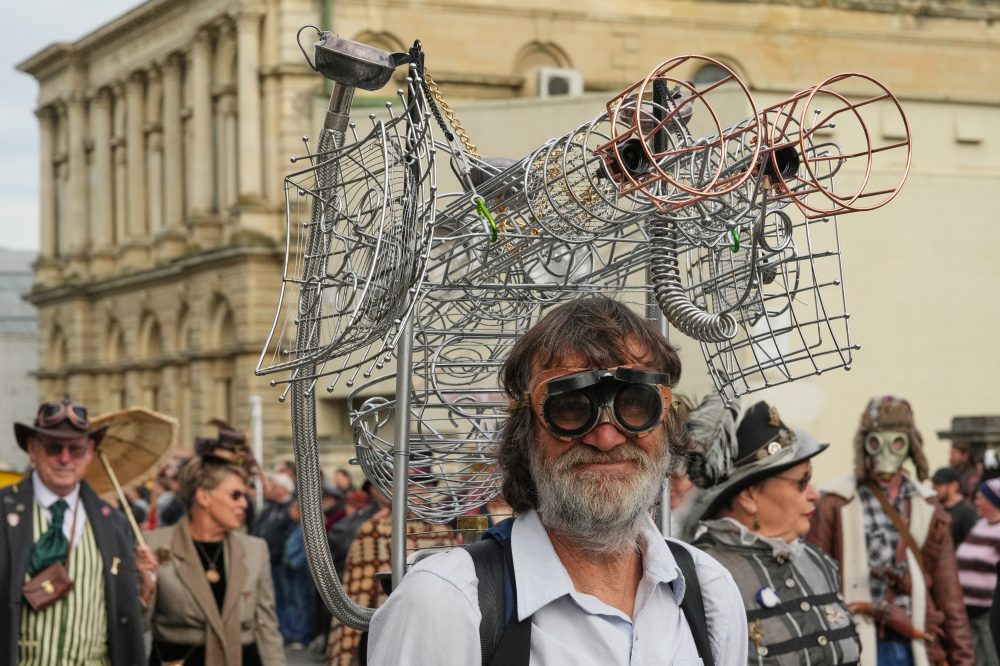
Standing beside her, a man looked through eyewear crafted from welded forks.
“Captain Bob McSpoon, inventrepreneur,” he announced.
Along a historic Victorian street in rural Ōamaru, New Zealand, these costumed characters — known in everyday life as Juliet and Greg Thorn — blended seamlessly with hundreds of other goggle-wearing, steam-emitting festival-goers. They had traveled to this small community for the yearly steampunk celebration, a four-day tribute to creative eccentricity that attracts thousands of participants from across New Zealand and beyond.
The steampunk movement combines Victorian-era design and engineering with futuristic science fiction elements, creating an alternative reality where steam-powered technology evolved to modern times. This artistic genre thrives on boundless creativity, with more unusual concepts earning greater appreciation.
Festival participants take pride in their recycling abilities and hands-on craftsmanship, developing expertise in tailoring, metalwork, millinery and steam engineering while creating elaborate fictional identities complete with matching costumes. Throughout the year, these enthusiasts work as construction workers, engineers, artists and agricultural workers, with many describing their typical personalities as introverted or quiet. However, they traveled to this festival seeking the spotlight.
“The first time you dress up and go out in public is really scary and then people get such a buzz out of it,” Juliet Thorn explained. “It’s so cool that you take on a different personality.”
Now in its 17th year, the steampunk festival has spawned entire traditions and competitive activities, earning recognition as one of the world’s most prominent events of its kind.
Hundreds gathered in second-floor venues and vintage community centers for steampunk-themed competitions. Contestants rushed to dip biscuits in tea cups and stuff the soggy treats into their mouths faster than their rivals. A parasol-fighting tournament resembled competitive dance moves evaluated on quickness and flair.
Michele Cotten claimed victory in a fashion competition showcasing elaborate and repurposed garments that participants had perfected over months. Cotten merged steampunk elements with the Star Trek franchise to design a bell-shaped gown styled after a navy Starfleet uniform. She equipped it with holiday lights to suggest a cosmic theme, and Cotten, a spectator favorite, walked and posed to cheers from the audience.
The event also featured teapot racing, where participants guided remote-controlled machines topped with teapots through a challenging obstacle course while spectators gasped and groaned.
“If you go out of bounds, that’s a disqualification,” explained Ross McKay, one of the competition’s inventors, who developed it alongside his deceased wife and a friend. He has since brought teapot racing to additional steampunk gatherings around the globe.
“It’s lots of fun and the judges will take bribes,” he joked.
When McKay’s wife first shared photographs of steampunk enthusiasts with him, he remembered thinking, “What a bunch of weirdos,” but the self-described “history geek and science fiction nerd” discovered much to appreciate about the movement. The former banking professional soon registered for evening sewing courses.
Today he performs as Captain Roscoe Dangerfield, Inspector of Nuisances to Her Majesty Queen Victoria III, which blends the historical aspect of an authentic Victorian position with the fantasy of a ruler who never existed.
The steampunk community had become his chosen family, he noted.
Ōamaru serves as the peaceful residence for 14,000 residents and 3,000 threatened native penguins, with the birds inhabiting a colony at the town’s edge that produces such strong odors they can be detected from the overlooking hillside. This South Island community lacks the dramatic landscapes featured in the Lord of the Rings movies that draw tourists to neighboring areas, and for many years served primarily as a rest stop between the larger cities of Christchurch and Dunedin.
A unique architectural feature has established Ōamaru’s reputation as what residents call the global steampunk headquarters. The community boasts a completely intact Victorian street near the waterfront, remaining from the 1800s when Ōamaru functioned as a commercial and trading center, serving as a shipping hub for meat, wool and grain exports from New Zealand to Britain.
These pale stone structures now provide the setting for the festival’s steampunk activities. During other times of the year, the town hosts a Victorian celebration honoring a historically faithful version of that period, with both events coexisting harmoniously after steampunk and Victorian enthusiasts agreed the community could accommodate everyone.
Steampunk, a label created in the 1980s, offers participants a chance to reimagine Victorian social rules based on the principle that if you’re traveling on flying carpets or moving through time, conventional restrictions no longer apply.
“We’re an equal opportunity society,” stated Iain Clark, who helped establish the festival and is recognized throughout the community as Agent Darling. “Women, unlike in Victorian times, can be anything. We have female engineers, captains of industry, captains of airships, adventurers, explorers, scientists.”
Sometimes within the same week. Bringing multiple outfits for each festival day is typical, and changing areas at the event’s headquarters enable rapid costume switches, with nothing too bizarre to surprise anyone.
On the street, a Star Wars soldier walked by, trailed by a group of wolves. A French visitor nervously adjusting his knitted and leather gloves had only learned about steampunk three days prior and instantly embraced the movement.
“You can be creative and you can be somebody else and no one cares,” said John Syben, who was attending his fourth festival.
His partner, Chris Sinclair, explained that the couple had previously been “far too tame, so we’ve gotten more and more outrageous every year.”
“There’s always someone who’s more nuts than you,” she added.